Archive for the ‘Economic reform’ Category

Knowledge sharing SEZ conference held

Friday, May 2nd, 2014

In September 2013 the DPRK held its first conference on economic development zones under the just announced State Economic Development Commission. Read all about it here.

On May 2, 2014, KCNA announced a second conference:

Knowledge Sharing on SEZs in DPRK Held

Pyongyang, May 2 (KCNA) — There took place at Yanggakdo International Hotel on Friday knowledge sharing on SEZs in the DPRK hosted by the Korea Economic Development Association [AKA State Economic Development Commission/Association].

It was attended by Ri Chol Sok, vice-chairman of the association, and its other officials and experts and teachers and researchers at scientific and educational institutions and officials concerned.

Also present there were Kyung-Ae Park, professor at University of British Columbia, Canada, prestigious experts on special economic zones from China, India, Canada, Philippines and the U.S. and foreign diplomatic envoys and representatives of international bodies here and foreign embassy officials.

Ri Chol Sok and Kyung-Ae Park made speeches.

The speakers congratulated those participants on the successful holding of the event and mentioned the importance of the exchange of each other’s experience and cooperation in developing special economic zones and managing and operating them.

They said that the event would help to broaden experts’ vision and expand the development work and also contribute to promoting the international exchange and cooperation.

Then followed speeches.

Introduced at the event were the present situation in some economic development zones of the DPRK and their prospect and policies of preferential treatment and the master plan for Wonsan-Kumgangsan area.

The results of researches and opinions were exchanged and the BOT widely applied to investment and cooperation and the experience gained by various countries in doing so were discussed.

The event marked an occasion in contributing to turning economic development zones of the DPRK into world-level economic cooperation zones by introducing the advanced experience gained in special economic zones according to the specific conditions of the country.

Uriminzokkiri posted this video of Kyung-Ae Park and Yun Yong-sok:

Here is a loose translation of the video:

Q) What were your initial thoughts on the SEZ’s?
A) It is important to differentiate the North’s SEZ’s from those of other countries to make them attractive to investors. For tourism SEZ’s, many experts have recommended minimizing environmental degradation to promote sustainability. 신평 관광개발구 (신평 tourism SEZ) is a good example where sustainable development can help attract tourists who wish to relax and enjoy the environment.

Q) You teach Poli Sci at UBC, how did you get interested in SEZ’s?
A) Faculty exchanges among economics and management experts are often more profitable than academic discussions on political science. Naturally, those who participated in the exchange programs were talking about SEZ’s more often than any other topics.

Q) What are your thoughts on the prospects of the North’s SEZ’s ?
A) I was impressed how the entire country is putting an effort into SEZ projects. This is a very positive aspect, but we need to think about making these SEZ’s more attractive than SEZ’s of other countries.

Here is another translation:

Dr. Park: The key issue of establishing economic development zones (EDZs) is how to make ‘our’ zones distinctive from other countries. In the tourism industry, for example, it has been suggested that simply constructing new buildings, hotels, and condominiums does not offer any competitive advantage because others have been doing the same way. Instead, a better way is to ask ourselves what makes our zones unique so that they could attract people and investment. For North Korea, it is indeed the beauty of the wilderness and untouched nature that makes the country remarkable.

While teaching political science in University of British Columbia, I’ve come to realize that the South-North exchange should first take place in the area where both have mutual interests and the outcome can be mutually beneficial. Exchanges among the political scientists will unlikely be productive; so instead, we have been inviting numerous North Korean professors of economics and business, including those from Kim Il-Sung University, Wonsan University of Economics, and Pyongyang University of Foreign Studies. And this year we are extending our invitation for the fourth time.

Yet, compared to the number of North Korean experts coming to Canada, not many scholars have visited the North from our end as part of an exchange program. While we were considering ways to facilitate an academic exchange at a greater level, we were lucky to get in touch with Korea Economic Development Association (KEDA; aka Chosun Economic Development Committee). We had a meeting on special economic zones last October […] and this was a follow-up meeting after the successful outcome of the first one. Canada-DPRK Knowledge Partnership Program (KPP) organized the event, and KEDA co-hosted the meeting.

Many experts have suggested that more study is needed to make North Korean economic zones distinctive, unique, and attractive. The critical issue remains as to how to attract foreign capital and investment. Despite many challenges North Korea may confront, we believe that passion and diligence of North Koreans will prove fruitful.

Share

The 17th Pyongyang Spring International Trade Fair sees sharp rise in applicants

Wednesday, April 30th, 2014

Institute for Far Eastern Studies (IFES)
2014-4-30

A large increase in the number of new companies that registered for the 17th Spring International Trade Fair has been reported in a recent Choson Sinbo article. The fair will run from May 12-15, 2014 and be held at the New Technology & Innovation Hall at Pyongyang’s Three Revolution Exhibition.
 
According to the April 22nd article by the Japan-based pro-North Korean news outlet, the number of countries expected to participate rose from 12 to 14, and the total number of registered companies more than doubled compared to the previous exhibition, from 140 to 290.
 
A large variety of new products and technology are expected to be revealed at the upcoming exhibition, such as new machinery and developments in metalworking, electricity, mining, construction, farming and food processing. Other products and technological innovations in energy conservation, environmental protection, transportation and communication are also expected to be revealed at the exhibition.
 
The North Korean media reported that contrary to the negative assessments reported in the western media, foreign economists are actually highly anticipating the rapid growth of the North Korean economy. In an interview, a representative for the Korean International Exhibition Corporation was quoted as saying, “Even amidst economic sanctions imposed by America and its followers, our nation’s economic construction is moving forward with speed.” It was also reported that foreign participants and observers of past exhibitions are relaying this fact to the outside world, which steered the expanding size of the fair.

In addition, North Korean state media boasted the reason for the exhibition’s rise in popularity was due to the increase in domestic product quality, which has led to an expected increase in not only the number of participating countries and companies but also the number of expected visitors to the fair.
 
The Pyongyang International Trade Fair was held for the first time in 1989 with the hopes of establishing friendly economic relations with other countries, and to specifically promote the exchange of goods and technology. In addition, North Korea opened the fair in order to break into new international markets and attract foreign investment. The second International Trade Fair was held three years later in 1992, and has been held annually since the year 2000.
 
The host of the exhibition, the Korean International Exhibition Corporation, oversees the introduction of new companies and products; offers consultation on trade, commerce, investments and joint-venture policies; promotes the exchange of goods and technology, new market openings and foreign investments; and works together with participating companies to facilitate international trade.
 
The Pyongyang International Trade Fair is North Korea’s largest trade exhibition, and is held twice a year in the spring and fall with the goals of attracting foreign capital and finding new export opportunities. In relation to this event, the 10th Pyongyang Fall International Trade Fair will run from September 22-25, and will be accepting applications until August 5.

Share

European business leaders tour Kaesong Industrial Complex

Tuesday, April 29th, 2014

According to Yonhap:

More than 40 European businessmen in South Korea traveled across the heavily fortified border into North Korea on Tuesday for a rare trip to an inter-Korean factory park amid tensions on the Korean Peninsula, a unification ministry official said.

A 42-member delegation of the Korean-German Chamber of Commerce and Industry in Seoul plan to tour facilities and South Korean factories in the North’s western border city of Kaesong before returning home later in the day, the official said.

The delegation includes officials of the German engineering giant Siemens AG and BMW, a premium German automaker. It also includes Swiss nationals and Austrians, according to the official.

Separately, about 40 South Korean business leaders from around the world also plan to visit the factory park in Kaesong on Friday, according to the unification ministry official.

In December, about two dozen officials from the world’s G-20 economies toured the Kaesong complex on the sidelines of their global financial meeting in Seoul.

The sprawling enclave in Kaesong is home to 120 small South Korean plants producing garments and other labor-intensive goods. More than 44,000 North Koreans work in the complex.

Read the full story here:
European businessmen visit inter-Korean factory park in N. Korea
Yonhap
2014-4-29

Share

DPRK signs economic agreement with local Russian governments

Tuesday, April 29th, 2014

Not much specific information is available, but the DPRK has signed economic agreements with Russia’s Amur and Sakhalin Regions.

According to RIA Novosti:

North Korea’s Foreign Trade Ministry and the authorities of Russia’s Amur region in the country’s southeast have signed an economic cooperation agreement, the Yonhap news agency reports.

“An agreement on trade and economic cooperation was signed between the DPRK ministry of Foreign Trade and the Amur Regional Government of the Russian Federation,” Yonhap cited Pyongyang’s KCNA state news agency as saying Monday.

According to the Korean Central News Agency, the accord was signed Monday during the visit of Yuri Trutnev, a Russian Deputy Prime Minister and Putin’s official envoy to Russia’s Far Eastern Region.

As part of his North Korea trip, Yuri Trutnev met with the Cabinet’s Vice President Ro Tu-chol and reportedly shared his views on a broader economic cooperation between the two nations, among other issues.

The agreement between Moscow and Pyongyang is another step towards closer economic partnership in the Far Eastern region, after the Amur territory on China’s northern border signed a fraternity and trade deal with Korea’s South Pyongan province in 2011.

A similar economic cooperation agreement was signed last week between Pyongyang and the local government of Russia’s Sakhalin region.

Voice of Russia reports the following:

North Korean’s Foreign Trade Ministry and the government of Russia’s far-eastern Amur region have signed an agreement on trade and economic cooperation, the Yonhap news agency reports with reference to the Korea Central News Agency (KCNA).

The agreement was signed on Monday during a visit to Pyongyang of a Russian delegation led by Deputy Prime Minister and Presidential Plenipotentiary in the Far-Eastern Federal District Yuri Trutnev.

No further details have been immediately available.

A wide range of matters, connected with the development of political, trade-and-economic cooperation will be discussed in the Democratic People’s Republic of Korea (DPRK) by Yuri Trutnev, Russia’s Vice-Premier and Russia’s plenipotentiary presidential representative in the Far Eastern Federal District.

An official at the Russian Embassy to the DPRK said that Trutnev would arrive here by air on Monday by a special flight at the head of a Russian delegation for a three-day visit, TASS reports.

Apart from talks with DPRK officials, the Vice-Premier will attend a ceremony marking the handover of a large consignment of fire-engines to the Korean side.

The delegation will also lay flowers to the Liberation Monument here. The Monument bears an inscription “Eternal glory to the Great Soviet Army that liberated the Korean People from the yoke of Japanese militarists and opened up the road for the Korean people to freedom and independence!”.

The delegation leader will be accompanied by Primorsky Territory Governor Vladimir Miklushevsky, Khabarovsk Territory Governor Vyacheslav Shport, and Amur Region Governor Oleg Kozhemyako.

In March this year, the DPRK was visited by President Rustam Minnikhanov of the Republic of Tatarstan, as well as by Alexander Galushka, Russian Minister for the Development of the Far East. The latter attended a meeting of the Co-Chairmen of the Intergovernmental Commission for Trade-and-Economic, Scientific and Technical Cooperation between the Russian Federation and the DPRK as head of the Russian part of the Commission.

Moscow and Pyongyang actively strengthen economic contacts of late. The delegations of Russia and the DPRK attended a meeting the international “Organization for Cooperation of Railways. It is reckoned that the Organization’s main goals are to develop international freight and passenger transportation, and establish a Common Railway Transportation Space in Eurasia. This year the Organization’s conference is being attended for the first time by South Korea as well.

Tense relations between Pyongyang and Seoul are keeping on at the political level. Nevertheless, Russia is calling on the two countries to reach agreement between each other and take part in implementing the project for linking up the inter-Korean Railway and the Trans-Siberian Mainline Railway (Trans-Sib).

Railway transport is one of important areas of cooperation between Russia and the DPRK. A ceremony marking the completion of the upgrading of the railway section running from the Russian station of Khasan to the North Korean city of Rajin was held in the Republic in September last year. Work has been also completed to bring into being a general-purpose trans-shipment terminal in Rajin the principal port in the Rason trade-and-economic zone.

The upgrading of the infrastructure of the Khasan-Rajin railway leg is viewed as the pilot segment of the reconstruction of the entire Trans-Korea Railway. In prospect, when railway communication from the South Korean port of Pusan via the DPRK to Russia is established in full, an opportunity will open up to reorient to Russia’s Trans-Sib a considerable part of goods, which are currently shipped now via a trans-oceanic seaway from South Korea to Europe.

The possibility is being explored for inviting South Korean businessmen to participate in developing the railway transportation infrastructure o the DPRK, including port facilities.

Here is some comprehensive analysis by 38 North.

Here is some more analysis at the Hankoyreh.

Read the full stories here:
Russia, North Korea Strike Economic Cooperation Deal
RIA Novosti
2014-4-29

N Korea, Russia’s Amur region seal regional cooperation deal
Voice of Russia
2014-4-29

Share

EDZs to be set up in northern area

Saturday, April 26th, 2014

According to the Pyongyang Times (2014-4-26):

Amid steady efforts to establish and develop unique economic zones in line with the specific conditions of each province, two economic zones are in the making in the border area in Jagang Province.

The province in the northwestern part of the country adjoins China with the Amnok River in between.

The Jagang Provincial People’s Committee is planning to set up an economic development zone in Manpho City and an industrial development zone in Wiwon County by taking advantage of the favourable geographical environment and exploitable resources.

Manpho is opposite Jilin Province of China over the Amnok.

It is blessed with cultural relics.

In Segom-dong there are the site of Segom Pavilion, Mangmi Pavilion built in 1436 and a 1 200-metre-long stone wall around the town of Manpho.

The site of Segom Pavilion is on the natural rock on the cliff, 100 metres above the water surface of the Amnok and facing the river. The pavilion was built during the feudal Joson dynasty (1392-1910) and burnt down by the Japanese imperialists in 1938 before Korea’s liberation. As the place commands a marvellous view it has been known as one of eight scenic spots in the northwestern region of Korea since olden times.

There are Kosanjin Fort and a group of graves in Kyongsong Valley, which were built during the feudal Joson dynasty, in Kosan-ri, menhirs from the period of Koryo (918-1392) in Mitha-ri and stone graves in Munak-dong.

There are mineral springs good for the treatment of various diseases including gastric disorders in Yonha- and Mitha-ri.

The Manpho Economic Development Zone covers an area of about 3 square kilometres embracing parts of Mitha-ri (Poltung Islet in the Amnok River included) and Phosang-ri which face Jian in Tonghua of Jilin over the river.

It is 8-18 km from the DPRK-China border bridge of Manpho, 70 km from that of Wiwon, 165 km from that of Junggang and 8-18 km from the border railway station of Manpho. There are railway lines between Manpho and Pyongyang and between Manpho and Hyesan, and Jian Railway Station in Jilin on the opposite side leads to Changchun via Tonghua.

Power and water supplies are satisfactory as the zone is located 14 km from the Jangjagang Power Station with a capacity of 90 000 kW and 15 km from the Manpho Yonha Power Station with a capacity of 10 000 kW and the water source of the Amnok River is plentiful.

An international service base combining tourism and trade will be built in the Mitha-ri area comprising Poltung Islet by exploiting cultural relics and tourism resources and a modern agricultural base incorporating the food production cycle in the Phosang-ri area.

Wiwon County is opposite Northeast China over the Amnok River.

It is rich in mineral deposits including white silica.

Forests account for 87 per cent of the area of the county and so it is a leading timber production centre.

The county’s water system is comprised of the Amnok, Jangja and Wiwon rivers and Wiwon Reservoir.

The Wiwon Industrial Development Zone also covers an area of nearly 3 square kilometres encompassing the shores of the Wiwon River, a tributary of the Amnok, and Wiwon Reservoir, and parts of Togam- and Kosong-ri in the county opposite China’s Jian.

It is 20 km from the Wiwon Power Station with a capacity of 390 000 kW and 25 km from the Manpho Yonha Power Station.

In and around the zone there are metallic silicon factories that turn out ferrosilicon and other metallic silicon.

It has a favourable condition for entry and exit and transport of imports and exports as it is 20 km from the point of border transit in Wiwon, 80 km from that in Manpho and 180 km from that in Junggang.

The zone will mainly specialize in processing minerals, timber and local farm products and manufacturing machinery on the basis of rich natural resources while engaging in scientific research into sericulture and freshwater fish farming.

Plans of the development zones have already been completed and investors are making field surveys.


Share

ROK extends bridge loans to firms that invested in the DPRK

Friday, April 25th, 2014

According to Yonhap:

South Korea said Friday it will extend 20 billion won (US$19.2 million) in loans to companies that have been in financial trouble for years due to the suspension of their businesses with North Korea.

The decision came four months after South Korean investors called for special low-interest loans to help ease their financial pinch following the shutdown of their businesses.

South Korea has suspended a tour program to Mount Kumgang since 2008 when a female South Korean tourist was shot dead by a North Korean soldier near the mountain resort on the North’s east coast.

Seoul’s move dealt a heavy blow to South Korean companies that invested in the North’s mountain resort, including Hyundai Asan, the inter-Korean business arm of Hyundai Group.

North Korea has since repeatedly called for the resumption of the tour program, which served as one of a few legitimate revenue sources for the cash-strapped country.

South Korean businessmen involved in projects in North Korea suffered further setbacks in 2010 when Seoul slapped sanctions on Pyongyang over the deadly sinking of a South Korean warship blamed on the North.

Under the sanctions, South Korea has suspended inter-Korean projects and banned new investment in the North, except for their joint factory park in the North’s border city of Kaesong.

The unification ministry, which handles inter-Korean affairs, said it expected the latest extension of loans to help ease financial difficulties of the companies.

South Korea has extended special loans worth 62.6 billion won ($60.1 million) to more than 230 local companies involved in cross-border projects with North Korea in recent years.

This week, the North called on South Korea to lift the sanctions imposed on Pyongyang in retaliation for the sinking in March 2010 that killed 46 South Korean sailors.

South Korea has called for, among other things, the North’s admission of its involvement in the sinking in return for lifting of the sanctions, though Pyongyang has refused to take responsibility for the deadly attack.

Read the full story here
S. Korea to extend 20 bln won to firms with ties to N. Korea
Yonhap
2014-4-25

Share

Economic Management Improvement Measures – changes after one year

Friday, April 11th, 2014

Institute for Far Eastern Studies (IFES)
2014-4-11

The Choson Sinbo, a Japan-based pro-North Korean newspaper, reported on April 2, 2014 that since March of last year all production facilities across North Korea have begun to take measures that will allow them to operate more autonomously. The article is currently garnering attention due to its explanation of the changes and improvements to economic management and by introducing factories where these measures have been successful.

The news also reported that North Korean factories have to diverge from the national economic plan and produce and sell products at their own discretion. Furthermore, workers’ compensation and benefits packages are being adjusted according to each individual factory’s economic situation.

One year after the implementation of the economic management improvement measures, the concept of “business know-how” has begun to settle in each factory. Factories that have been achieving successful results all share similar developments in worker enthusiasm, sense of responsibility, originality and creativity. Promoting the growth of these qualities in factory workers became the key to the successful economic management and growth during this period.

Specifically, the newspaper reported that the North Korean factory workers are seeing returns on their increased profits, and that their enthusiasm is the driving force of the nation’s economic growth.

In the article, Pyongyang Electric Cable Factory 326 was introduced as the first factory to be labeled as a “leading unit” and is considered as an ideal factory workplace for many job seekers in Pyongyang.

At this factory, monthly wages have steadily risen in increments that allow workers to meet the rising costs of living and maintain healthy lives. Workers at Pyongyang Electric Cable Factory 326 are now earning dozens of times more than the national average every month, and the highest record for wages soaring to over 100 times the average was observed this past year.

Alongside slogans and posters that inspire the workers’ will to work, competition charts are also posted at various locations around the factory. This has created a sort of “Socialist production competition.” Factories that submit detailed reports of their business performance receive gifts, and the unit that receives first place is rewarded with a special congratulatory dinner.

Another reason why job seekers are choosing this factory as their ideal workplace is because of housing security. Factory 326 solves its workers’ housing problems by constructing residence complex for the employees and workers become eligible to receive housing after working three to four years.

According to the article, the recent measures taken to improve economic management have been effective in creating a sense of attachment between worker and factory and increasing workers’ desire to succeed. This, combined with the introduction of new scientific technology has allowed factories across North Korea to attain a 10 percent increase in production over the last year. While overall production has in fact increased, it can be concluded that the boost to worker morale is the biggest and most important part of the changes seen in the economy since the implementation of the management improvement measures.

On March 31 of last year, the Central Committee of the Workers’ Party of Korea held a plenary meeting where the “Byungjin line” or parallel policy that supports both economic and nuclear development, was adopted, and where Pak Pong Ju was elected to the Politburo — and later Premier (formerly First Deputy Director of the Central Committee of the Workers’ Party) — in an unprecedented move. From this point forward, North Korea began to officially advance its plans for economic management measures.

Share

China’s plans for Quanhe Customs House

Monday, April 7th, 2014

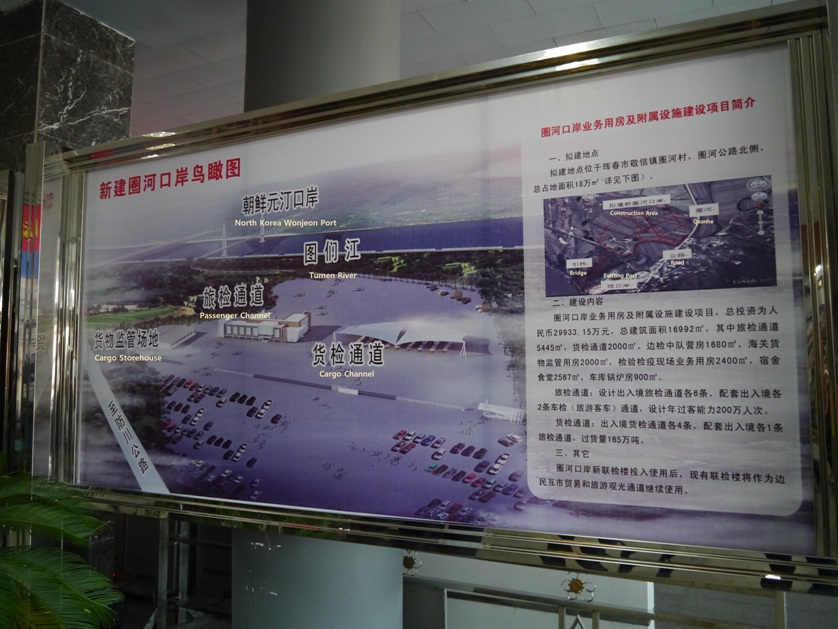
Quanhe Customs House will be the border facility for managing Chinese traffic into Rason (and further down the coast). Within the administration building on the site is a poster advertising the plans to expand the customs house to manage more traffic.

Quanhe-customs-2

The billboard offers a conceptual image of the new facility, a map of the new location, and some informative copy (in Chinese).

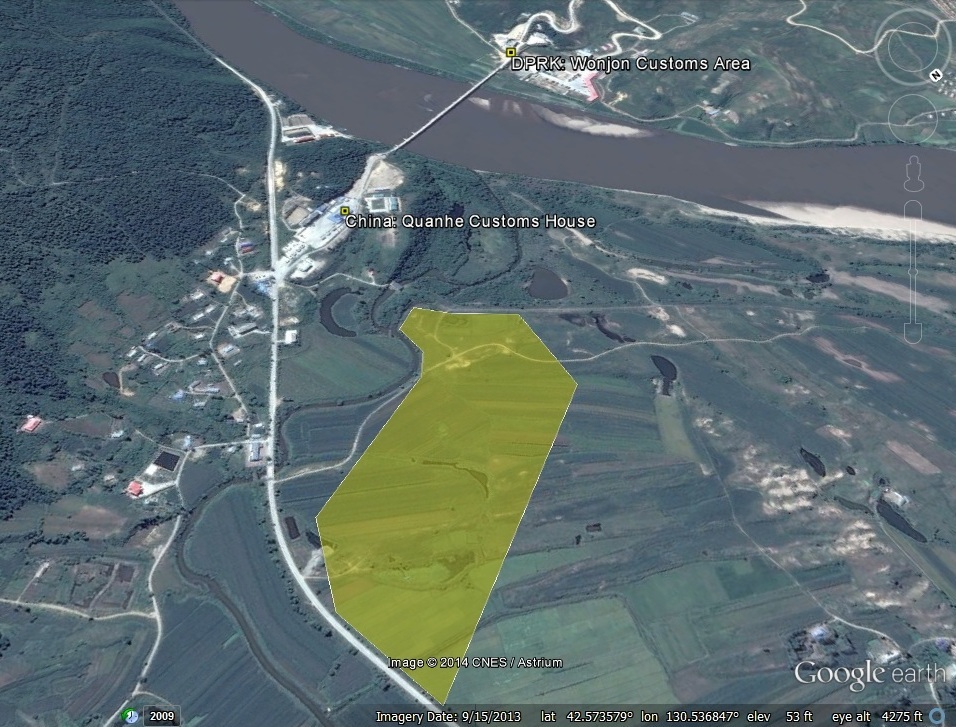
Here is a Google Earth image of the proposed construction site in relation to the existing border compound:

New-Quanhe-customs

Here is a translation of the Chinese on the sign text:

Introduction of Construction Project of Quanhe (Guanghe) Port

1. The Proposed Location
The proposed site is located in Quanhe Village, Jingxin-Zhen of Hunchun City, north side of Quanhe Road. The project covers an area of 180,000 square meters (map below).

2. Construction Project
The total investment of Quanhe Port Project is 299,331,500 RMB, and the total construction area is 16992m2. including Passenger Security Channel (5445m2), Cargo Inspection Channel (2000m2), House For Frontier Inspection (1680m2), Cargo Storehouse (2000m2), Inspection And Quarantine Site (2400m2), Dormitory Restaurant (2567m2), Garage And Boiler Room (900 m2).

Passenger Security Channel: Including each 6 channels for entry and exit, and another 4 vehicle channels for touring bus. Designed annual passenger capacity is 2 million.

Cargo Inspection Channel: Including each 4 channels for entry and exit of cargo and another 1 channel for passenger. The designed annual cargo capacity is 1.65 million tons.

3. Remaining
The existing inspection building will be used as channels for border trade and tourism after the new facilities getting into operation.

Thanks to Berhhard Seliger for the info!

Share

Sinuiju-Kaesong high-speed rail project (UPDATED)

Monday, April 7th, 2014

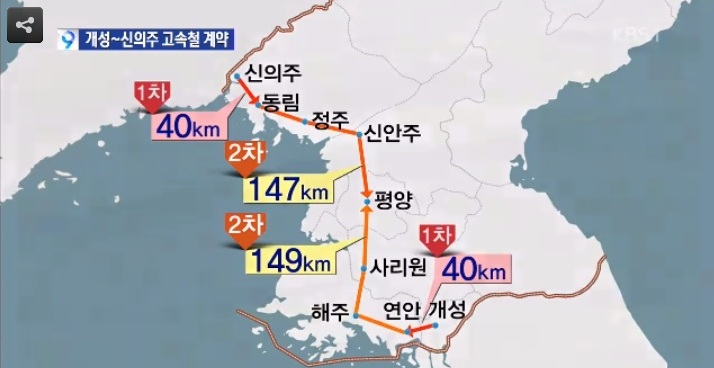
Sinuiju-Kaesong-high-speed-rail

Pictured Above (KBS):  A map of the planned high-speed rail project

UPDATE 4 (2014-4-29): The Choson Ilbo reports that Ms. Choi has returned from the DPRK:

The Organisation for Co-Operation between Railways (OSJD) has decided to hold two major meetings, the Commission on Freight Traffic in 2015 and Conference of General Directors in 2019, in Seoul.

KORAIL president Choi Yeon-hye made the announcement at Gimpo Airport on Monday after returning from an OSJD meeting in Pyongyang. It is unprecedented for an associate rather than full member to host the conference.

The OSJD is an organization of 27 former and current communist countries, including Russia, China and North Korea.

“We don’t know yet whether the North will attend the meetings in 2015 and 2019, but the participants unanimously decided to hold them here, and the North didn’t oppose it, so we expect them to come,” she added.

The annual conference of general directors alternatively takes place in Asia and Europe, but exceptionally the 2019 meeting will also be held in Asia following the 2018 meeting in Vietnam.

The government here is keen to work with the railway body to link South Korea to Eurasia via North Korea.

Here is coverage in Yonhap.

UPDATE 3 (2014-4-22): The Choson Ilbo reports that the head of Korail has left for the DPRK:

KORAIL president Choi Yeon-hye is appropriately on her way to North Korea by train.

Choi left for Pyongyang on a train from Beijing on Monday afternoon to attend a meeting of the Organisation for Co-Operation between Railways (OSJD), KORAIL said Monday.

The OSJD is an organization of 27 former and current communist countries, including Russia, China and North Korea.

The government approved Choi’s request to visit to the North on Sunday after the North sent her a letter of invitation. She got a visa from the North Korean Embassy in Beijing the same day.

The train runs from Beijing to the North Korean border city of Sinuiju in 24 hours, where she switches trains for the 225 km stretch to Pyongyang.

A KORAIL executive said, “Choi’s visit is the North’s first approval of a South Korean official’s visit” since the South imposed sanctions against North Korea in 2010.

She is the first senior South Korean figure to visit Pyongyang since the inter-Korean summit in 2007.

President Park Geun-hye is keen to connect South Korea to Eurasia by railway, which requires cooperation from the OSJD.

Here is coverage in Yonhap.

UPDATE 2 (2014-4-7): KBS has a report (in Korean) on the project. See the report here. Seoul Village has translated some of the details.

Construction would last 6 years, with two waves that have not been fully detailed yet:
1st stretches: 80 km
From the North: Sinujiu Station – Tongrim Station (Sinujiu-Dongnim, 40 km)
From the South: Kaesong – Yonan (Gaesong-Yeonan, 40 km)
2nd stretches: 296 km

From the North: Tongrim – Chongju – Sinanju – Pyongyang (Dongnim-Jeongju-Sinanju-Pyongyang, 147 km)
From the South: Yonan – Haeju – Sariwon – Pyongyang (Yeonan-Haeju-Sariwon-Pyongyang, 149 km)

UPDATE 1 (2014-4-7): Korail may be involved in the high-speed rail project. According to the Hankyoreh:

News of a recent agreement between North Korea and China to build an international high-speed railroad and highway between Sinuiju (a city on the Chinese border) and Kaesong is raising questions about the fate of a scheduled North Korea visit on Apr. 24 by Korail CEO Choi Yeon-hye.

If Korail does participate in the project, it would bring South Korea one step closer to the Asian continent via the North Korea-China high-speed rail project, which comes on the heels on North Korea‘s Rajin-Hasan development project with Russia.

South Korean businesspeople in China who are closely involved in the high-speed rail project said on Apr. 6 that a contract for the railway/highway construction was signed in Beijing on Feb. 24 by North Korea’s State Economic Development Commission, chaired by Kim Ki-sok, and a Chinese consortium headed by the Shangdi Guanqun investment company. The line would be 376 km in length and connect Sinuiju with Chongju, Sukchon, Pyongyang, Haeju, and Kaesong, with the five-year construction beginning in 2018 with a budget of US$21 billion, or around 22 trillion won. The method would be a Build-Operate-Transfer (BOT) arrangement, with an international North Korean-Chinese consortium providing the investment and delivering the line to North Korea once the costs are recouped. A survey team for the Chinese consortium is reportedly scheduled to visit North Korea in late April.

The chances of South Korea participating are higher in the wake of President Park Geun-hye’s speech in Dresden on Mar. 31. There, she declared that an “organic linkage between South Korean capital and technology and North Korean resources and labor could contribute to building a future economic community on the Korean Peninsula.”

She also said she planned to “achieve shared development for the Korean Peninsula and Northeast Asia both through collaborations with North Korea and Russia, as with the current Rajin-Hasan distribution project, and collaborations with North Korea and China focusing on Sinuiju.”

Further increasing the possibility of South Korean participation are guidelines handed down in January by North Korean leader Kim Jong-un, who said North Korea should work with China and South Korea on an international line through a privately funded BOT arrangement.

Meanwhile, Korail is awaiting Ministry of Unification approval on a request to allow CEO Choi Yeon-hye to travel to North Korea to attend a general directors’ conference for the Organisation for Co-Operation between Railways (OSJD), which is scheduled to take place on Apr. 24.

“Our basic position is to approve visits to North Korea in cases of international events,” said an official from the ministry on condition of anonymity, adding that a final decision would be made “after discussions with the other agencies.”

But Korail remains cautious about the possibility of future cooperation, whatever the outcome for Choi’s visit ends up being. Speaking on condition of anonymity, a source there said, “We’re preparing data on things like a plan to expand cargo transport for different continental rail zones, which is one of the topics on the agenda at the OSJD meeting.”

“We’ve never officially examined the North Korea-China high-speed rail project, and it doesn’t look like it would be economically feasible anyway unless a section is opened between Seoul and Kaesong,” the source added. “Anyway, the government has not decided on participating, and that‘s not a matter that KORAIL can weigh in on by itself.”

ORIGINAL POST (2013-12-20): High Speed Rail and Road Connecting Kaesong-Pyongyang-Sinuiju to be Built
Institute for Far Eastern Studies (IFES)
2013-12-20

On December 8, 2013, North Korea reached an agreement with a consortium of international companies to construct highways and high-speed railroad connecting Kaesong, Pyongyang, and Sinuiju.

The agreement between North Korean authorities and a consortium representing the Chinese companies was signed in both Chinese and Korean by Kim Chol Jin, Vice-Chairman of State Economic Commission of North Korea and representatives from state-owned enterprises of China’s Commerce Department.

The construction period was designated as five years and businesses will operate the rail for 30 years and return the operation rights to North Korean government in the form of a BOT (build-operate-transfer) project, worth a total of 15 trillion KRW. The high-speed rail will be a double-track system with a speed of more than 200km per hour, and the construction of four-lane highway will be built adjacent to the railway. Fence will also be built to prevent unauthorized access to the railway.

The construction zone will cover the areas of Kaesong, Haeju, Sariwon, Pyongyang, Sinanju, Jongju and Sinuiju, approximately 400 km in total length and from Sinuiju will connect to Chinese cities via railway while from Jongju will connect with the Rajin-Sonbong SEZ (special economic zone) to the Russian Khasan railway to be linked with the Eurasian railway.

The consortium working group is planning to visit North Korea to confirm the specific construction plans. It was tentatively decided that the formal contract be signed in Pyongyang based on the proposal submitted by the consortium.

The subject of agreement is a multinational consortium of international investment group, which also includes a South Korean company, which is known as a company involved in North Korean mineral resources development. Once the project is in progress, there are plans of bringing other South Korean companies into the project.

In exchange, businesses will obtain the development rights of extracting gold from Hyesan City (Ryanggang Province) and iron ore in Musan (North Hamgyong Province). North Korean officials are claiming that this project was the legacy of Kim Jong Il and welcomed the participation of South Korean companies.

In March 2011, former North Korean leader Kim Jong Il is reported to have instructed that inter-Korean exchange programs be continued. Upon the completion of the railways and highways, the Presidium of the Supreme People’s Assembly will proclaim international road operations to ensure its stable operation.

The operation rights will be given to the consortium for 30 years while the ownership rights will be shared by the North Korean government and the consortium.

China is also building new railway lines up towards the North Korean border.

Share

DPRK – China trade: What is happening?

Friday, April 4th, 2014

Previous reports indicated that the execution of Jang Song-thaek has to date had little effect on DPRK-China trade. According to the Institute for Far Eastern Studies (2014-3-12):

Trade between North Korea and China in January has increased roughly 16 percent against the previous year. After the December 2013 purge of Jang Song Thaek it was predicted that trade between the two countries would decrease; however, there is no visible sign of this yet.

According to the Korean Foreign Trade Association’s* data, trade between North Korea and China in February increased from 471 million USD to 546 million USD, up 15.9 percent compared to the previous year.

February also showed an increase in anthracite exports, North Korea’s main export to China, rising 21.3 percent to 102 million USD. Iron ore exports also showed a slight increase of 35 million USD compared to last year.

Chinese exports to North Korea, including leading export commodities such as cellular phones and other wireless radio/communication devices, increased 28 percent compared to January of last year, totaling 14.5 million USD. In February, goods exported through China to North Korea increased by 10.2 million USD, a 38.6 percent increase compared to January of last year.

The trade gains in this report are annual for the most part…comparing 2013 data with 2014 data. This reveals little about the change in trade volume from month to month.

Now a story in Yonhap offers January and February 2014 data, and journalists have reached the opposite conclusion. Jang’s execution has played a role in DPRK-China trade. According to the article:

“In January and February this year, North Korea significantly stepped up checks on its coal exports to China,” a source in Beijing said on the condition of anonymity.

“Such reinforced checks appear to be related to the execution of Jang Song-thaek,” the source said.

According to the latest data by the Korea International Trade Association* in Seoul, North Korea’s exports of coal to China in February fell 26 percent from a month ago to 920,000 tons. The North’s exports of iron ore to China also fell 23 percent in February from a month earlier to 197,000 tons.

The North’s total trade with China in February plunged 46 percent from a month earlier to US$255 million, the data showed.

In Dandong, the Chinese border city with North Korea where about 80 percent of bilateral trade is conducted, the flow of goods in and out of North Korea appears to be affected by the execution of Jang.

“In previous years, the North Korean authorities had usually set their annual targets for exports and imports, and given quotas to trading firms,” said another source in Dandong who is doing businesses with North Korea. “But, no quota has been given yet this year.

“Obviously, the mood is different than previous years,” the source said.

No progress has been made on special economic zones, including Hwanggumphyong and Wihwa, set up by the North on the border with China, according to the source.

“Under the current circumstances, Chinese investors will not invest in the North’s special economic zones,” the source said.

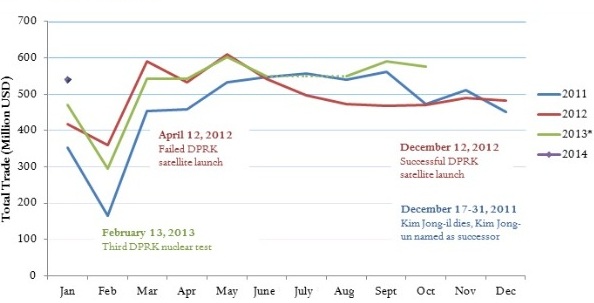
Does this mean anything?  Well, we don’t know enough about these numbers, or the cause for such dramatic change in trade patterns, so we will need to continue to watch the data.  Even before the February numbers came out, Scott Snyder reminded us that DPRK-China trade has taken a dip between January and February for each of the last three years!

Snyder-DPRK-China-Trade-2011-2013

Then there are the caveats: 1. This only counts legitimate trade (no illicit, secret, or military trade) 2. No aid 3. No official or unofficial transfers 4. No capital flows.

*Presumably the Korean Foreign Trade Association and the Korea International Trade Association are the same thing.

Read the full Yonhap story here:
N. Korea’s trade with China shaken after Jang’s execution
Yonhap
2014-4-4

Share