Archive for the ‘Economic reform’ Category

Hoiryeong Market Price of Rice Wanes from 1000 to 800 North Korean Won

Tuesday, April 10th, 2007

Daily NK
Kwon Jeong Hyun
4/10/2007

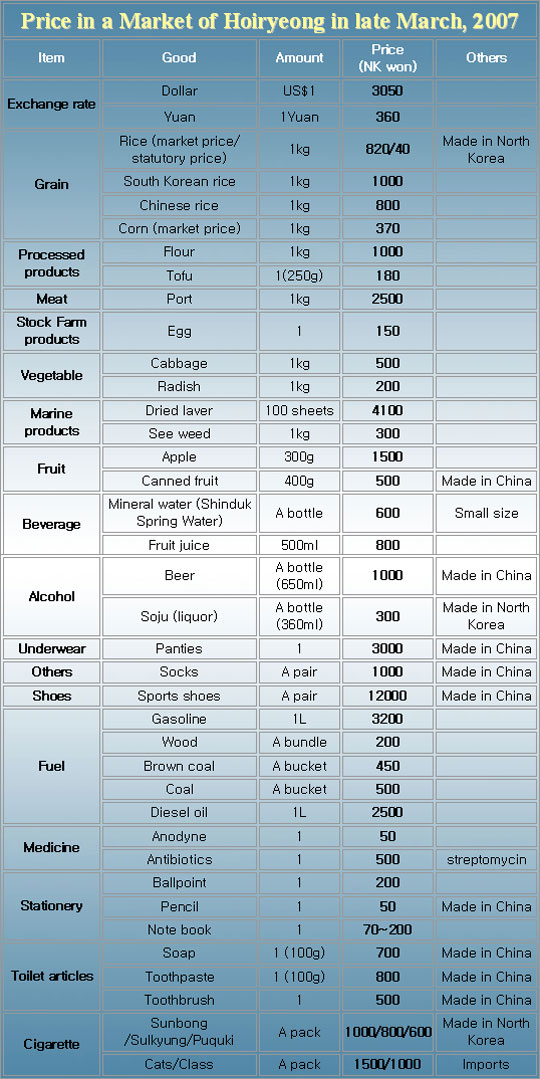
riceprices.jpgAt the end of March, the price of North Korean rice in Hoiryeong City’s jangmadang (market) fell to 820 won per 1kg, around 200 won lower than early January of this year. At a 100 won less value, the price of rice is in a falling state.

The result of Daily NK’s survey of three cities – Shineju, Hoiryeong, Kwaksan – in North Korea’s southern and northern regions at the end of March revealed that the declining price of rice will remain a reality through all regions of North Korea. In Shineju, North Korean rice costs 800 won per kg, 850 won for South-Korean rice, and 700 won for Chinese rice. The price of rice in Shineju is not much different than in January.

The price of corn, which is the staple among North Korea’s low-income, fluctuated narrowly from 340 won at the beginning of the year to 370 won at the end of March. Compared to the decline in the price of rice, the price of corn remaining at the current level can be said to reflect the demand for corn which has been transferred from the demand for rice on a small-scale.

As a whole, the stability of North Korea jangmadang’s price of rice indicates that food supply for North Korean citizens is relatively stable, compared to before. Since the North Korean authorities have not fulfilled the nationwide rations, a large majority of the citizens are purchasing their food at the jang.

In spite of North Korea entering the spring shortage season where the difficulty of obtaining food becomes more severe, the stability of the current price of rice is significant contrary evidence from the position upheld by world’s food organizations or domestic aid organizations of “100,000 tons of food deficit” in North Korea.

The value of the North Korean currency has been in a recession since March. In the Northern region, the currency declined from 3200 won per dollar early this year to 3050 won by the end of March. The Chinese yuan has also declined from 418 won to 360 won. North Korea’s inflation is falling back daily.

The price of North Korean pork at 2500 won per kg does not differ much from early this year. The price of flour, which is rare in North Korea, is 1000 won per kg; it always exceeds the price of rice. The price of North Korean sea foods is still astronomical. The bidding price for one frozen Pollack is 4000 won. That is enough to buy 5kg of rice.

A local source who conducted the price investigation of markets inside North Korea said, “The results of this investigation revealed that the price difference among the North Korean regions is very significant” and “besides medicinal or daily products, the price level in Hamkyungdo is higher than the price level in Pyongando.”


Share

To Be Legal or to Be Humanitarian?: Logic of Rescuing Defectors

Tuesday, April 10th, 2007

[NKeconWatch: Exit the government, enter the mafia?]

Daily NK
Han Young Jin
4/10/2007

South Korean court recently ruled to nullify any contract between defectors and brokers. Brokers help North Korean defectors to sneak into South Korea and get paid in return.

On Sunday, Seoul Metropolitan West District Court ruled against plaintiff, a broker, who sued former defector, a forty-five year old female A. In a ruling, the court stated “H (the broker) exploited A’s inexperience and hastiness to profit exorbitant amount.”

H made a complaint against A to pay five million won (roughly 5,400 US dollars), the amount A made a contract to do so in China for helping her to defect to Seoul.

Such controversy between brokers and defectors have been ongoing problem for a long time. And many have argued the contracts between defectors in China and brokers to be illegal.

The court ruling is based on South Korean civil code article number 104, in which ‘any legal activity lack of fairness due to one’s inexperience or hastiness is nullified.’ However, as the district court ruled, is brokerage of defection really an ‘act of exploiting defectors to profit exorbitant amount?’

There are many different types of brokers; somebody who profit from helping defectors, and others who receive minimal amount of compensation, barely enough to take defectors to Seoul, with somewhat humanitarian intention.

The decision by court on Sunday, however, might cause all those “contracts” between brokers and defectors invalid, which would definitely reduce the number of brokers and extent of their rescuing activity.

As of now, most of defectors who entered South Korea are helped by those brokers. Defectors, who lack information and legal status, often find it extremely hard to find safe area or a route via a third country to South Korea. Until they are in safe area or Seoul, brokers provide them protection and ways to escape.

South Korean government no longer offers protection for defectors at first hand for various reasons. Whatever the reasons may be, North Korean defectors are willing to pay a certain amount of money, which most of them do not have, in exchange of their freedom to go to Seoul. So defectors sign a contract with brokers to promise to take some of the government subsidy for settlement to reimburse.

An Inchon-based broker J said in an interview “Brokers are taking high risks because there’s no collateral but a piece of signed contract.” According to J it costs two million won to get a defector out of China safely. The cost includes food, transportation from northeast China to a country in Southeast Asia and bribe.

Since defectors do not have any money beforehand, brokers usually borrow money from bank with high interest. Thus, total cost could rise up to three million won to even five million.

Another broker K called the price “completely market price.” “This is not a risk-free business. If court nullify contract between defector and broker, there will be no more brokers, the only ones that defectors could ask for help.”

A broker from Busan, Y, told his experience. Y also went to court with a “contract” on his hand. In this case, the judge decided to let defectors pay at least some of the money.

Even defectors view the cash for entering Seoul as fair and legitimate.
Another K, a defector, said “I didn’t think even ten million won was too much to go to South Korea when I was in China. If there was no broker, I could’ve never escaped to South Korea.”

The district court’s decision might make in sense on the code. However, given harsh condition of defectors in China and South Korean government’s indifference toward them, brokers are necessary in rescue of wandering defectors.

Share

Rice bought, sought at markets in N. Korea: source

Tuesday, April 10th, 2007

Yonhap
4/10/2007

North Korean authorities have scaled back their country’s food rationing system and allowed rice to be bought and sold at open markets in major cities, sources here said Tuesday.

In July 2002, the communist country reduced food rationing and introduced an economic reform program under which wages were raised and farmers’ markets were expanded so that people could buy food. But the policy has zigzagged on the purchase and sale of cereals and rice. 

“Since last year, rumors have spread about the sale at state-run stores as the food rationing system did not function well. Currently, not only corn but also rice is being traded at the markets,” a government source said, asking to remain anonymous because of the sensitivity of the issue.

The source added that North Korean authorities permitted the sale of imported rice at state-run stores. “The authorities hope to clamp down on high rice prices at black markets by diversifying the sources of rice distribution,” the source said. On the North’s black market, the product costs about 20 times more than rice at state-run stores. 

Share

Cash delivered to North for video reunions

Sunday, April 8th, 2007

Joong Ang Daily
Lee Young-jong and Ser Myo-ja
4/7/2007

South Korea hand-delivered $400,000 in cash to North Korea yesterday for Pyongyang’s purchase of video communication equipment. The North will spend the money to buy computers and display screens to reunite families separated for more than a half century by the demilitarized zones through video conference calls.

Two South Korean Red Cross officials boarded a cargo ship in Incheon for Nampo of North Korea Thursday morning. They carried a suitcase containing 40 bundles of one hundred, $100-dollar bills. The ship arrived in North Korea yesterday morning.

According to Red Cross officials, the cash was handed over to their North Korean counterparts at the port. “We told the North Koreans to inform us of the specific spending of the money,” an official was quoted as saying, adding that he received a receipt from the North Koreans for the cash.

The two Koreas’ Red Cross societies agreed last year that the South will fund the equipment for high-tech reunions and the promise was reaffirmed in March. South Korea was unable to provide equipment directly to the North because of U.S. regulations banning the export of dual-use goods to the North. Under the U.S. export administration regulations, strategic goods that include more than 10 percent of U.S.-made components or technology are banned for export to state sponsors of terrorism.

The money was from the inter-Korean cooperation fund. The Unification Ministry wired it to the South Korean Red Cross bank account and informed the Bank of Korea about taking the large sum of foreign currency out of the country. The money had to be hand-delivered because North Korea has had trouble accessing the international financial system since its funds were frozen at the Banco Delta Asia.

“It is sad that the North Koreans do not have a proper bank account that we can wire money to,” a Roh administration official said. “It shows the unfortunate reality of North Korea as an outsider of the international community.”

Share

Kaeseong’s N.K. workers have warmed up to S.K. bosses

Friday, April 6th, 2007

Hankyoreh
4/6/2007

At first reclusive, North’s workers are smiling, eating together with Southern counterparts

Two years after the Gaeseong (Kaesong) Industrial Complex began operations, the attitude of North Korean workers toward their South Korean employers has significantly changed for the better, according to heads of South Korean plants located in the joint Korean industrial park.

Ra Sang-jin, 66, the plant chief of Daehwa Fuel Pump, which started operations at Gaeseong in June 2005, said North Korean workers’ attitude toward their South Korean employers has changed. When Ra came to Gaeseong, North Koreans disliked South Korean employees coming to restaurants for the Northern workers, for at Gaeseong, the restaurants are divided along the lines of ’North’ and ’South,’ as the North Korean workers were at first reluctant to dine with Southerners. Currently, however, Ra frequently visits North Korean restaurants and is asked by North Korean workers to join in a a meal.

“It seemed to take seven to eight months to remove the wall,” Ra said. North Korean workers are also adapting to the lifestyle at Gaeseong at a faster pace than before. “Recently, some North Korean workers are smiling after only three or four months,” Ra said.

North Korean workers’ reclusive habits – having not met any South Koreans before – have changed, as well. Hwang U-seung, 46, the plant chief of Shinwon, said, “When I meet a North Korean worker on the street and ask which company she is working for, she answers me. That was impossible in the early days [of the Gaeseong complex],” Hwang said. Baek Yeong-ho, 59, the plant chief of Pyeonghwa Shoes, “In early days, the North Korean workers didn’t go to the bathroom alone,” like some sort of old-fashioned social habit. “But they do now. They also don’t step aside when South Koreans are passing.”

Some Korean cowerkers are picking and choosing from the language of the other country, as the language in the North and South has been rendered different after more than 50 years of separation. For example, some South Korean workers call a toilet ‘wisaengsil,’ the North Korean term, and Some North Korean workers call the toilet ‘hwajangsil,’ the South Korean term.

Meanwhile, at first only North Koreans used their common phrase, “Ileopseupnida,” which to them means “no problem” but has a slightly rude meaning in South Korea, akin to “I don’t care.” Now, Northerners and Southerners alike use the phrase. A South Korean who has been working alongside North Koreans at Gaeseong said that “my family in South Korea sometimes tells me my accent has become a little strange.”

Share

Inter-Korean commercial trade rises 40 percent in first quarter

Thursday, April 5th, 2007

Yonhap
4/5/2007

Commercial trade between South and North Korea rose 40 percent to US$187.08 million year-on-year in the first quarter, a top unification official said Thursday.

The increase was mainly attributed to an influx of zinc bullion, sand, fishery items, shoes, clothing and watches into a joint industrial complex in the North Korean border city of Kaesong.

“But noncommercial trade between the two sides rose a mere 6.7 percent to $278.11 million in the first quarter because of the halt in government and civic aid to the North,” Vice Unification Minister Shin Un-sang said in a press briefing.

Last week, South Korea sent the first batch of its promised 300,000 tons of fertilizer aid as well as flood relief supplies to the North.

Shortly after the North conducted missile tests in July, the South suspended food and fertilizer aid along with its emergency aid to the impoverished North. In retaliation, the communist nation suspended inter-Korean talks, family reunions and the construction of a family reunion center.

In March, the two Koreas agreed to resume humanitarian aid and family reunion events just days after North Korea promised to take steps to shut down its main nuclear reactor and eventually disable it in return for energy aid from South Korea, the United States, China, Russia and Japan.

Share

South, North Korea to open joint college in September

Wednesday, April 4th, 2007

Yonhap
4/4/2007

South and North Korea will open their first joint college later this year in a show of warming ties between the two sides, officials said Wednesday.

The Pyongyang Science and Technology College is scheduled to open in the North’s capital on Sept. 10 and will initially house 150 graduate students for such courses as master of business administration (MBA).

“We had originally planned to open it in April but strained inter-Korean ties delayed the project. The favorable environment will make the project go smoothly this time,” said Lim Wan-geun, a boarding member of the Northeast Asia Foundation for Education and Culture.

Kim Jin-kyong, dean of Yanbian Science and Technology College, will be the first dean of the inter-Korean college, the official said. The college will consist of a five-story building for lectures, a four-story building for a library, dining facilities and research and five dormitory buildings.

Inter-Korean relations have warmed considerably since the 2000 summit of their leaders, but tension persists since the rival states are still technically in a state of war, as no peace treaty was signed at the end of the Korean War.

South Korea suspended its food and fertilizer aid to North Korea after it conducted missile tests in July. A possible resumption of the aid was blocked due to the North’s nuclear bomb test in October.

But the relationship was revived after North Korea promised to end its nuclear weapons program in return for energy aid, and the two sides held the first ministerial talks in seven months in March.

Koreas to open first joint university
Korea Herald

Cho Ji-hyun
3/15/2007

The first joint university between South and North Korea will open in Pyongyang in September, a senior member of the founding committee told The Korea Herald.

South Koreans including Park Chan-mo, president of POSTECH in Pohang, visited Pyongyang yesterday to discuss the establishment and operation of Pyongyang University of Science and Technology, or PUST.

Early last year, the Northeast Asia Foundation for Education and Culture, a Seoul-based nonprofit organization, agreed with the North’s education authorities to open PUST as early as last October.

The schedule has been delayed due to the lack of progress in their talks amid tensions caused by North Korea’s missile and nuclear tests last year.

Their contacts have recently resumed as the ties between the two Koreas improved following the six-party agreement on the North’s nuclear programs in Beijing.

In an interview with The Korea Herald, Park, a member of the founding committee, said the school will open in September and that further discussions will take place before the opening.

The visiting delegation includes Kim Chin-kyung, president of Yanbian University of Science and Technology, who assumes the post of founding president of the Pyongyang university.

Choi Kwang-chul, professor of Seoul’s Korea Advanced Institute of Science and Technology, also joined the trip.

For the four-day trip, they are to inspect the progress of construction work, and discuss the cross-border passage of faculty and internet connections for the school.

“We will raise two demands – constructing a land route between the two Koreas to allow professors to travel across the borders and providing internet connection,” Park said.

A Seoul government official also confirmed that the school will open in September.

The project was first initiated in 2001. The Northeast Asia Foundation for Education and Culture plans to expand the school into a university with 240 professors and more than 2,000 students from both countries.

However, the university plans to open with 50 professors and 200 students participating in master’s and doctoral programs in its first year, university officials wrote on their school website.

The university project is led by Park, Lee and Malcolm Gillis, former university president of Rice University in Texas.

In a separate effort, POSTECH has worked on a joint project with the Pyongyang Informatics Center, or PIC, since April 2001, according to Park.

Using PIC’s three dimensional computer aided design program, POSTECH has completed the development of a software called “Construction,” which offers a virtual walk through the construction site to detect errors, he said.

Share

New prime minister says Kaesong Industrial Complex to benefit from FTA with U.S.

Tuesday, April 3rd, 2007

Yonhap
4/3/2007

Incoming Prime Minister Han Duck-soo said Tuesday that goods produced in a joint industrial complex in North Korea will benefit from a free trade pact agreed upon with the United States the previous day.

Denying reports that the free trade agreement put aside the country-of-origin issue for future negotiations, Han said that the two countries cleared the way for treating goods produced in the Kaesong Industrial Complex as made in South Korea.

“The media reports that the Kaesong Industrial Complex was put on as a ‘built-in’ agenda are not true,” Han, who took office early in the day, told reporters in his inaugural press conference at the government building.

A “built-in” agenda refers to a negotiating scheme for sensitive issues in which the countries involved agree to put them on hold and discuss them in the future. Local reports have called the Kaesong issue “built-in,” as Seoul has been pushing for its inclusion in the trade deal despite Washington’s objection.

Under the deal, the two sides agreed to establish a “committee on outward processing zones on the Korean Peninsula” to discuss the Kaesong issue as part of their trade liberalization. But they also stipulated that such a step will be made under specific circumstances, such as the progress in denuclearizing North Korea, according to a statement by the Ministry of Foreign Affairs and Trade.

Han said the agreement is in line with South Korea’s constitution that its territory is the entire Korean Peninsula, and it does not recognize North Korea as a state.

Han also said the government will make public all of the contents of the agreement in mid-May when it is expected to be completed, and all the documents related to the agreement will be released three years later.

The Kaesong complex, just north of the inter-Korean border, is one of two flagship projects the South operates in the spirit of reconciliation with the North following the historic inter-Korean summit in 2000. Over 11,000 North Korean workers are employed by dozens of South Korean companies there, where they produce garments, utensils and other labor-intensive goods. Another reconciliation project is the operation of tours to the North’s scenic Mount Geumgang.

South Korean companies operating in Kaesong say the inclusion of the goods in the FTA is crucial, as this will allow them to export goods to the world’s largest market, as well as provide a template for future trade deals with other countries. 

U.S. Accepts Kaesung Industrial Complex as an “Outward Processing Zones”
Daily NK
Kim Song
4/3/2007

A press conference was held following the conclusion of the Korea-U.S. Free Trade Agreement (FTA) on the 2nd where Korea’s Trade Minister Kim Hyun Chong announced, “The U.S. agreed to recognize the Kaesung Industrial Complex as a remote location.” By this he meant that goods manufactured in Kaesung complex would be accepted as goods made in Korea.

As annexes to the agreement, Committee on Outward Processing Zones on the Korean Peninsula must be established. Undeniably, the article also states that the contents would have to be approved by the U.S.

It seems that both sides agreed that this approach would be the U.S.’s minimal request and compromise on the Kaesung issue and a built-in tactic to keep the negotiating flame burning rather than a deal-breaker.

Previously, the U.S. made concessions regarding Outward Processing Zones with Singapore and Israel’s FTA. As for Korea, these preferential tariffs, not only acknowledges goods manufactured from Kaesung by the FTA, but sets a standard to other sectors in the world such as the European Free Trade Association and ASEAN.

It appears that the recognition of Kaesung as an Outward Processing Zone was based on an agreement that the Korean Peninsula would advance towards denuclearization.

The denuclearization of the Korean Peninsula will eventually lead to the removal of laws that will further eliminate hostile diplomacy and trade between the U.S. and North Korea. It is possible that denuclearization will establish the normalization of U.S.-North Korea relations and solve the issue of Kaesung naturally, in due time.

However, the denuclearization of the Korean Peninsula is not something to be solved within a short time. As a U.S. official once revealed, amity between the U.S.-North Korea can only be possible when North Korea decides to comply with the rules of the international community. In the bigger picture of the Korean Peninsula and economic conglomerate, Kaesung in relation to denuclearization is only a long-term sketch.

Furthermore, there is one minor glitch. Kaesung complex does not match the international standards accepted by the U.S. in relation to labor requirements and such. At any opportunity given, Jay Lefkowitz, U.S. Special Envoy on Human Rights in North Korea, has continuously targeted wage issues at Kaesung complex. Additionally, there have been many criticisms on pay issues regarding North Korean laborers working even within the nation, as well as violations to contracts of employment.

Throughout the FTA, President Roh Moo Hyun has been striving to protect rice while trying to negotiate the Kaesung Industrial Complex. Though President Roh argues that political calculations were omitted from the negotiations, these two issues contradict his words.

Some argue that the future will depend on South Korea’s attitude to the U.S. It is even possible that this is a political attempt by the U.S. to lure North Korea into denuclearization.

Share

Foreign Policy Memo

Tuesday, April 3rd, 2007

Urgent: How to Topple Kim Jong Il
Foreign Policy Magazine
March/April 2007, P.70-74
Andrei Lankov

From: Andrei Lankov
To: Condoleezza Rice
RE: Bringing Freedom to North Korea

When North Korea tested a nuclear weapon late last year, one thing became clear: The United States’ strategy for dealing with North Korea is failing. Your current policy is based on the assumption that pressuring the small and isolated state will force itto change course. That has not happened—and perhaps never will.

North Korea’s Kim Jong Il and his senior leaders understand that political or economic reforms will probably lead to the collapse of their regime. They face a challenge that their peers in China and Vietnam never did—a prosperous and free “other half” of the same nation. North Korea’s rulers believe that if they introduce reforms, their people will do what the East Germans did more than 15 years ago. So, from the perspective of North Korea’s elite, there are compelling reasons to resist all outside pressure. if anything, foreign pressure (particularly from Americans) fits very well into what Pyongyang wants to propagate— the image of a brave nation standing up to a hostile world dominated by the United States.

Yet, sadly, the burden of encouraging change in North Korea remains the United States’ alone. China and Russia, though not happy about a nuclear North Korea, are primarily concerned with reducing U.S. influence in East Asia. China is sending considerable aid to Pyongyang. You already know that South Korea, supposedly a U.S. ally, is even less willing to join your efforts. Seoul’s major worry is not a North Korean nuclear arsenal but the possibility of sudden regime collapse. A democratic revolution in the North, followed by a German-style unification, would deal a heavy blow to the South Korean economy. That’s why Seoul works to ensure that the regime in Pyongyang remains stable, while it enjoys newfound affluence and North Koreans quietly suffer.

Do not allow this status quo to persist. Lead the fight for change in North Korea. Here are some ideas to make it happen:

Realize a Quiet Revolution Is Already Under Way: For decades, the Hermit Kingdom was as close to an Orwellian nightmare as the world has ever come. But that’s simply not the case anymore. A dramatic transformation has taken place in North Korea in recent years that is chronically underestimated, particularly in Washington. This transformation has made Kim Jong Ii increasingly vulnerable to internal pressures. Yes, North Korea is still a brutal dictatorship. But compared to the 1970s or 1980s, its government has far less control over the daily lives of its people.

With the state-run economy in shambles, the government no longer has the resources to reward “correct” behavior or pay the hordes of lackeys who enforce the will of the Stalinist regime. Corruption runs rampant, and officials are always on the lookout for a bribe. Old regulations still remain on the books, but they are seldom enforced. North Koreans nowadays can travel outside their county of residence without getting permission from the authorities. Private markets, once prohibited, are flourishing. People can easily skip an indoctrination session or two, and minor ideological deviations often go unpunished. It’s a far cry from a free society, but these changes do constitute a considerable relaxation from the old days.

Deliver Information Inside: North Korea has maintained a self-imposed information blockade that is without parallel. Owning radios with free tuning is still technically illegal— a prohibition without precedent anywhere. This news blackout is supposed to keep North Koreans believing that their country is an earthly paradise. But, today, it is crumbling.

North Korea’s 880-mile border with China is notoriously porous. Smuggling and human trafficking across this remote landscape is rampant. Today, 50,000 to 100,000 North Koreans reside illegally inside China, working for a couple of dollars a day (a fortune, by North Korean standards). In the past 10 years, the number of North Koreans who have been to China and then returned home may be as large as 500,000. These people bring with them news about the outside world. They also bring back short-wave radios, which, though illegal, are easy to conceal. It is also becoming common to modify state-produced radios that have fixed tuning to the state’s propaganda channels. With a little rejiggering, North Koreans can listen to foreign news broadcasts.

But there are few broadcasts that North Koreans can hope to intercept. It was once assumed that South Korea would do the best job broadcasting news to its northern neighbor. And that was true until the late 1990s, when, as part of its “sunshine policy,” South Korea deliberately made these broadcasts “non-provocative.” There are only three other stations that target North Korea. But their airtime is short, largely due to a shortage of funds. Radio Free Asia and Voice of America each broadcast for roughly four hours per day, and Free North Korea (FNK), a small, South Korea-based station staffed by North Korean defectors, broadcasts for just one hour per day.

Being a former Soviet citizen, I know that shortwave radios could be the most important tool for loosening Pyongyang’s grip. That was the case in the Soviet Union. In the mid-1980s, some 25 percent of Russia’s adult population listened to foreign radio broadcasts at least once a week because they were one of the only reliable sources of news about the world and, more importantly, our own society A dramatic increase in funding for broadcasts by Voice Of America is necessary.  It is also important to support the defectors’ groups that do similar broadcasting themselves. These groups are regularly silenced by South Korean authorities, and they have to do everything on a shoestring. A journalist at the FNK gets paid the equivalent of a janitor’s salary in Seoul.  Even a small amount of money- less than U.S. military forces in Seoul spend on coffee-could expand their airtime greatly. With an annual budget of just $1 million, a refugee-staffed station could be on air for four hours a day, 365 days a year.

Leverage the Refugee Community in the South: There are some 10,000 North Korean defectors living in the South, and their numbers are growing fast. Unlike in earlier times, these defectors stay in touch with their families back home using smugglers’ networks and mobile phones. However, the defectors are not a prominent lobby in South Korea. In communist-dominated Eastern Europe, large and vibrant exile communities played a major role in promoting changes back home and, after the collapse of communism, helped ensure the transformation to democracy and a market economy. That is why the United States must help increase the influence of this community by making sure that a cadre of educated and gifted defectors emerges from their ranks.

Today, younger North Korean defectors are being admitted to South Korean colleges through simplified examinations (they have no chance of passing the standard tests), but a bachelor’s degree means little in modern South Korea. Defectors cannot afford the tuition for a postgraduate degree, which is the only path to a professional career. Thus, postgraduate scholarships and internship programs will be critical to their success. Without outside help, it is unlikely that a vocal and influential group of defectors will emerge. Seoul won’t fund these programs, so it will be up to foreign governments and non-governmental organizations to do so. Fortunately, these kinds of initiatives are cheap, easy to enact, and perfectly compatible with the views of almost every U.S. politician, from right to left.

Fund, Plan, and Carry out Cultural Exchanges: The Cold War was won not by mindless pressure alone, but by a combination of pressure and engagement. The same will be true with North Korea The United States must support, both officially and unofficially, all policies that promote North Korea’s Contacts with the outside world. These policies are likely to be relatively expensive, compared to the measures above, but cheap in comparison to a military showdown with a nuclear power.

It makes sense for the U.S. government to bring North Korean students to study overseas (paid for with U.S. tax dollars), to bring their dancers or singers to perform in the West, and to invite their officials to take “study tours.” Without question, North Korean officials are wary of these kinds of exchanges with the United States. However, they will be less unwilling to allow exchanges with countries seen as neutral, such as Australia and New Zealand. In the past, Pyongyang would never have allowed such exchanges to happen. But nowadays, because most of these programs will benefit elite, well- connected North Korean families, the temptation will be too great to resist. in-other words, a official in Pyongyang might understand perfectly well that sending his son to study market economics at the Australian National University is bad for the communist system, but as long as his son will benefit, he will probably support the project.

Convince Fellow Republicans That Subtle Measures Can Work: Some Republicans, particularly in the U.S. Congress, might object to any cultural exchanges that will benefit already-privileged North Koreans. And, for many, funding Voice of America isn’t as attractive as pounding a fist in Kim’s face. But these criticisms are probably shortsighted. As a student of Soviet history, you know that mild exposure to the world outside the Soviet Union had a great impact on many Soviet party officials. And information almost always filters downstream. A similar effect can be expected in North Korea. During the Cold War, official exchange programs nurtured three trends that eventually brought down the Soviet system: disappointment among the masses, discontent among the intellectuals, and a longing for reforms among bureaucrats. Money invested in subtle measures is not another way to feed the North Korean elite indirectly; it is an investment in the gradual disintegration of a dangerous and brutal regime.

North Korea has changed, and its changes should be boldly exploited. The communist countries of the 20th century were not conquered. Their collapse came from within, as their citizens finally realized the failures of the system that had been foisted on them. The simple steps outlined here will help many North Koreans arrive at the same conclusion. It may be the only realistic way to solve the North Korean problem, while also paving the way for the eventual transformation of the country into a free society. This fight will take time, but there is no reason to wait any longer.
Share

Atlantic Eye: Investing in North Korea

Monday, April 2nd, 2007

United Press International
Marc S. Ellenbogen
4/2/2007

The most effective way to influence the future of North Korea is through economic development and incentives. The 500 million euro North Korea Investment Fund exists to economically engage the Democratic People’s Republic of Korea. While the six-party talks continue — which they should and must — Global Panel and the Prague Society will continue to grow this fund.

At the 4th Session of the North Korea Initiative in Bratislava just weeks ago, there was a consensus that growing the NKIF is a good strategy for engaging the DPRK. The NKIF will be used for entrepreneurial ventures, to provide micro loans, for knowledge transfer, healthcare and for building, energy and infrastructural projects.

The biggest task facing Pyongyang is converting one of the worlds most centrally planned and isolated economies into something remotely resembling a free market. Industrial capital stock is nearly beyond repair as a result of years of underinvestment and shortages of spare parts. Industrial and power output has declined as well. The development of former East Germany cost 1.2 trillion euros. It is calculated that the redevelopment of the DPRK will cost 5 trillion euros. Pyongyang will only allow development if it can simultaneously protect its power position.

In the 1980s companies failed to predict the collapse of the centralized Soviet system. They were wholly unprepared and certainly had few dedicated funds in place (George Soros was an exception) when the changes in Central Europe came about. The NKIF seeks to remedy this mistake by having funds in place that can be used to aid a changing North Korea at the point change takes place. The NKIF targets investors who know a return of investment is years in the future but recognize the need for such a fund.

A prerequisite for the fund’s future success is confidence-building measures. General Dieter Stockmann, the former NATO deputy commander, made comparisons to China. As the head of the bilateral German-China security talks, he noted that “we need access to human resources.” He was quick to point out that the DPRK military will play an indispensable role in the DPRK’s economic future.

Paul Beijer, Sweden’s special representative on Korean peninsula issues, noted that the Australians have experience with micro-loan projects. Others observed that Sweden, Switzerland and the European Union have separately held conferences in Pyongyang focused on economic reform. There have been both government and private — through international foundations — conferences in the DPRK.

Poverty is out of control in the DPRK. The World Food Program and the Carter Center have calculated some 50 percent of the population lives below the poverty line. Even the nascent micro-markets have virtually collapsed. The gap between the wealthiest and poorest is staggering — amongst the most dramatic on earth.

Previously, there had been a period when small and middle-sized entrepreneurs had done fairly well in North Korea. Tapping into these existing entrepreneurs must be a key goal of the NKIF. The NKIF must provide educational training for this entrepreneurial class and help it grow. Training, also of those doing the training, will be a specific area to add value.

The selection process will be difficult, and nearly impossible without a physical presence in the DPRK. North Korea is a huge market for the development of a financial infrastructure and financial services. Companies interested in participating in the future can aid in these trainings and seminars, which would give them a chance to get their foot in the door.

One expert commented that the DPRK government is highly compartmentalized and that it is extremely difficult to get the different agencies to sit together. It was suggested that a conference in Pyongyang focusing on a narrow topic — modern accounting, microfinance — might be of value. Eduard Kukan, until recently the long-serving Slovak foreign minister, cautioned that Pyongyang remains very weary of outsiders and that even good intentions could very likely be seen as interference.

Any investment must be linked to certain performance benchmarks. It must be linked to practical steps and an action plan. A critical component must be systems in place to monitor outcomes. At the moment, this is virtually impossible with the DPRK. Many who criticize the concept of engagement believe monitoring to be the weakest link. They argue one cannot make sure investments are being used solely for intended civilian economic and industrial purposes.

It is difficult to engage a country that is essentially disinterested in being engaged or only interested in doing so under very strict conditions.

Even the government in Pyongyang cannot ignore basic facts. It recognizes the problems that exist but fears losing its power base. Any solution must convince the current elite that the future is good for it. This, on the other hand, is a very difficult sell to many who wish to punish the current DPRK government.

Regardless, before the NKIF is put to use, a monitoring process should be in place. And this allows time for the fund to grow and to find its niche.

Share

