Archive for the ‘Economic reform’ Category

Tourists will soon be able to visit inner Kumgang

Monday, February 26th, 2007

Joong Ang Daily
Seo Ji-eun
2/26/2007

Hyundai Asan Co., an exclusive operator of tour packages between South and North Korea, said yesterday tourists will be allowed to travel to the inner part of scenic Mount Kumgang in the North, an area that has been off-limits, as early as April.

Assisted by the recent agreement on the North’s nuclear issue, Hyundai and North Korea discussed the further opening of the mountain last week.

“The two sides have the same opinion about allowing tourists into inner Mount Kumgang,” said a Hyundai Asan spokesman. “The tour will be possible around early April.”

After visiting the area to look into the feasibility of travel last May, Hyundai Asan forecast it would begin the new service last autumn, but its plans were derailed by the North’s missile and nuclear tests.

According to the Hyundai Asan spokesman, technicians from both Koreas will be gathering as early as possible to talk about constructing roads, developing tour courses and mending facilities.

The leisure arm of Hyundai Group aims to attract 400,000 tourists to Mount Kumgang this year. Although the firm set the same target last year, it ended up achieving 260,000, partly as a consequence of reduced tourism following the nuclear test.

To meet the goal this year, the firm plans to shorten travel times by operating planes that link Seoul’s Gimpo airport to Yangyang in Gangwon province, near Mount Kumgang. Also, a duty-free shop run by the Korea National Tourism Organization will be launched in March and a golf course and spa facilities are slated to open in October.

Share

Key facts on relations between North and South Korea

Monday, February 26th, 2007

Reuters (Hat tip DPRK studies)
2/26/2007

Senior officials from South and North Korea resume talks on Tuesday, seven months after dialogue broke down in acrimony over Pyongyang’s missile tests.

Following are key points in the ties between the two:

STILL AT WAR

– An armistice ending the 1950-53 Korean War dominates the relationship between the two Koreas. Nearly 1.2 million North Korean soldiers and South Korea’s 680,000 troops remain in a tense military standoff despite political and commercial ties that have warmed since 2000.

– The two have enough missiles and artillery pointed at each other to largely destroy major cities on both sides of the Korean peninsula.

POINTS OF EXCHANGE

– An industrial park in Kaesong just a few minutes’ drive from the heavily-fortified border is home to 21 companies employing about 12,000 North Korean workers.

– About 1.4 million South Koreans have visited the Mount Kumgang resort in the North just above the border on the east since the tours began in 1998. Roughly a quarter of a million made the visit in 2006 even as tension spiked following the North’s missile and nuclear tests.

– About 102,000 people crossed the border last year, not including Kumgang tourists and most of them South Koreans visiting the North for business. The total exchange of people was 269,336 as of the end of 2006.

TRADE

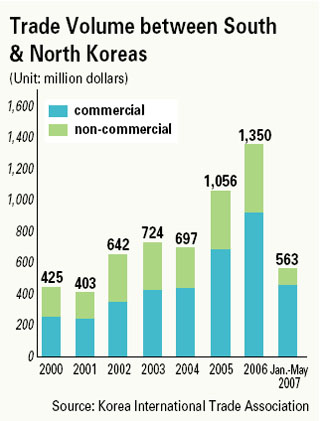
– Cross-border trade was $1.35 billion in 2006 up from $1.05 billion a year ago, largely from the strength of the Kaesong industrial park.

HUMANITARIAN AID

– South Korea has supplied between 200,000-350,000 tonnes of fertiliser a year to the North since 2000.

– It has also shipped up to 500,000 tonnes of rice a year to the North in the form of low-interest, long-term loans. Food aid has been suspended since the North’s missile tests in last July.

REFUGEES, PRISONERS OF WAR AND ABDUCTEES

– South Korea believes more than 1,000 of its people are still alive in the North either as civilian abductees or as prisoners captured during the Korean War.

– North Korea has said 10 South Korean POWs and 11 civilians were alive there.

– More than 1,000 North Koreans each year have fled hunger and persecution in the North and sought refuge in the South. In the first six months of last year, 854 arrived in the South for a total of 8,541. (Source: South Korean Unification Ministry, Kaesong Industrial District Management Committee, Reuters)

Share

Wage payment to N. Korean workers in Kaesong complex surges 48% since missile tests

Sunday, February 25th, 2007

Yonhap
2/25/2007

Wages paid for North Korean labor in an industrial complex in the North’s western border town of Kaesong surged nearly 50 percent in the second half of last year, despite the communist country’s missile and nuclear tests, government data showed Sunday.

According to a report submitted by the Unification Ministry to the National Assembly, North Korean employees’ wages in the Kaesong industrial complex amounted to US$4.23 million in the second half of last year, up 48 percent from the first half’s $2.87 million.

“Even after the North’s missile tests and nuclear test (in October), the hard currency, which the international community takes issue with, continues to end up in the hands of the communist regime while the payment for the Kaesong workers also is expanding,” said Chin Young, a lawmaker of the main opposition Grand National Party, who released the report.

The Kaesong industrial complex is one of two major cross-border projects along with a joint tourism project at the North’s scenic Mount Geumgang.

In the joint industrial complex, South Korean businesses use cheap North Korean labor to produce goods. More than 20 South Korean factories employ a total of 11,189 North Korean workers in Kaesong.

The North, meanwhile, conducted missile tests in July and its first nuclear test in October in defiance of opposition from the international community.

Those incidents prompted a setback in inter-Korean relations and raised concerns that the money paid to the North in the industrial park could be funneled to the communist regime, an allegation that Pyongyang denied.

The report showed wages paid to the North Korean workers have been on the increase in the past few years. In 2004, they stood at $390,000 but rose to $2.76 million in 2005 and $7.10 million in 2006.

Share

Perry Praises Kaesong Complex

Thursday, February 22nd, 2007

Korea Times
2/22/2007

Former U.S. Secretary of Defense William James Perry on Thursday called an inter-Korean industrial complex in Kaesong, North Korea, as the “future of the Korean Peninsula.’’

He made the remarks after a half-day visit to the joint venture.

Perry described the Kaesong complex as a very positive and impressive project to promote peace and prosperity on the Korean Peninsula, an official of the Ministry of Unification who accompanied Perry on the visit, said.

He also praised North Korean officials, calling them “frontiersmen,’’ the official said.

He led a five-member delegation including Stephen Warren Bosworth, former U.S. ambassador to Seoul, Kim Jeong-hun, a Korean-American businessman, and Ashton Baldwin Carter, a professor at Harvard University.

The American delegation was briefed by Kim Dong-keun, the president of the complex’s management committee, and it looked around two factories, including that of clothing manufacturer ShinWon.

During their four-day visit to Seoul, which ended Thursday, they met with Minister of Foreign Affairs and Trade Song Min-soon and leading presidential hopefuls including former Seoul Mayor Lee Myung-bak. The presidential poll is slated for Dec. 19.

The South Korean government plans to resume the expansion of the Kaesong site no later than mid-April.

Last Tuesday, the ministry said it plans to parcel out a 530,000-pyong lot for South Korean manufacturers. One pyong equals 3.3 square meters.

The land is the remainder of a lot of 1 million pyong that the two Koreas have been jointly developing since the first phase of the inter-Korean project. Under the project, a 20 million-pyong industrial base will be built for South Korean companies by 2012.

When fully expanded by 2012, the complex is expected to house about 2,000 South Korean manufacturers employing about half a million North Koreans, according to the ministry.

The industrial complex is one of two major cross-border projects South Korea has kept afloat despite the chilly inter-Korean relations. The two Koreas are also running a joint tourism project at Mount Kumgang in the communist North.

Share

Expansion of Kaesong Site to Resume by April

Tuesday, February 20th, 2007

Korea Times
Lee Jin-woo
2/20/2007

Unification Minister Lee Jae-joung said Tuesday the ministry would resume the halted expansion of a joint industrial complex in the North Korean city of Kaesong no later than mid-April.

Last September, the South Korean government decided to hold off expanding the Kaesong complex because of heightened tension on the Korean Peninsula after the North’s test-firing of seven missiles in July. After Pyongyang’s first-ever underground nuclear test on Oct. 9, tensions increased further.

Minister Lee had been negative about the expansion of the joint business venture, saying more progress in the six-party talks as a prerequisite condition to proceed with the plan.

“We’ve already completed preparing some 3.3 million square meters of land there with almost perfect water and electricity supply,” Lee said in a press briefing at the ministry in Seoul. “Considering its important role for small- and medium-sized South Korean companies, I believe we should resume the expansion plan late next month or mid-April at the latest.”

The Kaesong site is one of two major cross-border projects South Korea has kept afloat despite the chilly inter-Korean relations. The two Koreas are also runing a joint tourism project at Mt. Kumgang in North Korea.

When fully expanded by 2012, the complex is expected to house about 2,000 South Korean manufacturers employing about half a million North Koreans, according to the Ministry of Unification.

The minister also said another inter-Korean summit would be a very useful tool to boost a more reconciliatory atmosphere on the Korean Peninsula, but said the government is not making any efforts to prepare for one.

“Just like the historic summit in June 2000 did, another inter-Korean summit would play a crucial role in bringing peace and prosperity between the two Koreas without a doubt,” Lee said.

“However, an agreement between the leaders of the two Koreas is necessary to realize another summit. We’re not currently working on the issue with North Korea.”

Lee also said South and North Korea should play a leading role in forming a separate peace forum among nations participating in the nuclear disarmament talks. The establishment of the peace forum was mentioned in an agreement made in Sept. 19, 2005, which laid out the course for North Korea’s eventual denuclearization.

“I’m not sure exactly how many nations will take part in the forum to guarantee peace on the Korean Peninsula. It could be four including the two Koreas, the United States and China,” Lee said. “However, Seoul and Pyongyang should play a leading role in preparing the forum.”

Lee said, if last week’s agreement in the six-party talks is carried out as planned, the two Koreas should begin to set up the peace forum at the same time.

On Feb. 13, the North pledged to take the first steps toward dismantling its nuclear program in return for energy aid and other humanitarian assistance during the six-party talks.

Land for S. Korean companies in Kaesong complex on sale next month: ministry
Yonhap

2/20/2007

South Korea’s Unification Ministry said Tuesday that it plans to parcel out a 530,000-pyeong lot for South Korean manufacturers in the inter-Korean industrial complex in Kaesong late next month. One pyeong is 3.3 square meters.

The land is the remainder of the 1-million-pyeong lot which the South and North Korean governments have been jointly developing in the western North Korean border town in the first phase of the inter-Korean project which is to construct a 20-million-pyeong industrial base for South Korean companies by 2012. The complex, if completed, is expected to employ as many as half a million North Korean workers for some 2,000-3,000 South Korean manufacturers.

The government originally planned to sell the lot in three stages last year, but had to put it off amid inter-Korean tension caused by the North’s missile and nuclear tests.

“I believe it’s proper to sell the lot as early as the end of next month,” Unification Minister Lee Jae-joung said, citing his report submitted to President Roh Moo-hyun on Feb. 6 on his agency’s business for this year.

The Kaesong Industrial Complex is one of the two major cross-border projects that South Korea has kept afloat in spite of U.S. opposition. The two Koreas also run a joint tourism project at the North’s scenic Mount Geumgang.

In the industrial complex, South Korean businesses use cheap but skilled North Korean labor to produce goods. Currently, 21 labor-intensive South Korean factories employ about 11,160 North Korean workers.

But U.S. hard-liners criticize the complex, claiming that the factories where North Korean workers earn about US$60 per month are actually channels to funnel much-needed hard currency to the tyrannical North Korean regime.

Share

North Korea Enacts Law Against Money Laundering

Tuesday, February 20th, 2007

Korea Times
Park Song-wu
2/20/2007

The National Intelligence Service (NIS) on Tuesday confirmed that North Korea recently enacted a law that prohibits money laundering.

The standing committee of the North’s Supreme People’s Assembly adopted the legislation last October to ban financial transactions involving illegal earnings, the agency said in a press release.

The enactment apparently aimed at settling the U.S. financial sanctions on a bank in Macau that was blacklisted by Washington in September 2005 for its suspicious role in helping the North conduct illicit financial activities, it said.

Under the latest six-party agreement, reached on Feb. 13, the United States is to resolve financial sanctions within 30 days on North Korean assets worth $24 million that have been frozen in the Macau bank.

The NIS also confirmed that the North has a highly enriched uranium (HEU) program.

NIS officials made the confirmation during a closed-door National Assembly session as the Beijing deal on initial actions to implement the denuclearization of North Korea came under criticism for not mentioning the HEU program.

After ending the session, a lawmaker said on condition of anonymity that the NIS officials confirmed the existence of the HEU program in the North.

When North Korea’s uranium enrichment program came to the fore in 2002, Washington and Pyongyang accused each other of violating the 1994 agreed framework that eventually collapsed.

Seoul and Washington are reportedly sharing the view that Pyongyang has an HEU program, for which the North began purchasing large quantities of centrifuge-related equipment in 2001.

But what is not yet clear is whether the North has begun to produce weapons-grade uranium.

In a separate Assembly session, Minister of Foreign Affairs and Trade Song Min-soon also faced the same question from lawmakers on why the Beijing agreement did not mention the HEU program.

He avoided speaking specifically on the sensitive issue that triggered the second nuclear crisis in October 2002. But he said it will be addressed as the latest agreement invoked section one of the joint statement adopted in September 2005.

“The Beijing deal is about initial steps, and it’s not a complete roadmap toward the denuclearization,” Song said. “But the recent agreement requires the North to declare all of its nuclear programs.”

In section one of the September statement, the North committed to abandoning “all nuclear weapons and existing nuclear programs” and returning at an early date to the treaty on the nonproliferation of nuclear weapons treaty (NPT) and to International Atomic Energy Agency (IAEA) safeguards.

The main opposition Grand National Party (GNP) also expressed doubts over Pyongyang’s willingness to abide by its pledges to implement initial measures for the denuclearization of North Korea.

Rep. Kim Yong-kap of the conservative party found problems with the deal reached in Beijing on Feb. 13 since key components of it, especially on the disablement of the North’s nuclear facilities, are overly “abstract.”

“Despite the North’s agreement to disable its 5 megawatt reactor in Yongbyon, it later changed the wording into a temporary stoppage of operations,” Kim said.

The North’s media promptly reported the result of latest six-party talks, but did not use the term “disablement.” Seoul officials interpreted it as an attempt to mislead North Koreans so they do not lose their pride.

“In addition, there is no deadline on the disablement. I am simply doubtful of the deal’s practicality,” he said.

According to a Chosun Ilbo-Gallup Korea poll, conducted on Feb. 19, 77.9 percent of respondents predicted that the North would not keep its pledges, while 15.8 percent of the 1,006 respondents trusted the North.

But Song said the Beijing deal was a good chance to reaffirm Pyongyang’s willingness for an early denuclearization.

He also dismissed the GNP’s claim that Seoul is determined to share the largest financial burden of aiding the North to achieve a second inter-Korean summit in the run-up to the December presidential election.

“We will not bear all the burden because all five parties have agreed to provide economic aid on the principle of equality and equity,” he said. “And the provision of assistance will be made in line with the principle of action for action.”

As a first step toward denuclearization, North Korea is to shut down its nuclear-related facilities at Yongbyon while allowing United Nations nuclear inspectors back to the nuclear complex to seal them off.

Seoul’s top nuclear negotiator, Chun Yung-woo, said in Beijing on Feb. 13 that the deal is working under an “incentive system.”

For shutting down the Yongbyon complex, the North would receive the equivalent of 50,000 tons of heavy fuel oil in emergency relief aid. An additional 950,000 tons of heavy oil or equivalent aid will be provided to the country upon its completion of disabling other nuclear-related facilities.

Share

LFNKR Expands its NK Food Supply Network

Thursday, February 15th, 2007

http://www.northkoreanrefugees.com/2007-02-supply.htm
2/15/2007

The operation to distribute emergency supplies in Hamgyong-bukto, North Korea was a success. Through one of our clandestine local networks, we were able to provide extremely needy people with a total of one ton of rice, as well as clothing and antibiotics. The value of all items supplied equaled 300,000 yen (about US$2,500). The extra supplies were financed by recent donations. Late November of last year, five members of LFNKR’s local group JYO entered Hoeryong-si, North Korea from China, carrying several boxes filled with winter clothing, antibiotics and penicillin.

To avoid indefinite delays at customs, bribes had to be paid to the North Korean customs personnel. Beyond the customs gate, many hungry day workers waited, hoping to earn money by carrying boxes. The JYO members had to keep a firm grip on their supplies so they wouldn’t be snatched away. The rescue team stayed in Hoeryong-si 10 days completing the mission.

They found that the people in the area are cut off from aid from abroad. Local prices are soaring, which adds to the people’s frustration. Although Hoeryong-si has open marketplaces, business hours are restricted. They may only stay open for the 9 hours from 8:00am to 5:00pm. Transactions earlier or later than the specified hours are strictly prohibited. One of the merchants who owns a small market stall (1m x 2m) complained that the restrictions are so severe, he hardly makes enough to survive.

In early September, the marketplace managers were repeatedly confronted by merchants protesting the strict business rules, including the tight business hours. During one protest, the national security guards in Hoeryong-si were called out to suppress the crowd of protesting merchants because one of the protesters had been trampled to death and several others were injured during the demonstration. But the severe restrictions on market activities continued, and that provoked another large demonstration in November. At this protest, 20 to 30 people were reportedly arrested.

The reason for the ongoing protests is simple. A majority of people in North Korea are still starving, and their only option is to engage in trade. Meanwhile, the authorities place unreasonably tight controls on merchandise and free trade at the marketplaces.

According to our local members, the authorities have been strictly limiting the number of people they allow to travel into China. Even with people bribing the authorities, only 2 or 3 out of every hundred applicants are issued permits.

Recently, Chinese people seeking to visit relatives are no longer allowed to enter North Korea unless they are properly registered and can prove they are related. Even tighter restrictions have been placed on North Koreans wishing to visit relatives living in China. In addition, no one is allowed to invite relatives from China without submitting beforehand a set of registration documents showing detailed descriptions of the relatives for identification. The documents are minutely scrutinized by all relevant agents, including the local foreign affairs office, the national security department, and the customs house. Incidentally, the fee for this process is 6,000 won.

Here are a few typical prices of food items in Hoeryong-si in December 2006 (unit: NK won):

Rice (1kg): 1300W
Corn (1kg): 550
Sugar (1kg): 1800
Wheat flour (1kg) 750
Pork (1kg): 3300 

Our JYO rescue team handed out winter clothing to people who could not afford to buy warm garments, and also distributed antibiotics to those needing them. The shortage of medicines in the market places is obvious. A single package of antibiotics was selling for at least 12,000 to 16,000 won, while in China it is sold for less than half that, or 15RMB (about 6,000 won).

After the JYO team’s return from North Korea, they received news that the marketplace closing time had finally been extended to 7:00pm as a result of the two large protest demonstrations. The authorities were forced to accept the fact that the merchants can barely survive unless they work extra hours, even if they have to use kerosene lamps to continue business after dark.

Share

Land Leasing Law

Sunday, February 11th, 2007

From Naenara:

The DPRK Law on the Leasing of Land was adopted by Resolution No. 40 of the Standing Committee of the Supreme People’s Assembly on October 27, 1993, and amended by Decree No. 484 of the Presidium of the Supreme People’s Assembly on February 26, 1999.

The law consists of 42 articles in 6 chapters.

Chapter 1. Fundamentals (Articles 1~8)

This chapter stipulates that the mission of the law is to contribute to establishing a proper system in the leasing of land needed for foreign investors and foreign-invested enterprises and for use of the leased land.

A foreign corporate body or individual may lease and use land in the DPR Korea and the lessee has the right to use the land leased. When land is leased, natural resources and deposits in the land leased are not covered by the right to use land. The term of lease is fixed by agreement between the contracting parties within the limit of 50 years.

Chapter 2. Ways of leasing land (Articles 9~14)

This chapter defines the ways of leasing land.

It stipulates that the leasing of land should be undertaken through consultation or by means of tender or auction. It also notes that the lessor should provide the lessee with the data like the location and area of the land and its topographical map, uses to which the land may be put, the building area, a plan for development of the land, the period during which construction must be completed and the minimum amount of investment required, the requirements for environmental protection, hygiene and anti-epidemics and fire prevention, the term of lease of the land and the state of development of the land.

The lessee must use land in accordance with the contract for use of land. A lessee who wishes to alter the use of land must conclude a supplementary contract with the lessor.

Chapter. 3 Transfer and mortgage of the right to use land (Articles 15-27)

This chapter stipulates that the lessee is permitted, with the approval of the lessor; to transfer (by means of selling, re-leasing, donation or inheritance) or mortgage to a third party the right to use a part or the whole of the land leased and defines in detail the problems arising in the transfer and mortgage of the right to use land.

It also prescribes the condition for transferring the right to use land, the limits of its transfer and the procedure for the sale of the right to use land.

The lessee is allowed to sell, re-lease, donate or mortgage the leased land only after paying the total amount of charge for transferring the right to use land stipulated in the contract for leasing the land and making the contracted investment. In case of the transfer of the right to use land, the rights and obligations relating to the use of the land, and the structures and other appurtenance on it, are also transferred.

When a lessee sells the right to use land, the lessor has the preferential right to buy it.

The chapter also notes that the lessee may re-lease the land leased observing due formalities and defines the procedures for mortgaging the right to use land.

A lessee may mortgage the right to use land with the purpose of obtaining a loan from a bank or other financial institutions. In this case the mortgagor and the mortgagee must conclude a contract for the mortgage in accordance with the terms of the contract for leasing the land. The two contracting parties must register the mortgaged right with the relevant lessor within 10 days.

If the right to use land is mortgaged, the structures and other appurtenance on the land are also mortgaged with the land. When concluding a contract for the mortgage, the mortgagee may request the mortgagor the contract for leasing the land, a copy of the transfer contract, a copy of the certificate for use of the land or other information relating to the current state of the land.

The chapter defines the right of mortgagee when the right to use land is mortgaged as well.

The mortgagee may dispose of the right to use the land mortgaged by contract, as well as the structures and other appurtenance of the land in accordance with the mortgage contract if the mortgagor fails to pay the amount due by the expiry of the mortgage, or if business has been dissolved or gone bankrupt during the period of the mortgage contract. One who has won the right to use land and the structures and other appurtenance on it disposed of by the mortgagee must receive attestation from a notary office, register the change with the registration office and use the land in accordance with the contract for leasing the land.

The mortgagor is not permitted to remortgage or transfer the right to use land during the period of contract without the approval of the mortgagee.

Chapter 4. Rent of land (Articles 28-33)

This chapter notes that the lessee must pay rent for the leased land to the lessor. When leasing developed land, the lessor will receive from the lessee the charge for transferring the right to use land plus the cost of land development. The lessee must pay the total amount of charge for transferring the right to use land within 90 days of signing the contract for leasing land. If the charge is not paid before the prescribed deadline, the lessor must demand additional payment equivalent to 0.1% of the overdue rent on a daily basis, starting from the first day of default.

A lessee who has been leased land through consultation or auction must pay to the lessor a guaranty equivalent to 10% of the charge for transferring the right to use land, within 15 days of the conclusion of the contract for leasing the land. The user of the land leased should pay annually land use charge. In this case, for those who invest in priority sectors and in the Rason economic and trade zone, land use charges may be reduced or exempted for up to 10 years.

Chapter 5. Return of the right to use land (Articles 34~38)

This chapter provides that the right to use land automatically returns to the lessor on the expiry of the term of the lease stipulated in the contract. The structures and other appurtenance on the land also return, without compensation being paid.

The chapter defines the procedure for canceling the registration of the right to use land, extension of the term of land lease, the expense for the withdrawal and clearance of the leased land and the cancellation of the right to use the leased land.

Chapter 6. Penalties and settlement of disputes (Articles 39-42)

This chapter specifies that if a lessee illegally uses land without the certificate for the use of land, or changes the use of land or transfers or mortgages the right to use land without approval, he must be fined, have the facilities on the land confiscated or be required to restore the land to its original state, and the contract for transfer or mortgage be declared null and void.

The chapter also stipulates the ways of depriving the lessee of the right to use land, appealing to or filing a suit on it and settling the disputes.

In case of a failure to invest 50% of the total sum of investment during the period prescribed in the contract for the leasing of land, or to develop the land as contracted, the lessee may be deprived of the right to use land.

If the lessee disagrees with the penalty imposed on him, he may appeal to an institution senior to the one that has imposed sanctions or file a suit with an appropriate court within 20 days of the receipt of the notice of penalty.

Disagreements arising in leasing land or transferring and mortgaging leased land to a third party must be settled through consultation.

In case of failure in consultation, they must be settled through arbitration or legal procedures provided by the DPRK, or may be taken to an arbitration body in a third country for settlement.

The DPRK Law on the Leasing of Land contributes to establishing a proper system and order in the leasing of land needed for foreign investors and foreign-invested enterprises in order to secure their investment and activities.

Share

Foreign Rating Agency Executives Visit Kaesong

Friday, February 9th, 2007

Korea Times
Lee Jin-woo
2/9/2007
 
A group of 17 people including high-level executives from Moody’s Investors Service and Goldman Sachs made a half-day visit to the joint industrial complex in the North Korean border city of Kaesong on Friday, the Ministry of Unification said.

Three executives from each company were accompanied by officials from the Ministry of Finance and Economy as well as the Ministry of Unification.

The short trip was part of the foreign rating agencies’ annual meeting on South Korea’s sovereign rating.

During the visit, they received a briefing from officials of the Kaesong Industiral District Management Committee, which manages the site’s development process, and looked around the first completed district of the industrial complex.

The government has had to hold off its plan to sell the first batch of some 1 million pyong (3.3 million square meters) of land to South Korean companies that wished to move into the industrial complex.

The plan was initially scheduled in June last year, but was suspended indefinitely due to signs of a North Korean missile test. Pyongyang pushed ahead with its plan and test-fired seven ballistic missiles on July 5, which was then followed by its first-ever nuclear test on Oct. 9.

Moody’s upgraded South Korea’s rating to A3 in March 2002, its seventh-highest investment grade.

Officials, however, were cautious about the chances for a higher sovereign rating.

“It remains to be seen whether Moody’s will upgrade South Korea’s credit rating, but it’s true that they react quite sensitively to geopolitical issues related to North Korea,” said a ranking official of the finance ministry.

Another official expected a positive effect from the visit, saying “The outcome of the ongoing six-party talks in Beijing is most important without a doubt, but this trip will help officials of the foreign rating agencies have a better understanding of our efforts and faith in inter-Korean business projects.”

The number of North Koreans working for the 18 South Korean firms at the industrial complex surpassed 10,000 late last year.

By 2012, the complex is expected to house about 2,000 South Korean manufacturers employing about half a million North Koreans, according to the Ministry of Unification.

Share

Foreign Rating Agency Officials to Visit Kaesong

Tuesday, February 6th, 2007

Korea Times
Lee Jin-woo
2/6/2007

High-level executives from Moody’s Investors Service and Goldman Sachs will visit a joint industrial complex in the North Korean border city of Kaesong on Friday, the Ministry of Unification said Tuesday.

The delegation includes Thomas Byrne, a senior credit officer for Korean affairs at the global credit appraiser Moody’s.

Three executives from each financial company will visit the Kaesong Industrial Complex accompanied by officials from the Ministry of Finance and Economy.

The half-day visit is part of the foreign rating agency’s annual meeting on South Korea’s sovereign rating. The Moody’s delegation will visit Seoul from Feb. 9-14.

The visit is aimed at observing North Korea’s economic situation and attitude toward economic reform, sources said.

North Korean officials are positive about the visit, a source said. The Stalinist state has not issued an invitation for the delegation as of 2 p.m. Tuesday.

Moody’s delegates will meet with officials from the Finance Ministry, the National Assembly, the Bank of Korea and other government offices in Seoul from Feb. 12-14.

In the meetings, the two sides will discuss South Korea’s macroeconomic policies, fiscal stability, ongoing negotiations on a U.S.-South Korea free trade agreement and the North Korean nuclear issue.

Moody’s upgraded South Korea’s rating to A3 in March 2002, its seventh-highest investment grade.

Moody’s Investors Service is a credit rating, research and risk analysis company. It has more than 9,000 customer accounts and employs more than 2,400 people, including more than 1,000 analysts, according to its Web site.

The Seoul branch of Goldman Sachs did not provide much detail on the scheduled visit.

The number of North Koreans working for the 18 South Korean firms at the industrial complex surpassed 10,000 late last year.

In 2012, the complex is expected to house about 2,000 South Korean manufacturers employing about half a million North Koreans, according to the Ministry of Unification.

Share

An affiliate of 38 North