Archive for the ‘Foreign direct investment’ Category

Cancor Report #297: Knowledge Sharing with the DPRK

Sunday, January 27th, 2008

November 12, 2007

The latest edition of the CanKor Report has only one longer-than-usual item.  It is the preparatory document of a workshop recently held in Seoul, Korea, in which NGOs, academics, practitioners and diplomats from Europe, Asia, Australia and North America consulted about the prospects for international cooperation regarding education and training programmes that need to be undertaken with the DPRK if denuclearization proceeds according to the Six-Party timetable.  Experts in economic development believe that the next step in international engagement will have to be the building up of DPRK expertise and intellectual capacity to absorb the significant development assistance that may follow successful completion of the Six-Party process. In this working paper, loyal CanKor reader and former World Bank official Bradley Babson defines “knowledge sharing”, explains why the time is ripe for all sectors to become involved, outlines potential pitfalls, and suggests guiding principles for future engagement by the international community.
*************************************************

Contents:

1.   KNOWLEDGE SHARING WITH THE DPRK
    Bradley O. Babson, CanKor original
       Introduction
       Why knowledge sharing?
       Strategic considerations
       DPRK internal challenges
       Nuclear politics
       Inter-Korean reconciliation
       China, Russia and Northeast Asia regional perspectives
       Operational challenges in the DPRK context
       An underlying tension
       Relationships
       Information
       Absorptive capacity
       Coordination
       Resources
       International experience and best practices
       Conclusions and principles for future engagement
*************************************************

(more…)

Share

Travel to Kaesong Restricted to Prevent Awareness of South Korea

Friday, January 25th, 2008

Daily NK
Yang Jung A
1/25/2008
 
A job in a factory at the Kaesong Industrial Complex is fast becoming the ideal job for North Korean citizens, and positive feelings toward the South are continuing to grow.

Good Friends reported on the 23rd that most North Koreans are aware that economic cooperation at Kaesong is thriving as South Korean enterprises supply advanced materials and management, and North Korea supplies labor.

“South Korean advisory managers supervise workers. If workers do not come to work on time in the morning or they do not work diligently, the managers simply say, ‘You don’t need to come here tomorrow’” reported one North Korean citizen through Good Friends.

The citizen added, “Workers try to complete their appointed tasks under all conditions, while monitoring the South Korean supervisors’ attitudes.”

As the Kaesong Complex grows, the internal customs procedures into Kaesong become more complicated.

Good Friends reported, “Kaesong was originally a strictly controlled zone because of its location just north of the 38th parallel. If a North Korean wanted to visit Kaesong, they had to register, undergo an investigation and get a pass. Now, If they try to go to Kaesong, the process is much more complicated.”

A cadre working at the Kaesong Complex said that this is because people have growing positive feelings toward South Korea. The authorities worry about the great gap between the North and the South and worry about growing public disillusionment.”

He added, “The only place people can talk about South Korea is at Kaesong. They have a yearning for South Korea, especially after they’ve encountered South Korean products.” 

Share

DPRK Regulations on Certification

Friday, January 11th, 2008

From Naenara:

The DPRK government adopted the “Regulations of the DPRK on Certification” on June 30, 2003 by Decision No. 37 of the Cabinet, and is enforcing them with an aim to establish the scientific quality management system in all organs and enterprises, and to upgrade the quality of products for improving the people’s livelihood and facilitating foreign trade.

The regulations consist of 37 articles in four chapters: Chapter 1. General provisions (Article 1–8), Chapter 2. Quality certification bodies (Article 9–18), Chapter 3. Assessment on quality certification (Article 19–31) and Chapter 4. Supervision and control (Article 32–37).

Chapter 1. General Provisions

The management and guidance in quality certification shall be undertaken in a unified way by the State Administration for Quality Management (hereinafter referred to as SAQM).

The SAQM shall publish the products that are subject to compulsory certification step by step in accordance with the urgent requirements. The compulsory certification products can be exported only under certification.

The compulsory certification products exported to and imported from foreign countries which concluded certification agreement with our country are not subject to quality inspection at trade ports, border railway stations, airports and frontier transit points.

The term of validity for certification shall be three years. The quality certification bodies and certified organizations shall fall under surveillance and reassessment within the period defined by the SAQM.

The SAQM shall promote exchange and cooperation with international organizations and foreign bodies in the field of quality certification.

Chapter 2. Quality Certification Bodies

The quality certification bodies shall take charge of the assessment of quality management system of the organizations applying for certification. The quality certification bodies shall be designated by the SAQM.

The quality certification bodies shall undertake product certification, assessment and registration of quality management system, personnel certification, certification testing and training of certification assessors.

Chapter 3. Assessment on Quality Certification

The organizations and individuals who will be certified shall submit the written applications confirmed by their upper body to the relevant central organ to which the quality certification bodies belong.

The applications for product certification and registration of quality management system include the description of quality management system of a product or its production process and the confirmation of the relevant quality supervision body. The application for personnel certification shall comprise the confirmation of the organization to which the applicant belongs.

Upon the receipt of application, the relevant central organ shall confirm whether the application is formulated or not as required by the regulations and send it to its affiliated certification body in time.

In regard to the product certification assessment, the quality certification body shall examine mainly samples and document as well as the quality management system of processes which may affect the quality of products.

The assessment of product certification shall be completed within 60 days.

The assessment of quality management system consists of the document review and on-site assessment.

The document review aims at identifying whether the documents related to quality management system are properly made or not. The on-site assessment aims at ensuring the conformity of quality management system with the contents of the documents and their effectiveness. The registration of quality management system shall be completed within 90 days from the notification of assessment to the applicant.

The quality supervision organs may commit the organizations to inspect the quality of their products which have been certified and registered.

The quality certification bodies and the certified organizations shall use the relevant marks.

Chapter 4. Supervision and Control

The supervision and control on quality certification shall be exercised by the SAQM and the relevant supervision and control organs.

In case of any incidents in sale and export of the certified products or products manufactured through the certified process, the SAQM shall investigate them and take the necessary measures.

In case of any errors in quality certification due to irresponsibility of the quality certification organ and its official, the SAQM shall take strict sanctions such as disqualification and deprivation of authority against them.

In case the relevant organization and personnel violate the regulations and the order concerning quality certification, the SAQM and quality certification bodies may deprive it/him of its/his certificates and marks already issued.

In case of encroachment on the interests of the State and people or damage to the dignity of the country, the person concerned shall suffer from administrative and judicial sanctions according to the degree of seriousness.

Share

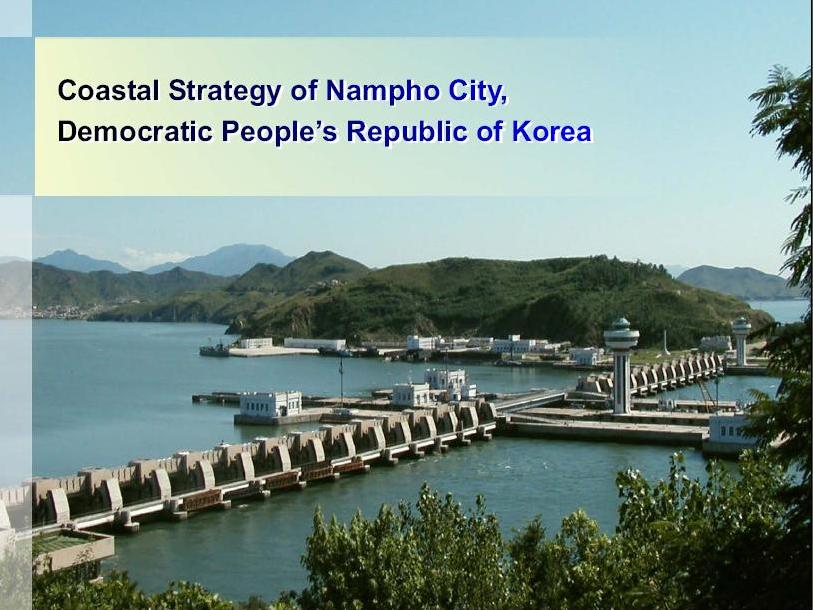
More than you wanted to know about Nampo

Wednesday, January 9th, 2008

nampo.JPG

Judging by this presentation it seems that by 2004 western consultants had already made their way to Nampo:

Click on the image to see the powerpoint presentation.

(more…)

Share

2007 Biggest year for inter-Korean exchange, at USD$1.79 billion

Monday, January 7th, 2008

Institute for Far Eastern Studies (IFES)
NK Brief No. 08-1-10-1
1/10/2008

The net worth of inter-Korean exchanges totaled 1,797,890,000 USD in 2007, up 33% from the 1.35 billion USD in the previous year. Exchanges between the two Koreas began in 1989, and topped one billion dollars for the first time in 2005. The almost 1.8 billion dollars in trade recorded in 2007 is the highest to date, and is equal to 65 percent of North Korea’s non-Korean trade volume of 2.996 billion USD in 2006.

Inter-Korean commercial trade was worth 1,431,170,000 USD, 54 percent higher than the 928 million USD in 2006, while non-commercial trade fell 13 percent, from 421,660,000 dollars in 2006 to only 366,720,000 dollars last year. Overall, commercial trade made up over 80 percent of cross-border exchanges, proving that inter-Korean exchanges continue to grow based on commercial transactions. Commercial trade growth was centered around the mining and fishery sectors (52 percent) and increased production in the Kaesong Industrial Complex (48 percent). Textiles and other goods processed on commission also grew by 30 percent.

Additional manufacturing by companies entering the KIC, as well as the installment of equipment used to increase output by those manufacturers already established in the first phase of the complex, saw a great jump last year. Additionally, South Korea loaned the North 80 million USD for equipment, cloth, soap, polyester fibers, synthetic leather, and other materials to be used in light industry, while the North repayed 2.4 million USD (3 percent) of the loan by delivering 1,000 tons of zinc. This was the first example of the North repaying funds to the South, and shows opportunities for the two Koreas to fulfill each other’s needs and carry out friendly economic cooperation in the future.

With increases in domestic use and export of Bukhan Mountain’s minerals and timber, improvements in communications, customs, and transport issues at the KIC and a growing number of companies moving into the complex leading to an increase in production and manufacturing activity, inter-Korean exchanges are expected to continue to grow in the future.

Share

Will the new ROK govt revisit inter-Korean projects?

Monday, January 7th, 2008

Yonhap (Jan 7, 2008) reports that newly elected South Korean president Lee Myung-bak will revisit the agreement struck between former President Roh and Chairman Kim Jong il last fall.

(excerpt) Projects under review will be the construction of a shipyard complex and its infrastructure in [Haeju] North Korea, along with the establishment of a “peace zone” along the disputed [Northern Line Limit] border in the West Sea, the site of deadly naval clashes between the two Koreas in 1999 and 2002.

“Humanitarian projects, such as the reunion of family members living separately in the two Koreas, and rice and fertilizer aid can be continuously pushed for, but economic cooperation projects should be carried out in parallel with the pace of North Korea nuclear talks,” a key member of the team was quoted as saying at the briefing.

——

Projects in the North are not the only things potentially headed for the chopping block–so it seems is the South Korean Ministry of Unification itself, which could potentially be merged with the South Korean Foreign Ministry. 

The incoming president, however, did suggest a carrot to go with his sticks.  Yonhap reported on January 4 that the new administration plans to launch a USD$40 million fund to promote economic growth in North Korea. 

(excerpt from Yonhap) The planned fund is in line with Lee’s ambitious plan to help increase the impoverished North’s per capita income to $3,000 within a decade if it makes the bold decision to abandon its nuclear program and open its market, said the team’s spokesman Lee Dong-gwan. There are no accurate data on the reclusive nation’s economy but some estimates put its per capita income at around $1,300.

Share

Hyundai Asan to Post $10 Mil. in Operating Profit

Friday, December 28th, 2007

Korea Times
Ryu Jin
12/28/3007

Hyundai Asan, the South Korean operator of various cross-border economic projects with North Korea such as Mt. Geumgang tourism program, said Friday that its operating profit this year is estimated to exceed 10 billion won (roughly $10.6 million).

“We saw a great upturn for our profits this year thanks to an increase in the number of tourists to Mt. Geumgang,’’ a ranking company official said. “According to our tentative calculation, the operating profit is expected to surpass 10 billion won.’’

Hyundai Asan, which began another tour program to North Korea’s border city of Gaeseong this year, expects that the company’s annual sales will reach 300 billion won this year, a notable increase from 220 billion won last year.

According to the firm, some 350,000 people crossed the border to the North to visit the mountain resort on the eastern part of the peninsula, up from last year’s 240,000, largely thanks to the launch of a new route up the inner part of the mountain in June.

Company officials anticipate that the tours will further prosper next year, as it plans to start a fresh tour program to Mt. Baekdu on the border between China and North Korea next May.

Founded in February 1992, Hyundai Asan has suffered losses for a long time. But its large-scale investment in the poverty-stricken Stalinist state is paying off at last. In 2005, the company went into the black with 5.7 billion won in operating profit for the first time.

Share

Kaesong output increases 150 pct: Unification Ministry

Friday, December 28th, 2007

Yonhap
12/28/2007

The total output of a South Korea-built industrial complex in North Korea’s border town of Kaesong totaled over US$180 million this year, shooting up 150 percent from a year ago, Seoul’s Unification Ministry said on Friday.

“The total production by businesses at the Kaesong industrial complex recorded an estimated $185 million this year, up about 150 percent from $74 million last year,” the ministry said in a press release.

Share

S. Korea to develop two resource rich areas in N. Korea

Thursday, December 27th, 2007

Yonhap
12/27/2007

South Korea plans to develop two resource rich regions in North Korea that can benefit both countries and fuel cross-border economic cooperation, the government said Thursday.

The blueprint calls for more funds to be funneled into North Korea so prospective developers can conduct geological surveys and compile detailed data for future reference, the Ministry of Commerce, Industry and Energy said.

Resource-poor South Korea imports most raw materials to operate its heavy industry-centered economy. Lack of social infrastructure and mining knowhow have prevented North Korea from fully developing resources.

(more…)

Share

Koreas Begin Talks on Shipbuilding Project

Tuesday, December 25th, 2007

Korea Times
Yoon Won-sup
12/25/2007

The two Koreas began four-day talks in the southern port city of Busan Tuesday to discuss ways of establishing shipbuilding areas in North Korea, according to the Unification Ministry.

A sub-committee for shipbuilding and marine cooperation, part of an agreement reached at the inter-Korean prime ministers’ meeting last month, convened for the first time to map out the details of the shipbuilding project.

(more…)

Share
