Since 2003, a comprehensive agricultural management method was piloted in Suan County of North Hwanghae Province. From last year, this method was introduced in other regions to be administered nationwide.
An official from DPRK’s Ministry of Land and Environmental Protection gave an interview with the KCNA on June 17 and “from this year a comprehensive agricultural management method is being introduced in many regions and until now 100,000 jungbo or 991,735,537 square meters of forest area has increased,” he said.
Comprehensive agricultural management method is explained as “a new forestry management method to improve the ecological environment and protection of land as well as cultivate various species of trees in forests and crops, herbs, and grass that combine farming and livestock raising to increase production of lumber, crops, livestock, and mountain fruits.”
In the past, majority of forests were destroyed during the time of extreme food and firewood shortage food. To repair the damage, planting crops in forests became an urgent matter and from 2003, comprehensive agricultural management method was adopted in Suan County of North Hwanghae Province and other areas that had favorable conditions that were environmentally safe and socially beneficial.
According to the Ministry of Land and Environmental Protection, “the survival and growth rate of trees improved drastically as people began to use forest lands more efficiently. In this regard, a national policy for comprehensive agricultural management method was introduced across the country from last year.” Various local organizations were established on the city, state, and county levels of people’s committees as they learned to administer the new comprehensive management method.
A seminar was held in Pyongyang on July 29, 2008 on the topic of comprehensive agricultural management method. This was funded by the Swiss Development Cooperation (SDC). Swiss government at the time was transferring know-how and technology for raising cabbage, corn, and other crops as well as pest control, crop rotation, slope farming, and other related skills.
The KCNA reported that at this event, “various national, regional and global environmental problems were addressed and specific actions were being taken to protect food security and ensure the improvement of people’s lives,” said Choe Sang-ho, director of the Ministry of Land and Environmental Protection.
The news elaborated on the notion and practical necessity for the comprehensive agricultural management method and state policy to promote research and education to develop the slope farming and disseminate the comprehensive agricultural management method and technology development in this area.
The participants at this seminar discussed the need to expand international exchanges to cooperation to strengthen and distribute comprehensive farming management by eco-regions and also visited the pilot unit in Suan County.
DPRK Economic Development Committee launched: Special economic and tourism zones to be named (IFES)
In the wake of normalizing the Kaesong Industrial Complex (KIC) agreement, North Korea has announced that it had installed the Economic Development Committee and named special economic and tourism zones, as well as newly appointed officials in charge. In the near future, North Korea has plans to announce specific special economic zones in Sinuiju, Nampo, and Haeju, along with tourism zones in Mount Baekdu, Wonsan, and Chilbosan. The head and director-level executives for the Economic Development Committee are likely to be appointed from the Joint Venture Investment Committee. The head of the Tourism Development is reported to be the former director of Korea Tourism Administration.
Meanwhile, North Korea has released the preamble of the economic development law adopted at the recent Presidium of the Supreme People’s Assembly held on May 29. As inter-Korean relations are progressing with the plans of restarting the Kaesong Industrial Complex and the reunion of separated families moving forward, North Korea’s economic development law is drawing attention once again.
In principle, the selection process for the special economic zones must possess these following elements: Area must 1) be in a favorable location for foreign economic cooperation and exchanges; 2) contribute to the economic and science and technology development; 3) be at a fixed distance from the residential areas; and 4) be at a location that does not intrude in the state protected areas (Article 11). This can be interpreted as the North’s effort to segregate the existing residential areas with the special economic zone similar to the Kaesong Industrial Complex so as to minimize the political and social impact of these zones.
The newly confirmed information for the new Economic Development Law is the list of development activities. “Investors from other countries are permitted to develop economic zones either alone or in collaboration after obtaining state approval (Article 20).” Evidently, North Korean institutions and enterprises may also develop economic zones after receiving approval from the state.
In addition, the law granted comprehensive property rights to the development companies. It states that “Companies have the right to sell, re-lease, bequeath, or transfer the ownership of the buildings and land lease” and “the selling or re-lease price shall be determined by the development company” (Article 29).
As for recruitment of workers, there is a provision that states “our country’s labor force must be given preferential consideration” (Article 41), and “the minimum wage for the employees of the Economic Development Zone shall be determined by central guidance organization of special economic zone” (Article 42). This poses some concern as the employee wage at the Economic Development Zone could be compared to that of the KIC, which could lead to wage disputes after the KIC begins to implement its internationalization process.
Another noteworthy change is the currencies permitted at the zone: “currency for circulation and payment must be Korean Won (KPW) or other specified currency” (Article 46), suggesting that other currencies such as the US dollar and euro will be allowed.
Furthermore, the Act specifies that “Companies in the economic development zone will decide on the commodity and service prices, and all the prices in the Economic Development Zone between institutions, enterprises and organizations shall be determined by the international market price based on agreement of all the parties” (Article 43). This suggests that the products produced in the zone may be traded domestically in North Korea.
In this Act, corporate income tax rate was set at 14 percent of profits and “Economic Development companies that operate for more than 10 years will be considered for a tax cut or exemption from the corporate income tax.” Article 58 grants “communication guarantees” for the usage of mail, telephone, and fax services, but did not include the use of the Internet.
UPDATE 3 (2013-8-30): In August, the Pyongyang Times issued the following information on the DPRK’s Law on Economic Development Zones:
New law friendly towards investment
The law on economic development zone was enacted and promulgated in the DPRK on May 29.
The Pyongyang Times staff reporter Kim Rye Yong interviewed Kang Jong Nam, PhD and researcher at Law College of Kim Il Sung University, about the law.
What is the difference between this law and other laws that are in force in such special zones as Rason Economic and Trade Zone, Hwanggumphyong and Wihwado Economic Zone and Kaesong Industrial Park?
The recent law is applied to economic development zones to be newly established.
According to the law, an economic development zone is the area where investors receive preferential treatment in their economic activities in line with the legislation specially laid down by the state. Such a zone includes industrial, agricultural, tourist, exports processing and cutting-edge technology development areas. It is a principle to establish such a zone in the area which is favourable for external economic cooperation and exchange, conducive to the development of the country’s economy, science and technology and somewhat distant from residential areas and reserves.
Foreign investors may develop the zone singly or jointly and DPRK institutions and enterprises may be developers.
The zone shall be invested by foreign bodies corporate, individuals (natural persons) and economic groups and overseas Koreans.
The law defines that the investors’ rights, interests, properties and lawful profits are under protection by law. The state shall not nationalize or expropriate their properties. Should unavoidable circumstances make it necessary to expropriate or temporarily use their properties for the public good, it shall inform them of this in advance and make a full and timely compensation for this.
The personal safety of investors is also protected by law. Without legal grounds they will not be subjected to detention or arrest and their residences will not be subjected to search.
Where there are treaties concluded between the DPRK and foreign countries as regards personal safety, they shall prevail.
How is an economic development zone managed?
It is managed by the economic development zone management body under the guidance and with the assistance of the central special economic zone guidance organ and the people’s committee of a relevant province or a municipality directly under the central authority.
The management body carries out assignments given by the central organ and the people’s committee including the formulation of rules of the development and management of the zone, creation of investment environment and invitation of investment, licensing of the establishment of enterprise and its registration and the licensing, supervision and cooperation related to the construction, management and operation of project.
The law stipulates that an investor can lease land for a maximum of 50 years and, if need be, continue to use the land by renewing the contract before the expiry date.
The enterprise income tax rate shall be 14 per cent of settled accounts profits and that in encouraged sectors 10 per cent, a very low rate. An enterprise that operates in the zone for over ten years shall enjoy the benefit of exemption from or reduction of taxes. Where an investor reinvests profits to increase registered capital or sets up a new enterprise to operate it for over five years, he shall be paid back 50 per cent or 100 per cent of the income tax.
Tariff in the zone is preferential.
The prices of goods and services dealt between enterprises in the zone and those of goods dealt between the enterprises in the zone and the Korean economic organizations outside the zone shall be fixed by mutual consent between the parties proportionate to international market prices.
North Korea passes economic development zone law
Institute for Far Eastern Studies (IFES)
2013-6-14
Since the start of Kim Jong-un regime, internal economic management measures continue to be established. Recently, a new law was enacted for the establishment of economic development zones.
The KCNA reported on June 5 that a law for economic development zones was adopted and “in this regard, ordinance of the DPRK Supreme People’s Assembly’s Standing Committee was promulgated at the session on May 29.”
The legislation is composed of 7 chapters and 62 sections, which cover matters such as configuration, development, management, conflict resolution, and so forth.
The report added that “Economic development zones, in accordance with the regulations set forth by the state, are entitled to various privileges as special economic zones.”
In addition, “Foreign corporations, individuals, economic organizations, and overseas Koreans are able to invest in the economic development zones, and can freely engage in economic activities including establishment of businesses, branches, and offices.” It also indicated that “the state will provide preferential terms to investors in areas such as land usages, recruitment, and tax payments.”
The details of the rights granted to investors were expounded, emphasizing that economic development zone is a special zone, and provides legal safeguards to protect the rights, investment properties and legitimate profits of foreign investors.
According to the KCNA, the economic development zones will include various economic and science and technology sectors such as industrial development, agricultural, tourism, export processing, and high-tech development zones.
Chairman Kim Jong-un delivered a speech at the WPK’s Central Committee Meeting entitled “Economic Development Zones Must Be Created in Every Province Reflecting the Regional Characteristics,” hinting at the state’s policy to attract more foreign investment to accelerate the development of the economic zones.
In particular, investments in infrastructure construction, state-of-the-art science and technology sector, and production of goods highly competitive in the international market were especially encouraged.
The management of these economic development zones will be separated into local-level and central-level zones, indicating that economic development zones will be established in all parts of the country.
However, this law does not apply to the preexisting economic and trade zones in Rason, Hwanggeumpyeong, Wihwa Island, Kumgang and Kaesong. The new legislation indicates that North Korea is committed to economic development regardless of the tense relations on the Korean Peninsula.
UPDATE 1 (2013-6-23):Yonhap offers new details of the legislation not published by KCNA:
North Korea will offer a maximum 50 year lease on land for the economic development zones it wants to set up across the country to spur outside investment, an analysis of a propaganda magazine monitored in Seoul showed Sunday.
Close examination of the May 29 edition of the Tongil Sinbo, a weekly magazine that highlights activities taking place in the isolationist country, revealed the lease system.
The 50-year scheme for development zones is on par with land lease favors offered by Pyongyang to businesses operating in the Kaesong Industrial Complex and the Rason Economic and Trade Zone. The plan can offer assurances to investors, which can be a critical incentive.
Kaesong is on the west coast just north of the demilitarized zone, while Rason is located in the country’s northeastern region near the border with China and Russia.
In addition, the weekly said companies will be able to freely buy and sell rights on buildings and land in the economic zones and even hand over property deeds with a clause being fixed that can allow the present rights holder to release it to a third party.
Development of land leased can be assisted by North Korean state organizations and companies.
The weekly said Pyongyang has set corporate tax rates for these zones at 14 percent of earnings after the settlement of accounts, with the government pledging the safety of all foreigners in the special zones under North Korean law.
In regards to where the development zones will be set up, the weekly said the North will give priority to areas that can trade easily with the outside world, a region that can contribute to the advancement of the national economy, and a location that is separate from local residences.
The report said that all authority for the new development zones will be given to a centralized economic oversight organization to make it easier for investors to talk to authorities and receive administrative assistance.
Read the full story here:
N. Korea to offer max 50 years lease on land in economic development zones
Yonhap (via Global Post)
2013-6-23
Pyongyang, June 5 (KCNA) — The DPRK enacted a law on economic development zones.
A decree on the law was promulgated by the Presidium of the Supreme People’s Assembly of the DPRK on May 29.
The law has seven chapters (62 articles) and additional rules (two articles).
The law deals with fundamentals of the law, establishment, development and management of economic development zones, economic transactions in the zones, their encouragement, preference and settlement of complaints and disputes.
According to the law, economic development zones are special economic zones in which preference is granted as for economic activities under the laws and regulations specially provided for by the state.
The economic development zones include industrial development zone, agricultural development zone, tourism development zone, exports processing zone, ultra-modern technological development zone and other development zones in the fields of the economy and science and technology.
The state will assort the economic development zones into local-level economic development zones and central-level economic development zones and manage them according to their affiliations.
Foreign corporate bodies, individuals and economic organizations and overseas Koreans can invest in the economic development zones and also set up businesses, branches and offices and conduct free economic activities.
The state shall provide investors with conditions for preferential economic activities regarding the use of land, employment of labor, payment of taxes, etc.
The state shall specially encourage investment in the fields of infrastructural construction and ultra-modern science and technology and in the field producing goods with high competitiveness in international market in the economic development zones.
Rights granted to investors and investment properties and legal income are protected by law in the zones.
The law on economic development zones and regulations and rules for its enforcement will be applied as for economic activities like development and management of the economic development zones and the operation of businesses.
This law is not applied to the Rason Economic and Trade Zone, Hwanggumphyong and Wihwado economic zones, Kaesong Industrial Zone and Mt. Kumgang Tourist Special Zone.
Here is the Korean version of the article from KCNA (2013-6-5):
경제개발구법 채택
(평양 6월 5일발 조선중앙통신)조선에서 경제개발구법이 채택되였다.
이와 관련한 조선민주주의인민공화국 최고인민회의 상임위원회 정령이 5월 29일에 발표되였다.
법은 7개의 장(62개조)과 부칙(2개조)으로 구성되여있다.
경제개발구법의 기본, 경제개발구의 창설, 개발, 관리와 경제개발구에서의 경제활동, 장려 및 특혜, 신소 및 분쟁해결에 대해 서술되여있다.
법에 의하면 경제개발구는 국가가 특별히 정한 법규에 따라 경제활동에 특혜가 보장되는 특수경제지대이다.
경제개발구에는 공업개발구, 농업개발구, 관광개발구, 수출가공구, 첨단기술개발구 같은 경제 및 과학기술분야의 개발구들이 속한다.
국가는 경제개발구를 관리소속에 따라 지방급경제개발구와 중앙급경제개발구로 구분하여 관리하도록 한다.
다른 나라의 법인, 개인과 경제조직, 해외동포는 경제개발구에 투자할수 있으며 기업, 지사, 사무소 같은것을 설립하고 경제활동을 자유롭게 할수 있다.
국가는 투자가에게 토지리용, 로력채용, 세금납부 같은 분야에서 특혜적인 경제활동조건을 보장한다.
경제개발구에서 하부구조건설부문과 첨단과학기술부문, 국제시장에서 경쟁력이 높은 상품을 생산하는 부문의 투자를 특별히 장려한다.
경제개발구에서 투자가에게 부여된 권리, 투자재산과 합법적인 소득은 법적보호를 받는다.
경제개발구의 개발과 관리, 기업운영같은 경제활동에는 이 법과 이 법에 따르는 시행규정, 세칙을 적용한다.
라선경제무역지대와 황금평, 위화도경제지대, 개성공업지구와 금강산국제관광특구에는 이 법을 적용하지 않는다.
Naenara offers news of a rare DPRK international public tender:
Invitation for International Public Tender
The Ministry of Land and Environment Protection of the Democratic People’s Republic of Korea plans to build a new road between Pyongyang and Phyongsong in order to facilitate public transportation in the western region of the country, including Pyongyang.
To this end, the ministry is going to purchase equipment and materials necessary for the project through international public tender. It also intends to employ international consultation services for technical assistance.
The international consultancy services will include road design, building operations and technical supervision (land fill, sand and gravel bedding, cement stability, paving, bridge construction, construction of small structures and protective guard and installation of road signs) and use of equipment and machines for road construction.
The equipment and materials to be purchased are as follows:
Letters of tender invitation will be issued early in July 2013.
For more details, please contact:
International Implementing Office for Road Construction Project
Add: Pothonggang-dong No.1, Pothonggang District, Pyongyang, DPR Korea
Fax: 850-2-381-4416/4410
North Korea to Acquire Road Equipment and Materials via International Auction
2013-6-22
North Korea has revealed plans to acquire equipment and materials for new road construction through an international auction.
In the May 29 economic news section of ‘Naenara,’ a website run by North Korea, it was reported that a new road is being built between Pyongyang and Pyungsung, South Pyongan Province. It announced that “with regards to the construction, the Ministry of Land and Environment Protection will purchase the necessary equipment and material through an internationally competitive auction.”
Naenara speculates that the ministry will purchase hydraulic excavators, buses, cement, and transformers, among fifty other items, with the auction invitation to be issued this July. Naenara also announced that the construction and technological management of the roads will receive voluntary international consulting.
It is uncommon for North Korean media to publicize plans for receiving goods via an international auction. Whereas North Korea has usually made direct contact with foreign companies based in China, it has recently diversified its reception of foreign capital.
As the international society’s trust in North Korea is low, North Korea is pursuing changes in its methods of acquiring capital through avenues like international auctions. This can be interpreted as an intentional effort to show that North Korean liberalization and development policies are following international norms. Furthermore, in addition to adopting the law on economic development zones, North Korea is starting to focus more on developing a ‘special zone’, with construction of the ‘Sinuiju Special Zone’ scheduled to start soon.
Also, following the 12.1 Policy from last year, an umbrella organization will be set up to comprehensively manage the economic development zones pursued by the thirteen cities and provinces, and the two hundred twenty districts. While the North Korean Joint Venture Committee (Chaired by Lee Kwang-keun) was in charge of securing foreign investments for the development of the special zones, the new organization will manage not only all the specialized zones but also all the development zones.
Furthermore, there are plans to link Sinuiju, Pyongyang, and Kaesong via highway and high speed rail, an investment which is expected to cost 14.1 trillion KRW. The highway is expected to cost 4.7 trillion won and the high speed rail carries an anticipated price tag of 9.4 trillion won. In order to secure funding, North Korea plans to sell underground resources and secure sources of private investment. In terms of financing procurement methods, North Korea is considering BOT (build-own-transfer), BTL (build-transfer-lease), resources development rights as collateral, etc.
It was the end of March, about 20 days after the United Nations Security Council adopted resolution No. 2094 punishing North Korea for its third nuclear weapons test with new sanctions. At a newly built, modern-style train station in this southeastern Chinese city bordering Macau, three North Koreans in black suits with badges bearing the portrait of former leader Kim Jong-il appeared in the early evening. From the station they carried a large and obviously heavy gunny sack to a sedan parked about 30 meters (0.18 miles) away. They all got in and pulled away.
Two hours later, the sedan arrived at a high-rise building in Menggang district, Guangdong Province. Inside was an office of a private loan shark.
They entered the office on the seventh floor. One of the visitors, a middle-aged North Korean who spoke fluent Cantonese, greeted a Chinese man whom he called “Russelle.”
The North Korean dragged the sack to Russelle and opened it. Inside were bundles of U.S. banknotes. Russelle handed them to his underling and ordered him to count them with a banknote-counting machine.
After the total was confirmed, the North Korean withdrew a piece of paper with bank account numbers written on it. As in a thriller movie, Russelle began electronic banking transactions on a computer. He divvied up the total amount of cash among the accounts, sending set amounts to each. The total amount transferred: $2 million.
For helping in the money-laundering, Russelle was to receive 15 percent of the $2 million. In more urgent situations, his commission rises to 30 percent.
Several sources familiar with loan sharks in Guangzhou described these scenes to the JoongAng Sunday. The North Koreans were allegedly officials working for the Kwangson Banking Group, an affiliate of North Korea’s state-run Foreign Trade Bank, the country’s primary foreign exchange bank. The North Korean who led the shady business with Russelle was Kim Kwi-chol, head of the Kwangson branch in Zhuhai.
North Korea has, sources say, conducted illicit activities like money-laundering through Kwangson’s branches in Zhuhai and Dandong, and it is playing a role for Pyongyang similar to that of Macau’s Banco Delta Asia’s after 2005, when sanctions brought its business to a halt.
According to “Recent Financial Activities of North Korea,” a report by Kim Gwang-jin, a defector-turned-researcher at the Institute for National Security Strategy under the National Intelligence Service, Kwangson Bank is in charge of slush funds used by North Korean leader Kim Jong-un, money-laundering and remittances from banks sanctioned by the U.S. or UN Security Council.
The U.S. Treasury Department froze U.S. assets of the Kwangson Banking Corporation and prohibited U.S. citizens from doing business with the group in August 2009, accusing it of aiding the proliferation of weapons of mass destruction. Last March, it said the Foreign Trade Bank was covered by executive order No. 13382, freezing all of its U.S. assets and prohibiting U.S. financial institutions from doing business with it. In May, the Bank of China said it would stop all dealings with it.
But an expert in international finance told the JoongAng Sunday in April, “The sanctions taken by the U.S. Treasury Department against North Korea has no effect in regard to the Foreign Trade Bank.”
The head of the Zhuhai branch of Kwangson, Kim Kwi-chol, was allegedy born in Hoeyang, Kangwon Province in the North, on Nov. 19, 1955. In April 1984, he started work at the Foreign Trade Bank of North Korea and worked in a branch of the bank in China in the late 1990s, and in Libya during the mid-2000s. He moved to the branch in Zhuhai on April 13, 2003.
Sources said Kim is in charge of delivering slush funds to Kim Jong-un and other members of his elite inner circle. He’s also in charge of some large-scale money-laundering, taking advantage of Zhuhai bordering Macau. He is fluent in Cantonese and Mandarin with working experience in China for more than 10 years as a financial expert. He is allegedly living with his wife Pak Yong-hui, 57, in Zhuhai.
“He is a person who is always vigilant,” researcher Kim said.
An official investigating North Korea’s businesses in Zhuhai said, “We have recently confirmed that there are five workers and Kim Kwi-chol in the branch [in Zhuhai]. The amount of money the branch is dealing with is about $3 billion won a year, which is a bit less than that of the branch in Dandong in Liaoning Province.”
“Since Banco Delta Asia was frozen in 2005, North Korea’s funds are going through Guangzhou, Shenzhen and Zhuhai,” an official in Macau said on the condition of anonymity.
On April 30, a JoongAng Sunday reporter visited a residential complex in Zhuhai, where several sources alleged the Kwangson Banking Group’s Zhuhai branch was located. The complex was composed of three separate apartment buildings with a front gate that required a security code for entrance. The JoongAng Sunday reporter sneaked into the complex when some residents punched in their codes.
However, when the reporter reached the office of Kwangson, there was no sign on its door. Although the reporter pressed the doorbell, no one answered. A security guard at the building said: “I have not heard of Kwangson Banking Group.”
Sources said the office kept as low a profile as possible. A resident of the complex who has seen the office said, “It’s not that large with several workers at the desks looking at financial terminals. The atmosphere was bleak.”
“Recently, the Hong Kong financial authorities launched a probe into Kwangson bank’s branch in Zhuhai, on suspicion of starting a shell company in Hong Kong under a fake name and working on money-laundering,” an official at a corporate intelligence service in Hong Kong said.
The official said the company was registered to a woman who doesn’t live in Hong Kong but in mainland China. Starting several years ago, more than $100 billion has been remitted to her accounts, raising suspicions she could be connected to the Kwansgon branch in Zhuhai.
A similar front company, Leader (Hong Kong) International Trading Company, was sanctioned by the U.S. Treasury Department in January.
“Since the incident with Banco Delta Asia, most North Koreans staying in Macau left due to tightened supervision of money-laundering,” a source said. “However, they still had to keep in touch with their clients and partners in Macau, so they chose Zhuhai, bordering Macau, as an alternative.”
Currently, North Korea’s two major state-run banks are its Central Bank and the Foreign Trade Bank. The Foreign Trade Bank is in charge of foreign currency.
Although the Kwangson Banking Group officially belongs to the Foreign Trade Bank, in fact, it is a special organization that deals with foreign currency that is dubbed the “revolution fund.” The bank’s other name is Bureau 711.
“Kwangson Banking Group is a special financial organization in charge of slush funds of the Kim family under the direct control of Kim Kyung-hui, younger sister of the late leader Kim Jong-il,” Kim Gwang-jin said. “The group’s branch in Dandong was founded in September 2002 and another one in Macau was moved to Zhuhai after the problems with Banco Delta Asia starting in 2005.”
“After Banco Delta Asia, the foreign currency business of normal North Korean banks was paralyzed, but the Kwangson Banking Group has led the money-laundering business with the full support of the North Korean elite.”
Kim said there are three financial experts specializing in foreign currency in North Korea – Ri Tong-rim, president of the Kwangson Banking Group, Kim Kwi-chol, head of the Zhuhai branch and Ri Il-su, head of the Dandong branch.
Ri, the 57-year-old executive, was born in Songgan County, Chagang Province. He started as a manager at the Foreign Trade Bank in 1980 and became president of the 711 Bureau, the Kwangson bank, in 2004.
“When the Soviet Union collapsed, he collaborated with the Russian mafias and successfully withdrew $4.5 million from a bank in the USSR,” Kim said.
Ri Il-su, head of the bank’s Dandong branch, is assumed to be in his mid-50s. He was a vice president of the Foreign Trade Bank’s branch in Zhuhai and vice president of the 711 Bureau in the mid-1990s.
In June 2006, he signed an agreement with the China Construction Bank’s branch in Dandong over founding a joint bank in a border region between China and North Korea. The joint bank is in charge of foreign currency in three provinces in northeastern China.
“Under the agreement, if the Dandong branch remits money to a local bank in the three provinces first, then the Chinese bank resends the money to another bank in China or a third country for money-laundering,” Kim said. “Although the Bank of China or other major banks ban North Koreans opening accounts, other small-scale banks allow it.”
The Kwangson bank reportedly has a branch in Shenzhen, southern China, but its head is unknown.
“In the financial sector in Hong Kong, it’s said that Kwangson bank’s Zhuhai branch is earning big profits through gold investment, stock transactions and foreign exchange,” an official at a croporate intelligence service in Hong Kong, said. “A rumor says that when North Korea shelled the South Korean island of Yeonpyeong in November 2010, the branch bought a bunch of stocks of South Korean companies whose prices drastically dropped because of the shelling and made huge profits.”
“It is really urgent to stop the illicit activities of these North Koreans in China,” a South Korean government official said. “It is actually impossible to impose effective sanctions against North Korea without the full help of the Chinese government.”
Read the full story here:
North money laundering done in Guangdong Joongang Ilbo
Ahn Sung-kyoo
2013-6-5
UPDATE 3 (2013-5-23): More news coming out on aid agencies that are facing new challenges in making payment transfers. According to the Associated Press:
Gerhard Uhrmacher, program manager for German humanitarian aid organization Welthungerhilfe, said when recent bank transfers failed, he managed to keep projects running by routing 500,000 euros ($643,000) to Chinese or North Korean accounts in China to pay for building supplies and other goods.
He said Welthungerhilfe, which signed the communique and works on agriculture and rural development projects in North Korea, has some reserves in Pyongyang but must also resort to carrying cash into the country by hand.
“It doesn’t give a good impression. We’re trying to be transparent, to be open to all sides and now we’re more or less forced to do something that doesn’t really look very proper because people who carry a lot of cash are somehow suspect,” said Uhrmacher who is based in Germany and has worked in North Korea for the past 10 years.
“Whatever you’re doing, everybody looks at you very closely,” he said. “That’s why we don’t like it because bank accounts are proper. Everybody can have a look at it and everybody can control it. Now we are forced to do something else.”
Some analysts said aid groups were simply “collateral damage” and that they will find a way to work around the sanctions as they have been forced to do in other countries. Others said the poorest North Koreas would be hurt if some humanitarian groups have to pull out of the country. The aid groups work on a range of issues from food security to improving health and assisting with disabilities.
UPDATE 2 (2013-5-23): Many NGOs are now unable to transfer funds to the DPRK. According to Reuters:
Aid agencies helping millions of people in North Korea could be forced to pull out after a Chinese bank cut ties with main foreign exchange bank, a humanitarian group said on Wednesday.
…
Some aid workers are now resorting to bringing in cash in person, putting them at personal risk. It is thought some agencies have only enough reserves to last a couple of months.
“All agencies with offices in Pyongyang are affected and everyone is extremely concerned,” Mathias Mogge, director of programmes for German aid group Welthungerhilfe, told the Thomson Reuters Foundation.
“This could eventually reduce our ability to carry out projects or even force a complete close down. If all the agencies had to pull out, it would affect millions of people,” said Mogge, who has just returned from the secretive country.
UPDATE 1 (2013-5-10): Additional Chinese banks are cutting ties with the DPRK. According to the Asahi Shimbun:
China’s four largest state-owned commercial banks have suspended money transfers to North Korea as part of sanctions against Pyongyang’s missile launch and nuclear test.
The action was based on a direct instruction from a government agency, sources close to the banks said.
The Bank of China, the Industrial and Commercial Bank of China, the China Construction Bank and the Agricultural Bank of China took the step following North Korea’s third nuclear test in February, the sources said.
“North Korea came under sanctions over issues including the launch of ballistic missiles,” said a senior official at a branch of the China Construction Bank.
A source close to the Bank of China, which trades heavily in foreign currency, said the bank received instructions from a government agency that manages foreign currency trade.
…
A Chinese trading company in Dandong, a city in Liaoning province bordering North Korea, has been unable to transfer money to North Korea, a source close to the company said.
North Korean workers in China are also believed to be having difficulties sending money home.
However, the effectiveness of these financial sanctions remains to be seen since the amount of money North Korea’s Foreign Trade Bank has handled is unknown.
Much of the trade between China and North Korea is settled in cash or barter, a diplomatic source in Beijing explained.
An official at a Chinese trading company also said money can be brought into North Korea by human couriers.
Nevertheless, the blockade is far from watertight. A smaller bank based in northeastern China across the border from North Korea said it was still handling large-scale cross-border transfers, an indication that Beijing is not willing to entirely cut off North Korea.
ORIGINAL POST (2013-5-7): According to the New York Times, the Bank of China has cut ties with the DPRK’s Foreign Trade Bank:
The state-controlled Bank of China said on Tuesday that it had ended all dealings with a key North Korean bank in what appeared to be the strongest public Chinese response yet to North Korea’s willingness to brush aside warnings from Beijing and push ahead with its nuclear and ballistic missile programs.
…
Ruan Zongze, a former Chinese diplomat in Washington who is now a vice president of the China Institute of International Studies in Beijing, said the Chinese government was responding to a recent United Nations resolution imposing further sanctions on North Korea after its nuclear and ballistic missile tests and was not responding to American pressure. He noted that the Chinese government had recently encouraged state-controlled enterprises to follow the resolution in their dealings with North Korea.
…
In a single-sentence statement on Tuesday afternoon, the Bank of China said it has “already issued a bank account closing notice to North Korea’s Foreign Trade Bank, and has ceased accepting funds transfer business related to this bank account.”
A spokeswoman for the bank declined to say whether money in the account would be frozen or returned to North Korea. The spokeswoman, who insisted that her name not be used in keeping with bank policy, said the account had been closed by the end of April.
The Bank of China was the overseas banking arm of China’s central bank until the 1980s and is still majority-owned by the Chinese government, playing an important role in diplomatic and financial policy.
…
Mr. Cai said that the move by the Bank of China appeared to be “predominantly symbolic,” but later added, “It could have practical consequences, because North Korea is already under such heavy international sanctions, and China is such an important economic channel for it.
“If China narrows the door to North Korea, then its economic operations or financial flows could be affected,” he said. “But primarily this appears to be a way of China showing its views about their behavior, so that North Korea is more likely to rethink its actions.”
On April 22, for the first time since Premier Pak Pong Ju took office as the new Premier of the DPRK Cabinet, North Korea held an extended cabinet plenary meeting. Cabinet members discussed a variety of topics including the economy, enhancing nuclear capability for military purposes, advancing the party line, the results of the National Light Industry Convention, the first quarter assessment of the People’s Economic Development Plan, and adjustments to be made to the People’s Economic Development Plan during the second quarter.
The meeting has spurred interest in what economic breakthroughs will be made under Premier Pak’s direction. While this was only the first extended meeting held since Premier Pak became premier, there appeared to be no fundamental changes in the party line. The results from the last Politburo extended meeting regarding the National Light Industry Convention and the advancement of the party line in the areas of economics and the nuclear program were mirrored in the cabinet meeting. At the meeting, cabinet members emphasized groundbreaking measures that would contribute to improving the lives of the North Korean people.
At the Light Industry Convention, Kim Jong Un ordered for the normalization of operations of factories that produce consumer goods. As Pak was the official in charge, it is likely that he demanded for specific plans to stabilize production.
At the extended cabinet meeting, measures in response to the international sanctions against the country were also discussed. The KCNA reported the results of the meeting: “Foreign economic business must be strengthened to destroy the blockade of the US imperialists and their followers and put forth tasks and measures to explore favorable conditions to become an economic powerhouse.”
In order to avoid the sanctions of the international community, North Korea must continue foreign trade with China and other countries, as covertly as possible.
With respect to the contents of the meeting, Minju Choson, the state-run North Korean government newspaper, reported that “specific plans were discussed to expand the fuel production and restart Yongbyon GMR (graphite moderated reactor), and educational programs for nuclear experts.” In addition, plans for the development of practical and communications satellite were established and reaffirmed in order to continue the launch of long-range ballistic missiles.
North Korea’s long-range missiles, restart of the Yongbyon nuclear facility, and uranium exploration are under the control of the Second Economic Commission, military defense (military economy affairs), not the Cabinet. The Second Economic Committeeis the central coordinating body of the DPRK’s military-defense industry. Yet, the cabinet declared its decision to continue nuclear and missile launches at the cabinet meeting. This would suggest that the cabinet is supportive of Kim Jong Un’s “byungjin line,” or policy of pushing forwarding economic construction and the building of a nuclear force.
Expectations that cabinet reform would be mentioned did not come to fruition. There is a probability that Premier Pak is preparing to implement in earnest the ‘6-28 Economic Management Improvement Policy’ which has been in the works internally since last year.
North Korean leader Kim Jong Un, since delivering the New Year’s Address last January, has promoted Premier Pak as the leader most qualified to execute plans to make North Korea an economic power. However, it is unclear whether Premier Pak will be able to meet such a challenge given the limited reforms in progress and the deterioration of the external situation. On the other hand, Premier Pak chose a cooperative farm for his first site visit which suggests that the North Korean cabinet may concentrate on agricultural sector this year.
Text of report by “Comrade Pak Pong Ju, member of the Political Bureau of the Workers Party of Korea Central Committee and premier of the DPRK Cabinet” at a central report meeting held at Hwanghae Iron and Steel Complex on 1 May to mark the 123rd May Day, carried by North Korean radio Korean Central Broadcasting Station on 1 May
Today, we are meaningfully commemorating the 123rd anniversary of May Day, an international holiday of the working people throughout the world, at an exciting time when the entire party, the entire army, and all the people have turned out like mountains in the struggle to implement the line of simultaneously pushing forward economic construction and the building of nuclear armed force presented by respected and beloved Marshal Kim Jong-un at the historic March 2013 plenary meeting of the Central Committee [CC] of the Workers Party of Korea [WPK].
May Day is a meaningful holiday for vigorously demonstrating all over the world the revolutionary mettle and militant might of workers, farmers, intellectuals and other working people of military-first Korea who are struggling devotedly for the fatherland’s wealth and prosperity in single-hearted unity around the party, and also for strengthening international solidarity with the working people the world over who are struggling for democratic freedom and rights and independent life by breaking the iron chains of capital. [applause]
On the occasion of May Day, our working people, who are enjoying the most dignified and worthwhile life on account of upholding an extraordinary heaven-sent brilliant commander, are extending militant greetings and firm solidarity to the working people all over the world who are fighting to build a just and peaceful new world under the banner of independence against imperialism.
Our working class and all other working people are now looking back, with deep emotion, on the proud course of victory and glory in which they have advanced with the matchless great men of Mt Paektu held in high esteem at the head of the revolution, and they are overflowing with a blazing resolve to complete the cause of the chuch’e revolution to the end under the wise leadership of respected and beloved Marshal Kim Jong-un, inscribing deep on their heart! s the luck of being blessed with the leader and the general, generation after generation. [applause]
Comrades!
The Korean revolution was unprecedentedly arduous and rough, but our working people were able to excellently carry out their noble historic mission and duty in the struggle to achieve the cause of the chuch’e revolution and the cause of socialism, thanks to upholding the great leader and the great leader.
The great leader Comrade Kim Il Sung put forward a broad range of workers, farmers, intellectuals, and other working people as masters of their destiny early on under the banner of chuch’e idea from the first days of setting out on the road of the revolution, and ushered in a new historic era, the chuch’e era, of achieving independence of the popular masses by activating their inexhaustible strength. [applause]
The great leader, who always paid deep attention to the position and role occupied and played by the working class and other working masses in implementing the popular ma! sses’ cause of independence, further heightened the revolutionary zeal of the masses by having them meaningfully commemorate May Day even amid the arduous struggle of the great anti-Japanese war, and vigorously encouraged our working people to the struggle to build a new fatherland by personally attending a Pyongyang mass rally held to commemorate May Day in the first year after national liberation.
During that difficult period after the war, the great leader visited the working class of Kangso’n and kindled the flames of the Ch’o’llima [mythological winged horse] movement, and warmly led our working people by hand to perform feats in socialist construction with his unsurpassed and tested leadership during every period and at every stage of the revolution and construction.
Forever will shine for ages, along with eternal prosperity of military-first Korea, the immortal revolutionary achievements of the great leader Comrade Kim Il Sung who stayed a! mong the working people all his life and raised workers, farmers, and intellectuals into the most revolutionary working people upholding the party and the leader with faith and obligation and into the reliable persons in charge of building a wealthy and powerful fatherland, and built a socialist powerful state of independence, self-support, and self-defence on the land of the fatherland by arousing the boundless spiritual strength and united strength of the working popular masses. [applause]
The great leader Comrade Kim Jong-il cherished the completion of the cause of the chuch’e revolution pioneered by the fatherly leader as his lifelong mission and stood at the head of the revolution to firmly rally the working class and a broad range of the working masses around the party with his politics of love and trust and benevolent politics, and wisely led the popular masses’ cause of independence and the cause of socialism along a single path of victory with the might of single-hearted unity. [applause]
With enormous love and trust toward the workers, farmers, and intellectuals who loyally upheld the party and the leader while always sharing their destiny with the party both in days of glory and hardship, the great general had May Day commemorated as an international holiday of the working people all over the world from a chuch’e-oriented viewpoint, thereby reinforcing the single-hearted unity of our revolutionary ranks in every way and enabling a broad range of the working people to excellently discharge their responsibility and duty based on the awareness that they are the masters of the country and revolution.
The great general energetically led our working people to strongly arm themselves with the chuch’e idea and military-first idea; create the Kanggye spirit by following and learning from the revolutionary soldier spirit and fighting traits of the people’s army; kindle the torches of the grand march of great upswing one after another; and embroider chronicles of the vic! tory of socialism and a heroic epic of powerful state construction.
Thanks to the energetic leadership of the great general, who unfolded a new history of the great revolutionary upswing in the whole country and had millions of soldiers and people boldly charge ahead toward the world while breaking through the ultra-cutting edge with their spiritual strength in the course of carrying on an ultra-intense forced march day and night until the last moments of his great revolutionary life, the flames of Hamnam [South Hamgyo’ng Province], the flames of the industrial revolution in the new century, blazed up fiercely; marvellous events took place in multiple stages on all fronts of improving the people’s living standards and building an economically powerful state; and our fatherland came to demonstrate its dignity and majestic might as the great Mt Paektu state, the socialist power with nuclear weapons and satellites. [applause]
The sacred history of the great general’s leadership over the military-first revolution, in wh! ich he led the revolution and construction to victory by relying on the boundless creative ability and united strength of the working class and other working popular masses, is continuing vigorously through respected and beloved Marshal Kim Jong-un. [applause]
Respected and beloved Marshal Kim Jong-un is wisely leading the van of the anti-US war of confrontation and the struggle to build a powerful state with his extraordinary sagacity, unsurpassed art of command, and matchless courage and gusts while ceaselessly carrying on the road of the military-first long march, with the supreme command established on the foremost front of defending the fatherland.
The respected and beloved marshal is energetically leading our working people to struggle vigorously for the final victory, while clearly illuminating the course of powerful state construction and trusting and putting forward the working class and other working people as his revolutionary comrades! and comrades-in-arms.
By wisely discerning the natural-law governed demands of the grave situation prevailing before our revolution and the developing revolution, respected and beloved Marshal Kim Jong-un presented a new strategic line on simultaneously pushing forward economic construction and the building of nuclear armed force at the historic March 2013 plenary meeting of the party CC. This is a great event in the history of the nation firmly guaranteeing the ultimate victory of the cause of the chuch’e revolution, which achieving the final victory in the anti-US all-out war of confrontation and the construction of a powerful state. [applause]
Our army and people came to be able to fight more powerfully with overflowing conviction of sure victory and optimism, thanks to the presentation of the new simultaneous line, which is a crystallization of the unshakable faith and will of our party to finally settle all accounts in the anti-US war of confrontation and build the world’s most powerful country and a paradise ! of the people on this land as soon as possible.
Our country is highly displaying the mettle of the great Mt Paektu state by firmly attaining the status of a space power and a nuclear power; an unprecedented great heyday of thriving prosperity is unfolding in all fields of the revolution and construction; and the party’s far-sighted plans to enable our people to enjoy wealth and honour under socialism to their hearts’ content are being realized one by one. This proud reality is a clear manifestation of respected and beloved Comrade Kim Jong-un’s extraordinary leadership ability. [applause]
Preciously etched in every chronicle of the Korean revolution embroidered with victory and glory are the creative passion and heroic feats of our working class and other working people, who have struggled devotedly for the fatherland and revolution with hammers, sickles, and writing brushes, remaining true to the leadership of the party and the leader.
The invincible majestic might of a socialist power possessed of nuclear weapons and satellites that no one dares to provoke; our-style CNC [computer numerical control] technology that broke through the world’s ultra-cutting edge; the majestic and splendid great monumental creations striking the world’s people with admiration and chuch’e-based production systems demonstrating the might of self-supporting economy; the modern production bases and marvellous socialist fairylands that sprang up everywhere; and other proud achievements demonstrating the high ideal and civilization of our people vividly show the indomitable spiritual strength and creative ability of our working people who are endlessly loyal to the party and the leader. [applause]
There are many countries in the world and each country has many working people, but there are no working people like our working people of military-first Korea who devote themselves to the cause of patriotism with their creative labours, while displaying their independent dignity as human! beings and enjoying a worthwhile and proud life in the arms of the extraordinary heaven-sent great men.
Truly, it is the supreme fortune and enormous honour and happiness of our working people to fight resolutely for a bright future of the new century, flying high the sun’s flag of great Comrade Kim Il Sung and Comrade Kim Jong-il highly praised by the entire world as the sun of mankind and holding respected and beloved Marshal Kim Jong-un, the military-first brilliant commander of Paektu, in high esteem at the head of the revolution. [applause]
On this meaningful occasion of commemorating the 123rd anniversary of May Day, the international holiday of the working people all over the world, by reflecting the blazing loyalty of the working people throughout the country, I pay the loftiest respect to great Comrade Kim Il Sung and Comrade Kim Jong-il who made forever immortal achievements in implementing the popular masses’ cause of independence, an! d extend the greatest honour and the most fervent gratitude to respected and beloved Marshal Kim Jong-un, the supreme leader of our party and people who is leading the anti-US war of confrontation and powerful state construction to victory with his leadership over the military-first revolution and bringing every happiness to our working people. [applause]
Arising before us today is an honourable yet heavy task to thoroughly implement the new strategic line on simultaneously pushing forward economic construction and the building of nuclear armed force, holding high the spirit of the historic March 2013 plenary meeting of the WPK CC, and thus defend the dignity and sovereignty of the nation, and build the world’s most powerful country and a paradise of the people on this land under respected and beloved Marshal Kim Jong-un’s leadership.
Respected and beloved Comrade Kim Jong-un has said that we will win without fail, as long as great Comrade Kim Il Sung and Comrade Kim Jong-il, who live forever in the hearts of all of! ficers and men of the people’s army and the people across the country, bless our bright future and we have the unrivalled powerful revolutionary army of Mt Paektu, the invincible great army-people unity, and the loyal people who uphold the party’s cause with conscience and obligation.
Cherishing an absolutely immutable faith that great Comrade Kim Il Sung and Comrade Kim Jong-il are with us forever, we should hold the fatherly leader and the great general in high esteem for all ages and add lustre to the glorious revolutionary lives and immortal achievements of the leader and the general through all generations. [applause]
We should spruce up the Ku’msusan Palace of the Sun all the better as a great monument to the immortality of the leaders, a symbol of the dignity of the Korean nation, and an eternal sacred place of the sun, and death-defying preserve it at the risk of our lives.
Holding fast to great Comrade Kim Jong-il’s behest as a programmatic guiding principle, all working people should implement it to the end unconditionally without an inch of deviation or the slightest concession and do all work of the revolution and construction in accordance with the general’s ideas and intentions and in the general’s style.
Respected and beloved Marshal Kim Jong-un, who is an extraordinary statesman and a distinguished military-first brilliant commander, is the destiny and future of Kim Il Sung and Kim Jong-il Korea and the banner of all victories and glories. [applause]
Following the tradition of death-defying defence of the leader, we should uphold respected and beloved Marshal Kim Jong-un with pure loyalty, lofty moral obligation, and single-minded devotion, turn ourselves into fortresses and shields in innumerable layers to death-defying defend him, and firmly continue the Paektu road of march by uniting, uniting, and again uniting around the marshal.
All working people should hold high the spirit of the March 2013 plenary meeting of the party CC and thoroughly implement the line of simultaneously pushing forward economic construction and the building of nuclear armed force, thereby holding fast to and glorifying our idea, cause, and socialist system to the end.
We should vigorously turn out in the anti-US all-out war of confrontation and the great war of justice for the fatherland’s reunification to cope with the grave situation in which the aggression manoeuvres of the US imperialists and the puppet warmongers have reached the extreme, and maintain full combat and mobilization readiness to wipe out the aggressors without a trace and achieve the final victory.
All working people should actively assist the people’s army, which is a reliable scout party and a firm supporting point of the military-first revolution, ceaselessly bolster self-defensive national defence capabilities with the nuclear armed force as the backbone, and consolidate the great army-people unity like s! teel.
All working people should strongly arm themselves with the spirit of defending the fatherland displayed in the 1950s, and while always maintaining a strained and mobilized posture, should turn out like mountains in the sacred retaliatory war of justice once the respected and beloved comrade supreme commander gives the order, and by giving full vent to their long pent-up grudge and rage, they should mercilessly smash the US imperialists – the sworn enemies – and the puppet groups of traitors in an instant and accomplish by all means the historic cause of the fatherland’s reunification, the greatest long-cherished desire of our nation. [applause]
This year is a meaningful year marking the 65th founding anniversary of the Republic and the 60th anniversary of war victory.
With the faith of sure victory and exceptional resolve, we should fiercely stoke up the flames of miracle and innovation in all sectors of the people’s economy through a bold attack and an all-people life-and-death battle.
The working class of the leading sectors of the people’s economy and the basic industrial sectors should open up a breakthrough for victory in today’s march of great upswing with the same fighting spirit and the same vigour as displayed in implementing the party’s simultaneous line in the 1960s, as befitting the scout and forerunner of building an economically powerful state.
The working people of agricultural and light industrial sectors should fill up the country’s rice bin by doing the farming well in accordance with the demands of the chuch’e-oriented farming method, and improve the people’s living standards within the shortest span of time by increasing the production of quality people’s consumer goods based on a strong sense of responsibility that they are in charge of the main front of building an economically powerful state.
Holding high the torch of the industrial revolution in the new century by thoroughly embodying Kim Jong-il pat! riotism, the working people of all sectors and units of the people’s economy should boldly wage the battle of breaking through the ultra-cutting edge and more fiercely raise a hot wind for changing the country’s economy to a knowledge economy.
Scientists and technicians should ceaselessly develop our self-supporting nuclear power industry and space science and technology and thus continue to vigorously demonstrate the national power of the great Mt Paektu state with the same spirit they displayed in dealing a hard blow to the US imperialists and their following forces by developing space and succeeding in the third underground nuclear test.
The fatherland’s reunification is the most pressing task of the nation that cannot be put off any longer and the lifelong desire and behest of the great generalissimos.
Grave obstacles are standing in the way of the fatherland’s reunification and an ultra-tense situation in which a war may break out at any moment is prevailing in this land due to the vicious anti-Re! public hostile policy and frenzied nuclear war manoeuvres of the US imperialists, the sworn enemies of our people, and their following forces.
More firmly taking hold of the nuclear treasured sword of independence as the enemies’ manoeuvres grow more vicious, we will mercilessly punish the United States and all sorts of other hostile forces and realize the historic cause of the fatherland’s reunification without fail through final victory in the anti-US all-out war of confrontation. [applause]
Our working people will further boost their solidarity with the entire world’s working people who love justice and peace, and discharge their historic mission in defending peace and stability of the region and accelerating mankind’s cause of independence under the idea of independence, peace, and friendship.
Only victory and glory will be in store on the road ahead of our people, who are advancing dynamically along the road of independence, th! e military-first road, and the road of socialism under respected and beloved Marshal Kim Jong-un’s wise leadership with blessings of the great generalissimos. [applause]
Let us all single-heartedly unite around respected and beloved Marshal Kim Jong-un and firmly take hold of the party’s new simultaneous line to fight vigorously for the construction of a socialist powerful state and the fatherland’s reunification, and for the ultimate victory of the cause of the chuch’e revolution with overflowing conviction of sure victory and optimism. [applause]
Long live great Kimilsungism-Kimjongilism! [applause and participants shouting hurrahs three times]
Long live the glorious WPK, the organizer and guide of all victories of our people! [applause and participants shouting hurrahs three times]
Long live May Day, the international holiday of the working people all over the world! [applause and participants shouting hurrahs three times]
Source: Korean Central Broadcasting Station, Pyongyang, in Korean 0800 gmt 01 May 13
UPDATE 2 (2013-4-25):Yonhap reports on the DPRK’s plans for the Tanchon Port:
North Korea is scurrying to develop the resources-rich city of Tanchon on the east coast as part of the country’s efforts to make it a source of foreign currency income, recent news reports from the North showed.
Tanchon will become a key transit point in shipping goods to and from Russia’s Siberia, the northeastern part of China and Mongolia, said the Wednesday issue of the Choson Sinbo, a Korean language newspaper published by North Korean nationals in Japan.
The newspaper, a mouthpiece of North Korea, said the port city of Tanchon should become the source of finance for the country’s broader policy line of pursuing both economic development and nuclear capacities.
In a bid to boost exports, the country completed the construction of a port in May last year in the city with rich reserves of magnesite, zinc and other mineral resources, which sits about in the middle of the country’s east coast line. the Choson Sinbo said the city has about 5.4 billion tons of magnesite deposit, possibly the third biggest reserve in the world.
The news outlet also highlighted the country’s planned ways to increase earnings in the resources-rich city from which the country used to export mineral resources to China for meager profits.
“North Korea will move to manufacture processed magnesite goods in order to make high-value added goods,” the Choson Sinbo noted. “To that end, many plants will be built in the Tanchon region and the areas will become a new industrial zone.”
North Korean leader Kim Jong-un has also underlined the country’s plan to boost profits from the Tanchon development, saying in a national meeting of light industrial workers last month that profits from Tanchon development should be exclusively used to prop up the livelihood of North Korean people.
UPDATE 1 (2012-5-3): KCNA announces the completion of the Tanchon Port:
A modern trading port made its appearance in the area of Tanchon in South Hamgyong Province on the occasion of the 100th anniversary of President Kim Il Sung’s birth.
The construction of the port with a cargo traffic capacity of millions of tons provides a guarantee for greatly contributing to developing the nation’s foreign trade and improving the people’s living standard.
A ceremony for the completion of the construction was held on the spot Thursday.
Present there were Choe Yong Rim, Kwak Pom Gi, Ro Tu Chol and other officials concerned, officials of the Ministry of Land and Marine Transport, builders and working people of industrial establishments in Tanchon City.
Read out there was a joint congratulatory message sent by the Central Committee of the Workers’ Party of Korea and the Cabinet of the DPRK to the officials and members of shock brigades who performed labor feats in the construction of the port.
The message highly praised them for successfully building another giant structure in the era of Songun greatly conducive to building an economic power true to the life-time desires and last instructions of President Kim Il Sung and leader Kim Jong Il.
It expressed belief that they would perform greater feats in the efforts for the country’s prosperity united close around the WPK Central Committee headed by the dear respected Kim Jong Un.
Minister of Land and Marine Transport Kang Jong Gwan, in his speech made for the occasion, said the construction of the port was a brilliant fruition of the wise leadership of Kim Jong Il who initiated the construction of the port and worked heart and soul to translate the desire of the President into a reality till the last moments of his revolutionary life and the clear-sighted guidance and meticulous care of Kim Jong Un.
Speakers at the ceremony pledged themselves to carry out their tasks including dredging in a short span of time in the same spirit as displayed in the construction of the port.
At the end of the ceremony the participants looked round different places of the port.
Just a few days ago, the Choson Sinbo reported the following (via Yonhap):
The North is estimated to have 15 billion tons of anthracite coal, a key mineral Pyongyang uses to produce steel, the Choson Sinbo newspaper said.
The North also has an estimated 5.4 billion tons of magnesite in Tanchon, a home to mines in South Hamgyong province, and other areas, according to the newspaper.
North Korea is set to open Tanchon as a modern trade port, the newspaper said, without giving any specific time frame for the opening.
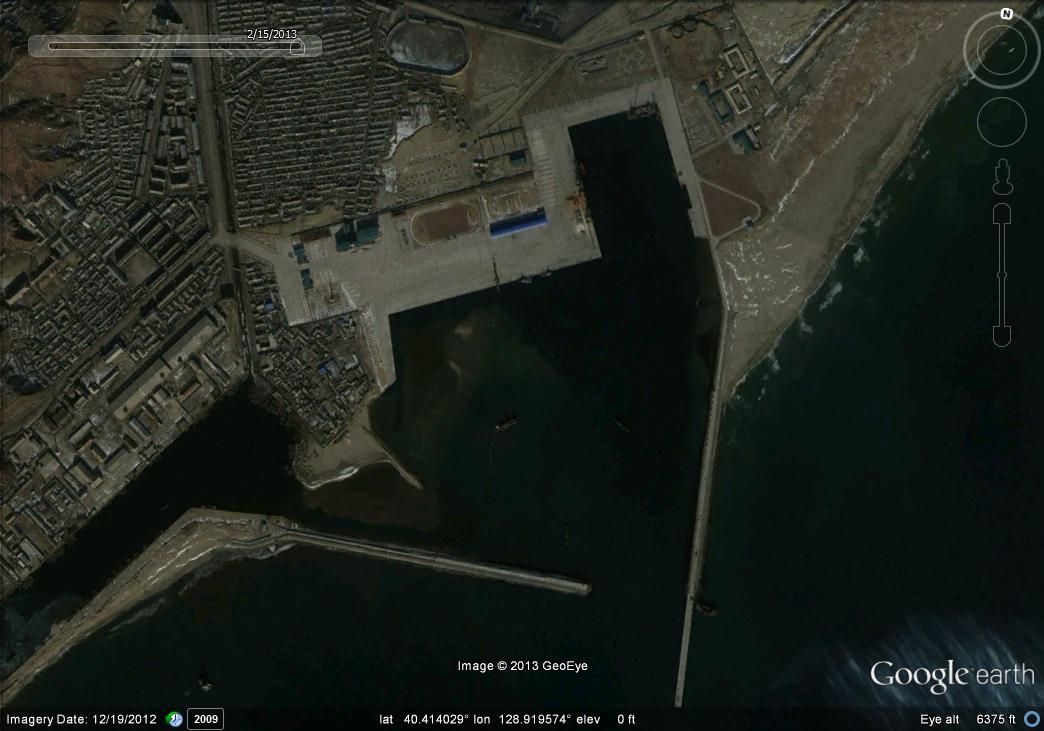
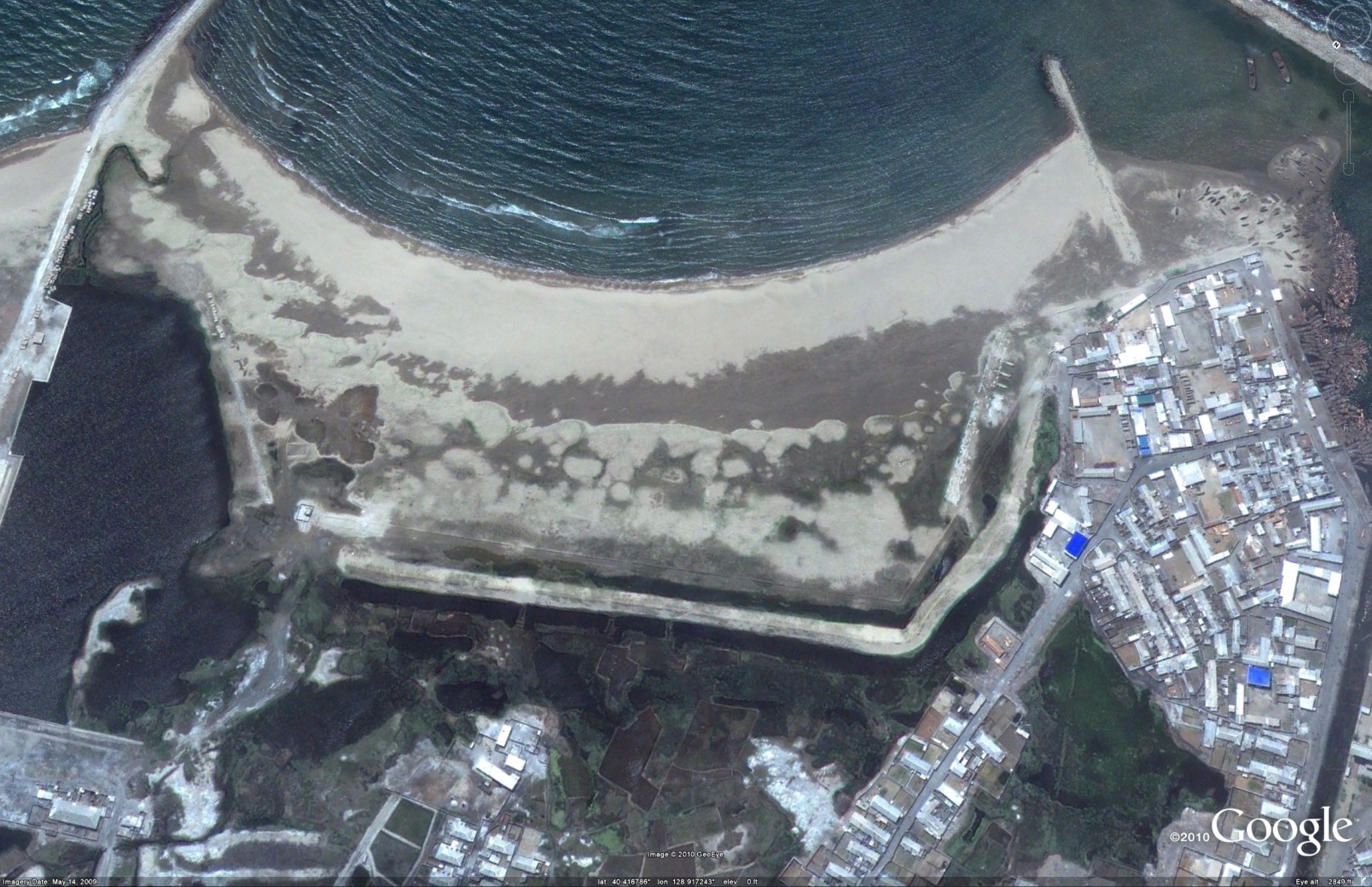
ORIGINAL POST (2010-12-9): On December 2, KCNA announced that Kim Jong-il visited the port in Tanchon County, South Hamgyong County (40.412522°, 128.917731°) where he gave guidance on the port’s reconstruction.
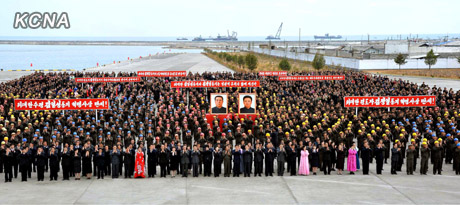
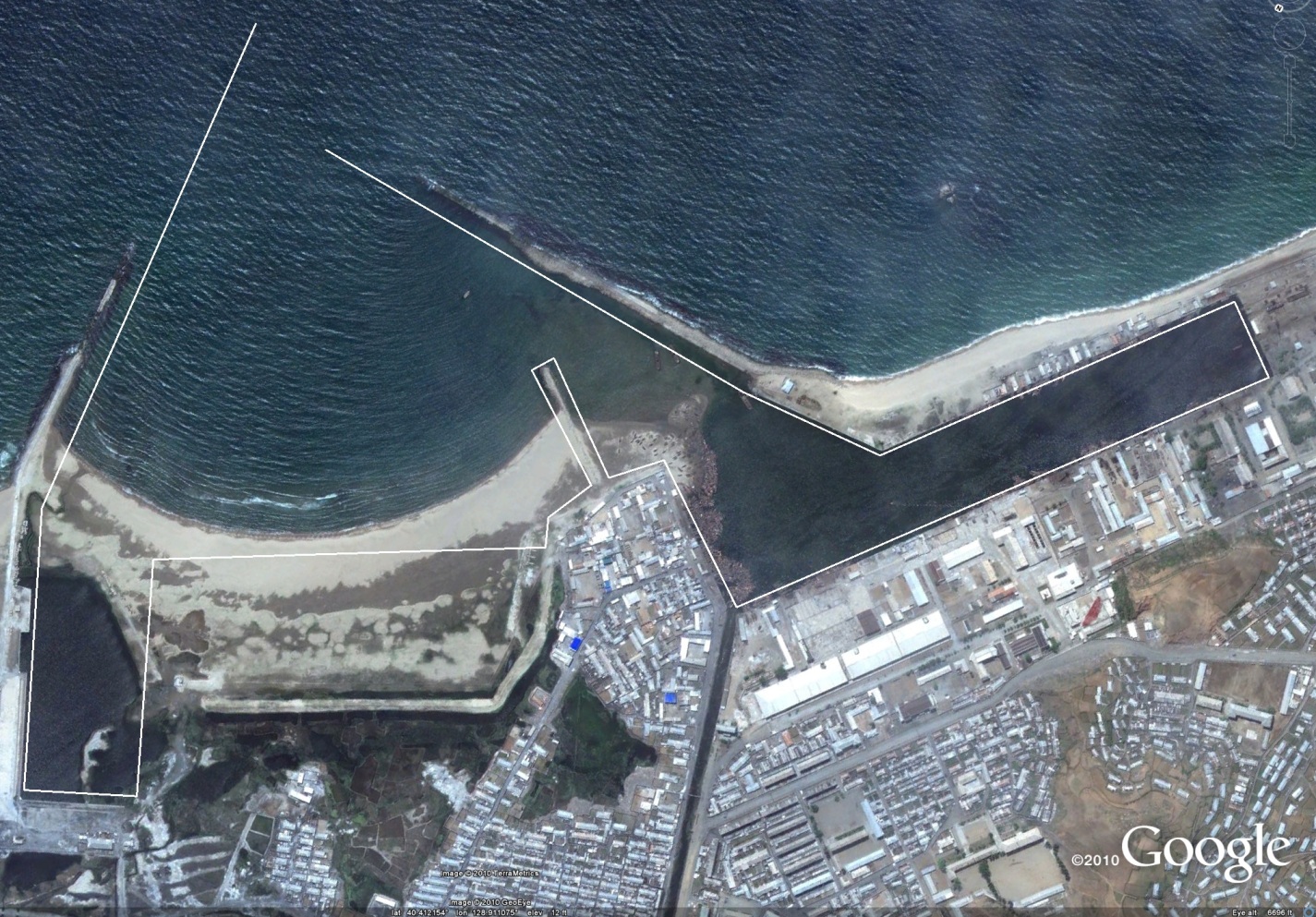
Judging by the satellite imagery of the area on Google Earth, it appears that the project had already begun by May 13, 2009, where we can see concrete blocks ready to be used to extend the jettys (breakwaters). I have outlined the proposed port project on Google Earth imagery below and provided a picture of the completed project from KCTV:
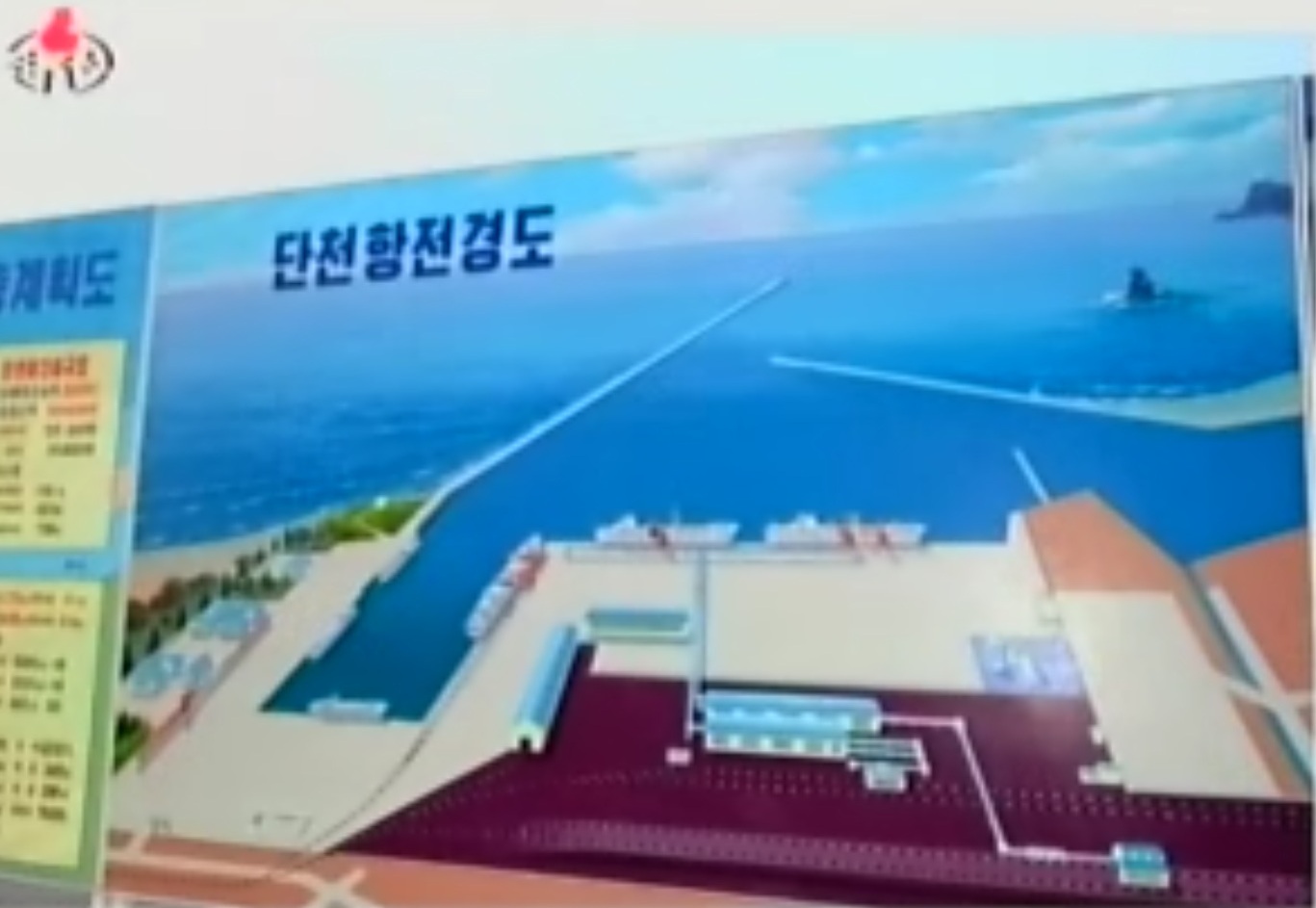
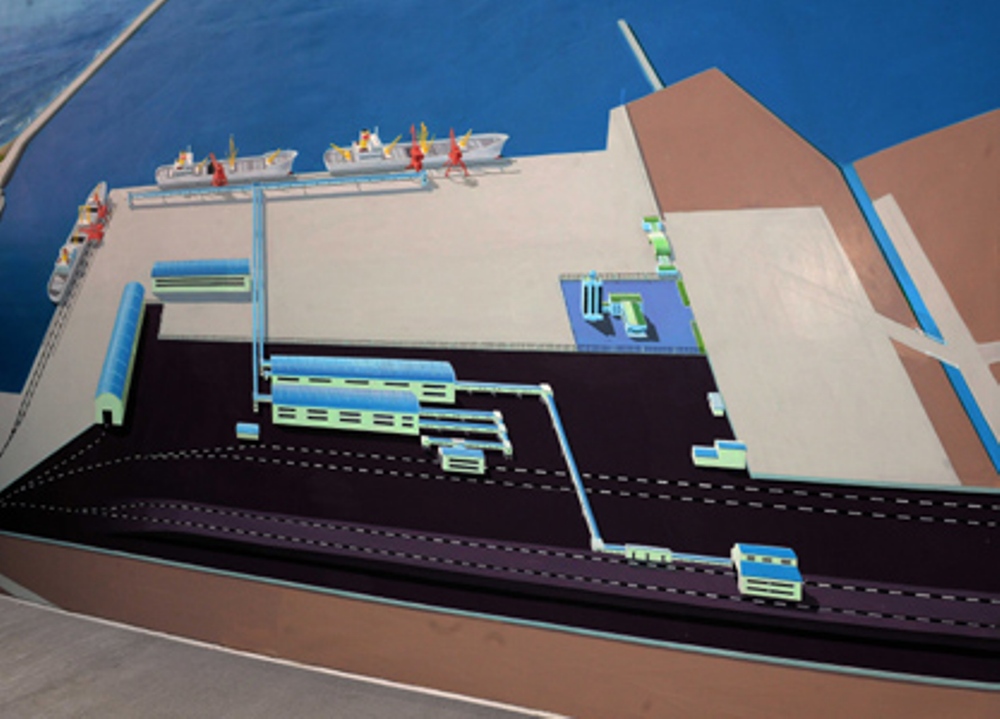
After the jettys are extended, the major construction work and dredging can begin. Below are images of the port’s main construction site as it appears on Google Earth and a prediction of the project’s conclusion from KCNA:
It appears from the picture that the port will be connected to the railway system—likely via the nearby Tanchon Smeltery and Magnesia Plant (both recently renovated) whose products will probably be exported from the port.
Tanchon is also home to the DPRK’s Komdok and Taehung Youth Hero Mines (among others). As is well known to readers, raw materials exports are the DPRK’s most significant (legal and transparent) source of hard currency. According to Yonhap’s North Korea Handbook 2002:
Geomdeok [Komdok] Mine is a special company in Bonsan-dong, Dancheon, South Hamgyeon Province, and is very famous for about 300 million tons of deposited leads and zincs. This mine annually produces 52,000 tons of lead, 124,000 tons of zinc, both of which account for 47% of total production in North Korea, and more than twice as much as the production of Eunpa Mine, North Korea’s second largest mine, in Eunpa-gun North Hwanghae Province. Concentrates of lead and zinc produced from Geomdeok Mine are processed into electric zinc at Dancheon refinery. Opened in 1932, this mine produces 14,200 tons of raw ore annually with three ore dressing plants. Annual production capacity can reach up to 11 million tons. The first dressing plant was completed in July 1953, near the end of the Korean War. It now processes a million tons of ore a year. The second dressing plant was opened with a production capacity of 3,200 tons of ore. The third one constructed in September 1983 can process 10 million tons of ore.
Rice prices in North Korean markets have fallen dramatically after the authorities increased levels of food distribution in major urban areas like Pyongyang and Sinuiju, part of state policy of “normalizing” public distribution. Most people are undecided about the policy, but the reality is that grain has been provided by the state both last month and into this, and this is having an effect on market grain prices.
A Pyongyang source told Daily NK on the 21st, “There was five days of distribution in the first part of last month and ten days in the last part, then a further five days at the start of this month, so rice prices fell. The authorities are saying that they are going to give ten days of distribution per month until September, then normalize it completely after that.”
Ten days of distribution at North Korea’s own mandated levels means 4.5kg for workers and a further 2kg for dependent family members.
“When they first heard about [the policy of distribution normalization] they didn’t believe it, but after getting fifteen days distribution last month and another five days this, people are wondering whether this time it could be different,” the source said. “Even last month most people said ‘this will only last for this month,’ but now they have done it this month as well the number of expectant people is rising.”
The source also revealed data on the drop in market grain prices, saying that at one point the price of rice in Pyongyang had declined from 6500-7000won/kg, the approximate price point since the start of the year, to 4500won. “Although it has since climbed back up through the 5000won barrier, it is holding steady,” she added.
However, “From the middle part of April the price started slowly rising again,” she went on, conjecturing, “If distribution is achieved next month as well then it should stay below 6000won, perhaps even staying at around 4000-5000won.”
Aware that Pyongyang is a unique case in the North Korean context, Daily NK has also been checking conditions in other parts of the country, including along the Sino-North Korean border, and has learned that there has been distribution in the North Pyongan Province city of Sinuiju, the Yangkang Province city of Hyesan, and Heoiryeong and Chongjin in North Hamkyung Province, raising the possibility, which sources have echoed, that distribution is occurring nationwide. All the areas checked by Daily NK have also seen rice prices falling sharply thanks to the state distribution.
One Sinuiju-based source explained the situation there, saying, “As far as I know, the official policy of normalizing distribution is not just for our region but all other regions, too. They recently gave us ten days of rice here, so the price in the jangmadang (market) has fallen below 5000won.”
Sources report that between April 14 and 17 the price of rice has fallen to 5400won in Hyesan, 5100won in Hoiryeong, 5200won in Chongjin, and 5000won in Saebyeol County.
A source from Chongjin explained, “On or around April 10th it was selling for 4800won, but has since gone back over 5000won. They have given distribution but exchange rates are not falling, so if distribution ceases at any point, prices will have to rise again.” The same source noted, however, that in Hyesan prices fell, but when the authorities then stopped importing rice from China, they rose again, reaching 6400won. “Rumor has it that they will allow imports again,” the source noted, “but nobody knows when so prices remain high.”
Read the full story here:
Rice Prices Fall on State Distribution
Daily NK
Kim Yong Hun
2013-4-21
On March 31, KCNA reported on the recent plenary meeting of the Korean Worker’s Party:
The historic March, 2013 plenary meeting of the Central Committee of the Workers’ Party of Korea took place at the building of the WPK Central Committee, supreme staff of the Korean revolution, on Sunday.
First Secretary of the WPK Kim Jong Un guided the meeting.
Present at the meeting were members and alternate members of the WPK Central Committee and members of the Central Auditing Commission of the WPK.
Present there as observers were senior officials of ministries, national institutions, provincial, city and county committees of the WPK, complexes, major munitions factories and enterprises.
The participants paid silent tribute to President Kim Il Sung and leader Kim Jong Il.
Taken up for discussion at the meeting were the following agenda items “1. On tasks of our Party on bringing about a decisive turn in accomplishing revolutionary cause of Juche as required by the present situation and the developing revolution”, “2. On personnel affairs issue to be submitted to the 7th Session of the 12th Supreme People’s Assembly” and “3. On organizational matter”.
Kim Jong Un made a report and concluding speech on the first agenda item.
The plenary meeting set forth a new strategic line on carrying out economic construction and building nuclear armed forces simultaneously under the prevailing situation and to meet the legitimate requirement of the developing revolution.
This line is a brilliant succession and development onto a new higher stage of the original line of simultaneously developing economy and national defence that was set forth and had been fully embodied by the great Generalissimos.
It was stressed at the meeting that the party’s new line is not a temporary countermeasure for coping with the rapidly changing situation but a strategic line to be always held fast to, in the supreme interests of the Korean revolution.
The nuclear weapons of Songun Korea are not goods for getting U.S. dollars and they are neither a political bargaining chip nor a thing for economic dealings to be presented to the place of dialogue or be put on the table of negotiations aimed at forcing the DPRK to disarm itself.
The DPRK’s nuclear armed forces represent the nation’s life which can never be abandoned as long as the imperialists and nuclear threats exist on earth. They are a treasure of a reunified country which can never be traded with billions of dollars.
Only when the nuclear shield for self-defence is held fast, will it be possible to shatter the U.S. imperialists’ ambition for annexing the Korean Peninsula by force and making the Korean people modern slaves, firmly defend our ideology, social system and all other socialist treasures won at the cost of blood and safeguard the nation’s right to existence and its time-honored history and brilliant culture.
When the party’s new line is thoroughly carried out, the DPRK will emerge as a great political, military and socialist economic power and a highly-civilized country which steers the era of independence.
The meeting set forth tasks for carrying out the new line and ways for doing so.
All the officials, party members and other people should wage bold offensive and all-people decisive battle with faith in sure victory and strong determination and thus make the flame of miracle and innovation sweep all fields of national economy.
The pilot fields of the national economy, the basic industrial fields should be drastically developed and production be increased to the maximum. Forces should be directed to agriculture and light industry, key fields in building an economic power to improve and put on a stable basis the people’s living standard at the earliest possible date.
The self-reliant nuclear power industry should be developed and the work for developing light water reactor be dynamically promoted to actively contribute to easing the strain on the electricity problem of the country.
Spurs should be given to the development of space science and technology and more advanced satellites including communications satellites be developed and launched.
The country’s economy should be shifted into knowledge-based economy and the foreign trade be made multilateral and diversified and investment be widely introduced.
The economic guidance shall be fundamentally improved as required by the new situation and Korean-style advantageous economic management methods be completed by embodying the Juche idea.
The DPRK’s possession of nukes should be fixed by law and the nuclear armed forces should be expanded and beefed up qualitatively and quantitatively until the denuclearization of the world is realized.
The People’s Army should perfect the war method and operation in the direction of raising the pivotal role of the nuclear armed forces in all aspects concerning the war deterrence and the war strategy, and the nuclear armed forces should always round off the combat posture.
As a responsible nuclear weapons state, the DPRK will make positive efforts to prevent the nuclear proliferation, ensure peace and security in Asia and the rest of the world and realize the denuclearization of the world.
Institutions in charge of security and safeguard, judicial and prosecution and people’s security and the Korean People’s Internal Security Forces should resolutely foil the vicious moves of the imperialist reactionaries and class enemies, devotedly defend the party, social system and people and surely guarantee the new line of the party with arms and by law.
The party and working people’s organizations and power bodies should increase their militant function and role in every way in the struggle for implementing the party’s line.
The meeting entrusted the Presidium of the SPA and the Cabinet with the matters of taking legal, administrative and technical measures for implementing the tasks.
At the meeting a decision on the first agenda item “On carrying out economic construction and building nuclear armed forces simultaneously and thus bringing earlier the final victory in the cause of building a thriving socialist nation” was adopted with unanimous approval.
The second agenda item, personal affairs issue to be submitted to the 7th Session of the 12th SPA, was discussed and decided at the meeting.
The meeting also dealt with an organizational matter, its third agenda item.
Members of the Presidium of the Political Bureau of the WPK Central Committee, members and alternate members of the Political Bureau were recalled and new ones were elected to fill vacancies.
Pak Pong Ju was elected to fill a vacancy of a member of the Political Bureau of the WPK Central Committee.
Hyon Yong Chol, Kim Kyok Sik and Choe Pu Il were elected to fill vacancies of alternate members of the Political Bureau of the WPK Central Committee.
Members and alternate members of the WPK Central Committee were recalled and new ones were elected to fill vacancies.
Upon authorization of Kim Jong Un, Paek Kye Ryong was appointed as director of the Light Industrial Department of the WPK Central Committee and Yun U Chol as editor-in-chief of Rodong Sinmun, organ of the WPK Central Committee.
Members of the Central Auditing Commission of the WPK were also recalled and new ones were elected to fill vacancies.
Central Committee of the Workers’ Party of Korea Stresses Development of Agricultural, Light, and Nuclear Industries
Institute for Far Eastern Studies (IFES)
2013-4-4
The Korean Central News Agency (KCNA) reported on March 31 that a plenary meeting of the Central Committee of the ruling Workers’ Party of Korea was held. At the meeting, a new strategic line was announced to have been set, which called for building a stronger economy and nuclear arsenal. This meeting is drawing attention as it is suspected that Pyongyang will pursue a new economic policy.
The news described the new strategic line as, “most revolutionary and people oriented policy for the construction of a powerful socialist nation by consolidating defense capacity through development of defensive nuclear weapons and economic construction.”
It stressed that this policy is significant as a “creative and parallel policy for defense and economy continuing the policies of Kim Il Sung and Kim Jong Il, which must be adopted as a permanent strategy.”
At the plenary meeting, the main agendas for the parallel policy of economy and defense were announced as: 1) Improvement of the production of people’s economy and capacity enhancement for agricultural and light industries to stabilize prices to improve the lives of the people; 2) development of self-reliant nuclear power industry and light water reactors; 3) development and launch of more satellites including communication satellites through advancement in space science and technology; 4) transition to knowledge economy and diversification of foreign trade to vitalize foreign investments; and 5) establish legislation to be recognized as a nuclear state and develop nuclear arsenal both in quantity and quality until denuclearization is realized worldwide.
At the plenary, the new parallel policy was commended, “The supremacy of the policy is demonstrated by expanding capability in war deterrence and national defense without increasing defense budget and enabled concentration on economic development and improvement of the lives of the people.”
The statement released by the KCNA stated that the plenary meeting’s emphasis on transition to knowledge economy and diversification of foreign trade as the main tasks and appears to be pursuing a “fundamental improvement in economic leadership.”
In addition, the plenary assigned the presidium of the Supreme Peoples’ Assembly and the Cabinet to serve as the economic control tower to oversee the future projects decided at the plenary meeting.
North Korea is continuing to place emphasis on light and agricultural industries. The Kim Jong Un regime entered its second year. The leader was reported to have attended the light industry conference, which was held for the first time in ten years and underscored the importance of concentrating on development of the capacity of light industry.
The new Korean line, 병진 (Pyongjin, Byungjin) is the simultaneous development of nuclear weapons and the economy. Learn more about it here.
Following the central committee plenary meeting, the 7th Session of the 12th Supreme People’s Assembly was held. According to KCNA:
The Seventh Session of the 12th Supreme People’s Assembly (SPA) of the DPRK took place at the Mansudae Assembly Hall Monday.
Kim Jong Un, first secretary of the Workers’ Party of Korea, first chairman of the National Defence Commission of the DPRK and supreme commander of the Korean People’s Army, was present at the session.
Present there were deputies to the SPA.
Also present there as observers were officials of party, armed forces and power bodies, public organizations, ministries and national institutions and those in the fields of science, education, literature and art, public health and media.
All the participants observed a moment’s silence in memory of President Kim Il Sung and leader Kim Jong Il in humblest reverence.
The session decided the following agenda items of the Seventh Session of the 12th SPA of the DPRK:
1. On amending and supplementing some contents of the Socialist Constitution of the DPRK
2. On adopting the DPRK Law on the Kumsusan Palace of the Sun
3. On adopting the ordinance of the SPA of the DPRK “On Consolidating the Position of Nuclear Weapons State for Self-Defence”
4. On adopting the DPRK Law on Developing Space
5. On adopting the decision of the SPA of the DPRK “On Setting up the DPRK State Space Development Bureau”
6. On the work of the DPRK Cabinet for Juche 101 (2012) and its tasks for Juche 102 (2013)
7. On the review of the fulfillment of the DPRK’s state budget for Juche 101 (2012) and state budget for Juche 102 (2013)
8. Organizational matter
The session discussed the first and second agenda items.
Deputy Kim Yong Nam, president of the Presidium of the DPRK SPA, made a report on amendment and supplement to some contents of the Socialist Constitution of the DPRK and on adopting the law on the Kumsusan Palace of the Sun.
Then followed speeches on the first and second agenda items.
Deputy Kim Ki Nam, secretary of the WPK Central Committee, spoke on behalf of the WPK, Deputy Choe Ryong Hae, director of the General Political Bureau of the KPA, on behalf of the KPA and Deputy Jon Yong Nam, chairman of the C.C., the Kim Il Sung Socialist Youth League, on behalf of the youth.
The speakers fully supported and approved of deliberation and adoption of the draft amendment and supplement to the Socialist Constitution of the DPRK and the law on the Kumsusan Palace of the Sun at the current SPA session reflecting the unanimous feelings of all party members, service personnel and youth across the country.
The ordinances of the SPA of the DPRK “On Amending and Supplementing Some Contents of the Socialist Constitution of the DPRK” and “On Adopting the DPRK Law on the Kumsusan Palace of the Sun” were adopted at the session with the approval of all deputies.
The session discussed the third, fourth and fifth agenda items.
The ordinances of the SPA of the DPRK “On Consolidating the Position of Nuclear Weapons State for Self-Defence” and “On Adopting the DPRK Law on Developing Space” and the decision of the SPA of the DPRK “On Setting Up the DPRK State Space Development Bureau” were adopted at the session with the approval of all deputies.
Deputy Choe Yong Rim, premier of the Cabinet, made a report on the sixth agenda item.
Deputy Choe Kwang Jin, minister of Finance, made a report on the seventh agenda item.
Then followed speeches on the sixth and seventh agenda items. Written speeches were presented at the session.
The speakers noted that the Cabinet work and the fulfillment of the state budget for last year were correctly reviewed and summed up, clear tasks of the Cabinet were set forth to meet the requirements of the general offensive to open an epochal phase in building an economic power at the final stage of the all-out action against the U.S. and the state budget was correctly shaped. They expressed full support and approval of them.
They expressed their determination to reenergize the overall economy of the country, step up the grand advance for improving the standard of people’s living to make loud shouts of hurrah for the Workers’ Party and socialism heard this year marking the 65th anniversary of the DPRK and the 60th anniversary of the victory in the Fatherland Liberation War, true to the historic New Year Address of Kim Jong Un and the decision of the March, 2013 plenary meeting of the WPK Central Committee.
The decision of the SPA of the DPRK “On Approval of the Report on the Work of the DPRK Cabinet and the Review of the Fulfillment of the State Budget for Juche 101 (2012)” and the ordinance of the SPA of the DPRK “On the DPRK’s State Budget for Juche 102 (2013)” were adopted at the session with the approval of all deputies.
The session discussed the organizational matter.
At the session Deputy Choe Yong Rim was recalled from the post of premier of the DPRK Cabinet and Deputy Pak Pong Ju was elected premier of the DPRK Cabinet at the proposal of the WPK Central Committee.
Choe Yong Rim was elected honorary vice-president of the Presidium of the DPRK SPA.
Deputies Kim Jong Gak and Ri Myong Su were recalled from the posts of member of the DPRK National Defence Commission (NDC) due to the transfer to other jobs.
Deputies Kim Kyok Sik and Choe Pu Il were elected members of the DPRK NDC to fill vacancies at the proposal of the WPK Central Committee and the WPK Central Military Commission.
Deputy Thae Hyong Chol was recalled from the post of secretary general of the Presidium of the DPRK SPA and Deputy Hong Son Ok was elected secretary general of the Presidium of the DPRK SPA.
Some members of the Cabinet were relieved of their posts and appointed at the session.
Deputy Pak Pong Ju, premier of the DPRK Cabinet, took an oath at the SPA.
KCNA also issued several reports that stemmed from the SPA meeting:
Report on Adopting Draft Amendment and Supplement to Socialist Constitution and Law on Kumsusan Palace of Sun
Pyongyang, April 1 (KCNA) — Kim Yong Nam, president of the Presidium of the Supreme People’s Assembly, made a report on adopting the draft amendment and supplement to the Socialist Constitution of the DPRK and the law on the Kumsusan Palace of the Sun.
According to the report, the draft amendment and supplement to the Socialist Constitution and the law on the Kumsusan Palace of the Sun to be submitted to the session for discussion will legalize the plan and intention of the Workers’ Party of Korea to fix by law the shining achievements made in accomplishing the cause of perpetuating the memory of the leaders and complete it on a new higher stage.
To be supplemented to the preface of the Socialist Constitution is the sentence which says that the Kumsusan Palace of the Sun where President Kim Il Sung and leader Kim Jong Il lie in state is a grand edifice for the immortality of the leaders, a symbol of the dignity of the whole Korean nation and its eternal sacred temple.
The law on the Kumsusan Palace of the Sun specifies that its noble mission is to preserve and glorify forever the palace, which is the supreme temple of Juche, as the eternal temple of the sun of the entire Korean nation.
The law stipulates that Kim Il Sung and Kim Jong Il will be held in high esteem forever as in their lifetime at the Kumsusan Palace of the Sun and that it is the obligation of all the Koreans to regard the Palace as a symbol of dignity and a great pride of the nation.
It also specifies the state duty to spruce up the Palace in a sublime and perfect way with the state, all-people and nationwide efforts and devotedly safeguard the Palace in every way so that no one can violate.
Also stipulated in the law are matters for carrying out the work of eternally preserving the Palace as the most important state work with consistency, organizing the committee for the eternal preservation of the Palace and preserving for photos, train coaches, cars, boat and other relics and orders which represent the noble lives of the great Generalissimos.
Orders were also set so that Korean people, overseas Koreans and foreigners can pay respects to the great Generalissimos at the Kumsusan Palace of the Sun.
Also mentioned in the law are the matters of establishment of special sanctuary of the Palace for its protection and management as well as the management of buildings in the premise of the palace, park, arboretum, outdoor lighting and lighting facilities and orders concerning the operation of the plaza and the park of the Palace.
It was specified in the law that electricity, facilities, materials and other supplies needed for the Palace shall be planned separately and be provided without fail on a top priority basis. The law also set the duty to be fulfilled by relevant institutions to strictly supervise and control on a regular basis the work for safeguarding, eternally preserving and providing the conditions for the management and operation of the Palace.
The reporter said that the law on the Kumsusan Palace of the Sun is the unique code for the immortality of the leaders, adding that it is the biggest honor for the army and people of the DPRK to have the legal weapon for the immortality of the leaders.
The adoption of the law will serve as a historic occasion for defending and further glorifying the idea on perpetuating the memory of the leaders clarified by the dear respected Kim Jong Un, he stressed.
The reporter said that the Presidium of the Supreme People’s Assembly of the DPRK submits the draft amendment and supplement to the Socialist Constitution and the draft law on the Kumsusan Palace of the Sun to the SPA session for discussion according to Article 95 of the Socialist Constitution.
And…
DPRK’s Law on Kumsusan Palace of Sun Adopted
Pyongyang, April 1 (KCNA) — The DPRK’s Law on the Kumsusan Palace of the Sun was adopted.
The ordinance of the DPRK Supreme People’s Assembly on it was promulgated Monday.
The Kumsusan Palace of the Sun where President Kim Il Sung and leader Kim Jong Il lie in state is the
eternal temple of the sun of the whole Korean nation.
The ordinance says that the SPA decides to adopt this law to eternally preserve and glorify forever the
Kumsusan Palace of the Sun as a grand edifice for the immortality of the leaders symbolic of Kim Il Sung’s and Kim Jong Il’s Korea.
And…
Law on Consolidating Position of Nuclear Weapons State Adopted
Pyongyang, April 1 (KCNA) — A law on consolidating the position of nuclear weapons state for self-defence was adopted in the DPRK.
An ordinance of the Supreme People’s Assembly of the DPRK in this regard was promulgated on Monday.
The ordinance said as follows:
The DPRK is a full-fledged nuclear weapons state capable of beating back any aggressor troops at one strike, firmly defending the socialist system and providing a sure guarantee for the happy life of the people.
Having an independent and just nuclear force, the DPRK put an end to the distress-torn history in which it was subject to outside forces’ aggression and interference and could emerge a socialist power of Juche which no one dares provoke.
The Supreme People’s Assembly of the DPRK decides to consolidate the position of the nuclear weapons state as follows:
1. The nuclear weapons of the DPRK are just means for defence as it was compelled to have access to them to cope with the ever-escalating hostile policy of the U.S. and nuclear threat.
2. They serve the purpose of deterring and repelling the aggression and attack of the enemy against the DPRK and dealing deadly retaliatory blows at the strongholds of aggression until the world is denuclearized.
3. The DPRK shall take practical steps to bolster up the nuclear deterrence and nuclear retaliatory strike power both in quality and quantity to cope with the gravity of the escalating danger of the hostile forces’ aggression and attack.
4. The nuclear weapons of the DPRK can be used only by a final order of the Supreme Commander of the Korean People’s Army to repel invasion or attack from a hostile nuclear weapons state and make retaliatory strikes.
5. The DPRK shall neither use nukes against the non-nuclear states nor threaten them with those weapons unless they join a hostile nuclear weapons state in its invasion and attack on the DPRK.
6. The DPRK shall strictly observe the rules on safekeeping and management of nukes and ensuring the stability of nuclear tests.
7. The DPRK shall establish a mechanism and order for their safekeeping and management so that nukes and their technology, weapon-grade nuclear substance may not leak out illegally.
8. The DPRK shall cooperate in the international efforts for nuclear non-proliferation and safe management of nuclear substance on the principle of mutual respect and equality, depending on the improvement of relations with hostile nuclear weapons states.
9. The DPRK shall strive hard to defuse the danger of a nuclear war and finally build a world without nukes and fully support the international efforts for nuclear disarmament against nuclear arms race.
10. The related institutions shall take thorough practical steps for implementing this ordinance.
And…
DPRK Law on Developing Space Adopted
Pyongyang, April 1 (KCNA) — The Law on Developing Space was adopted in the DPRK.
The ordinance of the DPRK Supreme People’s Assembly on it was promulgated Monday.
And…
DPRK SPA Decides to Set Up State Space Development Bureau
Pyongyang, April 1 (KCNA) — The DPRK decided to set up the State Space Development Bureau.
The decision of the Supreme People’s Assembly (SPA) of the DPRK promulgated on Monday said:
The DPRK is a full-fledged satellite manufacturer and launcher.
It is an invariable stand of the DPRK to develop the country into a world-class space power by exercising its legitimate right to space development for peaceful purposes.
To step up economic construction and improve the people’s standard of living by radically developing the space science and technology of the country and guide and manage all the space activities of the DPRK in a uniform way, the SPA decides as follows:
1. The DPRK State Space Development Bureau shall be set up.
2. The bureau is a state central institution which guides and manages the supervision and control over the working out of a space development program and its implementation and space development work in a uniform way.
3. The Cabinet of the DPRK and other institutions concerned shall take practical measures to implement this decision.
And…
Work of Cabinet for Last Year and Tasks for This Year
Pyongyang, April 1 (KCNA) — At the 7th Session of the 12th Supreme People’s Assembly held on Monday, Deputy and Premier Choe Yong Rim made a report on the last year’s work of the DPRK Cabinet and this year’s tasks.
According to the report, last year electricity and coal production and the volume of railway freight transport increased amid the endeavors to shore up the four pilot fields of the national economy. Increase was also made in the production of a variety of industrial goods, the report said, and went on:
The Kumsusan Palace of the Sun was remodeled to be the supreme temple of Juche, the National Gifts Exhibition House, Pyongyang Folklore Park, Changjon Street, Rungna People’s Pleasure Park and other big edifices in the era of Songun have been built.
Big industrial projects such as the Huichon Power Station, Tanchon Port, Taedonggang Building Materials Factory were completed and technological updating and modernization of major factories and enterprises in the field of metal, machine, chemical and light industries have been pushed forward, consolidating the material and technological foundation of the national economy.
Satellite Kwangmyongsong 3-2 was successfully manufactured and launched and the third underground nuclear test by the use of smaller and lighter A-bomb of great explosive power was successfully conducted.
The bases for the production of cutting-edge technical goods were built and projects for the development of science and technology have been successfully carried out and the modernization of the information and communications field have been stepped up.
A law on the enforcement of the universal 12-year compulsory education was promulgated. This paved a wide avenue for consolidating the socialist education system and raising the quality of education.
In the field of health care, a telemedicine service has been successfully introduced. The DPRK’s players glorified the honor of the country at major international sports events including the 30th Olympic Games and other signal achievements were made in the field of cultural construction.
The reporter said that this year’s tasks are to realize at an early date the lifetime desire of President Kim Il Sung and leader Kim Jong Il, who devoted their whole lives to putting the country’s economy on the level of a prosperous and powerful country and to making the people live with no more to desire in the world.
According to the report, this year the Cabinet will organize the economic work with a main emphasis on solving issues arising in the people’s living by shoring up the pilot fields, the basic industrial field, consolidating the springboard for building an economic power and concentrating all efforts on agriculture and light industry while regarding coal industry and metal industry as key fields.
It is necessary to increase the production of coal.
Technological updating and modernization of iron works and steel works will be stepped up while improving the bases for the production of Juche iron which have already been built in the field of metal industry. Strict measures for supplying raw materials and fuel should be taken to increase the production of rolled steel more than 3.5 times as compared with last year and thus meet the need for steel.
The field of railway transport will ease strain on transport by consolidating the material and technical foundation of railways.
The grain production plan for this year should be carried out without condition.
The whole country should make efforts for the reclamation of Sepho Tideland and the construction of stock-breeding bases and thus complete the creation of grassland within this year.
The production should be put at a high rate at major chemical factories and the percentage of locally available raw materials should be significantly increased. The production at mines, factories and enterprises in Tanchon area should be increased and exports be boosted to ensure in a responsible manner funds for improving the people’s living standard.
Big efforts should be directed to the construction of dwelling houses. Wonsan area should turn into a world-level resort and tourist destination and living environment and conditions be improved in provinces, cities and counties.
The state investment in the field of science and technology should be increased and the flame of industrial revolution in the new century be raised so as to bring about a decisive turn in building an economic power by dint of science and technology.
Ultra-modern technological goods of high competitiveness should be massively researched and developed. Scientific and technological issues arising in the technological updating and modernization of the national economy should be satisfactorily solved.
The state investment will be increased in education and the preparations for enforcing the universal 12-year compulsory education system be rounded off within this year and fresh progress be made in education, public health, literature, arts, sports and all other fields of cultural construction.
All the fields and units of the national economy should build under a long-term plan export bases for producing second-stage and third-stage processed goods and finished goods of high competitiveness at international markets by relying on locally available resources and indigenous technology. Latest scientific and technological achievements should be positively introduced to increase the varieties of exports and remarkably raise their quality.
Trade should be made diversified and multilateral while conducting a variety of trade activities. The joint venture and collaboration should be actively promoted and the work for setting up economic development zones be pushed forward.
And…
Review of Fulfillment of State Budget for Last Year and State Budget for This Year
Pyongyang, April 1 (KCNA) — Deputy Choe Kwang Jin, minister of Finance, made a report on the review of the fulfillment of state budget for last year and the state budget for this year at the 7th Session of the 12th Supreme People’s Assembly held on Monday.
According to the report, the state budgetary revenue last year was over-fulfilled by 1.3 percent, an increase of 10.1 percent over the previous year.
The plan for local budgetary revenue was carried out at 113.8 percent.
The state budgetary expenditure was implemented at 99.6 percent, an increase of 9.7 percent over that in the previous year.
44.8 percent of the total state budgetary expenditure for the economic development and improvement of people’s living standard was used for funding the building of edifices to be presented to the 100th birth anniversary of President Kim Il Sung, the consolidation of the material and technological foundation of Juche-based, modern and self-supporting economy and the work for face-lifting the country.
38.9 percent of total expenditure was spent for enforcing popular policies and measures for social culture under socialism such as the universal free compulsory education system, free healthcare, social insurance and social security, recuperation and relaxation systems as well as those for development of literature and art and building of a sports power.
Some of the total state budgetary expenditure went to national defence.
According to the report, this year’s state budgetary revenue and expenditure have been shaped in such a way as keeping the overall economy afloat and bringing about a decisive turn in stabilizing and improving the standard of people’s living.
The state budgetary revenue is expected to increase 4.1 percent over that last year.
Out of this, the transaction tax, main source of budgetary revenue, is expected to grow 3.5 percent, the revenue from the profits of state enterprises 6 percent, revenue from the profits of cooperative enterprises 5.3 percent, the revenue from the depreciation 2.8 percent and revenue from real estate rent 3.4 percent.
In the total state budgetary revenue, national budgetary revenue will account for 83 percent and local budgetary revenue 17 percent.
Provinces, cities and counties are envisaged to ensure expenditure with local import and put a huge amount of fund into national budget.
The state budgetary expenditure is expected to grow 5.9 percent over last year.
It was decided to increase expenditure in the field of coal, electricity, metal and railway transport 7.2 percent, the field of agriculture and light industry 5.1 percent, basic investment in capital construction and big overhaul 5.8 percent, the field of science and technology 6.7 percent, the field of education 6.8 percent, the field of public health 5.4 percent, the field of social insurance and security 3.7 percent, the field of sports 6.1 percent and the field of culture 2.2 percent.
Some of the total state budgetary expenditure will go for national defence.
A large amount of educational aid fund and stipends will be sent for the education of Korean children in Japan to promote the development of the democratic national education of the General Association of Korean Residents in Japan.
The reporter called for working hard to glorify this significant year marking the 65th anniversary of the DPRK and the 60th anniversary of the victory in the Fatherland Liberation War as a year of gigantic creation and innovations, in hearty response to the historic New Year Address by Kim Jong Un and the decision made at the March, 2013 plenary meeting of the WPK Central Committee.
Here is what Yonhap had to say about the DPRK’s defense budget:
North Korea is expected to spend 16 percent of its budget on national defense in 2013, up 0.2 percentage point from the year before, the country’s state media said Tuesday.
According to the Rodong Sinmun, an organ of the North’s ruling Workers’ Party, Finance Minister Choe Kwang-jin reported to a meeting of the Supreme People’s Assembly in Pyongyang on Monday that the money is needed to effectively cope with “indiscriminate” provocations by the United States and its followers.
The paper, however, did not disclose the exact size of the defense budget, although South Korea’s unification ministry speculated that last year’s military budget totaled US$910 million.
The proportion of the spending plan compared to the overall budget, is the highest tallied since 1998, according to South Korean analysts.
From 1998 through 2002, the North is estimated to have spent 14.4 percent to 14.5 percent of its annual budget on defense, with numbers going up and being fixed at 15.8 percent in the 2007-2012 period, they said.
Additional information:
1. Here and here is KCTV footage of the SPA meeting.