Archive for the ‘DPRK organizations’ Category

KPA Journal No. 1, Vol. 10, 11, and 12 published

Monday, December 20th, 2010

Joseph Bermudez, military analyst for Jane’s Intelligence Review and author of The Armed Forces of North Korea, has published the 10th, 11th, and 12th issues of his very fascinating KPA Journal.

You can download them all below (PDF):

KPA Journal No. 1, Vol. 10 -Articles include: “KPA Lessons Learned from Foreign Conflicts 1960-Present, Part II,” “Ri Chun Hui, the Voice of KCTV,” by Michael Madden, “Kim Jong-iI Issues Order on Promoting Military Ranks,” and “Vice Marshal Jo Myong Rok Dies,” by Michael Madden.

KPA Journal No. 1, Vol. 11 – Yonpyong Island shelling Part I

KPA Journal No. 1, Vol. 12 – Yonpyong Island shelling Part II

Mr. Bermudez also published some declassified documents which are all available here.

Previous issues of KPA Journal can be found here.

Share

Daedong Credit Bank Press Release

Monday, December 20th, 2010

On November 18, 2010, the US Treasury Department issued the following press release:

Treasury Designates Key Nodes of the Illicit Financing Network of North Korea’s Office 39

WASHINGTON – The U.S. Department of the Treasury today designated Korea Daesong Bank and Korea Daesong General Trading Corporation pursuant to Executive Order (E.O.) 13551 for being owned or controlled by Office 39 of the Korean Workers’ Party.  Office 39 is a secretive branch of the government of the Democratic People’s Republic of Korea (North Korea) that provides critical support to North Korean leadership in part through engaging in illicit economic activities and managing slush funds and generating revenues for the leadership. Office 39 was named in the Annex to E.O. 13551, issued by President Obama on August 30, 2010, in response to the U.S. government’s longstanding concerns regarding North Korea’s involvement in a range of illicit activities, many of which are conducted through government agencies and associated front companies. Korea Daesong Bank is involved in facilitating North Korea’s illicit financing projects, and Korea Daesong General Trading Corporation is used to facilitate foreign transactions on behalf of Office 39.

“Korea Daesong Bank and Korea Daesong General Trading Corporation are key components of Office 39′s financial network supporting North Korea’s illicit and dangerous activities,” said Under Secretary for Terrorism and Financial Intelligence Stuart Levey.  “Treasury will continue to use its authorities to target and disrupt the financial networks of entities involved in North Korean proliferation and other illicit activities.”

E.O. 13551 targets for sanctions individuals and entities facilitating North Korean trafficking in arms and related materiel; procurement of luxury goods; and engagement in certain illicit economic activities, such as money laundering, the counterfeiting of goods and currency, bulk cash smuggling and narcotics trafficking. As a result of today’s action, any assets of the designated entities that are within U.S. jurisdiction are frozen and U.S. persons are prohibited from conducting financial or commercial transactions with these entities.

You can learn more about the Treasury’s press release here.

Here is the US Treasury Department’s new North Korea resource page.

In response, the Daedong Credit Bank issued the following press release:

FOR IMMEDIATE RELEASE:

US Treasury Press Release 18th November 2010

London UK/Pyongyang DPRK, December 20th 2010

Daedong Credit Bank (DCB) has noted the press release of 18th November 2010 by the US Treasury and makes the following comments:

1.    Korea Daesong Bank (KDB) is a 30% shareholder in DCB.  DCB is not, and never has been, aware of any activity by KDB which is in breach of any of its obligations, domestic or international.  In particular, DCB is not aware of KDB having acted in breach of any sanctions.  DCB is not aware of any cause of concern about the conduct of KDB.

2.    KDB has no executive control of DCB.

3.    DCB is majority owned by overseas investors and is foreign-managed.

4.    DCB does not act and has never acted in breach of any of its domestic or international obligations.  DCB acts in a manner consistent with domestic and international law.

5.    DCB is apolitical and promotes foreign investment in the DPRK as a positive development.

The Daedong Credit Bank looks forward to playing a significant part in facilitating normal commercial relationships between the DPRK and the international business community.

About Daedong Credit Bank

Daedong Credit Bank is a joint venture retail bank based in Pyongyang. It was established in 1995 as “Peregrine Daesong Development Bank”. The Bank underwent a change of name and foreign ownership in 2000.

Daedong Credit Bank is the first, by fifteen years, foreign majority held bank in the DPRK. DCB considers itself a flagship successful joint venture in the DPRK, and a key part of the infrastructure needed to assist the foreign-invested ventures, which drive the country’s economic reforms.

The bank’s principal function is to offer normal “high street” banking facilities in hard currency to; foreign companies, joint ventures, international relief agencies and individuals doing legitimate business in the DPRK.

Daedong Credit Bank was the first bank in the DPRK to introduce, and vigorously implement, a comprehensive set of anti-money laundering procedures. DCB’s anti-money laundering procedure manual was introduced seven years ago, and subsequently updated based on anti-money laundering guidelines provided by the Asian Development Bank. The manual has been sent to, and accepted by, DCB’s international correspondent banks.

Daedong Credit Bank also maintains strict procedures for the detection and rejection of counterfeit bank notes; it uses regularly updated note checking machines, and has personnel with over 10 years’ of experience of handling notes. DCB have encountered and impounded the so-called ‘superdollar’ notes, proving that these notes (despite media misconceptions) are not undetectable.

The wealth of experience garnered over Daedong Credit Bank’s 15 years of successful operation is unrivaled.

Daedong Credit Bank has a significantly strong position in relation to the future economic development of the DPRK and, being the oldest established foreign invested commercial bank in the DPRK, it is the intention of the bank to capitalise on these advantages.

CONTACT INFORMATION:

Daedong Credit Bank office address in Pyongyang is:

Daedong Credit Bank
401, Potonggang Hotel
Ansan-dong
Pyongchon District
Pyongyang
Democratic People’s Republic of Korea

Phone Switchboard  +850 2 381 2228/9    ext 401
Direct line     +850 2 381 4866
Mobile          +850 193 801 8400 *
*Note, the mobile number may not be obtainable from certain countries (eg UK and Hong Kong).
Corporate Website www.daedongcreditbank.com

FOR IMMEDIATE RELEASE:

US Treasury Press Release 18th November 2010

London UK/Pyongyang DPRK, December 20th 2010

Daedong Credit Bank (DCB) has noted the press release of 18th November 2010 by the US Treasury and makes the following comments:

1. Korea Daesong Bank (KDB) is a 30% shareholder in DCB. DCB is not, and never has been, aware of any activity by KDB which is in breach of any of its obligations, domestic or international. In particular, DCB is not aware of KDB having acted in breach of any sanctions. DCB is not aware of any cause of concern about the conduct of KDB.

2. KDB has no executive control of DCB.

3. DCB is majority owned by overseas investors and is foreign-managed.

4. DCB does not act and has never acted in breach of any of its domestic or international obligations. DCB acts in a manner consistent with domestic and international law.

5. DCB is apolitical and promotes foreign investment in the DPRK as a positive development.

The Daedong Credit Bank looks forward to playing a significant part in facilitating normal commercial relationships between the DPRK and the international business community.

About Daedong Credit Bank

Daedong Credit Bank is a joint venture retail bank based in Pyongyang. It was established in 1995 as “Peregrine Daesong Development Bank”. The Bank underwent a change of name and foreign ownership in 2000.

Daedong Credit Bank is the first, by fifteen years, foreign majority held bank in the DPRK. DCB considers itself a flagship successful joint venture in the DPRK, and a key part of the infrastructure needed to assist the foreign-invested ventures, which drive the country’s economic reforms.

The bank’s principal function is to offer normal “high street” banking facilities in hard currency to; foreign companies, joint ventures, international relief agencies and individuals doing legitimate business in the DPRK.

Daedong Credit Bank was the first bank in the DPRK to introduce, and vigorously implement, a comprehensive set of anti-money laundering procedures. DCB’s anti-money laundering procedure manual was introduced seven years ago, and subsequently updated based on anti-money laundering guidelines provided by the Asian Development Bank. The manual has been sent to, and accepted by, DCB’s international correspondent banks.

Daedong Credit Bank also maintains strict procedures for the detection and rejection of counterfeit bank notes; it uses regularly updated note checking machines, and has personnel with over 10 years’ of experience of handling notes. DCB have encountered and impounded the so-called ‘superdollar’ notes, proving that these notes (despite media misconceptions) are not undetectable.

The wealth of experience garnered over Daedong Credit Bank’s 15 years of successful operation is unrivalled.

Daedong Credit Bank has a significantly strong position in relation to the future economic development of the DPRK and, being the oldest established foreign invested commercial bank in the DPRK, it is the intention of the bank to capitalise on these advantages.

CONTACT INFORMATION:

Daedong Credit Bank office address in Pyongyang is:

Daedong Credit Bank
401, Potonggang Hotel
Ansan-dong
Pyongchon District
Pyongyang
Democratic People’s Republic of Korea

Phone

Switchboard +850 2 381 2228/9 ext 401
Direct line
+850 2 381 4866
Mobile
+850 193 801 8400 *
*Note, the mobile number may not be obtainable from certain countries (eg UK and Hong Kong).

Corporate Website www.daedongcreditbank.com

#004

Share

Daily NK reports agricultural increase in DPRK

Sunday, December 19th, 2010

According to the Daily NK:

Even though some of North Korea’s farmland including much around Shinuiju was flooded this year, in other provinces food production has been greater than in previous years, according to sources.

One source from South Pyongyang Province told The Daily NK yesterday, “There have been heavy rains and rivers overflowing in some places this year, but the rice crop is better than last year’s. It seems to be thanks to imported fertilizer from China.”

The Food and Agriculture Organization (FAO) and World Food Program (WFP) also reported last month that North Korea’s grains yields had increased by 3 percent over last year, to 4.48 million tons in total.

The source explained, “In April and May this year fertilizer came just in time, so it helped with the farming. Since the situation in that period decides the number of ears of grain, if you don’t provide fertilizer production can be halved.”

Another source from Yangkang Province agreed, saying, “This year in the jangmadang in Hyesan, 50 kilos of fertilizer was selling for 220 Yuan. The price was quite expensive, but people used it even on their private fields because it was so beneficial for production.”

However, the source said angrily, “Even though farming was better than last year, the year’s distribution for farmers was a mere 30kg of rice and 50kg of corn, 20kg of rice and 30kg of corn short of last year’s distribution. So farmers complained about it but the only answer was ‘more food should go to the military’. They were lost for words.”

The source said, “The authorities keep reiterating that thanks to the Youth Captain we will live better in the future, but then give us less distribution; who would believe this? Does this not mean that the Youth Captain will also try only to feed the military?”

He added, “In the end, the vicious circle where farmers on collective farms steal rice from the farm continues. Farm cadres have already siphoned off what they want, and then farmers also do that in groups.”

The source explained, “Due to the lack of electricity and frequent machinery failures, the threshing is still going on now. Military trucks are always waiting by the threshing location, and as soon as it is done, the rice goes to military bases.”

Furthermore, he added, “Rice provided for the military is also stolen by high officials, so normal soldiers are provided only with corn.”

Previous stories about the DPRK’s food and agricultural production can be found here and here.

Stories about the UN World Food Program and FAO can be found here and here.

Read the full story here:
Higher Yields and Lower Distribution
Daily NK
Shin Joo Hyun and Kang Mi Jin
12/17/2010

Share

Yangkang (Ryanggang) Province gets new 10th corps

Friday, December 17th, 2010

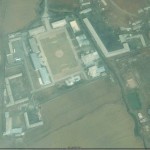
Pictured above: Chun-dong (춘동) in Hyesan (2005) via Google Earth

According to the Daily NK:

North Korea has created a new military body, the 10th Corps of the Chosun People’s Army, charged with security and order in Yangkang Province.

An inside source reported to The Daily NK on the 15th, “The foundation of the Yangkang Province 10th Corps was ratified in September in the name of the National Defense Commission Chairman,” and added, “Accordingly, the construction of the Corps Headquarters has been completed in the Chundong area of Hyesan.”

Hitherto, the 10th District Command of the Local Reserve Forces, a civilian reserve force, provided local protection in Yangkang Province. Its military strength was obviously inferior to that of North Hamkyung Province, which it neighbors. North Hamkyung Province has been guarded by the 9th Corps stationed in Chongjin on the east coast since it was created in 1995.

Even though the specific details of the makeup of the new 10th Corps have not emerged, it seems to consist of the 42nd Brigade (No. 1551 Base) stationed at Samsoo and the 43rd Sniper Brigade (No. 682 Base) at Gapsan, and brigades of the Local Reserve Forces in Pungsan and Wunheung. Additionally, and importantly, officers from the 9th Corps have been transferred to fill higher positions.

The source explained, “The number of enlisted soldiers increased during spring recruitment, but the number of officers was still inadequate, so the corps was formed with officers transferred from the 9th Corps. However, housing for military officers has not been completed yet, so there are still many living apart from their families.”

The Daily NK reported exclusively in September 2009 that the National Defense Commission was planning to reinforce the 10th District Command with 10,000 additional soldiers.

The source explained the possible background to the founding the 10th Corps, saying, “In fact, the value of military strength in Yangkang Province has dropped more than people think. Considering the fact that major strategic facilities such as Samjiyeon Airport, Samjiyeon Missile Base, Baekam Radar Base and Huchang Missile Base are all here, Local Reserve Forces are not sufficient to cover provincial defense.”

He added, “There is significance in the foundation of the 10th Corps, in that defense of a strategic position has been reinforced, and moreover may have the effect of coping with possible Chinese military moves which actually could occur,” and went on, “It might also have been a measure reflecting the concern which Pyongyang has had since its first nuclear test, whereby, ‘We don’t know when China will betray us.’”

Now, the North Korean military consists of nine official corps: the 1st Corps stationed in Hoiyang, Kangwon Province, 2nd in Pyongsan, North Hwanghae Province, 4th in Haeju, South Hwanghae Province and 5th in Pyeonggang, Kangwon Province, which cover the DMZ and the front line; and the 3rd Corps in Nampo, 7th in Hamheung, South Hamkyung Province, 8th Corps in Youngju, North Pyongan Province, 9th in Chongjin, North Hamkyung Province and the newly created 10th in Hyesan, Yangkang Province, which are in charge of rear defense.

As previously noted, the 6th Corps has not existed since shortly after an attempted coup in North Hamkyung Province in 1995.

Each corps consists generally of one or two combat brigades, three or four mechanized brigades and several battalions.

Besides these, there are special corps disguised as “training centers” in order to draw a veil over the reality, which is that in practice their military power is much greater than that of the general corps. While the first obligation of the general corps is local defense, these training centers are designed to push into the South.

Among the best known of these “training centers” are No. 425 Training Center stationed in Jungju, South Pyongan Province, No. 806 in Muncheon, Kangwon Province, No. 815 in Seoheung, North Hwanghae Province, No. 820 in Sariwon, North Hwanghae Province and No. 620 in Shinkye, North Hwanghae Province.

Additionally, there is the “Artillery Bureau” which conducts artillery attacks, “Education Bureau” designed to penetrate the rear of enemy lines, and “No. 91 Training Center”, Pyongyang Defense Command, which is charged with defending the capital.

Read the full story here:
Yangkang Province Gets New 10th Corps
Daily NK
Im Jeong-jin
12/16/2010

Share

Jon Il-chun re-surfaces

Wednesday, December 15th, 2010

According to the Choson Ilbo:

South Korean intelligence officials breathed a sigh of relief on Sunday. They had finally located Jon Il-chun, the head of a special department in North Korea’s Workers Party that manages Kim Jong-il’s slush fund. Jon, who had eluded intelligence officials for the past six months, was finally spotted on a North Korean TV broadcast featuring one of leader Kim Jong-il’s so-called on-the-spot guidance tours in Pyongyang.

The 69-year-old Jon went to high school with Kim (68) and was appointed head of the department, known as Room 39, early this year. It manages 17 overseas branch offices and around 100 trading companies and even owns a gold mine and a bank. The US$200-300 million those companies make each year is funneled into Kim’s secret bank accounts around the world.

Room 39 is targeted each time the U.S. and other foreign governments apply financial sanctions against North Korea. Kim replaced its head early this year because the former director, Kim Tong-un, was put on an EU list of sanctioned individuals late last year, making it impossible for him to manage the leader’s secret overseas bank accounts.

Due to the importance of the department and the clandestine nature of its business, the director of Room 39 rarely appears in public, but he sometimes accompanies Kim Jong-il on guidance tours when they involve organizations linked to Kim’s slush funds, an intelligence official said.

In the TV clip on Sunday, Jon is seen with Kim on an tour to Hyangmanlu, a popular restaurant, and Sonhung food manufacturing plant. A North Korean defector who used to live in Pyongyang, said the restaurant was built in the 1990s by a wealthy ethnic Korean from Japan and is located in a busy part of Pyongyang. “It was always packed with wealthy party officials,” the defector said, adding the party manages the restaurant so the entire proceeds probably go into Kim Jong-il’s coffers. He added there is a strong possibility that the food factory also belongs to the party.

The last time Jon appeared on North Korean TV was on June 20, at the opening of a mine in Yanggang Province. A North Korean source said the Huchang Mine is a famous copper mine that had been closed for some time but must have reopened. “Judging by the fact that Jon took part in the opening ceremony, it appears to be one of many mines run by Room 39.”

Jon was also spotted at Kim’s inspections of two fisheries companies last year and one this year. A Unification Ministry official said, “North Korean exports of fisheries products are handled by the party or the military and they’re sources of revenue for Kim Jong-il’s slush fund.” Fisheries products accounted for the second largest North Korea’s W1.64 trillion exports to South Korea last year, amounting to W173 billion or 16.3 percent. Textiles totaled W477 billion or 44.8 percent.

“This is one of the reasons why we blocked imports of North Korean fisheries products” following the North’s sinking of the Navy corvette Cheonan, the official said.

Additional Information:

1. Michael Madden has written a biography of Jon Il-chun here.

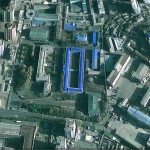
2. Here is a satellite image of the Hyangmanru Restaurant.  Here is a satellite image of the Sohung Foodstuff Factory (right next door).

Read the full story here:
Elusive Manager of Kim Jong-il’s Slush Funds Pops Up Again
Choson Ilbo
12/15/2010

Share

Pyongyang Information Center (PIC)

Monday, December 6th, 2010

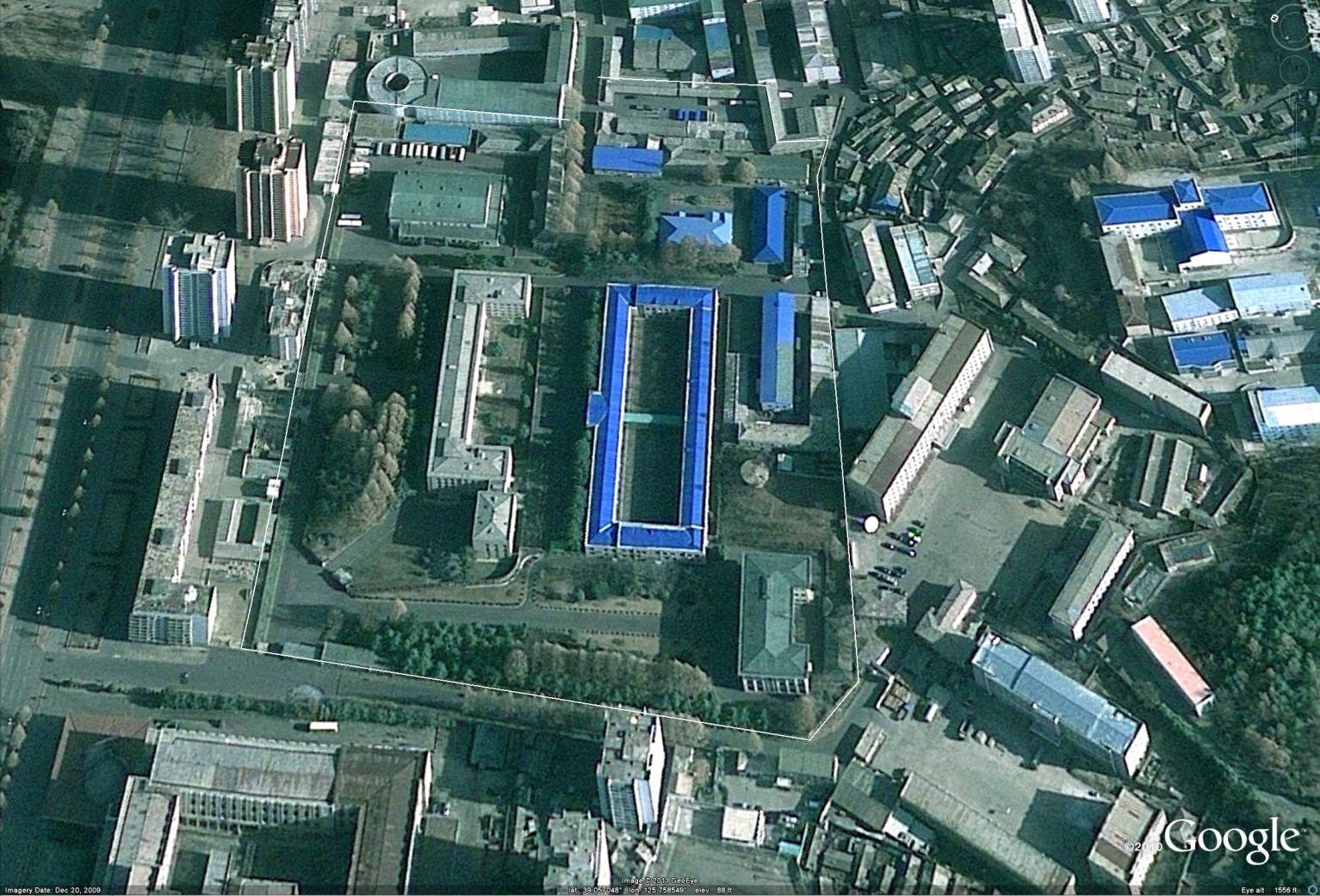
Pictured Above (Google Earth): Pyongyang Information Center and Annex

* AKA Pyongyang Informatics Center

Choi Sung, Professor of computer science at Namseoul University, writes in the IT Times:

I have been writing about North Korea’s IT industry since the start of this year. In this installment, I would like to introduce North Korea’s major information and communications institution. If the Choson Computer Centre (KCC) is called the centerpiece of North Korea’s IT R&D, Pyongyang Information Centre (PIC) is the mecca of their software development. The PIC, founded on July 15, 1986, was jointly funded by the United Nations Development Programme (UNDP) and Jochongnyeon (the pro-Pyongyang federation of Korean residents in Japan). It is situated in Kyong-Heung dong near the Botong River in Pyongyang.

The PIC was created as the Pyongyang Program Development Company and changed its name to Pyongyang Electronic Calculator Operator in October of 1988 and then again to Pyongyang Information Centre (PIC) in July of 1991. As of now, the best and the brightest of North Korea’s IT talent is developing various kinds of programs and devices at the PIC: nearly 300 IT professionals, who graduated from the North’s most prestigious universities such as Kim Il-sung University, Kim Chaek University of Technology and Pyongyang University of Science and Technology (PUST), are on the payroll of the PIC.

On the overseas front, the PIC has its branches in China, Japan and Singapore, where PIC IT experts are working on software development, and has teamed up with foreign companies to jointly develop software programs and expedite technology transfers. The PIC, North Korea’s major software developer, has been at the vanguard of these following areas: language information processing, machinery translation, document editing, global IMEs (Input Message Editor), computer-aided design (CAD), networks, database systems, fonts, multimedia, dynamic images, etc. For instance, the PIC’s database development taskforce consists of about 40 IT experts, who are all working on the development of information management systems for production lines, companies and other institutions. The PIC’s publishing group has been engaged in various R&D projects from the development of Chang-Deok, a PC word processor, to DTP (desk top publishing) systems for Mac computers. Last but not least, the PIC’s application software group is keen on CAD, virtual reality and the development of project management devices. The PIC has been developing a plethora of software products: embedded software, CAD, image processing, Korean-language information processing and systems, network management systems, multimedia dynamic images, etc. The PIC’s 3D CAD has been widely employed by North Korean and foreign architectural design companies and more sophisticated versions of it are coming out. What’s more, the PIC is ramping up its joint R&D efforts with overseas IT developers with a focus on the development of diverse image processing programs. Korean-language information processing and systems are about developing the technologies for character recognition, voice recognition, natural language processing and primary retrieval while the development of network management systems includes fire walls, security solutions, encryption, e-commerce, IC cards, instant messenger programs, mobile game programs, etc. They are also working on the development of multimedia and dynamic images: technologies for producing 3D materials, 2D cartoon production and the technology for adding accompaniments to images are being developed. The PIC’s font development team has developed 300 Korean fonts and a myriad of calligraphic styles for imported mobile phones and dot fonts for PDAs.

The PIC has thus far scaled up its IT exchanges with overseas information and technology companies as well as R&D institutions. A case in point is the North-South joint venture, HANA Program Center, which is located in Dandong-si in Liaoning, China and was jointly invested in May of 2001 by the PIC and North-South HANA Biz, a subsidiary of South Korea’s Dasan Network. Another showpiece of the PIC’s effort for joint R&D is the software development for fonts and Chinese character recognition in collaboration with Soltworks (an e-publishing software developer). On top of that, the PIC’s IT exchanges with overseas institutions have been on the rise.

As such, inter-Korean cooperation projects will serve as the driving force behind the PIC’s IT exchanges with South Korea. To that end, non-military sanctions imposed on Pyongyang should be eased, such as the Wassenaar Arrangement (a multilateral export control regime (MECR) with 40 participating states) should be eased to move US – North Korea relations forward and the US’s EAR (Export Administration Regulation) on the North should be scaled back. Above all, IT-initiated unification of the two Koreas should be preceded by pragmatic dialogues with the North and North Korea’s efforts for reaching out to other nations. As of now, the North needs to draw up a future blueprint to embark on phased cooperation with the S. Korean government and companies in a bid to open its doors to the international community.

UPDATE from a reader who has spent some time there:

[T]hey are an interesting institution that not everyone has a chance to see from the inside. What was interesting is that they really work on software for foreign markets (i.e. mobile software for well known international cell network providers). In addition to that they have an impressive library of books on all topics of software development which was up-to-date at the time I visited.

In contrast to the other institutions they immediately showed commercial accomplishments instead of where the leaders have walked. Employees have access to a gym too. A place out of place in Pyongyang. What I found interesting in the article is that the mentioned developments match some of those the KCC presents in their building. The PIC made much more an impression of a service unit for foreign customers than for the country itself. However, they are training hardware specialists for the infrastructure there.

Read the full story here:
North Korea’s IT Application Software Development Center – Pyongyang Information Centre (PIC)
IT Times
Choi Sung
12/6/2010

Share

DPRK comments at the International Conference of Asian Political Parties in Phnom Penh

Monday, December 6th, 2010

According to the Daily NK:

In yet another hint as to Kim Jong Eun’s true status, Secretary of the International Department of the Chosun Workers’ Party Kim Young Il pointed to the beginning of the leadership of the successor at a recent conference in Cambodia.

Alongside politicians from 31 Asian states including South Korea, Kim was attending the 6th International Conference of Asian Political Parties in Phnom Penh on December 2nd as the head of the Chosun Workers’ Party delegation. There, according to Rodong Shinmun, Kim used his speech to explain, “At the Workers’ Party Delegates Conference, we appointed respected Comrade General Kim Jong Eun to Vice Chairman of the Central Military Commission of the Party.”

Kim also made several further mentions of the results of the Delegates’ Conference. Speaking of Kim Jong Il, he said “Our great leader, Comrade Kim Jong Il continues as General Secretary of the Chosun Workers’ Party…”, but by using the most honorary of terms like “respected”, he appeared also to emphasize the fact that the era of Kim Jong Eun has begun.

Chosun Central News Agency also reported the details of Kim’s speech on December 4th, emphasizing the words, “Every member of the Party and the people, with the great pride and self-respect of having a man of unsurpassed greatness at the highest level of the revolution, celebrated the 65th anniversary of the founding of the Chosun Workers’ Party splendidly last October; a great political festival to be spoken of as a special event in our people’s history.”

Given the context of the Korean used, it appears that the “man of unsurpassed greatness” refers to Kim Jong Eun.

Also, Kim reportedly added, “The nation’s economic power is being strengthened by the creation of Chosun-style iron, textiles and fertilizer, while we have seized control of the foundations of CNC technology; the most advanced CNC-equipped factories are being built constantly.”

Synthesizing these reports coming from Rodong Shinmun and Chosun Central News Agency and based on the fact that a major Party figure participating in an international conference should talk of Kim Jong Il and Kim Jong Eun in the same breath suggests the formalization of the Kim Jong Eun succession to power

Especially, Kim Young Il mentioning CNC, which the North Korean authorities are promoting as an amorphous “achievement” of the successor is seen in some quarters as tantamount to an announcement that Kim Jong Eun’s leadership has began. Recently, North Korea has allegedly been encouraging the expansion of CNC technology into most industrial fields.

Kim Yeon Su, a professor at National Defense University in Seoul, explained to The Daily NK, “This is to proclaim to the outside world that Kim Jong Eun has advanced to the successor’s position and that he has begun to lead.”

Professor Kim commented, “During the South Korea-U.S. joint military exercises in the West Sea (November 30th~December 1st), Kim Jong Il went on an on-site inspection without Kim Jong Eun. This is a very exceptional incident and an expression of trust in Kim Jong Eun and confidence, suggesting that the Kim Jong Eun succession leadership system is ready.”

Meanwhile, also during his speech, Kim Young Il repeated existing arguments that the shelling of Yeonpyeong Island was based on the right to self-defense, and asserted that responsibility for it lies with South Korea.

Read the full story here:
“A Man of Unsurpassed Greatness”
Daily NK
Kim So Yeol
12/6/2010

Share

New Pyongyang management law aims at modernization

Tuesday, November 30th, 2010

Institute for Far Eastern Studies (IFES)
NK Brief No. 10-11-30
11/30/2010

North Korea has recently revised the Pyongyang City Management Law in order to support ongoing modernization efforts by increasing the management and operational authority of the Cabinet and of the State Planning Committee. On October 21, the Cabinet newspaper ‘Minju Chosun’ ran an article emphasizing the need to ensure that necessary capital and supplies were guaranteed for the construction of 100,000 new residences in Pyongyang and now it appears the North is backing up this modernization drive with the law.

The legal code was revised in accordance with Order No. 743, passed down by the standing committee of the Supreme People’s Assembly on March 30 of this year, but was just recently made public in South Korea. What stands out in this newly revised law is that the central government has strengthened its hold on management and operations within the city.

Article 47 of the city management law states, “The Cabinet must naturally take control of and supervise Pyongyang management operations,” and Article 48 stipulates that the State Planning Committee and the Pyongyang People’s Committee establish and strictly follow detailed plans for each sector of management operations within the capital city. Article 47, of the former law (enacted on 26 Nov. 1998), which covered management projects within Pyongyang, was removed while five new articles were added. Article 17 covers housing construction, Article 27 covers management of street lighting, Article 43 covers the delivery of publications, Article 46 stipulates basic working conditions, and Article 51 guarantees that goods will be produced for Pyongyang markets.

Article 17 stipulates that “the construction of housing must completely guaranteed,” and Article 51 states that planning for and production of commercial goods for Pyongyang must be ensured “without fail.” Housing, goods, electricity, capital and other necessities for the modernization of Pyongyang have now been essentially legally guaranteed. New housing in the capital has been a priority for the North, with construction already underway and plans for 30,000 additional units next year and 35,000 more in 2012. In order to show off these new renovations day and night, Article 27 calls for the “logical installation of street lights” to brighten walkways, roads, and national monuments. The new legal revision appears to be yet another step toward shoring up the framework for establishment of a ‘Strong and Prosperous Nation’ and transition of power to yet a third generation of Kims.

The new law reinforces Pyongyang’s centrality in North Korea’s revolutionary ambitions, referring to the capital as “the home of Juche,” “the heart of the Korean people,” and “the face of the nation.”

Share

DPRK strengthens control mechanisms with revised law on the people’s economy

Friday, November 26th, 2010

Institute for Far Eastern Studies (IFES)

NK Brief No. 10-11-26-1
11/26/2010

North Korea has recently revised its law governing the planning of the People’s Economy, significantly strengthening the state’s ability to oversee and control economic activities throughout the country. The South Korean Ministry of Unification recently released the contents of the law, which the North revised on April 6, as well as details of two laws created by the Supreme People’s Committee Standing Committee on July 8; the Law on Labor Protection (Order 945) and the Chamber of Commerce Law (Order 946).

The new law on economic planning contains seven new articles, but since the details of the August 2009 revision were never made public, it is unclear when the new articles were added. What is clear, however, is how different the new law is when compared to the Law on Planning the People’s Economy that was passed in May, 2001 and the Economic Management Reform Measure enacted on July 1, 2002, both of which significantly boosted the autonomy of business managers and eased government restrictions on economic activity.

With the July 1 Measure, the authority of the National Economic Planning Committee was downgraded, central allocations were graduated based on managerial autonomy and profits, the central rationing system was dismantled, and wages were increased. While the economic planning law of 2001 and the July 1 Measure of 2002 eased restrictions on, and oversight of, the people’s economy, the newly-revised law strengthens state control. The new law appears to not only return but also bolster the central control mechanisms that were eliminated by the 2001 law.

Article 16 of the new law states that the planned economy will be based on prepared figures, while Article 18 states that enterprises, organizations and companies will operate on the principle of ensuring regulated numbers, and Article 24 requires the people’s economic plan, drafted by the Cabinet, State Planning Organization, and regional authorities, to be broken down in detail, by timeframe and indexes, and distributed to enterprises, organizations and companies by the end of October. The planning law passed in 2001 called for economic plans to be drawn up based on production statistics provided from ‘below’ and passed up through chains of command (Article 17), but this has been eliminated from the new law.

With the revision of the law on labor protection, North Korea has added more specific language to Article 12 of the ‘Socialist Labor Law’, which was established in April 1978. Article12 of the Law on Labor Protection states that the protection of laborers’ work is the primary demand of the socialist system, which sees the people as the most precious resource. The law strengthens the role of the state in protecting laborers, and identifies ‘difficult and strenuous’ jobs, including mining, fishing, and earthquake investigation. Workers in these fields are to be given favorable treatment, including the issuance of additional clothing, food and other rations.

In addition, the law covers the installation and maintenance of safety equipment, the issuance of protective gear, and additional protections for female workers. It also restricts work to eight hours per day and guarantees holidays and time off, health care, and protection of property. These and other articles in the law increase state management of workers, but defector testimonies paint a different picture. Most workers save their wages with the assumption that they will have to pay bribes, medical costs and other expenses out-of-pocket.

The law on commercial activity further details the ‘Chamber of Commerce Regulation’ handed down by the Cabinet in 2008. The law covers a range of duties and rights regarding commercial operations, including contracts and operations regarding joint ventures with foreign firms; legal letters of confirmation, certificates of country of origin and other paperwork related to trade issues; as well as exhibitions and conventions held in conjunction with foreign businesses.

Share

More DPRK loggers reportedly running away

Monday, November 22nd, 2010

According to the Daily NK:

According to a former North Korean logger in Russia, instances of forestry workers running away from a “Forestry Mission” program organized by North Korea’s Forestry Ministry in the Russian Far East are increasing due to excessive salary deductions currently being imposed by the North Korean authorities.

Song Ki Bok, a 48-year old former logger who now lives in South Korea told The Daily NK on November 18th, “The Forestry Mission takes 70% of monthly salary in the name of Party funding. Who would want to work there when all the money you earn from working yourself to death is taken from you?”

Prior to 2008, North Korea took 30% of the North Koreans’ wages for “Party loyalty funds”. However, after sanctions put in place by the international community following the first North Korean nuclear test began to bite, the amount was increased to 70%.

The North Korean forestry workers do hard physical labor. Depending on the intensity of their work, they receive just $40 to $100 per month.

Therefore, once 70% is deducted as Party funds, the take-home pay of the worker is between $12 and $30. As a result, workers cannot even dream of wiring sums back to family in the North. They just deliver what cash they can gather via colleagues returning home.

Worse yet, with this kind of swingeing monthly deduction, many workers cannot even recover the bribe they had to offer Party officials in order to be sent to Russia in the first place. For example, the total amount Song ended up paying was nearly $400.

Before escaping from the forestry program, Song saw a monthly salary of $30, meaning that even if he had saved every penny he earned for a year he still would not have recouped the $400 he paid out in bribes.

In the beginning, he was buoyed by the ‘Russia Dream’. The family of a worker in a foreign country traditionally lives in better conditions than most people. Therefore, Song went to Russia in the belief that if he worked hard for three years, he could make 10 years of a North Korean working man’s salary; however, the reality was as harsh as the bitter cold of Siberia.

The Forestry Mission in Russia; Kim Jong Il’s hard currency provider

According to Song, there are 17 forestry sites in Russia which employ North Koreans. Depending on the size of the camp there are differences; however, approximately 1,500~2,000 North Koreans work at each.

The major activities of the Party Committee in each camp are surveillance and the collection of Party funds. A manager, Party secretary and an agent from each of the National Security Agency and People’s Security Ministry are assigned to each site, and 15 administrative officers below them manage operations.

The life of workers is the same as it would be if they lived in North Korea. They must partake of weekly evaluation meetings, and food is provided by distribution. They plant potatoes and wheat in cleared areas near their digs to supplement the insufficient state provisions.

If workers leave without permission, they are punished upon their return. If the crime is grave, the worker might be summoned to North Korea for reeducation.

Song commented, “Sometime people leave the camp to go hunting to earn money. They can only escape punishment by bribing the management.”

In total, the amount gathered in the name of Party funds by the North Korean authorities from each camp can exceed $140,000 per month. Calculations suggest that the annual North Korean government take from the program exceeds $25 million.

However, this harsh Party policy is driving escapes, according to Song, “Since most of their monthly salary began to be taken away as Party funds, the number of workers escaping started to increase. Just from those I know, the average has reached 30 workers per a year.”

Song, describing the harsh working conditions at the site, said, “In 2006, a wood cutter from Dukcheon in South Pyongan Province who had frostbite in both feet at work didn’t receive treatment in time. In the end, they had to cut off both his legs. His co-workers, who could not ignore the situation, raised it with the Party Committee there; however, not only was this opinion ignored, but the wood cutter was sent home with the explanation, ‘It was an accident caused by my own carelessness’.”

“The life of a forestry worker fighting against cold which can reach -40˚C in winter is unspeakably tough,” Song said. “Meanwhile, they don’t even receive a proper month’s salary, which reduces their will to work.”

“If a worker escapes, in the end he has no choice but to head to South Korea. When I think about those of my colleagues who couldn’t come to South Korea with me, it is still hard to sleep at night.”

Read more about logging camps in Russia (including satellite imagery) here and here.

Read the full story here:
Runaway Loggers on the Rise Due to Wage Cuts
Daily NK
Kang Mi Jin
11/22/2010

Share

An affiliate of 38 North