UPDATE 13 (2012-8-23): The Institute for Far Eastern Studies reports on Jang’s visit to China:
Jang Song Thaek’s Visit to China: Outcomes and Limitations
Jang Song Thaek, vice chairman of National Defence Commission of North Korea recently visited China and is raising many speculations about the outcome of the visit.From August 13, Jang led 50 North Korean delegations to China, including high ranking officials such as Ri Kwang Gun, the chairman of the joint venture investment committee, Ri Su Yong, the former chairman of the same committee, and Kim Hyung-jun, deputy foreign minister. Together with the Chinese officials, Jang visited Rajin-Sonbong (Rason) special economic zone, and Hwanggumpyong and Wiwha Islands, and discussed the issues of expanding economic cooperation with China.
Jang attended a meeting with China’s Minister of Commerce Chen Deming, titled the Third Meeting of the DPRK-China Joint Steering Committee for the Development of Hwanggumpyong and Rason Districts. In addition to the meeting, Jang visited Jilin and Liaoning Provinces, asking for China’s active assistance and investment in these areas.
Jang also met with Wang Jiarui, head of the International Department of the Communist Party of China (CPC) Central Committee, President Hu Jintao and Premier Wen Jiaobao in Beijing to discuss the future economic cooperation between the two nations and to request for China’s further economic assistance.
North Korea was successful in obtaining positive response from China, promising to help the economic development of North Korea. China has agreed to provide electricity and other necessary infrastructures, including roads and communication network, to push forward with the joint development of Hwanggumpyong and Rason.
However, it is still unclear whether Jang’s visit to China will lead to actual revitalization of bilateral economic cooperation. Chinese companies are still cautious about investing in North Korea with its inadequate infrastructures and legal framework and volatile political situations posing as risks to their investments. Other than labor force export, natural resources development and agricultural and fishery product trades, there is yet to be other model for successful economic cooperation.
Chinese companies consistently argued investment in North Korea can be viable only under the condition that government guarantees or other safety mechanisms are provided to protect the investments of the Chinese companies.
However, in the recent agreement signed by Jang Song Thaek and Chen Deming, two sides have agreed to abide by the principle of development cooperation, to be “led by the governments, based on enterprises, and to achieve mutual benefit and win-win through market operation.” Thus, Chinese government has expressed its intentions to not provide government guarantees for the investments and North Korea has not put forth appropriate policy to soothe the apprehensions of the investors.
Moreover, there are more hurdles to be overcome in Rason and Hwanggumpyong development. Although China gains access to the East Sea through Rason, serving as an important logistics and manufacturing hub in the Northeast Asia reaching South Korea, Russia, and Japan, still no major investment is seen in the area due to the poor industrial infrastructures and basic industries.
Hwanggumpyong and Wihwa Islands are also faced with challenges of its own. Geographically it sits in close proximity to Dandong, in the Chinese territory and while North Korea is pursuing for joint development in the area, China is still passive in the development of this area. This area also frequently fall victim to severe flooding, costly in repairs and maintenance.
China is likely to continue to support North Korea’s economic revitalization efforts and the security of its regime. For North Korea, direct aid is limited and economic cooperation is the most effective option for economic recovery but until it fully accepts the international norm and open up to the outside world, it will be difficult to achieve full economic revitalization.
UPDATE 12 (2012-8-22): Marcus Noland comments on the visit and the agreement here.
UPDATE 11 (2012-8-20): The Choson Ilbo reports that Jang received no official support from Beijing as a result of the visit:
Jang left without receiving any pledges of material support from Beijing, a high-ranking government official here said on Sunday.
Asked about a reported request for US$1 billion in loans from China, the official said, “I have yet to hear of any economic support from China to North Korea, whether it involves $1 billion or $1 dollar. China stressed market principles to Jang.”
UPDATE 10 (2012-8-18): The Hankyoreh reports on a number of investment deals that were inked between the DPRK and Chinese enterprises:
The success of the zones’ development is crucial for North Korea in its current push for economic reforms and improvements to living conditions. This accords with Beijing’s strategy of leading Pyongyang into a gradual normalization through reforms and openness, with an eye to eventually resolving its nuclear program issue.
Another positive signal for Pyongyang is the string of Rason investment declarations by large Chinese corporations following Jang’s visit.
The Yatai Group, a major construction and real estate conglomerate, signed a contract with the Rason people’s committee to develop a construction materials complex in the city. On Friday, the large state-owned Ludi Group announced it would also be investing in Rason. Its director, Zhang Yuliang, announced in an interview with the People’s Daily website people.com.cn that his company would be taking on the construction of basic facilities at Rason, including a power grid.
UPDATE 9 (2012-8-18): Xinhua reports on Wen’s meeting with Jang:
Jang is in China for the third meeting of the joint steering committee for developing and managing the Rason Economic and Trade Zone and the Hwanggumphyong and Wihwa Islands Economic Zone.
Wen said both sides should give priority in developing and managing the zones as well as implement the consensus reached by the joint steering committee.
The premier said the two governments should strengthen the leadership and planning of the cooperation on the zones, improving laws and regulations; encourage relevant regions for active participation with close coordination; and let the market play its role creating favorable conditions for land and tax.
He called on the committee to encourage businesses to invest in the zones and help enterprises solve their problems, and improve customs and quality inspection services to help with bilateral cooperation.
UPDATE 8 (2012-8-18): Reuters reports on Jang’s visit with Wen Jiabao.
Premier Wen Jiabao encouraged North Korea to allow “market mechanisms” help revamp its economy, state media said on Saturday, and laid down other pre-conditions as China tries to wean its impoverished ally off its dependence on Chinese aid.
…
As well as allowing freer rein to market forces, the Chinese premier also recommended Pyongyang encourage economic growth by improving laws and regulations, encouraging business investment and reforming its customs services.
China’s President Hu Jintao also met Jang in a clear show of support for the North and its new leadership. Jang is seen as the driving force behind reforms that the isolated and destitute North is believed to be trying and for which it desperately needs Chinese backing.
…
So far North Korea has received around $300 million in non-financial direct investment from about 100 Chinese companies, mainly in the food, medicine, electronics, mining, light industry, chemicals and textile sectors.
China’s exports to North Korea rose 20.6 percent last year to $2.28 billion from 2010, while imports plunged 81.4 percent to $147.4 million, according to Chinese customs figures.
Those numbers are dwarfed by trade with South Korea, China’s third-largest trading partner.
UPDATE 7 (2012-8-17):
Hu Jintao Receives DPRK Delegation
Beijing, August 17 (KCNA correspondent) — President Hu Jintao, general secretary of the C.C., the Communist Party of China, met the delegation of the DPRK-China Joint Guidance Committee led by Department Director of the C.C., the Workers’ Party of Korea Jang Song Thaek who paid a courtesy call on him at the Great Hall of the People in Beijing on Friday. The delegation took part in the third meeting of the DPRK-China Joint Guidance Committee for the joint development and management of the Rason Economic Trade Zone and Hwanggumphyong and Wihwado Economic Zones.Jang Song Thaek conveyed greetings of the dear respected Kim Jong Un to Hu Jintao.
Expressing deep thanks for this, Hu Jintao requested Jang Song Thaek to convey his warm greetings and sincere congratulations to Kim Jong Un.
Hu Jintao, on behalf of the party, government and people of China, expressed sincere sympathy and consolation over the recent flood that hit the DPRK, causing huge damage.
He hoped that the Korean people would eradicate the aftermath of the disaster and bring the living of the people in the afflicted areas to normal as soon as possible under the leadership of First Secretary Kim Jong Un.
Noting that China and the DPRK are friendly neighbors linked by the same mountain and rivers, he said that the policy of the Chinese party and government to attach importance to and develop the China-DPRK friendship from the strategic viewpoint and on long-term basis would remain unchanged in the future, too.
He expressed his willingness to strengthen the high-ranking visits, cooperation in various fields and the exchange of views on international and regional problems and upgrade the bilateral relations to a new level as agreed by both sides.
He was rejoiced over the fact that the development of the two economic zones has entered a practical phase thanks to the common efforts, wishing that a good example of economic cooperation would be set.
The Chinese party and government support the Korean comrades following the road of development suited to their actual conditions and wish them greater success in their efforts to build a thriving nation under the leadership of First Secretary Kim Jong Un, he said.
The talk proceeded in a comradely and friendly atmosphere.
Present there were members of the DPRK-China Joint Guidance Committee, Ji Jae Ryong, DPRK ambassador to China, Chen Deming, minister of Commerce of China, Wang Jiarui, head of the International Liaison Department of the C.C., the CPC, Zhang Ping, head of the National Development and Reform Committee, Shi Xuren, minister of Finance, Wang Min, secretary of the Liaoning Provincial Committee of the CPC, Sun Zhengcai, secretary of the Jilin Provincial Committee of the CPC, Zhang Zhijun, executive vice-minister of Foreign Affairs, Chen Jian, vice-minister of Commerce, and Liu Hongcai, Chinese ambassador to the DPRK.
UPDATE 6 (2012-8-16): Xinhua reports on the visit:
The Rason Economic and Trade Zone will focus on the development of raw materials, equipment, high-tech products, light industry, the service sector and modern agriculture, the MOC said after the meeting.
It will gradually become an advanced manufacturing base, as well as an international logistics center and regional tourism center for northeast Asia.
The Hwanggumphyong and Wihwa Islands Economic Zone will focus on the development of the information industry, tourism, modern agriculture and garment manufacturing, the ministry said.
The DPRK passed and promulgated the Law for the Rason Economic and Trade Zone and Law for the Hwanggumphyong and Wihwa Islands Economic Zone in December 2011, Shen said.
“Construction on the two economic zones has entered the stage of introducing enterprises to invest in the zones,” he said.
The two sides will continue to make joint efforts to make laws and regulations, make detailed preferential policies, improve construction planning inside the zones and attract companies to invest in the zones.
“Both sides will make full use of their respective advantages and build the zones into models of China-DPRK economic and trade cooperation and platforms for economic and trade cooperation with the rest of the world,” Shen said.
The MOC said Tuesday that China and the DPRK will continue to follow the principle of “government-guided, enterprise-based, market-oriented and mutually beneficial” cooperation in developing the two economic zones.
The meeting was jointly presided over by Minister of Commerce Chen Deming and Jang Song Taek, chief of the central administrative department of the Korean Workers’ Party.
UPDATE 5 (2012-8-16):
Chinese Officials Vow to Make All Efforts to Implement DPRK-China Agreed Points
Pyongyang, August 16 (KCNA) — The delegation of the DPRK-China Joint Guidance Committee sojourned in Jilin and Liaoning Provinces, China on Tuesday and Wednesday.Department Director of the Central Committee of the Workers’ Party of Korea Jang Song Thaek, head of the delegation of the DPRK-China Joint Guidance Committee, met and had friendly talks with Sun Zhengcai, secretary of the Jilin Provincial Committee of the Communist Party of China, in Changchun City and Wang Min, secretary of the Liaoning Provincial Committee of the CPC, in Shenyang.
Sun Zhengcai extended congratulations to the successful third meeting of the above-said committee.
He said that Jilin Province is a significant place featured by historic relics on President Kim Il Sung and leader Kim Jong Il, recollecting with deep emotion the days when he was received by Kim Jong Il who visited the province in 2010.
The Jilin Provincial Committee of the Communist Party of China and the Jilin Provincial People’s Government will make efforts to implement the points agreed at the third meeting of the China-DPRK Joint Guidance Committee, he concluded.
Wang Min said he was pleased with the achievements made by the Korean people in building a thriving socialist nation under the leadership of the dear respected Kim Jong Un.
He underscored the need to contribute to boosting the traditional Sino-DPRK friendly relations provided by the leaders of the elder generations of the two countries by stepping up the joint development of the Hwanggumphyong and Wihwado Economic Zones.
UPDATE 4 (2012-8-15): The Associated Press reports on the meetings:
The ministry said the two sides signed a number of cooperation agreements related to their development of the two special economic zones: Rason on the Korean Peninsula’s northern tip and Hwanggumphyong, an island in the Yalu River that marks their border to the southwest.
It said plans for Rason would see it becoming a manufacturing base, logistics center and tourism hub, though the new agreements were still primarily focused on basic infrastructure, such as a plan to transmit electricity directly to the zone overland from China.
The Hwanggumphyong zone will focus on information technology, tourism, agriculture and garment manufacturing, it said.
Rason has recently begun to develop thanks to Chinese infrastructure projects, but Hwanggumphyong has languished since ground was broken last year.
The China Daily said in an editorial Wednesday that Chinese investment in the zones would help North Korea’s battered economy and improve stability on the Korean peninsula.
“The DPRK is in urgent need of capital to help revitalize its waning economy,” the paper said. “It can be expected that as a result of the agreements, Chinese investment in the special economic zones of the DPRK will increase rapidly.”
It noted that bilateral trade last year was $5.7 billion, up from $3.5 billion in 2010.
UPDATE 3 (2012-8-14): Ri Chol was among the group of DPRK leaders traveling to Beijing.
UPDATE 2 (2012-8-14): The Daily NK reports on Jang’s trip to China:
The level of popular interest in Jang’s visit is a reflection of two things: first, his relative importance in the North Korean power structure, and second, the fact that he is the highest North Korean official to visit Beijing since the official launch of the Kim Jong Eun regime late last year. Both these facts serve to make it highly likely that the remit of the trip extends quite a long way past the economic agenda cited by KCNA, presumably to encompass political and military concerns as well.
According to one diplomatic source in Seoul, “Kim Jong Eun quite possibly assumes that China harbors some anxiety about his newly launched system. Jang will probably explain the recent purging of former Chief-of-Staff Lee Young Ho, since this only made China more concerned.”
Sohn Gwang Joo, a senior researcher with the Gyeonggi Research Institute, went further, declaring, “The main reason behind Jang’s trip to China is to emphasize that ‘Chosun-China friendship transcends generations’, and that without the political, economic and military support that comes from that friendship, the Kim Jong Eun system cannot be maintained.”
“When Jang Sung Taek meets with high-level cadres including Xi Jinping, the two will discuss the issue of a bilateral summit,” Sohn added, noting the likelihood that such a summit is likely to occur after China’s own leadership transition in October.
Lee Tae Hwan, a researcher with the Sejong Institute, noted also that there is certainly more to the visit than KCNA made public, explaining, “There are a bunch of people who can solve economic problems like those at Rasun, Hwanggeumpyong and Wihwa Island, it doesn’t have to be someone as influential as Jang Sung Taek.”
“Therefore, Jang’s trip to China is not a working-level visit. He is raising the level of bilateral communication.”
UPDATE 1 (2012-8-14):
Third Meeting of DPRK-China Joint Guidance Committee Held
Beijing, August 14 (KCNA) — The third meeting of the DPRK-China Joint Guidance Committee for the joint development and management of the Rason Economic Trade Zone and Hwanggumphyong and Wihwado Economic Zones was held in Beijing on Tuesday.Present there were members of the delegation of the DPRK-China Joint Guidance Committee led by its DPRK side Chairman Jang Song Thaek who is department director of the Central Committee of the Workers’ Party of Korea and Ji Jae Ryong, DPRK Ambassador to China.
Also present there were members of the delegation of the China-DPRK Joint Guidance Committee led by its Chinese side Chairman Chen Deming, minister of Commerce of China and Liu Hongcai, Chinese Ambassador to the DPRK.
The meeting reviewed the work done for developing them since the second meeting of the joint guidance committee.
In the Rason Economic Trade Zone, a master plan for developing the zone was mapped out, reconstruction of ports and railways made brisk headway, the project for reconstructing Rajin-Wonjong highway is nearing its completion and a work has made brisk headway in various fields including tourism and agricultural cooperation and measurement for the transmission of electricity from China was finished.
In the Hwanggumphyong Economic Zone, favorable preconditions were created for substantially starting the development project including the fixing of the spot for border passage according to the drafted detailed plan.
The meeting stressed the need to quickly start the Wihwado Zone development and show the world the will of both sides for the development of both zones.
At the meeting, both sides appreciated as the successes made since the second meeting the amendment, enactment and announcement of the law on the two economic zones, the agreement of development plans, the establishment of management committee, the work of various panels of the joint guidance committee, the training of management officials of the two economic zones, the promotion of already started projects, the border passage and positive progress in tele-communication cooperation through the joint efforts of the two governments.
Both sides reaffirmed that it plays an important role in consolidating and developing the traditional relations of DPRK-China friendship to invariably implement the historic agreement on the joint development and management of the two economic zones reached between the top leaders of the two countries in line with mutual interests.
Both sides said in unison that to develop the two economic zones of weighty significance in boosting exchange and cooperation in all fields between the two countries, developing economy and achieving regional stability and prosperity is in line with the common interests of the two peoples.
They agreed upon a series of matters of jointly pushing forward the top priority processes in creating environment favorable for investment in the two economic zones to meet international standard and mutual interests.
They agreed to make sure that the two governments support and encourage local governments and enterprises push forward this work now that all the matters related to the development of the two economic zones were agreed upon and have reached the phase of implementation. They also agreed to positively promote the development of the Wihwado zone.
They agreed to hold the fourth meeting of the Joint Guidance Committee in Pyongyang in the first half of 2013.
Minutes of the third meeting and the Agreement on Economic and Technological Cooperation between the Governments of the DPRK and the PRC were signed by Jang Song Thaek and Chen Deming.
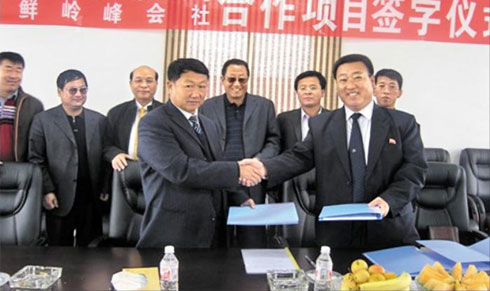
A ceremony of declaring the establishment of the Management Committee of the Rason Economic Trade Zone and the Hwanggumphyong Economic Zone took place and relevant documents including The Basic Agreement on Investment in Port and Industrial District of the Rason Economic Trade Zone, A MOU on setting up the Management Committee of the Hwanggumphyong Economic Zone for Joint Development and Management between the North Phyongan Provincial People’s Committee of the DPRK and the Liaoning Provincial People’s Government of the PRC and A MOU on Designing Processes for Basic Facilities in the Hwanggumphyong Economic Zone for the Joint Development and Management between the North Phyongan Provincial People’s Committee of the DPRK and the Liaoning Provincial People’s Government of the PRC were signed during the meeting.
The Chinese Ministry of Commerce gave a reception in connection with the successful third meeting that day.
ORIGINAL POST (2012-8-13): According to KCNA:
DPRK Delegation Leaves for China
Pyongyang, August 13 (KCNA) — A delegation of the DPRK-China Joint Guidance Committee Monday left here for Beijing, China to take part in the third meeting of the committee.It was headed by its DPRK side Chairman Jang Song Thaek who is a department director of the Central Committee of the Workers’ Party of Korea.
The meeting is reportedly to discuss the joint development and joint management of Rason Economic Trade Zone and Hwanggumphyong and Wihwado Economic Zone.