Archive for the ‘DPRK organizations’ Category

PDS distribution up in 2013

Wednesday, August 7th, 2013

According to the Daily NK:

The volume of food distributed under the North Korean Public Distribution System in the first half of 2013 increased when compared to 2012, Radio Free Asia (RFA) reported on the 6th.

According to North Korean submissions to the UN World Food Programme (WFP), the North Korean authorities provided 400g/day between January to May and 390g/day in June and July, a monthly average of 397g/day. This is a 14g increase on last year’s average of 383g/day.

According to the statistics, 66% of the total population of North Korea, around 16 million people, received state distribution of basic foodstuffs. Last year, 400g/day was achieved in April, the 100th anniversary of Kim Il Sung’s birth, but not in any other month.

Conversely, WFP reported that international food aid volumes to North Korea decreased in the first half of 2013. WFP began a new food aid operation for the country last month, but has since failed to reach half of its target support volume.

Last month, WFP supplied approximately 2900t of food to around 940,000 people, including more than 40,000 flood victims. This compares with 3400 tons of food to more than 1,310,000 people in the previous month.

Daily NK has reported on public food distribution on a number of occasions in 2013, noting in particular that the North Korean authorities distributed some stocks of rice ordinarily intended for wartime distribution.

Yonhap also covered the story.

Read the full article here:
PDS Distribution Volumes Rise in 2013
Daily NK
Jin Dong Hyuk
2013-8-7

Share

Google Earth provides glimpse into North Korea’s latest military parade preparation

Wednesday, July 24th, 2013

Mil-parade-prep-2013

Read the full story here.

Share

Report: Korean Workers’ Party sets up Economy Department

Friday, July 12th, 2013

According to Radio Free Asia:

The party has created a centralized department with branches throughout the nation to formulate and oversee policies ranging from appointment of top economic officials to approval of companies and implementation of foreign exchange controls, a source from Jagang province, near the border with China, told RFA’s Korean Service.

The Party’s Department of Economy was set up last month.

“From last June, each [Party] committee in the provinces and cities established a [a branch of the] Department of Economy,” the source said on condition of anonymity.

“It will further strengthen the control and management of the Party,” he said.

The move by the Workers’ Party Central Committee was part of a shakeup within the Party and led to several branches of existing departments being transferred to the Department of Economy, he said.

A source in Yanggang province, also along the Chinese border, told RFA that the newly-formed department would wield as much power as the Department of Organization Management, which oversees the entire Workers’ Party.

“From now on, all officials in charge of economic matters have to be approved by the Department of Economy, while all companies also require approval from the department when they are established, shut down, or merged,” the Yanggang source said.

The Department of Economy also has the power to punish and appoint officials in charge of economic matters, he said, adding that he expects it to become “the strongest department in the Party.”

Even if the North Korean military, judicial agencies, and the Cabinet—or executive branch of the government—seek to establish new units for earning foreign currency or production, they are required to obtain permission in advance from the department, he said.

“Establishing the Department of Economy is related to the so-called ‘reformed economic management system,” the source in Yanggang province said, referring to a new policy announced in June last year which grants individuals greater authority in the distribution of goods.

“It means the Party never wants to lose its control over the economy, even though the ‘reformed system’ takes place everywhere,” he added.

The source said that the lack of central control had led to situations in which bogus companies and organizations were running businesses and generating foreign currency revenue without reporting them, creating a need for the Party to more efficiently oversee these groups.

For example, he said, several companies and restaurants which were established under the guise of being welfare organizations to feed and clothe the poor are really generating foreign currency for the North Korean Cabinet.

But he noted that even as the Department of Economy sought to rein in these businesses, it would inevitably generate conflict within the Party as it grew in power, leading different factions to jockey for control.

“[Some of] the functions of [the Party’s] Department of the Executives and Department of Organization Management were already taken away by the Department of Economy, and also the Department of Administration has seen interference from the department as well,” the source said.

“In the future, the scope of Department of Economy’s activity will surely conflict with other departments of the Workers’ Party.”

Read the full story here:
North Korea’s Workers’ Party Takes Economic Control
Radio Free Asia
Sung Hui Moon
2013-7-12

Share

North Korea attempting to revive the food ration system

Thursday, July 11th, 2013

Institute for Far Eastern Studies (IFES)
2013-7-11

North Korea is attempting to restart its halted food distribution system. In March, military food provisions were released to the public and food distribution is reported to have resumed on a biweekly basis. The provision of food rations for more than three consecutive months is a rare occurrence.

A North Korean defector organization in South Korea, NK Intellectuals Solidarity, released the following information in their information briefing session: “From June 1, it was confirmed that residents in border cities and towns received food distribution every 15 days, about 470 grams per person a day.”

The foods distributed were mainly from Warehouse No. 2, stockpiled as military food provisions. It is unclear how long the food distribution will last but North Korea appears to be straining itself to revive the food distribution system in order to resolve the food shortage problem.

According to Radio Free Asia, the North Korean government has begun to reissue food stamps, with residents in North Hamgyong Province having confirmed recently the receipt of such stamps.

North Korean economic policy has focused mainly on the agricultural sector and food supply. There appears to be gradual improvement. The price of 1 kg of rice in January was about 6,600 KPW in Pyongyang and by June it dropped to 5,000 KPW. The price of rice is reported to have dropped in other cities such as Sinuiju and Haesan by as much as 1,000 KPW.

However, a South Korean official commented that the food distribution is not equal nationwide, as some regions are left without food rations. He added, “Unless North Korea is able to secure sufficient supply of food, it will be difficult to revive the food distribution system of the past.”

Meanwhile, some have testified that North Korea is leasing farm lands to urban workers in cooperative farms as a means to resolve the food crisis.

Citing an unnamed source in North Korea, NK Intellectuals Solidarity stated that “state-owned collective farm lands are being leased to city workers,” explaining this as a measure to overcome the current food situation as work in factories in the cities also has declined.

NK Intellectuals Solidarity explained that farm lands are being leased on an annual basis and workers in various state factories and enterprises are receiving about 250 pyong (826.4 square meters) of land per employee.

Employees must allocate a portion of their harvest to the state (100g of corn and 50g of beans per pyong (3.3 square meters) and the total yield of harvest will be counted as the total production output of the farm. The expectation is that this method of leasing land of cooperative farms will resolve the food shortages in the cities and improve the food supply of the entire nation.

Share

US sanctions DPRK Daedong Credit Bank

Thursday, June 27th, 2013

Here is the press release from the Treasury Department:

Treasury Sanctions Bank, Front Company, and Official Linked to North Korean Weapons of Mass Destruction Programs

6/27/2013
Action Targets North Korea’s Use of Deceptive Financial Practices
to Support its Weapons Programs

WASHINGTON – Today the U.S. Department of the Treasury took another step in our ongoing efforts to disrupt North Korean financial networks supporting the regime’s illicit ballistic missile and weapons of mass destruction (WMD) programs and proliferation activities. Daedong Credit Bank (DCB), together with DCB Finance Limited—a DCB front company—and DCB’s representative Kim Chol Sam were designated pursuant to Executive Order (E.O.) 13382, which targets proliferators of WMD and their supporters. The financial operations carried out by DCB, DCB Finance Limited, and Kim Chol Sam are responsible for managing millions of dollars of transactions in support of the North Korean regime’s destabilizing activities.

The Treasury Department also designated Son Mun San, the External Affairs Bureau Chief of North Korea’s General Bureau of Atomic Energy (GBAE) under E.O. 13882 for his work directing North Korea’s nuclear-related research efforts. The GBAE, which was previously designated by the U.S. and the UN, is responsible for North Korea’s nuclear program, which includes the Yongbyon Nuclear Research Center and its five megawatt plutonium production research reactor, as well as its fuel fabrication and reprocessing facilities.

“Although the recent spate of provocations has waned, North Korea’s dangerous and destabilizing illicit nuclear and ballistic missile program continues apace, supported by North Korean financial institutions like Daedong Credit Bank. We are committed to increasing the sanctions pressure on North Korea until it complies with its international obligations,” said Under Secretary for Terrorism and Financial Intelligence David S. Cohen. “We urge financial institutions around the world to be wary of dealing with Daedong Credit Bank and the other designated entities in order to maintain the transparency and legitimacy of the international financial system.”

North Korea’s nuclear and missile programs and proliferation activities violate UN Security Council Resolutions 1718 (2006), 1874 (2009), and 2094 (2013); destabilize the region; and undermine the global nonproliferation regime. Today’s designations build upon other recent U.S. efforts to target DPRK proliferation activities, including the March 2013 designation of North Korea’s main foreign exchange bank, the Foreign Trade Bank (FTB).

Daedong Credit Bank has engaged in the same type of activity that was at issue in the FTB designation, most notably providing financial services to the Korea Mining Development Trading Corporation (KOMID), Pyongyang’s premier arms dealer as well as KOMID’s main financial arm, the Tanchon Commercial Bank (TCB), both of which have been previously designated by the U.S. for the central role they play supporting North Korea’s illicit nuclear and ballistic missiles programs. KOMID and TCB were also designated by the United Nations. UNSCR 2094 requires the imposition of targeted financial sanctions on entities that work for or on behalf of, or at the direction of, UN-designated North Korean entities. Since at least 2007, Daedong Credit Bank (DCB) has facilitated hundreds of financial transactions worth millions of dollars on behalf of KOMID and TCB. In some cases, DCB has knowingly facilitated transactions by using deceptive financial practices.

DCB Finance Limited and Kim Chol Sam

Since at least 2006, Daedong Credit Bank has used its front company, DCB Finance Limited, to carry out international financial transactions as a means to avoid scrutiny by financial institutions avoiding business with North Korea. DCB Finance Limited is registered in the British Virgin Islands and also operates out of China.

Kim Chol Sam is a representative for Daedong Credit Bank who has also been involved in managing transactions on behalf of DCB Finance Limited. As a Dalian, China-based representative of DCB, it is suspected Kim Chol Sam has facilitated transactions worth hundreds of thousands of dollars and likely managed millions of dollars in North-Korean related accounts.

Son Mun San

Since at least 2010, Son Mun San has served as the External Affairs Bureau Chief of North Korea’s General Bureau of Atomic Energy (GBAE).

GBAE is responsible for North Korea’s nuclear program, which includes the Yongbyon Nuclear Research Center and its five megawatt plutonium production research reactor, as well as its fuel fabrication and reprocessing facilities. GBAE was designated by the United Nations Security Council in July 2009 and was also designated pursuant to E.O. 13382 in September 2009.

U.S. persons are generally prohibited from engaging in any transactions with the entities and individuals listed today, and any assets they may have subject to U.S. jurisdiction are frozen.

Identifying information:

Entity Name: Daedong Credit Bank
AKA: DCB
AKA: Taedong Credit Bank
Address: Suite 401, Potonggang Hotel, Ansan-Dong, Pyongchon District, Pyongyang, DPRK
Alt. Address: Ansan-dong, Botonggang Hotel, Pongchon, Pyongyang, DPRK
SWIFT: DCBK KPPY

Entity: DCB Finance Limited
Address: Akara Building, 24 de Castro Street, Wickhams Cay I, Road Town, Tortola, British Virgin Islands
Alt. Address: Dalian, China

Name:Kim Chol Sam
Date of Birth: March 11, 1971
Nationality: Democratic People’s Republic of North Korea
Role: Treasurer, Daedong Credit Bank

Name: Son Mun San
Date of Birth: January 23, 1951
Role: External Affairs Bureau Chief, General Bureau of Atomic Energy

According to Reuters:

The U.S. Treasury said Daedong Credit Bank has been providing financial services to the Korea Mining Developing Trading Corp, or KOMID, which it said was Pyongyang’s premier arms dealer, and the Tanchon Commercial Bank, or TCB, its main financial arm.

“Since at least 2007, Daedong Credit Bank has facilitated hundreds of financial transactions worth millions of dollars on behalf of KOMID and TCB,” the Treasury said. “In some cases, (it) had knowingly facilitated transactions by using deceptive financial practices.”

The Treasury said it was also sanctioning a Daedong front company called DCB Financial Limited, that company’s representative, Kim Chol Sam, and Son Mun San, the external affairs bureau chief of North Korea’s Bureau of Atomic Energy.

It said the front company had carried out international financial transactions as a way to avoid scrutiny by institutions trying to avoid doing business with North Korea.

The action generally prohibits U.S. citizens from engaging in any transactions with the entities or persons targeted, and freezes any assets they might have in the United States.

The fresh set of sanctions follows a decision by the United States in March to target North Korean’s Foreign Trade Bank, its main foreign exchange institution, to try to choke off cash to the government in Pyongyang.

Banks in the European Union have been reluctant to do business with FTB in the wake of the U.S. sanctions, and China’s biggest foreign exchange bank, the Bank of China, closed FTB’s account.

Treasury Under Secretary David Cohen told reporters on a conference call that he expects banks outside the United States to continue to limit or terminate their dealings with the sanctioned banks. “Being exposed to a financial institution like Daedong Credit Bank exposes those financial institutions to real risk, in particular reputational risk,” he said.

Cohen said previous sanctions had increased the North Korean regime’s financial isolation and that these latest designations would ratchet the pressure up further.

Here is the Wall Street Journal’s coverage.

Additional information:

1. Previous posts on Daedong Credit Bank here.

2. The US recently sanctioned the DPRK’s Foreign Trade Bank. Previous posts on the Foreign Trade Bank here.

3. Previous posts on KOMID here.

Read the full story here:
U.S. sanctions North Korea bank as it targets weapons program
Reuters
Paige Gance
2013-6-27

Share

Comprehensive agricultural management method being introduced to each region

Thursday, June 27th, 2013

Institute for Far Eastern Studies (IFES)
2013-6-27

Since 2003, a comprehensive agricultural management method was piloted in Suan County of North Hwanghae Province. From last year, this method was introduced in other regions to be administered nationwide.

An official from DPRK’s Ministry of Land and Environmental Protection gave an interview with the KCNA on June 17 and “from this year a comprehensive agricultural management method is being introduced in many regions and until now 100,000 jungbo or 991,735,537 square meters of forest area has increased,” he said.

Comprehensive agricultural management method is explained as “a new forestry management method to improve the ecological environment and protection of land as well as cultivate various species of trees in forests and crops, herbs, and grass that combine farming and livestock raising to increase production of lumber, crops, livestock, and mountain fruits.”

In the past, majority of forests were destroyed during the time of extreme food and firewood shortage food. To repair the damage, planting crops in forests became an urgent matter and from 2003, comprehensive agricultural management method was adopted in Suan County of North Hwanghae Province and other areas that had favorable conditions that were environmentally safe and socially beneficial.

According to the Ministry of Land and Environmental Protection, “the survival and growth rate of trees improved drastically as people began to use forest lands more efficiently. In this regard, a national policy for comprehensive agricultural management method was introduced across the country from last year.” Various local organizations were established on the city, state, and county levels of people’s committees as they learned to administer the new comprehensive management method.

A seminar was held in Pyongyang on July 29, 2008 on the topic of comprehensive agricultural management method. This was funded by the Swiss Development Cooperation (SDC). Swiss government at the time was transferring know-how and technology for raising cabbage, corn, and other crops as well as pest control, crop rotation, slope farming, and other related skills.

The KCNA reported that at this event, “various national, regional and global environmental problems were addressed and specific actions were being taken to protect food security and ensure the improvement of people’s lives,” said Choe Sang-ho, director of the Ministry of Land and Environmental Protection.

The news elaborated on the notion and practical necessity for the comprehensive agricultural management method and state policy to promote research and education to develop the slope farming and disseminate the comprehensive agricultural management method and technology development in this area.

The participants at this seminar discussed the need to expand international exchanges to cooperation to strengthen and distribute comprehensive farming management by eco-regions and also visited the pilot unit in Suan County.

Share

DPRK Law on Economic Development Zones Enacted

Monday, June 24th, 2013

UPDATE 4 (2013-9-6): On May 29, the Presidium of the Supreme People’s Assembly promulgated the “DPRK Law on Economic Development Zones“. Now it appears they have named a body to administer the law. According to the Institute for Far Eastern Studies (IFES):

DPRK Economic Development Committee launched: Special economic and tourism zones to be named (IFES)

In the wake of normalizing the Kaesong Industrial Complex (KIC) agreement, North Korea has announced that it had installed the Economic Development Committee and named special economic and tourism zones, as well as newly appointed officials in charge. In the near future, North Korea has plans to announce specific special economic zones in Sinuiju, Nampo, and Haeju, along with tourism zones in Mount Baekdu, Wonsan, and Chilbosan. The head and director-level executives for the Economic Development Committee are likely to be appointed from the Joint Venture Investment Committee. The head of the Tourism Development is reported to be the former director of Korea Tourism Administration.

Meanwhile, North Korea has released the preamble of the economic development law adopted at the recent Presidium of the Supreme People’s Assembly held on May 29. As inter-Korean relations are progressing with the plans of restarting the Kaesong Industrial Complex and the reunion of separated families moving forward, North Korea’s economic development law is drawing attention once again.

In principle, the selection process for the special economic zones must possess these following elements: Area must 1) be in a favorable location for foreign economic cooperation and exchanges; 2) contribute to the economic and science and technology development; 3) be at a fixed distance from the residential areas; and 4) be at a location that does not intrude in the state protected areas (Article 11). This can be interpreted as the North’s effort to segregate the existing residential areas with the special economic zone similar to the Kaesong Industrial Complex so as to minimize the political and social impact of these zones.

The newly confirmed information for the new Economic Development Law is the list of development activities. “Investors from other countries are permitted to develop economic zones either alone or in collaboration after obtaining state approval (Article 20).” Evidently, North Korean institutions and enterprises may also develop economic zones after receiving approval from the state.

In addition, the law granted comprehensive property rights to the development companies. It states that “Companies have the right to sell, re-lease, bequeath, or transfer the ownership of the buildings and land lease” and “the selling or re-lease price shall be determined by the development company” (Article 29).

As for recruitment of workers, there is a provision that states “our country’s labor force must be given preferential consideration” (Article 41), and “the minimum wage for the employees of the Economic Development Zone shall be determined by central guidance organization of special economic zone” (Article 42). This poses some concern as the employee wage at the Economic Development Zone could be compared to that of the KIC, which could lead to wage disputes after the KIC begins to implement its internationalization process.

Another noteworthy change is the currencies permitted at the zone: “currency for circulation and payment must be Korean Won (KPW) or other specified currency” (Article 46), suggesting that other currencies such as the US dollar and euro will be allowed.

Furthermore, the Act specifies that “Companies in the economic development zone will decide on the commodity and service prices, and all the prices in the Economic Development Zone between institutions, enterprises and organizations shall be determined by the international market price based on agreement of all the parties” (Article 43). This suggests that the products produced in the zone may be traded domestically in North Korea.

In this Act, corporate income tax rate was set at 14 percent of profits and “Economic Development companies that operate for more than 10 years will be considered for a tax cut or exemption from the corporate income tax.” Article 58 grants “communication guarantees” for the usage of mail, telephone, and fax services, but did not include the use of the Internet.

Posts on the Economic Development Commission can be found here.

UPDATE 3 (2013-8-30): In August, the Pyongyang Times issued the following information on the DPRK’s Law on Economic Development Zones:

New law friendly towards investment

The law on economic development zone was enacted and promulgated in the DPRK on May 29.

The Pyongyang Times staff reporter Kim Rye Yong interviewed Kang Jong Nam, PhD and researcher at Law College of Kim Il Sung University, about the law.

What is the difference between this law and other laws that are in force in such special zones as Rason Economic and Trade Zone, Hwanggumphyong and Wihwado Economic Zone and Kaesong Industrial Park?

The recent law is applied to economic development zones to be newly established.

According to the law, an economic development zone is the area where investors receive preferential treatment in their economic activities in line with the legislation specially laid down by the state. Such a zone includes industrial, agricultural, tourist, exports processing and cutting-edge technology development areas. It is a principle to establish such a zone in the area which is favourable for external economic cooperation and exchange, conducive to the development of the country’s economy, science and technology and somewhat distant from residential areas and reserves.

Foreign investors may develop the zone singly or jointly and DPRK institutions and enterprises may be developers.

The zone shall be invested by foreign bodies corporate, individuals (natural persons) and economic groups and overseas Koreans.

The law defines that the investors’ rights, interests, properties and lawful profits are under protection by law. The state shall not nationalize or expropriate their properties. Should unavoidable circumstances make it necessary to expropriate or temporarily use their properties for the public good, it shall inform them of this in advance and make a full and timely compensation for this.

The personal safety of investors is also protected by law. Without legal grounds they will not be subjected to detention or arrest and their residences will not be subjected to search.

Where there are treaties concluded between the DPRK and foreign countries as regards personal safety, they shall prevail.

How is an economic development zone managed?

It is managed by the economic development zone management body under the guidance and with the assistance of the central special economic zone guidance organ and the people’s committee of a relevant province or a municipality directly under the central authority.

The management body carries out assignments given by the central organ and the people’s committee including the formulation of rules of the development and management of the zone, creation of investment environment and invitation of investment, licensing of the establishment of enterprise and its registration and the licensing, supervision and cooperation related to the construction, management and operation of project.

The law stipulates that an investor can lease land for a maximum of 50 years and, if need be, continue to use the land by renewing the contract before the expiry date.

The enterprise income tax rate shall be 14 per cent of settled accounts profits and that in encouraged sectors 10 per cent, a very low rate. An enterprise that operates in the zone for over ten years shall enjoy the benefit of exemption from or reduction of taxes. Where an investor reinvests profits to increase registered capital or sets up a new enterprise to operate it for over five years, he shall be paid back 50 per cent or 100 per cent of the income tax.

Tariff in the zone is preferential.

The prices of goods and services dealt between enterprises in the zone and those of goods dealt between the enterprises in the zone and the Korean economic organizations outside the zone shall be fixed by mutual consent between the parties proportionate to international market prices.

UPDATE 2 (2013-6-24): The Institute for Far Eastern Studies (IFES) offers information on the new law:

North Korea passes economic development zone law
Institute for Far Eastern Studies (IFES)
2013-6-14

Since the start of Kim Jong-un regime, internal economic management measures continue to be established. Recently, a new law was enacted for the establishment of economic development zones.

The KCNA reported on June 5 that a law for economic development zones was adopted and “in this regard, ordinance of the DPRK Supreme People’s Assembly’s Standing Committee was promulgated at the session on May 29.”

This legislation is a follow up to the decision reached on April 1 this year by the Supreme People’s Assembly for the creation of economic development zones.

The legislation is composed of 7 chapters and 62 sections, which cover matters such as configuration, development, management, conflict resolution, and so forth.

The report added that “Economic development zones, in accordance with the regulations set forth by the state, are entitled to various privileges as special economic zones.”

In addition, “Foreign corporations, individuals, economic organizations, and overseas Koreans are able to invest in the economic development zones, and can freely engage in economic activities including establishment of businesses, branches, and offices.” It also indicated that “the state will provide preferential terms to investors in areas such as land usages, recruitment, and tax payments.”

The details of the rights granted to investors were expounded, emphasizing that economic development zone is a special zone, and provides legal safeguards to protect the rights, investment properties and legitimate profits of foreign investors.

According to the KCNA, the economic development zones will include various economic and science and technology sectors such as industrial development, agricultural, tourism, export processing, and high-tech development zones.

Chairman Kim Jong-un delivered a speech at the WPK’s Central Committee Meeting entitled “Economic Development Zones Must Be Created in Every Province Reflecting the Regional Characteristics,” hinting at the state’s policy to attract more foreign investment to accelerate the development of the economic zones.

In particular, investments in infrastructure construction, state-of-the-art science and technology sector, and production of goods highly competitive in the international market were especially encouraged.

The management of these economic development zones will be separated into local-level and central-level zones, indicating that economic development zones will be established in all parts of the country.

However, this law does not apply to the preexisting economic and trade zones in Rason, Hwanggeumpyeong, Wihwa Island, Kumgang and Kaesong. The new legislation indicates that North Korea is committed to economic development regardless of the tense relations on the Korean Peninsula.

UPDATE 1 (2013-6-23): Yonhap offers new details of the legislation not published by KCNA:

North Korea will offer a maximum 50 year lease on land for the economic development zones it wants to set up across the country to spur outside investment, an analysis of a propaganda magazine monitored in Seoul showed Sunday.

Close examination of the May 29 edition of the Tongil Sinbo, a weekly magazine that highlights activities taking place in the isolationist country, revealed the lease system.

The 50-year scheme for development zones is on par with land lease favors offered by Pyongyang to businesses operating in the Kaesong Industrial Complex and the Rason Economic and Trade Zone. The plan can offer assurances to investors, which can be a critical incentive.

Kaesong is on the west coast just north of the demilitarized zone, while Rason is located in the country’s northeastern region near the border with China and Russia.

In addition, the weekly said companies will be able to freely buy and sell rights on buildings and land in the economic zones and even hand over property deeds with a clause being fixed that can allow the present rights holder to release it to a third party.

Development of land leased can be assisted by North Korean state organizations and companies.

The weekly said Pyongyang has set corporate tax rates for these zones at 14 percent of earnings after the settlement of accounts, with the government pledging the safety of all foreigners in the special zones under North Korean law.

In regards to where the development zones will be set up, the weekly said the North will give priority to areas that can trade easily with the outside world, a region that can contribute to the advancement of the national economy, and a location that is separate from local residences.

The report said that all authority for the new development zones will be given to a centralized economic oversight organization to make it easier for investors to talk to authorities and receive administrative assistance.

Read the full story here:
N. Korea to offer max 50 years lease on land in economic development zones
Yonhap (via Global Post)
2013-6-23

ORIGINAL POST (2013-6-5): According to KCNA (2013-6-5):

DPRK Law on Economic Development Zones Enacted

Pyongyang, June 5 (KCNA) — The DPRK enacted a law on economic development zones.

A decree on the law was promulgated by the Presidium of the Supreme People’s Assembly of the DPRK on May 29.

The law has seven chapters (62 articles) and additional rules (two articles).

The law deals with fundamentals of the law, establishment, development and management of economic development zones, economic transactions in the zones, their encouragement, preference and settlement of complaints and disputes.

According to the law, economic development zones are special economic zones in which preference is granted as for economic activities under the laws and regulations specially provided for by the state.

The economic development zones include industrial development zone, agricultural development zone, tourism development zone, exports processing zone, ultra-modern technological development zone and other development zones in the fields of the economy and science and technology.

The state will assort the economic development zones into local-level economic development zones and central-level economic development zones and manage them according to their affiliations.

Foreign corporate bodies, individuals and economic organizations and overseas Koreans can invest in the economic development zones and also set up businesses, branches and offices and conduct free economic activities.

The state shall provide investors with conditions for preferential economic activities regarding the use of land, employment of labor, payment of taxes, etc.

The state shall specially encourage investment in the fields of infrastructural construction and ultra-modern science and technology and in the field producing goods with high competitiveness in international market in the economic development zones.

Rights granted to investors and investment properties and legal income are protected by law in the zones.

The law on economic development zones and regulations and rules for its enforcement will be applied as for economic activities like development and management of the economic development zones and the operation of businesses.

This law is not applied to the Rason Economic and Trade Zone, Hwanggumphyong and Wihwado economic zones, Kaesong Industrial Zone and Mt. Kumgang Tourist Special Zone.

Here is the Korean version of the article from KCNA (2013-6-5):

경제개발구법 채택

(평양 6월 5일발 조선중앙통신)조선에서 경제개발구법이 채택되였다.

이와 관련한 조선민주주의인민공화국 최고인민회의 상임위원회 정령이 5월 29일에 발표되였다.

법은 7개의 장(62개조)과 부칙(2개조)으로 구성되여있다.

경제개발구법의 기본, 경제개발구의 창설, 개발, 관리와 경제개발구에서의 경제활동, 장려 및 특혜, 신소 및 분쟁해결에 대해 서술되여있다.

법에 의하면 경제개발구는 국가가 특별히 정한 법규에 따라 경제활동에 특혜가 보장되는 특수경제지대이다.

경제개발구에는 공업개발구, 농업개발구, 관광개발구, 수출가공구, 첨단기술개발구 같은 경제 및 과학기술분야의 개발구들이 속한다.

국가는 경제개발구를 관리소속에 따라 지방급경제개발구와 중앙급경제개발구로 구분하여 관리하도록 한다.

다른 나라의 법인, 개인과 경제조직, 해외동포는 경제개발구에 투자할수 있으며 기업, 지사, 사무소 같은것을 설립하고 경제활동을 자유롭게 할수 있다.

국가는 투자가에게 토지리용, 로력채용, 세금납부 같은 분야에서 특혜적인 경제활동조건을 보장한다.

경제개발구에서 하부구조건설부문과 첨단과학기술부문, 국제시장에서 경쟁력이 높은 상품을 생산하는 부문의 투자를 특별히 장려한다.

경제개발구에서 투자가에게 부여된 권리, 투자재산과 합법적인 소득은 법적보호를 받는다.

경제개발구의 개발과 관리, 기업운영같은 경제활동에는 이 법과 이 법에 따르는 시행규정, 세칙을 적용한다.

라선경제무역지대와 황금평, 위화도경제지대, 개성공업지구와 금강산국제관광특구에는 이 법을 적용하지 않는다.

Share

New Pyongyang – Phyongsong Road

Sunday, June 16th, 2013

Naenara offers news of a rare DPRK international public tender:

Invitation for International Public Tender

The Ministry of Land and Environment Protection of the Democratic People’s Republic of Korea plans to build a new road between Pyongyang and Phyongsong in order to facilitate public transportation in the western region of the country, including Pyongyang.

To this end, the ministry is going to purchase equipment and materials necessary for the project through international public tender. It also intends to employ international consultation services for technical assistance.

The international consultancy services will include road design, building operations and technical supervision (land fill, sand and gravel bedding, cement stability, paving, bridge construction, construction of small structures and protective guard and installation of road signs) and use of equipment and machines for road construction.

The equipment and materials to be purchased are as follows:

Hydraulic excavator, cement truck, self-propelled road liner, measuring equipment, bus, bulldozer, fuel truck, concrete cutter, geological testing equipment, cement, grader, trailer, voltage regulator, examination equipment, round steel, loader, sprinkler, water pumping equipment, drilling equipment, angle iron, Macadam roller, crane truck, dredger, printer, steel pipe, Dandem roller, stone crushing plant, horizontal vehicle for bridge construction, plotter, iron sheet, composite roller, mobile compressor, guniting machine, laptops, timber, tired roller, hammer drill, welder, laser surveyor’s rod (LEICA TCA 2003), asphalt, concrete paver (with the framed rails), rock-driller, electric generator, digital theodolite (SOKKIA DT 610S), fuel, concrete mixing station, asphaltic emulsion truck, pressure pump, automatic leveling instrument (SOKKIA C32II), aluminum sheet, asphalt mixing station, automatic truck, vibratory pile hammer, fork-lifter, luminous paper, mixture truck, asphalt paver, pressure pump, light reflection sign, and car.

Letters of tender invitation will be issued early in July 2013.

For more details, please contact:
International Implementing Office for Road Construction Project
Add: Pothonggang-dong No.1, Pothonggang District, Pyongyang, DPR Korea
Fax: 850-2-381-4416/4410

UPDATE 1 (2013-6-22): The Institute for Far Eastern Studies wrote about this tender:

North Korea to Acquire Road Equipment and Materials via International Auction
2013-6-22

North Korea has revealed plans to acquire equipment and materials for new road construction through an international auction.

In the May 29 economic news section of ‘Naenara,’ a website run by North Korea, it was reported that a new road is being built between Pyongyang and Pyungsung, South Pyongan Province. It announced that “with regards to the construction, the Ministry of Land and Environment Protection will purchase the necessary equipment and material through an internationally competitive auction.”

Naenara speculates that the ministry will purchase hydraulic excavators, buses, cement, and transformers, among fifty other items, with the auction invitation to be issued this July.  Naenara also announced that the construction and technological management of the roads will receive voluntary international consulting.

It is uncommon for North Korean media to publicize plans for receiving goods via an international auction. Whereas North Korea has usually made direct contact with foreign companies based in China, it has recently diversified its reception of foreign capital.

As the international society’s trust in North Korea is low, North Korea is pursuing changes in its methods of acquiring capital through avenues like international auctions. This can be interpreted as an intentional effort to show that North Korean liberalization and development policies are following international norms. Furthermore, in addition to adopting the law on economic development zones, North Korea is starting to focus more on developing a ‘special zone’, with construction of the ‘Sinuiju Special Zone’ scheduled to start soon.

At first, the ‘Sinuiju Special Zone’ was intended to develop by sections, receiving capital from not only Chinese companies but also Korean companies. However, due to faltering relations between the North and South, China has emerged as the sole partner of North Korea to co-develop the special zone.

Also, following the 12.1 Policy from last year, an umbrella organization will be set up to comprehensively manage the economic development zones pursued by the thirteen cities and provinces, and the two hundred twenty districts. While the North Korean Joint Venture Committee (Chaired by Lee Kwang-keun) was in charge of securing foreign investments for the development of the special zones, the new organization will manage not only all the specialized zones but also all the development zones.

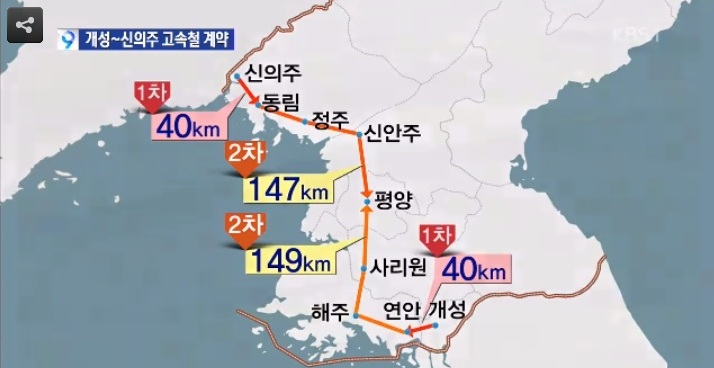
Furthermore, there are plans to link Sinuiju, Pyongyang, and Kaesong via highway and high speed rail, an investment which is expected to cost 14.1 trillion KRW. The highway is expected to cost 4.7 trillion won and the high speed rail carries an anticipated price tag of 9.4 trillion won. In order to secure funding, North Korea plans to sell underground resources and secure sources of private investment. In terms of financing procurement methods, North Korea is considering BOT (build-own-transfer), BTL (build-transfer-lease), resources development rights as collateral, etc.

Share

Mansudae Art Studio repaired German fountain

Thursday, June 6th, 2013

According to Bloomberg:

In November 2005, two Germans flew to North Korea on official business. Their goal was not to discuss nuclear disarmament or diplomatic relations. Rather, they went to check on the progress of a sculptural commission: the reconstruction of Frankfurt’s so-called Fairy Tale Fountain, an art nouveau relic from 1910 that had been melted down for its metal during World War II.

Blueprints for the original Fairy Tale Fountain had gone missing, and the City of Frankfurt needed sculptors who could work from old photographs to re-create the naked beauty gazing down on an array of cherubic children and enormous water-spewing reptiles and fish. For this intricate job, the Germans had turned to Pyongyang’s Mansudae Art Studio.

Klaus Klemp, deputy director of Frankfurt’s Museum of Applied Art, discovered Mansudae back in 2004 and was impressed enough by the craftsmanship to convince Frankfurt officials to hire the atelier. “It was a purely technical decision,” he says. “The top tier artists in Germany simply don’t make realist work anymore. North Koreans on the other hand haven’t experienced the long evolution of modern art; they are kind of stuck in the early 1900s, which is exactly when this fountain was made.” North Korea’s price tag for reconstructing the ornate bronze fountain was also attractive: €200,000, including shipping and handling.

In Pyongyang, Ministry of Culture officials escorted Klemp and his colleague, Philipp Sturm, to an expansive, well-lit factory space hung with banners touting slogans like, “When the Party Gives Orders, We Execute!” and “Self-Sustenance Is the Only Path To Survival!” There, a full-size plaster model of the German fountain stood among other works-in-progress, including a 25-foot-tall white marble statue of North Korea’s first leader, and a smaller statue of three revolutionary heroes, one of them brandishing an enormous flag.

The quality of the work was impeccable, but the Germans did have one complaint: Their art nouveau fountain had been rendered with a slightly hard, angular communist touch. “The woman had kind of a cement block hairdo,” recalls Sturm. “It wasn’t anything that couldn’t be fixed. We explained to the head sculptor that the socialist realist style wasn’t really in vogue in Frankfurt at the moment. He was very receptive and softened the look accordingly.”


Germany is the only Western democracy to have hired Mansudae’s art army, and it did so before North Korea further sank into isolation by launching the country’s first nuclear and missile tests in 2006. “There’s no question that North Korea was a criminal country, even then,” says Klemp, but Germany at the time hoped a policy of rapprochement might help the Hermit Kingdom embark on a better, more humanitarian path. “It would be very difficult to hire them today,” Klemp says.

Frankfurt’s Fairy Tale Fountain was completed entirely in North Korea, and went off without a hitch. The Germans took precautions early on to supply Mansudae’s sculptors with photos of European children, so the sculptures “wouldn’t end up looking too Korean,” says Klemp. “We knew that could be a problem, but so did they.” Once complete, the fountain got shipped from China to Hamburg, and then trucked to Frankfurt where it was installed. “We were all really pleased with the work,” says Klemp. “Everything was done on time, and everyone we worked with was exceptionally professional and personable … for me, the most interesting part was how normal it all was.”

Read the full story here:
Mansudae Art Studio, North Korea’s Colossal Monument Factory
Bloomberg
Caroline Winter
2013-6-6

Share

DPRK Money laundering in Guangdong

Wednesday, June 5th, 2013

According to to the Joongang Ilbo:

It was the end of March, about 20 days after the United Nations Security Council adopted resolution No. 2094 punishing North Korea for its third nuclear weapons test with new sanctions. At a newly built, modern-style train station in this southeastern Chinese city bordering Macau, three North Koreans in black suits with badges bearing the portrait of former leader Kim Jong-il appeared in the early evening. From the station they carried a large and obviously heavy gunny sack to a sedan parked about 30 meters (0.18 miles) away. They all got in and pulled away.

Two hours later, the sedan arrived at a high-rise building in Menggang district, Guangdong Province. Inside was an office of a private loan shark.

They entered the office on the seventh floor. One of the visitors, a middle-aged North Korean who spoke fluent Cantonese, greeted a Chinese man whom he called “Russelle.”

The North Korean dragged the sack to Russelle and opened it. Inside were bundles of U.S. banknotes. Russelle handed them to his underling and ordered him to count them with a banknote-counting machine.

After the total was confirmed, the North Korean withdrew a piece of paper with bank account numbers written on it. As in a thriller movie, Russelle began electronic banking transactions on a computer. He divvied up the total amount of cash among the accounts, sending set amounts to each. The total amount transferred: $2 million.

For helping in the money-laundering, Russelle was to receive 15 percent of the $2 million. In more urgent situations, his commission rises to 30 percent.

Several sources familiar with loan sharks in Guangzhou described these scenes to the JoongAng Sunday. The North Koreans were allegedly officials working for the Kwangson Banking Group, an affiliate of North Korea’s state-run Foreign Trade Bank, the country’s primary foreign exchange bank. The North Korean who led the shady business with Russelle was Kim Kwi-chol, head of the Kwangson branch in Zhuhai.

North Korea has, sources say, conducted illicit activities like money-laundering through Kwangson’s branches in Zhuhai and Dandong, and it is playing a role for Pyongyang similar to that of Macau’s Banco Delta Asia’s after 2005, when sanctions brought its business to a halt.

According to “Recent Financial Activities of North Korea,” a report by Kim Gwang-jin, a defector-turned-researcher at the Institute for National Security Strategy under the National Intelligence Service, Kwangson Bank is in charge of slush funds used by North Korean leader Kim Jong-un, money-laundering and remittances from banks sanctioned by the U.S. or UN Security Council.

The U.S. Treasury Department froze U.S. assets of the Kwangson Banking Corporation and prohibited U.S. citizens from doing business with the group in August 2009, accusing it of aiding the proliferation of weapons of mass destruction. Last March, it said the Foreign Trade Bank was covered by executive order No. 13382, freezing all of its U.S. assets and prohibiting U.S. financial institutions from doing business with it. In May, the Bank of China said it would stop all dealings with it.

But an expert in international finance told the JoongAng Sunday in April, “The sanctions taken by the U.S. Treasury Department against North Korea has no effect in regard to the Foreign Trade Bank.”

The head of the Zhuhai branch of Kwangson, Kim Kwi-chol, was allegedy born in Hoeyang, Kangwon Province in the North, on Nov. 19, 1955. In April 1984, he started work at the Foreign Trade Bank of North Korea and worked in a branch of the bank in China in the late 1990s, and in Libya during the mid-2000s. He moved to the branch in Zhuhai on April 13, 2003.

Sources said Kim is in charge of delivering slush funds to Kim Jong-un and other members of his elite inner circle. He’s also in charge of some large-scale money-laundering, taking advantage of Zhuhai bordering Macau. He is fluent in Cantonese and Mandarin with working experience in China for more than 10 years as a financial expert. He is allegedly living with his wife Pak Yong-hui, 57, in Zhuhai.

“He is a person who is always vigilant,” researcher Kim said.

An official investigating North Korea’s businesses in Zhuhai said, “We have recently confirmed that there are five workers and Kim Kwi-chol in the branch [in Zhuhai]. The amount of money the branch is dealing with is about $3 billion won a year, which is a bit less than that of the branch in Dandong in Liaoning Province.”

“Since Banco Delta Asia was frozen in 2005, North Korea’s funds are going through Guangzhou, Shenzhen and Zhuhai,” an official in Macau said on the condition of anonymity.

On April 30, a JoongAng Sunday reporter visited a residential complex in Zhuhai, where several sources alleged the Kwangson Banking Group’s Zhuhai branch was located. The complex was composed of three separate apartment buildings with a front gate that required a security code for entrance. The JoongAng Sunday reporter sneaked into the complex when some residents punched in their codes.

However, when the reporter reached the office of Kwangson, there was no sign on its door. Although the reporter pressed the doorbell, no one answered. A security guard at the building said: “I have not heard of Kwangson Banking Group.”

Sources said the office kept as low a profile as possible. A resident of the complex who has seen the office said, “It’s not that large with several workers at the desks looking at financial terminals. The atmosphere was bleak.”

“Recently, the Hong Kong financial authorities launched a probe into Kwangson bank’s branch in Zhuhai, on suspicion of starting a shell company in Hong Kong under a fake name and working on money-laundering,” an official at a corporate intelligence service in Hong Kong said.

The official said the company was registered to a woman who doesn’t live in Hong Kong but in mainland China. Starting several years ago, more than $100 billion has been remitted to her accounts, raising suspicions she could be connected to the Kwansgon branch in Zhuhai.

A similar front company, Leader (Hong Kong) International Trading Company, was sanctioned by the U.S. Treasury Department in January.

“Since the incident with Banco Delta Asia, most North Koreans staying in Macau left due to tightened supervision of money-laundering,” a source said. “However, they still had to keep in touch with their clients and partners in Macau, so they chose Zhuhai, bordering Macau, as an alternative.”

Currently, North Korea’s two major state-run banks are its Central Bank and the Foreign Trade Bank. The Foreign Trade Bank is in charge of foreign currency.

Although the Kwangson Banking Group officially belongs to the Foreign Trade Bank, in fact, it is a special organization that deals with foreign currency that is dubbed the “revolution fund.” The bank’s other name is Bureau 711.

“Kwangson Banking Group is a special financial organization in charge of slush funds of the Kim family under the direct control of Kim Kyung-hui, younger sister of the late leader Kim Jong-il,” Kim Gwang-jin said. “The group’s branch in Dandong was founded in September 2002 and another one in Macau was moved to Zhuhai after the problems with Banco Delta Asia starting in 2005.”

“After Banco Delta Asia, the foreign currency business of normal North Korean banks was paralyzed, but the Kwangson Banking Group has led the money-laundering business with the full support of the North Korean elite.”

Kim said there are three financial experts specializing in foreign currency in North Korea – Ri Tong-rim, president of the Kwangson Banking Group, Kim Kwi-chol, head of the Zhuhai branch and Ri Il-su, head of the Dandong branch.

Ri, the 57-year-old executive, was born in Songgan County, Chagang Province. He started as a manager at the Foreign Trade Bank in 1980 and became president of the 711 Bureau, the Kwangson bank, in 2004.

“When the Soviet Union collapsed, he collaborated with the Russian mafias and successfully withdrew $4.5 million from a bank in the USSR,” Kim said.

Ri Il-su, head of the bank’s Dandong branch, is assumed to be in his mid-50s. He was a vice president of the Foreign Trade Bank’s branch in Zhuhai and vice president of the 711 Bureau in the mid-1990s.

In June 2006, he signed an agreement with the China Construction Bank’s branch in Dandong over founding a joint bank in a border region between China and North Korea. The joint bank is in charge of foreign currency in three provinces in northeastern China.

“Under the agreement, if the Dandong branch remits money to a local bank in the three provinces first, then the Chinese bank resends the money to another bank in China or a third country for money-laundering,” Kim said. “Although the Bank of China or other major banks ban North Koreans opening accounts, other small-scale banks allow it.”

The Kwangson bank reportedly has a branch in Shenzhen, southern China, but its head is unknown.

“In the financial sector in Hong Kong, it’s said that Kwangson bank’s Zhuhai branch is earning big profits through gold investment, stock transactions and foreign exchange,” an official at a croporate intelligence service in Hong Kong, said. “A rumor says that when North Korea shelled the South Korean island of Yeonpyeong in November 2010, the branch bought a bunch of stocks of South Korean companies whose prices drastically dropped because of the shelling and made huge profits.”

“It is really urgent to stop the illicit activities of these North Koreans in China,” a South Korean government official said. “It is actually impossible to impose effective sanctions against North Korea without the full help of the Chinese government.”

Read the full story here:
North money laundering done in Guangdong
Joongang Ilbo
Ahn Sung-kyoo
2013-6-5

Share

An affiliate of 38 North