The North Korean authorities have ordered the formation of ‘Day of the Sun Gift Preparation Committees’ at the provincial Party level and subordinate ‘Day of the Sun Gift Subcommittees’ at the city and county scale, Daily NK has learned.
A Yangkang [Ryanggang] Province source who spoke with Daily NK on the 6th explained, “The ‘Day of the Sun Gift Preparation Committee’ was formed at the start of this month by the provincial Party Committee to prepare for the Suryeong’s birthday, and groups of areas were banded together to form the ‘Day of the Sun Gift Subcommittees’.”
“There was no distribution for February 16th,” the source recalled. “Possibly because the central Party received reports of popular discontent about this and asked some searching questions of provincial cadres, now they are running around trying to get ready for April 15th holiday distribution.”
“Enterprise traders are mostly bringing in soy bean oil, soap and towels via Chinese customs. They are printing ‘Day of the Sun 100th Anniversary’ on the towels,” he added.
The formation of the committees has also reportedly had a noticeable influence on levels of public expectation of the April 15th festivities, representing as it does the first time that ‘Gift Preparation Committees’ have been formed since they disappeared without a trace in the mid 1990s.
“They are already saying that each household is going to receive a huge gift for this Day of the Sun, so people are really expecting a lot,” the source said, adding, “The rumor among jangmadang traders is that every house is going to get a DVD player made by Hana Electronics in Pyongyang.”
As the source noted, the move comes following significant public discontent at the lack of gifts on February 16th (Kim Jong Il’s birthday).
On February 21st, Daily NK reported new of that discontent, citing a Yangkang Province source as saying, “There was a flood of criticism about the total lack of holiday distribution for Gwangmyungsung Day, so they began telling every organ, enterprise and people’s unit meeting, ‘That is because we are close to the 100th anniversary of the Suryeong’s birth, and the Party is preparing big gifts for that.’”
North Korea began giving snacks, rice and other foodstuffs to the people every year on the birthdays of Kim Il Sung and Kim Jong Il, along with things like school uniforms and blankets every 5th and 10th year, in the 1970s. However, the system ceased to function in the 1990s as the country was gripped by famine and economic disintegration.
Meanwhile, sources also report that with the arrival of the early spring lean season, a time when many people on the Korean Peninsula have traditionally struggled to find sufficient sustenance, prices in the market are beginning to creep up.
According to the Yangkang Province source, “Until late last week the Yuan price was 607 won, but now it is up to 635 won. The price of rice has also gone from 3,300 won to 3,800 won.”
Read the full story here:
North Forms Party 4.15 ‘Gift Preparation Committees’ Daily NK
Lee Seok Young
2012-3-5
North Korea is likely to make an official announcement of its new economic development plan in April to commemorate the centennial anniversary of Kim Il Sung’s birthday, which is also celebrated as a national holiday in North Korea as the “Day of the Sun.” In addition to the new economic plan, North Korea is also planning to align organizations and establish appropriate legislations in the foreign economic sector. The Daepung Group was recently consolidated with the Joint Venture and Investment Committee (JVIC).
According to an unnamed North Korean source, “many organizations in North Korea with overlapping functions or with unsatisfactory performance were merged as a part of promotion of North Korean socialism. The Daepung Group was merged as a bureau under the JVIC.”
The two chiefs of the Daepung International Investment Group (Daepung Group) were Workers’ Party of Korea (WPK) Unification Strategy Department Director Kim Yang Gun, who served as the chairman of the board, and Pak Chol Su, a Korean-Chinese businessman, who headed the group as the president and elected standing vice-chairman. They were in charge of attracting large foreign investment needed for the “10-Year State Strategic Plan for Economic Development (2011-2020).”
The WPK Director of Administration Jang Song Thaek is in charge of the Daepung Group and the JVIC and is likely to have ordered the merge of the two organizations to increase work efficiency. Kim Yang Gun’s position as the head of Daepung weakened after the souring of inter-Korean relations despite his efforts to bring investment from the South. As a result, Kim will likely step down from his position and Pak Chol Su and the executive management of the JVIC will likely manage the Daepung Group in the future.
The JVIC has also faced changes in its organization with the appointment of Ri Gwang Gun as the new head of the JVIC. Other foreign investment companies and related organizations were merged and the roles of the directors were revised.
The Beijing office of the JVIC has opened its doors in December 30 last year. North Korea is likely to dispatch experts and professionals from various organizations to provide “one-stop service” to attract more investment to North Korea, starting from this April.
Kim Chol Jin is the person in charge of the JVIC Beijing Office. The Rason Special Economic Zone (SEZ) and Hwanggumpyong SEZ will have a change in leadership, as Hong Suk Hyong will replace Kim Il Young as the new vice-chairman.
The previous chairman of the JVIC, Ri Su Yong, who was also the former ambassador of the DPRK to Switzerland, is now serving as the new advisor to Kim Jong Un at the Secretary’s Office.
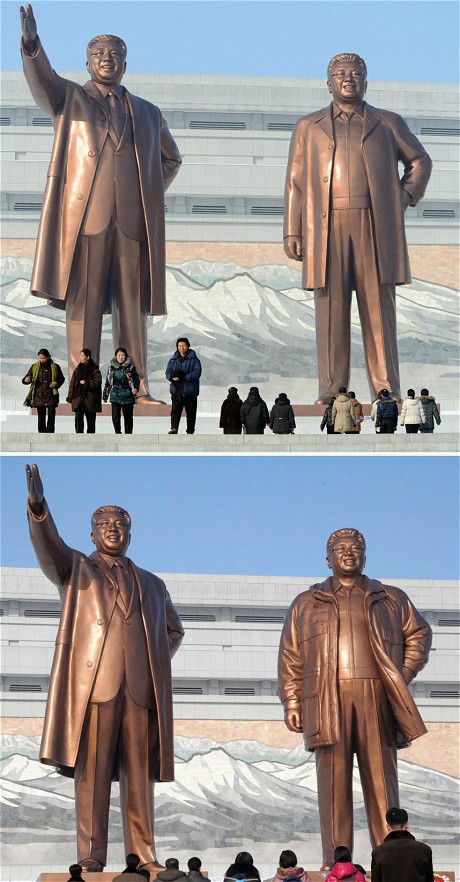
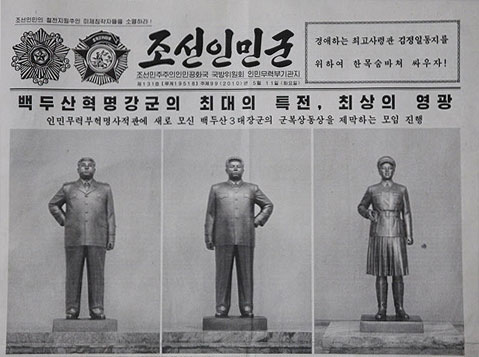
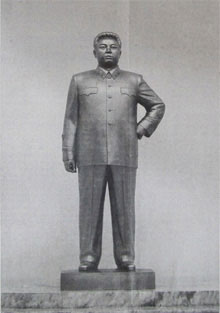
UPDATE 4 (2013-1-10): Kyodo (via The Telegraph) solves the riddle of just why the Kim statues on Mansu Hill were covered up in October 2012 (See below)–a new version of the Kim Jong-il statue was put up. It replaced a statue that was erected in April 2012.
Below is a before/after comparison.
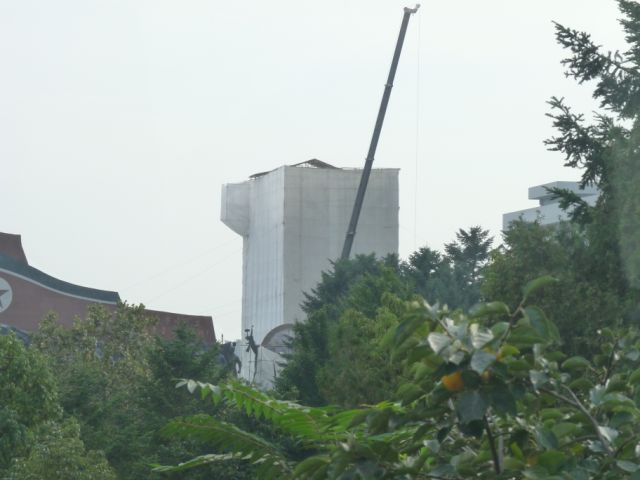
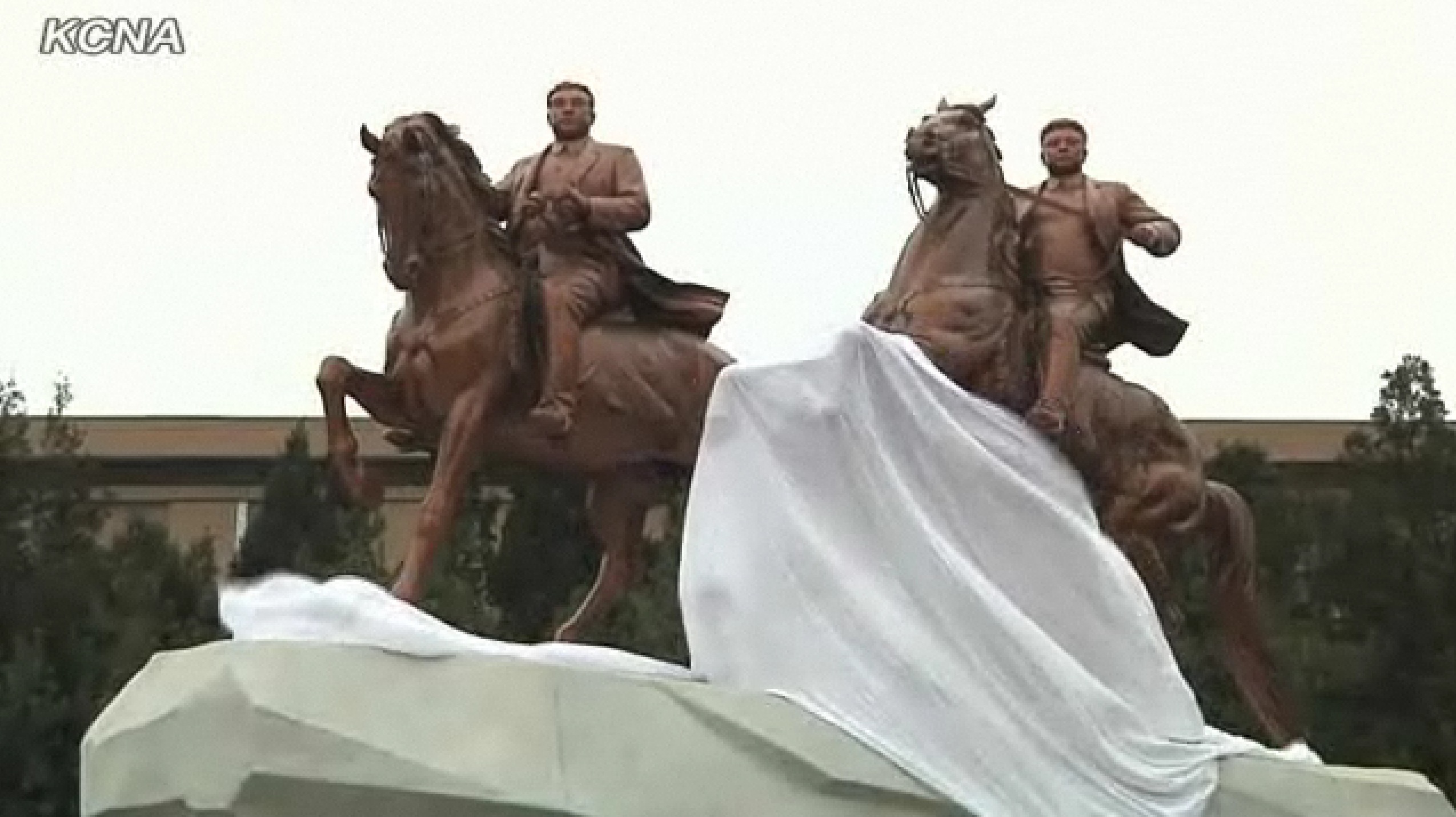
UPDATE 3 (2012-10-3): A reader sends in this image of the statues covered up.
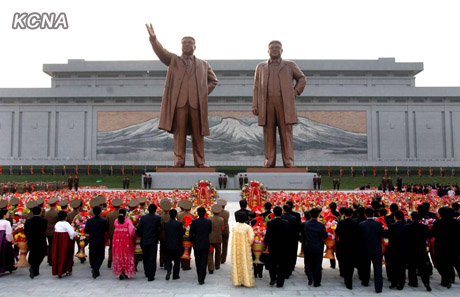
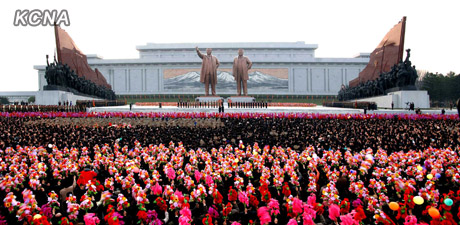
Statues of President Kim Il Sung and leader Kim Jong Il were successfully built on Mansu Hill.
The statues portray smiling Kim Il Sung who indicates the way ahead with his hand held forward and smiling Kim Jong Il blessing Songun Korea prosperous morrow while looking far into its bright future in the new century.
Large sculptures on both sides of the statues have been renovated on the highest level.
The unveiling ceremony took place with splendor Friday.
There were huge crowds of people from all walks of life, servicepersons, youth and students, 300 000 in all, on Mansu Hill and nearby streets. They were holding bouquets and balloons.
Supreme leader of the Workers’ Party of Korea and the people of the DPRK Kim Jong Un, first secretary of the WPK, first chairman of the National Defence Commission of the DPRK and supreme commander of the Korean People’s Army, was present at the opening ceremony.
Present there were senior party, state and army officials, chairpersons of friendly parties.
Also on hand were delegates to the celebrations of the centenary of the birth of the President, creators, officials and employees of the Mansudae Art Studio, officials of the party, armed forces and power bodies, social organizations, ministries and national institutions, anti-Japanese revolutionary fighters, anti-Japanese patriotic martyrs, servicepersons of the Korean People’s Army and the Korean People’s Internal Security Forces (KPISF), officials in the fields of science, education, literature and arts, public health and media, heroes, bereaved families of revolutionary martyrs, men of merits and working people in the city.
Also present there were a delegation of the Koreans in Japan and delegations of overseas compatriots and overseas Koreans, the chief of the Pyongyang mission of the Anti-Imperialist National Democratic Front, diplomatic envoys of different countries and representatives of international organizations here and foreign guests who are participating in the World Congress on the Juche Idea, the international festival and the April spring friendship art festival.
The statues were unveiled by senior party, state and army officials.
The moment thunderous cheers of “Hurrah!” resounded forth, fireworks were displayed and balloons were released.
Laid before the statues were large floral baskets in the joint name of the Central Committee of the WPK, the Central Military Commission of the WPK, the National Defence Commission of the DPRK, the Presidium of the Supreme People’s Assembly, Cabinet and in the name of all the Korean people.
Laid were floral baskets in the name of ministries, national institutions, armed forces organs, provinces, cities, counties, important units which were visited by the President and Kim Jong Il, units of the KPA and the KPISF, party and power bodies and factories, enterprises, co-op farms, universities, colleges and schools in Pyongyang and local areas.
Floral baskets were also laid by the diplomatic corps and the military attaches corps here and foreign guests and overseas compatriots.
All the participants bowed to the statues.
Kim Yong Nam, member of the Presidium of the Political Bureau of the WPK Central Committee who is president of the Presidium of the Supreme People’s Assembly of the DPRK, made a speech.
He said that Kim Jong Un instructed to build the statue of Kim Jong Il on Mansu Hill together with that of Kim Il Sung and energetically led the work to build them on the highest level in the shortest time possible.
It was possible to erect the statues on the highest level in a matter of some 100 days thanks to the yearning and devotion made by all the soldiers and people, overseas Koreans and the world progressives.
This great auspicious event is a precious fruition of the noble moral obligation of Kim Jong Un and his energetic leadership. It is also a striking manifestation of the unshakable will of the army and people of the DPRK to hold Kim Il Sung and Kim Jong Il in high esteem for all ages.
A new statue of Kim Jong Il on a horse was unveiled at Mansudae Art Studio on the 15th Feb. It has been placed alongside the one already existing there of Kim Il Sung on a horse. It also appears that they are making a new large statue of Kim Jong Il which will go on Mansu Hill next to the one of Kim Il Sung there which is currently covered up. This is expected to be completed by April.
UPDATE 1 (2012-2-21): According to the Korea Times, this store is now providing people with a legal window to exchange local for hard currency:
North Korea is apparently allowing foreign currency to be exchanged at unofficial, black market rates at a newly-renovated department store in Pyongyang, according to a diplomatic source who recently visited the country, Tuesday.
The source said people could exchange euros, dollars and yuan at kiosks at Kwangbok Area Supermarket, which recently opened after refurbishment and is said to resemble department stores in the South. The North has long kept the value of its local currency artificially high.
Euros were being exchanged at the rate of one euro for 4,420 North Korean won, while the official rate is around 130 won per euro, the source said.
“They are exchanging hard currency at a rate that seems to be an unofficial rate,” the source told The Korea Times. “People can also shop at the department store using foreign currency by taking their receipts to the booths.”
…
The source added that the exchange rates were written on a board inside the kiosks.
ORIGINAL POST (2012-1-6): See the original post below.
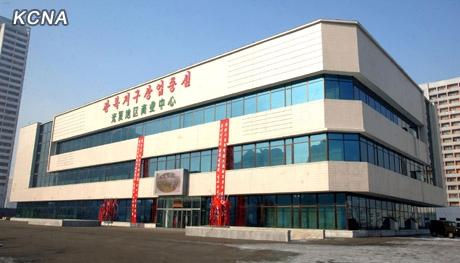
Pictured Above: (L) The original facade of the “Kwangbok Department Store (광복백화점)”. (R) The new facade of the “Kwangbok Area Supermarket (광복지구상업중심)”
Here is KCNA coverage of the opening of the facility (Posted to YouTube):
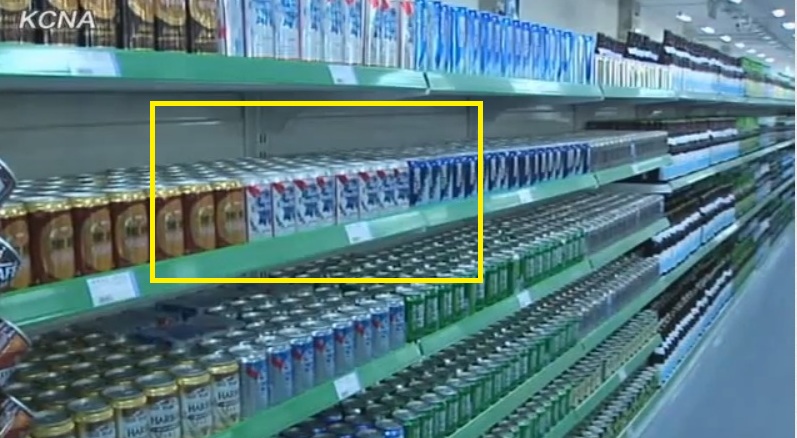
Astute observers will notice the American beer, Pabst Blue Ribbon, featured prominently in the beer section.
Here is coverage of the opening in KCNA (2012-1-5):
Pyongyang, January 5 (KCNA) — The Kwangbok Area Supermarket was opened with due ceremony on Thursday.
All business service at the supermarket built as a commercial service center has been put on IT and digital basis. Customers can buy varieties of goods according to their taste and requirements in the sales rooms on each floor stacked with household appliances, electronic products, foodstuff, fibre, sundries and others.
Present there were officials concerned, officials of the Korea Taesong General Trading Corporation, officials and employees of the Kwangbok Area Supermarket, members of the Feihaimengxin Trading (Beijing) Co. Ltd. staying in the DPRK and the Chinese embassy here.
O Ryong Il, general president of the Corporation, said in his speech that the work to build the supermarket was successfully completed under the energetic leadership of leader Kim Jong Iland the dear respected Kim Jong Un and the positive efforts of the peoples of the two countries.
He expressed belief that the supermarket would help towards improving the people’s living standard and promoting the well-being of the two peoples through better service and management.
Xue Rifei, executive managing director of the Feihaimengxin Trading (Beijing) Co. Ltd., said in his speech that Kim Jong Il and Kim Jong Un gave field guidance to the supermarket on December 15, 2011 and named it the Kwangbok Area Supermarket.
He expressed the expectation that an effort will be made to reenergize the supermarket to win high appreciation for its best management, service and credit.
The Korea Taesong General Trading Corporation is a sanctioned organization, and according to the US Treasury, it is a “key node” in the illicit activity of Office 39. According to NK Leadership Watch:
One of the participants at the opening ceremony was Jon Il Chun (Chon Il-chun), deputy director of the Korean Workers’ Party’s Finance and Accounting Department and section chief of Office #39. Mr. Jon accompanied Kim Jong Il on a visit to the Kwangpok store in mid-December 2011, which was KJI’s last reported public appearance before his death.
On a more casual note, the supermarket marks a point of administrative departure from the way department stores are typically managed in socialist countries. The Kwangbok Department Store (the former name) was one of Pyongyang’s premier formal retail outlets. For decades it operated in the same way as other socialist department stores: customers ended up standing in three lines before they were able to collect their merchandise (one line to order, another line to pay, and another line to pick up). The new Kwangbok Supermarket has adopted a market-style check out line. Though unnoticed by foreigners, this is the first such check out line I have seen in a North Korean department store.
The supermarket is supplied with home and foreign-made products which are in demand in the country.
Although I have not acquired data specific to this store, I believe it is reasonable (even rational) to assume that if the supermarket sells imported goods it will charge had currency for them. This opinion is based on the following assumptions: 1. The Chinese investors will not accept North Korean won under any circumstances. 2. The goal of Office 39 is to acquire hard currency for the Kim family. 3. North Korean retail outlets frequently post prices in multiple currencies so I don’t see any reason why it would be different here. Today a plurality of North Koreans can easily acquire foreign exchange.
Here is my working assumption of the business model: Chinese partner acquires merchandise and imports it to the DPRK. Sales in hard currency go towards allowing the Chinese supplier to recover its costs. Chinese partner either earns a profit from a markup it charges Kwangbok or it divides the profit with Office 39 along some agreed percentage.
If Chinese profits are earned from a cost-plus markup that it charges Kwangbop, then the partnership is closer to an exclusive supplier deal rather than a true joint equity deal. The North Koreans could cheat on this deal by finding cheaper suppliers and decreasing its purchases from the Chinese partner. If after-sales profits are split between the Chinese and Office 39, then both partners will need auditors on hand to make sure the books are accurate. The Chinese partner will also need a good relationship with the Chinese embassy if it runs into problems with the DPRK managers should they unilaterally change the terms of the contract (the split).
The statues of President Kim Il Sung and leader Kim Jong Il riding on horses together were erected at the Mansudae Art Studio with approach of the Day of the Shining Star.
Their construction, the first of its kind in the history of the Workers’ Party of Korea and the Korean revolution, is a great glory and pride of Kim Il Sung’s nation and Kim Jong Il’s Korea.
A ceremony of unveiling the statues took place on Tuesday.
Present there were senior party, state and army officials Kim Yong Nam, Choe Yong Rim, Ri Yong Ho, Kim Yong Chun, Kim Ki Nam, Choe Thae Bok, Yang Hyong Sop and Kang Sok Ju, officials of party, military and power bodies, social organizations, ministries and national institutions, men and
officers of the Korean People’s Army and the Korean People’s Internal Security Forces, officials and employees of the Studio and working people in the city of Pyongyang.
Senior officials of the party, state and army and officials of the studio unveiled the statues.
Laid at the statues is a floral basket from Kim Jong Un, supreme leader of the WPK and the people and KPA supreme commander.
Placed were floral baskets in the name of the WPK Central Committee, the Presidium of the DPRK Supreme People’s Assembly, the DPRK Cabinet, the Ministry of the People’s Armed Forces, the Ministry of People’s Security, working people’s organizations, ministries and national institutions,
units of the KPA and party and power organs in the city.
The participants made bows to the statues.
Kim Yong Nam, member of the Presidium of the Political Bureau of the C.C., the WPK and president of the Presidium of the SPA, made an address at the ceremony.
It was the unanimous desire and ardent wish of all the Party members, servicepersons and people to erect a statue of Kim Jong Il as well as Kim Il Sung’s in order to hand down for all ages the prominent traits and revolutionary feats of the illustrious great man, the speaker said, adding:
This ardent desire has been realized thanks to Kim Jong Un’s boundlessly noble loyalty and meticulous guidance.
He called for glorifying the revolutionary careers and undying feats of Kim Il Sung and Kim Jong Il forever with the immutable faith that they are always with us.
The participants looked round the statues after being briefed on them.
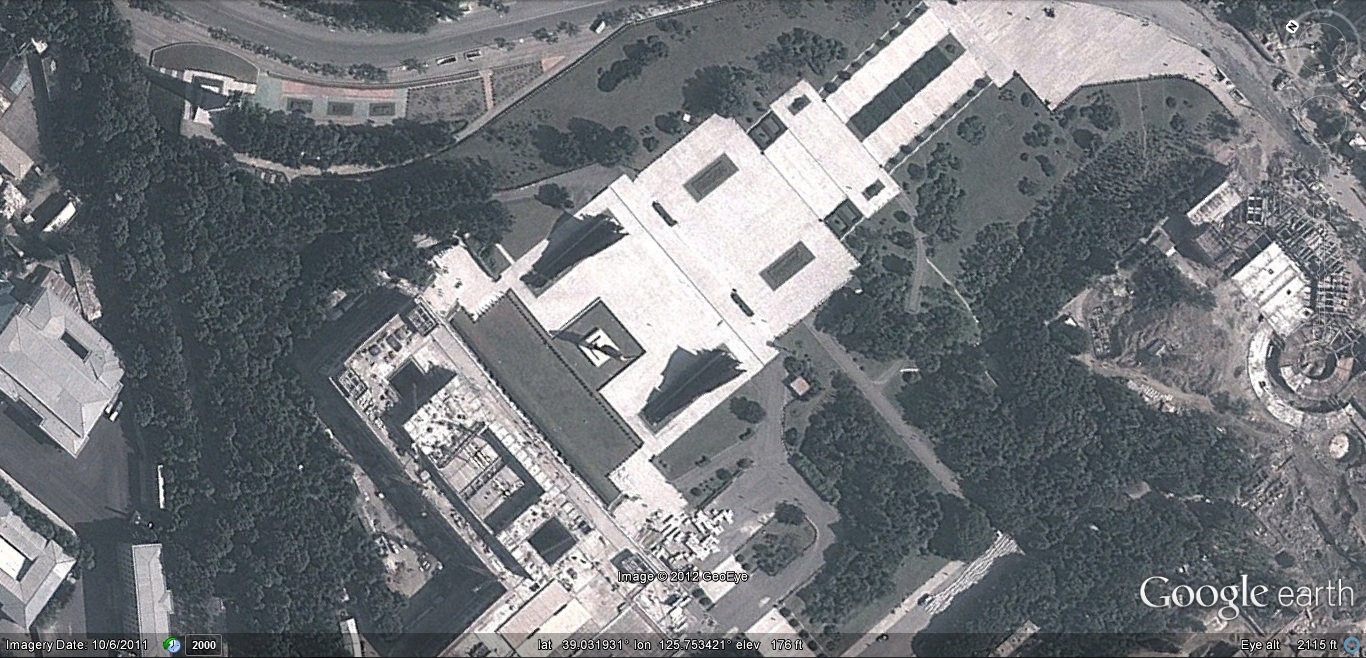
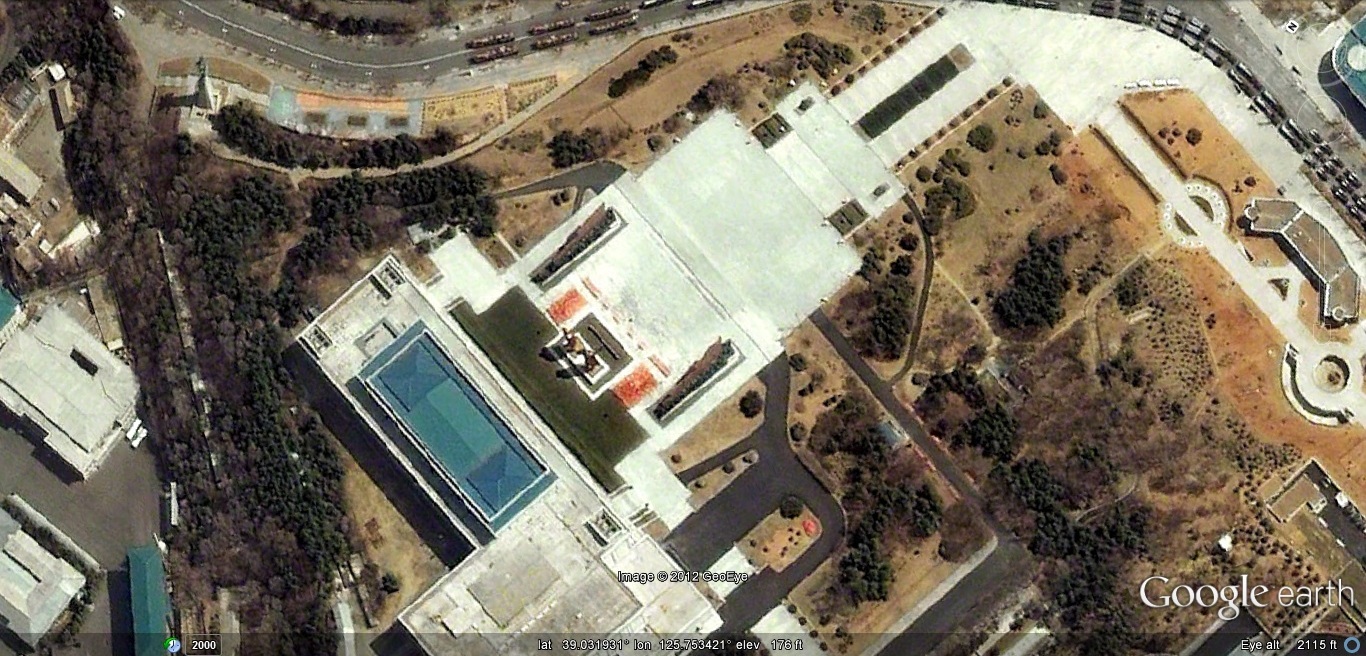
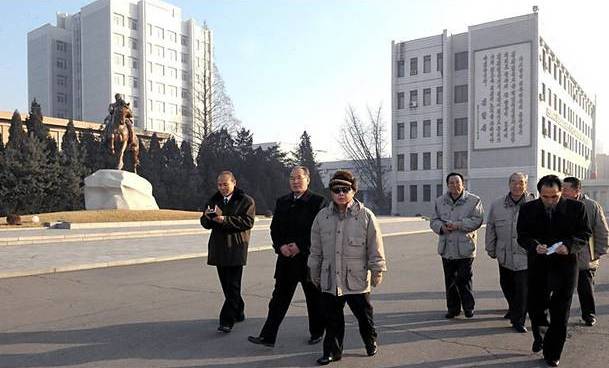
Though the unveiling displayed BOTH Kim Il-sung and Kim Jong-il statues, there was previously a Kim Il-sung statue located at this exact spot. I am not sure if this statue has been decommissioned, moved, or incorporated into the new sculpture:
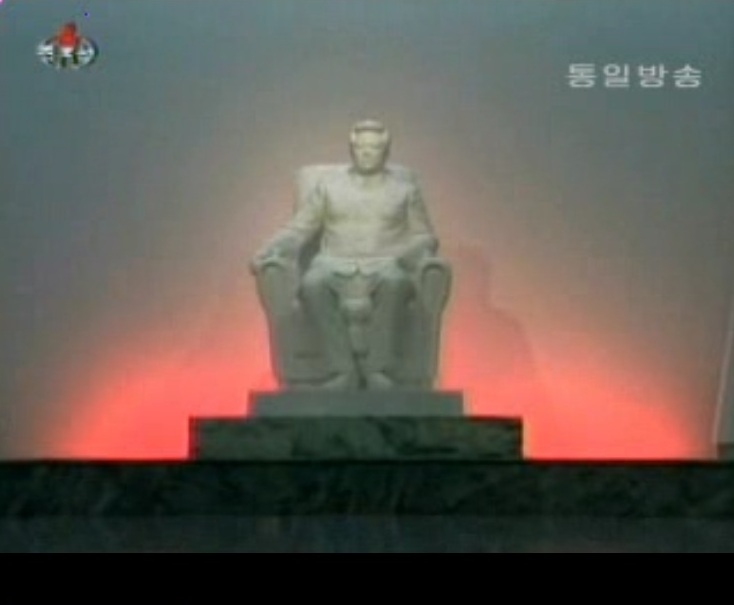
This is only the third Kim Jong-il statue of which I am aware–and the first located outside.
There is a Kim Jong-il statue at the International Friendship Exhibition in Myohyangsan:
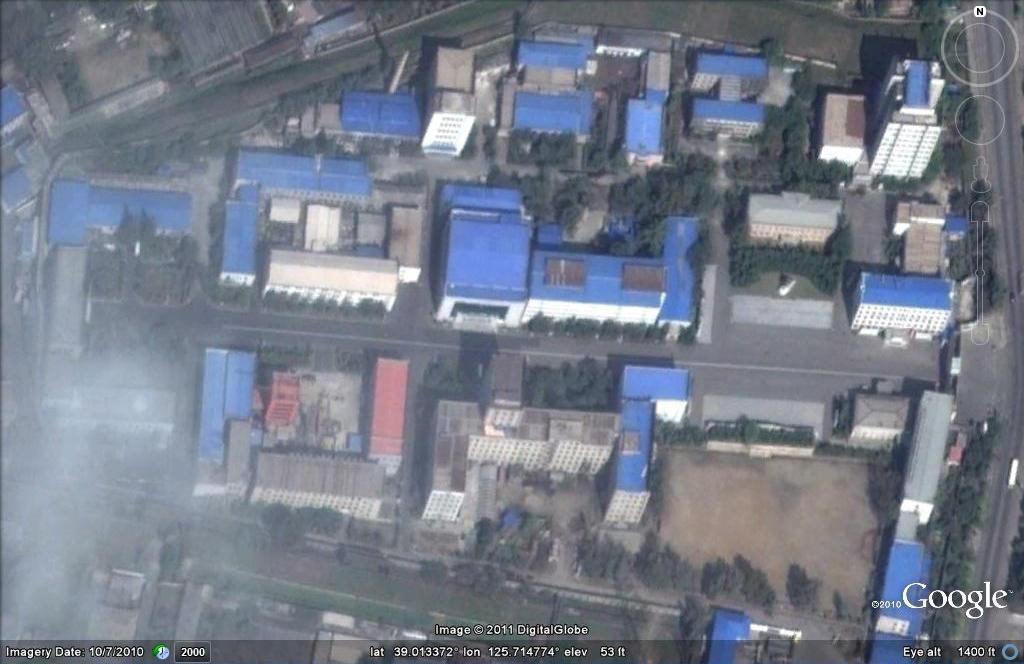
Both the Kim Il-sung statue and the Kim Jong-il statues were manufactured on location at the Mansudae Art Studio:
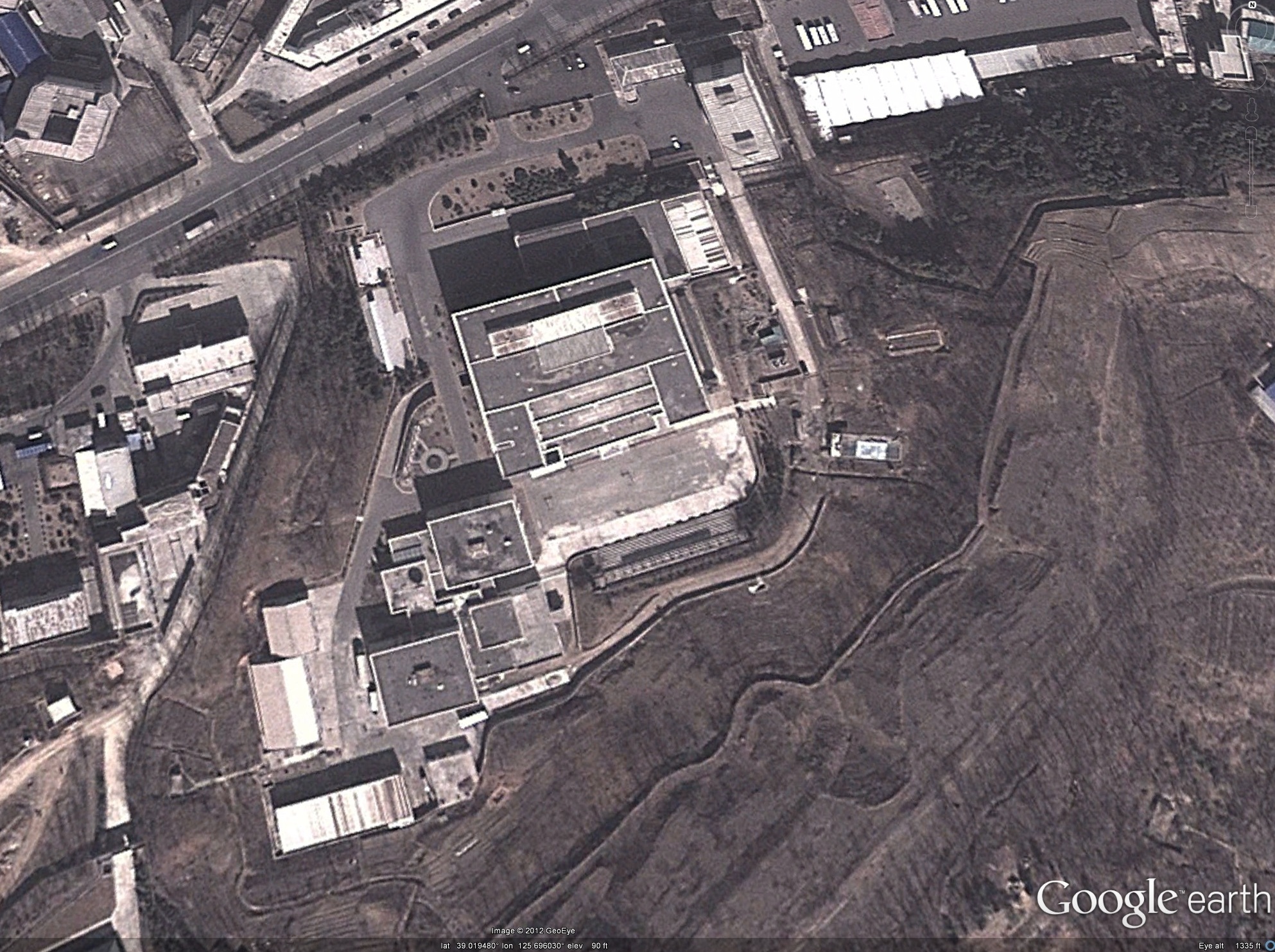
Pictured above (Google Earth): The Mansudae Art Studio in Pyongyang. The blue roofs indicate that most of the buildings have recently been renovated.
At the same time, the Daily NK reports that Kim Jong-un has asked that the costs of memorializing his father not be passed on the people (like this).
UPDATES related to the celebrations of Kim Jong-il’s 70th birthday:
1. Kim Jong-il also named “Generalissimo” — a title previously reserved for his father, Kim Il-sung. This clears the way for Kim Jong-un to be promoted to “Marshal”. Many officers were also promoted and awarded the Kim Jong-il Prize. Daily NK coverage here.
2. Commemorative gold and silver coins were issued to celebrate Kim jong-il’s 70th birthday. See more here and here.
As we mentioned recently, Ri Chol, the broker of the Orascom deal, has moved on from JVIC. Where he has gone is not yet certain, but the choice for his replacement is interesting.
Ri Gwang Gun is the new head of JVIC and was introduced as such to the CEO of Orascom last week. Ri Gwang Gun has held various positions related to trade, including executive positions at state owned enterprises and as Minister of Foreign Trade. He apparently reports to Kim Yang Gon.
He was (is?) a Daepung Investment Group man. We’ve speculated that the existence of both Daepung and JVIC reflected a kind of “competition at the top” for influence in attracting and managing investments. They were both formed around the same time in 2009/2010 and have similar charges. Therefore, Ri Gwang Gun’s promotion could indicate a potential harmonizing of this competition.
Of course, the contours of this are difficult to see. Daepung, with stronger ties to the NDC, could be construed as taking over the JVIC from the top; perhaps the military has been able to exert itself to make sure that in the new leadership era, it does not get shut out of the investment game. (JVIC has become the more active and influential of the two groups.)
It could also be seen as a victory for JVIC, with Daepung being left to crumble and the top talent from that group being brought across. It remains to be seen if there will be some kind of exodus from either group.
Perhaps, also, it is some kind of compromise and a merger of sorts, with competing groups of elites ‘buying in’ to a unified system of investment management under the JVIC brand. They may see this as a way to increase effectiveness, avoid the negative outcomes of unfettered intra-elite competition and therefore encourage stability overall.
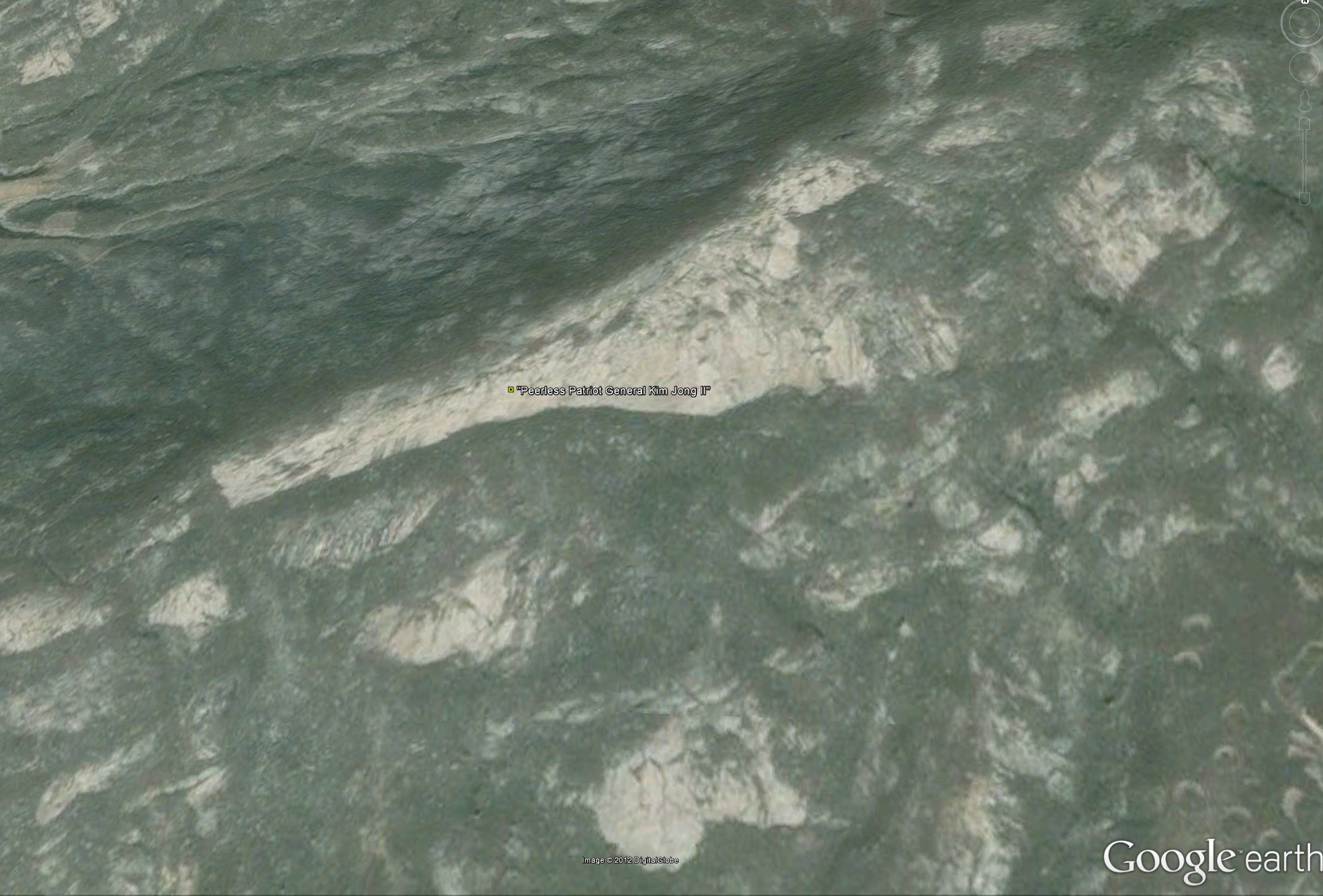
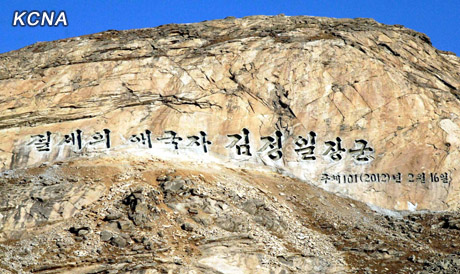
Pictured above: (L) A Google Earth satellite image of the face of Mt. Sokda (석다산) before it was “blessed” with the Kim Jong-il commemorative carving (Coordinates: 39.180907°, 125.361290°) (R) A photo from KCNA of the new carving.
According to KCNA:
Pyongyang, February 8 (KCNA) — Letters “Peerless Patriot General Kim Jong Il. February 16, Juche 101 (2012)” were carved on natural rock in Mt. Sokda, Jungsan County, South Phyongan Province on the 70th anniversary of his birth.
The total length of the letters is 120 meters with his name 10 meters high, 5.5 meters wide and 1.4 meters deep. Other letters are 8.5 meters high, 4.8 meters wide and 0.9 meters deep.
Officials and working people in South Phyongan Province chose the rock that is easily visible, reflecting the ardent desire of the people
around the country to exalt his immortal revolutionary feats forever.
An unveiling ceremony took place on Wednesday.
Present there were Kim Ki Nam, Choe Thae Bok, Yang Hyong Sop officials concerned, party members and other working people in the county and helpers.
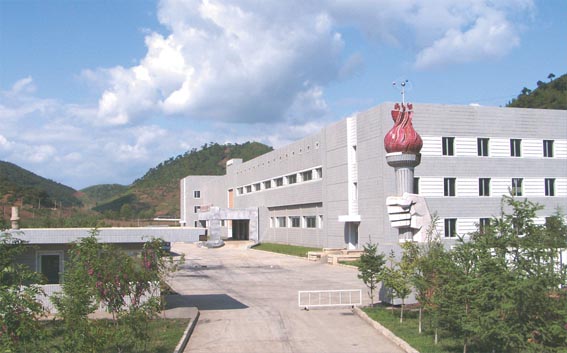
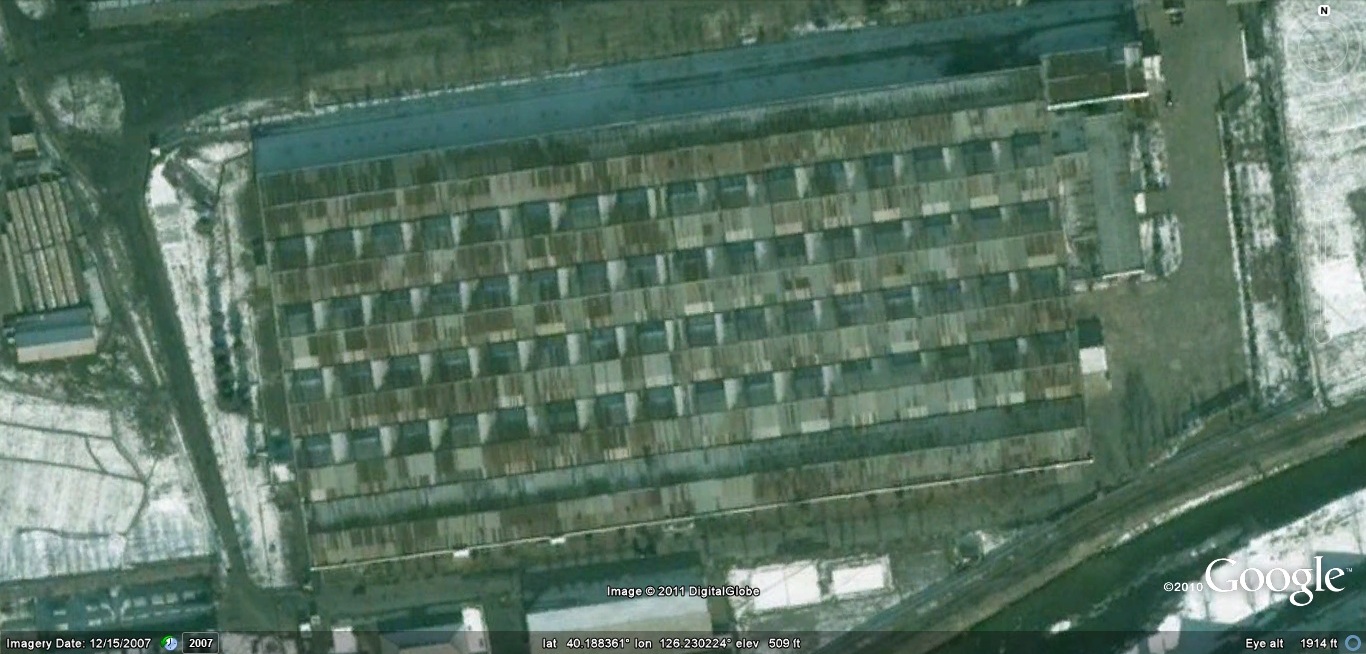
The company that is tasked with producing and selling CNC is Ryonha, through its subsidiary, Unsan. The company had a booth at the recent International Trade Fair in Rason, held in North Korea’s Special Economic Zone in the far Northeast, bordering Russia and China. Their booth was staffed by a Vice President and – as one might expect – attracted lots of attention from the locals in attendance.
The president claimed annual exports of 30,000,000 euros to Europe, South America and South East Asia. He didn’t have exact details on profits, but mentioned that Unsan imported 10,000,000 euro worth of parts, mostly from Europe, such as control units and electronic relays Siemens and Arno. Their main CNC factory is 40,000 sq. meters and the “biggest in the world” according to the manager. They have two facilities, one in Pyongyang and one in Jagang with 12,000 employees in total. They want to open a factory in Rason, ideally without investors. Prices were said to be: 150,000 EUR for a European made CNC machine but only 52,000 EUR for an equivalent machine made in the DPRK, with the “same quality”.
Unfortunately for Ryonha, it seems to be a subsidiary of the Korea Ryonbong General Corporation, which is under UN sanctions as a WMD proliferator. This no doubt impacts Ryonha’s ability to market itself to customers abroad. Ryonha also doesn’t seem to have a website, which can’t help, either.
Should Ryonha’s parent corporation be taken off the UN’s list of designated proliferators, it will find easier access to a global CNC market that was $6.1 billion in 2007, before the financial crisis hit. The market has contracted since then, as the crisis left a global glut in inventory in 2009, which has taken well into 2011 to clear. The sharply reduced demand, particularly from automakers, has made the CNC market particularly competitive, though a sustained economic recovery would eventually drag the industry back up to pre-crisis levels.
It’s difficult to know what kind of impact Ryonha might have on the global CNC industry, as customers and vendors alike are probably reluctant to trumpet where their machines are made. One of the effects of sanctions has been that companies try to hide their tracks when conducting business with the DPRK, even when the industry is unrelated to sanctioned items. This is sometimes done through an extra layer (or two) of outsourced contracts, or with textiles, sometimes just label-switching. This is tough to do with bigger machines, of course, leaving North Korean CNC machines facing perhaps understandable prejudices.
Its impact on the domestic market will be more significant, of course, reducing the need to spend hard currency on imported CNC machines from China and elsewhere. Perhaps then, this import substitution will allow the DPRK to use that unspent capital on projects that actually benefit the daily lives of its citizens.
Prosecutors indicted two executives of small trading houses in Nagoya and Tokyo on Wednesday on charges of exporting used personal computers to North Korea in violation of Japanese government trade sanctions.
Lee Mun Ryang, 61, in Nagoya, and Kaoru Morino, 44, in Tokyo, allegedly exported used PCs and other items worth a total of 8.2 million yen to North Korea in June and December 2010, according to the Osaka District Public Prosecutors Office.
The exported goods are believed to have been delivered to the Korea Computer Center, North Korea’s governmental information technology research center set up by late North Korean leader Kim Jong Il.
Both Lee and Morino were quoted by prosecutors as saying they knew that the goods would be delivered to the KCC.
Japan has imposed a total ban on exports to North Korea since June 2009 in protest at its nuclear program.
Lee and Morino began exporting daily necessities to North Korea in 2006, according to investigative sources.