Archive for the ‘South Korea’ Category

What is the DPRK-China realtionship

Tuesday, July 11th, 2006

An interesting strategic analysis fo the DPRK/PRC realtionship in a regional competition context.  From the Council on Foreign Relations:

Introduction
China and North Korea have been allies for more than half a century. Beijing is a key provider of food and fuel to Kim Jung-Il’s regime, and it is heavily invested in preventing a destabilizing regime collapse that would send North Korean refugees flooding across its northeastern border. But as Kim tests ballistic missiles and develops his nation’s nuclear weapons capacity, China may be rethinking its support.

How strong is the current relationship between North Korea and China?
China has supported North Korea since Chinese fighters flooded onto the Korean peninsula to fight for the Communist Democratic People’s Republic of Korea (DPRK) in 1950. Since the Korean War divided the peninsula between the North and South, China has given both political and economic backing to North Korea’s leaders: Kim Il Sung, and his son and successor, Kim Jung-Il. In recent years, China has been seen as one of the authoritarian regime’s few allies.

On July 4, North Korea test-fired a series of ballistic missiles despite explicit warnings from Beijing, Tokyo, and Washington. This led to an unusually public rebuke from Chinese officials, a sign of strain in the relationship. Despite their long alliance, experts say Beijing cannot control Pyongyang. “In general, Americans tend to overestimate the influence China has over North Korea,” says Daniel Pinkston, a Korea specialist and director of the East Asia nonproliferation program at the Center for Nonproliferation Studies in Monterey, California. At the same time, China has too much invested in North Korea to halt or withdraw its support entirely. “The idea that the Chinese would turn their backs on the North Koreans is clearly wrong,” says Adam Segal, the Maurice R. Greenberg senior fellow for China studies at the Council on Foreign Relations.

How does North Korea benefit from the relationship?
Pyongyang is economically dependent on China, which provides most of its food and energy supplies. North Korea gets about 70 percent of its food and 70 to 80 percent of its fuel from China. Beijing is Pyongyang’s largest trading partner, and an estimated 300,000 North Koreans live in China, many of them migrant workers who send much-needed remittances back home.

China is also a strong political ally. “As an authoritarian regime that reformed, they understand what Kim Jung-Il is most concerned with—survival,” Segal says. China has repeatedly blocked UN Security Council resolutions against North Korea, including some threatening sanctions. China has also hosted the Six-Party Talks, a series of meetings in which North Korea, South Korea, Japan, China, Russia, and the United States have tried to resolve the security concerns associated with North Korea’s nuclear weapons program. There and in other international forums, China is seen as a buffer between North Korea and the United States and Japan, which favor punitive sanctions and other measures to prevent Pyongyang from gaining nuclear weapons.

How does China benefit?
China’s support for Pyongyang ensures a stable nation on its northeastern border, as well as providing a buffer zone between China and democratic South Korea. North Korea’s allegiance is also important for China as a bulwark against U.S. military dominance of the region and the rise of Japan’s military. And China gains economically from its association with North Korea; growing numbers of Chinese firms are investing in North Korea and gaining concessions like preferable trading terms and port operations. Chinese trade and investment in North Korea now totals $2 billion per year. “They’re becoming a stakeholder in the North Korean economy,” Pinkston says.

What are the drawbacks to the relationship?
Pyongyang is not an ally Beijing can count on. Kim Jung-Il’s foreign policy is, like its leader, highly unpredictable. “North Korea is extremely difficult to deal with, even as an ally,” says Daniel Sneider, the associate director for research at Stanford’s Asia-Pacific Research Center and a former longtime foreign correspondent specializing in Asia. “This is not a warm and fuzzy relationship,” he says. “North Korean officials look for reasons to defy Beijing.” Some experts say the missile tests were just one example of North Korea pushing back against China’s influence. “”It was certainly a sign of independence [and] a willingness to send a message to China as well as everyone else,” Segal says. The Chinese, who favor “quiet diplomacy” with North Korea instead of public statements, took the unusual step of making public the fact that Wen Jiabao, the Chinese premier, warned North Korea not to launch their missiles. The fact that Pyongyang did anyway has hurt China’s image, other experts say.

What kind of leverage does Beijing have over Pyongyang?
Not as much as outsiders think, experts say. Beijing has bullied or bribed Pyongyang officials to get them to the negotiating table at the Six-Party Talks many times. “It’s clear that the Chinese have enormous leverage on North Korea in many respects,” Sneider says. “But can China actually try to exercise that influence without destabilizing the regime? Probably not.” Pinkston says that for all his country’s growing economic ties with China, Kim still makes up his own mind: “At the end of the day, China has little influence over the military decisions.”

What are China’s goals for its engagement with North Korea?
“For the Chinese, stability and the avoidance of war are the top priorities,” Sneider says. “From that point of view, the North Koreans are a huge problem for them, because Pyongyang could trigger a war on its own.” Stability is a huge worry for Beijing because of the specter of hundreds of thousands of North Korean refugees flooding into China. “The Chinese are most concerned about the collapse of North Korea leading to chaos on the border,” Segal says.

If North Korea does provoke a war with the United States, China and South Korea would bear the brunt of any military confrontation on the Korean peninsula. Yet both those countries have been hesitant about pushing Pyongyang too hard, for fear of making Kim’s regime collapse. “They’re willing to live with a degree of ambiguity over North Korea’s military capability,” Sneider says, as long as Pyongyang doesn’t cross the “red line” of nuclear testing. Even then, “the Chinese can live with a nuclear North Korea, because they see the weapon as a deterrent against the United States, not them,” agrees Segal. But North Korea’s military moves could start an arms race in Northeast Asia and are already strengthening militarism in Japan, which could push for its own nuclear weapons if North Korea officially goes nuclear.

How does Washington factor into the relationship?
The United States has pushed North Korea to verifiably and irreversibly give up its uranium enrichment activities before Washington will agree to bilateral talks. Experts say Washington and Beijing have very different views on the issue. “Washington believes in using pressure to influence North Korea to change its behavior, while Chinese diplomats and scholars have a much more negative view of sanctions and pressure tactics,” Pinkston says. “They tend to see public measures as humiliating and counterproductive.” Since U.S. officials have repeatedly refused North Korean invitations to establish bilateral talks, “the Chinese have some sympathy for the North Korean view that the United States is not interested in negotiating,” Segal says.

Pinkston says the adversarial Pyongyang-Washington ties will likely not improve. “I don’t think the relationship with the Bush administration is reparable,” he says. “It’s a complete disaster, and someone else has to pick up the pieces. We can only hope it doesn’t degenerate more, but that the status quo will be maintained” until a new U.S. administration takes over, he says. In the meantime, U.S. pundits and lawmakers who push China to take what it sees as destabilizing actions in its region—i.e. support punitive actions or sanctions against North Korea—”are living in a different world,” Pinkston says.

“There’s always been a difference between how the Chinese felt we should approach these negotiations and how the Bush administration felt about it,” Sneider says. “That tension has always been there, and both governments have gone out of their way to obscure that gap because they’re well aware that the North Koreans are good at exploiting those differences.”

What is likely to happen to the China-North Korea relationship?
Despite the tensions caused by the recent missile tests, the relationship will likely continue to be close. Each side has too much invested in the other to drastically change the situation, experts say. If North Korea continues to test missiles, it’s possible that China will react more strongly than it has in the past. Most of the nations involved in the crisis will try to bring North Korea back to the Six-Party Talks. But after that, it is unclear what happens next. “Everyone who deals with North Korea recognizes them as a very unstable actor,” Sneider says.

However, some experts say North Korea is acting assertively both in its relationship with China and on the larger world stage. “The North Koreans are developing a much more realist approach to their foreign policy,” Pinkston says. “They’re saying imbalances of power are dangerous and the United States has too much power—so by increasing their own power they’re helping to balance out world stability. It’s neo-realism straight out of an International Relations textbook.”

The China-North Korea Relationship
Esther Pan, Staff Writer

Share

ROK suspends aid until missle issue resolved

Saturday, July 8th, 2006

From the Joong Ang Daily:

Flows of aid to stop until crisis abates
South willing to meet North only on missiles, weapons
July 08, 2006

A senior government official said that Seoul would withhold promised aid to the North until the missile crisis is over. That decision did not include a delay in the provision of the last promised fertilizer shipment to North Korea, however; a ship left port yesterday bound for North Korea with the last 20,000 tons of that assistance.

Although the Unification Ministry said that it would not cancel the ministerial talks, which are to be held in Busan from Tuesday through Friday, there is no guarantee that they will actually be held. A former senior ministry official noted that Pyongyang could well boycott the talks themselves in a tit-for-tat response to Seoul’s rejection of working-level military talks it proposed two days before it launched seven missiles on Wednesday. In response to those launches, Korean conservatives have also publicly burned the North Korean flag, another sore point with Pyongyang.

The additional promised 100,000 tons of fertilizer and 500,000 tons of rice aid would not be sent to the North. “We made public what we want to address at this meeting so that the North will hear it,” he said. Echoing the former official’s comments, he added, “It is difficult to say whether the North will actually come.”

While Seoul was pondering how to respond to the missile launches, Pyongyang warned against retaliatory sanctions. Kyodo News Agency reported yesterday that Song Il-ho, the North’s representative for normalization talks with Japan, demanded that Japanese sanctions imposed after the missile tests be lifted. From Yonhap:

North Korea warned on Saturday that Japan could face “stronger physical measures” after it banned a Pyongyang ferry from entering its ports for six months in response to the communist state test-firing seven missiles last week.

Song Il-ho, North Korea’s ambassador in charge of normalizing diplomatic ties with Japan, told a pro-Pyongyang newspaper in Japan that, “If anyone tries to put us under pressure, we will have no choice but to take stronger physical measures.”

Regarding the sudden ban on the North Korean ferry Mangyeongbong 92, he said, “Such (an) anti-humanitarian measure is causing a significant anti-Japanese sentiment among our people,” Song was quoted as saying by the Chosun Sinbo.

Share

Missle test could affect ROK aid to DPRK

Thursday, July 6th, 2006

From Joong Ang Daily:

One ROK official said yesterday that shipments of 100,000 tons of fertilizer and 500,000 tons of rice, the remainder of assistance promised this year, would be suspended at least temporarily.

“There should be no misunderstanding on this,” the official said. “We told the North that actions would be taken if they fired a missile.”

Other projects, such as manufacturing at the Kaesong Industrial Complex and tours to the resort area of Mount Kumgang, will probably not be touched. Mr. Lee, the Unification Minister, said the two projects had long-term goals and involved private capital, and so were not appropriate instruments of retaliation.

Share

Missle prompts Japan to tighten trade with DPRK

Thursday, July 6th, 2006

Washington Post
Colum Lynch and Anthony Faiola
7/06/06

Japan imposed limited economic sanctions on the North, including a measure prohibiting its officials, ship crews and chartered flights from entering Japan.

A draft U.N. resolution, formally introduced by Japan, would also require states to prevent the transfer of money, material or technology that could “contribute” to Pyongyang’s ballistic missile program or advance its capacity to develop nuclear explosives or other weapons of mass destruction.

In addition, Japanese officials indicated they might be prepared to halt millions of dollars in remittances that are sent annually to North Korea from Koreans living in Japan.

As for China’s response:

Several observers warned that even if Beijing agreed to some form of censure, it would remain reluctant to impose tough economic sanctions out of fear that such measures could destabilize North Korea and spark a crisis on their shared border.

“I don’t think China will take at this moment stronger political or economic action against North Korea,” said Chu Shulong, a political science professor at Tsinghua University and expert in international security. “We Chinese believe basically, fundamentally it is not our problem, the missile launch problem. It’s a problem between North Korea and the U.S., it’s a problem between the DPRK and Japan, it might be a problem between North Korea and South Korea. But basically it’s not a China problem.”

North Korea experts said the options for the Bush administration remain limited, particularly if the Chinese and South Koreans were reluctant to impose tough economic sanctions. Instead, many said, it was more likely that Japan and the United States would seek to continue isolating North Korea by slowly tightening economic sanctions.

Share

DPRK missle wont affect ROK bond rating

Thursday, July 6th, 2006

From the Korea Times:

Missile Tests Won’t Have Major Impact on Korean Ratings: S&P
By Yoon Ja-young

Standard & Poor’s (S&P) said that North Korea’s test launches of missiles earlier in the day will not drastically affect South Korea’s economic prospects.

“At this stage, it (North Korea’s missile launch) will not directly and significantly affect the macroeconomic outlook and fiscal position of South Korea,” Takahira Ogawa, a sovereign credit analyst and director at S&P said.

“Politically, the launches are likely to make negotiations in the six-party talks more difficult, and could possibly lead to further economic sanctions by the U.S. and Japan beyond a six-month freeze on the ferry service between North Korea and Japan announced this morning,” Ogawa added.

The U.S. ratings agency noted that its baseline scenario on the North Korea issue remains that “a peaceful solution will be found, although it could be protracted and may not be comprehensive.”

It also hinted that the North Korean nuclear issue has been taken into account in the credit assessment of Asia’s fourth-largest economy, noting that it “has long assumed that relations with North Korea would remain difficult.”

“Geopolitical risks have figured as the most critical risk factor weighing on South Korea’s credit standing,” S&P said.

Share

Missle test does not stop last shipment of ROK aid

Thursday, July 6th, 2006

from the Joong Ang Daily:

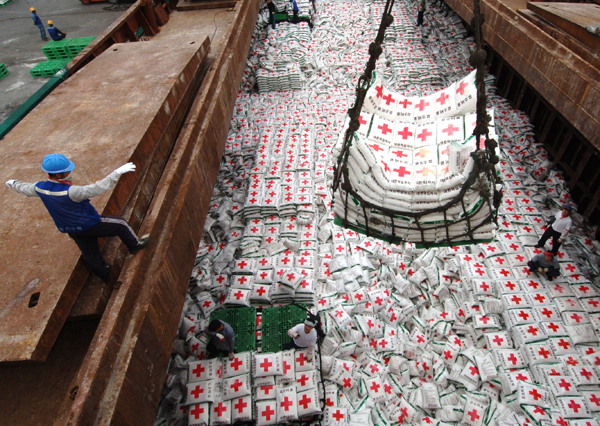
fertilizer aidSouth Korean workers loading fertilizer sacks yesterday at a dock in Ulsan. The ship and another ship from Yeosu, South Jeolla province, will head today to Haeju Port and Nampo Port to transport the last 20,000 tons of 200,000 tons of fertilizers South Korea promised to send to North Korea. Despite North Korea’s missile tests, the South Korean government decided to send the last fertilizers as a humanitrian aid.

Share

DPRK defectors release CD in ROK

Thursday, June 29th, 2006

From the Korea Times:

Wild Rocambole Band _ Tallae Umakdan in Korean _ an all-female band of six North Korean defectors will release their first album here this August. Most studied at music schools in North Korea, or performed with state-run troupes.

Included on the album is “Hong Kong Lady,’’ one of the most beloved trot songs in South Korea along with several songs they learned in North Korea.

Leader Han Ok-jung, 28, who escaped the North in June 1998 is good at singing and Chinese while dancer Heo Su-hyang, 22, who fled in 2001, is well-versed in apparatus gymnastics and singing.

Kang Yoo-eun from Pyongyang, and Lim Yoo-kyung from North Hamkyong Province, both 19, sing and play the accordion.

To protect their families who remain in the North, two of the members, who are now South Korean citizens, use false names.

Share

ROK to promote knowledge sharing with DPRK

Thursday, June 29th, 2006

From the Korea Times:

Seoul to Promote Knowledge Sharing With N. Korea
By Kim Sung-jin
Staff Reporter

The government Thursday said it will continue to promote various projects to exchange economic knowledge with the reclusive North Korea.

Vice Finance and Economy Minister Bahk Byong-won said Thursday that private economic cooperation between the South and the North has become brisker than ever with the Kaesong Industrial Complex and North Korean tourism projects getting into full swing, but inter-government cooperation is still very limited.

“What we need more than anything else to further advance the cooperative inter-Korean economic relations is an extension of knowledge-sharing programs with the North,” Bahk said. He made the remarks at a conference on knowledge sharing for the economic development of North Korea at the Westin Chosun Hotel in downtown Seoul.

Participants in the conference included the Asia Foundation’s country representative in Korea Edward Reed, head of political section of the Delegation of the European Commission to Korea Maria Castillo Fernandez, former Swiss Agency for Development and Cooperation’s (SDC) North Korean office resident director Rudolf Strasser and Korea Institute for International Economic Policy (KIEP) president Lee Kyung-tae.

As Bahk noted, government-level economic exchange programs between the South and the North are still very limited although Seoul and Pyongyang agreed on revising a plan to dispatch economic inspectors across the demilitarized zone (DMZ) at the Inter-Korean Economic Cooperation talks held on Cheju Island between June 3 and 6.

“The Korean government will make consistent efforts to widen knowledge sharing with the North as well as with the international community,” Bahk said.

“We also hope that academia, non-government organizations and international organizations will play a leading role in extending inter-Korean knowledge sharing programs,” he added.

Annual inter-Korean economic transactions, including the transaction of merchandise and services such as tourism, have made a significant improvement over the past five years regardless of the political tension on the Korean Peninsula. They expanded to $1 billion in 2005 from some $200 million prior to the inter-Korean Summit held in 2000.

Meanwhile, the Korea International Trade Association (KITA) said Thursday that inter-Korean economic transaction, or trade, expanded 30 percent in the first five months of this year, thanks to vibrant industrial activity in Kaesong just across the inter-Korean border.

Between January and May, inter-Korean economic transactions amounted to $428.63 million, up 34.4 percent from the same period last year.

In the cited period, North Korea-bound South Korean goods jumped 35.4 percent to $264.97 million, and imports from the North increased 32.9 percent to $163.66 million.

Inter-Korean economic transactions are forecast to expand sharply next year as the number of South Korean manufacturers moving into the Kaesong industrial complex will reach 300 with the completion of the first phase of the industrial park construction project, up from current 15.

Seoul plans to help Kaesong house as many as 2,000 South Korean firms by 2012 when the complex is fully developed.

From Yonhap:

South Korea will intensify efforts in technical assistance and training for North Korea in order to help the communist state’s economy grow further, a government official said Thursday.

“We should help the North to enhance its understanding of economic principles and their operation mechanism, which will guarantee us more substantial and enduring results from economic assistance to North Korea,” Vice Finance Minister Bahk Byong-won said in a speech at a forum titled “Knowledge Sharing for Economic Development of North Korea.”

“Material assistance without economic knowledge and managerial capacity cannot contribute to sustainable economic growth,” he said.

Bahk said excessive transaction costs caused by the lack of adequate knowledge about economic principles, practices and international economy on the North Korean side have posed bigger threats to economic development than anything else.

“Some have suggested that inter-Korean cooperation has proceeded at a slow pace, but despite a rapidly changing environment, inter-Korean economic cooperation has shown remarkable strides,” he said.

Inter-Korean trade volume, which stood at US$2 million-$3 million before the 2000 inter-Korean summit, reached $1 billion last year, making South Korea the second-largest trading partner of North Korea, the official said.

Also, personnel exchanges and movement between South and North Korea have never been more frequent than recently, he said.

Bahk said economic cooperation between the Koreas, which has been regarded as one-sided, has also shifted to the one that is reciprocal and serves mutual interests, he said.

“South Korea, international organizations and nongovernmental organizations should seek to create synergies by exerting concerted efforts through sharing information among ourselves with regard to the knowledge-sharing experience with North Korea,” Bahk said.

The South Korean government will not spare any effort to vitalize knowledge sharing with North Korea for its economic development in close partnership with the international community, he said.

Share

South Korean Red Cross to aid DPRK

Wednesday, June 28th, 2006

From the Korea Times:

South Korea’s Red Cross will provide $400,000 (a little over 388,000,000 won) to its North Korean counterpart along with 10 buses and 6 cars to facilitate more on-screen reunion meetings of family members separated by the inter-Korean border.

The provision is in line with an agreement both sides signed earlier this month through an exchange of letters via the Panmunjom truce village.

According to the agreement, the South will provide the North with cash and vehicles for promoting family reunions and will also give the North necessary materials for building on-screen family reunion centers in the North at the earliest possible date.

The North, for its part, will concretely inform the South of its use of the money, vehicles and materials, the agreement says.

South Korean Red Cross officials will also be allowed to inspect on-screen family reunion center construction sites.

The two Koreas started operating on-screen family reunions through video link on Liberation Day, Aug. 15 last year. Four on-screen sessions have so far been held, while 14 face-to-face reunions have been held since August 2000, including the ongoing session at Mt. Kumgang in the North.

“Most of the separated family members have become aged and, considering this trend, we need to resolve the issue as early as possible,’’ a South Korean Red Cross official said. “To expand the on-screen family reunion sessions, we concluded that the North needs to be equipped with more facilities for on-screen reunions.’’

Share

Mindan-Chongryon reconciliation unreconciles

Tuesday, June 27th, 2006

from the Korea Times

Failure of Reconciliation in Japan
Continuous Efforts Needed to Achieve Mindan-Chongnyon Amity
 
It is regrettable last month’s historic reconciliation agreement between pro-Seoul and pro- Pyongyang Korean residents in Japan has unravelled in less than 40 days. The hugging and handshaking between Ha Byong-ok, leader of the pro- Seoul Korean Residents Union in Japan (Mindan), and So Man-sol, chairman of the pro-Pyongyang General Association of Korean Residents in Japan (Chongnyon), at the headquarters of the latter on May 17 was hailed as an end to the long-standing enmity between the two groups.

However, mounting opposition from Mindan’s rank and file has derailed the agreement. Discord among Mindan members was caused by the unilateral move of its leadership in declaring reconciliation with the Chongnyon. In a central committee meeting last Saturday, Ha said “we are virtually in a state of undoing our earlier reconciliation declaration.”

The primary responsibility for the confusion lies with Ha who hastily proceeded with the reconciliation, disregarding the opinions of provincial Mindan organizations. We can’t help but believe Ha’s personal ambition of achieving something as a leader disrupted the long-standing move to reconcile with its rival group. The important fact we have to consider is that reconciliation came at a time when the hostile mood of Japan toward North Korea is reaching a peak in connection with the abduction of Japanese citizens by North Korean agents.

Some of Korean residents belonging to Mindan were alienated from their Japanese friends after the report was released that Mindan reconciled with Chongnyon. Some Japanese are displeased with the reconciliation, asking: “Is Mindan also becoming an enemy to Japanese society?” The leadership failed to read the underlying sentiment of Japanese society and the hostile attitude of Japanese society strengthened opposition among Koreans to reconciliation.

The Korean residents’ groups have been at odds the last 50 years, symbolizing the territorial division of their fatherland. The invisible barriers between people of the two organizations in Japanese society were said to have been stronger than the DMZ dividing South and North Korea. But, we believe the ideological confrontation among the Koreans was a waste of energy for Japan’s largest ethnic group.

Though Korean residents are divided by the organizations with conflicting ideologies, they are living together in Japanese society where a market economy based on democracy has fully blossomed. We believe it is not so difficult for ordinary members of both groups to become friendly. What is important is that a change of attitude by Pyongyang is crucial to expedite reconciliation of both Korean groups in Japan. It is also hoped Korean residents in Japan continue their efforts to achieve ethnic solidarity through reconciliation in days to come.

Share