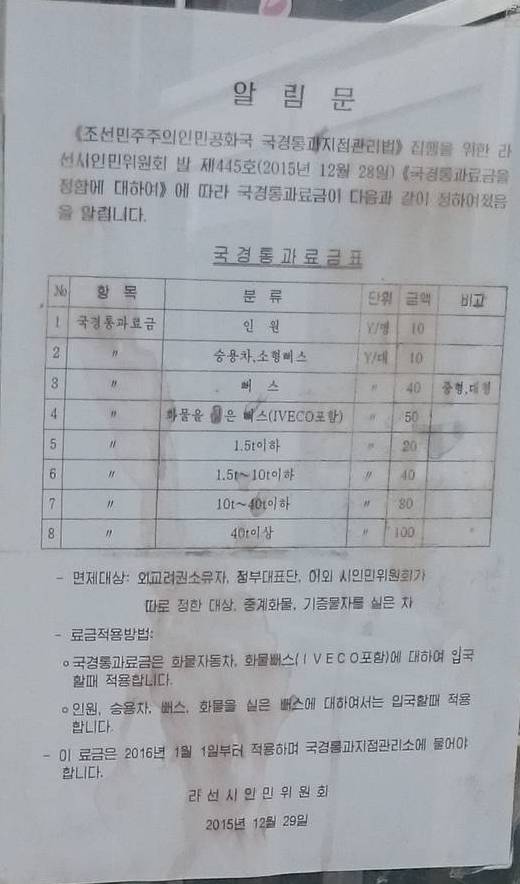
UPDATE 7 (2016-3-24): The Daily NK reports that DPRK coal shipments are sitting in limbo outside of Chinese ports.
UPDATE 6 (2016-3-18): NPR discusses China’s interest in enforcing new sanctions:
Beijing has begun instructing Chinese banks, ports and shipping and trading companies doing business with North Korea to implement the U.N. resolution to the letter.
Adam Szubin, the Treasury Department’s acting undersecretary for terrorism and financial intelligence, tells NPR that China is taking this very seriously.
“I know from my meetings here in Beijing that my counterparts have very much taken the resolution to heart,” he says.
Szubin, who visited Beijing this week, says the new sanctions will hit hard enough to change Pyongyang’s “decision-making calculus.”
The new U.N. resolution is not just “adding a few new companies to a sanctions list or a few new North Korean officials,” Szubin says. Instead, it targets “every major aspect of North Korea’s access to international shipping, international banking [and] international trade to develop revenues for its missile and illicit nuclear programs.”
Although China appears committed, the sanctions put it in a tough spot.
First, says People’s University international relations expert Cheng Xiaohe, some Chinese companies are going to take a hit to their bottom line. China-North Korea trade was worth $6.86 billion in 2014.
“At the same time as we protect our national security interests, we must be prepared to sacrifice some of our own economic interests in order to accurately target North Korea with sanctions,” he says.
Cheng says the U.S. has its work cut out for it, collecting intelligence on the hundreds of Chinese firms doing business with North Korea, and on North Korean firms adept at concealing their business dealings behind fronts and shells.
And if Chinese firms are found to be violating the U.N. resolution, Cheng points out, they could themselves face sanctions.
“This could create new frictions between the U.S. and China,” he warns. “I hope that the U.S. will think carefully before it uses this big stick to crack down on Chinese firms.”
Cheng notes that China continues to supply North Korea with crude oil as humanitarian assistance. The sanctions allow this, even if North Korea may be able to refine some of the oil for military uses.
China says neither a humanitarian crisis nor regime collapse are acceptable outcomes for North Korea. But Zhang Liangui, a veteran North Korea watcher at China’s Central Party School in Beijing, says that at the end of the day, China cannot save North Korea from its fate.
“If North Korea is going to collapse,” he says, “no external force can prop it up. Frankly speaking, whether it collapses or continues to develop will mainly depend on its own domestic and foreign policies.”
UPDATE 5 (2016-3-15): According to UPI, the Philippines has searched a second DPRK ship.
UPDATE 4 (2016 3-10): Sanctioned North Korean ship, Gold Star 3, was turned away from Hong Kong port. According to Yonhap (via Korea Times):
Hong Kong has banned a North Korean freighter, which is blacklisted by new U.N. sanctions over the North’s latest nuclear test and rocket launch, from berthing at its port, a source with knowledge of the matter said Thursday.
The North Korean freighter Gold Star 3 arrived at the Hong Kong port on Wednesday to get fuel and supplies for its crew, but Hong Kong authorities did not allow the ship to dock at the port, the source said on the condition of anonymity.
The ship is among 31 vessels operated by a North Korean shipping company, Ocean Maritime Management, which is hit by the new U.N. sanctions.
For now, the ship is said to be staying in international waters, according to the source.
Media reports have said the Chinese port of Rizhao in the eastern Shandong province also barred another North Korean ship from docking at the port.
China has said it will “earnestly” implement the new U.N. sanctions, but the sanctions should not affect the well-being and humanitarian needs of North Korean people.
Still, China is unlikely to put crippling sanctions on North Korea because a sudden collapse of the regime could spark a refugee crisis at its border and lead to a pro-U.S., democratic Korea on its doorstep, analysts say.
UPDATE 3 (2016-3-6): North Korea ship impounded in Philippines. According to Yonhap:
A North Korean ship impounded in the Philippines last week was registered as being from Sierra Leone via a practice called flag of convenience, South Korea said Sunday.
Flag of convenience is a business practice of registering a merchant ship to a country other than its origin for the purposes of avoiding taxes and other regulations.
The Philippines seized the North Korean ship Jin Teng on Saturday, becoming the first country to enforce sanctions on the reclusive country since the United Nations Security Council passed a more comprehensive resolution last week.
Resolution 2270 subjects 31 ships belonging to North Korea’s Wonyang Shipping Corp. to an asset freeze and sanctions.
Despite being Sierra Leone-flagged, the Jin Teng was seized because the sanctions are imposed via the ship’s International Maritime Organization (IMO) number, not its country of origin, a South Korean official said.
Nine other ships on the list are registered as being from countries other than North Korea, including Tanzania and Cambodia, the official added.
Here is coverage in Xinhua.
UPDATE 2 (2016-3-4): Analysis of the sanctions by the European Council on Foreign Relations:
The case of sanctions against North Korea – where earlier resolutions were already adopted in 2006, 2009 and 2013 – provides a useful window into their efficiency and limits. All the more so because the debate on this latest round of sanctions has been long and hard (it has been nearly two months since the DPRK’s nuclear test of 6 January). As noted by ECFR’s Mathieu Duchâtel earlier this week, China and Russia have taken a big step towards tightening the noose around Pyongyang – by accepting to place limits on its external revenue, in areas that go much beyond the illicit activities directly targeted by the resolution. They have agreed to a ban on the export of coal, iron ore, rare earth and other minerals, as well as gold, and also to inspection of North Korean cargoes in other ports. The sanctions include North Korean diplomatic offices that harbour entities otherwise targeted by sanctions. All of these developments have the potential to be game changers. The fact that China – which received 90 percent of North Korea’s foreign trade given earlier sanctions – has agreed to the sanctions, certainly gives some indication of how vast the chasm between the Chinese and North Korean leadership is growing.
But more questions arise as a result of these sanctions, and on three different levels. Firstly, what are the limits of the resolution, secondly, how will it be implemented, and thirdly, what has been conceded or left out in order to secure this result at the United Nations Security Council.
The limits of these sanctions can be uncovered in the wording of the resolution itself. Almost all new sanctions can be overridden if the trade is being made for “humanitarian” or “livelihood purposes”. These exceptions only apply if they do not generate “revenue”, which would seem to reserve the provision of bona fide food or medical assistance. Alas, the resolution’s language appears to be contradictory in places. Point b of article 28 exempts trades which are “exclusively for livelihood purposes and unrelated to generating revenue for the DPRK’s nuclear or ballistic programs or other activities prohibited”. This clearly leaves the door open to other revenue streams. It is not clear whether the resolution will target North Korea’s export of indentured labour – not only in Russia, but in Poland and reportedly in Lithuania and Slovakia too. In these places there are North Korean workers remitting over 70 percent of their wages to the state – which leaves them with just $120 a month for living.
This loophole, along with the exclusion of oil imports from sanctions, has all the hallmarks of being imposed by China. There are many others too, such as the exclusion of coal re-exported from the port of Rason – a transit center for Mongolian coal towards Russia. Aviation fuel cannot be sold to North Korea but its planes can be fueled elsewhere on a return journey. North Korean financial institutions and firms elsewhere are subject to sanctions, with trade banned, but foreign firms already present in North Korea are not.
More important than these concerns is the undefined nature of “inspections” in foreign ports. In this respect, the US sanctions go much further by imposing checks on third parties. It will be interesting to see if the European Union, a champion of the “smart power” of sanctions, follows suit. Some, for example the French, who still suffer from the heavy fines imposed by the US on BNP Paribas because of its actions in Sudan, may beg to differ. In any case, the practical difficulties of checking, for example, on China’s immense export and re-export volume preclude an efficient implementation. What happens in Dandong, China’s notoriously opaque harbor that processes North Korea’s trade, is key. US sanctions will create moral hazard for traders, which is altogether a desirable but insufficient goal.
Which leads us to a third observation. The resolution has left a wide gamut of sanctions open to interpretation. In practice, these interpretations will be dictated by China, North Korea’s chief intermediary with the outside world. In some aspects, the resolution hands the key to North Korea’s economic fate to China, even if one might believe that North Korean diplomats are experts at circumventing restrictions, and creatively exploiting loopholes in “easy” third countries. After all, who will be checking the “humanitarian” nature of its relations with Namibia?
UPDATE 1 (2016-3-2): Chinese banks halt transfer of yuan currency to N. Korean banks. According to Yonhap:
Chinese banks in the northern border city of Dandong have suspended the transfer of the yuan currency to North Korean banks, Chinese financial sector officials told Yonhap News Agency on Wednesday.
The move comes as the U.N. Security Council is set to vote on new sanctions against North Korea’s fourth nuclear test and rocket launch this year.
Employees of the Dandong branch offices of China’s top four state-owned banks, including Agricultural Bank of China and Industrial and Commercial Bank of China, as well as six commercial banks such as China Merchants Bank, told Yonhap that the suspension came after “orders” from their headquarters.
Since North Korea’s third nuclear test in 2013, the Dandong branches of the Chinese banks have halted the transfer of U.S. dollars to North Korean banks.
An employee of the Dandong branch of the Agricultural Bank of China said the order came down after North Korea’s fourth nuclear test in January.
Dandong is a border city between North Korea and China and a main conduit of bilateral trade between the two neighboring countries.
ORIGINAL POST (2016-3-2): According to the Washington Post:
The U.N. Security Council unanimously adopted harsh sanctions Wednesday against North Korea, imposing some of the strongest measures ever used to pressure Pyongyang to abandon its nuclear weapons program.
The new sanctions come two months after North Korea tested what it claimed was a hydrogen bomb and a month after it conducted what was widely described as a banned missile test under the guise of launching a satellite into space. But U.S. officials began drafting the measures three years ago, soon after North Korea conducted a previous nuclear test, in order to move swiftly the next time it happened. Negotiations to win China’s support began two days after North Korea’s January nuclear test, its fourth in a decade.
The resolution is far more sweeping than existing sanctions requiring a link to proliferation activities. That precondition has been removed, in effect erasing the presumption of innocence.
It mandates cargo inspections for all goods going in and out of North Korea by land, sea or air, chokes off supplies of most aviation fuel for its armed forces, and bans the sale of all small arms and conventional weapons to Pyongyang. It also prohibits transactions that raise hard cash for North Korea through sales of its natural resources.
The resolution doubles the blacklist of people and institutions already sanctioned and requires countries to expel North Korean diplomats involved in any sanctioned activities.
One provision was designed to prevent Pyongyang from sending taekwondo instructors to train foreign police forces. Another bars North Koreans from specialized training at any school or research center in the world if the learning can advance Pyongyang’s nuclear and ballistic missile programs.
President Obama welcomed the sanctions as a firm and appropriate response to North Korea’s attempts to develop weapons of mass destruction.
“Today, the international community, speaking with one voice, has sent Pyongyang a simple message: North Korea must abandon these dangerous programs and choose a better path for its people,” he said.
As soon as the sanctions were released, the Treasury Department and the State Department updated their blacklists of people and entities tied to the Democratic People’s Republic of Korea, the official name for North Korea, and its proliferation programs. The designation freezes their U.S. assets and bars Americans from doing business with them.
The U.N. sanctions, which target the country’s elites and avoid “adverse humanitarian consequences” for civilians, aim to accomplish what worked with less onerous sanctions on Iran by pushing the impoverished nation to quit pumping money into its nuclear program.
“The chronic suffering of the people of North Korea is the direct result of the choices made by the DPRK government, a government that has consistently prioritized its nuclear weapons and ballistic missile programs over providing for the most basic needs of its own people,” said Samantha Power, the U.S. ambassador to the United Nations.
“The North Korean government would rather grow its nuclear weapons program than grow its own children,” she added.
The resolution was presented by the United States with the support of China, a sharp reversal, given Beijing’s longtime support of its neighbor. Although the United States has long had an embargo on trade with North Korea, China has provided food and fuel and has been a key trading partner. In recent years, living conditions in North Korea have improved, thanks in large part to China.
In the past, China has been unwilling to tighten the screws on Pyongyang, in part out of concern for what an imploding, unstable North Korea might mean for China’s own border. But recently North Korea has continued testing new weapons and missiles, disregarding China’s warnings and personal envoys.
After North Korea on Jan. 6 detonated a new device — calling it a hydrogen bomb, although most experts say it was a smaller nuclear device — China’s ambassador to six-party talks, Wu Dawei, went to Pyongyang to urge restraint. Instead, North Korea announced while he was there that it would test a missile.
China’s about-face suggests it has started to realize that doing nothing would impose growing political costs internationally — the possibility of a greater U.S. presence in the region and weaker relations with South Korea, which Beijing has been cultivating.
“I expect there’s been a delayed recognition in China to the political price China was paying, with South Korea in particular, for its equivocation or outright silence about how to respond to North Korea and North Korea actions,” said Jonathan Pollack, a specialist on East Asian politics and security at the Brookings Institution.
During a visit to Washington last month, Chinese Foreign Minister Wang Yi hinted at the strains in policy toward North Korea.
“On the one hand, we’re saying to the international community . . . that the normal exchanges, especially those affecting the livelihoods of the North Korean people, should not be adversely affected,” he said at the Center for Strategic and International Studies. “On the other hand, in order to uphold the international nuclear nonproliferation regime for the sake of denuclearization, our exchanges will be affected to some extent.”
But some analysts question the depth of China’s commitment to the latest round of sanctions.
“The real question going forward is whether China will enforce the new measures,” said Victor Cha, a professor at Georgetown University. “My guess is that China will squeeze for a little bit, but not too hard, while the U.S. will want China to squeeze harder and for a longer period of time.”
Sung-Yoon Lee, a Korean studies professor at Tufts University, said the U.N. sanctions, even if violated in the future, will become increasingly meaningful if ordinary citizens in North Korea are adversely affected.
“The fact the U.N. is involved will lend greater legitimacy to the effort to sanction North Korea and enable others, like Japan and Europe, to shoulder some of the blame if there are negative repercussions from sanctions, so the blame doesn’t just fall on the shoulders of the United States,” he said.
Preparatory work on the sanctions began in early 2013, immediately after the Security Council passed a sanctions resolution in response to North Korea’s third nuclear test, according to a State Department official who spoke about the sensitive negotiations on the condition of anonymity. U.S. officials concluded that incrementally ratcheting up sanctions was insufficient and that more restrictive measures were needed, the official said.
As technical experts from many government agencies met to share ideas, a contingency draft of sanctions was repeatedly updated to be ready for a fourth nuclear test by North Korea.
On Jan. 8, two days after North Korea announced the fourth test, diplomats from the U.S. mission to the United Nations presented a draft to the Chinese mission. There was little response during January as China studied the proposed sanctions, which dropped requirements to prove proliferation links, as China had insisted on previously.
China did not change its position during a Jan. 27 visit to Beijing by Secretary of State John F. Kerry or during a Feb. 5 phone call that Obama placed to Chinese President Xi Jinping.
But after the Feb. 7 missile test, the State Department official said, the Chinese came around to the U.S. point of view. Throughout much of February, U.S. and Chinese diplomats met several times a day to discuss provisions that had to be approved by Beijing, the official said.
“At 8 or 9 at night, diplomats at the U.S. mission would schlep to the Chinese mission,” the State Department official said. Then they would meet again the next day after Beijing had worked through the provisions overnight.
After a tentative agreement was reached early last week, U.S. officials had hoped for a quick adoption by the Security Council. But there were delays while Russia studied the sanctions to gauge their impact. Russia transports coal over a short stretch of railroad in North Korea to a port, and Moscow wanted reassurances it would not be banned, the official said.
In recent days, North Korea has boasted that more sanctions would not hurt. Now China, South Korea, Japan and the United States are awaiting its reaction. Early Thursday, hours after the sanctions were approved, the North fired short-range projectiles into the sea, South Korea’s Defense Ministry said.
“We’ve seen its reckless and unpredictable acts for years,” Power said. “We’ve seen threats directed at the continental United States and the Republic of Korea. We’ve seen cyberattacks on American companies costing hundreds of millions of dollars. We do not expect a change of behavior overnight.”
Read the full story here:
U.N. adopts sweeping new sanctions on North Korea
Washington Post
Carol Morello and Steven Mufson
2016-3-2