Archive for the ‘International Governments’ Category

Japan Could Tax North Korea Offices

Saturday, March 4th, 2006

From the Donga:

The ruling Liberal Democratic Party of Japan has decided to ask local autonomous organizations to levy local taxes on offices being used by Jochongryeon, a pro-North Korean residents’ league in Japan, according to Japanese newspaper reports.

The Yomiuri reported yesterday that the Liberal Democratic Party will send official documents to local autonomous groups asking them to levy the taxes. Japanese Chief Cabinet Secretary Shinzo Abe gave the similar directions to the Ministry of Public Management Home Affairs, Posts and Telecommunications last February.

According to a survey by Japan’s Ministry of Public Management Home Affairs, Posts and Telecommunications, there are 19 local autonomous organizations that exempt buildings such as Chosun Hall from paying local taxes, and 13 local autonomous organizations that partly exempt taxation across Japan. Chosun Hall is the building used by Jochongryeon for educational and cultural purposes.

The measures by the Japanese government and the ruling party seem to be aimed at increasing pressure on North Korea and seeking solutions to the Japanese abduction issue.

In the past, Japan viewed Jochongryeon as a quasi-diplomatic organization and did not levy taxes on it. But as public opinion has turned against North Korea due to the abduction issue, some local autonomous organizations stopped their tax exemptions starting in 2003.

The Japanese government is squeezing the group’s financial resources by collecting receivable bonds from Jochongryeon-related financial institutions as well.

Estimates of the amount of money sent by Jochongryeon to North Korea range from $200 million to $600 million a year, to just a few million. As a result, it is hard to predict how much damage the taxation will inflict on North Korea.

Share

World Food Program-DPRK aid plan announced

Friday, March 3rd, 2006

From the Seoul Times:

WFP’s governing Executive Board has approved a two-year plan to build on the agency’s ten-year record of humanitarian assistance to the Democratic People’s Republic of Korea by tackling nutritional deficiencies and chronic hunger.

Valued at US$102 million and requiring 150,000 metric tons of commodities for 1.9 million North Koreans, the plan aims to provide vitamin-and-mineral enriched foods produced in-country to young children and women of child-bearing age, and cereal rations to underemployed communities to build and rehabilitate agricultural and other community assets.

Several members of the Executive Board expressed strong concerns about the restrictions on monitoring and access that the DPRK government has imposed. These include a reduction in the number of international staff from a peak of 46 to just 10, and a reduction in the number of monitoring visits from approximately 400 per month to a much more limited number.

“We now look to the government of the DPRK to agree to conditions that will allow us to do our work properly, for the sake of the people who need our help.” “If we cannot reach a suitable final agreement on our operating conditions, we will be forced to withdraw,” Morris told the Executive Board members.

Past WFP operations mobilised more than four million tonnes of commodities valued at US$1.7 billion, supported up to one-third of the population of 23 million, and contributed to a significant reduction in malnutrition rates.

While in years past WFP’s resources were spread across all accessible counties – 160 out of 203 for much of 2005 – the new operation envisages a more focused approach, with 80 percent of the food going to the 50 most vulnerable counties.

Share

Can I bum a smoke?

Thursday, March 2nd, 2006

I have visited the DPRK twice, and in that time, I purchased every different brand of cigarette I saw.  So I have 9 different brands (not including menthols).  So it came a a shock to me when I read in the Daly NK about another brand I had never heard of…and it was the most popular!?!?

“Craven A” Cigarettes! (a.k.a. cat cigarettes)

  • They cost a pretty steep 1,500W ($.5).  Considering that the monthly salary of a North Korean worker is b/n 2000~10,000W ($0.6-3.3) and the price of 1kg of rice is 800~900W($0.27-0.3), CRAVEN’s are very costly.
  • Caven A is a product of British American Tobacco (BAT), and is widely consumed in the Middle East and Africa. In October 2004, the Guardian, British daily newspaper, had reported that BAT has been secretly operating a cigarette factory in North Korea. BAT announced that they had established “Daesung-BAT” with the Korean “Chosun Suhkyung Trading Company” in September 2001, and have been producing Craven A and Viceroy (?).
  • Teresa La Thangue, a spokesman from BAT said, “Approximately 200 workers are present in the factory in North Korea, producing maximum of 2,000 million cigarettes every year, and all the products are consumed strictly in North Korea.” When asked the reason for not revealing the existence of the factory in North Korea earlier, Thangue replied, “Compared to the scale of BAT, which produces 90 billion cigarettes every year, the factory in North Korea only takes up a very small portion of the output.” Assuming there are 20 million North Korens, and if half of them are men (smokers), then that means BAT produces  200 cigarettes per North Korean per year.  What is the official ration? (NKEW)
  • North Koreans can tell the difference between DPRK and Chinese “Craven A”s.  They prefer the Chinese.  They also prefer American Marlboro Reds as well. (NKEW)
  • Defectors allege that the factory used to make counterfit cigarettes.  Whether it does still or not, who knows?
  • Since their invention, cigarettes have served a number of functions (besides smoking).  The same is probably true in the DPRK.
Share

Trade Volume between North Korea and Japan in 2005

Thursday, March 2nd, 2006

Republic of Korea, Ministry of Unification 
3/2/2006

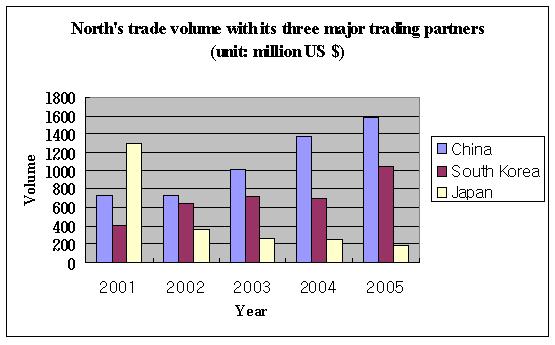
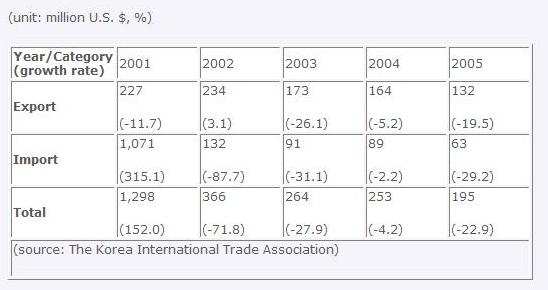
The trade volume between North Korea and Japan amounted to around 200 million U.S. $, recording a negative year-on-year rate of 22.9 percent. The North’s export to Japan decreased 19 percent, totaling 132 million U.S. $ while the North’s import from Japan shrank by 29.2 percent, recording 63 million U.S. $, down from 900 million U.S. $ in 2004.

table.JPG

The top five export items including marine products, mineral fuels, electrical equipment, vegetables and clothing, took up 74 percent of the total export volume, about 100 million U.S. $. Among them, marine products recorded a minus 49.4 percent due to Japan’s tightening crackdown on country of origin but still accounted for the largest share of the total export volume, 27.7 percent. While electrical equipment and clothing decreased by 18.9 percent to 20 million U.S. $ and by 46.3 percent to 10 million U.S. $ respectively, export of vegetables snowballed by 60.2 percent to 200 million U.S. $.

With the major import items on the downward slope, import of vehicles took up the largest share of the total import volume, recording 300 million U.S. $. The top five import items including vehicles, electrical equipment, machineries, artificial filament, and cigarettes, amounted to 400 million U.S. $, accounting for 65.3 percent of the total import volume.

table2.JPG

(This part is excerpted from the KITA’s report on the status on bilateral trade between North Korea and China in 2005 written in Korean)

Since 2002 when the issue of the Japanese abductees bulged out, bilateral trade volume has been on the decrease for four consecutive years. The issue worsened the North’s images and raised anti-sentiment among the Japanese consumers, which deepened their reluctance to buy North Korean goods.

The increase in bilateral trade will be expected to be restrained by two factors: Japan’s ban on the entry into its ports by ships weighing over 100 metric tons which are not insured, and Japan’s regulations on export of strategic goods to North Korea.

Share

Culture Shock in Kaesong

Thursday, March 2nd, 2006

From the Standard (China) and LA Times:
3/2/2006

The Kaesong industrial park is only an hour from Seoul but it’s like traveling to the moon, writes Barbara Demick
It takes barely an hour to drive from downtown Seoul to the other side of the demilitarized zone, but the culture shock is such that you might as well be commuting to the moon.

Mobile phones, books, newspapers, magazines, videos, laptops, MP3 players and many other appurtenances of 21st-century life must be checked on the south side of the border.

Also best left behind are any wisecracks about the North Korean regime, or in particular its leader, Kim Jong Il.

“You’ve got to watch what you say,” said Kim Yi Gyeom, a South Korean telecommunications worker standing in a long line of Monday-morning commuters waiting to go north. “The spirit of openness has not come to North Korea yet.”

In the boldest experiment to date with inter-Korean cooperation, nearly 500 South Koreans are working side by side with more than 6,000 North Koreans in a year-old industrial park just north of the DMZ.

South Koreans are assuming all the financial risk, having invested more than US$2 billion (HK$15.6 billion).

The South would like to reduce political tensions and reap the benefit of inexpensive North Korean labor so its manufacturers can compete with China.

For the North Koreans, the Kaesong experiment is a way to build its economy with only the most limited dose of openness to the outside world. But the political risk is all for the North Korean government, which fears that contact with the better-fed, better-clothed South Koreans could endanger its grip on power.

“It is natural that there is a culture gap,” said Hwang Boo Gi, director of the Kaesong Industrial District, who led a group of foreign journalists through the park Monday.

“We are talking about the difference between capitalism and socialism.”

Or as a North Korean official, Han Cheol, said diplomatically, “We like to emphasize what we have in common, like our heritage, and not our differences.”

Nevertheless, the contrast is particularly glaring when coming from Seoul, the high-tech, neon-lit capital of the world’s 12th-largest economy, a mere 58 kilometers away. Around the industrial park, which lies outside the center of the city of Kaesong, there is little but desiccated rice paddies and yellow hills denuded long ago by people scratching for firewood. Nearby is an abandoned agricultural college, its crumbling facade decorated by a faded red sign trumpeting the achievements of the North Korean Workers’ Party. Scrawny goats graze outside two-story white- washed houses with windows made of plastic sheeting.

The industrial park itself is surrounded by 8km of perimeter fencing and poker-faced, rifle-toting North Korean soldiers.

Inside the fenced compound everything from the toilets to the machinery are South Korean-made, mostly the latest, state-of-the-art models. Although all 11 companies now operating in the 9.31-hectare pilot project are South Korean, the North Koreans keep a tight rein over the work environment. No South Korean money is accepted here, even at a Family Mart convenience store set up for the exclusive use of South Korean employees.

North Korean patriotic music in praise of Kim Jong Il blares over the loudspeakers of a futuristic warehouse where North Korean women in crisp royal blue uniforms stitch athletic shoes using brand-new sewing machines.

The monthly salaries of US$57.50 for each North Korean worker – regardless of position – are paid directly to the North Korean government, which in turn gives the workers about US$8, more than double the average monthly salary. South Korean companies have asked repeatedly to pay the workers directly and to give bonuses for better work, but have been refused.

Even New Year’s gifts such as extra food and warm clothing could be given only after elaborate negotiations to make sure everybody was getting the same.

South Koreans, many of whom live for weeks at a time in modular housing in the complex, have their own cafeteria and their own medical clinic, all off- limits to North Koreans.

Last year, stories appeared in the South Korean media about a purported Romeo-and-Juliet romance between a North Korean woman and a South Korean man. But people at Kaesong said the story was apocryphal because the North Korean women are never alone.

There have been countless cases of culture shock. When Shinwon held a fashion show in October – complete with disco music, strobe lighting and slinky models in denim mini-skirts – it offended the conservative sensibilities of some North Koreans.

For their part, some South Koreans were taken aback recently to see the North Koreans workers dancing and singing enthusiastically to an accompaniment of accordion music at a fuel- pump factory. It turned out they were rehearsing in anticipation of Kim Jong Il’s birthday on February 16.

As is often the case, many misunderstandings resulted from acts of kindness.

South Koreans have tried covertly to give medicine from their private clinic to ailing North Koreans.

One South Korean employee was accused of trying to bribe a North Korean soldier when he gave him two packages of instant ramen noodles, according to a military source.

In a more serious incident, a South Korean was caught trying to distribute Christian literature, which is strictly anathema in the communist country, the source said.

“Almost every day something happens, some small quarrel or misunderstanding. But because Kaesong is so important to Kim Jong Il, the North Koreans choose to ignore it,” said Lim Eul Chul, a scholar at South Korea’s Kyungnam University who has written extensively on Kaesong.

Both sides have ambitious plans for Kaesong. When fully completed in 2012, the enclave is supposed to encompass 64.75 square kilometers and employ 700,000 workers.

The biggest impediment to the project’s success might be North Korea’s ongoing nuclear weapons program and its hostility to the United States. The tensions have limited the nature of the products manufactured at Kaesong to low technology – with anything having potential dual use for military purposes prohibited – and mostly confined sales to the domestic market within South Korea.

Although Shinwon Apparel, for example, supplies clothing to Kmart and Wal-Mart, among others, those garments are largely produced in Vietnam. US officials, who earlier this month announced negotiations toward a free- trade pact with South Korea, have said they would not consider Kaesong products to be labeled “Made in South Korea.”

With no progress on the horizon in its long war of nerves with the United States, the North Koreans have no choice but to chum it up with South Korea. If they are merely holding their noses and tolerating the presence of the South Koreans for their money, they go to pains not to show it.

The well-disciplined North Korean cadres who were showing foreign reporters around Kaesong Monday all lavishly praised their South Korean counterparts.

Share

ROK government lightens Kumgang loan burden

Wednesday, March 1st, 2006

From the JongAng Daily:

The government is being criticized for easing conditions on loans funded from the inter-Korean cooperation funds that were given to the Korea National Tourism Organization for Mount Kumgang tour projects. On Monday, the government decided to lower the interest rate on a loan given to the organization in June 2001 by 2 percent.

The organization originally received a loan of 90 billion won ($93.7 million) with an interest rate of 4 percent and repayment over a five-year period, after a three-year deferment. However, the payback period has now been extended to 10 years at an interest rate of 2 percent.

The Unification Ministry said yesterday that the organization asked the government to make changes to the conditions of the loan, arguing that under the tours’ current profit structure it was unable to repay the funds. This request was acceded to.

The ministry said that after an accounting firm had reassessed the loan, the decision was made with all relevant government organizations involved agreeing to make changes to its conditions.

Nevertheless, the argument that the profit level is too low for the organization to make its payments seems weak as the number of tourists taking trips to the North’s Mount Kumgang has increased over the years.

Only 57,000 people made the trip in the year the loan was granted but by last year the number of visitors had increased to 301,000.

The organization paid the 90 billion won to Hyundai for operating rights to the Kumgang hot springs and resort. Hyundai made a payment of 29 billion won to the North, for which it had been in arrears.

In response, some civic groups argued that public funds should not be used to finance such projects in the North.

Share

Japanese-Korean remittances

Tuesday, February 28th, 2006

Apparently the Japanes Post Office (who also holds many personal savings accounts) sends remittances from its depositors to North Korea.

In 2003, there were 503
In 2004, there were 506

Share

Want to Study/Work/Visit the DPRK?

Monday, February 27th, 2006

I Updated the information on Kimsoft:

The DPRK UN Mission in New York does not issue any visas at all under an agreement reached with the United States. Visas to Americans are issued by the DPRK Embassy in Beijing. You may contact Mr. Kim Ryong Hwan (A representative in Beijing of the Korea International Travel Company, Fax 011-86-1-532-4862) for visa or travel information.
Non-Koreans can reach Pyongyang by train or air by way of Moscow or Beijing. Some Japanese and Koreans resident in Japan are allowed to come to Wonsan by ship.

1. Short-term teaching or other works in N Korea: A letter of recommendation or introduction from Graham Bell, the Eugene Bell Foundation, the Carter Center or a Christian church organization may enhance the chances. If you are a Korean compatriot, all you have to do is either to make a stopover at the UN Mission and identify yourself or to send a letter to the Overseas Compatriots Aid Committee in Pyongyang.

A. Contact the DPRK New York UN Mission by email or smail or phone or Fax or go to New York to visit the mission:

Permanent Representative of the Democratic People’s Republic of Korea to the United Nations
515 East 72nd Street, 38-F, New York, N.Y. 10021
Telephone: (212) 972-3106
FAX (212) 972-3154

B. Write a letter direct to his or her target university or institution in North Korea, offering to teach English, history, engineering and etc. Upon receiving a positive response or letter of invitation, you are to visit the North Korean Embassy in Beijing (Phone: 532-1186 visa section: 532-4148 or 6639).

2.  Travel to the DRPK:
*Koryo Tours: http://www.koryotours.com/
*I visited with the Korean Friendship Association: http://www.korea-dpr.com/

A. AIR KORYO, Flughafen Schoenefeld, D-12521, Berlin, Germany: Fax: +49 (0) 30 – 60 91 36 65.
B. Korea Publications Exchange Association, Ri Chang Sik, Fax: +850-2-3-814 632.
C. National Directorate of Tourism, Central District, Pyongyang, DPR Korea Tel: (2) 381 7201. Fax: (2) 381 7607.
D. Kumgangsan International Tourist Company, Central District, Pyongyang, DPR Korea, Tel: (2) 814 284. Fax: (2) 814 622.
E. General Delegation of the DPRK, 104 boulevard Bineau, 92200 Neuilly-sur-Seine, France, Tel: (1) 47 45 17 97. Fax: (1) 47 38 12 50. Telex: 615021F.
F. Regent Holidays UK, 15 John Street, Bristol BS1 2HR, Tel: (0117) 921 1711. Fax: (0117) 925 4866. 
G. David Hunter — Edwards and Hargreaves Holidays Ltd, Portland House, 1 Coventry Road, Market Harborough, Leicestershire, England LE7 7HG, Fax 01858 433427 Tel: 01858 432123
H. Mr. Pak Gyong Nam, Manager — SAM Travel Service, Korea International Travel Company, Central District, Pyongyang, DPR of Korea, Tel: 850-2-817201, Telex: 5998 RHS KP, Fax: 850-2-817607
I. North Asia Consultancy & Services Co, Ltd is in a position to organise business missions into NK for European businessmen.NACS is organising on a regular basis sectorial fact finding missions to North Korea on behalf of the European Union Chamber of Commerce in (South) Korea.

3. Information:
The European Union Chamber of Commerce : Tel : 822-543-9301~3; Fax : 822-543-9304; E-Mail : [email protected]

Young Koreans United of the USA, P.O. Box 12177, Washington, DC 20005-0677, tel. 202-387-2420

International Korean Alliance for Peace and Democracy, 2530 1/2 South Crenshaw Blvd., Los Angeles, CA 90016, tel. 213-733-7785.

Travel Time email, 1 Hallidie Plaza, Suite 406, San Francisco, CA 94102, USA ; phone +1-415-677-0799, fax +1-415-391-1856, 1-800-956-9327 (1-800-9-LOW-FARE) toll-free in the USA

Chugai (Phone: 81-3-3835-3654, Fax: 81-3-3835-3690) based in Tokyo. It is affiliated with Chongryun, the General Association of Korean Residents in Japan. It arranges package tours to Pyongyang every month.

The Kumgangsan International Group ( email or Web Page) handles investments in N Korea. This group also makes travel arrangements. It is operated by Ms. Park Kyung Youhn, a Korean-American woman, who is not associated with Chongryon.

Ryohaengsa Korea International, Pyongyang, Korea; Tel. (850) 2-817 201, Fax (850) 2-817 607

The DPRK Committee for the Promotion of External Economic Cooperation, Jungsongdong, Central District, Pyongyang. FAX 011-850-2-3814664 and Tel: 011-850-3818111,2,3 & 4.

4. Research and Other Scholarly Works: At present, no institution, center, school or university in the DPRK is ready for “official exchanges” with American counterparts. Such exchanges will likely come only after the two ‘enemy’ countries have signed a peace treaty and established diplomatic relations. However, Kim Il Sung University has established a sister rela tionship with Seton Hall University. American scholars and authors are allowed to examine North Korean archives on an individual basis. Contact the Society for Cultural Relations with Foreign Countries, Kim Il Sung University, the Party Revolutionaly History Institute or the Asia-Pacific Peace C ommittee.

5. Check with the DPRK UN Mission for the phone and fax number of other agencies: The DPRK UN Mission is not the only gate to North Korea. Americans and other foreigners are being invited to visit the DPRK by way of many other organizations in the States, Japan and other parts of the world.

North Koreans are being invited to visit the United States not necessarily through the good offices of the New York mission. Any American host can establish a direct access to North Korea by mail, fax, and phone or by personal courier.

Warning: There are ‘horror’ stories of bureaucratic bungling by the DPRK Beijing Embassy vis-à-vis invited American guests. They are partly true and partly untrue. A possible explanation is a poor communication between the prospective visitor, th e UN mission and the DPRK. The DPRK Embassy in Beijing makes it the iron rule not to issue a visa even to a carrier of a written invitation from a DPRK organization unless it has been instructed to do so by the Foreign Office in Pyongyang.

The prospective visitor is advised to make it double sure with the host organization or the UN mission that the host organization has arranged for issue of a visa through the Foreign Office and that a visa is ready in Beijing (Phone: 011-86-1-6532-1186 or 1189, FAX: 011-86-1-6532-6056. Visa Section: 011-86-1-6532-4148 or -6639).

Share

DPRK agrees to Chinese aid based on market principles

Saturday, February 25th, 2006

Kyodo News:

China has reached an agreement with North Korea to let the private sector, rather than the government, take the initiative in providing economic aid to Pyongyang and to respect market principles, sources familiar with China-North Korea relations said Saturday. According to the sources, the market-based approach is contained in a cooperation agreement in economy and technology signed by the two countries when Chinese President Hu Jintao visited North Korea in late October.

One of the objectives of North Korean leader Kim Jong Il’s visit to China in January was to confirm this approach, the sources said.

The sources also said a cooperation agreement in economy and technology signed by a Chinese delegation led by Vice Premier Wu Yi during their visit to North Korea in early October is separate from the agreement with the same name signed during Hu’s visit later that month.

The earlier agreement calls on China to continue providing materials and technological cooperation for the Da’an Friendship Glass Factory near Pyongyang. It also allows North Korea to export glass products made at the factory.

Share

Macau bank drops N Korean clients

Thursday, February 16th, 2006

According to the BBC:

A Macau bank accused by the US of laundering money for North Korea has agreed to dissolve all links with the communist state.

The US Treasury said Banco Delta Asia had acted as a “willing pawn” for North Korea to channel money through Macau.

Macau’s authorities took control of the bank last year after the fraud claims led to a run on its deposits.  Customers withdrew 10% of total deposits after the allegations surfaced.

Officials said the bank would end ties with North Korean clients and tighten its anti-money laundering procedures.

Share