Archive for the ‘International Governments’ Category

Ideological Center of North

Tuesday, January 30th, 2007

Korea Times
Andrei Lankov
1/30/2007

The North Korean press insists that the “great and immortal” juche idea was designed by the “Great Leader,” Kim Il-sung, in the mid-1920s and has remained the guiding principle of the Korean revolution ever since. But do not expect to find references to juche in Korean publications of the 1950s or even early 1960s.

Even if Kim Il-sung first used the term in his speech in December 1955, it took at least five years before the term became widely known in the country _ and five more years for it to become the name of North Korea’s official ideology.

Only in April 1965, while delivering a lengthy lecture in Indonesia, did Kim Il-sung make it clear that from that point on juche would be considered the basic principle of North Korean ideological policy.

The North Korean leadership badly needed a new ideology in 1965. Why? This was the year when the dispute between the Soviet Union and China reached new heights. The two communist powers had been quarrelling for some time, but from 1965 to 1970 the two countries, which had recently vowed “eternal friendship,” were on the brink of war.

North Korea wisely decided to maintain neutrality, allowing it to milk both sponsors. But in the heavily ideological world of oldstyle communism one needed a theoretical justification for one’s position, even if this position was taken exclusively on account of pragmatic considerations (sounds like academia, doesn’t it?).

Nothing could be as handy as a new ideology, especially since the North had been drifting away from Soviet-style Leninism for some time. A locally designed juche was a good solution to the ideological conundrum.

It was easy to say that North Korea had discovered a new truth that was, needless to say, superior to the truth of Sovietstyle Leninism or Chinese-style Leninism-plus-Maoism. Hence, being bearers of the supreme truth, Koreans could not be ordered around.

But what exactly were the relations between juche and Marxism? For our readers this might appear a rather scholastic question, but the world of communism was based on ideology, and ideological disputes mattered. Of course, communist leaders had long learned how to bend their ideology and how to adjust its postulates to any given current political purpose.

In this regard, they were no different from leaders of supposedly religious states, whose actual policy was not too constrained by their loudly professed faith.

Nonetheless, some explanations had to be invented.

Until the late 1960s, juche was presented as a specific form of Marxism-Leninism, which suited the Korean realities and demands of the Korean communist revolution. It was not separated from Marxism. This explanation found its way into the North Korean constitution of 1972. Article 4 described juche as “a creative application of Marxism-Leninism to the conditions of our country.”

The next step in juche’s development took place around 1974 and was perhaps related to the gradual rise of Kim Jong-il. It has been often stated that Kim Jongil introduced new interpretations of juche because he wanted to flatter his father, the founder of juche, and thus demonstrate his loyalty to Kim Il-sung’s cause.

Whatever the reasons, in 1974 some documents signed by Kim Jong-il but actually written by the administration’s chief theoretician, Hwang Jang-yop (currently in Seoul), began to use the term “kimilsungism” as a synonym for juche. In February 1974, Kim Jong-il explained that the works of Marx and Lenin had become outdated.

They described the world as it was 100 or 50 years ago, while juche was suited for the modern world, they argued. Thus, in 1980 the Korean Workers’ Party proclaimed juche the party’s guiding ideology, without mentioning its relationship to Marxism.

That statement doubtless resonated well with the nationalism of Korean cadres because it essentially placed North Korea at the ideological center of the world. Since then, the nationalist element of juche has been increasingly emphasized.

That position was also an open challenge to orthodoxy as understood in Moscow and Beijing. It was as if a local Catholic bishop proclaimed that he had a better grasp of the Holy Scriptures than the pope (or, to take the analogy a bit further, two quarrelling popes) and was able to devise something like a Newest Testament.

These statements made juche-worshipping North Koreans into open heretics within the communist camp, but other “fraternal countries” had to swallow this: Whatever they said, strategic considerations took precedence over ideology. Nobody wanted to alienate Pyongyang, which had been long seen as a strangebehaving sibling of the communist “family.”

However, this family unity did not last. In 1992, the newly amended North Korean constitution completely omitted references to Marxism-Leninism and replaced it with juche as the sole official ideology. Nobody was outraged.

By that time Leninism was patently dead, and even the few countries that still maintained a commitment to that ideology hardly took their own declarations seriously.

However, after the death of Kim Il-sung there were some signs that the significance of the juche idea began to wane.

Share

U.S., N.K. open talks on BDA

Tuesday, January 30th, 2007

Korea Herald
Lee Joo-Hee
1/30/2007

Officials from Washington and Pyongyang are in Beijing today for their second round of talks on U.S. financial sanctions against North Korea.

The discussions are likely to set the tone for the upcoming round of six-party talks scheduled to resume early next month.

The agenda is thought to include North Korea’s acknowledgement of illicit financial activity, a pledge to prevent any reoccurrence, and the lifting of a U.S. embargo on North Korean accounts at a Macau bank.

Washington imposed financial restrictions against Banco Delta Asia after charging the bank with helping North Korea launder counterfeit dollars and funds raised from smuggling restricted goods. The move prompted Pyongyang to boycott the six-party talks process in 2005.

Upon returning to the six-party process in December last year, North Korea demanded it must first solve the financial issue before discussing the nuclear question.

The United States remains adamant that the financial measures were separate from the nuclear issue but has offered to discuss it on the sidelines of the nuclear talks.

The U.S. side is led by Daniel Glaser, the Treasury Department’s deputy assistant secretary for terrorist financing and financial crimes.

The North Korean team is led by Oh Gwang-chul, president of the Foreign Trade Bank of Korea, the reclusive regime’s window for foreign banking.

The two delegations are likely to discuss the technical aspects of the issue, which North Korea claims was a political gesture by the United States as part of its hostile policy.

On Sept. 15, 2005 the U.S. Treasury Department banned all American banks from dealing with Banco Delta Asia for allegedly helping North Korean companies launder money from smuggled cigarettes and counterfeit $100 bills.

Washington and Pyongyang have been exchanging questions and information regarding the measures since their first discussion in Beijing on the sidelines of the six-party talks last month.

N. Korean financial officials arrive in Beijing for talks on U.S. sanctions
Yonhap
1/30/2007

A group of North Korean financial experts arrived in Beijing Tuesday for talks with their U.S. counterparts on removing U.S. financial sanctions on the North, a major hurdle to six-way negotiations on the communist nation’s nuclear weapons program.

The U.S.-North Korea financial talks come ahead of a new round of six-nation negotiations next week aimed at persuading North Korea to give up its nuclear weapons program.

The Chinese Foreign Ministry said Tuesday the new round of the nuclear disarmament talks will start Feb. 8.

The North Koreans, headed by O Kwang-chol, president of the North’s Foreign Trade Bank, arrived in the Chinese capital at 9:30 a.m. The North Koreans were expected to hold talks with a U.S. financial team led by Daniel Glaser, a deputy assistant secretary at the U.S. Treasury Department.

Upon arriving from Pyongyang, the head North Korean delegate said the sides would hold talks at their countries’ embassies here.

The two last met here on the sidelines of a December round of the nuclear talks, also held in Beijing. The working-group financial meeting seeks to remove U.S. sanctions imposed in September 2005 on a Macau bank suspected of laundering money for the North, which Pyongyang used as an excuse to stay away from the nuclear talks for 13 months.

Expectations of progress from the financial discussions, as well as the nuclear talks, have been significantly raised following a three-day meeting of top U.S. and North Korean nuclear negotiators in Berlin earlier in the month, at which the two agreed “on a number of issues,” according to Christopher Hill, the top U.S. nuclear envoy.

Hill said Monday (Washington time) that the next round of the nuclear talks could produce an agreement similar to a 1994 pact in which North Korea agreed to freeze its nuclear activities in return for economic and energy assistance. The 1994 Agreed Framework became defunct when the ongoing dispute over the North’s nuclear ambitions erupted in late 2002.

However, Hill made it clear that the goal of the six-party negotiations is to carry out a 2005 agreement in which Pyongyang agreed in principle to completely and verifiably dismantle its nuclear program in return for economic and diplomatic benefits.

“Whatever emerges in the next round, our job will not be finished until the full joint statement is finally realized and implemented,” Hill told Reuters in Washington.

“I am not too worried whether something might look like the Agreed Framework because we’re only looking at part of what we’re aiming at,” Hill added.

The top U.S. envoy to the financial talks Tuesday also expressed hope for progress.

“We are prepared to go through these talks as long as it takes for us to get through our agenda,” Glaser was quoted as telling reporters in Beijing. “I am hopeful we’ll make progress.”

Treasury officials have so far refused to confirm it, but recent reports said the United States may unfreeze part of North Korea’s assets at the Macau bank to help move the nuclear negotiations forward.

Pyongyang has about US$24 million in 50 accounts at the Macau bank, Banco Delta Asia, and as much as $13 million is believed to belong to legitimate accounts.

Share

Last US defector in North Korea

Tuesday, January 30th, 2007

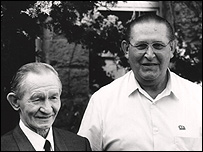
dresnok.jpgThe folks who brought us “The Game of their Lives” and “A State of Mind”  have delivered their third DPRK-based documentary, “Crossing the Line” about four American soldiers that defected to the DPRK.  It was shown at the Sundance Film Festival this week, and sorry to Simon, Nick and Dan that you did not win.

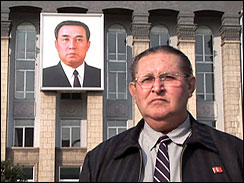
A section of the interview with the last remaining defector, James Dresnok, was aired on CBS this week.  It was very interesting, not only because we get a glimpse into the life of Dresnok, but also his children.  Click here to see the video clip.

The story below was also published in the BBC.

BBC
1/23/2007

dresnokjenkins.jpgIn the 1960s four US soldiers separately defected to North Korea, and were little heard from again.

Now one – the last known former American GI left in the country – has spoken for the first time to British documentary-makers.

James Dresnok is something of a celebrity around the North Korean capital Pyongyang, his home for the last 44 years.

Unmissable thanks to his 6ft 5in height and bulky frame, the 64-year-old has appeared in North Korean films, taught English at university and been a propaganda hero for the Communist nation.

“I have never regretted coming to [North Korea]. I feel at home,” he says, in the documentary Crossing the Line, which premiered at the US Sundance Film Festival on Monday.

James Dresnok was a 21-year-old army private when he decided to leave his post in South Korea one August afternoon in 1962 to cross into the North.

Three months earlier, Private Larry Abshier had become the first known US soldier to defect to the North, while patrolling the demilitarised zone between the two Koreas.

In the three years that followed, Specialist Jerry Parrish and Sergeant Charles Jenkins would follow Abshier and Dresnok across the border.

The four, who initially lived in the same house, found their new life tough in the early years. Mr Dresnok admits he did not want to stay. “I didn’t think I could adapt”.

A joint bid for asylum at the Soviet embassy in 1966 was rejected and the four were forced to undergo intense re-education, which included learning North Korea’s official Juche ideology.

It was at that point, Mr Dresnok says, that he decided he would try to fit in. “Man is the master of his life, and little by little I came to understand the Korean people,” he said.

All four married, were granted North Korean citizenship and – apart from starring as evil capitalists in a propaganda film called Nameless Heroes in 1978 – appeared to drop off the face of the earth.

In fact, so little was known about them that Larry Abshier had been dead for 13 years when the US defence department said, in 1996, it believed all four men were still alive. Jerry Parrish had in fact died in 1996.

Persistence

UK documentary-maker Daniel Gordon and his Beijing-based co-producer Nick Bonner were already familiar to North Korea’s film-making authorities when they asked them about the rumours of the four defectors.

Their 2002 film, The Game of Their Lives – about the North Korean football team that beat Italy in the 1966 World Cup and qualified for the quarter finals – had been a huge hit in the country.

They were working on their second film, A State of Mind – following two North Korean schoolgirls preparing for the mass games – when they asked for permission to make a film about Mr Dresnok and the others.

“We were initially told it was absolutely impossible,” Mr Gordon explained, “but we took that to mean it was possible.”

In June 2004, at a meeting they thought would be with the North Korean authorities, the filmmakers were brought face-to-face with James Dresnok and Charles Jenkins for the first time.

“The two men weren’t wholeheartedly keen on making the film. It had the potential to blow up in their faces. But at the end of the two-and-a-half hour meeting, they had come round,” Mr Gordon said.

Within five weeks of the meeting, however, Charles Jenkins’ story became known to the whole world when he left North Korea to be reunited with his wife in Japan.

Privileged

While the documentary is about all four defectors, the focus is undoubtedly on James Dresnok who is filmed fishing, going to a restaurant, the opera and having a medical check-up.

“I found him a fascinating guy,” Daniel Gordon says. “He has had such a unique experience of life.

“It is hard to understand from our perspective why an American soldier would choose to make his life in arguably the biggest US-hating nation on earth.”

James Dresnok describes how an unstable childhood and his first wife’s infidelity left him with a sense of hopelessness before he crossed the line into the North.

Since his defection, he has been married twice and has three children.

He taught languages and carried out translating work even though he, like the other three, had dropped out of school by the age of 15.

And he also appeared in several other films, apart from Nameless Heroes, and is still referred to as Arthur after a character he once played.

Mr Dresnok admits he lives a privileged life by North Korean standards, confessing that he got rice rations during the deadly famines of the late 1990s while others were starving.

“The government is going to take care of me until my dying day,” he tells the documentary team.

Share

US regulations codify UN sanctions

Monday, January 29th, 2007

U.S. Federal Register (Hat Tip OneFree Korea)

Here are the highlights:

DEPARTMENT OF COMMERCE
Bureau of Industry and Security
15 CFR Parts 732, 738, 740, 742, 746, 772 and 774

[Docket No. 070111012-7017-01]
RIN 0694-AD97

North Korea: Imposition of New Foreign Policy Controls
AGENCY: Bureau of Industry and Security, Commerce.
ACTION: Final rule.
———————————————————————–

SUMMARY: In accordance with recent United Nations (UN) Security Council resolutions and the foreign policy interests of the United States, the United States Government is imposing restrictions on exports and reexports of luxury goods to the Democratic People’s Republic of Korea (North Korea), and is continuing to restrict exports and reexports of nuclear or missile-related items and other items included on the Commerce Control List (CCL). To this end, the Bureau of Industry and Security (BIS) is amending the Export Administration Regulations (EAR) to impose license requirements for the export and reexport of virtually all items subject to the EAR to North Korea, except food and medicines not listed on the CCL.
    BIS will generally deny applications to export and reexport luxury goods, e.g., luxury automobiles; yachts; gems; jewelry; other fashion accessories; cosmetics; perfumes; furs; designer clothing; luxury watches; rugs and tapestries; electronic entertainment software and equipment; recreational sports equipment; tobacco; wine and other
alcoholic beverages; musical instruments; art; and antiques and collectible items including but not limited to rare coins and stamps.
    BIS will continue to generally deny applications to export and reexport arms and related materiel controlled on the CCL and items controlled under the multilateral export control regimes (the Missile Technology Control Regime, the Nuclear Suppliers Group, the Australia Group, and the Wassenaar Arrangement). This includes items specified in UN documents S/2006/814, S/2006/815 and S/2006/853. BIS will also generally deny applications to export and reexport other items that the UN determines could contribute to North Korea’s nuclear-related, ballistic missile-related, or other weapons of mass destruction-related programs.
    BIS will also generally approve applications to export or reexport: non-food, non-medical humanitarian items (e.g., blankets, basic footwear, heating oil, and other items meeting subsistence needs) intended for the benefit of the North Korean people; items in support of United Nations humanitarian efforts; and agricultural commodities and medical devices that are determined not to be luxury goods.
    BIS will review on a case-by-case basis applications to export and reexport all other items subject to the EAR.

DATES: This rule is effective January 26, 2007.

The following further amplifies the illustrative of list luxury goods set forth in Sec.  746.4(c):
    (a) Tobacco and tobacco products
    (b) Luxury watches: Wrist, pocket, and others with a case of precious metal or of metal clad with precious metal
    (c) Apparel and fashion items, as follows:
    (1) Leather articles
    (2) Silk articles
    (3) Fur skins and artificial furs
    (4) Fashion accessories: Leather travel goods, vanity cases, binocular and camera cases, handbags, wallets, designer fountain pens, silk scarves
    (5) Cosmetics, including beauty and make-up
    (6) Perfumes and toilet waters
    (7) Designer clothing: Leather apparel and clothing accessories
    (d) Decorative items, as follows:
    (1) Rugs and tapestries
    (2) Tableware of porcelain or bone china
    (3) Items of lead crystal
    (4) Works of art (including paintings, original sculptures and statuary), antiques (more than 100 years old), and collectible items, including rare coins and stamps
    (e) Jewelry: Jewelry with pearls, gems, precious and semi-precious stones (including diamonds, sapphires, rubies, and emeralds), jewelry of precious metal or of metal clad with precious metal
    (f) Electronic items, as follows:
    (1) Flat-screen, plasma, or LCD panel televisions or other video monitors or receivers (including high-definition televisions), and any television larger than 29 inches; DVD players
    (2) Personal digital assistants (PDAs)
    (3) Personal digital music players
    (4) Computer laptops
    (g) Transportation items, as follows:
    (1) Yachts and other aquatic recreational vehicles (such as personal watercraft)
    (2) Luxury automobiles (and motor vehicles): Automobiles and other motor vehicles to transport people (other than public transport), including station wagons
    (3) Racing cars, snowmobiles, and motorcycles
    (4) Personal transportation devices (stand-up motorized scooters)
    (h) Recreational items, as follows:
    (1) Musical instruments
    (2) Recreational sports equipment
    (i) Alcoholic beverages: wine, beer, ales, and liquor

Share

Suspect in killing of N.Korean in Russia’s Far East arrested

Monday, January 29th, 2007

RIA Novosti (Hat Tip DPRK Studies)
1/29/2007

A suspect in the case of a North Korean national beaten to death in a Russian Far Eastern city has been arrested, an aide to the regional prosecutor said Monday.

The man’s body was found in a hostel housing North Korean construction workers in the Pacific port of Vladivostok, near the North Korean border, Friday. Forensic experts said the man died of a brain injury.

“A forensic psychiatric expert examination has been ordered for the suspect in the case, to determine whether he is sane,” Irina Nomokonova said, adding that the suspect was a Russian citizen.

Witnesses said Friday the victim had returned to the hostel with bruises on his face, saying he had fallen accidentally. But several hours later, his North Korean colleagues found him dead.

Two other people from the Communist nation were battered to death in Vladivostok in December in an attack investigators said was carried out by a group of teenagers.

Local police say attacks on foreigners have become more frequent in the Primorye Territory, which borders on China and North Korea and is home to thousands of migrant workers from those countries.

In 2006, 247 attacks were made on people of foreign appearance in the region, compared to 181 the previous year. The statistics reflect a rise in xenophobic sentiment in the country as a whole.

Bloody interethnic clashes in northwest Russia last fall prompted authorities to impose restrictions on the number of foreign workers, effective as of this year.

Share

North Korea urgently needs food aid

Sunday, January 28th, 2007

UNFAO
10/30/2003

Despite better harvests this year, the Democratic People’s Republic of Korea (North Korea) will have another substantial food deficit in 2004, requiring a large amount of external assistance, two United Nations agencies said today.

A combination of insufficient domestic production, the narrow and inadequate diet of much of the population and growing disparities in access to food as the purchasing power of many households declines, means that some 6.5 million vulnerable North Koreans will require assistance next year, according to a joint report by the UN Food and Agriculture Organization (FAO) and World Food Programme (WFP).

The situation remains “especially precarious” for young children, pregnant and nursing women and many elderly people, the Rome-based agencies warned.

The report projected domestic cereal availability in the 2003/04 marketing season (November-October) at 4.16 million tonnes, 4.7 per cent up from the revised 2002/03 estimate of 3.97 million tonnes.

The 2003 rice and maize harvests each rose by an estimated 4.5 per cent over 2002, to 1.48 million tonnes (milled basis) and 1.73 million tonnes respectively. The improvements were attributed to favourable weather, a relatively low incidence of crop pests and diseases, increased application of donated fertilizer andbetter irrigation.

Forecasting total cereal needs – food, animal feed and seeds – for 2003/04 at 5.1 million tonnes, the FAO/WFP report projected an import requirement of 944,000 tonnes. Given anticipated commercial imports of 100,000 tonnes, concessional imports of 300,000 tonnes, and food aid expected to be in stock or to arrive after 1 November, 2003 of 140,000 tonnes, the uncovered gap will be 404,000 tonnes.

Despite evidence of improved nutritional levels in recent years, malnutrition rates remain “alarmingly high”, the report said. Four out of ten young children suffer from chronic malnutrition, or stunting, according to a large-scale, random sample survey conducted in October 2002 by UNICEF and WFP. Continued, targeted food aid interventions are essential to prevent a slippage back towards previous, higher levels of malnutrition, the UN agencies said.

The economic policy adjustment process initiated in July 2002 has led to many factories being unable to pay full wages. Combined with food price increases that were higher than increases in wages, this has caused a further deterioration in the already inadequate purchasing power of many households, especially in urban areas.

Rations from the Public Distribution System (PDS) – a primary source of food for the 70 per cent of North Korea’s 23 million people living in urban areas- are set to decline to no more than 300 grams per person per day in 2004, from 319 grams this year, according to government authorities. The present allocation ensures only half of an individual’s caloric requirements.

Low as the PDS rations may be, industrial workers and elderly people now spend up to 60 per cent of their income on these rations alone. After paying for non-food necessities, they can ill-afford staples such as rice and maize in private markets, where prices are as much as 3.5 times higher, let alone more nutritious foods.

As the situation may worsen in the immediate future, the report recommended that attention also be given to the low-income PDS dependents in urban areas rendered increasingly under-employed by economic adjustment process.

The FAO/WFP report urged that 484,000 tonnes of commodities, including 400,000 tonnes of cereals, be sought as food aid for 2004 for the most vulnerable North Koreans. Three-quarters of the total is earmarked for children in nurseries, kindergartens, primary schools, orphanages and hospitals, pregnant and nursing women and elderly people.

Despite improvements in the operating environment for aid agencies, the report noted that there are still restrictions on access to the needy and to marketsand shops, reducing the scope for monitoring and the timely detection of newly emerging food-insecure groups. But it also says that the North Korean government has been more forthcoming with information needed to assess household food security.

The report recommended that “in addition to providing urgently needed food aid, the international community enter with the government into a policy dialogue to set an enabling framework to mobilise the economic, financial and other assistance needed to promote sustainable food production and overall food security.”

Share

U.S. to defer contributions pending UNDP audit

Saturday, January 27th, 2007

Joong Ang Ilbo
1/27/2007

Washington said Thursday it will withhold all contributions to the United Nations Development Program (UNDP), an agency accused of mismanaging its North Korea activities that led to a large, steady influx of cash into a regime suspected of seeking nuclear weapons.

The United States would also consider proposing that the UN stop all programs in the North except those for humanitarian assistance, said Ambassador Alejandro Wolff, acting U.S. envoy to the United Nations. He said the U.S. was satisfied with UNDP’s announcement of steps to remedy the situation, including an audit and readjustment of its 2007-2009 North Korea program.

“In the meantime, until we get the results of that audit and the program is reviewed, we would defer approval of the new program for the DPRK.,” the envoy said. “The U.S. also withholds its contribution in part to UNDP to the DPRK program,” he said. DPRK stands for Democratic People’s Republic of Korea, North Korea’s official name.

Japan went further, its envoy suggesting the UN stop all programs in North Korea except for direct humanitarian aid. Mr. Wolff said the Japanese argument “is quite compelling” and added the U.S. will consider the proposal.

At the State Department, spokesman Sean McCormack denied that the UNDP probe is targeted at Pyongyang. “This is not a U.S.-North Korea issue,” Mr. McCormack told reporters. “This is not directed at North Korea. This is simply an issue of management and oversight of UN programs. The secretary-general and executive director of UNDP understand it as such.”

The UNDP has been accused by Washington of mismanaging its aid in North Korea, resulting in a massive cash flow into the Pyongyang regime through hard currency payments to the North Korean government and local employees and vendors.

Ban Ki-moon, the new UN leader, asked for an overall audit of all UN funds and programs, starting with the first report on North Korea to be completed within 90 days.

Pyongyang in a statement claimed strict conformity with UN regulations.

Share

Number of Undernourished N. Koreans More Than Doubled

Friday, January 26th, 2007

Korea Times
1/26/2007

The number of undernourished people in North Korea has more than doubled over the past decade with a diminishing dietary energy supply despite the country’s increased food production, the Yonhap News Agency said Friday citing a Food and Agriculture Organization (FAO) report.

FAO said in its annual report in Rome on Wednesday that it estimated the number of undernourished in North Korea at 7.9 million for 2001-2003, more than twice as many as the 3.6 million recorded for 1990-1992.

The dietary energy supply, measured in daily calorie intake per person, dropped to 2,150 in 2001-2003 from 2,470 in 1990-1992, marking a 1.25 percent decrease, according to the report.

The proportion of undernourished subsequently grew from 18 percent of the total population to 35 percent, the report said.

North Korea’s per capita food production, however, was growing at an annual average of 1.9 percent during the 1996-2005 period, compared to a drop of 1.8 percent from 1986 to 1995.

Yonhap, a semiofficial South Korean news agency, quoted the report as saying that the North exported $22 million worth of agricultural products in 2002-2004, accounting for 2 percent of the country’s total exports.

The figures compare with $354 million in agricultural imports during the same years, representing 17.1 percent of North Korea’s total imports.

Plagued by repeated floods and droughts, North Korea subsisted on international food donations for nearly a decade from the mid-1990s. But the U.N. World Food Program (WFP), the main coordinator of the donations, was told to leave the country, which claimed it was producing a bumper crop and receiving aid outside of the U.N. relief agency.

The WFP curtailed much of its presence and activities in the North last year as a result.

Yonhap quoted FAO’s report as stating that North Korea has been the biggest recipient of food aid in recent years and still receives more than 1.1 million tons of grain equivalents per year on average. This equaled 31 percent of the country’s total cereal production in 2002 and 22 percent in 2003.

The report said the number of undernourished in South Korea stayed the same at 800,000 in 1990-1992 and 2001-2003, with the dietary energy supply increasing 0.12 percent between the two periods.

Share

3 Million NK Refugees Expected in Crisis: BOK

Friday, January 26th, 2007

Korea Times
Na Jeong-ju
1/26/2007

If at least one member of a North Korean household moves to South Korea after reunification, more than 3 million from the North may head south if the two Koreas are reunited, the Bank of Korea (BOK) said Friday.

According to the BOK’s Institute of Finance and Economy, if such an exodus takes place in North Korea after reunification, the South may face serious economic consequences, the report said.

If Koreas adopt a German model, in which West Germany extended financial support to East Germany before and after reunification, South Korea would shoulder a total of $500-$900 billion in reunification costs. If the money is spent appropriately, it will take 22-39 years for North Korea to top $10,000 in gross national income, the report said.

The institute proposed South and North Korea try to reduce economic gap through economic cooperation programs. If the South supports the North through development programs, using its capital and the North’s cheap labor, it can reduce reunification costs considerably, it said.

“It is desirable for the two Koreas to designate special economic zones to reduce their economic gap and conduct programs to develop the North Korean economy,’’ the report said.

With the development programs, the South can spend much less than adopting the German model, the report said. The reunification costs will be cut to $300-500 billion, while the period for North Korea to see a GNI of $10,000 will be shortened to 13-22 years, it added.

Share

UNDP to adjust North Korea program, bolster audit and monitoring

Thursday, January 25th, 2007

Yonhap
1/25/2007

The U.N. Development Program (UNDP), recently accused of unmonitored activities in Pyongyang that led to a large, unintended influx of cash to the regime there, announced Thursday that it will adjust the North Korea program and delay its implementation until approved.

But the US$17.91 million resource allocation made in the original 2007-2009 program will be maintained, it said.

Share