Archive for the ‘International Governments’ Category

Kim Jong Il Gets the Gifts, and All North Korea Ends Up Paying

Wednesday, May 16th, 2007

Bloomberg
Bradley Martin
5/16/2007

For decades, tourists visiting North Korea have been brought to a 200-room, 70,000-square-meter palace completed in 1978 that displays presents to Kim Il Sung, the “Great Leader,” who died in 1994.

Starting with Joseph Stalin’s 1945 gift of a bulletproof railway carriage, the items include a stuffed bird from American evangelist Billy Graham and a piece of the Berlin Wall donated by a German writer.

These days most visiting foreign dignitaries bring gifts for Kim’s eldest son and successor, Kim Jong Il, 65. The junior Kim’s loot is housed in a 20,000-square-meter (215,278-square- foot) annex that was completed in 1996 — a time when a famine was starving tens of thousands of North Koreans.

Why would the country have spent vast sums on four-ton bronze doors and polished marble floors? “Our people couldn’t display all these precious gifts in a poor palace,” says tour guide Hong Myong Gun. “So we built this palace with our best.”

The gifts in the windowless “International Friendship Exhibition” at Mt. Myohyang, a two-hour drive north of the capital, Pyongyang, range from the trivial to the grandiose.

Cable News Network founder Ted Turner donated paperweights with the CNN logo. A tribal chief in Nigeria offered a throne featuring carved lions, with matching crown and walking stick. Romanian communist dictator Nicolae Ceausescu brought the stuffed head of a bear he had hunted and killed.

Giving and Receiving

In Asia, the protocol of gift-giving has been well established since Chinese emperors began expecting visitors to bear tribute. The Chinese know how to give as well as to receive: Pride of place in the exhibit goes to one of their presents, a life-sized wax figure of Kim Il Sung standing on a three-dimensional representation of a lake shore.

Reverent music, calculated to induce bowing, plays in the background of the posthumous gift, the final exhibit viewed by visitors to the hall.

The elder Kim’s title of President for Eternity makes him the world’s only dead head of state, and Hong says he continues to receive gifts. As of last year, his presents numbered 221,411.

“No other president could draw so many presents, so our people live in pride,” she says. “Except for this place, where can you see such a sight?”

The annex for Kim Jong Il, whose titles include secretary general of the Workers’ Party and chairman of the Military Commission, houses 55,423 additional presents, Hong says. As with his father’s gifts, most of them were never used but were immediately donated to the exhibition.

A Dynasty Sedan

Some highlights in the annex: a 1998 luxury sedan from the founder of South Korea’s Hyundai group — the model named, appropriately enough, Dynasty — and two roomfuls of carved, gilded furniture from South Korea’s Ace Bed Co.

From time to time, groups of uniformed soldiers troop past to see the gifts. A high percentage of them are five feet tall or shorter. In the 1990s, North Korea reduced the minimum height for military service to 148 centimeters (4 foot 9 inches) from 150 centimeters and the minimum weight to 43 kilograms (95 pounds) from 48 kilograms, according to South Korea’s National Intelligence Service.

A 2004 World Food Program nutritional survey found that 37 percent of North Korean children suffered chronic malnutrition. The state “bears central responsibility” for the shrinking of North Koreans, says Marcus Noland of Washington’s Peterson Institute for International Economics, co-author of a new book about the famine.

Freeing Up Foreign Exchange

“As aid began arriving, the North Koreans cut commercial food imports, freeing up foreign exchange,” Noland said in an e-mail exchange.

The saved money was used to purchase surplus military aircraft from Kazakhstan and to build monuments “to the recently departed Great Leader Kim Il Sung and his son,” Noland says. If the regime had maintained the rate of commercial food imports during the 1990s, using aid as a supplement instead of a substitute, he says, “the famine could have been avoided.”

Noland estimates the death toll at 600,000 to 1 million; others have said as many as 4 million people may have died.

Tour guide Hong, 27, places the blame elsewhere. “From 1993 to 2000 our people suffered from countless natural disasters and also from other pressure in the economic field owing to the U.S. aggressors,” she says, referring to sanctions. Even during such hardships, she says, constructing the annex with the best materials was “the greatest desire of our people.”

As she speaks, there is a brief power blackout, a frequent occurrence in the energy-short country. When the lights come back on, Hong continues.

“Our people are very grateful because the Great Leader Kim Jong Il sent all the gifts here for the people to look at freely,” she says. “It was our duty to preserve them and show them to the new generation.”

Share

Korean-Americans head to N.K. for family reunion

Wednesday, May 16th, 2007

Korea Herald
5/16/2007

A group of Korean-Americans will fly to North Korea on Wednesday for what will be the first family reunion for those living abroad, Yonhap News Agency said.

The group of 15 people will enter Pyongyang through Shenyang, China, by airplane and begin an eight-day visit that will include face-to-face reunions with family members, a view of the North Korean Arirang Festival and a tour of the Panmunjom truce village.

South and North Koreans began family reunions in 1985, but this is the first time that ethnic Koreans living abroad have been officially allowed into the North to see their kin.

Shin Nam-ho, head of the Los Angeles branch of South Korea’s National Unification Advisory Council, visited Pyongyang in February to negotiate the reunion.

The group takes with it some 2,000 bags of fertilizer and vitamin sets for children in the North.

Share

Russia and China seek use of port in North

Wednesday, May 16th, 2007

Joong Ang Daily
Lee Yang-soo and Brian Lee
5/16/2007

With an eye on future transportation infrastructure, both Russia and China are courting North Korea to get in on the development of Najin port, in the far north of the country near the Russian border.

A Foreign Ministry official said yesterday that Russian Railways President Vladimir Yakunin is scheduled to visit North Korea to discuss launching a project aimed at improving and repairing a railroad from Najin to Khasan, just across the border into Russia.

Yakunin told former Prime Minister Han Myeong-sook, who visited Russia last month, that President Vladimir Putin had great interest in the project and Russia was hoping for the active participation of South Korean companies, the official said. The railway official visited Seoul in July last year to discuss the project with South Korean companies. The issue was also discussed in March at a bilateral meeting with Russia on economic cooperation.

A government official said that Russia wants to use Najin port as a logistics hub, but is also intending to develop the port into a base for future development of oil and natural gas in Siberia. The ultimate goal would be to connect the trans-Siberian railway with an inter-Korean railway system.

Beijing also has its eye on the North Korean port, which it envisions as part of its grand design to build a transport network that stretches from the Indian Ocean to the North Pacific.

“Najin Port is near the Jilin area and China’s own ports in the area have already reached their full capacity,” a government official said yesterday.

Beijing has recently notified Pyongyang that it is willing to spend $1 billion to develop port facilities, build railroads connecting the port to China and improve existing infrastructure such as highways, the official said.

In a report published earlier this year, Cho Myung-chul, a researcher at the Korea Institute for International Economic Policy, predicted that China would use investments in the North’s ports and railroads to extend its own infrastructure for export and import purposes. China has made similar investments in Burma and Bangladesh, among others.

Share

China cushions the fall in North Korean trade

Tuesday, May 15th, 2007

Joong Ang Daily
Hwang Young-jin
5/15/2007

North Korean trade with the EU and Japan went into a free fall last year, but China helped pick up the slack.

Missile and nuclear tests interfered with North Korean trade in 2006, leading to the country’s first decrease in five years, a report from the Korea Trade-Investment Promotion Agency said. Decreases in trade with the West caused by political problems were the biggest culprit, the agency said.

North Korean exports to Japan fell 41 percent while imports from Japan dropped 30 percent. Trade with the European Union went down 23 percent in exports and 18 percent in imports. The European Union and Japan are the world’s first- and third-largest economies. Trade with the world’s second-largest economy, the United States, was practically zero.

But trade with China, the nation closest to the North politically and geographically, served as a buffer to reduce the impact of the large drops in European and American trade, so the North’s overall trade figures didn’t change much, the agency said.

Almost 60 percent of North Korea’s trade is conducted with China. The North’s next-biggest trade partner was Thailand, which accounted for 12.5 percent.

The communist country’s trade volume in 2006 fell 0.2 percent, with exports dropping 5.2 percent to $947 million and imports increasing 2.3 percent to $2 billion. Trade has been growing since the start of the new millennium. In 2005, the total trade topped a record $3 billion.

With an international economic blockade in place, trade relations with Japan and the European Union got worse.

The Kotra report said the Feb. 13 agreement reached during the six-nation talks in Beijing regarding the nuclear issue is a positive signal for the recovery of North Korean trade, but it is up to North Korea whether to act on its commitments and allow trade to recover.

Inter-Korean trade was not considered in yesterday’s report. Trade between the two Koreas reached $1.3 billion in 2006, a 28 percent rise year-on-year. The South sold $830.1 million and bought $519.5 million.

Share

Agency to give the North raw goods

Tuesday, May 15th, 2007

Joong Ang Daily
Lee Young-jong
5/15/2007

With a one-time test run of an inter-Korean railroad set this week, South Korea’s Ministry of Unification said yesterday it will create an organization designed solely to provide $80 million worth of raw materials to North Korea.

The South promised to provide the materials, for light industry, in return for security assurances over the inter-Korean train line.

South Korea hopes the line will be permanent, but North Korea has only agreed to one test run.

The new organization will be jointly operated by related South Korean government agencies, Unification Ministry spokesman Kim Nam-sik said in a briefing yesterday. The agency will also represent South Korea in talks with the North over the joint development of a mine in North Korea.

The government is scheduled today to hold a meeting hosted by Unification Minister Lee Jae-joung to endorse a 2 billion won yearly budget for the organization, Kim said. The money will come from the Inter-Korean Cooperation Fund.

“The fund the government will provide to the organization is a kind of commission for doing state affairs instead of the government,” Kim said.

Share

Audit report on UNDP to be presented to U.N. general meeting

Friday, May 11th, 2007

Yonhap
5/11/2007

An external audit report on United Nations activities in North Korea will be presented to a general meeting of the United Nations next week, a Washington-based radio station reported Friday.

Citing an informed source, Radio Free Asia said that an audit report is being made of the relevant documents and information without the inspectors visiting the communist country. The audit of all U.N. operations in North Korea began in March amid U.S. allegations that U.N. aid money was being diverted to the North’s regime.

The U.N. Development Program (UNDP) said it has completed the process of wrapping up all of its operations in North Korea, and its two remaining staff members were supposed to leave Pyongyang last week.

The agency suspended operations on March 1 because North Korea failed to meet conditions set by its executive board following suspicions that the aid money might be diverted for illicit purposes, including the development of nuclear weapons. It withdrew seven of its nine international staff in mid-March.

U.N. Secretary-General Ban Ki-moon ordered an external audit of all U.N. operations in North Korea that began on March 12.

The UNDP’s office equipment and materials are currently being safeguarded by the World Food Programme in Pyongyang and will be available to the auditors, officials from the international body said.

Share

Status of US travelers in North Korea

Wednesday, May 9th, 2007

Office of Foreign Asset Control
(hat tip to Mr. Lukacs, with whom I visited Turkmenistan with Koryo Tours)

[Code of Federal Regulations]
[Title 31, Volume 2]
[Revised as of July 1, 2003]
From the U.S. Government Printing Office via GPO Access
[CITE: 31CFR500.563]

[Page 543]
 
                  TITLE 31–MONEY AND FINANCE: TREASURY
 
 CHAPTER V–OFFICE OF FOREIGN ASSETS CONTROL, DEPARTMENT OF THE TREASURY
 
PART 500–FOREIGN ASSETS CONTROL REGULATIONS–Table of Contents
 
 Subpart E–Licenses, Authorizations and Statements of Licensing Policy
 
Sec. 500.563  Transactions incident to travel to and within North Korea.

    (a) All transactions of persons subject to U.S. jurisdiction, including travel service providers, ordinarily incident to travel to, from, and within North Korea and to maintenance within North Korea are authorized. This authorization extends to transactions with North Korean carriers and those involving group tours, payment of living expenses, the acquisition of goods in North Korea for personal use, and normal banking transactions involving currency drafts, charge, debit or credit cards, traveler’s checks, or other financial instruments negotiated incident to personal travel.
    (b) The purchase of merchandise in North Korea by persons subject to U.S. jurisdiction, and importation as accompanied baggage, is limited to goods with a foreign market value not to exceed $100 per person for personal use only. Such merchandise may not be resold. This authorization may be used only once in every six consecutive months. As provided in Sec. 500.206 of this part, information and informational materials are exempt from this restriction.
    (c) This section does not authorize any debit to a blocked account.

[60 FR 8935, Feb. 16, 1995]

Share

Photos of Kim Jong Il’s Brother, Kim Pyong Il and Recent Visits

Wednesday, May 9th, 2007

Daily NK
Kim Song A
5/9/2007

KPI.jpg

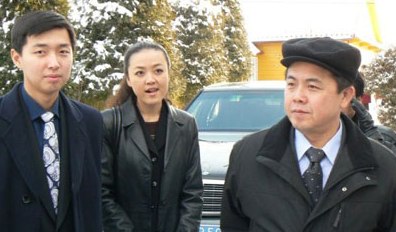
Photos of Kim Jong Il’s half-brother, Kim Pyong Il and the North Korean ambassador in Poland were recently made public.

Kim Pyong Il’s daughter, Eung Song and son, In Kang who have until now lived a sheltered and private life are also exposed in the photos. They are Kim Jong Il’s niece and nephew.

The photos were first released in March on Poland’s City of Narew homepage. The photos show Kim Pyong Il, his children and city officials making visitations to industrial sites, exhibitions, museums and participating recreational activities. In reference to the photos, it seems that these events took place on February 10.

Throughout the past, North Korea has maintained economic and cultural exchanges through the Korean Friendship Association with various countries in the East-European bloc. The events that took place on this day were organized by the association with North Koreans residing in Poland also participating in the occasion.

The homepage showed photos of Kim Il Pyong Il visiting NARMET Pty Ltd, his son, In Kang playing a game of table tennis and daughter Eun Song playing the piano.

Through the photos of Kim Pyong Il, you can see an exact resemblance of his father, though a “younger Kim Il Sung.” His two children are known to have completed a Masters degree in Poland and look healthy and well in appearance.

Kim Jong Il has one younger sister Kim Kyung Hee (married to Jang Sung Taek) as well as half-brothers (to different mothers) Kim Pyong Il, Kim Young Il (deceased 2000) and half-sister Kim Kyung Jin (51, married to Kim Kwang Sup, Ambassador to Austria). After being appointed as the successor in 1974, Kim Jong Il sent his brothers and sisters to work at alternative foreign departments so that they could not interfere with his power.

According to elite North Korean officials, there was a time where Kim Il Sung had considered appointing his succession to his three sons, “Jong Il, the Party, Pyong Il, the military and the government to Young Il.” However, after winning a power conflict with his uncle Kim Young Joo, Kim Jong Il ousted his uncle to Jagang province and sent his other siblings including Pyong Il to other departments where they could not come near of his power.

Kim Pyong Il was born on August 10 1954 and graduated from Kim Il Sung University with a major in economics. Following, he was appointed a high rank position and after passing the Kim Il Sung National War College, began working as a battalion commander at the guards headquarters. Once it was confirmed that Kim Jong Il would succeed his father, Kim Pyong Il left Pyongyang in 1979 to work at the North Korean Embassy in Yugoslavia. Around the same time, Kim Kyung Jin left with her husband for Czechoslovakia and Kim Young Il to East Germany.

In 1988, Kim Pyong Il was appointed Ambassador for Hungary but as soon as South Korea and Hungary developed amiable relations in December that year, he was re-appointed as the Ambassador to Bulgaria. Then in 1998, he became the official Ambassador to Poland where he has continued his services until now.

Kim Pyong Il’s wife is Kim Soon Geum. It is the first time that photos of their daughter Eun Song and son, In Kang, have been exposed to the public. When Kim Jong Il and his first wife Kim Young Sook had their first daughter, Kim Il Sung named the child “Sul Song.” When Kim Kyung Hee had her first daughter, she was named “Geum Song.” Similarly, it seems that Kim Il Sung named Kim Pyong Il’s first daughter, “Eun Song.” Kim Kyung Hee’s first daughter Jang Geum Song was known to have committed suicide last year in France as her parents opposed a marital proposal.

Of North Korea’s central committee under the Workers’ Party, the office 10 is known for regulating, controlling and being responsible for Kim Jong Il’s half-siblings.

Kim Pyong Il: North Korea’s Man in Poland
Daily NK
Nicolas Levi
5/17/2009

In February 2005, when I met Kim Pyong Il in Poland for the first time, he told me that he favored ameliorating the human consequences of the division of Korea.

Afterwards he started to talk to the other people present there in a room at the North Korean embassy; one of them later told me that Kim Pyong Il is usually very discrete, and is rarely present at receptions in other embassies in Warsaw. He generally only goes to the Chinese and Russian embassies, and sometimes to the Romanian and Algerian ones as well. North Korea was a model for both communist Romania under Ceaucescu and Algeria, that’s why the North Korean ambassador has special ties with those countries. In addition, Shaif Badr Abdullah Qaid, the last Yemeni ambassador in Warsaw studied in Pyongyang in the 70’s and became Kim’s good friend; their conversations dealt with life in North Korea, but never about the private life of half brother of Kim Jong Il.

In February 2006, I had occasion to talk with Kim Pyong Il again during a reception on Kim Jong Il’s birthday. During this meeting I saw a confident Kim Pyong Il, happy in Poland. However our conversation remained very diplomatic; Kim agreed that Korea should be reunified peacefully.

I never talked with Kim In Kang (26), Kim Pyong Il’s son, but I did have the chance to meet his daughter Kim Eung Song (28) some 10 times, both with her friends and face to face. She was a very open person. She was not only a nice girl; she also had impressive languages-skills (she is fluent in English, Polish, French and presumably Russian). She had a great social life in Poland with many friends. However, her father ordered her to return to Pyongyang in 2007, where she was supposed to marry the son of a North Korean General. She refused for a time, but finally went back to the North Korean capital.

Kim Sun Gum (56), the wife of Kim Pyong Il is a very discreet person, and rarely talks to others. Theirs was an arranged marriage. The wedding was personally organized by Kim Il Sung. It is said that she has a political background; her family apparently comes from the special services.

The last time I met Kim Pyong Il, in February 2009, I told him that I was preparing a doctoral thesis about his extended family (Kim Il Sung has two official wives: Kim Jong Suk, the mother of Kim Jong Il and Kim Sung Ae who is Kim Pyong Il’s mother). He reacted violently, telling me it was too dangerous.

That was my last contact with Kim Pyong Il; we haven’t met again since.

Kim Jong Il has a younger sister called Kim Kyung Hee (married to Jang Sung Taek) as well as half-brothers Kim Pyong Il (55) and Kim Yong Il (deceased in 2000), and half-sister Kim Kyung Jin (51), who is married to Kim Kwang Sop, Ambassador to Austria. After being appointed successor to his father in 1974, Kim Jong Il sent his half-brothers and sisters to work in overseas missions so that they could not interfere with his power. Kim Pyong Il started out in Yugoslavia, before moving to Hungary in 1988. However, he was swiftly relocated to Bulgaria as part of a protest over the opening of diplomatic relations between Hungary and South Korea. He then went on to work in Finland, but since January 1998 has resided in Warsaw.

Nicolas Levi is a Polish free publisher whose interests are mainly connected with the Korean Peninsula.

Share

Int’l Trade Fair to Open in Pyongyang

Monday, May 7th, 2007

KCNA
5/7/2007
The 10th Pyongyang Spring International Trade Fair will be held at the Three-Revolution Exhibition from May 14 to 17. 

Participating in it will be companies from the DPRK, China, Russia, Syria, the Netherlands, Germany, Bangladesh, Switzerland, Singapore, Australia, Italy, Indonesia, Pakistan, Poland and Taipei of China. 

Machine tools, electric and electronic equipment, vehicles, medicaments, daily necessities, foodstuffs and so forth are to be on display in the fair.

Share

European firms in N. Korea running business association: chairman

Saturday, May 5th, 2007

Yonhap
5/5/2007

European companies operating in North Korea have been running a business coalition to better coordinate trade ties with the reclusive nation, a businessman said Saturday.

“Our purpose is to build bridges between Europe and North Korea,” Felix Abt, chairman of the European Business Association (EBA), said in an interview with Washington-based radio station Radio Free Asia. The association was founded in April 2005.

The businessman, who is also president of the joint venture PyongSu Pharma Co., said European firms need to do more business with Pyongyang, whose business ties are heavily dependent on Northeast Asia.

The association comprises 11 companies, mostly European or joint ventures between European and North Korean state-run firms. DHL, the logistics arm of Germany’s Deutsche Post AG, is also a member.

North Korea’s trade with the European Union accounted for less than 10 percent of its total volume in 2004, while trade with China surged by 35.4 percent, according to the EBA’s Web site.

Share
