Archive for the ‘International Governments’ Category

Statement of UNDP on DPRK activity audit

Wednesday, June 6th, 2007

UNDP welcomes the preliminary report (DPRK-prelimauditreport-20070601.pdf) of UN Board of Auditors (UNBOA) on the operations of UNDP and other UN agencies in DPRK.  UNDP has cooperated fully with the audit process and will continue to do so. 

UNDP operated in DPRK at the express wish of its Executive Board.  Member states encouraged UNDP to assist the country to engage progressively with the norms and standards of the global community. 

The operating environment was very difficult.  In recent years UNDP tightened control mechanisms and conducted frequent audits (1999, 2001 and 2004).  These audits did not lead to any suggestion that UNDP funding was being diverted to purposes other than those for which it was intended. 

UNDP is encouraged that the UNBOA preliminary report confirms:

– That UNDP operated a relatively modest programme in DPRK ($2-3 million per year – far less than “$100s of millions” alleged in press reports)
– That UNDP international staff could – and did – regularly visit project sites to verify how UNDP funding was being used

The preliminary report also highlights specific aspects of the difficult operating environment in DPRK, including staffing and foreign currency arrangements not in line with worldwide practice.  UNDP notes that:

– The Executive Board knew of UNDP’s staffing practices in DPRK, which date back 27 years
– Similar staffing and foreign currency practices were followed by all UN agencies, international NGOs and foreign diplomatic missions in DPRK, including past and current members of UNDP’s Executive Board
– UNDP was not able to follow worldwide practice, but no UNDP regulations or rules were broken
– Following requests by some Board members, UNDP notified DPRK that it was changing its staffing and currency practices.  The proposed changes were formally endorsed by the Executive Board in January 2007
– UNDP suspended operations in the country on 2 March 2007 when DPRK failed to meet the operational changes endorsed and mandated by the Board.
– UNDP took the lead in asking the DPRK government to conform to international practice before the Board’s decision  

The report highlights areas in which UNDP rules or procedures could be strengthened.  UNDP is committed to addressing these areas.

UNDP will be transmitting a formal management response to the ACABQ shortly.  UNDP would welcome a continuation of the audit process, including a visit by the UNBOA to DPRK.  UNDP looks forward to the final audit report.

Share

Despite Nuclear Tests North Korea-China Trade Continues to Rise

Tuesday, June 5th, 2007

Daily NK
Kim Yong Hun
6/5/2007

table 5.jpg

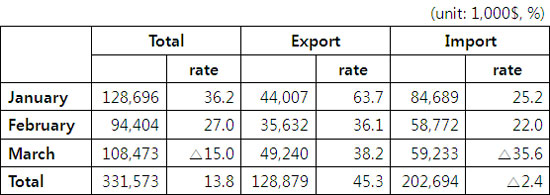
Despite the nuclear test last October, trade between North Korea and China has increased steadily. Rather, signs of North Korea’s economic dependence on China is becoming more obvious.

According to statistics recently released by the Ministry of Unification, “2007 1st Quarter, North Korea’s trade status with China,” trade between the two countries recorded $330mn, a 13.8% increase compared to 2006. While North Korea exported $130mn worth of commodities, an increase of 45% compared to the previous year, imports equaled a total of $200mn, a small decrease of 2.4%.

Last year, trade between both North Korea and China totaled $1,699.6mn recording the highest amount of trade ever in history and even this figure had risen 7.5% compared to the year before.

Analysts argue that North Korea’s economic dependence on China is increasing as a result of sanctions implemented by the international community and delay of the February 13 Agreement.

Even until last year, the trade deficit had increased to $764.17mn, an increase of 29.9% compared to 2005. However, in the first quarter of 2007, the trade deficit seems to have taken a major plummet of 61.3% down to $74mn.

North Korea’s main trade commodities are fuel based including coal and minerals, accounting for $45mn (49% increase to 2006) of exports to China, and 34.7% of total exports. In detail, $33mn of minerals, $12mn of medicine, $7.7mn of steel and $6.2mn of fisheries are exported also.

On the other hand, goods imported into North Korea are again fuel based including petroleum and crude oil and account for $31mn (42.5% decrease to 2006) of imports. Further, machinery equates to $17mn of imports, electric appliances $16mn and filaments $11mn.

In the report, the Ministry of Unification indicated North Korea’s major export to China as coal and minerals and analyzed, “This is the result of China’s increased demands for economic growth.”

The Ministry reported, “The majority of imported goods are energy, electric appliances and machinery” and added, “Demand for these light industry goods have increased from an expansion in North Korea’s consumer market. Imports have risen as a result of materials necessary for industrialization.”

According to a report recently released by the U.S. Congressional Research Service (CRS) “North Korea’s Economy,” the amount of trade that occurred between the U.S. and North Korea barely reached $3,000 in 2006, the lowest figure ever recorded since 1990. The only items exported to North Korea were books and newspapers and no imports were received by the U.S, revealed the CRS.

Furthermore, 2006 recorded an all time low of $130mn trade between Japan and North Korea, undoubtedly a reflection of Japan’s strong implementation of economic sanctions on North Korea. Since 1995, Japan has been supporting North Korea with a total of 1.2mn tons of food aid but suspended the aid relief in late 2004 following the issue of Japanese abductees.

Russia’s exports of minerals and coal to North Korea surged dramatically in 2003 and in 2006, total trade with North Korea recorded $220mn. Hence, Russia became now one of the big three trading partners of North Korea with China, South Korea, the CRS reported.

Share

N. Korea’s food situation not as bad as expected: agricultural scholar

Tuesday, June 5th, 2007

Yonhap
7/6/2005

North Korea’s food situation is stabilizing and is not as bad as expected in rural areas, a South Korean agricultural scholar who just returned from Pyongyang said Tuesday.

In an interview with Yonhap News Agency, Kwon Tae-jin, senior scholar of the state-run Korea Rural Economic Institute, said, “The peak of food shortage usually comes in June, but I didn’t feel it probably because North Korea released food rations.”

Kwon visited Pyongyang, Chongju in North Pyongan Province, Hamhung in South Hamgyong Province and Paechon in South Hwanghae Province, along with officials of World Vision, an international relief agency, May 25-31.

In March, North Korean officials indicated that North Korea faced a shortfall of 1 million metric tons of food and asked the World Food Program (WFP) to expand its assistance.

Jean-Pierre DeMargerie, head of the WFP’s office in North Korea, said that the situation is not as bad as it was in the 1990s when about one million North Koreans are estimated to have died of hunger, but the food situation has again “started to deteriorate because of June and August flooding of critical cropland and major reductions in WFP and bilateral food assistance.”

Kwon said North Korea would have little difficulty planting rice seedlings this year as reservoirs are full of water in most plains, and tractors and rice-planting machines can work at full capacity.

“In some areas the food situation might be worsening, but agricultural production has stabilized. They seem to be focusing on diversifying their sources of income by planting some cash crops,” he said.

A weak harvest in 2006, disastrous summer flooding and a 75 percent fall in donor assistance dealt severe blows to the impoverished nation, according to WFP officials.

South Korea resumed shipments of fertilizer and emergency aid to the North, but it plans to withhold rice aid as an inducement for North Korea to fulfill its promise to shut down its main nuclear reactor as part of the landmark February 13 agreement.

South Korea suspended its food and fertilizer aid to North Korea after the North conducted missile tests in July. Resumption of the aid was blocked due to the North’s nuclear bomb test in October.

According to a recent think tank report, North Korea could run short of up to one third of the food it needs this year if South Korea and other countries withhold aid.

Data from the WFP and South Korea’s Unification Ministry show that the North will need between 5.24 million tons and 6.47 million tons of food this year. Depending on the weather, the availability of fertilizer and other factors, the communist state may only be able to produce 4.3 million tons of food by itself, the report said.

Share

How To Beat an Audit

Monday, June 4th, 2007

Wall Street Journal
6/4/2007

North Korea will not extend “cooperation” to any U.N. review.

The case of U.N. hard currency for Kim Jong Il took its latest turn Friday with the release of the much-awaited audit on United Nations operations in North Korea. The investigation confirms and elaborates on irregularities in United Nations Development Program’s activities in North Korea, first reported on these pages in January. It fails, however, to examine the central question of this scandal: Whether U.S. cash in North Korea was diverted from its intended recipients and instead used to prop up Kim’s totalitarian regime?

Let us stipulate that any investigation having to do with North Korea is bound to have its share of, shall we say, frustrations. Just ask the U.S. State Department, which, nearly two months after the first nuclear-disarmament deadline, still can’t get Pyongyang to live up to the initial round of its commitments no matter how many times it sweetens the deal.

The first thing to know about the U.N. probe is that it was an internal affair–conducted by the organization’s own Board of Auditors, a monitoring group that in U.N. doublespeak is said to conduct “external” inquiries. The second salient point is that it was conducted entirely in New York City. The longest journey the auditors undertook was to cross First Avenue from the U.N. Secretariat to the offices of the UNDP. To their credit, they tried to go to North Korea but were rebuffed.

In refusing to let the auditors into North Korea, Kim Jong Il displayed his disrespect for Secretary-General Ban Ki Moon. The Board of Auditors had asked Mr. Ban’s office to intercede on its behalf with help on travel arrangements. “In an email dated 11 April 2007,” the audit report reads, “the Board was informed that on 20 March 2007, the Deputy Permanent Representative of DPRK [North Korea] advised [Mr. Ban’s chief of staff] that his government was not going to extend any cooperation to UNDP’s audit.”

Even given the limited scope of their investigations, however, the auditors were able to confirm the massive irregularities in the UNDP’s operations in North Korea. The auditors also found violations at three other agencies–Unicef, the U.N. Population Fund and the U.N. Office for Project Services. The infractions covered three areas:

Staffing: In violation of U.N. rules, local staffers were hand-picked by the North Korean government and allowed to work in “general service” jobs that, for example, allowed them access to the UNDP checkbook and other sensitive documents. Salaries were paid in euros directly to the government, and the auditors could not confirm whether the staffers actually received their pay.

Foreign-currency transactions: Also in violation of regulations, U.N. agencies in North Korea made large-scale disbursements in foreign currency, including payments for salaries, allowances and rent. The auditors could not verify controls over the disbursements. UNDP, Unicef and the U.N. Population Fund spent a total of $72.5 million on programs between 2002 and 2006, though the auditors caution that “the information supplied was not verified and no source documents were examined.”

Program oversight: Visits to U.N. projects, while permitted, were controlled by the North Korean government. Authorization took a week, and government officials accompanied the U.N. inspectors. Most revealing of all, it’s unclear whether the inspectors were international officials or the North Korean government officials on loan to the U.N. organizations whose first loyalty, it’s safe to say, would have been to Pyongyang.

UNDP says it provided evidence to the auditors of 38 field visits during 2002-2006. According to the auditors’ report, UNDP had a total of 172 projects over that five-year period. Do the arithmetic and it seems that only one in five UNDP projects was visited annually. Some “oversight”–especially if the inspectors were government factotums.

The auditors say that this is a “preliminary review.” That’s an understatement. Most glaringly, they failed to investigate the broader role UNDP is said to have had as a kind of money manager for other U.N. programs and, possibly, for countries sending aid to the North. UNDP is trumpeting the auditors’ finding that it spent only an average of $2.6 million a year during 2002-2006. But if it was making disbursements on behalf of other entities, the actual sums under its control–which presumably were subject to the same shoddy financial controls criticized by the auditors–could be far higher.

The UNDP suspended operations in North Korea in March when Pyongyang refused to abide by conditions laid down by the UNDP executive board after the irregularities came to light (but years after the UNDP itself knew but ignored them). To the extent that it sheds light on the corruption, the just-released audit is a useful exercise. But there’s a long way to go before we get to the bottom of the Cash for Kim scandal.

Share

Fair Game?

Sunday, June 3rd, 2007

Korea Times
Andrei Lankov
6/3/2007

Kim Il Sung’s North Korea has always been a tough customer, and nobody knows who was more irritated by its constant antics: its foes or its friends. It has been a tough ally, ready to cheat and manipulate its sponsors. Since the 1950s most of its patrons have had to put up with its style _ largely because of their grand strategy, of course.

In the long run, it was probably the Soviets who were subject to Pyongyang’s diplomatic frolics most frequently, but China has the dubious honor of being the first country to enjoy such an experience in the early 1950s. Somewhat surprisingly, this happened during the Korean War when only a massive Chinese intervention saved Kim Il Sung’s regime from a sorry end.

Recent document-based research by Chinese scholars, especially by the formidable Shen Zhihua, has provided us with new insights into the early history of relations between the two supposedly “fraternal” countries. Now it is clear that the picture was anything but rosy.

When the North Korean troops invaded the South, it was implied that the Chinese forces would step in if the situation took a dangerous turn. Nonetheless, until late September, Pyongyang ignored Chinese advice and kept Beijing in the dark about the frontline situation. This drove the Chinese military attache and ambassador mad, but they could not do much about it.

The situation changed in October when Kim Il Sung had lost the war: by late October 1950, there was hardly one battle-ready battalion in the North Korean armed forces. The Chinese rushed in a large expeditionary force, but soon a question arose: who was to be in charge of the united armed forces?

Kim Il Sung clearly assumed that he would stay in command, and would have operational control over the Chinese units. This was unacceptable to the Chinese. To an extent, this was a clash of two nationalisms (and nationalisms of East Asia are notorious for being particularly virulent). However, there were real considerations involved as well.

First of all, the Chinese force far outnumbered the North Korean army. Second, the Chinese generals did not have much trust in the military competence of their North Korean colleagues. Peng Dehuai, whose task was to save the North, did not hide his outrage about Pyongyang’s style of operations. He was especially angry about the meaningless defense of a doomed Seoul, where about 30,000 North Korean soldiers were killed in late September. In late 1950, he sent a telegram to Beijing in which he labeled the North Korean style “childish”.

However, Kim Il Sung and other North Korean leaders avoided the issue, so the two armies (or, to be more precise, the Chinese army and the remains of the North Korean army) for a while acted independently–often, with sorry results. On November 4, for instance, the lack of coordination even led to a battle in which the North Korean tanks mistakenly attacked Chinese infantry, and thus unwittingly helped a semi-circled American unit escape.

At the same time, the Chinese attempts to incorporate the North Korean units into their own forces were met with resistance on the part of Kim Il Sung. He needed an army of his own, and was not ready for concessions.

It took more than a month to solve the question of joint command. Perhaps, the problems would have last longer, had Stalin not sent a cable demanding an immediate rectification of the situation. Stalin’s advice had to be taken seriously, and his intervention put an end to delays. The Joint Command was headed by Peng Dehuai, with two Chinese-speaking Korean generals acting as his deputies (incidentally, both generals were purged by Kim Il Sung a few years after the war).

However, new tensions arose in December 1950 when the railways came to be discussed. The Chinese forces could be supplied only by rail, and those lines were subjected to intense bombing. The railways had to be managed carefully, but the Chinese commanders discovered that Korean administration gave preference to cargo related to the economic needs of Korean reconstruction, rather than to military supplies. As a result, the Chinese and Koreans ran two different railway administrations, operating on the same railway network. It’s easy to imagine how this influenced the efficiency of the transportation system.

After a few months of discussion the North Koreans agreed to have a joint railroad command, but on the conditions that they would exercise overall control. By that time, most of the rolling stock had been provided by China, and the Chinese soldiers were also doing most of the maintenance work, hence the Chinese generals assumed that they should have the upper hand. But the Koreans did not agree. For them, this was an issue of their territorial rights, sovereignty, and other important symbols. For the Chinese, this was a question of their soldiers’ lives.

Once again, direct Soviet involvement was necessary to put an end to the squabbling. Stalin had no patience for the petty ambitions of his not very efficient satellite, and he was still in position to control the North. Hence, Stalin himself cabled Pyongyang demanding they agree to the Chinese conditions. In May 1951, after his august intervention, Pyongyang gave in.

These early squabbles were a sign of things to come. Over the years, North Korea has developed a peculiar diplomatic style, harsh and unbending but remarkably successful. It used to be applied to Moscow and Beijing. Nowadays the same tricks work wonders in dealing with the current sponsors of the regime, Beijing and Seoul as well as with Washington. But that is another story…

Share

Russia Belatedly Joins in Sanctions against N.Korea

Friday, June 1st, 2007

Chosun Ilbo
6/1/2007

According to Russia’s Itar Tass news agency on Wednesday, Russian President Vladimir Putin has signed a decree imposing sanctions on North Korea in compliance with a UN Security Council resolution in the wake of Pyongyang’s nuclear test last October.

The presidential decree applies a full weapons embargo against North Korea in pursuance of UN Security Council Resolution 1718. All Russian government agencies and enterprises will be banned from exporting to North Korea tanks, fighter jets, warships, heavy artillery pieces, missiles, and missile launchers, as well as materials that can be used for nuclear weapons development.

In addition, North Korean officials involved in development programs for weapons of mass destruction including nuclear weapons are banned from entering Russia. Shipments of luxury goods to North Korea are also banned.

The measure will likely have no tangible effects, however, given that the current annual trade volume between Russia and North Korea is only about $200 million.

The decree comes as North Korea continues to delay implementing the conditions of the Feb. 13 nuclear disarmament agreement. The decree may put pressure on North Korea to follow the agreement.

After the UN approved the sanctions against North Korea in October last year, Russian government agencies had consultations amongst themselves and coordinated with the Russian parliament. Putin finally signed the sanctions decree on Sunday.

Share

China’s grain exports to N. Korea remain flat in Jan.-April

Friday, June 1st, 2007

Kyodo (Hat Tip DPRK Studies)
6/1/2007

China, North Korea’s major food supplier, exported roughly the same amount of grain to the country in the first four months of the year as it did a year earlier, according to recently released Chinese customs figures.

China’s January-April exports of maize, rice and wheat flour to the country totaled 55,446 tons, up 0.6 percent from the same period in 2006, according to the figures.

When compared to 2005, exports were down 66.7 percent.

The World Food Program warned earlier this year that the food shortage in North Korea is worsening.

While North Korea has faced a chronic food shortage, the shortfall had been made up in the past by multilateral aid channeled through the WFP as well as bilateral shipments from countries such as China and South Korea.

But external food aid has gone down recently, leaving the North with a huge food deficit.

China does not explicitly reveal its food assistance to North Korea, and analysts rely on export figures to assess the amount of aid Beijing gives Pyongyang.

Share

North Korean Students in Beijing Called Back Home

Thursday, May 31st, 2007

Choson Ilbo
5/31/2007

All North Korean students studying in Beijing have returned to their home country, and some have dropped out of their schools, sources said on Wednesday. According to Peking University, 19 North Korean students from that school left for home before the weeklong May Day holidays starting May 1. None had returned as of Wednesday.

One North Korean student who was majoring in economics at Peking University’s Guanghua School of Management has reportedly quit the school. Many other North Korean students have apparently submitted applications to drop out and have returned to their home country.

Currently there are very few North Koreans studying in Beijing. About 200 North Korean studied in the Chinese capital in the 1980s, but now only 50 or 60 are studying there on North Korean and Chinese scholarships.

An official with the South Korean Embassy in China said, “The North Korean government has recalled students studying abroad and children of overseas residents, including diplomats, for ideological education every summer vacation. However, it is difficult to understand why the North Korean government has recalled students in foreign countries during the school semester.”

Share

Washington Ready for Normal Relations with North Korea

Wednesday, May 30th, 2007

Korea Times
Lee Jin-Woo
5/30/2007

U.S. Ambassador to Seoul Alexander Vershbow said on Wednesday Washington is prepared to move forward toward the establishment of normal relations with North Korea.

“We are ready to begin the process of removing North Korea from the list of state sponsors of terrorism and from the application of the Trading with the Enemy Act,” Vershbow said at a symposium in Seoul.

But progress on all these tracks depends on achieving the complete elimination of Pyongyang’s nuclear weapons programs, he said.

“We’re not ready to settle for a partial solution. It is only with complete, verifiable and irreversible denuclearization that we can contemplate the full normalization of relations,’’ he said.

Under the Feb. 13 accord in the six-party talks, the United States agreed to begin talks with the communist North over normalizing diplomatic relations. The two countries have had no diplomatic relations since the 1950-53 Korean War, which divided the Korean Peninsula into the two Koreas. The conflict ended in a cease-fire, but no peace treaty was signed.

The ambassador also hinted that the United States might urge the Banco Delta Asia (BDA), a bank in Macau where the North funds have been frozen, to replace its management, who they hold responsible for helping the North with counterfeiting and money laundering.

Meanwhile, U.S. Assistant Secretary of State Christopher Hill said in Beijing North Korea is appeared ready to follow through on the February agreement.

“Once they have their funds from the bank, they are prepared to do their part of the bargain, which is to shut down the Yongbyon plant,’’ Hill was quoted as saying by the Associated Press. The U.S. envoy was referring to the BDA issue.

Hill rejected suggestions that the six-party disarmament negotiations, which have been stalled since February, were dead.

Hill exchanged ideas with his Chinese counterpart Wu Dawei on ways to resolve the stalled nuclear issue but did not give specific details, the AP reported.

Share

Russia, North sign deal for a joint railway

Monday, May 28th, 2007

Joong Ang Daily
5/28/2007

Russia has its own dreams of a cross-border railway, linking its tracks to North Korea.

The former communist country has signed a non-binding deal with the communist country to rebuild a section of railway from the Russian border station of Khasan to the North Korean port of Najin, a Russian radio station reported yesterday.

Representatives of the Russian Railways and the North’s Ministry of Railways signed the memorandum last April at the end of the four-day talks held in Pyongyang, the Voice of Russia said.

A container terminal in Najin is the end goal of the new joint venture. After the repairs and reconstruction are completed, the two sides plan to ship freight from Northeast Asia to Russia and Europe, it said.

To solve technical and financial issues connected with this project, working groups will be set up. The first meeting is scheduled in Pyongyang next month.

After resolving practical issues, the two sides plan to organize a meeting of the leaders of the two countries’ railways to sign an agreement.

The restoration of the railway from Khasan to Najin will make it possible in the future to link the Trans Korean Railway to the Trans Siberian Railway, according to Russian media reports.

On May 17, two trains crossed the Military Demarcation Line dividing the two Koreas for the first time since the end of the 1950-53 Korean War. South Korea hopes the historic test runs will lead to the connection by railway of the Korean Peninsula, China and Europe.

Share
