Archive for the ‘International Governments’ Category

U.S., Critic of N. Korea Payments, Also Sends Millions

Monday, June 25th, 2007

Washington Post, Page A18
Colum Lynch
6/24/2007

Over the past six months, the Bush administration has repeatedly criticized the U.N. Development Program for channeling millions of dollars in hard currency into North Korea to finance the agency’s programs, warning that the money might be diverted to Pyongyang’s nuclear weapons program.

But the United States also has funneled dollars to Kim Jong Il’s regime over the past decade, financing travel for North Korean diplomats and paying more than $20 million in cash for the remains of 229 U.S. soldiers from the Korean War. And in a bid to advance nuclear talks, the Bush administration recently transferred back to North Korea about $25 million in cash that the Treasury Department had frozen at Banco Delta Asia, a Macao-based bank that the United States had accused of laundering counterfeit U.S. currency on behalf of North Korea.

Such transactions emphasize philosophical differences in the administration over the wisdom of engaging with North Korea and highlight the compromises that the United States, the United Nations and others face in dealing with Pyongyang.

“The U.S. has no moral high ground,” said Michael Green, a former special assistant to President Bush who served as senior director for Asian affairs in the National Security Council. “In terms of bribing Kim Jong Il, UNDP is a minor offender.”

North Korea’s regime has skillfully extracted hundreds of millions of dollars in bribes from foreign companies and governments, and has persuaded South Korea and China to supply billions of dollars’ worth of food and fuel with virtually no oversight. South Korea reportedly paid hundreds of millions to bribe the North Korean leader to attend a 2000 summit, and China agreed in 2005 to build a $50 million glass factory for North Korea in exchange for its participation in six-nation nuclear talks.

Such payments are “part and parcel of doing business in North Korea,” said L. Gordon Flake, executive director of the Mansfield Foundation, a nonprofit organization that promotes U.S. relations with Asian countries.

Since 1995, the United States has provided the North Korean regime with more than $1 billion worth of food and fuel in the hopes of forestalling famine — and of restraining Kim’s nuclear ambitions. In an effort to promote diplomatic contacts between the two countries, the Energy Department has channeled money to U.S. nonprofit agencies and universities, including a $1 million grant to the Atlantic Council to cover travel costs for informal talks between U.S. and North Korean diplomats.

U.S. military officials routinely traveled to North Korea’s demilitarized zone between 1996 and 2005 to give cash to North Korean army officers for the recovery of the remains of 229 of the more than 7,000 U.S. troops missing in North Korea since the Korean War. “There was a painstaking transfer process: cold, hard cash, counted carefully, turned over carefully,” said Larry Greer, spokesman for the Pentagon’s Prisoner of War/Missing Personnel Office.

Greer insisted that the payments, which covered labor, material and other expenses, were in line with recovery operations in other parts of the world. But he and other officials said North Korea frequently tried to inflate the costs and once requested that the U.S. military build a baby-clothing factory. The United States demurred, he said.

The Bush administration dramatically scaled back U.S. assistance to North Korea in 2002, but it continued to finance the effort to recover remains of Korean War veterans until 2005, when the U.S. military said it could no longer ensure the safety of U.S. recovery teams. Between 2002 and 2005, the United States flew a seven-member North Korean team, at a cost of $25,000 a year, to Bangkok for discussions about future recovery missions, according to the Congressional Research Service.

“It’s pretty close to a ransom of remains,” said James A. Kelly, U.S. assistant secretary of state for East Asian and Pacific affairs, adding he had little confidence that Washington could account for how the money was spent. “I personally didn’t like it, but I didn’t feel it was enough to get into a big squabble with the veterans organizations that felt strongly about it.”

Mark D. Wallace, the U.S. representative to the United Nations for administration and reform, lambasted the U.N. Development Program earlier this year for engaging in similar practices. For instance, he faulted the UNDP for flying a North Korean official in business class to New York at a cost of $12,000 to attend a meeting of the U.N. agency’s board of directors.

His complaints triggered a preliminary U.N. audit this month that confirmed that the UNDP had failed to abide by its rules by hiring workers handpicked by the North Korean government and paying them in foreign currency.

The UNDP operated for years “in blatant violation of U.N. rules [and] served as a steady and large source of hard currency” for the North Korean government, Wallace said. The UNDP’s efforts, he added, have been “systematically perverted for the benefit of the Kim Jong Il regime, rather than the people of North Korea.”

The controversy led the UNDP to suspend its North Korean operations in March after the government refused to allow it to independently hire staff members. The World Food Program and the U.N. Children’s Fund — which also pay government-supplied workers in foreign currency — remain active in North Korea.

Wallace has expanded his inquiry, alleging in congressional briefings that North Korea diverted nearly $3 million in UNDP cash to purchase real estate in France, Britain and Canada. He also contended that the UNDP received tens of thousands of dollars in counterfeit U.S. currency and imported sensitive “dual use” equipment into North Korea that could be used for a weapons program. The United States claims to possess internal UNDP documents to back up the claims but has refused to turn them over.

UNDP spokesman David Morrison said that the allegations “don’t seem to add up” and that the United States has not substantiated its assertions. He said the agency can account for the $2 million to $3 million it spends each year on its North Korea programs. UNDP officials said the dual-use equipment — which included Global Positioning System devices and a portable Tristan 5 spectrometer available on eBay for $5,100 — was part of a weather forecasting system for flood- and drought-prone regions.

“We have been subject to all manner of wild allegations about wide-scale funding diversion,” Morrison said.

U.S. officials said there is no link between criticism of the UNDP and U.S. efforts to restrain North Korean nuclear ambitions. “If I were a conspiracy theorist, I would think that way, but there is really no connection,” said a senior U.S. official who tracks the issue.

Share

Borderline Issues

Sunday, June 24th, 2007

Korea Times
Andrei Lankov
6/24/2007

The recent refugee crisis in China attracted much attention to the situation around the border between the two countries. Indeed, in recent decades the porous border with China has provided the major exit opportunities for both would-be defectors to the South and refugees escaping the food shortages and poverty of the North.

Most Communist countries guarded their borders against both intruders who tried to get in, and against defectors who wanted to run away from the not-so-perfect Communist paradises. From this point of view, the border with China constitutes a serious challenge. It follows two rivers _ the Amnok and the Tuman (Chinese read the same characters as Yalu and Tumen). Both are shallow in the upper streams, and completely freeze every winter. Thus, a determined defector or smuggler can always find his or her way across the border. At least until the late 1950s _ despite of the persistent efforts of both Korean and Chinese security agencies _ smugglers systematically crossed into China and back.

In the 1950s it was not only smugglers who moved across the border. Some of that human traffic included a number of North Korean dignitaries who chose to run away to China instead of being purged. One of the most famous incidents of this kind took place in early September 1956. On August 31 of that year a group of prominent North Korean leaders openly challenged Kim Il-sung’s policy at the plenary meeting of the KWP Central Committee. They wanted to replace him with a more moderate leader, but their proposal was voted down and they were immediately put under house arrest. They appeared to be doomed, but their ingenuity helped them to find a way out (they were former underground activists, after all!). In the middle of the night the rebels managed to secretly leave the house and then drove away in a car provided by a sympathetic friend. They easily reached the border and then proceeded to China where they were eventually granted asylum. Their example was later followed by other dissenting officials.

There was a movement from China as well. At the end of the 1960s, when the “cultural revolution” was at its height, some ethnic Koreans from China fled to the DPRK which in those years was a more stable and prosperous society. Since the relations with China were quite bad in the late 1960s, these refugees were not extradited and stayed in the North.

The ethnic composition of the region is favourable for those who, for whatever reason, want to make a clandestine border crossing. There are two million ethnic Koreans in China, and most of them live close to the border. Many ethnic Koreans have relatives in North Korea, and a small number of them are even technically DPRK citizens _ the so-called chogyo (in 1997 the number of chogyo was estimated at 6,000 or some 0.3 percent of the Korean population in the region).

On the other hand, in the DPRK there are a small number of ethnic Chinese or huaqiao. The ethnic Chinese from the DPRK and ethnic Koreans from the People’s Republic were allowed to visit their relatives throughout the 1970s and 1980s, when the governments of both countries tried to minimize the foreign contacts of their citizens. Their status was unique _ and widely used for commercial purposes. This trade, however, seldom if ever required illegal border crossings. In most cases, the traders arrived with proper visitor’s visas and large sacks of merchandise.

Generally speaking, the border with China was never protected well, especially when compared with the DMZ, arguably the world’s most heavily protected border. This was deemed unnecessary. The North Korean authorities believed that the runaways would be, in all probability, apprehended by the Chinese police and then extradited back to the North. Of course, occasionally the Chinese might have made a political decision about granting asylum to a disgruntled cadre, but it was too unusual a circumstance to warrant an expensive upgrade of the border protection system. In essence, the Chinese police served as a better deterrent to those with defection in mind than North Korean guards.

And there was not much incentive to run away _ at least for commoners. North-East China was one of the poorest parts of the PRC, and until the late 1980s North Koreans enjoyed much higher standards of living than their brethren across the border.

Things changed dramatically in the early 1990s. From that time, the movement across the border _ both legal and illegal _ began to increase until it developed into a full-scale refugee crisis soon after 1995.

Share

Defectors given right to divorce

Saturday, June 23rd, 2007

Joong Ang Daily
6/23/2007

In a landmark ruling, a court in Seoul yesterday cleared the way for North Korean defectors who left spouses in their communist homeland to remarry in the South.

The Seoul Family Court accepted requests by 13 defectors to divorce their spouses in North Korea.

Married North Korean defectors have so far been legally barred from remarrying in South Korea because they are already married in the North.

Under a new law on the protection of North Korea defectors revised in January, people who have obtained South Korean citizenship after defection now can file for divorce “if it is unclear whether their spouse lives in the South.”

The test case is the first of 429 lawsuits that have been lodged with the same court on the issue since 2003.

Judge Lee Heon-yeong said North Koreans have a legitimate reason for being unable to continue marriages formed in North Korea, since the current inter-Korean division is unlikely to change in the near future.

The ruling is expected to speed up the process and to increase the number of similar applications.

The number of divorce suits has grown since March, 2003 as the defectors were required to report the name of their spouse for census registration.

Share

North Korea Group in Japan Is Ordered to Pay Loans

Thursday, June 21st, 2007

Bloomberg (Hat Tip One Free Korea)
Saori Kuji
6/18/2007

The de facto embassy of North Korea in Japan may lose its headquarters after a Tokyo court ordered it to pay 62.7 billion yen ($508 million) to a government-run bad loan agency to cover unpaid debt.

The Tokyo District Court today ruled the General Association of Korean Residents in Japan must repay the government-run Resolution and Collection Corp., which took over non-performing loans advanced by credit companies associated with the pro-Pyongyang group. The court ruled the RCC can seize the group’s headquarters in central Tokyo in lieu of payment.

“This is clearly a huge blow for the organization,” Motoi Tamaki, chief director at Tokyo’s Modern Korea Institute, said. “The group is one step away from complete dissolution.”

The association represents about 50,000 North Koreans who live in Japan and acts as a representative for North Korea, which has no formal ties with the Japanese government. The group has channeled funds to the reclusive regime in North Korea, according to members.

The RCC told the court the funds were a portion of loans extended by now-collapsed credit unions, or Chogin, that were associated with Chongryon, which is liable for the debt because it received the money.

“Public funds were pumped into the fallen credit unions. It is entirely reasonable for the RCC to try to collect the money,” Prime Minister Shinzo Abe said in a comment on today’s court ruling.

Collapsed Deal

Chongryon made headlines last week when it emerged that a former head of Japan’s domestic spy agency signed a contract to buy the group’s headquarters in central Tokyo. The deal collapsed because of the RCC legal action and because the former official, Shigetake Ogata, wasn’t able to raise the funds.

Ogata said he set up an investment company called Harvest to buy the property to help Chongryon, which is called Chosensoren in Japanese.

“The ruling puts pressure on resident North Koreans and this is what I was afraid of,” Ogata said at a press conference today. “This ruling will be conveyed to North Korea and there will be retaliation against Japan which is not good for Japan’s national interest.”

North Korea test fired a long-range missile over Japan in 1998 and last year tested a nuclear device and other missiles, raising tensions in North Asia. The issue of Japanese citizens kidnapped by North Korean agents in the 1970s and 1980s is also impeding attempts to normalize ties.

Channeling Funds

Japanese prosecutors raided Ogata’s home in connection with the attempted purchase, Asahi newspaper reported on June 14. Prime Minister Shinzo Abe and Toshio Yanagi, director general of Japan’s Public Security Intelligence Agency, criticized the former spy head’s action.

“I cannot say much about it since the issue is still under investigation,” Ogata said.

Chongryon, founded in 1947, was set up to represent the interests of North Koreans resident in Japan and many of them donated money and goods to the organization and schools run by the group.

Some of the funds were funneled to the Stalinist regime in North Korea, which regularly criticizes Japan.

“I realized that Chosensoren was just a slave of Pyongyang and they didn’t help us at all,” Kim Jong Il who changed his citizenship to the South 10 years ago said. Kim is no relation to the North Korean leader Kim Jong Il. “They spied on us and took our money to support Pyongyang. We observe this court ruling with disgust.”

Share

North Korean Restaurants in China Send $10,000~30,000 Annually Back to Its Native Country

Tuesday, June 19th, 2007

Daily NK
Kim Min Se
6/19/2007

Having received permission from North Korean authorities, North Korean restaurants that are operating in China or in Southeast Asia are making fixed payments of $10,000 to 30,000 to North Korea.

The portion of payments made to North Korea by North Korean restaurants operating in China or Southeast Asia is a known reality, but this is the first time that the amount that these restaurants made to North Korea became known.

Kim Myung Ho (pseudonym, 59), who has experience running a North Korean restaurant in China under the auspices of a North Korean foreign currency-making activity organization, met our reporter in an unnamed quarter of Dandong in China on the 13th. He said, “Under the influence of each ministry in the administration or a money-making business, North Korea is trying to competitively establish restaurants abroad.”

According to Mr. Kim, the amount remitted by the restaurants is decided according to the number of waitresses and employees.

He said, “The amount sent back to the North is $10,000 if the number of employees is less than or equal to 15, but if it exceeds 20, then the amount of remittance is $20,000, and over that, the amount is capped at $30,000.”

Mr. Kim said, “Every year, the sum total is counted at the business headquarters in Pyongyang, but if there’s even a small default or lack of results, then the threat of evacuation is given.”

Currently, there are over a hundred odd restaurants which are known in China, Vietnam, Cambodia, and Laos. In the case that $10,000~30,000 is sent to North Korea every year, it can be calculated that North Korea is earning approximately several tens of thousands of dollars through overseas restaurant operations alone.

Mr. Kim revealed, “North Korean restaurants are receiving the limelight as main foreign currency-making activity businesses. Because they are pursuing business competitively, they have had to shut down operations one after the other due to the inability to manage internal affairs, such as employees breaking away.”

The shutdown of two North Korean restaurants, named “Pyongyang Moran Restaurant” and “Pyongyang Restaurant,” for several months due to the running away of waitresses was a confirmed fact of Daily NK’s investigations.

Presently, there are special trade companies who try to achieve the foreign-currency making activity plans issued by each ministry of the North Korean government. Most of North Korean restaurants that are operating overseas right now are associated with these trade companies.

Mr. Kim said, “Foreign currency collected in these ways is used as operating capital of superior offices Party and as a portion of the Party. Anything besides this, higher than that, is hard to say.”

The reason for the expensive price of food at North Korean restaurants is due to these remittance amounts. They exceed the price of food at surrounding restaurants by three times. In Dandung City, nangmyeon (Korean buckwheat noodle), which can be obtained for 6 Yuan at a high-class Chinese restaurant, is two times pricier at 10~15 Yuan at North Korean restaurants.

The price is expensive, but what makes these restaurants popular, which cannot be found at no other restaurant, is the performances accompanied by song and dance of North Korean waitresses. Performers are usually 20~25 young women who draw customers by singing North Korean songs and even Chinese songs.

Mr. Wang, a Chinese patron seeking a North Korean restaurant in the evening of the 14th, confessed, “I like the fact that I don’t have to seek out a karaoke, because I can sing and dance with the ladies of Pyongyang.”

Further, he expressed contentment that “I can receive high-class service which is difficult to receive at a Chinese restaurant, so it is good for entertaining business partners.” North Korean restaurants are drawing popularity by its unique business method of simultaneously providing food and amusement. Recently, they have tried to actively rouse regular customers by not only providing performances, but dancing with the customers.

A person of Korean-Chinese descent, who is pursuing North Korea-Chinese trade in Dandung, expressed, “It’s disappointing to see the sight of restaurants multiplying when trade is not sanctioned normally due to the lack of foreign currency. Businesses are operating with food and entertainment due to a lack of good income sources; in Dandung alone, there are over 10 restaurants.”

Share

Chongryon’s trouble

Tuesday, June 19th, 2007

Korea Herald
6/20/2007

The General Association of (pro-Pyongyang) Korean Residents in Japan or Chongryon (Jochongnyeon) is in the most serious trouble since its founding half a century ago. The Tokyo District Court on Monday ordered it to repay 62.7 billion yen (about $780 million) to a Japanese official debt-collection agency and allowed the agency to seize the premises housing Chongryon headquarters in Tokyo. If and when the Resolution and Collection Corp. starts procedures to impound the property, Chongryon will face eviction.

RCC took over non-performing loans from a Chongryon-affiliated credit union upon its bankruptcy, and filed a suit to have Chongryon repay them on the grounds that the loans had in effect been channeled to the Korean residents’ association. Chongryon asserted that the suit was politically motivated to deprive it of its headquarters building and force its dissolution. The judge rejected the claim and ruled in favor of RCC.

The Japanese media has extensively covered the suit as well as an unsuccessful attempt by Chongryon to turn over the ownership of the premises to a Japanese investment advisory firm headed by a former government intelligence chief in order to avoid seizure of the property. Ownership was transferred in the official registry, but no actual payment was made in the fake sale, and the transfer was canceled before the court ruling.

Chongryon, which has served as North Korea’s virtual embassy in Japan in the absence of diplomatic relations between Tokyo and Pyongyang, has funneled funds to the North collected from Korean firms and individuals affiliated with it. Japanese government’s and civil society’s antagonism toward it grew over the past few years as a result of the disclosure of North Korea’s abduction of Japanese nationals, its nuclear arms development and occasional test-firing of missiles toward and over Japan.

Japan’s “right turn” in recent days has curtailed Chongryon’s activities on political and social levels. Since Tokyo Governor Shintaro Ishihara lifted tax exemption on Chongryon facilities, other autonomous bodies have followed suit, causing deeper financial woes to the organization. Prime Minister Shinzo Abe vowed to cut ties between Pyongyang and Chongryon as he believed the residents’ association was instrumental in North Korea’s illicit operations in Japan.

Under these circumstances, Mindan or the pro-Seoul Korean Residents’ Association in Japan sought amity with Chongryon and the two organizations issued a “joint statement” on May 17 last year agreeing on steps toward reconciliation and concord, including joint observation of the Aug. 15 liberation anniversary. That accord, however, has not produced practical results.

The impending seizure of the Chongryon headquarters in Tokyo in lieu of debt payment will hasten the decline of the organization. The Tokyo court ruling will be followed by similar court actions against provincial Chongryon chapters that are more or less in similar situations. Japanese media reported that nine of 29 major Chongryon facilities across the country have already been seized by the Resolution and Collection Corp.

Young affiliates of Chongryon are leaving the organization or naturalizing in Japan in increasing numbers. Older Chongryon Koreans who had lived with the fantasy of a “socialist paradise” in the northern part of the Korean Peninsula up until the 1980s have long lost their pride. They are now seeing their once beloved fatherland still demanding contributions from their expatriates in Japan when their organization is facing eviction and eventual dissolution. It is a bitter irony that some Japanese liberals are protesting to their government for what they call the political persecution of Chongryon.

Share

Inter-Korean trade up by 300%

Tuesday, June 19th, 2007

Joong Ang Daily
Hwang Young-jin
6/19/2007

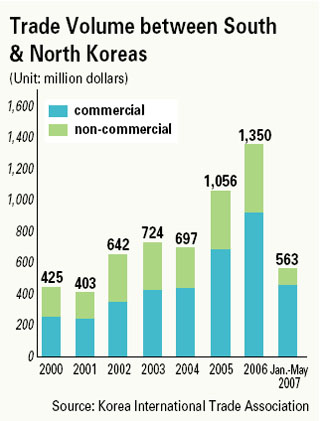
graph.jpgTrade volume between North and South Koreas has increased more than threefold since the historical June 15 Declaration in 2000.

With an average increase of 24.3 percent, annually, the total amount will reach $1.7 billion by the end of the year, according to the report on inter-Korean Trade from the Korea International Trade Association, also known as KITA.

Annual trade volume in 2000 was $425 million, which increased to $1.3 billion last year. Trade volume so far this year until May has already reached $563 million, which is a 31.3 percent increase year-on-year.

Besides the overall growth, what is healthy about the trade quality is that commercial trade accounts for almost 70 percent of the total trade. That figure was below 60 in 2000, according to the report. Non-commercial trade refers to aid including items such as rice, clothing and fuel. In other words, they are products that were sent to North Korea free of charge.

“The success of the Kaesong Industrial Complex is the biggest reason [for the rise],” said Roh Sung-ho, head of the Inter-Korean trade support team at KITA. “We are accepting bids for additional space at the Kaesong complex, and three times more companies bid than there are lots available.”

With more and more companies establishing factories in Kaesong, more material is exported from the South, and more manufactured goods return, said Roh.

The value of goods leaving South Korea was higher than the value of goods returning. However, about 30 percent of those goods were aid and were given free of charge. When that is taken into account, the North made more money from its exports to the South than the South made in exports to the North.

This allows the North to record a profit in trade account books.

“The nuclear incident last year, didn’t affect inter-Korean trade. There might be minor falls, but I expect trade volume between the two Koreas to increase for the time being,” Roh said.

Share

Japanese court orders seizure of pro-N. Korean group

Monday, June 18th, 2007

Yonhap
6/18/2007

A Japanese court Monday allowed the seizure of the headquarters of a pro-North Korean organization based in Japan because of its failure to repay its debts, a news report said.

In its ruling, the Tokyo District Court ordered the General Association of Korean Residents in Japan, better known here as “Chongryon,” to repay 62.7 billion yen to a government debt-collection body, the Kyodo News Agency reported.

Resolution and Collection Corp. (RCC) is expected to start procedures to confiscate the organization’s building, as it claims that the debt was part of loans extended by now-defunct credit unions associated with the group.

The RCC, which took over the non-performing loans from the credit unions, claimed that Chongryon is bound to pay the 62.7 billion yen (US$508 million) as the money was effectively purported to be handed over to Chongryon under the arrangements of the credit associations.

In connection with the suit, an investment advisory firm headed by the former chief of the Public Security Intelligence Agency, Shigetake Ogata, tried in vain to purchase the Chongryon head office for 3.5 billion yen (US$28.4 million) in an effort to prevent the premises from being seized.

Chongryon acknowledged the existence of the loans, but failed to reach an out-of-court settlement with the RCC.

Chongryon argued that the RCC, a public organization, had no right to demand that Chongryon pay the loans at face value, since the RCC had acquired the debts at very low prices.

“There is a purpose in depriving Chongryon of the headquarters’ premises and leading it to dissolution,” Chongryon said. “It offends public order and morality.”

Share

North Korea Gets $25 Million Frozen by U.S. Probe

Friday, June 15th, 2007

Washington Post, A17
Glenn Kessler
6/15/2007

North Korea took possession yesterday of about $25 million in funds previously frozen by a Treasury Department investigation, potentially clearing the way for Pyongyang to fulfill its commitment to shut down an aging nuclear reactor.

An impasse over transferring the money had stalled an agreement announced in February that the Bush administration had hailed as a first step toward ending North Korea’s nuclear activities.

Under that agreement, which angered President Bush’s conservative supporters, the United States was supposed to end the Treasury investigation within a month and North Korea was to shutter its reactor at Yongbyon by April 14. But North Korea refused to take that step until it received money caught up in the investigation.

The reactor had been frozen under a 1994 deal with the Clinton administration, but in 2002 Pyongyang restarted it after a dispute with the Bush administration. Experts estimate that North Korea — which conducted its first nuclear test in October 2006 — has obtained enough plutonium from the reactor for as many as 12 nuclear weapons.

Late this year or in early 2008, North Korea would need to produce fresh fuel to keep the reactor going, says a recent report by the Institute for Science and International Security.

The Treasury Department had targeted Banco Delta Asia, in the Chinese special administrative region Macau, alleging it was involved in money-laundering for North Korea. But the Treasury’s action had wider repercussions, essentially convincing banks around the world not to do business with North Korean firms.

Though the Treasury Department agreed to allow the return of money tainted by illicit activities, no bank was willing to transfer the money without explicit assurances that the Treasury would take no regulatory action. North Korea could have withdrawn the money in cash, but many experts suspected Pyongyang demanded a wire transfer to signal to financial institutions that it was once again part of the financial system.

U.S. officials trying to save the deal desperately searched for a willing bank, but each time an arrangement seemed possible, complications arose. Finally, after Russia indicated that one of its banks could help, the Treasury arranged for the Federal Reserve Bank of New York to transfer the money to a dormant North Korea account at a Russian bank that operates in the Far East, near the border with North Korea.

“Basically all of it has been transferred,” the Macau government said in a statement yesterday. “For Macao, this incident has come to a conclusion.”

When the Treasury ended the Banco Delta Asia investigation in March, it formally ordered a broad range of U.S. financial institutions to stop doing business with BDA. But that order did not include the banks’ regulator — the Federal Reserve system — which allowed the New York Fed to handle yesterday’s transaction without requiring an exemption from the Treasury.

Still, a group of Republican lawmakers this week asked the Government Accountability Office to examine whether the transaction complies with money-laundering and counterfeiting laws.

N Korea fund transfer ‘under way’
BBC

6/14/2007

The transfer of North Korea’s funds from a bank in Macau – a key issue in nuclear disarmament talks – appears to be under way.

A Macau finance minister reportedly said $20m of Pyongyang’s $25m (£12.7m) had left a blacklisted bank in Macau.

The money was earlier reported to be going to a North Korean bank account in Russia, via the US Federal Reserve.

North Korea insists it must access its funds before abiding by a deal to begin shutting its nuclear facilities.

Q&A: North Korean money in Macau
BBC
6/12/2007

In February North Korea agreed to a timeline for giving up its main nuclear site by April – in return for badly-needed fuel and the return of $25m from a bank in Macau.

But the money has yet to be transferred, and the site remains open.

Now, though, the Russians are offering to step in and get the money to Pyongyang, which could remove a key sticking point in neutralising North Korea’s nuclear capability.

How has such a small amount of money become such a sticking point?

The money is, in a sense, only the visible part of a broader problem.

Dozens of North Korean government departments do their international business through a bank in Macau called Banco Delta Asia.

But in September 2005, the US Treasury accused BDA of being a conduit for laundering money for Pyongyang, triggering severe limits on the bank’s dealings with US financial institutions – and a freeze on $25m of North Korean money in the bank’s accounts.

According to the Treasury, BDA was a “willing pawn” of North Korea, helping process as much as $500m a year in dirty money without asking awkward questions.

The move sent relations between Washington, DC and Pyongyang – frosty at the best of times – into the deep freeze.

Between then and now, the $25m became a tool for the US to achieve a deal on North Korea’s ambitions for nuclear weapons – and an excuse for North Korea to stall.

So has a deal been reached now?

Yes, in February this year. North Korea pledged to give up its nuclear reprocessing activities in exchange for thousands of tonnes of fuel.

At the same time, the $25m would be unfrozen, and could – in theory – head back to North Korea.

But the money has yet to leave Macau, because at the same time the US Treasury cut BDA off altogether from the US banking system.

This ultimate sanction, in banking terms, was made under section 311 of the USA Patriot Act – passed shortly after the 11 September 2001 attacks on New York. Effectively, it bars any financial institution from having anything to do with BDA, if they want to do business with or in America.

Understandably, therefore, attempts to find a way of wiring the money back to North Korea have failed.

Banks in China and Vietnam have been approached and have refused to get involved.

One US bank – Wachovia – has been asked by the US State Department to consider helping out, but it points out that it will need assurances that it is not in breach of section 311 before it can do anything.

What is Russia offering to do?

Russia is one of the partners in the six-way talks over denuclearisation of North Korea, and – given that it shares a border with North Korea – has a powerful interest in moving discussions along.

Early in June, Russian officials suggested that a Russian bank might step in to get the frozen $25m from Macau to Pyongyang – directly or via intermediaries.

The US Treasury has now acknowledged the possibility of Russian assistance.

But Russia is likely to require cast-iron assurances that US sanctions against banks which carry out transactions with North Korea will not apply.

One possibility would be for the money to go first via the New York branch of the US central bank, the Federal Reserve, and then on to Russia’s own central bank before being paid into Moscow’s Far East Commercial Bank, where North Korea has a long-unused account.

But what does a country like North Korea need money-laundering services for?

North Korea, in practical terms, is flat broke.

Its trade is minimal, its agriculture is suffering, and its contact with the outside world is severely limited.

But according to the US Treasury, not to mention many experts elsewhere in intelligence and financial crime, Pyongyang has for the past two decades made up for its lack of legitimate trade by taking an unhealthy interest in faking US banknotes, smuggling counterfeit tobacco products and even the narcotics trade.

Much of the proceeds, the US claims, have been laundered through BDA, which has also facilitated huge bulk cash shipments back to Pyongyang – as well as large trades in precious metals.

BDA, it should be said, has always strongly denied the allegations, insisting its business with North Korea is above board.

Why does the US not just send the money back itself?

In theory, the US could have provided a bank with the reassurance it needs to get involved, although that has yet to happen – and could, in any case, be legally tricky. “Difficult, yes; impossible, no,” was how the State Department’s spokesman described it.

Similarly, reports have suggested that since 2001 there has been a conduit for fund transfers between the State Department’s credit union and the Foreign Trade Bank in Pyongyang.

But as far as the Treasury is concerned, the ball is now in Macau’s court. It is up to the regulators there to work out how to get the money back to North Korea – and in the meantime the section 311 rule stays in force.

In any case, after years of playing hardball with North Korea, the last thing the current US administration wants is look as if it is doing things Pyongyang’s way.

Can’t North Korea get it back any other way?

It could – for instance, through a direct withdrawal from BDA back to Pyongyang.

Alternatively, if the US is right that bulk cash shipments have been going on for years illicitly, perhaps the technique could be used for above-board purposes.

But as far as North Korea is concerned, that kind of deal is unacceptable.

It seems that the authorities in Pyongyang want the transfer to pass through the international financial system, so as to send a signal that handling North Korean money does not mean instant ostracism.

Not only that; keeping the matter rumbling on means more time to extract concessions – and, some experts fear, to keep reprocessing nuclear material.

Share

S. Korea set to ship US$20 million in food aid to N. Korea via WFP

Thursday, June 14th, 2007

Yonhap
6/14/2007

South Korea will take steps to send food aid worth some $20 million to North Korea at the request of a United Nations food agency, the country’s point man on the North said Thursday.

“This is totally different in nature from the provision of rice to the North in the form of a loan,” Unification Minister Lee Jae-joung said in a press briefing, conscious of mounting criticism of what it appears to be the government’s sudden about-face in food aid to the North.

South Korea will consult with the World Food Program (WFP) to determine the proposed list and amount of food aid items, which include 24,000 tons of corn, 12,000 tons of bean, 5,000 tons of wheat, 2,000 tons of flour and 1,000 tons of powdered milk, Lee said. It will be the first time since 2004 that South Korea will provide food aid to the North via the WFP.

South Korea resumed shipments of fertilizer and other emergency aid to the North in late March, but withheld the loan of 400,000 tons of rice as an inducement for North Korea to start its nuclear dismantlement under a landmark February 13 agreement.

Besides, the South also decided to send 10,500 tons of rice to the North soon as part of a promise made last year to help the North recover from flood damage, Lee said. “I think it is right to push for this in consideration of cooperation with the North,”

South Korea suspended all types of food and fertilizer aid to North Korea after the North conducted missile tests in July. Resumption of the aid was stymied due to the North’s nuclear bomb test in October, but the two sides agreed to put all inter-Korean projects back on track in early March. Emergency rice aid for flood relief has also been put on hold in tandem with the suspension of the rice loan.

A weak harvest in 2006, disastrous summer flooding and a 75 percent fall in donor assistance have dealt severe blows to the impoverished nation, according to WFP officials.

According to a recent think tank report, North Korea could run short of up to one third of the food it needs this year if South Korea and other countries withhold aid.

Data from the WFP and the Unification Ministry show that the North will need between 5.24 million tons and 6.47 million tons of food this year. Depending on the weather, the availability of fertilizer and other factors, the communist state may only be able to produce 4.3 million tons of food by itself, the report said.

Share
