Archive for the ‘International Governments’ Category

Stratgeic alliances in North East Asia: Railways, ports, and energy

Tuesday, March 4th, 2008

Writing in today’s Asia Times, Dr. Leonid Petrov analyses the complexity of Russia, Rok, DPRK, and Chinese relations:

Russia and North Korea:

Territorial claims, in one form or another, involve almost all countries adjacent in this region with the exception of Russia and Korea. The Joint Russian Federation-DPRK Commission for the Demarcation of State Borders has recently completed its work by documenting and marking the 17-kilometer frontier. This strip of uninhabited and swampy land in the mouth of the Tumannaya (Tuman-gang) River plays an exceptionally important geopolitical role. It not only provides the two countries with land access to each other, but also prevents Chinese access to the East Sea (Sea of Japan).

China and North Korea: 

Here, some 50km north of the small port that forms the core of North’s Rajin-Seonbong Special Economic Zone, the interests of Russia and China are now at stake. Russia is rapidly repairing the railroad track, and China (in a similarly speedy manner) is constructing a new automobile highway, both leading from their respective borders to the port of Rajin. Russia, investing at least 1.75 billion rubles (US$72 million) into this project, seeks to strongly connect Rajin (and the rest of northern Korea) to its Trans-Siberian Railroad. China, in turn, hopes to divert the growing cargo traffic to its own territory, offering the efficient network of railroads for delivery of South Korean and Japanese goods to Central Asian and European markets. What position will the government of North Korea take in this clash of ambitions?

Russia and South Korea (energy and trade):

In 2007, the volume of the export of “black gold” from Russia to South Korea reached 38.13 million barrels (2.7 times more than in the previous year). The relative proximity of the Russian oil and gas fields is an attractive factor for Korean companies who actively search for alternatives to Middle East oil suppliers. This year South Korea will for the first time start importing natural gas from Russia. The expected volume of delivery during 2008 is 1.5 million tons (or 5.1% of South Korea’s annual demand).

and

Trade relations between Russia and Korea are steadily growing. According to customs statistics, last year Russia recorded the sharpest increase of South Korean imports (56.2% more than in 2006). Due to the inflow of “petro-dollars” the new class of nouveaux riches in Russia began actively buying Korean automobiles, cell phones, television sets and LCD monitors. South Korea exported to Russia goods worth US$8.1 billion (including $3.296 billion of automobiles, $859 million of mobile phone equipment, motor vehicles and spare parts worth $659 million). As for trade with North Korea, in 2006 Russia occupied third place after China and South Korea and absorbed 9% of the total $3.18 billion spent by the North on imports.

More on Russia/South Korea energy talk here. 

The whole article deserves reading here:
Russia lays new tracks in Korean ties
Asia Times
Leonid Petrov
3/5/2008

Share

DPRK 2007 trade statistics from KIEP

Tuesday, March 4th, 2008

The Daily NK covers the release of KIEP’s analysis of North Korea’s external trade in 2007.  I cannot find the report in English, so I have to take the Daily NK’s word for it–insert caveat here.

Here are the highlights:

  • The estimated total value of North Korea’s foreign trade decreased from US$2.996 billion 2006 to US$2.7 billion in 2007.

  • China occupies 70% of the trade volume, up from 56.7 in 2006 (a startling increase).

  • Trade with Japan fell to US$900,000, a decrease of 92% from 2006 (so it appears that some Chinese are getting rich from international trade restrictions).

  • Trade with Thailand fell 42.4% since the nuclear test.

  • Trade with the EU fell by 53.2% since the nuclear test.

To be honest I do not trust these numbers, so if someone comes across the KIEP report in English, please send it to me.

According to the Daily NK, the KIEP report is called: “Economic Prospect of North Korea in 2008” by Cho Myung Chul and Hong Ihk Pyo

The full story can be read here:
North Korea’s Economic Prospect for 2008
Daily NK
Yang Jung A
3/3/2008

Share

DPRK demanding $100 USD residence fee at Kaesong Industrial Complex

Monday, March 3rd, 2008

Institute for Far Eastern Studies
NK Brief No. 08-3-7-1
3/7/2008
 
North Korea’s latest demand at the Kaesong Industrial Complex (KIC) is a 100 USD per person registration fee for South Korean workers residing in the complex’s dormitories. The North demanded the fee early in 2007 to cover registration and issuance of registration certificates regarding workers visiting or residing in the complex, and negotiations have been underway the entire year.

An unnamed source close to the South Korean government stated, “At the end of January, the North unilaterally decided on the KIC visiting and residing fees, and when they were not complied with [the North] notified [the South] that they would ban entrance” to the complex, however, “despite this, currently entrance into the complex is freely obtainable.”

The North set a 35 USD fee for registering a short-term stay of up to 90 days, and a 100 USD fee for registering a one-year residency, according to the source. A Unification Ministry official acknowledged, “The fee demanded by the North is not exorbitant, but from the perspective of the businesses in the complex, negotiations on reasonable measures were in progress.”

North Korea is making its demands based on the ‘Kaesong Industrial Zone Entrance, Dwelling and Residence Regulation’ enacted in December 2003. According to this regulation, fees must be paid for issuance and reissuance of registration papers when applying for short term stays up to 90 days, long term visits over 90 days, and residency of one year or more. Currently, there are over 800 South Korean employees who would need to pay fees for visiting or residing at KIC.

Share

Vienna trains North Korean orchestra conductors…

Friday, February 29th, 2008

This week that Washington Post (hat tip Dr. Petrov)published an article which took a unique position on the NY Phil’s performance.  Rather than comment on whether the event was diplomatically significant, or whether it legitimized a regime with a poor human rights record, the columnist denounced it for having a “tinge of benevolent didacticism”…before pointing out that North Korea has no shortage of classically-trained, quality orchestra conductors.  In fact, for years they have been sending students to Vienna:

Asia is a hotbed of Western classical music. This passion has evidently not bypassed North Korea. Much of the West harbors images of North Koreans as either wealthy soldiers or starving peasants. But in Vienna, Austria, there is another image of them: as conducting students. The elite conducting class at the University of Music and Performing Arts there has trained no fewer than 17 North Korean students in the past decade.

According to Mark Stringer, the conductor who leads the class, the North Korean government decides, every few years, that it is time to train a new crop of elite young conductors. In the early 2000s — a few years before Stringer took over in 2005 — the government’s choice fell on this Vienna school. There were considerable bureaucratic hurdles to overcome; North Korean representatives insisted on sitting in on auditions, and had a hard time understanding why not all of their handpicked candidates were accepted by the school. But they were also paying attention.

“The next batch,” Stringer said, “knew what to expect. They were so prepared they could nail every single bit of our ferociously difficult entrance exam.”

The students also do not fulfill anyone’s expectations of politically guarded wards of the state. “They have a completely normal experience,” Stringer says. “Once they’re in the walls of the school, politics disappear. There is no breathing down our necks from the North Korean officials.” He describes the students as generally more open, easygoing and funny than their South Korean counterparts.

“Were they to be allowed to stay in the West,” he says, “a number of the ones I’ve seen would have a serious chance of a prominent international career. It’s phenomenal what they come to Vienna knowing how to do.”

UPDATE email from a reader:

I also visited that performance of the joint North-South Korean student’s orchestra at Vienna Music Universtity (and took a video of this performance).

Contrary to the Washington Post article the ambassadors were not attending the performance, but other staff of the respective embassies [were]. I don’t know, if they drank beer together, but anyhow, when arriving at the hall before performance the consuls (not ambassadors) greeted themselves nicely.

Very interesting the seating arrangement of the South and North Korean spectators in this student concert. The men (Korean, North an[d] south) in rows 2-4, the women in rows 5-6 and the students behind. (very Confucian …)  It was amazing to see how many North Koreans must be living here in Vienna.

In Vienna, there are not only North Korean conductor students, but also piano, violin, biology, architecture or English students. The same in Germany, Italy and maybe France and other countries.

The full article can be read here:
The N.Y. Philharmonic in North Korea: Symbology and the Music
Washington Post
Anne Midgette
Tuesday, February 26, 2008; Page C04

Share

Russian ship makes it home

Thursday, February 28th, 2008

UPDATE: Dr. Petrov made some interesting comments that deserve highlighting:

The BBC report is full of mistakes. The name of the ship was “Lidia Demesh”. On board were 23 members of crew and 1 passenger. After being arrested the ship was escorted to the port of Kimchaek.

The situation was resolved quickly thanks to the Russian Consular General, E.Val’kovich, who personally went to Kimchaek and sorted things out. Most Russian diplomats posted to DPRK are fluent in Korean and exempt from travel restrictions. So, no traditional Hawaiian symbol of respect is needed. 

ORIGINAL POST: The BBC reported last week that the North Koreans pulled a surprise ‘Pueblo’ on the Russians.

The Lida Demesh, carrying a consignment of cars from Japan, was heading for the Russian port of Vladivostok when it was stopped by patrol near Cape Musudan.

An armed group boarded the ship and ordered the captain to change course and go to a North Korean port [Chongjin],” he told the Russian NTV network.

Mr Yeroshkin said the centre had been told the ship’s 25 crew-members were fine and that there had been no threat to their lives. (BBC)

Strangely, this was not the first time this has happened… 

A similar incident in 2005 took 15 days to resolve through diplomatic channels. (BBC)

Fortunately for the crew, the situation did not last that long.

A Russian cargo ship released by North Korean authorities on Wednesday has arrived in the Far East port of Vladivostok.

Captain Yury Buzanov said on returning to Russia that he was forced to enter North Korean waters to avoid a shipwreck due to a heavy storm.

“To save the crew I decided to enter North Korean waters because the waves in the Sea of Japan were three to four meters high with winds of 25 meters per second. In such stormy conditions, the cargo could have shifted in an instant causing the ship to lurch and sink,” the captain said. (Novosti)

No word if they ever used the traditional Hawaiian symbol of respect.

The full stories can be found here:
North Korea Detains Russian Ships
BBC
2/23/2008

Russian ship arrives home after seizure by North Korea
Novosti
2/28/2008

Share

NY Philharmonic wrap up (and US national anthem)…

Wednesday, February 27th, 2008

UPDATE 2 (2013-6-24): A documentary was made of the NY Phil’s visit to Pyongyang.  You can watch both parts here:

Part I:

Part II:

UDATE 1 (2008-11-17): Suki Kim wrote about the experience in Harpers.  Download the PDF here:  harpers.pdf

ORIGINAL POST (2008-2-27): Its difficult to say anything about the NY Phil’s performance that has not already been reported on by numerous other forums, but I think I managed to put together enough interesting material to meet the high standards of North Korean Economy Watch readers:

Pyongyang and the Star Spangled Banner

This site claimed that the philharmonic’s performance would likely be the first time that the US national anthem was broadcast on North Korea’s airwaves.  The Joong Ang Daily backs this claim up with a caveat:

The Unification Ministry of South Korea said the U.S. national anthem was played in Pyongyang in 2005 at an international boxing match. It is, however, the first time the Star Spangled Banner has been broadcast live across North Korea. (Joong Ang Daily)

The first public performance of the Star Spangled Banner in Pyongyang was in honor of US female boxer Yvonne Caples (official biography here).  Here is how it was reported in KCNA:

DPRK Female Pro Boxer Choe Un Sun Wins World Championship

Pyongyang, June 28, 2005 (KCNA) — Female pro boxer Choe Un Sun of the Democratic People’s Republic of Korea captured the championship title of the WBCF in the women’s light flyweight category (48.98 kg). Choe Un Sun settled the bout by a unanimous decision over Yvonne Caples of the United States.
The champion belt, trophy and certificate were awarded to Choe.
The match was held at the Ryugyong Jong Ju Yong Gymnasium in Pyongyang Tuesday.

In the interest of fair reporting, here is Ms. Caples’ side of the story:

…Yvonne traveled to Pyongyang, North Korea to be a part of the historic first professional boxing matches in North Korea to fight for the WBCF Jr. Flyweight World Title against North Korean Eun Soon Choi. During Yvonne’s bout the American National Anthem was played for the first time in North Korea. Yvonne knew that in order to get a decision she would probably have to get a knock out. Eun Soon Choi proved to be very strong and skillful. Fighting in front of 13,000 cheering North Koreans, Yvonne fought what she felt was the best fight of her career. Despite the intimidating crowd Yvonne felt relaxed and confident throughout the fight. “I fought the fight of my life and came on very strong in the last five rounds. Even though I felt I won the fight, I knew I wouldn’t get the decision. It is no joke fighting in an arena with 13,000 people cheering against you. I was so proud of myself for keeping my composure and fighting so hard in this fight. I do have to take my hat off to the North Korean fighters. I expected them to be strong and well-conditioned, but they were also very skillful fighters. I don’t think anyone would be able to go over there and completely dominate them or knock them out.”

Ms. Caples aside, the editor of this site sang the US national anthem on a bus full of tourists and north Korean guides traveling to Wonsan in August 2005. For the record, this counts as the second live, “public” performance of the Star Spangled Banner.  The NY Philharmonic is only now taking the bronze.

Jazz also made its debut.  According to Defector Kim Chol-woong:

[“An American in Paris”] is a masterpiece, a mixture of classical and jazz. I am amazed that they will play jazz, because the genre is strictly forbidden in North Korea.

[W]hat musicians are allowed to perform is strictly political. Jazz is forbidden because it is American music. Jazz is considered lewd and immoral. (Joong Ang Daily)

What are North Korea’s full musical capabillities?
Dr. Petrov sent in a great Washington Post article on North Korea’s musical capabilities on which I wrote a separate post.

How many people heard the performance?
The theater holds 1500.  According to the WSJ, there were a minimum of 150 foreigners likely in the audience (they flew in with the orchestra).  Who knows if any of the small business, NGO, and diplomatic community residing in Pyongyang were able to attend.  There was also a dress rehearsal for 1200 earlier in the day.

The Daily NK reports (Via the Japanese Mainichi) the the performance was not boradcast on radio, only on television.  This means that relatively few people saw it since the penetration of radios is far more significant than television in the DPRK.

Addendum: Who attended?
In the comment section below, “Gag Halfrunt” (clever handle) links to a list of VIP attnedees in KCNA.

Don Kirk notices who did not attend.

Here you can listen to the perfomrance:

In the comment section below, Greg Halfrunt posts a link to http://www.medici.tv/.  Beginning Friday, Feb 29 (happy leap year), 2008.

The full stories cited in this post can be found here:
Americans in Pyongyang
Joong Ang Daily
Kim Ho-joung and Ser Myo-ja
2/27/2008

Philharmonic is hopeful sign for defector
Joong Ang Daily
Ser Myo-ja
2/23/2008

North Korea Criticizes the US during the New York Philharmonic Performance
Daily NK
Park In Ho
2/28/2008

A Sour Note in Pyongyang
Asia Times
Don Kirk
2/29/2008

Share

North Korean embassies having business problems

Sunday, February 24th, 2008

As readers of North Korean Economy Watch are well ware, North Korean embassies do not receive all of their operational funding from Pyongyang.  In most cases, the embassy staff do not only generate their own income, they must also remit money back to Pyongyang.

This system might seem strange to westerners, but it has one major benefit to Pyongyang: the embassies actually earn a profit! The down side, however, is that more than one North Korean diplomat has been caught neck deep in some kind of shady business deal.

It might be possible, though, that business for the embassies is not too brisk these days…

This week, the Daily NK reports that Kim Jong il’s half-brother, who is the exiled ambassador to Poland, seems to be making overhead cutbacks at his embassy:

The North Korea embassy in Poland has not been able to hold Kim Jong Il’s birthday party in the embassy since 2006 due to financial problems. Despite this, they have been holding events, ceremonies and parties in pro-North Korean organizations or North Korean branch companies with pro-North Korean figures in Poland.” (Daily NK)

This is the second DPRK emabssy story in the media recently.  Just a few days ago, it was reported the the North Korean ambassy in Australia was also closing

What other DPRK embassy cutbacks are we unuware of?

The full article can be found here:
Kim Pyong Il Says Kim Jong Il System Will Last For a While
Daily NK
Yang Jung A
2/22/2008 

Share

PBS Will Broadcast Concert From North Korea

Tuesday, February 19th, 2008

Update: Today the New York Times reports that the North Korean government has agreed to broadcast the New York Philharmonic’s Pyongyang concert live on state television.  Why is this interesting? First of all, this means that the US national anthem, and many other beautiful songs, will be played over North Korea’s airwaves–probably for the first time.  Secondly, communist countries are typically very hesitant to broadcast anything live. 

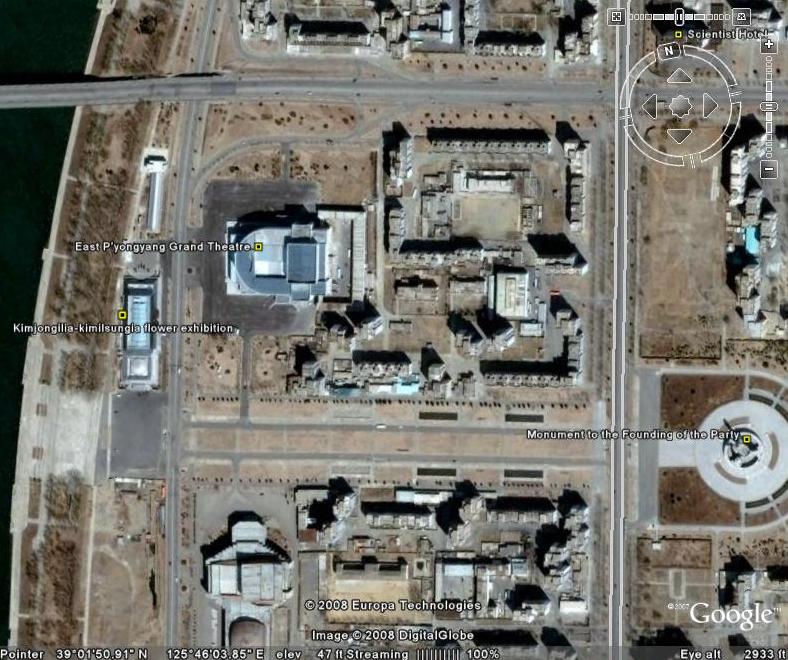
easttheater.JPGThe concert will take place in Pyongyang’s East Theater, located in the Munsu district on the east side of the city.

One thing is for sure, Politics aside, the performance will certainly be more interesting than the concert South Korea’s Shinhwa and Baby V.O.X. put on in Pyongyang! 

Original Post: 2/7/2008 
Today the New York Times (link requires free registration) ran a story on who will be broadcasting the New York Philharmonic’s concert in Pyongyang…

The New York Philharmonic’s concert in North Korea on Feb. 26 will be broadcast that evening on [New York’s local PBS station] WNET, Channel 13, and distributed two days later on PBS, broadcast officials said Wednesday.

In an unusual arrangement, ABC News will cooperate with WNET, New York’s public television station, to produce the broadcast.

Because of the time difference, the concert will actually take place before dawn New York time on Feb. 26. A live broadcast will be made available for any takers by EuroArts Music International, which produces and distributes classical music programming and has the rights to the broadcast outside South Korea.

The most interesting part of the story, however:

One place where the broadcast is still uncertain is North Korea itself. Government officials there have not said whether the concert will be shown on local television, according to Eric Latzky, the Philharmonic’s spokesman.

Given North Korea’s deep isolation and the government’s tight control over its citizens, the broadcast issue is of crucial interest. Orchestra officials said they had pressed hard to have the concert shown on North Korean television, to ensure that it would be heard by more than just a small audience of dignitaries. The broadcast of any event from North Korea is rare.

You can read the stories here:
Concert in North Korea to Be Broadcast Live
New York Times
Daniel Watkin
2/19/2008

PBS Will Broadcast Concert From North Korea
New York Times
Daniel Wakin
2/7/2008

Share

The gratuitous game theory of official support

Friday, February 15th, 2008

Yesterday’s post on accountability and South Korean aid to the North got me thinking about game theory again.

gametheorys.JPG

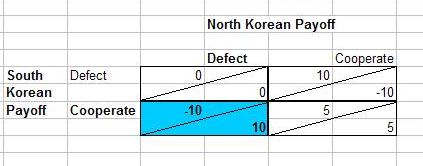
The South Korean Ministry of Unification has a dominant strategy to lend/give/invest in North Korea for ostensibly two reasons: 1. If the MoU does not, their raison d’etre goes away.  2. South Korea will ultimately see a payoff if a development strategy works in the DPRK.

Contracting with North Korea, however, is essentially a prisoner’s dilemma (see chart above), and North Korea has the ability to cooperate or defect.  However, the North Koreans have rational expectations, so they know the Ministry of Unification has a dominant strategy to cooperate.

Therefore the Nash equilibrium is for the South to keep cooperating and for the North to keep defecting.  In a repeated game, cooperation evolves over time as trust develops and defection decreases.  Because of South Korea’s dominant strategy,however, the North never has an incentive to cooperate–so we end up with an “anti-folk theorum” where defection is the only incentive compatible outcome over time.

Addendum: The game could be radically different for private investors, however, who are in a more credible position to say “no”–leading to defect/defect moves (because South Korean investors are not as politically constrained and can recognize sunk costs).  These moves result in neither gains nor losses for either side, however, because both sides have the ability to bargain, cooperation that is mutually beneficial can evolve over time as it should.

Share

Miniunific: Show me the money!

Thursday, February 14th, 2008

On February 8, it was announced that the South Korean Ministry of Unification, the agency responsible for official interactions with the North, would not be merged with the Foreign Ministry (full story)–dealing an early policy blow to the newly elected South Korean President’s efforts to reduce the size of the South Korean government.

However, just three days later, on February 11,  the Chosun Ilbo reported that a South Korean government cash donation to North Korea (cash donations are apparently unlawful) has [surprisingly] gone missing:

In March last year South Korea gave US$3.8 million worth of aid, including $400,000 in cash and building materials, to North Korea to build a center for inter-Korean video-link family reunions in Pyongyang. But North Korea has not even started construction on the site, it was known on Sunday.

The donation violated a ban on cash aid to North Korea, but South Korea’s Ministry of Unification said at the time that there would be no room for suspicious dealings because the North agreed to inform the South where the money was spent and the South agreed to visit the construction site to find out whether the money and materials were used properly.

It has been almost a year since the aid was delivered, but it is not clear what the North has done with the cash and building materials. The South Korean government has demanded that it be allowed to visit the construction site, but the North has brushed off the requests, saying it will show the site “next time” or after the center is dedicated.

[and…] 

On eight occasions from early April to late August last year, South Korea delivered to the North building materials such as cement, iron bars, electric cable, tiles, drills, adhesive glue, interior furnishings, elevators, and air-conditioning and heating equipment. It also sent 10 buses and six Rexton SUVs.

When sending the materials, Seoul demanded five times that the North allow South Korean officials to visit the construction site and provide details on where the materials were used. All such demands were rejected. (Chosun Ilbo)

Today, February 14, South Korean military authorities admitted to knowing (since 2003, when the previous Roh Moo-hyun administration was inaugurated), that North Korea has transported rice supplied by the South for humanitarian purposes to front-line units of the Korean People’s Army.

The South Korean military has admitted it found no fewer than 200 South Korean rice sacks transported to North Korean Army units on about 10 occasions to the demilitarized zone including Gangwon Province between 2003 and recently.

This is the first corroboration by the South Korean military of testimony by North Korean refugees that the food aid provided by South Korea is being diverted for military purposes. But despite their knowledge of this fact, neither the South Korean government nor military authorities protested to North Korea or asked it for an explanation, apparently for fear of provoking Pyongyang. (Chosun Ilbo)

Updated: 2/21/2008: North Korea denies it diverted food aid to military

Now, I personally favor some kind of engagement policy with the North, but implementing an effective strategy is difficult.  Strict transparency and accountability are absolutely necessary to avoid mismanagement of public funds.  This is admittedly difficult, even in the OECD, much less in a secretive communist state.  Under the current circumstances, however, the North is treating the South like an unwanted lover, and this is not a healthy outcome. 

Handing out public funds with weak- or no-strings attached (as the South has done for years) creates markets in political corruption in the North.  The North Koreans know that the Ministry of Unification has a bureaucratic incentive to spent the money on aid.  If they don’t, it will not be appropriated in the next fiscal cycle.  This is why government budgets almost never go down, and agency heads go on a spending spree just before the fiscal year ends–use it or lose it.  The North Koreans have simply learned how to say the right things, etc., so the Ministry of Unification can check the box and pay up, because they know there will be no consequences when they fail to deliver.

So what is the solution?  If the South Korean government demonstrated some desire to monitor development aid, and reduce it if necessary (say “no” once in a while), they might encourage the North Koreans to do with the money as they claim (at least more so).

Another option available to the South Korean government is to stop using public funds to develop North Korea and instead free the South Korean business community, and other individuals, to take their chances contracting with North Korean entities themselves.  Putting their own Won on the line will definitely encourage private investors and venders to keep an eye on their balance sheets, and will help depoliticize the development of a country with a poor reputation.  

See the gratuitous game theory here.

You can read the referenced articles below:
S.Korea Knew Its Rice Feeds N.Korean Military
Choson Ilbo
2/14/2008

N.Korea May Have Diverted Cash Aid
Chosun Olbo
2/11/2008

Share