Archive for the ‘International Governments’ Category

Japanese Red Army Hijackers Willing to Return to Tokyo to Face Trial

Tuesday, April 15th, 2008

(UPDATE 2: 1/12/2009) Last of the children of the Japanese Red Army will return to Japan:

The 14-year-old son of one of the Japanese men who hijacked a Japan Airlines airplane and defected to North Korea in 1970 will travel to Japan next week, the last of the children of the hijackers to move to Japan from the country. A supporter of the hijackers’ family members left for Pyongyang on Saturday, where he will meet with the boy and accompany him to Japan via Beijing on Tuesday.

The boy is the son of Moriaki Wakabayashi, 61, who is on the international wanted list for hijacking the plane. The supporter left the Chinese capital after obtaining a special traveling permit from the Japanese Embassy for the boy, who was born in North Korea and does not have a Japanese passport. Family members of the nine hijackers began returning to Japan in 2001. Those remaining in North Korea will be the four of the nine hijackers still living in the country and two wives who are on the international wanted list for their alleged involvement in the kidnapping of Japanese nationals for North Korea. (Japan Today, 1/10/2009)

(UPDATE: 5 days after NKeconWatch posts the press release)

From the Japan Times (h/t OneFreeKorea)

Asked in a telephone conversation whether the hijackers called for help from the European Parliament, Ford said, “The only help they seemed to want was to publicize their offer.”

Ford said the meeting was set up by his North Korean hosts when discussing barriers to the removal of North Korea from the U.S. list of state sponsors of terrorism.

He said he has informed the Japanese government of his meeting with the hijackers.

“This is an opportunity that I hope the Japanese government will take to move closer to normalize relations between Tokyo and Pyongyang,” Ford said.

Of the nine hijackers who sought asylum in the North, three have died and two who later returned to Japan were convicted.

Read the full article here:
EU lawmaker meets North fugitives
Japan Times
4/15/2008

Press Release:
redarmy2.JPG


Monday 7 April 2008

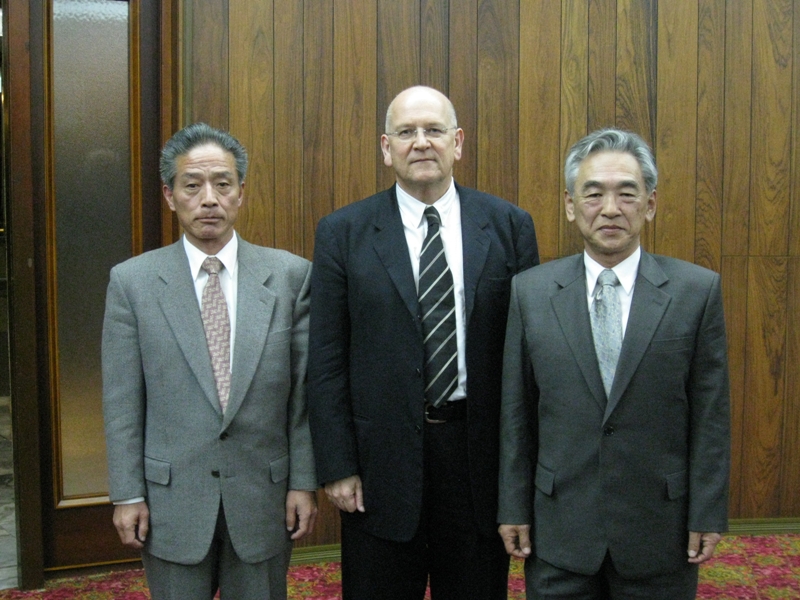
Glyn Ford (Labour MEP for South West England), met in Pyongyang with Moriaki Wakabayashi and Takahiro Konishi two of the four remaining Japanese hijackers in North Korea. Moriaki Wakabayashi and Takahiro Konishi, who hijacked Japan Airlines Yodo Flight 351 from Tokyo to Fukuoka in 1970 declared that they are willing to return to Japan to face trial. 

Following the meeting with the hijackers, Glyn Ford MEP, said: “All four hijackers are now willing to return to Japan.  This offer is only conditional on the dropping of arrest warrants against three of them for possible complicity in the abductions of Japanese citizens to North Korea in the 1980s. Their return would mean that the last remaining obstacle to the US removing its terrorist state designation of North Korea would have been removed consequently allowing progress to be made towards a final settlement of the current nuclear crisis on the Korean Peninsula.”

He continued “This is an opportunity that I hope the Japanese government will take to move closer to normalise relations between Tokyo and Pyongyang. If US Army deserter and defector Robert Jenkins can return to Japan after only serving a token 30 days in jail I see no reason why the Japanese government should refuse to accept an offer that might well lead to the four remaining hijackers, all now in their late 50s and 60s, facing up to 12 years in prison.”

In January Glyn’s book North Korea on the Brink: Struggle for Survival was published by Pluto Press. It will be published in Tokyo in June by Daiichihoki and in Korea by Humanitas.


Share

South Korea continues imports of DPRK coal

Monday, April 14th, 2008

From Yonhap:

A North Korea-registered cargo ship carrying coal arrived in South Korea’s port city of Ulsan Sunday amid increased cross-border tensions, according to maritime police.

The 2,496-ton freighter Changseong carrying a 29-member crew docked at the port, South Gyeongsang province, around 10:20 a.m. earlier in the day.

The ship carried 4,000 tons of coal, the first batch of 12,000 tons to be delivered by April 25, the police said.

And how much are they paying? IFES has the answer…

North Korea, in keeping with rising international coal prices, appears to have hiked up the export price of heating briquettes twice in the last three months. A North Korea insider in Shenyang, China recently reported, “North Korea’s Trade Bureau Price Control Division raised export prices at least twice as this month came around, so the export price soared up to 50 USD per ton,” and, “As the rising international coal price trend continues, there is a high probability that North Korean heating briquette prices will also rise further.”

Last year, North Korean heating briquettes were exported at 30 USD per ton, but as 2008 rolled around and international prices suddenly shot up, DPRK coal prices rose by over 50 percent, putting a significant burden on Chinese importers. However, Chinese importers still prefer DPRK briquettes as shipping costs from alternatives such as Vietnam or Indonesia still make North Korean imports relatively inexpensive.

It has been reported that the DPRK Trade Bureau has approved the export of briquettes to China at below-official prices of 44~45 USD per ton in cases in which there is Chinese capital or equipment has been invested in the coal mine. These charcoal briquettes are North Korea’s largest export item, with China importing 170 million USD-worth in 2007 alone.

So if South Korea was lucky enough to get China’s price (an assumption that might not be the case): 12,000 tons (by April 25) x USD$50/ton= $600,000

Read the full articles here:
N. Korean cargo ship visits Ulsan  
Yonhap
4/13/2008

DPRK coal briquet export prices jump this year
Institute for Far Eastern Studies (IFES)
(NK Brief No. 08-4-10-1)
2008-04-10

Share

When food and politics collide

Sunday, April 13th, 2008

News of the DPRK’s food shortages began to surface several weeks ago when Good Friends reported:

North Korea’s chronic food shortage has worsened to affect even some of the country’s elite citizens in the capital, a South Korean aid group said Thursday.

The communist nation has not given rice rations to medium- and lower-level officials living in Pyongyang this month after cutting the rations by 60 percent in February, the Good Friends aid agency said in its regular newsletter.

Pyongyang citizens are considered the most well-off in the isolated, impoverished country, where the government controls most means of production and operates a centralized ration system. Only those deemed most loyal to Kim Jong Il’s regime are allowed to live in the capital.

The food situation is more serious in rural areas, with residents in many regions in the country’s South Hwanghae province living without food rations since November, the aid group said. (AP)

Why was this the case?

Floods last August ruined part of the main yearly harvest, creating a 25 percent shortfall in the food supply and putting 6 million people in need, according to the U.N. World Food Program.

Over the winter, drought damaged the wheat and barley crop, according to a recent report in the official North Korean media. That crop normally tides people over during the summer “lean season” until the fall harvest.

North Korea’s ability to buy food, meanwhile, has plunged, as the cost of rice and wheat on the global market has jumped to record highs, up 50 percent in the past six months.

China also appears to have tightened its food squeeze on North Korea for domestic reasons. In order to meet local demand and control inflation, Beijing slapped a 22 percent tariff on grain exports to the North. (Washington Post)

So North Korea’s domestic agricultural production has fallen and so have commercial food imports (international inflation, OECD government subsidies for bio-fuels, and increasing fuel prices have combined to raise the prices of commodities such as rice and pork up to 70% in the course of a year). 

Compounding this problem, however, agricultural aid from North Korea’s two most reliable benefactors (China and South Korea) has dried up.

[China] has quietly slashed food aid to North Korea, according to figures compiled by the World Food Program. Deliveries plummeted from 440,000 metric tons in 2005 to 207,000 tons in 2006. Last year there was a slight increase in aid, but it remained far below the levels of the past decade. (Washington Post)

And strained relations with the new Lee government in South Korea have not helped:

The South typically sends about 500,000 tonnes of rice and 300,000 tonnes of fertiliser a year. None has been sent this year and without the fertiliser, North Korea is almost certain to see a fall of several tens of tonnes in its harvest (Reuters)

So what will be the mitigating factors that prevent another humanitarian emergency?

“The reason for the mass starvation that occurred in late 90s is that North Korea faced natural disasters without expanding the market’s capability to substitute for the broken planned economy capability, and so the damage to North Korean citizens was inevitably large.”

“The market in North Korea has expanded in the last 10 years. The supply and demand structure of daily necessities, including food items, has been formed.”

“Because the market capacity has expanded, the possibility of a mass-scale starvation occurring is no longer high. In actuality, the change in food prices is being monitored at the market.”

-Dong Yong Seung, the Samsung Economic Research Institute’s Economic Security Team Chief, speaking at the 19th Expert Forum sponsored by the Peace Foundation (Daily NK)

Mr. Dong’s analysis addresses the improved efficiency of DRPK’s market supply chains but does not address the effects of an adverse supply shock. 

The UN seems ready to help, although it has not been asked:

Institutionally, mechanisms are in place in North Korea to ring the international alarm bell before hunger turns into mass starvation. The World Food Program monitors nutrition in 50 counties, and the Kim government has become expert in asking for help.

“The North Koreans know that they are facing a difficult situation and have made it increasingly clear in the past few weeks that they will need outside assistance to meet their growing needs,” the U.N. official said, asking not to be identified because of the sensitivity of the issue.

North Korea, which even with a good harvest still falls about 1 million tonnes, or around 20 percent, short of what it needs to feed its people, relies heavily on aid from China, South Korea and U.N. aid agencies to fill the gap.

The UN official said it was clear from a variety of sources that the food security situation was worsening in North Korea and that it needed to be addressed.

Last month Kwon Tae-jin, an expert on the North’s agriculture sector at the South’s Korea Rural Economic Institute told Reuters that if South Korea and other nations did not send food aid, the North would be faced with a food crisis worse than the one in the 90s.

The U.N. Food and Agriculture Organisation said in late March it sees the North having a shortfall of about 1.66 million tonnes in cereals for the year ending in October 2008.

The North will start to feel the shortage the hardest in the coming months when its meagre stocks of food, already depleted by flooding that hit the country last year, dry up and before the start of its potato harvest in June and July. (Washington Post)

The UNWFP, however, will be under pressure from its donors to monitor food aid and make sure it is not diverted to non-emergency uses.  Under these conditions, it is not likely that they will be asked to provide much aid until a catastrophy is already underway.  So with the UN out of the picture, who is best positioned to prevent the reemergence of a humanitarian crisis in North Korea today? China.  

Despite China’s own food probelms, however, it is always likely to capitulate, at least in part, to North Korea’s emergency requests.  China does not want to deal with another North Korean famine, particularly during the Olympic season, and they certainly do not want to deal with any political instability that could result. 

Yonhap reports that the DPRK has asked the Chinese for 150,000 tons of corn this year.  Chinas says they will give 50,000 tons–and that is just initially. (Yonhap)

UPDATE 4/14/2008: I still have not seen any reports in the media of Noth Korea seeking suport from Russia.

UPDATE 6/9/2008: China increases grain export quota to North Korea to 150,000 tons

(more…)

Share

Pyongyang sends USD $2million to Chongryun

Saturday, April 12th, 2008

If you want to make money, you have to spend money. 

Excerpts from Yonhap:

North Korea regards [Chongryun] the pro-Pyongyang residents’ group in Japan as its major overseas support base. The pro-communist group operates a number of primary and junior and high schools in Japan where students of Korean ancestry learn the Korean history and language.

Kim Jong-il “sent 205 million yen as educational aid fund and stipends to the General Association of Korean Residents in Japan for the democratic national education of the children of Koreans in Japan,” the Korean Central News Agency said in a report, monitored in Seoul.

The latest North Korean financial donation comes amid warnings by international aid groups that the isolated communist country faces its worst food shortage in years.

Read the full sotry here:
N. Korea donates US$2 million to pro-Pyongyang group in Japan: report
Yonhap
4/12/2008

Share

China/North Korea financial integration

Saturday, April 12th, 2008

Last week we discussed the growing presence of North Korean companies in Russia.  This week, the Daily NK reports on China’s first steps at financial integration with North Korea:

China has introduced a new settlement system which allows North Korean business to open bank accounts in China and settle business transactions in Yuan, the Nikkei reported on Sunday.

With the adoption of the system, North Korean people and companies can open Yuan bank accounts within China after some formalities and use the accounts for trade settlement with their Chinese business partners. Accordingly, North Korea is now able to buy foreign currencies such as dollars and euros with its Yuan income from trade. In addition, North Korea can legally bring in foreign currencies or send them to third countries.

North Korean companies used to have difficulties of making a trade settlement with China in cash or by barter since the U.S. enacted financial sanctions on North Korea and China imposed economic sanctions regarding remittance and bank accounts after North Korea’s nuclear tests. However, China too suffered from the sanctions as the amount of Yuan smuggled into North Korea has skyrocketed proportional to the increasing volume of trade between North Korea and China.

The new settlement system will help reinvigorate the trade between two countries. However, the system can cause concerns at the Six Party Talks as it lowers the bargaining power needed to pressure North Korea to give up its nuclear programs, the Nikkei said.

Meanwhile, the People’s Government of Yanbian Korean Autonomous Prefecture announced last February that Jilin Province would allow North Korean people and companies operating in China to open Yuan bank accounts for trade purpose starting with February 20, 2008.

You can read the full article here:
China Lifts Sanctions on North Korea
Daily NK
Park Eun Jae
4/9/2008

Share

Haggard-Noland on North Korea’s economic integration

Tuesday, April 8th, 2008

Stephen Haggard and Marcus Noland published a piece focusing on North Korea’s economic integration.  Download it here: petersoninstitute.pdf

Although not the focus of the piece, here is an excerpt:

A first corollary of the injunction to avoid top-down approaches is that any collective development assistance must be extended in support of economic reform. Experience throughout the developing world demonstrates that assistance will have only marginal effects and may even have negative consequences if not coupled with policy changes. It is not simply that aid sustains the regime; since aid is fungible, even purely humanitarian aid will have that effect. The problem is that too much aid can delay or even undermine the reform process. Whatever the multilateral mechanism that ultimately emerges, it should encourage reform and economic opening in the North.

A second corollary of the injunction against top-down approaches is the importance of engaging the private sector: through trade, foreign direct investment, private capital flows (including remittances), and sheer expertise. Economic rehabilitation will require investment in social overhead capital, which will be led primarily by the public sector. But if North Korea is to evolve toward a self-sustaining market-oriented economy, private-sector involvement will be crucial. Participation of foreign firms means that projects are subject to the market test of profitability, and it encourages North Korean authorities to think of economic engagement in terms of joint gain rather than as political tribute.

(and)

North Korea is in need of depoliticized technical assistance for a whole panoply of issues running from the mundane but critical, such as developing meaningful national statistical capabilities, through basic agricultural and health technologies, to social infrastructure of a modern economy. This infrastructure includes policy mechanisms to manage macroeconomic policy, including through reform of the central bank; specify property rights and resolve commercial disputes; regulate markets, including financial markets as they emerge; establish and implement international trade and investment policies; and so on.

Read the full paper here:
A Security and Peace Mechanism for Northeast Asia: The Economic Dimension
Staphen Haggard and Marcus Noland
Peterson Institute Policy Brief
April 2008

Share

UN pulls out of North Korea Olympic torch ceremony

Saturday, April 5th, 2008

More politicization of the Beijing Olympics…

The United Nations has withdrawn its staff from the Olympic torch run in North Korea amid concerns that the relay will be used as a propaganda stunt.

The decision followed a heated internal debate among foreign donors, who face a constant battle with Kim Jong-il’s government in their efforts to get food and aid to impoverished people.

It is believed to be the first acknowledgment by the world body that the Olympic torch relay is a political event that can be exploited by unscrupulous governments, diplomats said.

and…

“Unicef originally decided to participate in the Pyongyang leg of the Olympic torch run in response to a request from, and as a demonstration of support for, the International Olympic Movement,” said Christopher de Bono, a spokesman for the organisation.

“However, we are no longer convinced that Unicef’s participation in the run will support the aim of raising awareness of the situation of children in the DPRK [Democratic People’s Republic of, or North, Korea] and elsewhere,” he said.

“Unicef has decided, in concert with other UN family entities, to withdraw from the Pyongyang relay.”

Read the full article here:
UN pulls out of North Korea Olympic torch ceremony amid fears of propaganda coup
Times of London
Michael Sheridan
4/6/2008

Share

North Korean businesses expanding in Russia

Saturday, April 5th, 2008

From the Donga Ilbo:

A black Benz with the red license plate of “087” passed by quickly. 087 is a number used exclusively for the sedans of North Korean diplomats. It was easy to tell that the North Korean embassy located on this street recently purchased the luxurious sedan.

“The North Korean embassy has been full of life since the latter half of 2006 because of the increased number of North Korean workers sent to Russia, diversified businesses and growing efforts to secure energy supplies,“ said North Korean defectors that the Dong-A Ilbo report team met in Moscow.

North Korean workers will construct the next APEC forum venue:

In order to prepare for the APEC, the Primorsky regional government (on the North Korean border) plans to issue work permits to 12,000 North Korean workers in 2008, four times higher than the number of those last year. A foreign national, who has hired North Korean workers, said, “North Korean senior officials are lobbying fiercely in order to increase the quota for laborers. They even arrange free tours of North Korea for Russian government officials.”

North Korea companies revived:

Recently, North Korean companies, such as Daedong River, Neungra, Baekdu and Goonpyo, have established their offices in many parts of Russia.

A 39-year-old North Korean defector who has stayed in Russia for 12 years said, “I believe, out of the 49 Russian provinces, North Korean firms have established their offices in about 30 provinces. Some 90 percent of them are responsible for overseeing North Korean workers.”

Joint ventures between Russia and North Korea, which went into hibernation after the United States froze North Korea’s account at Macau’s Banco Delta Asia in 2005, have recently resumed their activities. “Joint companies, which were active in the early 1990s, such as Dongbang Seafood and Far East Marine Transportation, have resumed their businesses,” said one Korean-Russian residing in Nakhodka.

Wages and Taxes:

“North Korean companies, which are spread across Russia, have been collecting about $400 to 500 from each North Korean worker every month. It is then used as high ranking officials’ business expenses,” said a 46-year-old North Korean defector.

“The discontent of workers is growing because high ranking officials dine out at fancy restaurants and their wives purchase expensive clothes with money earned by them,” added the defector.

(Uncle Sam is the only other government I know of that also taxes the income its citizens earn outside of its territory)

The story also makes a big deal out of the fact that the North Koreans pay huge bribes to do business in Russia, but who doesn’t?

Big players, who deliver a large sum of bribes to Russians, have also recently emerged. A captain of a North Korea freight ship was caught March 12 on site while shipping 100 tons of crude oil without reporting to customs at the Slavyanka shipyard, southern Vladivostok. It was found that the captain gave $45,000 to the president of the crude oil storage company as a kickback.

Read the full sotry here:
N.Korea’s Businesses Thriving in Russia
Donga Ilbo
4/4/2008

Share

Former DPRK embassy to become hotel

Friday, April 4th, 2008

As has been chronicled before on this website, North Korean embassies generally secure their own  operating funds.  Although this might seem odd to western observers, it is an innovative model that has its benefits (i.e. the embassies earn a profit and economic considerations play a large role in determining whether an embassy is worth the cost).  There is also a downside to this model, and that is that more than one North Korean diplomat has been caught in some sort of shady smuggling or tax avoidance scheme.

The staff at the DPRK’s embassy in Germany, however, have been quite entrepreneurial in managing their real estate holdings.  They are converting their old offices into hotel space:

The Cityhostel Berlin will initially have 37 rooms at a charge of 20 Euros ($31) per head a night, Sankei reported. A reception with a grand piano is being built and a Korean restaurant is due to open in May, the newspaper said.

The embassy buildings, occupying 8,160 square meters (87,788 square feet), were built in the 1970s during the Cold War and are located in old East Berlin, Sankei said. Staff numbers at the embassy were cut after the Cold War ended and the building being converted was previously leased to corporations, Sankei said.

Update 4/5/2008:
From the Daily Telegraph:

A spokesman for the North Korean embassy dismissed the reports as Japanese propaganda, however.

“The rumours about this hostel are based on Japanese media reports, but they are not correct,” the spokesman said.

“The Japanese media are very much influenced by their government and they probably gave out this wrong information because they are our enemies.”

but…

On its website, City Hostel notes that it signed a contract in December to occupy the building, which it describes as “formerly the consulate of North Korea”.

Read the full articles here:
North Korea Converts German Embassy Into Hostel, Sankei Reports
Bloomberg
Hideko Takayama
3/25/2008

Enjoy your stay… at North Korean embassy
Daily Telegraph
Harry de Quetteville
4/5/2008

Share

North Korea sells rocket launchers to Myanmar

Thursday, April 3rd, 2008

Reuters excerpt: 

North Korea has been selling multiple rocket launchers to military-ruled Myanmar since the two countries restored ties last year in violation of U.N. sanctions, Japan’s NHK public broadcaster reported.

Quoting unspecified diplomatic sources, NHK said in a report late on Wednesday that the launchers were the same type as those deployed near the demilitarized zone separating the Korean peninsula.

The report could not be independently confirmed.

A Security Council resolution passed after North Korea’s 2006 nuclear test blocks trade with the secretive communist country in dangerous weapons, heavy conventional weapons and luxury goods.

Read the whole story here:
North Korea sells rocket launchers to Myanmar: report
Reuters
4/3/2008

Share