Archive for the ‘International Governments’ Category

(UPDATE) North Hamgyong by rail

Monday, October 27th, 2008

(UPDATE) These adventurers set up a couple of blogs to catalogue their trip.
1. Approaching Russia/Korea border
2. Entering North Korea at Tumangang
3. By train across North Korea (1/2)
4. By train across North Korea (2/2)
5. Pyongyang-Myohyangsan
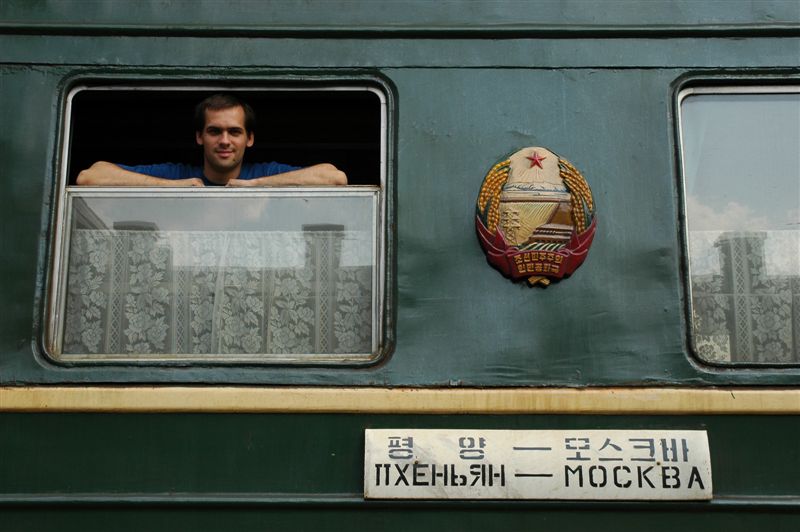
 

railimage.jpg

I just finished reading an incredibe DPRK travel account by two Swiss and Austrain rail enthusiasts who recently traveled the Trans-Siberian Railway from Europe to Pyongyang.  If you are interested in Russia and/or the DPRK you need to treat yourself to their pictures and travel journals as much of their material has not been published in the West.

I have included links to their trip from Ussuriyisk and Khasan to Pyongyang below, with some selected comments from their diary:

1. From Ussuriysk to Khasan (Russia):
http://www.railroadforums.com/forum/showthread.php?t=25908

Selected comments:

Trains over the border were not listed, but I knew that there is not only the twice-monthly sleeping car Moscow – Pyongyang, but also a twice-weekly cross-border passenger train Khasan – Tumangan.

I asked him [a Russian border agent], whether and how often he met foreigners here. He said, that he has been working here for about one year and that we were the 1st foreigners (except North Koreans, of course), he met.

The answer was that usually only Russian and Korean citizen cross the border, but that there have been a few third country citizen here, but they didn’t remember when that was the last time…

They also said, that among the passengers of the sleeping car to Pyongyang there are usually not even Russian citizen. Russian citizen crossing the border only go to the so called “Rajin-Sonbong Special Economic zone”, setup by the North Korean administration in cooperation with China and Russia

2. From Khasan to Tumangang Station (DPRK border)
http://www.railroadforums.com/forum/showthread.php?t=25971

3. From Tumangang Station to Pyongyang part 1:
http://www.railroadforums.com/forum/showthread.php?t=25993

Selected Comments:

(North Korea uses normal gauge – 1435mm)

We then talked about other things. They said that they had studied in Pyongyang and now have to serve at the army here in Tumangan. 

One of them told us, that he had seen the Hollywood-movie “Titanic” in the cinema in Pyongyang (I have also read before, that Titanic was shown in North Korean cinemas) and both said that they were glad to practice their language skills together with us. And one of them said, that he also wished to travel around the world like we did and see foreign countries… I hope in future it will be possible for him.

And of course the mobile-phones were of special interest, as they are forbidden in North Korea. The “translator” said, that they would be sealed and that we must open the envelope only when we leave the country. The sealing was quite simple: The customs official asked me for some of paper (obviously they didn’t have their own…) and I gave him two empty DIN-A4-sheets, in which he enwraped the mobile phones and which he closed with a yellow tape, which he then stamped several times…

They told us, that they now have to take the books, the laptop, the camera and the USB-sticks with them for some further inspection by a specialist, and that we would receive our belongings later.

They asked us to put all this items into the two smaller backpack (both of us had a big and a small backpack). Then they took the backpacks and left the sleeping-car.

They also provided the following information:

At http://www.logistics.ru/9/7/i77_6557p0.htm you can find a Russian article about the history of this border crossing point.

The line on the Russian side from Baranovskiy to Khasan was built between 1938 and 1951. The first bridge over the border was a wooden railway bridge opened in 1952. In 1954, when cross-border freight traffic offically started, 4400 tons of freight were transported over the border. That number rose to 12.000 tons in 1955.
In 1959 the new bridge, which still exists today, was opened.
The peak in freight traffic was in 1988 with 4.795.000 tons (USSR > DPRK: 4.070.000 tons, DPRK > USSR 725.000 tons). The numbers show, that the USSR ecenomically supported the DPRK and due to the political and economical changes in the former USSR the mostly unidirectional trade between the two countries decreased after 1988:

1988 – 4.795.000
1990 – 3.526.000
1993 – 2.306.000
1994 – 761.000
1999 – 230.000
2002 – 68.000

Only after 2002 a slight increase is noticeable, in 2004 106.000 tons were transported. However, the infrastrucuture was overdimensioned, and it has therefore been reduced: Several tracks at Khasan station were removed, as well as 3 of 14 passing-tracks between Baranovskiy and Khasan.

Passenger traffic was opened in 1958 and 10582 passengers crossed the border during the first year. Till 1988 this number rose to 21.000/42.000 passengers (I’m not sure, does “vozroslo na 200%” mean “rose to 200%” or “rose by 200%”?).

The new station building in Khasan was opened in 1989 and it was suitable to handle up to 500 international passengers per day. However, also passenger traffic is now lower than it was at it’s best times. During the 1st 6 months of 2005 5315 passengers crossed the border.

4. From Tumangang to Pyongyang part 2:
http://www.railroadforums.com/forum/showthread.php?t=25993
Selected comments:

Considering the number of other trains we met, one cannot say that railway traffic in North Korea is in total disorder and in it’s last throes. Trains are running and during our trip from Tumangan to Pyongyang there were obviously no problems with electricity supply for the catenary. Only once we stopped for 5 minutes in the middle of nowhere, but that might have been caused also by something else. However, the tracks are in bad condition, that causes the delay.

Freight trains where quite rare and relatively short (passing tracks at stations have usually a length of 400-500 meters according to Google Earth, so freight traffic inside North Korea might indeed be very low. And we saw less factories than expected considering our experiences in other former Socialist states. The main economic activity in North Korea seemed to be still agriculture.


Share

(UPDATE)DPRK food update

Friday, October 24th, 2008

UPDATE 3: Stephan Haggard and Marcus Noland chime in with “Famine in North Korea Redux”. 

UPDATE 2: IFES notes that Pyongyang is acknowledging the food shortage:

DPRK stressing unaided resolution to food crisis
Institute for Far Eastern Studies (IFES)
NK Brief No. 08-10-24-1
10/24/2008

On October 22, the North Korean Workers’ Party newspaper, Rodong Shinmun, reported on the international food crisis, and stressed, ‘The only things we can trust in the face of today’s severe food crisis are the efforts and self sacrifice of our blood, sweat, and tears,’ emphasizing an autonomous resolution to the food problem.

According to the paper, Kim Jong Il stated, “Today in our country, the agricultural problem is a very important problem that must be decisively resolved in order to build a strong and prosperous socialist nation.”

In particular, the paper stressed the urgency of the food problems, reporting, “Rice and food are of the utmost importance, like a lifeline to us,” while admitting that fertilizer, agricultural chemicals, fuel, and other essential items were in short supply, but adding, “the basis of agricultural production is not physical conditions, but determination.” By emphasizing that ‘determination’ would be key to solving the problem was a way of indirectly admitting that the government did not have the means to provide the supplies necessary to increase agricultural output.

The tone of the article conveys the idea that as the food crisis worsens around the world, international food aid to North Korea is being reduced, causing the worsening of the food crisis in the DPRK. It would appear that the government is trying to calm the people’s discontent by blaming outside influences, while at the same time mobilizing the efforts of North Korean farm workers.

While all of North Korea’s media sources have been repeatedly reporting the current global food crisis, they have emphasized that most others do not have rice to give, and those that do are not giving it, so that the North’s domestic food shortages need to be resolved by the North Koreans themselves.

UPDATE: Jess adds some great statistics in the comments

The Daily NK reports on the Ministry of Unification’s claims about the DPRK’s food situation.

ORIGINAL POST:We are getting some mixed messages on the state of the DPRK’s agricultural production and access to food….

Last month, IFES and the Daily NK reported that the DPRK was expecting a decent harvest this fall since the country’s farmlands were spared the seasonal flooding of the previous years:

A source involved in China-North Korea trade at a company in Shenyang was quoted on the 30th as saying, “[North Korean] rice traders are expecting this year’s food production to be considerably improved compared to last year,” and, “This year, with no large natural disasters, rice paddies and crop fields are doing well, and crop production will probably be much greater than last year.”

In a related matter, one North Korean insider reported, “With the [North Korean] food situation, no one is doing as well as the wholesalers,” and, “As the fall harvest season has come, traders have come by farms in each province and reported that rice and corn harvests are very good.”

The source went on to say, “This year, farming was not difficult, so as autumn passes, the market price of rice looks likely to fall. The price of corn will fall even faster, hitting the 1000 won per kilogram level by mid October.” In fact, by the end of this year’s fall harvest, the price of food is expected to return to pre-shock levels. Currently, rice is selling for 2200 won and corn for 1300 won per kilogram in North Korean markets. (IFES)

This week, however, the UN World Food Program sent the opposite signal, highlighting the acute food shortages they are seeing:

The UN food agency said Thursday that millions of North Koreans face a food crisis, but a South Korean official said that Seoul has not decided whether to respond to a request for food aid to the communist country.

“Some areas of the northeastern provinces in the country … have become extremely vulnerable, facing a situation of a humanitarian emergency,” Jean-Pierre de Margerie, the WFP’s country director for North Korea, said at a forum on North Korea.

Around 2.7 million people on North Korea’s west coast will also run out of food in October, the WFP said in a report released Tuesday.

The food shortages have forced many North Koreans to go to hills to collect wild food to complement their daily rations and reduce the number of meals per day to two, said de Margerie.

Asked if North Koreans face starvation, he said his agency hasn’t seen any evidence of starvation but said, “We have reached (a) very critical level and we shouldn’t wait for another starvation before ringing the alarm bells.”

The WFP also said the food shortages have especially affected urban households in areas with low industrial activity due to higher food prices, reductions in public food rations and lower employment.

Donor countries should back us up … Now is (the) time to act,” de Margerie said. (AP via New Zealand’s 3 News)

According to another report in the Times of London:

On Tuesday, WFP announced that some 2.7 million people on North Korea’s west coast will run out of food in October, and that, because of the worsening food situation, it was increasing from 1.9 million to 6.5 million the population which it seeks to help with food aid.

“Some areas of the north-eastern provinces in the country have become extremely vulnerable, facing a situation of a humanitarian emergency,” the organisation’s programme director for North Korea said. “We have reached a very critical level and we shouldn’t wait for another starvation before ringing the alarm bells.”

Additionally, UN’s point man on North Korean human rights, Vitit Muntarbhorn, has gone so far as to claim North Korea is clamping down on mobile phones and long distance telephone calls to prevent the spread of news about a worsening food crisis (Times of London). 

The South Korean Ministry of Unification, however, is publicly disputing the UNWFP’s numbers:

A South Korean official has disputed the U.N.’s assessment that millions of North Koreans are at risk of food shortages, saying Friday that the impoverished communist country does not appear to face a “serious” food emergency.

Unification Ministry spokesman Kim Ho-nyeon said that North Korea’s harvest this year is not bad, citing South Korean civic officials who recently visited the country.

“We believe that the North’s food condition is not in a serious crisis situation,” Kim told reporters, adding that the weather has been good and there were no heavy rains like the ones that devastated the North last year.

His comments came a day after the U.N. food agency said millions of North Koreans face a food crisis and called on donor countries, including South Korea, to provide urgent food aid.

Share

Korea Business Consultants Newsletter

Sunday, October 19th, 2008

Korea Business Consultants has published their latest newsletter.  You may download it here.

Topics covered include:
Six Party Talk progress
South Korea/Russia gas deal
More factories opening in the DPRK
UN survey of DPRK population
Summit pledges
Pyongynag hosts autumn trade fair
KEPCO to Abandon NK Reactor Gear
Trust Company Handling DPRK’s Overseas Business
DPRK-Russia Railway Work Begins
ROK Opposition Calls for Renewed Cooperation with DPRK
ROK Delegation Leaves for DPRK
ROK Aid Workers Leave for DPRK
“ROK Makes US$27.6 Billion from DPRK Trade”
“Kaesong Output Tops US$400 Million”
DPRK, Kenya Set Up Diplomatic Ties
Medvedev Hails DPRK Anniversary
Claim to North Korean rock fame
International Film Festival Opens
Ginseng

Share

US sends fourth aid shipment

Thursday, October 16th, 2008

UPDATE: According to Yonhap, the aid shipment has left Virginia:

The latest food aid from the United States to North Korea, comprised of 25,000 tons of corn and other grains, has made its departure from the U.S. state of Virginia, a U.S. radio station reported Saturday.

The Mary-Ann Hudson, a U.S. cargo vessel carrying 20,000 tons of corn and 5,000 tons of beans, left from Norfolk, Virginia, on Friday and is scheduled to arrive at North Korea’s western port of Nampo on Nov. 18, Radio Free Asia reported, citing a spokesperson of World Vision.

In June, the U.S. started shipping the first batch of some 500,000 tons of food aid, which it pledged to deliver to the North over a year-long period, through the World Food Programme (WFP).

Previous shipments were organized by the WFP, but the latest round is conducted jointly by relief organization World Vision and four other relief agencies, according to the spokesperson.

Since the late 1990s, when an estimated 1-3 million North Koreans starved to death, the North has prioritized its agricultural sector while accepting foreign aid to help feed its population of 23 million people. (Yonhap, Latest U.S. grain shipment to N.K. departs, 10-19-2008)

ORIGINAL POST: Press release from Mercy Corps (10/16/2008):

A fourth shipment of U.S. food aid for the Democratic People’s Republic of Korea sails this week to be distributed by five humanitarian agencies delivering urgent assistance to North Koreans suffering from severe food shortages. The commodities are scheduled to arrive before winter.

More than 894,000 of North Korea’s most vulnerable people – mainly children, pregnant and nursing mothers, and the elderly – will receive daily rations from this shipment of 25,060 metric tons of bulk corn and soy. The distributions are conducted in two North Korean provinces, led by Mercy Corps with World Vision as co-lead. Samaritan’s Purse, Global Resource Services and Christian Friends of Korea are the partner agencies.

“This new shipment of food will bring critical sustenance to many hungry people in North Korea,” said Nancy Lindborg, president of Mercy Corps. “We are very pleased with our success in getting food to needy people for the past few months, and are confident that efficient food distributions will continue into the winter.”

On arrival at the western port of Namp’o in the latter half of November, the food will be rationed to recipients through public distribution centers, orphanages, school, hospitals and nurseries in Chagang and North Pyongan Provinces. The program, funded by the U.S. Agency for International Development’s (USAID) office of Food for Peace, is the first U.S. food assistance program for North Korea since 2000.

“With North Korea’s people in a precarious situation facing low food stocks and the onset of a harsh winter, our primary concern is the country’s most vulnerable groups, children and mothers especially,” said George Ward, senior vice president of international programs for World Vision in the U.S. “We are moving urgently to ensure this assistance reaches those in most need at a critical time.”

The NGO partnership is on track to distribute 100,000 metric tons of the food aid during the year-long program, reaching 895,000 people, while the World Food Programme (WFP) is distributing another 400,000 metric tons in U.S. assistance. This week’s shipment is the first one entirely allotted for the NGO partnership to dispense.

The lack of food in North Korea became severe this year as floods devastated harvests, China erected barriers to food exports, and prices skyrocketed globally for staples such as rice and maize. In a June 2008 assessment, a team of experts from the partner agencies confirmed findings of food shortages and acute needs in North Korea. Malnourishment was prevalent, rations were reduced, and food stocks were dwindling. Separately, the WFP projected a shortage of 1.66 million metric tons of food, relative to the population’s needs.

The U.S. food assistance program includes clear provisions for monitoring distributions and conducting ongoing needs assessments. The partnership of humanitarian agencies has a staff of 16 based in the DPRK for the duration of the program to monitor activities continually and conduct random visits to distribution points.

Share

(UPDATED) US removes DPRK from state sponsors of terror list

Saturday, October 11th, 2008

UPDATE 2: Below are a list of materials from the US Department of State web site related to the DPRK’s list removal:

1. Existing Sanctions and Reporting Provisions Related to North Korea (thorough, but does not mention that the DPRK never obtained MFN or NTR status with the US, making it subject to the higher column 2, Smoot-Hawley, tarrifs.

2. Briefing on North Korea With Special Envoy for the Six-Party Talks Ambassador Sung Kim, Assistant Secretary of State for Public Affairs Sean McCormack, Assistant Secretary of State for Verification, Compliance, and Implementation Paula DeSutter, and Acting Assistant Secretary of State for International Security and Nonproliferation Patricia McNerney.

3. U.S.-DPRK Agreement on Denuclearization Verification Measures.

4. U.S.-North Korea Understandings on Verification

UPDATE 1: Since being removed from the list, it is now easier for the DPRK to obtain avian flu vaccinations from the US:

Yet deep inside an 86-page supplement to United States export regulations is a single sentence that bars U.S. exports of vaccines for avian bird flu and dozens of other viruses to five countries designated “state sponsors of terrorism.”

The reason: Fear that they will be used for biological warfare.

Under this little-known policy, North Korea, Iran, Cuba, Syria and Sudan may not get the vaccines unless they apply for special export licenses, which would be given or refused according to the discretion and timing of the U.S. Three of those nations – Iran, Cuba and Sudan – also are subject to a ban on all human pandemic influenza vaccines as part of a general U.S. embargo.

Under normal circumstances it would take at least six weeks to approve export licenses for any vaccine on the list, said Thomas Monath, who formerly headed a CIA advisory group on ways to counter biological attacks. All such decisions would follow negotiations at a “very high level” of government.

That could makes it harder to contain an outbreak of bird flu among chickens in, say, North Korea, which is in the region hardest hit by the virus. Sudan and Iran already have recorded cases of the virus in poultry and Syria is surrounded by affected countries. Cuba, like all nations, is vulnerable because the disease is delivered by migratory birds.(Associated Press)

ORIGINAL POST:
As reported in the Associated Press Saturday morning:

North Korea has agreed to all U.S. nuclear inspection demands and the Bush administration responded Saturday by removing the communist country from a terrorism blacklist. The breakthrough is intended to salvage a faltering disarmament accord before President Bush leaves office in January.

“Every single element of verification that we sought going in is part of this package,” State Department Sean McCormack said at a a rare weekend briefing.

North Korea will allow atomic experts to take samples and conduct forensic tests at all of its declared nuclear facilities and undeclared sites on mutual consent. The North will permit experts to verify that it has told the truth about transfers of nuclear technology and an alleged uranium program.

Verifying North Korea’s nuclear proliferation will be a serious challenge. This is the most secret and opaque regime in the entire world,” said Patricia McNerney, assistant secretary for international security and nonprofileration.

Proponents of de-listing say it is an important step in accomplishing the goals of the six-party talks which are ultimately aimed at realizing a denuclearized Korean peninsula.  Critics of this agreement claim that it addresses only the DPRK’s plutonium program while ignoring nuclear proliferation and uranium enrichment.  

North Korea stepped up the pressure this week barring IAEA inspectors from the DPRK’s nuclear facilities at Yongbyon:

North Korea “today informed International Atomic Energy Agency inspectors that effective immediately access to facilities at Yongbyon would no longer be permitted,” IAEA spokesman Marc Vidricaire said today in an e-mail. The country “has informed the IAEA that our monitoring activities would no longer be appropriate.”

The demand that inspectors leave the whole complex, which is the source of the country’s weapons-grade plutonium, followed a Sept. 24 instruction that monitors quit the reprocessing plant. The new orders will prevent UN personnel from seeing whether North Korea is removing spent uranium fuel rods from cold-water holding tanks. Spent uranium can be turned into plutonium.

IAEA inspectors will remain in the town of Yongbyon until ordered to leave by North Korean authorities, the agency said. (Bloomberg)

UPDATE: According to Reuters, “North Korea said on Sunday it would resume taking apart its plutonium-producing nuclear plant and allow in inspectors in response to a U.S. decision to remove it from a terrorism blacklist and salvage a faltering nuclear deal.”

Despite these recent developments, or maybe because of them, the Bush administration quickly negotiated a de-listing agreement with Pyongyang and spent the last few days selling it to other governments involved in the six-party talks. Though South Korea supported the move, the Japanese government was divided.  Japanese Finance Minister Shoichi Nakagawa (a North Korea hard-liner) called the move “extremely regrettable” as Japan was using US terrorism de-listing as leverage to discover the whereabouts of kidnapped Japanese citizens.  This leverage is now gone since the next president of the US will not likely go through the effort of adding the DPRK to the list again.  Other members of the Japanese government, however, believe there will not be any resolution to this issue until the nuclear issue is resolved. 

De-listing marks the end of the second of three phases agreed to in the six-party talks.  The third stage includes completely dismantling Yongbyon and ending atomic development on the Korean peninsula.  This is likely to be even more difficult than the previous stages. (Bloomberg)

De-listing, however, carries more political than economic significance.  According to the State Department web site (here) countries are added to the list for the following reasons:

Countries determined by the Secretary of State to have repeatedly provided support for acts of international terrorism are designated pursuant to three laws: section 6(j) of the Export Administration Act (which expred in August 2001), section 40 of the Arms Export Control Act (wikipedia), and section 620A of the Foreign Assistance Act. Taken together, the four main categories of sanctions resulting from designation under these authorities include restrictions on U.S. foreign assistance; a ban on defense exports and sales; certain controls over exports of dual use items; and miscellaneous financial and other restrictions.

Designation under the above-referenced authorities also implicates other sanctions laws that penalize persons and countries engaging in certain trade with state sponsors. Currently there are five countries designated under these authorities: Cuba, Iran, North Korea, Sudan and Syria.

As discussed before (here and here), the DPRK still faces a myriad of legal barriers which restrict it from accessing global trade and financial markets, including the US Column 2 tariffs (Smoot-Hawley Tariffs), US Treasury sanctions, bilateral Japanese sanctions (renewed on Friday), and recent UN resolutions 1695 and 1718.  In other words, the DPRK does not have much to gain financially from de-lisitng.

Here is the initial executive order to begin de-listing.  Now that the US terrorism list is one country shorter, who remains? Cuba, Iran, Syria, Sudan.

Read the full article here:
N Korea off US blacklist after nuke inspection deal
Associated Press (via Washington Post)
Matthew Lee
10/11/2008

N. Korea Removed From U.S. List of Terror Sponsors
Bloomberg
James Rowley and Viola Gienger
10/11/2008

Share

UK appoints new amassador to DPRK

Thursday, October 2nd, 2008

From KCNA:

Kim Yong Nam Receives Credentials from British Ambassador to DPRK
 
Pyongyang, September 30 (KCNA) — Kim Yong Nam, president of the Presidium of the DPRK Supreme People’s Assembly, received credentials from Peter Hughes, ambassador of the United Kingdom of Great Britain and Northern Ireland to the DPRK, at the Mansudae Assembly Hall on Tuesday.

After receiving the credentials, Kim had a talk with the ambassador.

Share

Wilson Center NKIDP documents DPRK-ROK-US relations in 68-69

Wednesday, October 1st, 2008

(The Wilson Center’s North Korean International Documentation Project (NKIDP) does innovative historical work collecting, translating, comparing, and analyzing records kept on the DPRK in the archives of formerly (and some currenty) communist countries.  They recently held an innovative conference where they brough in period policy makers to discuss and comment on these archival records.)

NKIDP publishes document reader from international conference “Crisis and Confrontation on the Korean Peninsula: 1968-1969”
September 8-9, 2008

Crisis and Confrontation on the Korean Peninsula: 1968-1969 focused on the two tumultuous years which saw the capture of the U.S. Navy’s intelligence ship USS Pueblo by the DPRK, the North Korean attempt to assassinate ROK President Park Chunghee with a cross-border commando raid on the Blue House, and numerous other provocative incidents.

The conference’s document reader—a 1200 page collection of newly declassified documents from South Korean, American, and former communist bloc archives–is the most comprehensive collection of primary source materials on US-ROK-DPRK relations during the late 1960s ever assembled, and it is now available for download free of charge from NKIDP.

Armed with this document reader, scholars from around the world, and former policy-makers from the United States, South Korea, and the former communist bloc gathered at the Woodrow Wilson Center in Washington for two days of discussions.

These discussions gave historians the opportunity to interact with the very officials whose reports and memoranda comprised the document reader, and will result in a more nuanced understanding of US-ROK-DPRK relations during the late 1960s.

Share

North Korea juggles South, Japan, Russia, and US

Tuesday, September 30th, 2008

The DPRK’s recent efforts to reconstruct the Yongbyon 5MW nuclear reactor seem to have brought implementation of the “second” Agreed Framework to a halt, though it was already behind schedule.  This week the US sent Chris Hill to Pyongyang to try and rescue the process which is hung up on verification protocol.   The North claims to have sufficiently declared their nuclear capabilities and believe they should be removed from the US list of state sponsors of terror.  The US does not believe this condition has been met and seeks to establish a protocol to verify if the North’s declaration is accurate.

Japan is also set to extend sanctions (due to expire) on the DPRK.  According to Bloomberg:

Japan’s ruling Liberal Democratic Party decided to extend sanctions against North Korea for six months after their Oct. 13 expiration date, Jiji Press reported.

LDP lawmakers agreed to extend the sanctions because North Korea took steps to reactivate its nuclear program and made little progress in an investigation into Japanese nationals abducted by North Korean agents, Jiji reported.

Prime Minister Taro Aso’s Cabinet is likely to endorse the extension by Oct. 10., the Japanese wire service said.

The sanctions include a ban on North Korean imports and the entry of North Korean ships into Japanese ports. The extension will be the fourth since sanctions began after North Korea’s October 2006 nuclear test, Jiji said.

Just as the DPRKs hopes of restoring/establishing relations with Japan and the US start to dim, however, they have reached out to South Korea, with whom political relations had recently gone sour due to the South’s policy change from unsupervised aid provision under the “sunshine policy” to a quid-pro-quo relationship under a “policy of mutual benefits and common prosperity“.  Additionally, the fatal shooting of a South Korean tourist in Kumgangsan led to a deterioration in cooperation between the two governments and suspension of the inter-Korean project (a cash cow for the North).

How much was the Sunshine Policy worth to the North?  South Korean GNP lawmaker Jin Yeong, who analzed data submitted by the Unification Ministry and the Export-Import Bank of Korea, claims that the Kim and Roh administrations oversaw the transfer of 8.38 trillion South Korean Won in aid and loans since 1998.

Taking office in February 2003 after the second North Korean nuclear crisis emerged in September 2002, Roh doled out 5.68 trillion won to Pyongyang over his five-year term, double that of his predecessor Kim (2.70 trillion won).

Kim and Roh gave to North Korea 2.4 trillion won for building light-water reactors and in food aid; 2.5 trillion won to pin the price of rice aid to that of the global market; 2.8 trillion won for other aid including fertilizer; and 696 billion won in aid from advocacy groups and provincial governments.

In 2003, South Korean aid to the North reached a high of 1.56 trillion won. Then after North Korean leader Kim Jong Il declared that his country had gone nuclear in 2005, the Roh administration sent 1.48 trillion won to the North.

Jin said, “South Korea gave a loan with rice first in 2000. Payments on the loan are deferred for 10 years. Thus, we are to receive the first repayment installment in 2010. But most of the 2.4 trillion won in loans seem irrecoverable.”

PricewaterhouseCoopers Korea audited the fiscal 2007 accounts of Seoul`s inter-Korean cooperation funds, saying, “Considering the characteristics of the North Korean government, grave uncertainty exists over the possibility of redeeming the loans given to the regime. The ultimate outcome depends heavily on the conditions around the Korean Peninsula.”

Since President Lee Myung-bak took office this year, exchanges between the two Koreas have been rare. Still, aid to the light-water reactor and the Gaesong industrial complex projects and civilian donations have continued, amounting to a combined 211.3 billion won. (Donga Ilbo)

It appears the Russians are doing their part to bring the North and South together through a project they can all agree on—building a natural gas pipeline from Russia to South Korea via the DPRK:

South Korea plans to import $90 billion of natural gas from Russia via North Korea, with which it shares one of the world’s most heavily fortified borders, to reduce its reliance on more expensive cargoes arriving by sea.

State-run Korea Gas Corp. signed a preliminary agreement with OAO Gazprom, Russia’s largest energy company, to import 10 billion cubic meters of natural gas over 30 years starting in 2015, the Ministry of Knowledge Economy said in a statement. The accord was signed in Moscow during President Lee Myung Bak’s three-day visit that began yesterday.

Gazprom Chief Executive Officer Alexei Miller said after talks today between Lee and Russian President Dmitry Medvedev that the exact delivery route hasn’t been determined and that shipments could begin as early as 2015.

“Russia suggested a pipeline via North Korea, which is expected to be more economical than other possible routes,” the minister said in a news briefing. “Russia will contact the North to discuss this.”

“Transporting gas through North Korea could be risky for South Korea,” said Kim Jin Woo, a senior research analyst at Korea Energy Economics Institute. “But the project will ease tensions on the Korean peninsula if Russia successfully persuades North Korea” to accept the plan.

North Korea could earn $100 million a year from the gas- pipeline project, the Ministry of Knowledge Economy said.

“Russia will supply the fuel in the form of LNG or compressed natural gas if negotiations with North Korea do not work out,” according to the ministry’s statement. South Korea and Russia will sign a final agreement in 2010 when a study on the route is completed.

South Korea is turning to Russia, holder of the world’s biggest proven gas reserves, as it faces intensifying competition for energy resources from China and Japan. Asia’s fourth-largest economy depends on gas for 16 percent of its power generation.

Under the agreement, a pipeline to South Korea will be laid via North Korea from gas fields on Sakhalin Island in Russia’s Far East. The pipeline would initially carry 10 billion cubic meters of gas a year, or about 20 percent of South Korea’s annual consumption. The cost of the gas link’s construction is estimated at $3 billion, the ministry said.

Read the full articles here:
South Korea Seeks $90 Billion of Russian Natural Gas
Bloomberg
Shinhye Kang
9/29/2008

Liberal Gov`ts Gave W8.38 Bln to North Korea`
Donga Ilbo
9/30/2008

Share

South Korea monitoring 76 pro-North websites

Thursday, September 25th, 2008

According to the Choson Ilbo, the South Korean government is monitoring 76 pro-DPRK websites:

The National Police Agency is monitoring a total of 76 pro-North Korea websites overseas. According to data on the NPA submitted to Grand National Party lawmaker Lee Bum-rae of the National Assembly’s Public Administration and Security Committee, of the websites with servers abroad, 31 in the U.S., 19 in Japan, 13 in China, 4 in Germany, and 9 in other countries. 

The NPA said it has also asked or advised web portals to delete a total of 6,377 pro-Pyongyang postings since the inauguration of the Roh Moo-hyun administration in February 2003. The number has been on the increase from 1,010 in 2004 to 1,434 in 2007. Until August this year, the NPA already asked web portals to delete a total of 1,035 such postings.

I find this personally disturbing for a couple of reasons—the first being that the South Korean government asking content to be removed from the Internet sounds more like a North Korean policy than that of a democratic government in one of Asia’s wealthiest nations.  The second bit of news that disturbs me is that I cannot come up with more than 10 pro-DPRK web sites.  Where are these people hiding?     

Read the full article here.

UPDATE: South Korea raids the offices of a pro-North group:

A group of agents from the National Intelligence Service, the police, and the Prosecutor’s Office Saturday stormed the headquarters of the All-Korean Committee for Implementation of June 15 Joint Declaration in Seoul and its 5 regional offices as well as the houses of the organization’s five officials simultaneously, Yonhap News reported.

The authorities also arrested seven officials of the organization, including its leader, whose last name is Choi, for violation of the National Security Law.

The authorities reportedly launched the massive investigation of the group when it was airing the media contents from North Korea through its Internet-based “6.15TV” that allegedly violated the 7th clause of the law that prohibits the praise for and encouragement on North Korea.
The group was established in October 2000 to commemorate the June 15 Joint Declaration and promote the unification movement on a civilian level. It has been engaged in civilian exchanges between the two Koreas, demanded the withdrawal of the U.S. troops from South Korea as well as a movement to understand North Korea better.

The group’s Web site (www.615.or.kr) was inaccessible Saturday afternoon due to heavy traffic volume.

Read the full story in the Korea Times.

UPDATE 2: 4 South Korean arrested for “praising north”

Four progressive civic group members were arrested Tuesday for allegedly praising North Korea, leading the Solidarity for Practice of the South-North Joint Declaration (SPSNJD) to criticize the National Intelligence Service (NIS) and the prosecution for abusing what they call the outdated National Security Law.

They were charged with opening an exclusive pro-North chat room on the group’s Web site ― restricted to certified members ― and releasing North Korean press material to praise the Stalinist country at the expense of the South. (Korea Times)

Really? A chat room with 4 nobodys?  It would be different if they had guns and plans, but reading silly North Korean press releases can’t seriously be considered subversive activity can it?

Share

Petrov on DPRK-Australian relations

Wednesday, September 24th, 2008

The Nautilus Institute has published an aritcle by Leonid Petrov on 60 years of Australian/DPRK relations.

Topics covered: on again/off agian diplomatic history, Australian foreign policy, bilateral relations, DPRK engagement with Australia, Pong Su (drug smuggling), denuclearization, economic sanctions, DPRK canberra embassy closing.

You may read the article on line here.

You may download a PDF of the article here: petrov-australia-dprk.pdf

Share