Archive for the ‘International Governments’ Category

DPRK ships (2)* Vs. Somali Pirates (1)

Monday, January 25th, 2010

(* = assist from the US Navy)

DPRK sailors (or DPRK flagged ships) have come under attack from Somali pirates three times since October 2007. 

In the first attack, the DPRK ship overcame the pirates with the assistance of the US Navy. More here

In November 2009, a North Korean crew was taken hostage by Somali pirates. I still don’t know what happened to them, but I hope they were released safely. More here

This week Josh points out an AP story about a third attackon a Yemeni-owned, DPRK-flagged vessel:

The U.S. Navy says it overtook a suspected Somali pirate skiff that tried to attack a commercial ship in the Gulf of Aden.

A Navy statement issued Sunday says a security team aboard the merchant vessel Napht Al Yemen 1 repelled the Jan. 20 pirate attack without U.S. help.

The USS Porter stopped and boarded the pirate skiff later that day.

The commercial ship is Yemeni owned but sails under a North Korean flag.

The incident marked a rare example of the U.S. military aiding North Korea, a reclusive rogue nation.

Piracy is among the fastest ways to make money in Somalia, a nation plagued by war and no functioning government.

Somali pirates seized 47 vessels last year. They currently hold about 200 crew members hostage.

Share

First DPRK-RoK joint venture in Rason announced

Tuesday, January 19th, 2010

According to the AFP:

A South Korean company said Tuesday it is planning a joint-venture factory in a free-trade zone in northeastern North Korea, the first such investment by Seoul in the faltering project.

Food processor Merry Co said Pyongyang last month approved its partnership with state-run Korea Gaeson General Trading Corp in the Rason zone near the North’s border with China and Russia.

“We’re going to have a first joint venture between the two Koreas in Rason,” Merry president Chung Han-Gi told AFP.

The North this month upgraded the status of the zone in an attempt to invigorate anaemic foreign investment there.

Chung said his company would invest 60 percent of the 7.5 million dollar cost of the new plant while its North Korean partner would put in 40 percent.

He said he would this week ask the South’s unification ministry, which must authorise all cross-border contacts, to approve the joint venture.

The communist state designated the Rajin-Sonbong Economic Special Zone — later renamed Rason — in 1991, its first such project. But little foreign investment materialised and senior officials who headed the project were reportedly sacked.

In recent years the North has begun trying to revive it, signing an accord with Russia to rebuild railways and the port there. China has also been exploring investment opportunities in the city.

The North’s leader Kim Jong-Il paid his first visit to the zone last month and state media said later that parliament has designated Rason as a municipality to upgrade its status.

South and North Korea have a joint-venture industrial estate at Kaesong near their border. Its operations have often been hit by political tensions, but the two sides were to start talks Tuesday on ways to develop it.

Chung said his firm’s joint venture at Rason, which would have some 200 North Korean employees, plans to produce canned and processed food including tuna for exports.

Merry, which also has a factory in Shanghai, will send Chinese engineers to Rason next month to install production facilities.

The Choson Ilbo adds some interesting details:

This is the first time that Pyongyang has allowed for direct business collaboration, set to take place between North Korea’s Gaeson General Company and the South’s Chilbosan Merry Joint Venture.

The firms are slated to split investment 60/40 and will work together to process and export canned marine and agricultural products starting in March.

UPDATE 1: As reader Gag Halfron points out, this is not the first DPRK-RoK joint Venture. Remember Pyonghwa Motors and Pyongyang’s fried chicken restaurant?

UPDATE 2: In the comments, Werner notes the following: http://www1.korea-np.co.jp/pk/149th_issue/2000101405.htm

Read the full articles below:
N.Korea OKs joint venture with South in trade zone
AFP
1/18/2009

First Inter-Korean Joint Venture to Be Established
Choson Ilbo
1/20/2010

Share

China to renew border rail link with N. Korea

Monday, January 18th, 2010

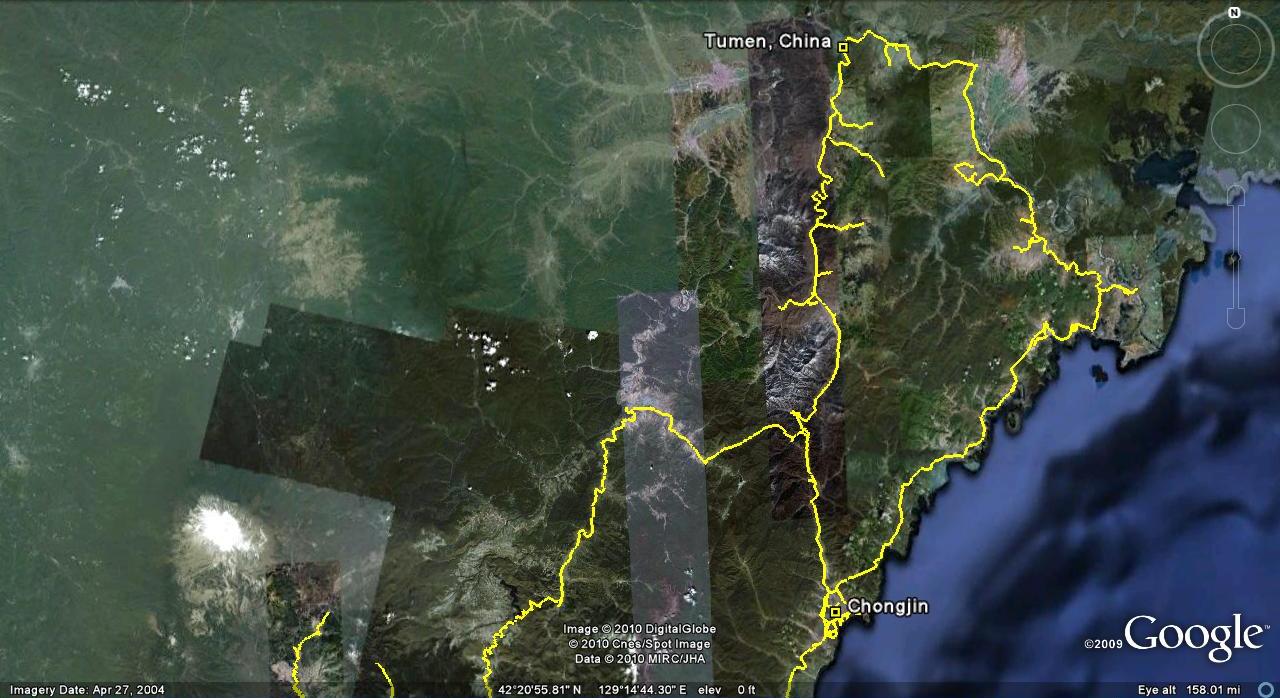
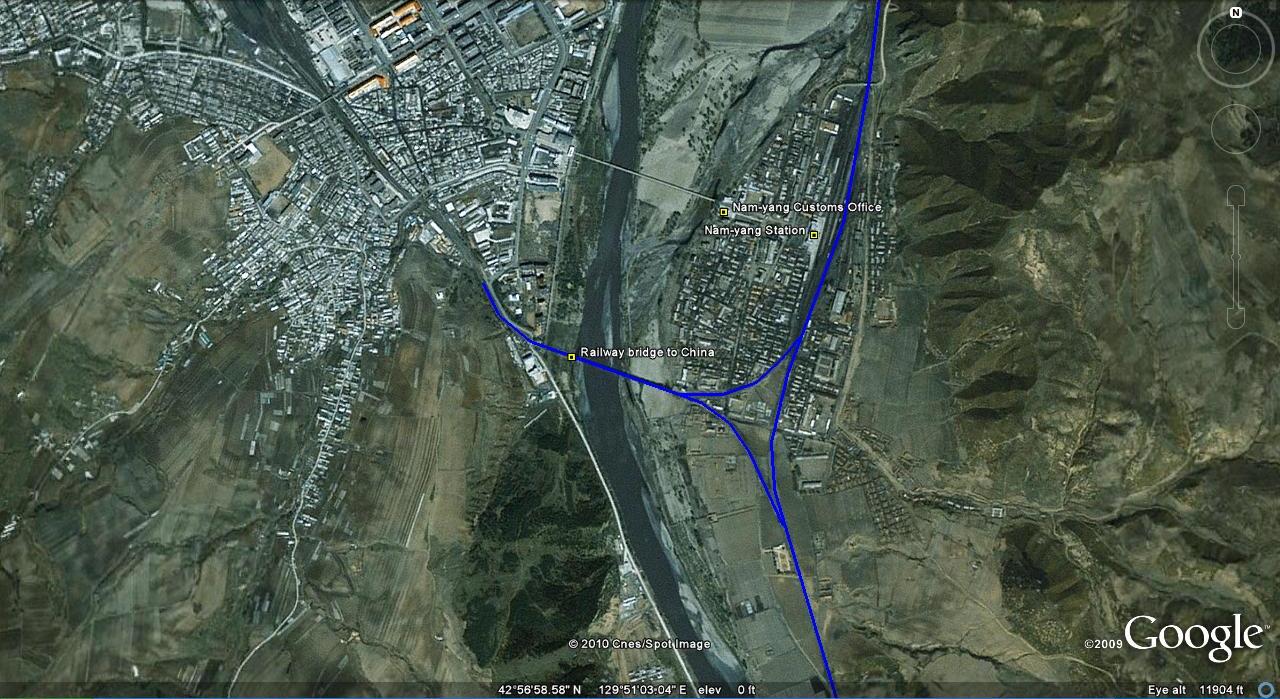
tumen-chongjin.JPG tumen-rr-crossing.JPG
Click on images for larger versions

According to Yonhap:

China will mend a rail link between one of its border cities and a North Korean port, a source familiar with North Korean affairs said Sunday, a move that indicates stronger economic ties between the two allies.

North Korea and the municipal government of the Chinese city of Tumen, which borders the North, have recently agreed to repair the railway linking the city with North Korea’s northeastern port of Chongjin, the source said.

Additional Information: 

1. Above I have posted Google Earth images of the China-DPRK border area and a simple map of the DPRK’s North Eastern railway system.

2. Long-time readers will remember that Russia recently installed Russian-gague railway track from the North Korean border to the city of Rason (Rajin-Songbon). It looks like both Russia and China get their own ports in the DPRK.

3. Chongjin is also home to both Russian and Chinese consulates

Share

Swiss aid agency to leave DPRK

Monday, January 18th, 2010

According to this SDC web page:

Following a decision made by the Swiss Parliament, the SDC’s special programme in North Korea will be discontinued at the end of 2011.

There was not much in the media on this, but a reader pointed me to this article:

Switzerland is standing by a decision to stop development aid to North Korea, which has focused on improving food security in the internationally isolated country.

The foreign ministry says it now has a strategy for the withdrawal of Swiss development workers from the communist country by the end of 2011.

In 2008 the government approved a motion by parliamentarian Gerhard Pfister demanding a halt to development aid in response to North Korea’s continuing nuclear ambitions.

“The atomic weapon programme violates international agreements. North Korea has shown itself to be utterly uncooperative, despite international efforts. It threatens to destabilise the region,” the motion said.

Although Switzerland has no official representation in the communist country, diplomatic relations were established in 1974.

The Swiss Agency for Development and Cooperation (SDC) has had an office in the capital, Pyongyang, since 1997 [Possibly located here]. According to the motion, the SDC justified its work there by saying that “supporting the reform process” should improve food security. The SDC cited a “tentative opening” of the country as a success.

Pfister maintains that today North Korea is no longer showing a “tentative opening” – rather the opposite.

The SDC’s main priority in the country has been aid projects aimed at improving the efficiency and sustainability of North Korean agriculture.

Consistent policy?

The central question is whether it is wiser to isolate a totalitarian regime or to cooperate with it. The attitude of the Swiss parliament and government is clear: stop development aid.

But is the issue simply black and white? On December 21 Switzerland celebrated – in the presence of the North Korean foreign minister – the 35th anniversary of diplomatic relations.

On December 28 Blaise Godet, the Beijing-based Swiss diplomat responsible for North Korea, told the Neue Zürcher Zeitung that Switzerland had nurtured a consistent policy of engagement and political dialogue. “We want to contribute to solutions,” he said.

As for the ending of aid at the end of 2011, foreign ministry spokesman Erik Reumann told swissinfo.ch that “the SDC would follow the decision of the government and parliament. A dismantling plan exists that will guarantee a well-organised withdrawal from North Korea”.

Similarities with Switzerland

While the Swiss government and parliament want to end development aid to North Korea, former justice minister Christoph Blocher, a leading figure in the rightwing Swiss People’s Party, has written in detail about his visit to the country – on a hiking holiday.

The self-confessed anti-communist noted in the Weltwoche weekly magazine in November that “one thing North Korea and Switzerland have in common is that both countries want to keep their autonomy and are working for a safe future”.

In Pyongyang Blocher said he came across “normal conditions”, but admitted that “we only had access to those areas and streets considered presentable”. Nevertheless, he continued, “the streets are tidy and the Korean people are all clean and decently dressed, and go everywhere on foot. People walk”.

But Blocher agreed that the food situation was unsatisfactory.

The Swiss Agency for Development and Cooperation (SADC) web page is here.Here is a report they helped produce: Tools for building Confidence on the Korean Peninsula.

Share

2009 Inter-Korean trade tops US$1.6 billion

Monday, January 18th, 2010

Institute for Far Eastern Studies (IFES)
NK Brief No.10-01-19-1
2010-01-19

Last year, despite the impact of the economic recession, North Korea’s second nuclear test and other issues hindering inter-Korean exchanges, the previously sharply shrinking value of North-South Korean trade appeared to steady.

According to a report from the South Korean Customs Administration released on January 18, inter-Korean trade last year was down 8.5 percent from the previous year, amounting to 1.66608 billion USD. Exports to North Korea were worth 732.62 million USD, while 933.46 million USD worth of goods were brought into South Korea, giving Seoul a 200 million dollar trade deficit. Inter-Korean trade hit its lowest point last year in February (100.89 million USD), but since then showed slow-but-steady growth, hitting 173.18 in September.

In the aftermath of last year’s economic recession, together with the North Korean nuclear test, naval clashes in the West Sea in the area of the Northern Limit Line, etc., there were many difficult issues in 2009, but as inter-Korean trade numbers recovered in the fourth quarter, tensions eased slightly. Despite strained political tensions between the two Koreas, trade seemed not to be seriously affected, as DPRK goods were offloaded from a North Korean ship at Incheon Harbor and replaced with silica used for metal casting just six days after a clash between North and South Korean naval ships.

While growing trade is positive, this is the second year in a row South Korea has recorded a trade deficit with the North. In 2008, Seoul’s cross-border imports exceeded imports by 53.96 million USD. With Lehman Brothers’ collapse in September 2008 and the economic stagnation that followed, the South continued to record trade deficits for 15 straight months, until November of last year.

In December 2009, South Korean trade was back in the black (23.91 million USD) for the first time in 16 months. Looking back over time, it can be seen that inter-Korean trade has improved considerably over the years, recording a mere 705.68 million USD in 2004, 1.08872 billion USD in 2005, climbing to 1.3796 billion in 2006 and 1.79494 billion USD in 2007, and 1.82078 billion USD in 2008.

The import of North Korean sand, mushrooms, and smokeless charcoal briquettes in October 2009 required the permission of the South Korean government. This reflects Seoul’s more strict controls over management and oversight of inter-Korean trade following the sanctions and heightened concerns over cash deliveries to Pyongyang after its second nuclear test on May 25, 2009. Since the nuclear test, the South Korean government has limited the import of North Korean goods to only those that could ease losses being suffered by South Korean manufacturers.

According to the South Korean Ministry of Unification, among North Korean exports to the South in 2008, sand was the largest (according to value) export, with charcoal ranking ninth and (pine) mushrooms ranking eighteenth. 

Yonhap offered a short blurb: 

Trade between South and North Korea declined 8.5 percent on-year in 2009 due mainly to the worldwide economic slowdown that sapped demand and investments, a government report said Monday.

The Korea Customs Service (KCS) said inter-Korean trade reached US$1.66 billion last year, down from a record high of $1.82 billion tallied for 2008.

Read the full article here:
Inter-Korean trade falls off 8.5 pct in 2009
Yonhap
1/18/2009

Share

Bermudez launches “KPA Journal”

Friday, January 15th, 2010

Joseph Bermudez, a military analyst for Jane’s Intelligence Review and author of The Armed Forces of North Korea, has launched a journal dedicated to the discussion of the DPRK military: KPA Journal.

According to the introduction by Mr. Bermudez:

The goals of this modest publication are to allow me to freely share with readers new, interesting or updated information concerning: all aspects of the Korean People’s Army (KPA, more commonly known as the North Korean Army) from its birth until present; ballistic missile development; intelligence operations (e.g., seaborne infiltration operations, etc.); and other defense and intelligence issues concerning the Democratic People’s Republic of Korea (DPRK, more commonly known as North Korea).

As I have researched, written and lectured on these subjects during the past 25+ years I’ve frequently come upon fragments or collections of interesting information that either didn’t fit into then current projects or that was deleted by editors in order to save space. Recently, while conducting research for three book projects—Combat History of the Korean People’s Army, DPRK Intelligence Services 1945-1975, and an update to my earlier North Korean Special Forces: Second Edition—I once again encountered numerous examples of these fragments and collections. Rather than let this information remain in my files unused I’ve decided to use it for KPA Journal.

Additionally, as I have written reports and articles concerning recent DPRK related issues new information has subsequently come to light. It is my hope to utilize KPA Journal to share such updated information with readers. While it is my hope that KPA Journal will eventually be a monthly publication, initially it will be distributed on an irregular basis until the time arrives when I can dedicate more energy to it.

A KPA Journal website is under construction and should be online later this year at www.kpajournal.com. It will eventually serve as a repository for issues of KPA Journal, declassified documents, longer research projects, previously authored articles and more.

Should readers find any of this information of interest or value, and decide to use it in your own research efforts, I would greatly appreciate your citing KPA Journal as your source.

Readers are encouraged to share KPA Journal with friends and colleagues. If they wish to be added to the mailing list, or should you not desire to be on the mailing list, please contact me at [email protected].

Download Vol. 1, No. 1 here (PDF).

Share

China expanding mining rights in N. Korea

Friday, January 15th, 2010

According to Yonhap:

China has expanded its mining rights in North Korea to cover as many as 20 sites, a South Korean report said Thursday.

China is a leading investor in North Korea, which, according to a South Korean study, is believed to have enormous deposits of natural resources, including coal, nickel, molybdenum and bronze.

Further efforts to isolate the DPRK economically allow China to capture even more of these resources at bargain prices.  The North Koreans, for their part, are not happy about this.  According to the Steel Guru:

At an international conference held in Yanjiin in October, Director of the Economy Institute at the North Korean Academy of Social Sciences Mr Kim Chol Jun had revealed that his country is restricting exports of unprocessed resources. He added that “Mineral resources are exported at high prices by processing them. Exports of cheap unprocessed goods are a loss to the state.”

South Korea’s Unification Ministry estimates that underground mineral resources in North Korea are valued at about JPY 540 and the amount of deposits of magnetite used to trim the weight of automobile parts is the world’s largest at 3 billion tonnes to 4 billion tonnes. In addition to iron ore, North Korea is said to be rich in such rare metals as molybdenum and rare earth.

On a positive note, Chinese takeover of the mines could possibly lead to greater investment in mine working conditions if only to increase output—-although no data is really available to determine if this is the case.

I have been unable to locate the report mentioned in Yonhap because the story did not give any information about the title, author, publisher, or even the date or place it was released.

Share

EU implements further sanctions on DPRK

Monday, January 11th, 2010

The EU has issued a list of 12 DPRK officials who will be denied entry visas to member countries.  According to the Choson Ilbo:

The EU has imposed sanctions targeting North Korea’s top leadership over the country’s nuclear weapons development. Twelve officials were blacklisted, many of them thought to be leader Kim Jong-il’s closest advisers.

The list includes Vice Marshal Kim Yong-chun (74), the minister of the armed forces, as well as Jang Song-taek (64), the director of the North Korean Workers Party’s Administration Department who is Kim Jong-il’s brother-in-law. Six of 13 members of the powerful National Defense Committee were blacklisted.

At a session of the Environment Council in Brussels on Dec. 22, the EU approved new sanctions against North Korea, including an entry ban on individuals and goods. EU regulations are binding on the 27 member states and overrule individual national laws.

The four other blacklisted committee members are O Kuk-ryol, the deputy chairman of the National Defense Commission; Jon Pyong-ho, the secretary of the Central Committee and head of the Committee’s Military Supplies Industry Department; Paek Se-bong, the chairman of the Second Economic Committee of the Central Committee; and Ju Kyu-chang, the first deputy director of the Defense Industry Department. Also on the blacklist are Hyon Chol-hae, the deputy director of the General Political Department of the Armed Forces, and Pak Jae-gyong, the deputy director of the Logistics Bureau of the Armed Forces.

So Sang-guk, the chair of the Physics Department at Kim Il Sung University who laid the technical groundwork for the North’s nuclear development, and Pyon Yong-rip, the president of the State Academy of Sciences, were also blacklisted.

The legal statement issued by the EU can be found here on page 16. The complete list of officials affected by the travel ban are listed here on page 3The UN Security Council sanctioned five individuals in 2009.

The EU also maintained its ban on Air Koryo.  According to Yonhap (h/t The Marmot):

Air Koryo, North Korea’s air carrier, has been banned from offering flight services to Europe for a fifth year after having failed to meet international safety requirements, U.S. international broadcaster Radio Free Asia (RFA) said Saturday.

The North Korean carrier has been involved in the list of carriers prohibiting from flying to the 27 members of European Union that was released this year, RFA said.

Air Koryo reportedly has a fleet of about 20 planes made between the 1960s and 1970s in the Soviet Union.

UPDATE: Here are the EU regulations adopted on Dec 22, 2009. Thanks to Mike.

Share

Food prices continue to increase

Sunday, January 10th, 2010

According to an AFP report that cites Good Friends:

Good Friends, citing its own contacts in the reclusive North, said prices for rice and corn doubled last week at markets in the capital Pyongyang and in the eastern port city of Chongjin.

Rice prices ranged from 120-150 won per kilogramme (2.2 pounds) in Pyongyang and 110 to 140 won in Chongjin last week — up from 40 to 50 won reported on December 30, the group said.

Corn also traded higher at 70-75 won last week — up from 20-25 won on December 30 in the areas, it added. Seoul’s unification ministry, handling cross-border issues, could not confirm the data.

The official exchange rate is 135 won to the dollar but the black market rate is between 2,000 and 3,000 won.

The report came as the World Food Programme struggles to raise relief funds for the food shortage-hit North.

Major donors — including South Korea and the United States — refuse to help in protest at its second nuclear test in May last year.

Statistics available at the WFP website display it raised 89.8 million dollars as of late last month, around only 18 percent of its target of 492 million dollars in relief funds for the communist North.

Read the full article here:
Food prices soaring in N. Korea: group
AFP
1/10/10

Share

2009 defection summary

Friday, January 8th, 2010

According to KBS (h/t RoK Drop):

The number of North Koreans who fled to South Korea in 2009 is known to be close to three-thousand.

A Ministry of Unification official said more than 2,200 women and almost 680 men from North Korea entered South Korea in 2009, totaling more than 2,950 in a preliminary tally.

The official added that this makes the cumulative number of North Korean escapees total approximately 18-thousand, which is almost certain to surpass 20-thousand in 2010.

Soms interesting supplementary information was posted at Yonhap:

The number of North Korean defectors hiding in China is estimated to have shrunken in recent years to almost one tenth the level seen in the late 1990’s, a U.S. demographer said Thursday.

The assessment is a controversial but important factor in shedding light on the conditions of those North Koreans who live in China. The defectors live under the constant fear of deportation because their country considers defection a capital crime.

Activists and relief groups say tens of thousands of North Korean defectors live in China, but Dr. Courtland Robinson at Johns Hopkins University Bloomberg School of Public Health said the number may have dropped to between 6,000 and 16,000 as of 2007.

“About a decade ago, people were literally being starved to death and fleeing to China,” Robinson said in an interview, putting the 1998 figure between 50,000 and 130,000. Famine had reportedly killed as many as 2 million people in North Korea in the mid-1990s.

An official at South Korea’s Unification Ministry, which handles affairs involving North Korea, said he could not support the figures given by either activists or Robinson, arguing it was impossible to determine the exact number of those defectors in hiding.

Robinson, speaking on the sidelines of a conference on North Korean defectors in Seoul, said he had turned to local residents in China as informants to assess the number of defectors living in their towns. He then applied demographic methods to come up with what he called “plausible ranges” of a population.

“The very essence of these measurements is to start selecting sites randomly, not sites where you think North Koreans may be living,” he said.

“It’s a combination of things that has contributed to the decrease. Tightened border security on both sides is one,” Robinson said. “Defectors have also evolved in terms of their understanding of how difficult it is to live in China.”

China reportedly stepped up its crackdown on North Korean defectors ahead of its hosting of the Summer Olympics in August 2008. Under a treaty forged in 1998, China is believed to arrest and repatriate North Korean defectors even though they could face imprisonment, torture and even execution.

Chinese residents are reportedly rewarded with cash if they report North Korean defectors, who find it difficult to hide their identities or get a job because they can’t speak Chinese.

Robinson said defectors have apparently accelerated the pace at which they “move on through China,” heading to countries such as Thailand where it is deemed safer or easier to go to South Korea.

Over 16,000 North Koreans have come to South Korea since the 1950-53 Korean War that ended in a truce rather than a peace treaty. The annual number of defectors is increasing year by year and the Unification Ministry expects the accumulated figure to top 20,000 this year.

Share