Archive for the ‘International Governments’ Category

Chinese tourist train makes first DPRK tour

Sunday, April 25th, 2010

According to the Press Trust of India:

A Chinese tourist train entered North Korea for the first time today, carrying more than 400 passengers including a group of Finnish students, Chinese state news agency Xinhua reported.

The train embarked on the four-day tour from the Chinese province of Liaoning under a new arrangement with North Korea expected to attract tens of thousands of tourists, the agency reported from the provincial capital Shenyang.

The first train is mostly carrying tourists from China but also includes foreigners living in China, notably the Finns, resident in Guangzhou.

The tour comes amid heightened tensions between reclusive North Korea and South Korea, as Seoul has appeared increasingly suspicious that the North was behind the sinking of one of its naval ships last month.

It also follows reports that North Korean leader Kim Jong-Il plans to visit China soon.

Read the full story here:
Chinese tourist train makes first North Korea tour
Press Trust of India
4/25/2010

Share

“Let’s eat huge rabbits” (Part 2)

Wednesday, April 21st, 2010

Back in 2007 a German breeder of large rabbits expressed concern that some rabbits he sold to the DPRK had been eaten.  You can read about it here.

Well, the rabbit story is back.  According to Radio Free Asia:

The fate of dozens of giant rabbits sent to North Korean to start breeding a cheap source of protein for the famine-hit poor is still unknown, leading to speculation that they may already have been eaten by officials in the isolated Stalinist state.

“I am not aware of [exactly] what happened after we sent the rabbits,” said Jin Sook Lee, the director of the German charity, the German Overseas Korean Cooperation Association. “I don’t even know if they are being used to boost the food supply.”

She said the intended breeding program had run into difficulties once the German-bred outsize rabbits arrived in the isolated Stalinist state, where some sectors of the population still face malnutrition.

To ensure the successful expansion of the giant rabbit population, rabbit cross-breeding and species hybridization were needed, Lee said.

But many female rabbits failed to get pregnant, and of the rabbit kittens that were born, many were deformed, she added.

Boosting ‘rabbit-breeding’

Several charities have raised money to send giant rabbits to North Korea to boost the food supply, as the animals yield up to 10 kilos (22 lbs) of meat.

While the uber-bunnies normally breed as rapidly as their smaller cousins, the French humanitarian group Premier Urgence said it had send staff to North Korea to boost “rabbit breeding skills” among officials in charge of the farms.

The charity, which has received around U.S.$1.5 million in European Commission assistance funds for North Korea, said last November it planned to send a further 200 giant rabbits purchased in neighboring China to North Korea.

Chinese media have meanwhile reported comments made to the German magazine Der Spiegel by the original breeder of giant rabbits Karl Szmolinsky, who has had no information from North Korean officials since he sent 12 rabbits to boost the breeding farms in 2007.

“The only conclusion I can come to is that my rabbits made a nice meal for someone,” an online Chinese farmers’ news service quoted him as saying.

“I would really like to go over there and give them a hand.”

Premiere Urgence said in November that it had sent giant rabbits to seven farms in the country, including Ryongsung in Pyongyang, Youngtan in Northern Hwanghae province, Mikok, and Chungjong in Northern Pyongan province.

Livestock failures

Premiere Urgence said it planned to help the North Koreans improve giant rabbit reproductive rates by sending equipment and working on rabbit-farming skills.

The group said in November it had already dispatched three international staff members to Pyongyang, including a French and a Dutch national, while seven local staff members were already in the office, tasked with technical and clerical duties.

In an attempt to overcome severe food shortages, the North Korean authorities have already experimented with chicken, cow, and pig farming.

However, because of the decrepit state of North Korea’s facilities and the lack of technical skills, most attempts to raise livestock for food appear to have failed.

Director Lee said that sending giant rabbits from Europe was very expensive, costing about U.S. $100 per animal.

The first two rabbits to travel to North Korea paid a fare of U.S. $1,300, with vaccinations and veterinary fees on top of that.

She said her group had given up further plans to send giant rabbits to North Korea.

Experts also said the giant rabbits require more than one kilo (2.2 lbs) of carrots and potatoes daily, hard to come by in impoverished North Korea.

Szmolinsky, 67, of the eastern German town of Eberswalde near Berlin, was first approached by North Korean officials in 2006 after he won a prize for breeding Germany’s largest rabbit.

According to the United Nations, North Korea suffers widespread food shortages, and many people “struggle to feed themselves on a diet critically deficient in protein, fats, and micronutrients.”

Each of Szmolinsky’s rabbits produces around seven kilos (15 lbs) of meat, and under normal conditions should be able to produce 60 offspring a year.

Read the full story here:
Giant Rabbits’ Fate ‘Unknown’
Radio Free Asia
Noh Jung-min
4/19/2010

Share

German NGO worker on the DPRK

Wednesday, April 21st, 2010

According to the Times of India:

Economic sanctions by the United States and other western countries is actually strengthening the Kim Jong-il’s regime, a German social worker involved with a non-government organization told reporters here this morning. Sanctions are also affecting life in other ways like the new-found emphasis on sustainable agriculture, she said.

“The leaders are using the sanctions as a justification. People believe the country is in a bad condition because of outside forces,” Karin Janz, country director in North Korea for the German NGO Welthungerhilfe, said while speaking at the Foreign Correspondents Club in Beijing. The official media justified its actions as efforts to fortify the nation against the onslaught of foreign forces, and the people fully believed it, she said.

The sanctions have hit the North Korean agriculture and caused fears of a worsening of the food situation, Karin said. “The North Korean agriculture is highly industrialized,” she said while explaining the country’s agriculture is heavily dependent on imported farm machines and chemical fertilizers. Most of these materials came from South Korea, which has now slammed the doors.

The government has suddenly realized the value of sustainable development and is asking agricultural cooperatives to change their focus. They are being asked to go for organic farming, grow composts and reduce their dependence on chemicals. It is a new policy on sustainable development by default, she said.

“It could be a good start in the direction of sustainable development. But it is a long way to rehabilitate the soil, which is badly damaged” she said.

The Internet is banned to ensure that local citizens do not communicate with the outside world. There is a limited form of Intranet for university students to chat among themselves. But if the ban on Internet were to be lifted, most North Koreans will use it to absorb new knowledge and grow the country with new technological inputs.

“I cannot imagine some kind of opposition rising because it is simply not possible,” she said while discussing the highly militarized nature of the society. The government controls every aspect of life in North Korea and ordinary people seem to be comfortable living in some kind of a “safety shell”, she said.

Patriotism runs high among the people and most have full faith in their leaders. The only sign of dissatisfaction Karin saw was in January when currency reforms hit a large number of people very badly. People who held old currency notes suddenly found they could not exchange them for the new Won notes the government introduced early this year.

Welthungerhilfe is one of the few foreign NGOs that are still operating in North Korea when most of the others have left either because of the challenges posed by government rules and the drying of financing from western sources. There are many Chinese NGOs but the local government does not allow they to communication with those from western countries.

In her five years travelling across nine provinces of North Korea, Karin has not come across a single case of starvation. The food situation is bad, but it is not as grave as the western media tended to show, she said. The government has also done a fairly good job of developing infrastructure and provide school education although the conditions are still a far cry from what prevails in the developed world, she said.

Here is the Welthungerlife North Korea web page (in German).  Here is the page in English (via Google Translate).

I cannot prove it, but I am willing to bet that Welthungerhilfe built these greenhouses near Kujang (via Kernbeisser).  These greenhouses are too new to be visible on Google Earth.

Read the full story here:
Economic sanctions strengthen North Korea’s dictatorship, says German NGO
The Times of India
Saibal Dasgupta
4/20/2010

Share

Over 30,000 Chinese tourists to visit Pyongyang this year

Monday, April 19th, 2010

Michael Rank

Over 30,000 Chinese tourists are expected to visit Pyongyang this year, well above normal levels of around 20,000, and numbers are likely to increase further in future, the head of the Pyongyang-based Korean International Travel Company said recently.

In a rare instance of a North Korean official divulging meaningful statistics, Jo Seong-gyu 조성규 赵成奎 was quoted on a Chinese website as saying that in addition to the average 20,000 Chinese tourists who visit under national agreements, a further 20,000 Chinese visitors a year cross into North Korea as border tourists. He said these had been typical levels since a bilateral tourism agreement was signed in 1988. Although Chinese tourists typically number around 20,000 annually, there had been up to 50,000 in some years, as well as years when levels had dipped sharply, he added.

Jo was speaking to Chinese journalists visiting Pyongyang to mark a newly implemented bilateral tourism agreement. He did not say how many border tourists were expected this year, but several new local agreements have been signed recently, so that number is also likely to increase.

Jo said KITC had hired almost 90 Chinese-speaking guides to cope with the expected flood of Chinese tourists. Apart from the usual tourist sights of Pyongyang, the Myohyang mountains and Gaeseong, there are also plans for Chinese tourists to visit the Chinese Korean war cemetery in Hoechang 회창군 county (satellite image here), about 100 km east of the capital, where 134 “martyrs” of the Chinese People’s Volunteers are buried, including Mao Anying 毛岸英, son of Chinese leader Mao Zedong. The 90,000 square metre cemetery is the largest of dozens of such cemeteries in North Korea. Click here for photos of Premier Wen Jiabao visiting the cemetery last October.

Jo said Mt. Chilbo 칠보산 七宝山 on the Sino-Korean border will also be opened to Chinese tourists.

He said the increase in Chinese tourists visiting North Korea was due to a vogue for “red tourism”  – nostalgic tours to revolutionary sites which have become fashionable in China in recent years. These tend to appeal mainly to the older generation who remember the Maoist era, including perhaps the Korean war, and Chinese reports suggest that visitors to North Korea are often in their fifties and sixties.

Jo warned Chinese tourists to behave themselves, saying they should “respect Korean laws and regulations and moral standards and proceed from a standpoint of cherishing Korean-Chinese friendship, mutual understanding and tolerance.”

Share

Zimbabweans planning to protest DPRK football team (canceled)

Monday, April 19th, 2010

UPDATE 4: The DPRK has canceled its football team’s visit to Zimbabwe.  According to the Times Live of South Africa:

The North Korean squad had been due to arrive in Zimbabwe on Tuesday to train and play friendlies against local teams before moving onto South Africa, where the World Cup kicks off on June 11.

But a senior source in the power-sharing government of President Robert Mugabe and former opposition leader, Prime Minister Morgan Tsvangirai, said the visit was called off after it provoked outrage among supporters of Tsvangirai’s Movement for Democratic Change (MDC).

UPDATE 3: Zimbabwe continues to put off  deliberation.  According to Voice of America:

Cabinet discussion of whether Zimbabwe should invite the North Korean soccer team to train in the country through the June-July World Cup period has been put off to next Tuesday as President Robert Mugabe and Prime Minister Morgan Tsvangirai are in Tanzania for the World Economic Forum, a ministerial source said.

Education, Sports and Culture Minister David Coltart told VOA Studio 7 reporter Gibbs Dube that the Cabinet will review the decision by the Zimbabwe World Cup 2010 Committee to invite the North Koreans.

“I presume that if the issue has to be discussed by Cabinet, it will be discussed on Tuesday and as far as I am concerned that team has not yet confirmed that it will be training in this country,” Coltart said.

Political commentator Samukele Hadebe said the North Korean team visit should be canceled to promote healing and reconciliation among Zimbabweans traumatized not only by political violence during the 2008 elections but by older episodes like the 1980s Gukurahundi purge of rival liberation activists in the Matabeleland region.

UPDATE 2: It is possible Zimbabwe could back out of the plan since they have yet to confirm a date. And according to the Guardian:

Zimbabwe’s sports minister, David Coltart, said the dates of the North Koreans’ visit were still to be confirmed. “It is important that the Zimbabwe government deals with this matter in a very sensitive way and does not ignore the history of North Korea here, and does not do anything that might inflame passions or reopen old wounds,” he said.

But he added: “I don’t think it is right to attack a group of young players for what happened 27 years ago in this country.”

Strangely…I met Coltart in Washington a few years ago. He was an MP representing Bulawayo at the time.

UPDATE 1: A Zimbabwe perspective:

Boycotting North Korea solves nothing
Tendai Huchu
4/21/2010

The people of Zimbabwe, more than any other nation in Africa, seem pathologically unable to come to terms with their past. As a nation we share the same psychological symptoms of people who have suffered abuse as children.

At the moment there are calls by some for the people of Matebeleland to boycott the visit by North Korea’s football team on May 25 for warm up matches before the World Cup. They site the Gukurahundi massacres in the mid 1980’s as the reason the North Koreans should be boycotted. These people forget that aggressive attempts to court teams like Brazil to Zimbabwe were rebuffed because of our current circumstances. A lot of countries want nothing to do with us but the North Koreans have agreed to come. They could have gone directly to South Africa like everyone else and found facilities there far superior to anything we can offer.

That the Gukurahundi atrocities were a great tragedy in the history of our nation is beyond debate. This is still an issue we have yet to come to terms with, but exactly how boycotting a team we have invited can help redress our past is difficult to understand. North Korea like Zimbabwe is an undemocratic state. These footballers have no influence whatsoever on their government’s policies, especially those from twenty years ago. The majority of them would have been toddlers or not even born when we were slaughtering each other in the 80s. It is absurd to punish these players for something that they had nothing to do with whatsoever. We are quick to protest when New Zealand and England boycott our cricket team because of their differences with the Mugabe government, yet here we are proposing to do the exact same thing to the North Koreans.

The Observer newspaper in the UK quoted Bulawayo-based activist Effie Ncube saying that the invitation is a “profound insult” because of North Korea’s role in training the Fifth Brigade. This is a typical Zimbabwean attitude of blaming everyone else except ourselves for things that have gone wrong.

The North Koreans are a people we should sympathize with. There are too many similarities between them and us to mention. Like us they depend on handouts from the international community or else they would starve. We, better than most other nations, know what it is like to be isolated from the rest of the world. We know what it is like to live under a government which has no regard for its citizen’s rights and opinions. This is an opportunity to show solidarity to a people who have many similar problems to our own.

We can continue to be a bitter and angry people who constantly look back at the past, not taking responsibility for our actions and blaming everyone else for the things we have done to one another or we can move on. The North Koreans are not our enemy, they have never been. Sport is supposed to bring people together, not to divide them. There is nothing that can be gained by protesting against the North Korean football team for something they had absolutely no involvement in. They deserve to be shown our true Zimbabwean hospitality. We can only pray that the future of both our nations is going to be better than the past we are leaving behind.

ORIGINAL POST: According to Times Live of South Africa:

Zimbabwe’s tourism minister has appealed to activists in the western provinces of Bulawayo to drop plans to protest against the North Korean football team’s scheduled camp in the country during the World Cup.

The presence of the team from the dictatorship of President Kim Jong Il has stirred up strong emotions over the massacre in the early 80s of an estimated 20,000 civilians of the Ndebele speaking people of western Zimbabwe, carried out by soldiers of the Zimbabwe army’s notorious Fifth Brigade who were trained by North Korean instructors.

Groups have threatened to carry out protests against the team in the western city of Bulawayo and in South Africa where over a million Zimbabwean exiles from President Robert Mugabe’s rule now live.

“We are totally against bringing the team to Zimbabwe,” said Methuseli Moyo, spokesman for the Zimbabwe African People’s Union party. “Having a team flying the North Korean flag is very provocative.” The team is due in Harare on May 25 and is set to play friendly matches against the Zimbabwe national team in the capital and in Bulawayo, but activists have warned they would make Bulawayo’s Barbourfields stadium a centre of resistance against the North Koreans.

Tourism minister Walter Mzembi was quoted Sunday in the weekly Standard newspaper as appealing to the groups not to mix politics with sport and to allow national healing to take place.

“Sport must remain the bridge for people-to-people contact, probably the only bridge that has remained standing even when nation states are in a state of fall-out,” he said.

“I wouldn’t want to make this a political issue. It’s purely a sports issue.” He said he had extended invitations to the major teams in the World Cup, including Brazil, England and the United States, but North Korea was the only team that had responded.

The North Korean [5th Brigate] instructors were brought to Zimbabwe in 1983 at the request President Robert Mugabe to form a new brigade of the army, composed exclusively of Shona-speaking veterans of Mugabe’s civil war guerrilla army, to put down a limited insurgency against Mugabe’s rule by Ndebele-based guerrilla veterans.

The Fifth Brigade troops immediately developed a reputation for savage brutality, butchering children and pregnant women to deny the guerrillas support among the population of rural areas where they operated.

Military experts say that the Fifth Brigade’s methods were starkly different from the rest of the country’s largely British-trained army.

Mugabe, held responsible for the massacres, has only referred to the murderous period in the country’s history as a moment of madness. Demands for acknowledgment of the brutality are rising round the country, but two weeks ago police forcibly closed down an art exhibition portraying the suffering of the period, and arrested the artist.

Additional information: 
1. Here is a satellite image of Barbourfields stadium.  (I visited Bulawayo in 1996 and it was a lovely town at the time).

2. Last I read North Korean laborers were building football stadiums in South Africa for the World Cup.  This was in dispute and I do not know whether it has been confirmed or disproven.

3. North Korean laborers built Zimbabwe’s Heroe’s Acre.  Here is a satellite image of it.

4. And just for fun, here is a satellite image of Robert Mugabe’s retirement palace.  If you view the location in Google Earth, you can scroll through historical imagery to see this and neighboring houses under construction.

Share

DPRK spends millions of US$ on fireworks show

Monday, April 19th, 2010

According to the Choson Ilbo:

North Korea spent more than US$5.4 million on fireworks displays along the banks of the Taedong River in Pyongyang on Wednesday to celebrate former leader Kim Il-sung’s 98th birthday the following day.

A North Korean source on Friday said the North had imported about 60 tons of fireworks from China for the display and invited foreign engineers for technical assistance. “They must have spent more than W6 billion for the fireworks and their display, transportation, and labor,” the source said.

The regime temporarily cut power and banned driving in an area near the Juche Tower for the fireworks spectacular to maximize the effect. The North’s state-run Korean Central Television broadcast the fireworks for an hour from 9 p.m. on Thursday, and reran it the following morning.

At the fireworks ceremony, Kim Ki-nam, a close aide to Kim senior and a secretary of the North Korean Workers’ Party’s Central Committee, said, “We put on the fireworks display full of hope today because we have held matchless great men in high esteem generation after generation.” Some interpret this as a hint at the succession from leader Kim Jong-il to his son Kim Jong-un.

You can watch the fireworks show on YouTube: Part 1, Part 2 (the new 10-minute CNC song kicks in at 5:10), Part 3.

Aside: I managed to get a great mp3 of the CNC song.  I am working on a CNC post and you will hopefully be able to donwload  it there.

Share

DPRK to make appearance at Shanghai Expo

Monday, April 19th, 2010

UPDATE 4: Here is the DPRK Pavilion’s web page (h/t NKNews.org).

UPDATE 3: A video of the DPRK pavilion at the Shanghai expo can be seen here.

UPDATE 2: Voice of America offers a description of the interior of theD PRK’s Pavilion:

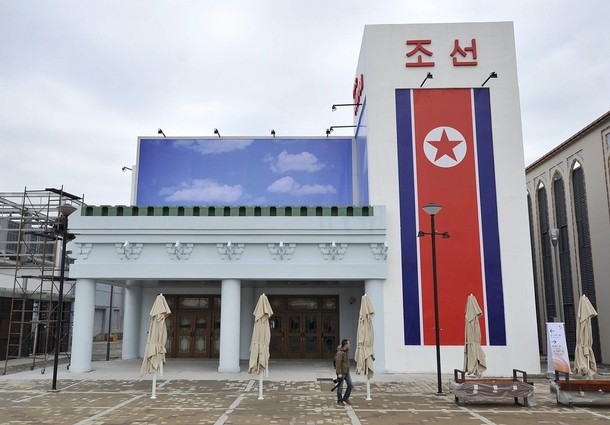
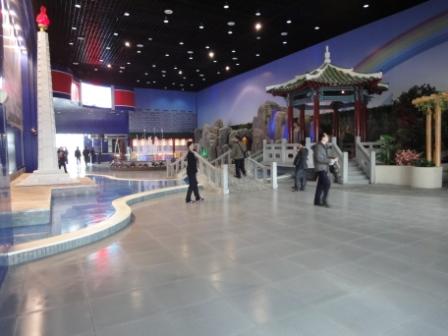
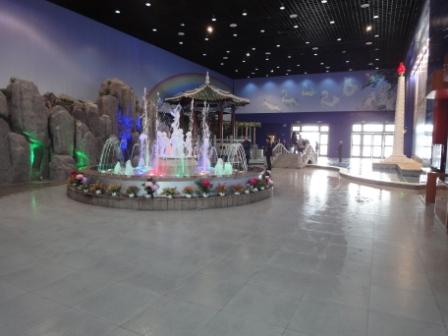
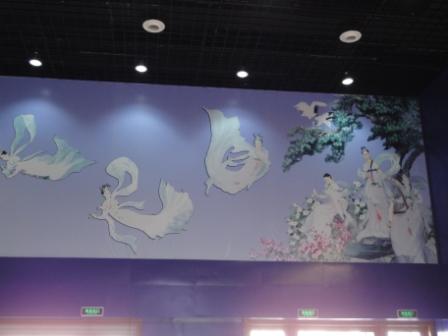
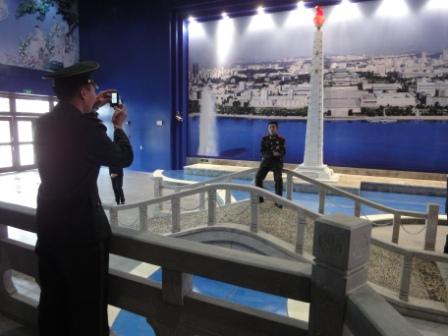
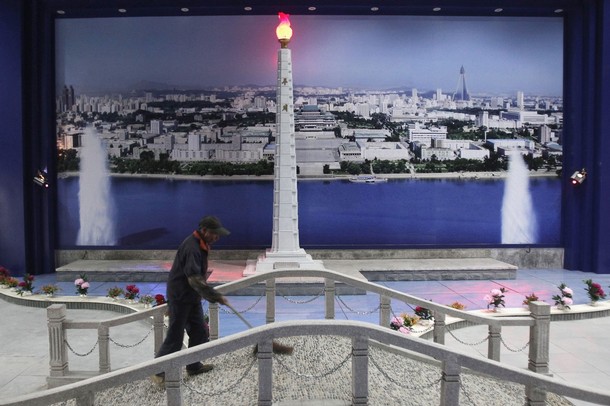
Inside, there is a replica of Pyongyang’s Juche Statue, a small waterway that represents the North’s Taedong River, a traditional bridge and large fountain with colored lights.

On top of the fountain, a group of white marble statues of naked boys encircle two others. One boy holds the other up in the air as he lifts a dove into the sky.

In one corner, there is a small cave that contains a reproduction of a mural from the North’s Koguryo Tombs, a World Heritage site.

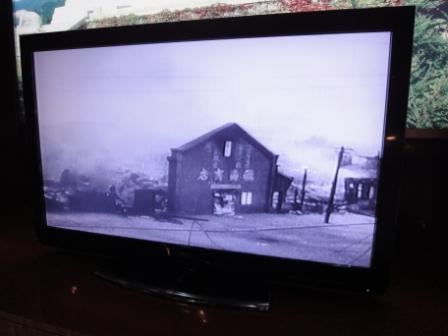
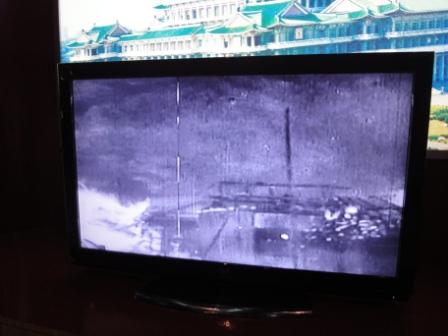
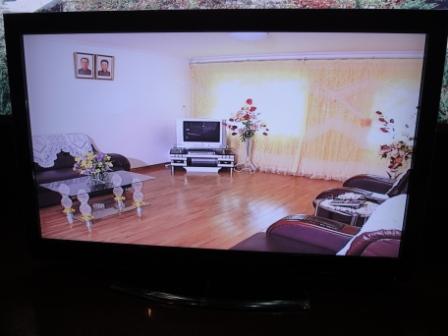
Along a wall, beneath the phrase “Paradise for the People,” a row of television sets plays videos depicting everyday life in North Korea.

Some of the videos show North Koreans leisurely bowling, playing golf and ice skating. Although some of the footage appears to be recent, other shots seem to be decades old.

Many who visited the pavilion Tuesday say that aside from the fact that there were no lines to get in, they wanted to visit because, as they put it, North Korea is so mysterious.

UPDATE 1:  The Shanghai Expo has posted some information on the DPRK’s Pavilion. Here are some of the details:

Theme: Urban Development of Pyongyang, the Capital of DPR Korea (Prosperous Pyongyang based on the River Taedong Culture)

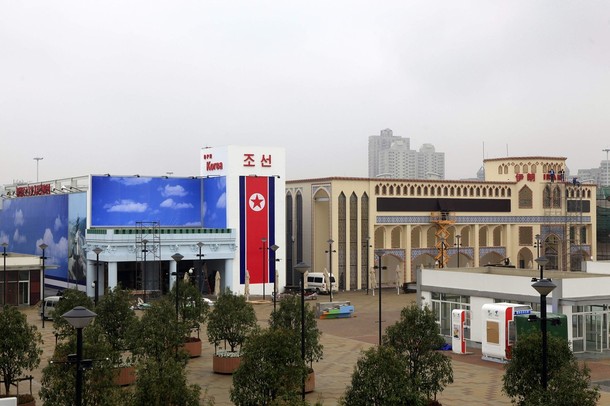
Pavilion Features: The pavilion perfectly merges national characteristics of DPRK together with its modern beauty. Outer walls are decorated with national flags and a winged steed bronze statue. Main items exhibited in the pavilion include Juche Tower, Taedong River, Korean-style pavilions, rockeries and small stone caves. All of them present a prosperous and modern Pyongyang based on the traditions of DPRK, where education, science, culture and sports have achieved great development during its long history.

Pavilion Highlights
Highlight 1: The Juche Tower Model — 4.5-meter-high model of Juche Tower is exhibited in the pavilion.
Highlight 2: Symbol of Taedong River — winding river flows across the pavilion, reminding people of the stretching Taedong River.
Highlight 3: National Section and Stone Caves — national section and stone caves are exhibited on the right side of the pavilion. Inside the cave the world heritage of tomb murals in Jiangxi County and paintings of DPRK style are displayed.

Here are some photos of the DPRK’s pavilion (h/t Daylife):

expo1.jpg expo2.jpg expo3.jpg

And here are some photos from the Shanghai Scrap blog:

shanghai-expo-4.jpg shangahi-expo-5.jpg shanghai-expo-6.jpg shanghai-expo-7.jpg shanghai-expo-8.jpg shanghai-expo-9.jpg shanghai-expo-10.jpg shanghai-expo-11.jpg shanghai-expo-12.jpg shanghai-expo-13.jpg shanghai-expo-14.jpg shanghai-expo-15.jpg

ORIGINAL POST: According to the PRC’s People’s Daily:

China welcomes countries including the Democratic People’s Republic of Korea (DPRK) to participate in the 2010 Shanghai World Expo, a Foreign Ministry spokesman said Tuesday.

DPRK Chamber of Commerce Vice-Chairman Ri Song Un told Xinhua on March 18 that the country had already finished preparatory work for the 2010 Shanghai World Expo, its first Expo appearance.

Situated in an area of 5.28 square kilometers at the core the city of Shanghai to exhibitions, events and forums, the six-month expo starting from May 1 will attract about 200 nations and regions and international organizations’ participation, as well as 70 million visitors from home and abroad.

Read the full story here:
China welcomes DPRK in attending Shanghai World Expo: FM spokesman
People’s Daily
3/30/2010

Share

Changchun-Pyongyang flights to begin in June

Friday, April 16th, 2010

Michael Rank

China Southern Airlines is planning flights to Pyongyang from the northeastern city of Changchun from June, a Chinese website reports.

It said flights will begin on June 20, but did not say how frequent the service will be or give any further details.

It said the Korean National Travel Company was in talks with the Jilin provincial tourism bureau about tours to North Korea from either Changchun, the provincial capital, or the border city of Yanji.

China Southern has operated Beijing-Pyongyang flights in the past does not do so at present.

Share

Chinese tours to North Korea growing

Thursday, April 15th, 2010

Institute for Far Eastern Studies (IFES)
NK Brief No. 10-04-15-1
4/15/2010

As North Korean tours to Keumgang Mountain and other trips aimed at South Korean visitors are all currently frozen, trips into the DPRK by Chinese tourists are beginning to grow. On April 10, a North Korean official revealed that Chinese group tours would be warmly welcomed by Pyongyang, and on April 12, a group of approximately 400 Chinese visitors and officials arrived in the North. Pyongyang and Beijing reached an agreement on tours last February. Cho Seong-kyu, director of the Choson International Tours, stated that his office, responsible for tours for foreigners to North Korea, is preparing a tour course to Pyongyang, Kaesong, Myohyang Mountain and Nampo for Chinese visitors. He explained that since 1988, 20,000 Chinese tourists annually visit Pyongyang, and that many more tour courses were being prepared.

For the past four years, the Chinese government has banned group tours to the DPRK, but that restriction has been completely lifted. Now, tourist trains are being operated and the range of tours offered is growing. Group tours to North Korea were banned in 2006 after Chinese officials were found to have been inappropriately gambling during their trips, but tours will resume on May 12. With 800 Chinese tourists set to board a DPRK-bound train leaving from Hangzhou, it appears that many Chinese are interested in tours of North Korea. On March 18, China’s National Development and Reform Commission and its Bureau of Travel and Tourism released a “Northeast China Tourism Industry Development Plan,” in which it revealed the plan to permit tours to North Korea. Following last year’s measures to improve industry in the northeast provinces, Beijing is now aiming specifically to bolster the tourism industry in the region by arranging overland tours to Russia and North Korea, as well as developing other new domestic and international tour destinations.

In addition to the existing tour to Sonyang-Dandong-Pyongyang, new routes from Baishan (Jilin Province)-Changbai-Hyesan and Yanji-Hunchun-Fangchuan-Rajin/Chungjin have been included. Until now, tour courses to North Korea were limited to Dandong-Sinuiju-Pyongyang, Sanhezhen-Chungjin/Mount Chilbo, and Mount Baekdu-Samjiyon-Pyongyang. As Rajin Port is opened, the Bureau of Travel and Tourism also plans overland trips to the city, in conjunction with a ferry shuttling Chinese tourists to Vladivostok, South Korea, and Japan. In addition, the Yanbian Autonomous Prefecture is promoting the development of a longer tour, from Hunchun through Rajin, on to Pyongyang and even down to Panmunjom.

North Korea has announced the seizure of South Korean property at the Keumgang Mountain tourist resort, and now Chinese travel agents are signing contracts to sell tours to the resort developed mainly by Hyundai-Asan and South Korean government investment. North Korean authorities have offered six-month contracts allowing the Chinese tour operators to book Keumgang tours, guaranteeing them access to hotels and other facilities in the resort area. Over 1,000 Chinese tourists have already booked tours to Keumgang, to begin after April 20.

North Korea froze South Korean government assets in the resort, including the Visitors’ Center, a spa, and a duty-free store, and deported South Korean employees in a first stage of measures to pressure the South into restarting cross-border tours. On April 13, the North stepped up the measures, freezing Hyundai-Asan and other South Korean private-sector assets, ordering the deportation of employees related to these businesses as well. Korean Central Broadcasting reported on April 8, “Because of south Korean authorities, Hyundai’s tourism agreement and contract have become invalid,” announcing that domestic and international tours would begin again with a new tour operator.

And according to the Choson Ilbo:

The first tour groups from across China started off on their way to North Korea on Monday. China has organized group tours of North Korea since 1988, but they were available only to provinces bordering the North such as Liaoning and Jilin.

But on Monday, a group of 395 Chinese tourists left for North Korea by air or train from Beijing, Shenyang and Dandong, the China National Tourism Administration said. They will gather in Pyongyang before starting an eight-day tour of tourist spots in the capital like the Kim Il-sung statue and Mansudae, as well as Kaesong, Panmunjeom, Mt. Myohyang and Nampo.

Mt. Kumgang is not included in their itinerary, despite threats by the North to find another partner for visits to the scenic resorts. South Korea declined to resume tours there in the wake of the fatal shooting of a tourist in 2008 unless the safety of travelers is guaranteed.

However, some Chinese travel agents are offering tour programs that include Mt. Kumgang.

Share

DPRK imports hundreds of cars in last week

Wednesday, April 14th, 2010

According to the Choson Ilbo:

A North Korean source saw around 30 identical vehicles crossing the bridge across the Apnok (or Yalu) River into Sinuiju at around 9 a.m. The vehicles were the Chinese compact sedan F3 manufactured by BYD, referred to as the “people’s car” in China due to its popularity. Around 100 cars reportedly crossed the border into North Korea on Tuesday alone. Starting last week, North Korea brought in more than 200 cars, including luxury foreign cars, jeeps and large vans. The total value of the imported cars is believed to be around US$5 million.

The North Korean regime often seeks to ensure the loyalty of senior officials by handing out the latest foreign-made cars on Kim Il-sung’s or Kim Jong-il’s birthday, but the Chinese-made cars imported this time are believed to be gifts for the middle ranks. “To my knowledge, the latest cars are gifts for mid-level officials at North Korea’s prosecution and state security agency and have been allocated to specific people in different regions,” the source said.

North Korea watchers believe the cars were bought to boost the morale of such officials, who were hit hard by the botched currency reform in December. “Failing to take care of mid-ranking officials could jeopardize the transfer of power to Kim Jong-il’s third son Jong-un,” said one North Korea expert. “The purpose of the gifts is to appease discontent.”

Judging from the pictures, it looks like the cars were driven across the Sinuiju/Dandong Sino-DPRK Friendship Bridge.  Satellite image here

So it appears the Kim Jong il uses automobiles in the same way foreign governments use international aid in North Korea–to “purchase” influence and support.  If the strategy works on a domestic level (within the DPRK), why does it have so much trouble on an international level?  Feel free to discuss.   

Read the full story here:
Kim Jong-il Imports Hundreds of Cars for Loyal Officials
Choson Ilbo
4/14/2010

Share