Archive for the ‘China’ Category

China capturing ROK’s old business in DPRK

Wednesday, June 8th, 2011

According to the JoongAng Daily:

South Koreans doing business with North Korea, or across its border with China, are seeing opportunities dry up as Pyongyang gives all the good breaks to Chinese companies.

Yesterday, workers were seen getting ready for a ground-breaking ceremony at Hwanggumpyong, a joint industrial complex run by North Korea and China on an island in the Yalu River.

North Korea’s official news agency said the complex would further deepen economic ties between the two countries. The exact reverse is happening to South Korean businesspeople.

“South Korean firms and investors have pretty much let their businesses at the China-North Korea border go since last May,” said Choi, the owner of a restaurant in Dandong. Choi, 54, has been running his restaurant for a decade and, to him, the good times are over.

“When business was active between South and North Korea, there were about 1,000 South Korean businessmen working in Dandong, all doing work related to North Korea,” said Choi. “But now most of them have left.”

“Most of the manufacturing jobs done inside North Korea have been taken by Chinese investors and the South Koreans left here in Dandong are mostly contractors for Chinese firms,” Choi said.

After the attack on the warship Cheonan in March 2010, business ties between South and North Korea have run dry due to sanctions ordered by Seoul the following May.

“I invested millions of dollars into developing the underground natural resources in North Korea before last May,” said Park, 56, who was working from Hunchun in northeast China. “Now that the South Korean government has banned all North Korean goods from entering the South, I’m about to lose all my money.”

Chinese investors – including ethnic Koreans living in China – are grabbing the business opportunities forfeited by the Southerners.

“I run short of stock even if I charge 10 renminbi [$1.54] for an abalone I used to sell at 5 renminbi,” said Han, 70, an ethnic Korean in China who sells abalones caught in North Korea. The trade was formerly done by South Koreans.

“Doing business with Chinese customers is much better because I can earn more and in cash, too,” he said.

The South’s sanctions on North Korea have resulted in some other problems as well. Pollack caught in Russian waters have been denied being imported into South Korea because they were mistaken for North Korean pollack. In fact, the fish cannot be found in North Korea anymore due to global warming.

“It was a loss for me when the fish didn’t make it through customs after being mistaken for North Korean pollack,” said Lee, 51. “I export Russian pollack to South Korea after they are caught and processed in China.” Lee is involved in aquatic product processing in Hunchun.

Jo Dong-ho, a professor of North Korean studies at Ewha Womans University in Seoul, said, “North Korea is looking for an alternative by doing business with China after trade with the South halted. There is a need for some breathing space when it comes to inter-Korean trade.”

Read the full story here:
China capturing North’s business
JoongAng Daily
Chang Se-jeong
2011-6-8

Share

2011-Q1 DPRK-PRC trade double 2010 level

Wednesday, June 8th, 2011

According to Arirang News:

Trade between North Korea and China nearly doubled in the first quarter of this year compared to 2010.

China’s imports of North Korean goods, which were valued at around 401-million US dollars, increased 214-percent, while its exports to the North, worth about 570-million dollars, rose by only 59-percent year-on-year.

As China’s imports significantly increased overall during this period, its trade surplus with its communist neighbor shrank about 27 percent compared to last year.

The top items China imported from the North included anthracite, iron, and zinc alloys, mostly mining resources.

China’s import of anthracite in the first quarter surged about 1300-percent compared to the same time last year.

Meanwhile, North Korea imported items like crude oil, gasoline, wireless phones, and coal from its last remaining ally.

Korea’s YTN News Agency reports that North Korea’s import of mobile phones, which appear to be all old models, increased about 330-percent from a year earlier.

And North Korea’s import of gasoline during the first quarter of this year increased 120-percent compared to 2010.

Experts say that the increase in gasoline imports likely has to do with its intensified military training since its attack on the South Korean warship Cheonan and the shelling of the South’s Yeonpyeong Island last year.

Read the full story here:
China-N.Korea Trade Volume Doubles in First Quarter of 2011
Arirang News
2011-6-6

Share

Korea Unpung Joint Operating Company

Monday, June 6th, 2011

According to Yonhap:

A China-North Korea joint venture maker of food additives, have been operating smoothly in a display of close ties between the two countries, China’s state-run Xinhua News Agency said Monday.

China’s Liaoning Wellhope Agri-tech Co. and North Korea’s Unpasan General Trading Company set up a joint venture, (North) Korea Unpung Joint Operating Company, in 2006, in Pyongyang, the North Korean capital city.

Liaoning Wellhope Agri-tech holds a 55 percent stake in the joint venture, while the North Korean trading firm has a 45 percent stake.

In a dispatch from Pyongyang, Xinhua said the total assets of Unpung have now reached 21 million yuan (US$3.24 million). During the six-year operation, the firm made a total pre-tax profit of 15.21 million yuan, and its cumulative sales of food additives reached 18,720 tons.

“At present, Unpung aims to become a first-class brand in the (North) Korean food additive industry,” the new agency said in a Chinese-language report.

“Recently, demand for food additives are rapidly rising in North Korea, and many companies need their employees to work overtime to meet the demand.”

Quoting the Chinese head of the joint venture, Xie Jingming, the report said the firm’s more than 5 years of business development and expansion can not be separated from the deepening economic cooperation between China and North Korea.

China-N. Korea joint venture maker of food additives operates smoothly: Xinhua
Yonhap
Kim Young-gyo
2011-6-6

Share

PRC intercepts DPRK meth shipment

Saturday, June 4th, 2011

According to Reuters:

Police in northeast China detained 10 people and seized a haul of methamphetamines smuggled in to the country from North Korea, Chinese state media said on Saturday.

South Korea and the United States accuse North Korea of involvement in a wide range of illicit activities, including drug smuggling, to raise funds for a government under wide-ranging sanctions due to its nuclear programme.

The 10 suspects were caught in Dandong, which faces North Korea on the Yalu River, carrying 450 grams (1 lb) of methamphetamine, a stimulant known as “ice”, the official Xinhua news agency said in an English-language report.

The suspects are all Chinese citizens and were also carrying 150,000 yuan ($23,150) with them, Xinhua said.

Police are looking for two other people in connection with the haul.

While Xinhua did not say where the drugs came from, it pointed out that Dandong is on the North Korean border and that this was a “cross-border drug trafficking case”.

It provided no other details.

There is probably some sort of “lips and teeth” / “meth mouth” metaphor in here somewhere, but I am not a professional writer.

Previous posts on drug smuggling in/from the DPRK can be found here.

Read the full story here:
China cracks ring smuggling drugs from N.Korea
Reuters
Ben Blanchard
2011-6-4

Share

Oxfam Hong Kong assisting DPRK

Wednesday, June 1st, 2011

The Pyongyang Times reports that Oxfam Hong Kong is providing farming assistance to the DPRK:

Oxfam Hong Kong is increasing aid to the DPRK’s agricultural sector.

The Hong Kong charity founded in 1976 is dedicated to helping victims of famine and natural disasters and is engaged in rendering humanitarian aid and education.

It has been giving aid to the DPRK since 1997.

In recent years it has supplied farming materials and food on several occasions via the Korean Committee for Promotion of International Trade to the Ryonghyon Cooperative Farm in Suan County, North Hwanghae Province and other farms.

The farms and the KCPIT are very grateful to the Hong Kong charity for their kind-hearted aid and hope for a wider range of relief activities.

The Oxfam Hong Kong webpage is here. I cannot find any information on their projects in the DPRK.

Share

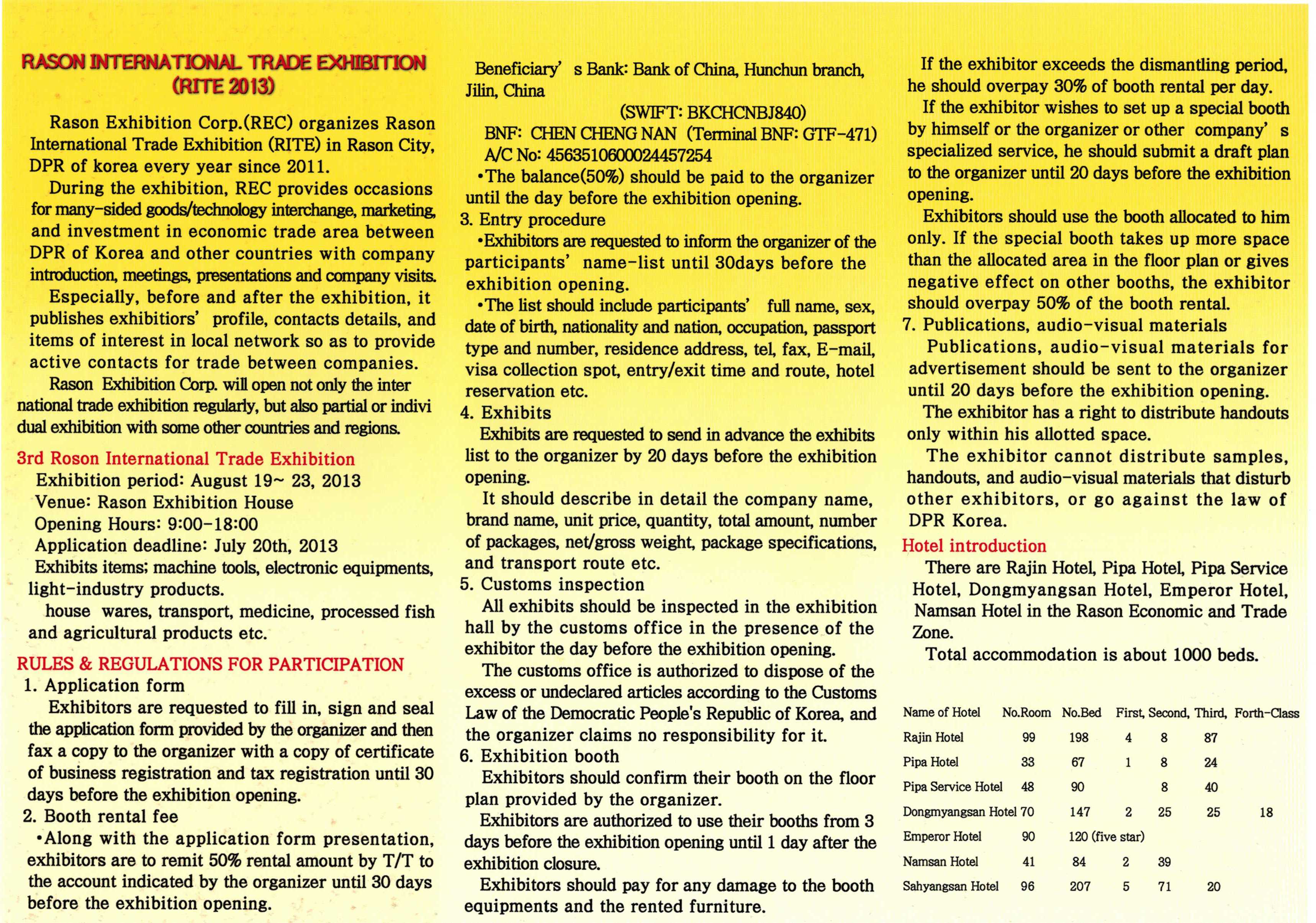
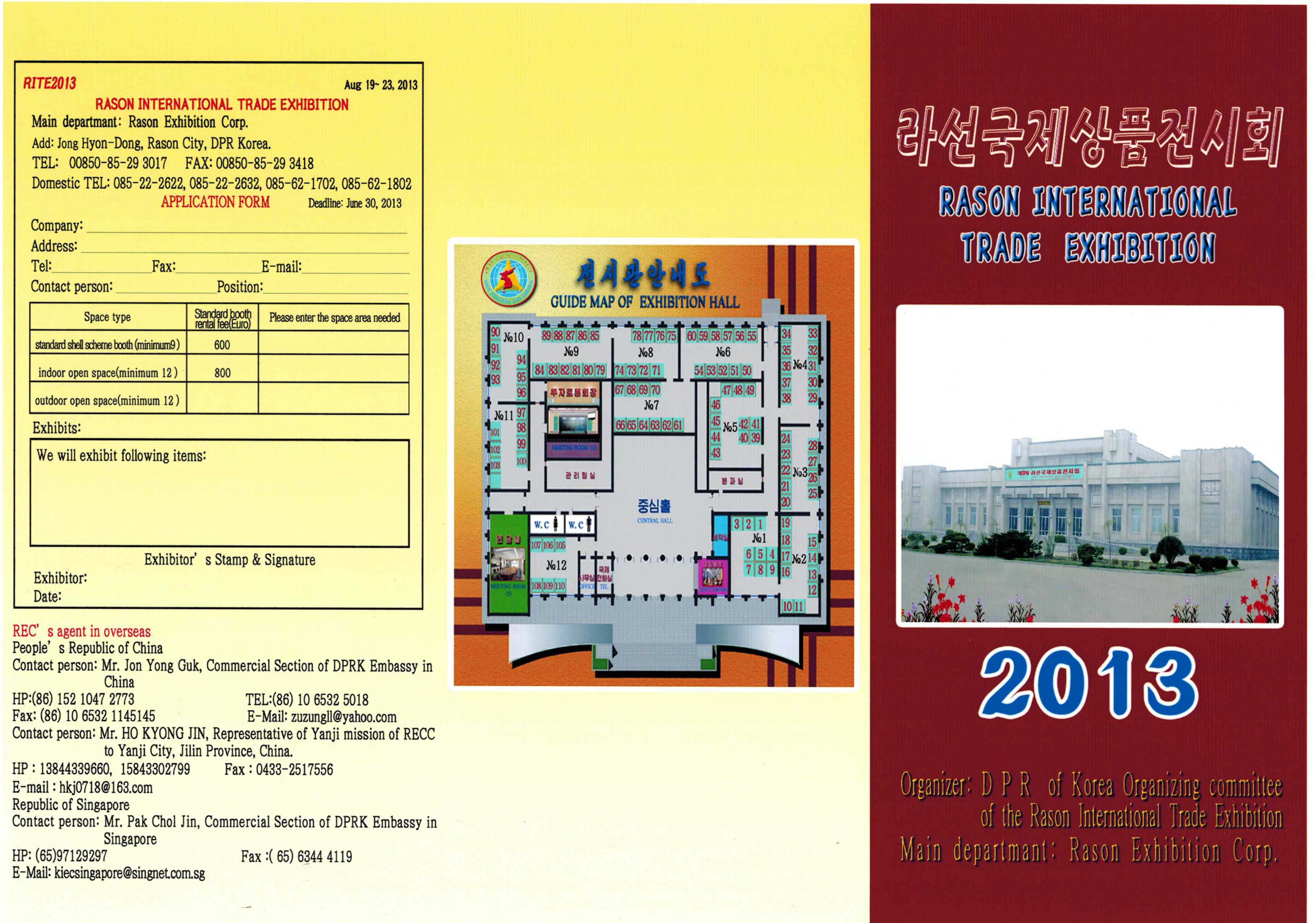
The blueprint for the development of the Rajin-Sonbong (Rason) economic and trade zone is released

Tuesday, May 31st, 2011

Institute for Far Eastern Studies (IFES)
2011.05.26

On May 23, the DPRK released the “Outline of DPRK-China Joint Development Plan for Rason and Hwanggumpyong Economic and Trade Zone” consisting of detailed blueprint of two countries’ recent bilateral joint development deal.

According to Yonhap News, China and North Korea are planning to turn the Rason and Hwanggumpyong areas into a comprehensive industrial complex of tourism and manufacturing producing automobiles, mobile phones, agricultural and chemical products.

In addition, the Law on Rason Economic and Trade Zone and the Special Law on Hwanggumpyong Zone will adopt market economy principles which will permit foreign bank investments and independent contracts between corporations and workers. Although the development plans are not definite yet, it is significant since it hints at North Korea’s shifting position on opening up and economic development.

The bilateral development plan between Pyongyang and Beijing will stretch from Rajin, Sonbong, Ungsang, to Gulpo areas.

In the Rajin area, four major industrial complexes will be constructed consisting of storage, logistics and distribution centers, state of the art technology, and equipment, clothing and food manufacturing. In the Ungsang area, comprehensive a wood processing complex will be built while in the Gulpo area, a high-efficiency agriculture zone will be constructed. In the Sonbong area, truck manufacturing factories will be built along with other metal producing factories. In Rajin, docks will be built for ship building and maintenance.

There are also plans of developing the Rason area into an international tourism zone. There are immediate plans to build basic tourism infrastructure such as hotels, resorts, and roads for sightseeing. The long-term goal is to build a grand Northeast Asia tour course, which will include Yanbian of China; Rason, Chongjin, Mount Chilbo and Mount Kumgang of North Korea; Vladivostok and Sakhalin of Russia; Sapporo and Nakata of Japan; and Sokcho and Busan of South Korea.

As for the Hwanggumpyong area, four major industrial complexes will be established: one each for information, tourism and culture, modern protected agriculture, and food processing. More specifically, Hwanggumpyong will connect information between Hwanggumpyong and the border city of Dandong in China. In addition, culture and tourism will be developed through promotion of Arirang and other cultural performances and exhibitions.

As for the high-efficiency agriculture zone, a modern agriculture technology research center will be established and China-DPRK joint markets will be set up to serve as a central commerce center.

To assist with the industrial development in the area, land and sea routes will be developed where roads and railroads will be built and Rajin will be upgraded to a comprehensive and multi-purpose port.

There are additional plans of constructing a coal power station to replace the current thermoelectric power plant in Sonbong. There is also discussion of possibly developing other alternative energy plants, such as wind and solar. There are also plans of building basic facilities of mobile telecommunication to promote international communication.

Hwanggumpyong is an island on the Yalu River and the new developments in building ports and roads along with distribution network, Internet, and mobile telecommunication will become a link connecting North Korea with China.

Pyongyang is pursuing development through multiple cooperation channels. It has plans of establishing three-tiered cooperative system with joint management committee, joint development management committee and investment development corporation with Beijing. These committees will be responsible for amending and negotiating any issues that may arise during the process of development and supervise various areas of investments, enterprises, and environment and as well as inspect land and commerce development and basic facility operations.

Both Pyongyang and Beijing will attract foreign investments through market-based tax and financial policies in the Rason and Hwanggumpyong zones. Specifically, tax refund policy will be implemented and tariffs will be lifted from any imported equipment and materials necessary for production. The foreign investment companies will be allowed to choose their own banks or even establish financial institutions to assist in their business management.

In addition, workers and companies will be permitted to sign their own labor contracts. The companies will be granted autonomy in hiring and firing, pricing, bankruptcy, liquidation and other business practices based on market principles.

As for investment protection policy, foreign investors will be permitted to transfer or inherit profits and assets and foreign investor’s investments and assets will not be collected as national property by North Korea.

Share

Lankov on the rise of China and Korean unification

Monday, May 23rd, 2011

Andrei Lankov recently wrote a paper on the rise of China and the implications for Korean unification for a Korean-language publication.

You can download a PDF of the paper in English here.

Abstract
The rise of China can be seen as the single most important strategic problem which Korea faces currently. In the late 1970s, China entered a phase of high-speed economic growth, which still seems to be almost unstoppable. According to World Bank estimates, the average annual increase in China’s GDP in the years 2000-2009 was 9.7%. This is the world’s highest growth rate. Perhaps for the first time in modern history, the country which has the highest growth rate is the country with the largest population.

The future of Korea depends on its ability to find how to handle the Chinese challenge. It is going to be difficult, but there are hopeful signs, too: Chinese political elite may be remarkably realist, even Machiavellian, in their outlook but also rational and averse to adventurism. This gives Korea some hope that compromises with China will be possible. Without such compromises no unification of Korea will be possible in a new world where China is bound to be a major player.

Share

KJI’s no 8. trip to China

Monday, May 23rd, 2011

UPDATE 7 (2011-5-30): According to the Choson Ilbo, the Hwanggumpyong Island groundbreaking ceremony was cancelled without any announcement.

UPDATE 6 (2011-5-27): According to the Irrawaddy, KJI’s delegation visit to Beijing overlapped with a Myanmar delegation.  Maybe the two met?

UPDATE 5 (2011-5-25): According the Choson Ilbo, Kim Jong-il’s security in China is facing an all new challenge: Yoku!

UPDATE 4 (2011-5-25): According to Yonhap and the Choson Ilbo, Kim Jong-il’s consort, Kim Ok, is traveling with him.

UPDATE 3 (2011-5-25): KJI is now in Beijing for talks with PRC President Hu Jintao (Yonhap).  According to a colleague, Xinhua claims KJI also met with Singapore’s Lee Kuan Yew in Beijing.

UPDATE 2 (2011-5-24): China confirms that Kim Jong-il is in the PRC (Nanjing on Tuesday).  China usually waits until KJI has returned to the DPRK before announcing his visits.  See the Wall Street Journal: China Real Time, Yonhap, AFP.

UPDATE 1 (2011-5-23): More coverage is coming out on KJI’s trip to the PRC:

1. Aidan Foster-Carter writes about Kim Jong-il’s previous trips to China in 38 North.

2. China claims Kim’s trip is focused on economic issues (WSJ):  “China invited North Korean dictator Kim Jong Il, who began his seventh trip there on Friday, to learn more about its economic development, Chinese Premier Wen Jiabao told South Korean President Lee Myung-bak Sunday.”

3. PRC-DPRK trade up significantly in the last year (Bloomberg): “North Korea’s trade with China jumped 30 percent last year even after the United Nations stepped up sanctions following its second nuclear test in May 2009, according to China’s commerce ministry.”

4. Yonhap reports that Kim Jong-il will possibly attend a groundbreaking ceremony for development of the Hwanggumpyong Island (see more here) .  This ceremony is supposedly scheduled for May 28th.

5. The Hankyoreh has an update of KJI’s travel itinerary as of today.

ORIGINAL POST (2011-5-20): This morning there were dozens of conflicting stories about whether Kim Jong-il and/or Kim jong-un had traveled to China.  Right now, the emerging view seems to be that Kim Jong-il is definitely in China and Kim Jong-un is possibly (probably not) in China.

So let’s back up a couple of days.  Kim Jong-il was just reported to have given on the spot guidance visits to the Ryongjon (룡전과수농장) and Toksong  (덕성과수농장) Fruit Farms on May 18th.  The Ryongjon Fruit Farm is located in Pukchon County (북청군, 40.172649°, 128.338476°) and the Toksong Fruit Farm is located in neighboring Toksong County (덕성군, 40.325806°, 128.262423°).  Those are the coordinates of the farms themselves if you want to check them out on Google Earth.

These farms lie on railway lines that indicate KJI was traveling north to cross into China at either Manpho (만포시) or Namyang, Onsong County (남양로동지구, 온성군).

So was Kim Jong-un traveling with Kim Jong-il?  Maybe, but I don’t think so…

KCNA reports from Kim’s guidance tours:

[Kim Jong-il] was accompanied by Kim Ki Nam and Choe Thae Bok, members of the Political Bureau and secretaries of the C.C., WPK, Thae Jong Su, alternate member of the Political Bureau and secretary of the C.C., WPK, and Kwak Pom Gi, chief secretary of the South Hamgyong Provincial Committee of the WPK.

Now I know that Kim Jong-un has reportedly accompanied his father on guidance trips without being listed as part of the official entourage and that he could have been omitted from official coverage precisely to hide his presence on the train to China.  In these situations I generally look to occam’s razor for the answer, and the razor says “no”.  Now I will just wait to be proven wrong.

The Wall Street Journal has more.

Here is coverage of the trip in the Washington Post.

Here is a headline (but no story) from Yonhap.

Share

China Exim Bank delegation visited DPRK in April

Monday, May 9th, 2011

According to the Donga Ilbo:

Members of the credit rating agency under the Export-Import Bank of China are known to have visited North Korea around the “Day of the Sun” on April 15, otherwise known as the birthday of the Stalinist country`s founder Kim Il Sung.

A source in Beijing said, “Around 10 people from the Export-Import Bank of China made a 10-day trip to North Korea ahead of the Day of the Sun. They not only visited Pyongyang but also other cities.”

The agency provides sovereign credit ratings for countries around the world. Critics say the members visited the North to seek further economic cooperation, adding their trip holds more meaning than attending the holiday event because they also visited other cities.

Another source in Beijing said, “The Chinese government is mulling financial benefits including no-interest loans to Chinese companies investing in the [North’s] city of Rason.”

Beijing seems to be preparing to invest in the Hunchun-Rason area near the Tumen River and Dandong-Sinuiju’s Hwanggeumpyong region near the Yalu River, where Pyongyang-Beijing economic cooperation is vital.

Read the full story here:
China`s Exim Bank delegation visited N. Korea last month
Donga Ilbo
2011-5-9

Share

100,000 Chinese visit Sinuiju in past year

Friday, May 6th, 2011

According to Yonhap:

The number of Chinese visitors to North Korea’s border town of Sinuiju has reached 100,000 over the past year after Beijing lifted a four-year ban on Chinese group tours from the Chinese border city of Dandong, a news report said Friday.

Dandong, which borders Sinuiju, is a major trade route between North Korea and China.

The Chinese government resumed the group tours to Sinuiju from Dandong in April last year, a Dandong newspaper said, adding the number of Chinese tourists to Sinuiju is likely to go up in the coming months.

The one-day group tour program allows the Chinese to visit Sinuiju without visas.

China is the North’s last remaining ally and benefactor.

Read the full story here:
Chinese visitors to N. Korean border city top 100,000 in one year
Yonhap
2011-5-6

Share

An affiliate of 38 North