Archive for the ‘Communications’ Category

N.K. orders shutdown of karaoke bars

Friday, July 13th, 2007

Korea Herald
7/12/2007

North Korea has ordered the closure of karaoke bars in an apparent attempt to stem outside influences on the isolated communist country, AP reported, quoting a South Korean civic group as saying Wednesday.

Separately, the North’s Ministry of People’s Security conducted house-to-house overnight inspections in areas near the border with China earlier this month to search for cell phones and illegal video CDs, the Good Friends aid agency said in a newsletter, according to the report.

It reported that the ministry said in a directive last week that the move against karaoke outlets was a ”mopping-up operation to prevent the ideological and cultural permeation of anti-socialism,” according to the aid group.

Violators were warned they would face punishment, including deportation to other regions within North Korea.

The group did not say how it obtained the information. Its previous reports on the North’s isolated regime have been reliable.

It was not clear how many karaoke bars the country has.

AP said officials at South Korea’s top spy agency, the National Intelligence Service, were not immediately available for comment.

Share

N. Koreans growing familiar with digital devices

Sunday, June 3rd, 2007

Yonhap 
6/3/2007

NKeconWatch: Joshua at One Free Korea is skeptical about the article below, read here.  As a side note, see how much lower health care prices can be if consumers are permitted to pay for it themselves. 

High-tech portal devices such as music players and cameras are almost ubiquitous in South Korea, but many may believe they are nowhere to be found in poverty-stricken North Korea.

Unlike the conventional wisdom, however, a growing number of North Koreans, though still confined to some privileged classes, listen to music with MP3 players and take pictures with digital cameras in their daily life, a North Korean souvenir shop clerk told Yonhap News Agency.

A group of South Korean reporters visited North Korea last week to cover a delegation from South Korea’s Gyeonggi Province which has been promoting agricultural exchanges with the communist government. The reporters were allowed to visit a department store and other attractions in the North’s capital, Pyongyang.

When asked what he was listening to with an earphone, the North Korean clerk answered plainly, “MP3 music files,” adding that he downloaded songs from the Internet.

When asked if he has a digital camera, the clerk replied, “I am using the same model Canon that you are carrying now.”

In terms of IT development, the reclusive North has been regarded as lagging far behind South Korea where almost all younger people take it for granted to use digital devices.

The clerk’s response does not provide any insight into the North’s IT sector, including how many of them use such digital devices, but experts say that they offer a glimpse into changes taking place in North Korea, though slowly.

Meanwhile, a North Korean restaurant worker said that many beauty-conscious North Korean women receive plastic surgeries to look prettier. “You can easily see a woman on the street who had a double eyelid operation,” he said.

Such eyelid plastic surgery costs around 0.7 euro in the North, slightly less than the average monthly salary in the country, he said.

Share

Freedom of the Press 2007 Survey Release

Saturday, May 12th, 2007

Freedom House
5/1/2007

North Korea comes in last place again: 197

Asia-Pacific Region: The Asia-Pacific region as a whole exhibited a relatively high level of freedom, with 16 countries (40 percent) rated Free, 10 (25 percent) rated Partly Free, and 14 (35 percent) rated Not Free. Nevertheless, Asia is home to two of the five worst-rated countries in the world, Burma and North Korea, which have extremely repressive media environments, as well as several other poor performers such as China, Laos and Vietnam, all of which use state or party control of the press as the primary tool to restrict media freedom.

Several bright spots worth noting include Nepal, where wide-ranging political change led to a dramatic opening in the media environment, and Cambodia and Indonesia, which also featured positive movement. Asia saw many negative developments in 2006, however, continuing the downward regional trajectory noted in last year’s survey. Coups and military intervention led to the suspension of legal protections for press freedom and new curbs imposed on media coverage in Fiji and Thailand. Intensified political and civil conflict during the year contributed to declines in Sri Lanka, East Timor and the Philippines. Heightened restrictions on coverage, as well as harassment of media outlets that overstepped official and unofficial boundaries, negatively impacted press freedom in Malaysia, China and Pakistan.

Share

Christians Find Innovative Ways to Smuggle Gospel into N. Korea

Sunday, April 29th, 2007

The Christian Post
Michelle Vu
4/29/2007

In a country described as a spiritual vacuum surrounded by the watchful eyes of a totalitarian regime and oppressed by a quasi religious cult centered on its leader’s family, North Koreans desperate to keep the Gospel alive have found innovative methods to smuggle in the Word of God.

Whether it is through human transport of Bibles or North Koreans risking their lives to testify to their families upon return or balloons filled with Christian tracts, the Word of God is penetrating the country where being openly Christian can result in execution.

From within the country, evangelism is taking place through disguised missionaries and North Korean Christians repatriated by China or returning on their own free will, according to North Korean defectors at the Open Doors USA panel discussion this past week on religious persecution in North Korea.

One North Korean defector, Ms. Eom Myong-Heui, said that she was evangelized through a Chinese-Korean missionary disguised as a businessman while still living in North Korea.

Eom – who is now an assistant pastor of a church in South Korea for North Korean defectors – said that she was desperate for food during the North Korea famine in the 1990s and had resorted to partnering with the disguised missionary businessman to earn money.

The Korean-Chinese missionary would teach her the Bible whenever they met and eventually Eom became a Christian.

Yet she and the other North Korean defector on the panel agreed that the best method to spread the Gospel in the closed society is through training North Korean refugees.

“The best and most effective way is using the North Korean refugees,” stated Eom, who said defectors can call their family and relatives in North Korea and share the Gospel.

Eom explained that she speaks to her two daughters still in North Korea through a cell phone from China that cannot be monitored by the North Korean government.

“We can train those North Koreans as strong believers and connect to relatives in North Korea … and conversations can spread [the] Gospel,” she said.

“Philip Lee,” a North Korean defector now living in South Korea. added that some North Koreans are even willing to return to the North and spread the Gospel. Lee, whose real name is withheld for security reasons, said that one of the main ministries in his church composed of North Korean defectors is to train strong Christian leaders who are willing to return to North Korea and witness.

But he noted that even refugees forcefully returned to North Korea can become powerful witnesses.

Lee recalled a repatriated North Korean Christian named Brother Luke who would daily urge his prison guards and officers, “You should believe in Jesus! You should accept Jesus!” Luke reportedly continued his exclamations even during torture and before a judge in court, according to Lee. Before his martyrdom one year later, one prison guard had accepted Christ.

Meanwhile, other North Korean defectors have found innovative ways to spread the Gospel in the North while still remaining in South Korea.

Lee Minbok, founder of North Korea Christian Association, began sending large balloons filled with thousands of Christian tracts across the North-South border about three years ago. Lee, previously a scientist in North Korea, is mostly joined by a small group of defectors or those who have worked with North Korean refugees. The balloons are said to land in North Korea within 20 minutes to 1 hour from its departure in the South.

“I’m proud that North Korea is angry,” said a grinning Choi Yong-Hun, a volunteer at NKCA and a South Korean who spent nearly four years in prison in China for helping North Korean refugees, to The Christian Post. “They ask, ‘Who sent it?’ We say that God sent it. It is a very effective way to send the Gospel.”

Other ways given to evangelize North Koreans include smuggling in Bibles, as Open Doors has done over the past ten years; Christian radio broadcast; and through organizations working with North Korean refugees along the border in China.

Last week’s panel discussion in Washington was part of North Korea Freedom Week, Apr. 22-29, which seeks to raise awareness of the brutal North Korean regime and to urge stronger actions by the U.S. government and international community to press North Korea on its human rights abuse.

The week mainly ended on Saturday with international protests against China’s violent treatment or North Korean refugees at Chinese embassies around the world.

Share

North Korea’s IT revolution

Tuesday, April 24th, 2007

Asia Times
Bertil Lintner
4/24/2007

The state of North Korea’s information-technology (IT) industry has been a matter of conjecture ever since “Dear Leader” Kim Jong-il famously asked then-US secretary of state Madeleine Albright for her e-mail address during her visit to the country in October 2000.

The answer is that it is surprisingly sophisticated. North Korea may be one of the world’s least globalized countries, but it has long produced ballistic missiles and now even a nuclear arsenal, so it is actually hardly surprising that it also has developed advanced computer technology, and its own software.

Naturally, it lags far behind South Korea, the world’s most wired country, but a mini-IT revolution is taking place in North Korea. Some observers, such as Alexandre Mansourov, a specialist on North Korean security issues at the Honolulu-based Asia-Pacific Center for Security Studies (APCSS), believes that in the long run it may “play a major role in reshaping macroeconomic policymaking and the microeconomic behavior of the North Korean officials and economic actors respectively”.

Sanctions imposed against North Korea after its nuclear test last October may have made it a bit more difficult for the country to obtain high-tech goods from abroad, but not impossible. Its string of front companies in Hong Kong, Singapore, Thailand and Taiwan are still able to acquire what the country needs. It’s not all for military use, but as with everything else in North Korea, products from its IT industry have both civilian and non-civilian applications.

The main agency commanding North Korea’s IT strategy is the Korea Computer Center (KCC), which was set up in 1990 by Kim Jong-il himself at an estimated cost of US$530 million. Its first chief was the Dear Leader’s eldest son, Kim Jong-nam, who at that time also headed the State Security Agency, North Korea’s supreme security apparatus, which is now called the State Safety and Security Agency.

Functioning as a secret-police force, the agency is responsible for counterintelligence at home and abroad and, according to the American Federation of Scientists, “carries out duties to ensure the safety and maintenance of the system, such as search for and management of anti-system criminals, immigration control, activities for searching out spies and impure and antisocial elements, the collection of overseas information, and supervision over ideological tendencies of residents. It is charged with searching out anti-state criminals – a general category that includes those accused of anti-government and dissident activities, economic crimes, and slander of the political leadership. Camps for political prisoners are under its jurisdiction.”

In the 1980s, Kim Jong-nam studied at an international private school in Switzerland, where he learned computer science as well as several foreign languages, including English and French. Shortly after the formation of the KCC, South Korean intelligence sources assert, he moved the agency’s clandestine overseas information-gathering outfit to the center’s new building in Pyongyang’s Mangyongdae district. It was gutted by fire in 1997, but rebuilt with a budget of $1 billion, a considerable sum in North Korea. It included the latest facilities and equipment that could be obtained from abroad. According to its website, the KCC has 11 provincial centers and “branch offices, joint ventures and marketing offices in Germany, China, Syria, [the United] Arab Emirates and elsewhere”.

The KCC’s branch in Germany was established in 2003 by a German businessman, Jan Holtermann, and is in Berlin. At the same time, Holtermann set up an intranet service in Pyongyang and, according to Reporters Without Borders, “reportedly spent 700,000 euros [more than US$950,000] on it. To get around laws banning the transfer of sensitive technology to the Pyongyang regime, all data will be kept on servers based in Germany and sent by satellite to North Korean Internet users.” Nevertheless, it ended the need to dial Internet service providers in China to get out on the Web.

Holtermann also arranged for some of the KCC’s products to be shown for the first time in the West at the international IT exhibition CeBIT (Center of Office and Information Technology) last year in Hanover, Germany. The KCC’s branches in China are also active and maintain offices in the capital Beijing and Dalian in the northeast.

Another North Korean computer company, Silibank in Shenyang, in 2001 actually became North Korea’s first Internet service provider, offering an experimental e-mail relay service through gateways in China. In March 2004, the North Koreans established a software company, also in Shenyang, called the Korea 615 Editing Corp, which according to press releases at the time would “provide excellent software that satisfies the demand from Chinese consumers with competitive prices”.

Inside North Korea, however, access to e-mail and the Internet remains extremely limited. The main “intranet” service is provided by the Kwangmyong computer network, which includes a browser, an internal e-mail program, newsgroups and a search engine. Most of its users are government agencies, research institutes, educational organizations – while only people like Kim Jong-il, a known computer buff, have full Internet access.

But the country beams out its own propaganda over Internet sites such as Uriminzokkiri.com, which in Korean, Chinese, Russian and Japanese carries the writings of Kim Jong-il and his father, “the Great Leader” Kim Il-sung, along with pictures of scenic Mount Paekdu near the Chinese border, the “cradle of the Korean revolution”, from where Kim Il-sung ostensibly led the resistance against the Japanese colonial power during World War II, and where Kim Jong-il was born, according to the official version of history. Most other sources would assert that the older Kim spent the war years in exile in a camp near the small village of Vyatskoye 70 kilometers north of Khabarovsk in the Russian Far East, where the younger Kim was actually born in 1942.

The official Korean Central New Agency also has its own website, KCNA.co.jp, which is maintained by pro-Pyongyang ethnic Koreans in Japan, and carries daily news bulletins in Korean, English, Russian and Spanish, but with rather uninspiring headlines such as “Kim Jong-il sends message of greetings to Syrian president”, “Kim Jong-il’s work published in Mexico” and “Floral basket to DPRK [North Korea] Embassy [in Phnom Penh] from Cambodian Great King and Great Queen”.

On the more innocent side, the KCC produces software for writing with Korean characters a Korean version of Linux, games for personal computers and PlayStation – and an advanced computer adaptation of go, a kind of Asian chess game, which, according to the Dutch IT firm GPI Consultancy, “has won the world championship for go games for several years. The games department has a display showing all the trophies which were won during international competitions.”

Somewhat surprisingly, the North Koreans also produce some of the software for mobile phones made by the South Korean company Samsung, which began collaboration with the KCC in March 2000. North Korean computer experts have received training in China, Russia and India, and are considered, even by the South Koreans, as some of the best in the world.

More ominously, in October 2004, South Korea’s Defense Ministry reported to the country’s National Assembly that the North had trained “more than 500 computer hackers capable of launching cyber-warfare” against its enemies. “North Korea’s intelligence-warfare capability is estimated to have reached the level of advanced countries,” the report said, adding that the military hackers had been put through a five-year university course training them to penetrate the computer systems of South Korea, the United States and Japan.

According to US North Korea specialist Joseph Bermudez, “The Ministry of the People’s Armed Forces understands electronic warfare to consist of operations using electromagnetic spectrum to attack the enemy by jamming or spoofing. During the 1990s, the ministry identified electronic intelligence warfare as a new type of warfare, the essence of which is the disruption or destruction of the opponent’s computer networks – thereby paralyzing their military command and control system.”

Skeptical observers have noted that US firewalls should be able to prevent that from happening, and that North Korea still has a long way to go before it can seriously threaten the sophisticated computer networks of South Korea, Japan and the US.

It is also uncertain whether Kim Jong-nam still heads the KCC and the State Safety and Security Agency. In May 2001, he was detained at Tokyo’s airport at Narita for using what appeared to be a false passport from the Dominican Republic. He had arrived in the Japanese capital from Singapore with some North Korean children to visit Tokyo Disneyland – but instead found himself being deported to China. Since then, he has spent most of his time in the former Portuguese enclave of Macau, where he has been seen in the city’s casinos and massage parlors. This February, the Japanese and Hong Kong media published pictures of him in Macau, and details of his lavish lifestyle there – which prompted him to leave for mainland China, where he is now believed to be living.

Whatever Kim Jong-nam’s present status may be in the North Korean hierarchy, the KCC is more active than ever, and so is another software developer, the Pyongyang Informatics Center, which, at least until recently, had a branch in Singapore. Other links in the region include Taiwan’s Jiage Limited Corporation, which has entered a joint-venture operation with the KCC under the rather curious name Chosun Daedong River Electronic Calculator Joint Operation Companies, which, according to South Korea’s trade agency, KOTRA, produces computers and circuit boards.

The US Trading with the Enemy Act and restrictions under the international Wassenaar Arrangement, which controls the trade in dual-use goods and technologies (military and civilian), may prohibit the transfer of advanced technology to North Korea, but with easy ways around these restrictions, sanctions seem to have had little or no effect.

North Korea’s IT development seems unstoppable, and the APCSS’s Mansourov argues that it can “both strengthen and undermine political propaganda and ideological education, as well as totalitarian surveillance and control systems imposed by the absolutist and monarchic security-paranoid state on its people, especially at the time of growing conflict between an emerging entrepreneurial politico-corporate elites and the old military-industrial elite”.

So will the IT revolution, as he puts it, “liquefy or solidify the ground underneath Kim Jong-il’s regime? Will the IT revolution be the beginning of the end of North Korea, at least as we know it today?” Most probably, it will eventually break North Korea’s isolation, even if the country’s powerful military also benefits from improved technologies. And there may be a day when the KCNA will have something more exciting to report about than “A furnace-firing ceremony held at the Taean Friendship Glass Factory”.

Bertil Lintner is a former correspondent with the Far Eastern Economic Review and is currently a writer with Asia-Pacific Media Services.

Share

North Korea Uncovered (Google Earth)

Sunday, April 22nd, 2007

DOWNLOAD IT HERE (to your own Google Earth)

Using numerous maps, articles, and interviews I have mapped out North Korea by “industry” (or topic) on Google Earth.  This is the most authoritative map of North Korea that exists publicly today.

Agriculture, aviation, cultural, manufacturing, railroad, energy, politics, sports, military, religion, leisure, national parks…they are all here, and will captivate anyone interested in North Korea for hours.

Naturally, I cannot vouch for the authenticity of many locations since I have not seen or been to them, but great efforts have been made to check for authenticity. In many cases, I have posted sources, though not for all. This is a thorough compilation of lots of material, but I will leave it up to the reader to make up their own minds on the more “controversial” locations.  In time, I hope to expand this further by adding canal and road networks. 

I hope this post will launch a new interest in North Korea. There is still plenty more to learn, and I look forward to hearing about improvements that can be made.

Share

N.K. defectors launch new political body

Tuesday, April 10th, 2007

Korea Herald
Annie Bang
4/10/2007

Twenty organizations of North Korean defectors established a politically unified group in Seoul yesterday and pledged to lead activities to democratize the North.

The group also revealed satellite photos of 17 private houses in the North owned by the North Korean leader Kim Jong-il.

“The defectors, who experienced living under the dictatorship of North Korean leader Kim Jong-il, must seek more systematic ways to democratize North Korea,” said Sohn Jung-hoon, secretary of the newly founded Committee of Democratizing North Korea.

The committee was formed by almost all the organizations of North Korean defectors in the South, including Democracy Network against North Korean Gulag, and Association of the North Korean Defectors.

“It is impossible for North Korea to recover its economy and resolve the shortage of food without freedom,” the committee said in a statement. “Democratizing North Korea is a must to bring peace on the Korean Peninsula, to improve inter-Korean relations and to recover the North Korean economy.”

Hwang Jang-yop, chairman of NKD, who was secretary of the Central Committee of the North Korean Workers’ Party, will lead the unified group.

There are over 100,000 North Koreans who defected from the North as of February, and the Seoul government believes the number will exceed 200,000 in five years.

Share

20 Questions From North Korea’s Young Football Aces

Monday, April 9th, 2007

Choson Ilbo
4/9/2007

“Why are so many crosses out there?” “Why do most children wear glasses?” “Can I see your mobile phone?” These were just a few of the many questions North Korea’s youth football squad had over the weekend. On the pitch, they are not different from young South Korean players. But moving around by bus or train, they were full of curiosity about the things they saw. Twenty-three members of the under-17 football team have been staying in South Korea for 20 days.

Many questions
The lobby of the Suncheon Royal Tourist Hotel at 9 a.m. on Saturday. The North Korean soccer squad look trim in their black uniform, shoes in hand. They had countless questions for the South Korean officials of the Sports Exchange Association accompanying them. “What is the cross for?”, one asks, and when told asks again, “What is a church?” The answer seemed to baffle them. When an official explained that many young South Koreans wear glasses because they use computers a lot, one team member said, “In North Korea, only few children and scholars who read lots of books wear glasses.”

The players were particularly taken by mobile phones. They wondered how people could make calls without lines and play games or take pictures with their phones. Whenever officials from the association used their mobile phones, the North Korean youngsters gathered to see their phones.

When shown magazine photos and asked to pick the most beautiful among actresses, Jeon Ji-hyun, Song Hye-gyo and Beyonce Knowles, they chose Beyonce Knowles, still insisted they didn’t care.

◆ They enjoyed playing chess and cards when taking a rest.

The squad had three meals in their hotel restaurant and only left the hotel for training for three hours in the morning and afternoon. In the hotel, they spent most of the rest of their time playing Chinese card games and chess. They did not watch TV except football games. When the team was moving to Suncheon by bus, one player started reading a memoir by former North Korean leader Kim Il-sung, and others asked to borrow it.

Ri Chan-myong, the head of the North Korean youth squad, and the other eight North Korean officials accompanying them drank together with South Korean officials of the sports exchange association. The North Korean officials drank a lot, finishing off 200 bottles of soju or Korean distilled liquor during their 11 days in Jeju.

◆ “I miss my parents”

Five members got wounds in the middle of training. Those players sometimes said, “I miss my parents.” North Korean soccer players, who did not talk much when they first arrived in Jeju, began talking on the third days. At first, North Korean soccer squad ate only Kimbab(rice rolled in dried laver) and Kimchi, now they eat sushi, sliced raw fish, cake and fruits such as banana, apple and pineapple. North Korean soccer squad will move to Seoul on April twelfth and depart for North Korea on twentieth after having a friendly match on fourteenth. Kim Kyung-sung, chief executive member of the South and North Korean Sports Exchange Association, said, “North Korean soccer team is considering going out before they leave but nothing is confirmed.”

Share

Samjiyon Information Technology Center (SITC)

Monday, April 2nd, 2007

Samjiyon Information Technology Center was established as a professional multimedia technology department under the control of KCC on October 24, 1990.

From that time down to this day, SITC has been conducting research & development activities about fields of multimedia communication, image processing, audio & video processing, embedded application, educational application, multimedia contents and authoring tools, and the many powerful and good products were developed.

Our products are being on sale on home and foreign markets, and well received by the customers.

SITC is making inroads actively into the foreign markets based on cooperative relations established with several companies of Japan and China in fields of marketing and joint research & development.

SITC is very proud of its employees, among them more than 80% are qualified with masters or doctoral degrees.

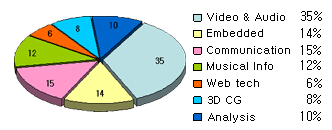
Distribution ratio of technical personnel by fields
pie.gif

Strategy
  – Continuous improvement of the qualitative growth of technical forces
  – Strengthening of the cooperative relations between enterprises and educational & research institutions
  – Maximum intellectual property

Management Goal
  – 3 unique products and services
  – 10 unique core technologies
  – Certification acquisition from ISO9001 Pyongyang Certificate authority and CMM3 acquisition

As in the past, SITC will meet customers’ expectations by superior technology and improved service while amplifying cooperation and exchange with home and foreign partners. 

Share

Stop Illegal Trade! Rations Will Begin April

Thursday, March 29th, 2007

Daily NK
Han Young Jin
3/29/2007

North Korean inside source informed that authorities had been asserting control over illegal selling and use of mobile phones at the markets near the border regions. National Security Agents have also been conducting in-depth investigations on illegal acts such as drug smuggling and slave trade.

In a telephone conversation with a reporter on the 28th, Park Jong Run (pseudonym) of Musan, North Hamkyung said, “Authorities came to the People’s Units and said furtively, ‘Rations will be distributed in April. In future, you will live a good life. So, stop engaging in illegal trade.’ Why would we listen to them when they tell us to stop selling especially since they aren’t going to give us distributions anyway?”

Park relayed, “They said, don’t sell our confidential information about our country through the mobile phone. People already in possession of mobile phones will be forgiven if they self-confess at the National Security Agency.” Since last year, North Korean authorities have been keeping a close watch on mobile phone use particularly in the border regions.

He said, “They threaten us with a declaration, so that we will report cases of illegality or corruption such as slave trade and drug trade.” For example, large amounts of drugs were found in the home of a Chairwoman for the Women’s Union of Hoiryeong City, late February.

According to Park, authorities will directly carry out the procedures at Jangmadang (markets) themselves, with assistance from Hoiryeong Security Agency and various police departments. Some goods found to be linked to illegal trade are in part taken away by the sudden wave of control. In particular, these authorities have a keen eye for goods made overseas such as Chinese items.

National Security Agents and the police confiscate the items arguing that, “now we have a gap between the rich and poor, as well as the richer getting richer and vice versa, because you, tradesmen have tasted some money. Now, socialism has been infected by capitalism.” However, even the security agents are acting tactful by removing only some of the goods as a mere example of punishment.

Goods confiscated are locked up at the security agency and kept in provision. The endless lines in the waiting rooms of the security agency make up the people ready to pay a fine and recollect their items, says Park. Nonetheless, security agents are reluctant to return the goods back to the traders and so bribes must be ready at hand also.

“I barely got my goods back after bribing them with 10 packets of cigarettes, but there was only half the goods left remaining in the bundle” Park criticized and said that the security agents sarcastically remarked, ‘Hey, let us eat and live a little.”

Following the nuclear experiment, authorities have been trying to gather regime support and elevate the nation’s pride arguing the nation had become a strong militaristic country. They proclaim, “The world is cooperating with us and is throwing their goods at us. In future, you will live well.” It will be difficult for North Korean authorities to prohibit trade, especially with the people’s strong will power to make money.

Share
