North Korea imported significantly less grain and fertilizers from China last year, mainly due to improvements in overall food conditions in the country, local sources said Tuesday.
Kwon Tae-jin, a research fellow at the Seoul-based Korea Rural Community Corp., said data compiled from January through November showed North Korea’s grain imports from its neighboring country reaching 257,931 tons.
This represents a 26.8 percent decrease from 352,282 tons tallied for the same 11 month period in 2011.
“There was a noticeable drop in various grain imports last year,” the researcher said, adding that imports of corn and rice fell 19.2 percent and 16.7 percent vis-a-vis the year before, with wheat and bean purchases declining 56.2 percent and 7.4 percent, respectively.
The latest data also showed Pyongyang importing 252,780 tons of chemical fertilizers from China up till November, down 28.8 percent from 355,023 tons reported from the year before.
Experts in the South said the decrease reflected improvements in overall food supply in the communist country brought on by the new leadership paying more attention to the economy.
Read the full story here:
N. Korea’s grain, fertilizer imports from China fall sharply Yonhap
2013-1-22
North Korea is tightening surveillance of the population using tens of thousands of Chinese-made surveillance cameras. According to Chinese customs data, the North imported a total of 16,420 CCTV cameras worth about US$1.66 million from China from January to November last year.
In 2009, the first year China published statistics on bilateral trade, the North imported a whopping 40,465 surveillance cameras from China. In 2010 the figure was 22,987 and in 2011 22,118. Altogether the North has imported over 100,000 cameras worth about $10 million.
…
Meanwhile, crude oil and oil products were the major products the North imported from China between January and November last year with a total value US$526 million. Next came naphtha products ($101.7 million), cargo trucks ($92.2 million), and flour ($58.8 million).
Read the full story here:
Chinese Cameras Help N.Korean Regime’s Surveillance Choson Ilbo
2013-1-14
North Korea’s trade with China expanded more than 60 percent to $5.63 billion in 2011 […]
Commerce with China accounted for 70.1 percent of the North’s total $8 billion trade in 2011, up from 57 percent in the previous year, South Korea’s national statistics office, Statistics Korea, said in its annual report today in Seoul. North Korea does not report economic data. Inter-Korean trade amounted to about $1.71 billion in the same year.
…
Excluding a dip in 2009, trade between the two countries has increased every year since the start of 2000, when the statistics bureau started releasing estimates. Data for 2012 will be released around the end of next year.
North Korea’s economy expanded 0.8 percent in 2011 and gross national income per capita was 1.33 million won ($1,239), nearly one nineteenth that of South Korea’s 25 million won, according to the Bank of Korea. South Korea’s total nominal gross national income was 38.2 times that of the North’s 32.44 trillion won.
The regime imported 3.8 million barrels of crude oil for 2011. Power generation capacity was 6.9 million kilowatts, less than one-10th that of South Korea. Steel production was 1.23 million tons and production of chemical fertilizer production was 471,000 tons.
North Korea’s population rose to 24.3 million in 2011 from 24.2 million the previous year — about half of South Korea’s. Population estimates were based on North Korea’s 1993 and 2008 censuses.
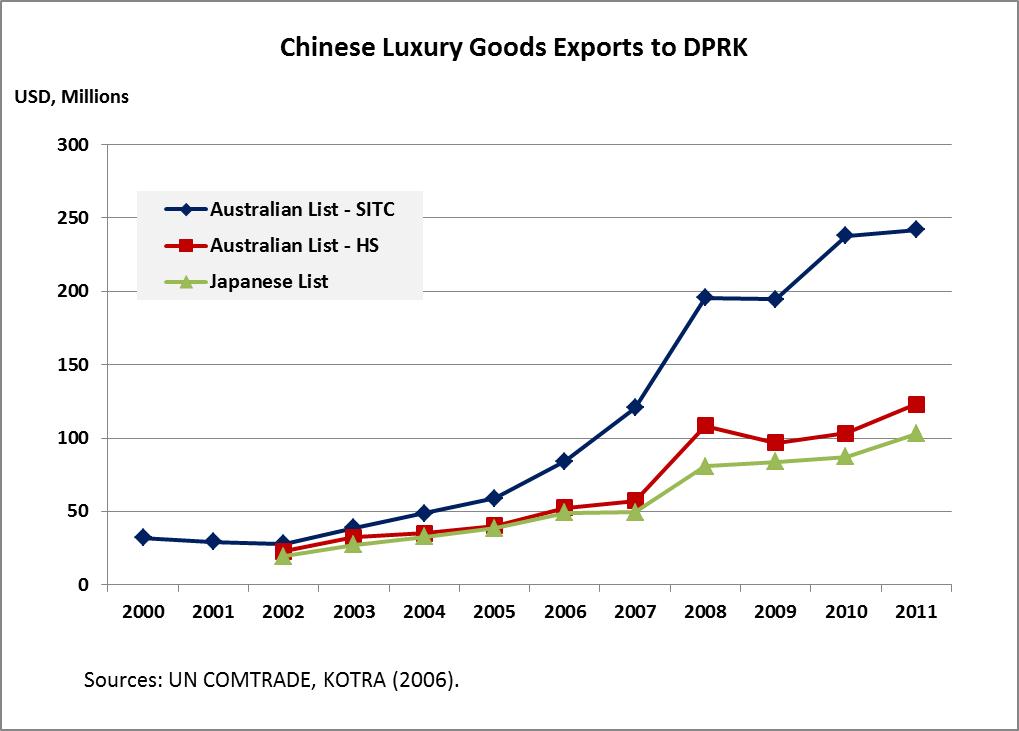
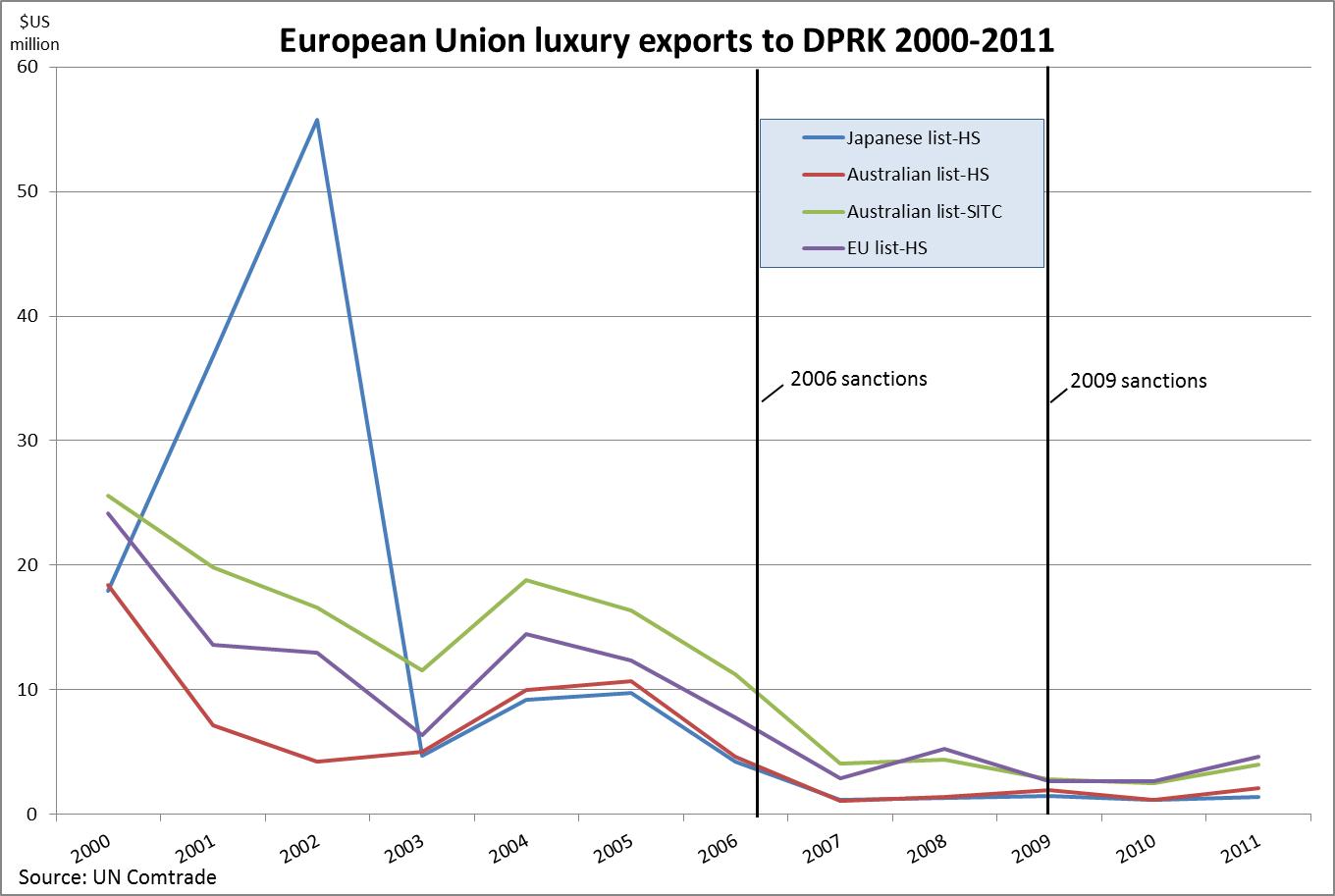
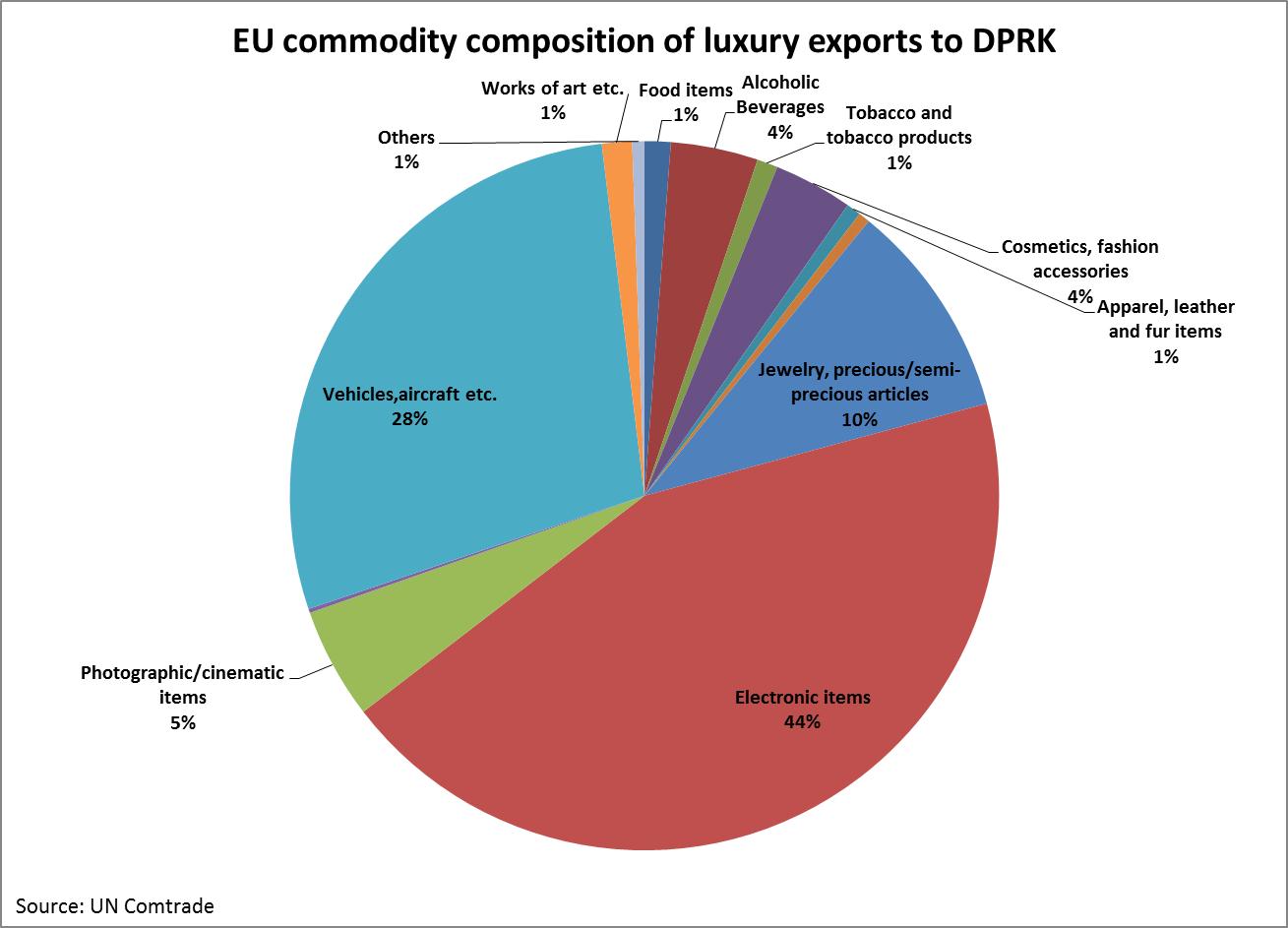
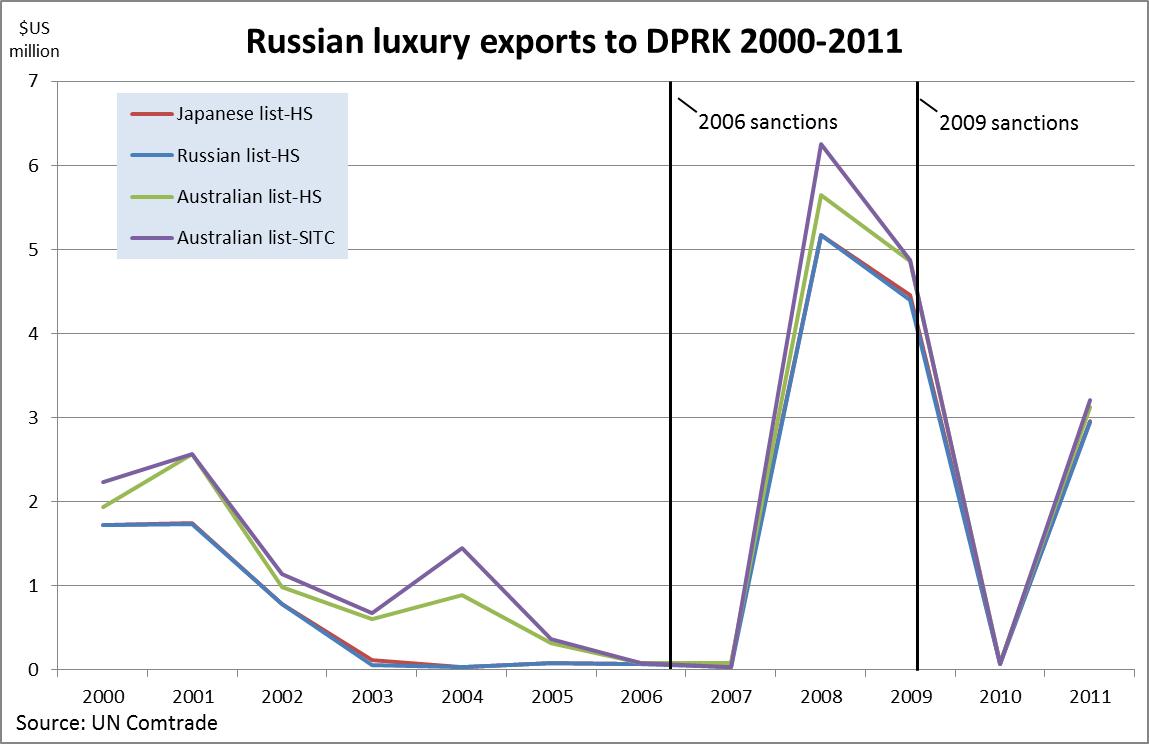
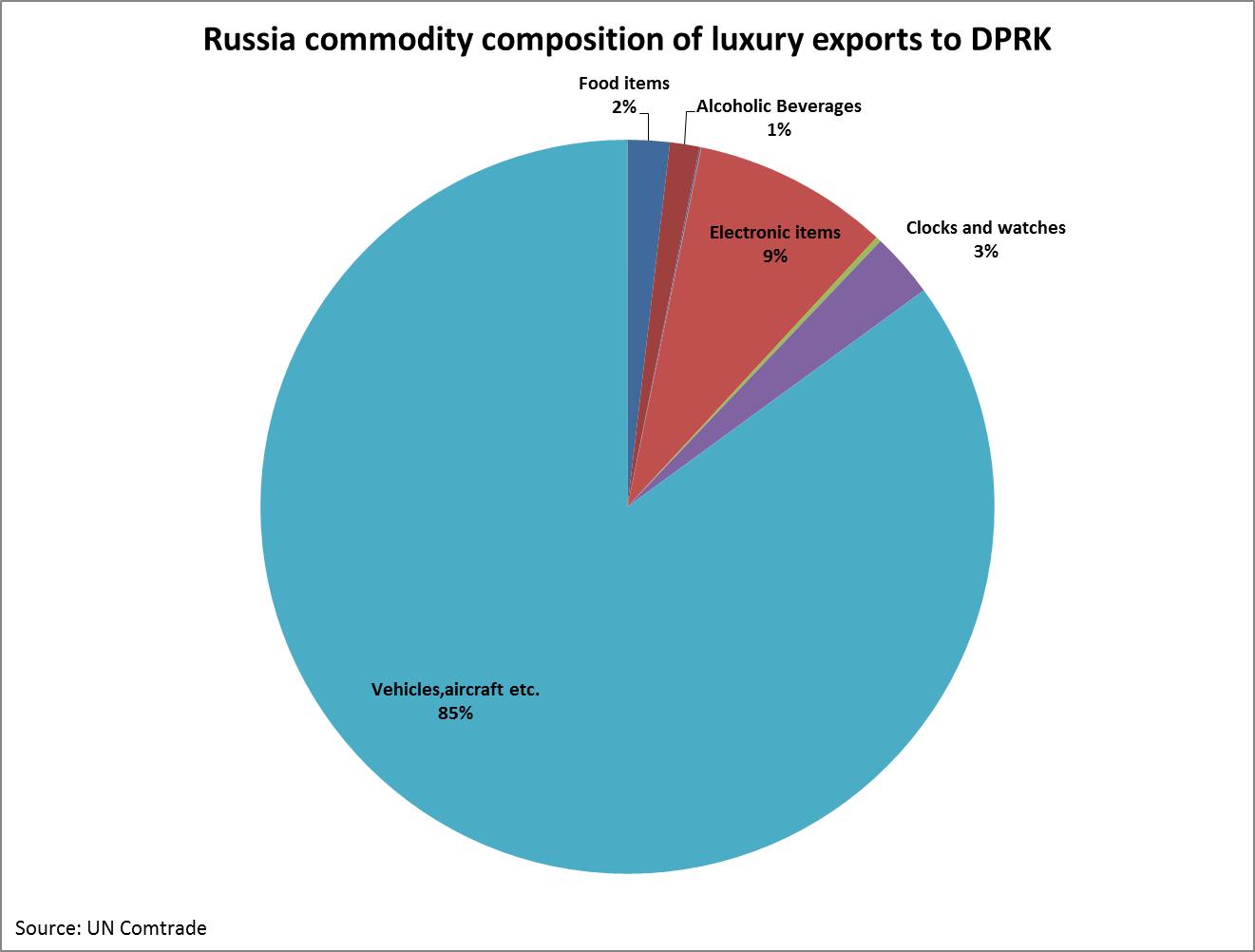
This fall Marcus Noland has posted three blog entries which feature DPRK trade statistics with China, the European Union, and Russia. I have put the graphs from these posts here as both an archive and as a quick reference for myself. See Dr. Noland’s original posts (linked above) for his analysis.
Chinese Luxury Goods Exports to the DPRK (Published 2012-9-17):
European luxury exports to North Korea (Published 2012-10-18):
Russian luxury good exports to North Korea (Published 2012-11-14):
North Korea imported US$170,000 worth of firearms from Switzerland in the first half of this year, Seoul’s trade agency said Friday.
The communist country brought in about $100,000 of guns such as shotguns, air and gas rifles, and revolvers while importing around $70,000 worth of firearm components, according to the report by the Korea Trade-Investment Promotion Agency, or KOTRA.
The state-run agency said the North had no record of firearm imports from Switzerland since 2009 until last year when it started to ship them in the first half.
Some experts said the new trend may be due to the fact that North Korean leader Kim Jong-un spent his adolescence in the country.
Read the full story here:
N. Korea imports US$170,000 of firearms from Switzerland Yonhap
2012-10-26
Despite the global economic slowdown, more than 6,000 business representatives from 20 countries signed agreements on more than 200 cooperative projects. Some 72 of the largest projects have a total combined value of $1.26 billion.
…
During the 11th Five-Year Plan period (2006-2010), total trade value between Dandong and DPRK amounted to $3 billion. Imports and exports between Dandong and the DPRK reached $1.86 billion in 2011.
So far, trade between Dandong and DPRK accounts for 40 percent of total China-DPRK trade, and the volume of the cross-border cargo trade via Dandong port makes up 80 percent of the total Sino-DPRK trade volume.
UPDATE 4 (2012-10-16):Xinhua reports on the closing of the expo:
The five-day 2012 China-DPRK Economic, Trade, Culture and Tourism Expo, held in the border city of Dandong, concluded on Tuesday with 72 agreements of cooperation intent signed. They have a combined value of 1.26 billion US dollars.
Pan Shuang, vice mayor of Dandong, said more than 6,000 Chinese and overseas people from over 20 countries and regions exhibited at and attended the expo. There were talks on 200 projects.
He said the projects related to industries ranging from aquaculture, clothes manufacturing, chemical production, wind power generation equipment, iron steel production to hotel construction.
AT THE EXPO
At the exhibition, the DPRK delegation exhibited ginseng products, food specialties, hand-made Hanbok, a traditional Korean costume, as well as mining and machinery equipment.
Ri Yong Chol, sales manager of Korea Roksan General Trading Corp., which is a ginseng supplier, said “I came to look for Chinese friends and potential business partners. Our company is also seeking opportunities to set up a subsidiary in China to get better access to the Chinese market.”
A Korean girl wearing brightly-colored Hanbok and traditional ornaments was selling costumes. “Our factory can make 20 such hand-made Hanboks a day. The clothes are for important occasions with exquisite workmanship and high-quality material,” she said.
Liu Songyu, chairman of a Korean garment firm from Yanbian Korean Autonomous Prefecture of Jilin Province, was interested in the business.
“Chinese labor costs have been rising fast. In Yanbian, a garment-factory worker’s salary has risen to 2,000 yuan (319 US dollars) a month. While, if the company had a factory in DPRK, it would save a considerable amount on labor costs. I would give a serious thought to that,” he said.
Yanbian is a heavily Korean ethnic populated region in China, where people also wear Hanbok during important occasions.
Elsewhere, Huang Zijun, an authorized dealer of Total Petrochemcial, was overwhelmed to obtain 20 orders from the DPRK delegation during the expo.
“I felt their enthusiasm in promoting business at the expo. I believe the DPRK is a big market for petrochemical products like lubricating oil,” he said.
An economic, trade, culture and tourism expo jointly initiated by China and the Democratic People’s Republic of Korea (DPRK) opened Friday in the border city of Dandong in northeast China’s Liaoning Province.
A delegation of 500 members from the DPRK is attending the 2012 China-DPRK Economic, Trade, Culture and Tourism Expo, which is scheduled to run from Friday to Tuesday, the event’s organizers said.
Over 400 Chinese companies from 12 industries are also attending the expo.
With the theme of “friendship, cooperation and development,” the expo consists of commodity exhibitions, trade fairs, DPRK art performances, craftwork exhibitions, a border trip to the Yalu River and an exhibition for the tourism resources of the two countries.
Supported by the China Council for the Promotion of International Trade, the event is being organized by the Liaoning Provincial Government.
China is DPRK’s biggest trade partner. Statistics show that bilateral trade volume went up 62.4 percent year on year to 5.64 billion U.S. dollars last year.
A source from Dandong described the unusually vibrant scene to Daily NK yesterday, saying, “The North Korean authorities have mobilized companies from Pyongyang and from here in China to sell goods and pitch for joint venture opportunities. There are loads of people; it’s standing room only.”
The source added that North Korean companies attending the event are pushing very hard to attract investment; notably, by distributing their own promotional literature expounding upon the given company’s superior virtues and providing exact contact details for follow-up inquiries. It is not hard to find meetings continuing in local North Korean eateries, as the North Korean side tries to woo potential sources of capital.
Chinese companies are keen to hear about the joint venture opportunities available, the source also said; and with most of the larger enterprises from China’s three northeastern provinces sending representatives to Dandong for the event, which runs until the 16th, most of the city’s hotels are apparently full to bursting.
However, due to past and present cases of lip service being paid to contractual obligations by North Korean companies whose only goal has been to attract funding rather than build business, Chinese representatives are still very cautious about actually signing on the dotted line.
One such representative from a Dandong-based company with a 10-year history of doing business with North Korea pointed out to Daily NK, “We have seen countless examples of companies making contracts and then there being little contact between the partners thereafter. Unbelievably, one manager I tried some minerals business with last year just changed the name of the company and came back again this year.”
UPDATE 1 (2012-6-7): The expo appears to have been pushed back to October 2012. According to KBS:
North Korea and China will jointly hold a fair on economy, trade, culture and tourism in the Chinese border city of Dandong for five days from October 12th.
A Dandong-based newspaper reports that this will be the first comprehensive fair covering several fields that the two countries hold. The paper said the fair will exhibit products, offer trade consultations, hold cultural and art performances and introduce both nations’ tourist attractions.
Roughly 400 Chinese companies exporting to North Korea will participate in the event. About 100 North Korean companies and cultural troupes will partake.
Dandong is China’s largest base for trade with North Korea, with 70 percent of its trade with North Korea running through the border city.
Read the full story here:
N.Korea, China to Hold Joint Industrial Fair in October KBS
2012-6-7
ORIGINAL POST (2011-12-3): Dandong to host Sino-DPRK economic and cultural expo. According to Xinhua:
The northeastern Chinese city of Dandong, which borders the Democratic People’s Republic of Korea (DPRK), will host a Sino-DPRK economic, trade and cultural exposition in June next year, a local Chinese official said Saturday.
A series of activities, including a commodity fair, investment and trade talks, tourism exhibition and arts exhibition, will be staged during the exposition, said a spokesman with the Publicity Department of the Dandong Municipal Committee of the Communist Party of China.
The Phibada Opera Troupe of the DPRK, an artists group well known to Chinese people, will give performances during the event, he said.
Adam Cathcart took the time to send me this interesting link to the official Dandong web page. It contains some videos (in Chinese) in which local officials promote the changes they expect to come to this city as it transitions into a regional trade hub.
Below I have added some links to recent blog posts that a re related to Dandong:
North Korea’s trade with China nearly tripled over the past five years, South Korean government data showed Sunday, underscoring the isolated North’s growing economic reliance on its major ally.
Trade between North Korea and China stood at US$5.63 billion last year, up 284 percent from $1.98 billion in 2007, Seoul’s unification ministry said in a report to the National Assembly.
North Korea’s exports to China almost quadrupled to $2.46 billion in 2011, compared with $580 million in 2007, the data showed. Imports rose to $3.17 billion last year, from $1.39 billion in 2007.
The North’s main export items were coal and iron ore, while primary imports from China were crude oil, gasoline and cargo trucks, it said.
A separate story on the report which also appeared in the Korea Herald featured these additional stats:
China accounted for only 67 percent of the North’s total trading with foreign countries, also including Russia, Thailand and Japan in 2007. But the dependency rate grew to 72.9 percent in 2008 and 82.9 percent in 2010 before hitting 89.1 percent last year, the report showed.
…
Annual food imports from China stood at 155,000 tons in 2008 and they have steadily grown to reach 380,000 tons for the whole of 2011, it said.
The same story had data on wages in the Kaesong Industrial Zone:
Another ministry audit report also showed that since 2004, South Korea has so far paid a total of $245.7 million in salary to North Korean laborers working in the Kaesong Industrial Complex, a joint inter-Korean industrial project in the North Korean village of Kaesong.
…
The report showed that a North Korean worker in the industrial zone earns an average $128.3 every month as of the first half of this year.
The average monthly pay stood at $68.1 in 2006 before steadily growing to $109.3 for last year.
Read the full story here:
N. Korea’s trade with China nearly tripled over past 5 years
Yonhap (via Korea Herald)
2012-10-7
N. Korea’s trade with China surges due to U.N. sanctions Korea Herald
2012-10-8
Saenuri Party lawmaker Yoon Sang-hyun, a member of the National Assembly`s foreign affairs, trade and unification committee, released Wednesday an analysis of closed trade data between North Korea and China, saying the North`s imports of luxury goods via Chinese customs reached 446.17 million U.S. dollars in 2010 and 584.82 million dollars last year. The figure was 272.14 million dollars in 2008 and 322.53 million dollars in 2009.
…
Imports were especially pronounced for high-end cars, TVs, computers, liquor and watches. Inbound shipments of luxury cars and associated components almost doubled to 231.93 million dollars last year from 115.05 million dollars in 2009. Ship exports increased more than 20 times from 17.48 million dollars from 840,000 dollars over the same period.
Artworks and antique imports reached 580,000 dollars last year, more than 10 times the figure of 50,000 dollars in 2009. Perfume, cosmetics and fur saw their inbound shipments double. Among items that saw sharp drops in imports were leather products and musical instruments.
In 2006, the United Nations banned member countries from exporting luxury goods to North Korea under U.N. Security Council Resolution 1718, entrusting them to decide on the items. South Korea also designated 13 luxury goods for the export ban in 2009. China has yet to designate its items, and North Korea is growing more dependent on imports from China.
These are all interesting data points. Do you think they offer reasonable journalistic evidence that the DPRK is practicing inflationary public finance?
First, Yonhap reports on DPRK food imports from China (2012-9-29):
North Korea’s grain imports from China slipped 16.3 percent on year in the first eight months of this year, in an apparent sign that the North may diversify its supply channels of grain, a Seoul researcher said Saturday.
North Korea imported 181,264 tons of rice, flour, corn and other grains from China in the eight-month period, compared with 216,535 tons for the same period last year, said Kwon Tae-jin of the state-run Korea Rural Economic Institute.
The decline in grain imports from China may be attributed to a rise in food aid from China and purchases from non-China markets such as Europe and South America, Kwon said.
“Including imports from non-China markets, North Korea’s total grain imports appeared to rise this year,” Kwon said in a report posted on his Web site, adding Pyongyang may “diversify its import channels.”
At the same time the Daily NK reports that food prices continue to rise (2012-10-2):
Internal sources informed Daily NK over the holiday that on September 29th the price of rice was 6,700 won/kg in Pyongyang, 7,000 won/kg in Onsung, North Hamkyung Province and 6,500 won/kg further west in Hyesan, Yangkang Province.
Not only do these prices far exceed those of Chuseok 2011, they even far exceed those of earlier this year.
The Hyesan source explained that on the day before the Chuseok holiday (Saturday) the atmosphere in the market was thus rather uncomfortable. “It was very slack,” she said. “People couldn’t buy anything easily, so most just seemed to be looking.”
Secondly, Yonhap reports that despite situations like those experienced by Xiyang or in Musan, mineral exports to China are up (2012-10-2):
North Korea’s exports of mineral resources recorded a 33-fold jump over the past decade with China remaining the biggest importer of the North’s iron ore and coal, a report showed Tuesday.
North Korea’s mineral exports stood at a meager US$50 million in 2001, accounting for 7.8 percent of its total exports, according to the report by Seoul’s Korea Trade and Investment Promotion Agency.
The mineral exports soared to $243 million in 2005 and $1.65 billion in 2011, accounting for 59.4 percent of the North’s total exports last year, the report said.
South Korea has estimated the total values of mineral deposits in North Korea at some $6.3 trillion.
Last year, North Korea exported $1.17 billion worth of anthracite coal and $405 million worth of iron ore, with China importing almost 100 percent of anthracite coal and iron ore, it said.
Bilateral trade between North Korea and its ally Russia surged nearly 50 percent from a year earlier in the first half, a report said Saturday.
According to the report from Seoul’s state-run Korea Trade-Investment Promotion Agency (KOTRA), the amount of bilateral trade between the two countries in the January-June period came to US$38.8 million, up 49 percent from the same period last year.
The report, however, noted such a large on-year increase was due to a large drop posted in the first half of 2011.
“The volume of bilateral trade between North Korea and Russia is still insignificant by any standard,” it said.
The increase was also caused by a 68.3 percent rise in shipments of Russian goods to North Korea with fuel and steel products accounting for 29.9 percent and 28.7 percent of total shipments, respectively.
North Korea’s exports to Russia dropped 10.9 percent on-year to $5.4 million, according to the KOTRA report.