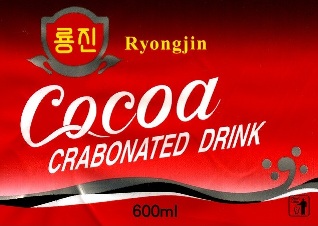
Pictured above, the DPRK’s local cola logo. Image source here.
UPDATE 1: Stephan Haggard believes this is a non-story.
ORIGINAL POST (2011-10-5): According to Forbes:
Global capital is an inherently lonely trade, but as Gabriel Schulze ambles into the conference room of Yanggakdo International Hotel, a towering edifice separated by a ring of water from the rest of Pyongyang, the most impenetrable capital in the world, it’s hard to imagine a more isolated business meeting.
“We warmly welcome you, the Coca-Cola delegation, with Mr. Schulze as your leader,” says Park Chol Su, the president of North Korea’s Taepung International Investment Group, singling out the 6-foot-7 American from his entourage of four people. “I hope this will be a good opportunity to make progress in the relations between the U.S. and Korea.”
Why is a U.S. businessman in Pyongyang pitching America’s most iconic consumer brand to the world’s most inhospitable marketplace? Because, surprisingly, the Democratic People’s Republic of Korea is ready to buy, and eager enough to flex its atrophied capitalistic muscles that it let a FORBES reporter follow along–and record everything–as the Coca-Cola discussions heated up.
Park says his Taepung Group, established by Kim Jong Il himself, wants to bring market principles to a planned economy, even down to setting what price a bottle of Coke made in Pyongyang would go for–sort of. “Costs are based on the demands of the market, but we will respect your price,” Park tells Schulze’s delegation. “If the price is too high, it will be restricted.”
North Korea, the most hidebound and repressive of socialist states, is slowly inviting not only China but also the wider Western World to invest in its near-moribund economy. Officials claim the country is open for business with outsiders, and that the political stripes of the investors do not matter as much as the money in their pockets and the willingness to deal. Chinese companies have signed a number of multimillion-dollar deals to extract resources and build and repair infrastructure, such as making port improvements in the northeastern region of Rason and paving a road from there to the Chinese border. Taepung also claims to have inked billiondollar contracts, including one to develop a huge coal mine, but those deals haven’t been nailed.
American signature brands may actually be most welcome, despite or perhaps because of decades of propaganda casting the U.S. as the devil incarnate. Pyongyang’s economic representatives made clear in this and other meetings, with focus and determination, that they want Yum Brands to open up KFC franchises.
Extreme wishful thinking though this may be, it’s linked to a planned ten-year revamp of the North Korean economy to expand national GDP from a meager $30 billion last year to $1 trillion by 2020. (The country can’t even feed its people; there is severe malnutrition in the countryside.) That all but impossible goal cannot be approached without an unshackling of enterprise, which may never occur, and massive help from the outside world, which may never come. The expression “reform and opening,” so familiar in China, is not yet politically acceptable language in Pyongyang. But North Korea’s courtship of the West has begun.
“Coke is strategic. I hope that Coke will serve as a bridge for relations between the two governments,” says Park, a slight man with a toothy smile and a taste for liquor, over a traditional Korean hot pot lunch and beer. Then, perhaps, sanctions could be lifted and more substantial investments could follow. “The door will be open to the whole world, not only China–even the U.S., even Western countries.”
But so far the West hasn’t come calling. North Korea remains in the dysfunctional totalitarian grip of Kim Jong Il. The regime is a defiant nuclear provocateur linked to proliferating weapons, drugs and counterfeit cash abroad, while operating a terrifyingly effective police state at home. Western companies will require more than the usual amount of persuasion. They will want something the North Koreans can’t possibly provide: a blessing from the White House.
That’s where Gabriel Schulze, scion of the Newmont Mining fortune, with a prospector’s taste for risk and opportunity, comes in. He has been surveying this forbidden market on the strength of informal connections to Coke and one of its bottlers, SABMiller, without either company’s toplevel approval–a Cold War-style mission that affords the higher-ups plausible deniability.
SABMiller sent a regional executive, at Schulze’s invitation, to the May meeting with Taepung Group, adding in a statement for this story, “We have no plans to invest in North Korea.” Coke turned down a request from Taepung Group (via Schulze) to visit this summer, and distanced itself from the remotest hint of soft-drink summitry with this statement: “No representative of the Coca-Cola Co. has been in discussions or explored opening up business in North Korea.”
Coke’s skittishness is striking from a company with a history of selling into almost any market–including such villainous or pariah states as Hitler’s Germany in the 1930s, Franco’s Spain and Pyongyang’s historical sponsors, China and the Soviet Union, in the 1980s (though Pepsi got to the Soviet Union first). North Korea is one of the last frontiers. “That is your task, to become a pioneer,” says Jang Gwang Ho, the senior North Korean official in the coterie greeting Schulze’s group.
Tall, blue-eyed and devout, Schulze is full-blooded pioneer. The great-great-grandson of Newmont founder William Boyce Thompson, he runs a family investment office out of Beijing, Schulze Global Investments, which specializes in China and difficult emerging markets.
While he has close ties to Republicans in U.S. politics, Schulze’s forays abroad, such as a cement plant in Ethiopia, are far from conservative. Schulze Global seeks “double bottom-line returns,” he says, profiting while helping poor emerging markets develop. Bringing Coke to North Korea would be historic, but he knows engagement with Pyongyang might be seen as a folly back home, both financially and politically.
“We understand that there’s a high likelihood that there could be all sorts of trouble and that we could end up losing money,” Schulze tells me after his trip. “There’s a lot of [U.S.North Korea] mistrust, there’s a lot of gamesmanship, and for us it’s not about pretending that that’s not there. We’re not in a little bubble of happiness.”
Would it even be legal for Coca-Cola to do business in North Korea, given international and U.S. sanctions? Those sanctions have proven to be narrow and permissive in practice, and there is no stricture against soft drinks (a sip of CocaCola is already imported, mostly from China, and sold to the few with disposable hard currency).
Hundreds of foreign businesses, most of them Chinese, have come into North Korea despite cautionary tales of investments gone bad, of officials changing the terms or the rules, soliciting bribes, demanding substantially higher payments or expropriating joint ventures.
And these businesses have made money. In a 2007 survey of 250 Chinese operations in North Korea, scholars Stephan Haggard and Marcus Noland found 88% saying they could turn a profit. (A majority also reported paying bribes.) Enterprises routinely encounter difficulties, yet many persist, hopeful for economic liberalization.
At least one American investor has profited in North Korea as well: Schulze Global. Three times in 2008 it made loans of hundreds of thousands of dollars to mining companies to buy equipment and expand, and each was repaid. This summer Schulze lent an additional $1 million to finance a North Korean conglomerate’s purchases of corn to feed its workers. (He consulted with sanctions lawyers in America before making the loans and has filed notices with the U.S. Treasury Department.)
“That opened the doors” to the Coke project, Schulze says. Making the world’s favorite carbonated beverage in Pyongyang would be quite another matter, though. The country still operates on a planned economy and has difficulty even manufacturing plastic bottles and cans. The government barters for sugar from Castro’s Cuba and would probably have to import steel to build a Coke factory. And although the estimated per capita income is $1,200 a year, the Coke factory’s workers would be paid barely more than a dollar a day (low wages are a key selling point to foreign investors). Further, the nation is plagued with persistent food shortages that force the regime to rely on international aid. Does a country this poor have consumers for the iconic American drink?
The answer is yes, at least in the capital. Home to the privileged upper crust, or an eighth of the nation’s 24 million people, Pyongyang has a visibly robust elite economy. The city’s wide Stalinist thoroughfares, bereft of private automobiles five years ago, are now filled with tens of thousands of foreign cars, including American and Japanese brands.
Mobile phone use is common, with more than 300,000 accounts in the capital using the 3G network built by Egyptian telecom Orascom. That includes some of the city’s traffic women, famous for white gloves and powder-blue uniforms. With traffic lights now doing most of their work for them, one was spotted on the sidewalk jabbering into her cellphone.
The city’s new Pothonggang Department Store was fully stocked with imported fare to be had at prices in North Korean won that are affordable only at the black-market exchange rate (2,500 won to the dollar at the time, compared with the official rate of 100 won). Name brands like Heinz Ketchup (the equivalent of $4 a bottle), Mars bars (a little more than $4 per bag) and all manner of high-end liquors and cigarettes are on offer, usually imported from Europe or Asia. On another floor you can find imported sweaters, dresses and shoes.
The checkout lines run briskly in midafternoon, the shopping done mostly by women, many of them likely the wives of government officials and army officers. (Kim Jong Il showcased the store with a visit in December.) Out on the streets the proles shop for snacks and locally made sodas–typically fruity concoctions in glass bottles–at hundreds of kiosks throughout the city, mostly priced at the black market rate of 20 cents to 40 cents.
Those prices would be 25 times higher at government exchange rates and thus out of reach for almost all North Koreans on their official salaries–but hard currency is flowing into the capital, “through this and that channel,” Jang says, and is spent. “Although officially they are not receiving the salaries from the government in hard currency, they have! So they like to spend the hard currency for their children because the children like to drink the Coke,” he explains.
Jang, of course, is not a commoner or for that matter a typical North Korean apparatchik. He speaks fluent if idiosyncratic English, was educated partly in the U.K. and is married to a doctor. First vice president of Taepung Group, he has a dual appointment on a government body overseeing economic development. Over two days of meetings Jang exudes an almost relaxed air of detachment. He typically parries questions with humor and stories while puffing on Dunhill cigarettes and flashing a Longines watch. (The president of Taepung, Park Chol Su, is a Chinese national, chosen in part for his Chinese contacts and experience.)
Do North Koreans like to drink beer? asks Anton van Heerden, a South African who runs SABMiller’s Asian supply chain. Yes, especially a growing cadre of retirees. “I can see so many old men, over 60, normally in the evening if we look around the city, they are making a queue to buy the beer,” Jang says, adding with a laugh: “There are crazy people! A lot of people drink the beer–30 bottles in the evening! I don’t know how.”
Friendly though they are with Schulze, Jang and Park both make clear that they answer to a higher power, the leader they refer to only as “the top man,” “the General” or the “Dear Leader”: Kim Jong Il. Park was born to Korean parents in northeastern China in 1959, as Kim Il Sung’s regime recovered from the Korean War. Park built relationships with North Korean officials by selling them much-needed gasoline in the 1990s. He is a salesman again, puffing up his chest as he blusters about the will of the General to change North Korea’s economy, led by his Taepung Group.
Parse the bombast and you get a rare glimpse inside the complexities of power relationships. Park says he has never met the top man and instead takes his instructions from a close Kim confidant, 73-year-old Kim Yang Gon, who is chief of the United Front Department, an intelligence arm of the Korean Workers’ Party, and chairman of the Taepung Group. Still greater power at Taepung likely lies with another member of the board of directors, Kim Jong Il’s brother-in-law Jang Song Taek, who as vice chairman of the National Defense Commission is considered North Korea’s second-most-powerful man. The National Defense Commission, chaired by Kim Jong Il, is also Taepung’s controlling shareholder.
To some Western analysts the tight control of Taepung signals that Kim’s coterie is not an agent of change and reform but precisely the opposite–a means to tighten its grip over the North Korean economy. The reasoning: Kim wants Taepung to bring in multibillion-dollar deals for resources, power plants, ports and roads, they say, so that he and his cronies can control the spoils.
Schulze hears the skeptics. But he notes that a Coca-Cola investment would be far more symbolic than lucrative. The total ante probably wouldn’t exceed $10 million (with Schulze Global’s share at $2 million)–tiny by comparison with some resource deals. He also argues that the only realistic way to engage with North Korea is precisely through those in power. “People say this is the leadership looking to benefit itself, and I would say yes, that is absolutely true.” But, he adds, “it doesn’t negate the fact that selfish ambition can still drive positive change and development, particularly in the economy, which can make a real difference in the lives of North Koreans.”
His groundwork laid in North Korea, Schulze will continue his quixotic quest to lobby not only Coke but also Capitol Hill and the Obama Administration. He is, in a way, following in the footsteps of his great-great-grandfather Thompson, the mining magnate. Thompson shocked his friends in the business establishment when, after returning from Russia after a trip in the fall of 1917, he urged that the U.S. and Britain engage with the new communist regime there to moderate the impulses of Lenin and Trotsky. No one, obviously, followed that advice.
Read the full story here:
Invading North Korea
Forbes
Gady Epstein
2011-10-5

