Archive for the ‘Bureau 39’ Category

Know the Party before Getting to Know Kim Jong Il

Wednesday, October 8th, 2008

Daily NK
Namgung Min
10/8/2008

As rumors regarding Kim Jong Il’s illness surfaced during North Korea’s 60th anniversary celebrations, opinion was divided on whether the military or the Party will rise in power post-Kim Jong Il.

It is true that the power of the military rose post-Kim Il Sung, according to the “military-first” political line. The National Defense Commission (NDC) began leading various agencies and councils, and came to hold greater power because Kim Jong Il was introduced as the National Defense Commission Chairman during North-South Summits.

Thus, the National Defense Commission under military-first politics began to appear to be North Korea’s sole power base, as news on general-level promotions was released publicly by the National Defense Commission.

However, despite military-first politics, it remains the Chosun (North Korea) Workers’ Party that fundamentally controls the North Korean regime. Therefore, in order to understand the North Korean regime, one must understand the Chosun Workers’ Party.

Upcoming October 10th is the founding anniversary of this most important of organizations. The eyes of the world are focused on whether Kim Jong Il will appear on this day or not.

Therefore, it is time to closely examine what the Chosun Workers’ Party does and how it controls the North Korean regime.

The Korean Workers’ Party claims to be the direct heir to the North Korean Branch of the Chosun Communist Party that was established during “The Chosun Communist Party Convention of Leaders and Devotees of the 5 Northwest Provincial Party Committees” held on October 10th, 1945. Hence the founding date is October 10th. In April, 1946 the name was changed to the North Chosun Communist Party, which then became the Chosun (North Korean) Workers’ Party after being merged with Chosun New People’s Party in August of the same year.

North Korea is operated under the leadership of the Chosun Workers’ Party, as previously seen in other socialist countries; the nation’s power is concentrated in the Party. This implies that as the Party controls the country, the country is evolving into a socialist society and from there into a communist society.

The Workers’ Party, venerable as it is, not only holds the highest position of authority in North Korea but thus stands above other national agencies, organizations or the military.

I. The positions and roles of the Chosun Workers’ Party

The positions and roles of the Workers’ Party are described in detail in the “Rules and Regulations of the KWP,” “Ten Principals for the Party’s Unique Ideological System” and the “Socialist Constitution of North Korea.”

It is written in Article 11 of the Socialist Constitution, amended in 1998, that “The DPRK shall conduct all activities under the leadership of the Workers’ Party.” Furthermore, the Workers’ Party is stated to be an organ that controls other agencies and organizations as the highest revolutionary organization leading all other working organs.

However, the socialist constitution and the rules of the Party are only for the purpose of propagating the notion of the rationality and legitimacy of North Korea abroad while concealing a dictatorship. The reality within North Korea is completely different from the actual contents of the constitution.

In actuality, the socialist constitution and the rules and regulations of the Party defines that all sectors such as government, military, administration, judiciary, and even public prosecutor’s office are led by the Party, while being utilized as the apparatus for Kim Jong Il’s Stalinist dictatorship. That is, the regulations recognize the Party’s leadership of the country and simultaneously state that the Party can only be operated and led by Kim Il Sung and Kim Jong Il.

The Workers’ Party in legal terms is an organ that guides North Koreans, but in reality it is only an organ under the iron command of the supreme Leader. Therefore, the Leader stands in the highest position, above the Party, nation and sovereign organs.

II. The structure and functions of the Chosun Workers’ Party

The utmost decision-making organ of the Workers’ Party is the National Party Congress.

According to the rules and regulations of the Party, all decision making of the Party regarding policies, strategies, and tactics should be passed through the National Party Congress. However, in actuality the Party Congress only rubber stamps the decisions that were already made by the Central Committee of the Party.

It is theoretically a ground rule that the Party Congress meets once every 5 years. The first congressional meeting was held in August 1946, the Congress met for the 6th time in October 1980, but has failed to meet since; 28 years. The fact that the Congress is not meeting regularly signifies that the regime system is not operating according to accepted principles of socialist states in the past.

If the Congress fails to meet, the Central Committee of the Party functions as the highest decision-making organ. The Central Committee should meet and discuss issues once every 6 months.

During these meetings, the General Secretary, committee members and the Presidium of the Politburo and committee members of the Central Committee of the Party should be elected. The Central Committee also has the authority to organize the Secretariat and the Central Military Commission.

However, even these twice annual meetings have not been held since the 21st meeting of the 6th cohort in 1993. When the meetings are not held, then the Politburo needs to take authority. However, the Secretariat of the Central Committee, whose General Secretary is currently Kim Jong Il, currently does so.

The highest organ in a communist society is officially the Presidium of the Politburo. In North Korea, Kim Jong Il is the only left in the presidium after the deaths of Kim Il Sung and Oh Jin Woo. This is why North Korea is sometimes called a totalitarian state. In the Chinese government, the Politburo presidium is properly functioning and decisions are made here. From a “democratic” perspective, the Chinese Communist Party and the Chosun Workers’ Party are completely different.

In any case, within the Secretariat of the Central Committee there are specialty departments such as the Guidance Department, Propaganda and Agitation Departments, and the United Front Department, and it also includes departments that supply secret funding to Kim Jong Il such as the 38th and 39th Departments.

The provincial organs of the Party consist of party committees of provinces, cities and counties that even include the most basic low-level party committees such as elementary party committees and sector party committees.

The structure of the Workers’ Party can also be divided into permanent party organs and temporary collective leadership groups. The permanent party organs include all members who work in any specialty departments, from the Central Committee down to low-level provincial party organs. Temporary collective leadership groups signify councils of high-level or low-level leaders of the central and provincial organs, made to implant permanent authority within the society through various meetings.

There are approximately 4,000,000 members of the Workers’ Party, including Kim Jong Il, high-level officials to low-level members, and figures from the legislature, judiciary, and the administration.

III. Main Departments and Their Roles

The main government complex of the Central Committee of the Worker’s Party is located in Changkwang-dong, Joong-district of Pyongyang. There are many buildings in the complex which include Kim Jong Il’s personal office and most of the Central Committee departments.

The second government complex is located in Junseung-dong, Moranbong-district of Pyongyang. The Social Culture Department, United Front Department and Operations Department are included in this complex.

The Workers’ Party has placed all specialty departments under the authority of the Secretariat, to function as restriction and guidance on all areas of the party members, citizens and North Korea. There is a Guidance Department that observes party members then there are other departments that exercise political functions.

The Guidance Department actualizes party guidance and restraint within communities. The department functions as Kim Jong Il’s right hand and as the core department by restraining the lives of all officials, members and citizens within the party.

The Guidance Department sub-divides into the inspection department, official department, party-member registration department, administration department and a communication department that allows direct reports regarding any incident or accident. The Guidance Department also manages the judiciary and the public prosecutor’s office.

The inspection department is responsible for inspecting any anti-party, non-party, undisciplined or unreasonable activities that develop within the regime or leadership of the Party and report to Kim Jong Il. The Guidance Department inspection section is strictly separated from other departments and North Korean party members or officials are all fearful of it.

There are approximately 20 specialty departments such as the Propaganda and Agility Department, the 38th and 39th Departments to supply fund to Kim Jong Il, the United Front Department dealing with South Korea, the International Department, the Science Education Department, and the Operations Department that carry out political activities.

Currently the Korean Workers’ Party is in the middle of the process of replacing 1st or 2nd generation leaders with 3rd or 4th generation, often more practical, personnel.

North Korea launching massive anti-corruption drive

Monday, February 11th, 2008

Last Friday, Yonhap reported that Kim Jong Il has ordered an anti-corruption investigation of two key agencies, both of which manage South Korean investments in the DPRK: the United Front Department (which Lankov claims is involved in clandestine operations) and the National Economic Cooperation Council.

North Korea is in the midst of a massive anti-corruption drive which has already resulted in the arrest of one of its top officials handling business with South Korea, informed sources in Seoul said Saturday.

The campaign, ordered by leader Kim Jong-il, was prompted by widespread allegations that some top party and administration officials took bribes as they pushed business projects with South Korean industrialists, said the sources well versed in North Korean affairs.

“The probe was launched as National Defense Commission Chairman Kim Jong-il said there was a lack of supervision over the United Front Department [a key party organization that supervises inter-Korean affairs], although lots of suspicions were raised over the department’s corruption,” one source told Yonhap News Agency.

According to the sources in Seoul, the North Korean leader was enraged after getting a report that some party and government officials allegedly pocketed bribes and diverted food and other aid from South Korea to black markets.

Also under investigation is the National Economic Cooperation Council, a government body that handles business with South Korean entrepreneurs, the sources said.

The Council’s chief, Jeong Woon-eop, remains under arrest pending investigation into allegations that he took “huge amounts” of bribes, said the sources, who wanted to remain anonymous. (Yonhap excerpted)

Frequently “anti-corruption campaigns” in developing countries have nothing to do with making the bureaucracy more accountable or responsive to public demands, but rather are political maneuvers to prevent “rents” or funds from being channeled to uses that lie outside the leadership’s control (or some faction of the leadership).  In other words, they are regime enhancing.  The announcement of this campaign demonstrates two important principles that deserve explicit mention:

1. Not all profits earned by North Korean joint ventures are channeled to the leadership, and in fact many of them are siphoned off by middlemen who actually control the financial machinery.  Once skimmed off the top, it is likely that these funds are used in illicit private commercial operations since they cannot be legally declared by the owner (unless there are domestic channels for laundering money in North Korea).

2.  If funds are being siphoned off of high-profile official joint venture operations, then the leadership is not in control of its internal fiscal affairs.  Indeed it is likely that, as in the Soviet Union, the people who keep the private economy running are the trusted mid- to senior-level officials who can skirt the rules and know how to actually get things done within the system.

Update 2/24/2008:

North Korean authorities have been investigating the chief of a North Korean committee in charge of inter-Korean economic cooperation for months after seizing $20 million from his house, a report said Friday.

The full article can be found here:
NK Official Suspected of Embezzling Funds From Seoul
Korea Times
Jung Sung-ki

Update 2/12/2008:

The chief of Daesung General Bureau, a division of the 39th Department which manages foreign transactions, was fired on suspicion of embezzling US$1.4 million last fall.” (Daily NK)

The full article can be found here:
North Korea launching massive anti-corruption drive
Yonhap
2/9/2008

DPRK super notes are of super quality

Saturday, July 22nd, 2006

From the New York Times (via NK Zone):

The counterfeits were nearly flawless. They featured the same high-tech color-shifting ink as genuine American bills and were printed on paper with the same precise composition of fibers. The engraved images were, if anything, finer than those produced by the United States Bureau of Engraving and Printing. Only when subjected to sophisticated forensic analysis could the bills be confirmed as imitations.

Counterfeits of this superior sort — known as supernotes — had been detected by law-enforcement officials before, elsewhere in the world, but the Newark shipment marked their first known appearance in the United States, at least in such large quantities. Federal agents soon seized more shipments. Three million dollars’ worth arrived on another ship in Newark two months later; and supernotes began showing up on the West Coast too, starting with a shipment of $700,000 that arrived by boat in Long Beach, Calif., in May 2005, sealed in plastic packages and wrapped mummy-style in bolts of cloth.

In the weeks and months that followed, federal investigators rounded up a handful of counterfeiting suspects in a series of operations code-named Royal Charm and Smoking Dragon. This past August, in the wake of the arrests, Justice Department officials unsealed indictments in New Jersey and California that revealed that the counterfeits were purchased and then seized as part of an operation that ensnared several individuals accused of being smugglers and arms traffickers, some of whom were suspected of having connections to international crime rings based in Southeast Asia.

The arrests also prompted a more momentous accusation. After the indictments were released, U.S. government and law-enforcement officials began to say in public something that they had long said in private: the counterfeits were being manufactured not by small-time crooks or even sophisticated criminal cartels but by the government of North Korea. “The North Koreans have denied that they are engaged in the distribution and manufacture of counterfeits, but the evidence is overwhelming that they are,” Daniel Glaser, deputy assistant secretary for terrorist financing and financial crimes in the Treasury Department, told me recently. “There’s no question of North Korea’s involvement.”

Last September, the Treasury Department took action to signal its displeasure. The department announced that it was designating Banco Delta Asia, a bank in Macao with close ties to North Korea, a “primary money-laundering concern,” a declaration that ultimately led to the shutting down of the bank and the freezing of several key overseas accounts belonging to members of North Korea’s ruling elite. In a public statement, Treasury officials accused Banco Delta Asia of facilitating North Korea’s illicit activities by, among other things, accepting “large deposits of cash” from North Korea, “including counterfeit U.S. currency, and agreeing to place that currency into circulation.”

The counterfeiting of American currency by North Korea might seem, to some, to be a minor provocation by that country’s standards. North Korea, after all, has exported missile technology in blatant disregard of international norms; engaged in a decades-long campaign of kidnapping citizens of other countries; abandoned pledges not to pursue nuclear weapons; and most recently, on July 4, launched ballistic missiles in defiance of warnings from several countries, including the United States.

But several current and former Bush administration officials whom I spoke with several months ago maintain that the counterfeiting is in important ways a comparable outrage. Michael Green, a former point man for Asia on the National Security Council, told me that in the past, counterfeiting has been seen as an “act of war.” A current senior administration official, who was granted anonymity because of the sensitivity of relations between the United States and North Korea, agreed that the counterfeiting could be construed by some as a hostile act against another nation under international law and added that the counterfeits, by creating mistrust in the American currency, posed a “threat to the American people.”

Whether counterfeiting constitutes an economic threat, the issue of North Korean counterfeiting is aggravating diplomatic relations between the two countries. According to some analysts, the freezing of North Korea’s bank accounts helps explain the regime’s decision to launch its missiles on July 4. Bill Richardson, the governor of New Mexico and a former U.S. ambassador to the United Nations, visited North Korea last fall, not long after the Treasury Department’s crackdown. When I spoke with him in mid-July, he said that the missile launch was in part a protest of the department’s actions. “When I was in Pyongyang in October,” he said, “my interlocutor raised the counterfeiting issue and the freezing of the assets as a major irritant for the government.” He continued, “The counterfeiting issue, and the crackdown on Banco Delta Asia, is a major factor which is contributing to Kim Jong Il’s posturing.”

How much of a concern should the counterfeiting be? Is it worth adding the issue to an already volatile diplomatic situation? The current South Korean government, which has made détente with North Korea a centerpiece of its foreign policy, has shied away from an open confrontation with the regime over the issue. Even many American law-enforcement officials who are upset that North Korea is counterfeiting nonetheless question the view that the counterfeiting poses an urgent threat. In Congressional testimony delivered in April, Michael Merritt, deputy assistant director of investigations for the Secret Service, which is responsible for protecting the nation’s currency from counterfeiters, said that the supernote was “unlikely to adversely impact the U.S. economy based on the comparatively low volume of notes passed.”

The Bush administration, though, is taking a hard line. In response to a question after a speech in Philadelphia in December, President Bush himself suggested that counterfeiting is among the regime’s gravest affronts. “North Korea’s a country that has declared boldly they’ve got nuclear weapons,” he said. “They counterfeit our money. And they’re starving their people to death.”

Funny Money

In December 1989, while counting a stack of $100 bills, an experienced money handler in the Central Bank of the Philippines became suspicious about one bill in particular. It passed the usual tests for authenticity but still felt a bit odd. The bill eventually found its way to the offices of the United States Secret Service. All counterfeits sent to the Secret Service headquarters, in Washington, are examined under a microscope, scrutinized in ultraviolet light and otherwise dissected to reveal their flaws and shortcomings, as well as the printing techniques used in their manufacture. This information is then cross-checked with a database of all known counterfeits.

As the mystery note underwent the usual scrutiny, it became apparent that this was no ordinary counterfeit. For starters, it was printed on paper made with the appropriate mix of three-quarters cotton and one-quarter linen of real U.S. currency. Making secure paper with this mix requires a special paper-making machine rarely seen outside the United States.

In addition, the note was manufactured using an intaglio press, the most advanced form of currency-printing technology available. These intaglio presses are far more expensive than ordinary offset, typographic or lithograhic presses, which yield inferior counterfeits. An intaglio press coats the printing plates with ink, and then wipes the surface clean, leaving behind ink in the recesses of the engraving. The press then brings paper and plate together under pressure, so that the ink is forced out of the recessed lines and deposited on the paper in relief. While counterfeits made using the intaglio process had been seen on rare occasions before, this note surpassed all of them in the quality of the engraving.

As with other new species of counterfeits arriving in the offices of the Secret Service, the bill was given its own flat-file drawer and christened with a sequential number: C-14342. In time, its remarkable quality earned it its more informal honorific: the supernote. But as soon became clear, the supernote was merely one member of a family of counterfeit notes. Technicians at the Secret Service soon linked it to another intaglio note detected around the same time, C-14403. This counterfeit had a few defects that the note from the Philippines did not, suggesting it was manufactured before C-14342. Nonetheless, C-14342 was soon known by the name Parent Note 14342, or PN-14342.

The Secret Service has drawn up what looks like a genealogical chart of these and related bills, which agents showed me during a visit to their Washington offices this spring. The chart displays the many members of the supernote clan: C-21555, for example, the first “big head” $100 (so-called because of the design of the most recent U.S. bills), which was initially identified in London; and C-22500, a more recent arrival that appeared in Macao. The family, which now has 19 members and remains unparalleled even in the world of high-quality counterfeits, also includes two $50 notes: C-20000, a small-head supernote that appeared in Athens, in June 1995; and C-22160, a big-head version, first sighted in Sofia, Bulgaria.

Thanks to sophisticated tools, including mass spectroscopy and near-infra-red analysis, along with old-fashioned visual inspection, the labs of the Secret Service have established genetic links between the family members. These links are not a matter of resemblance so much as they are an indication of a common ancestry: the notes in the PN-14342 family have been created by an individual or an organization using the same equipment and the same materials, and most likely operating from a single location.

As the number of supernotes multiplied, the question arose: who created them? In theory, only governments can buy intaglio printing presses used for making money, and only a handful of companies sell them. Those facts alone pointed toward government involvement, but for some time there was no consensus as to which nation was behind the counterfeiting. Many of the supernotes surfaced in the Middle East, notably in the Bekaa Valley of Lebanon and in Tehran. In 1992, Bill McCollum, a Florida congressman and chairman of the House Task Force on Terrorism and Unconventional Warfare, issued a report accusing Iran of printing the supernotes. The report estimated that the value of supernotes in circulation might eventually approach “billions.”

The Secret Service, however, distanced itself from this accusation. In a letter written in 1995 in response to a Government Accounting Office report on counterfeiting overseas, the Secret Service called the task force’s allegations “unsubstantiated” and characterized its conclusions as being based on “rumor and innuendo.” In reality, evidence was pointing elsewhere.

A Picture Emerges

With a country as closed and secretive as North Korea, information about government activities is hard to come by. But in the late 1990’s, a new source of information arrived in the form of defectors. Starvation, corruption and desperation had prompted thousands of North Koreans, many of them government officials, to flee the country. In 1997, two high-ranking bureaucrats — Hwang Jang Yop, a former secretary of the North Korean Workers’ Party, and Kim Duk Hong, head of a government trading company — sought political asylum at the South Korean Embassy in Beijing. They were the most prominent officials to defect, but they were hardly alone: thousands of North Koreans have fled to South Korea. Many thousands more have escaped to China.

In the international intelligence community, vetting accounts from defectors about activities in North Korea soon became a specialty — as well as a necessity, for the accounts were not always reliable. Raphael Perl, an analyst at the Congressional Research Service who has written extensively on North Korea’s counterfeiting operations, told me that “a lot of defectors or refugees give us information, but they tell us anything we want to know. You have to question the reliability of what they say.”

Nonetheless, the most trustworthy of these accounts, when combined with more traditional intelligence sources, permitted a best guess of what might be happening in North Korea. And as far as counterfeiting was concerned, the picture that emerged suggested that moneymaking had long been a passion for the country’s dictatorial ruler, Kim Jong Il, dating back to the 1970’s, years before he took over the reins of power from his father, the country’s founder and first president, Kim Il Sung.

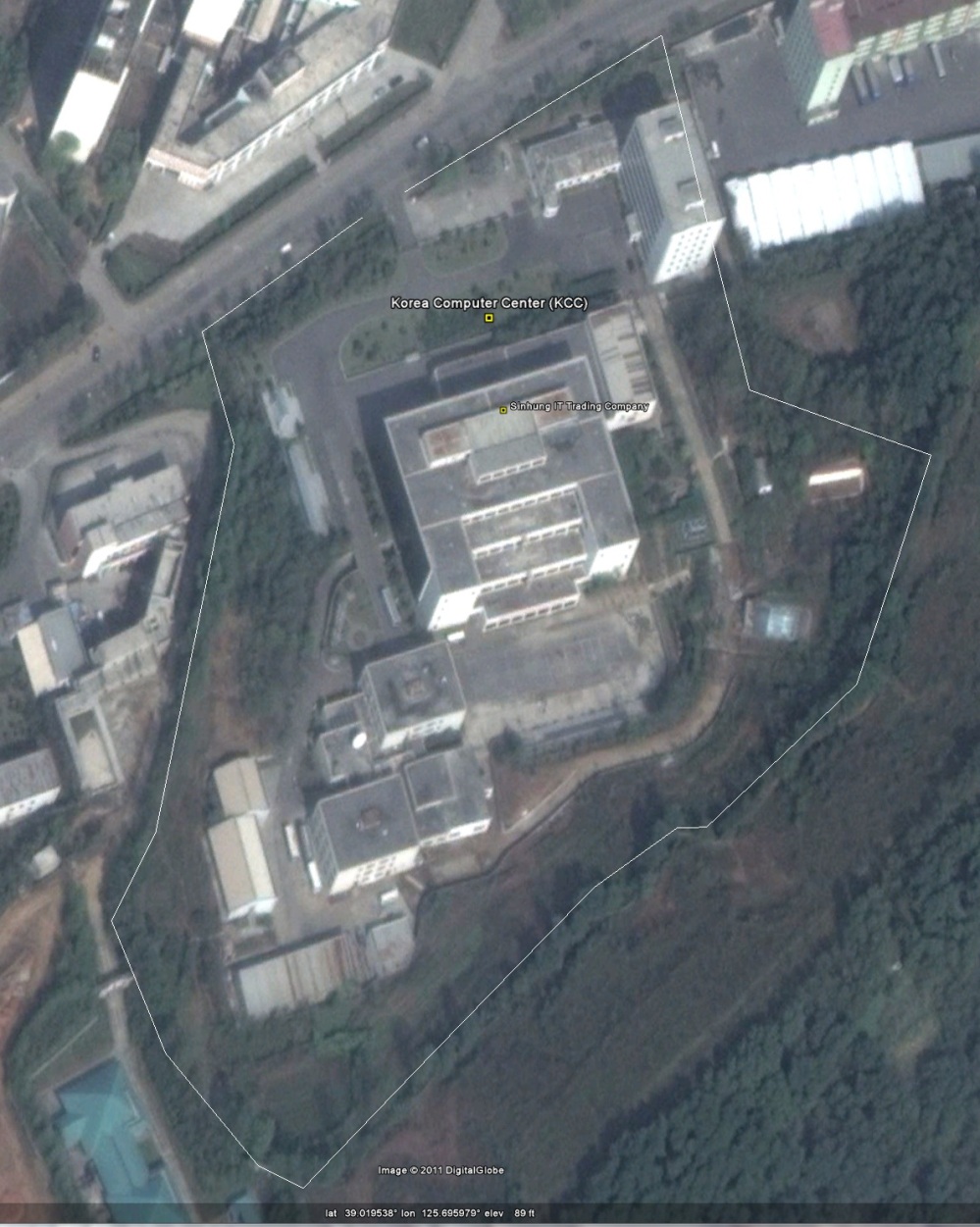
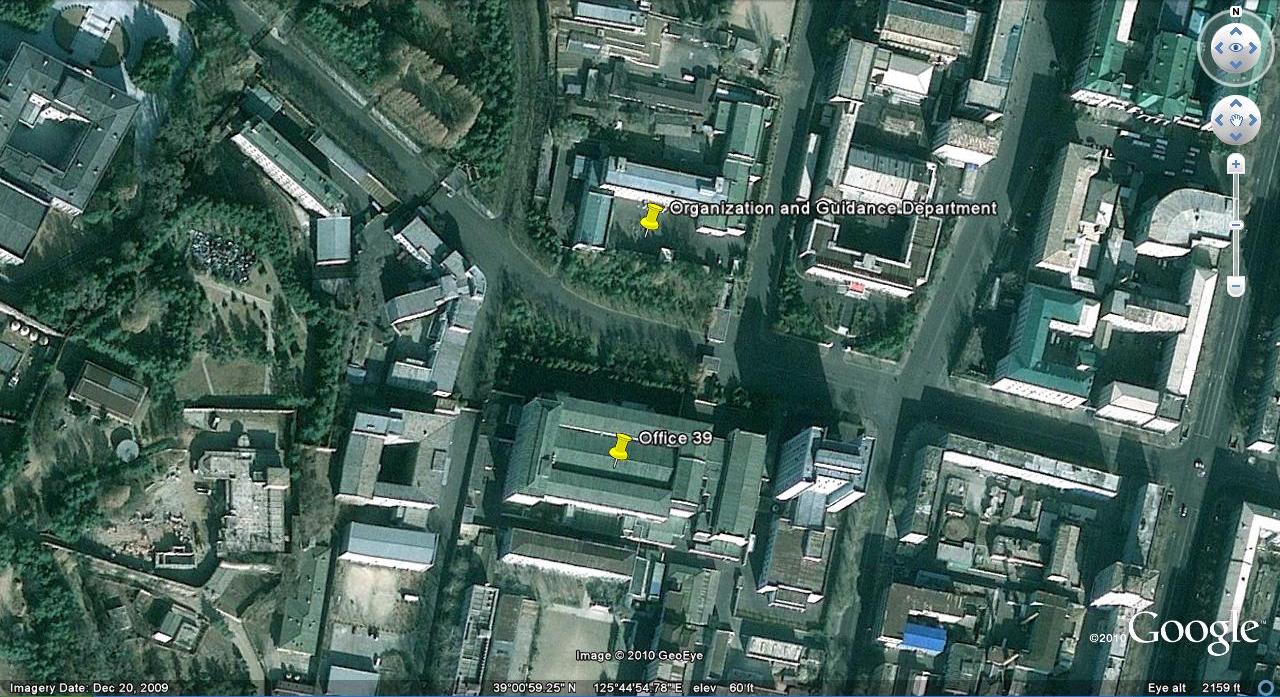
Today, on Changgwang Street in Pyongyang, the capital of North Korea, there is a barricaded compound of government buildings. Judging from satellite photos, these are unremarkable, rectangular structures that suggest no special purpose. Yet according to a North Korean specialist based in Seoul whom I spoke with recently, and who has interviewed many high-ranking North Korean defectors, including Hwang Jang Yop and Kim Duk Hong, these buildings are the home of Office 39, a government bureau devoted to raising hard currency for Kim Jong Il. (The specialist was granted anonymity because of the sensitivity of relations between North and South Korea.)

While the operatives of Office 39 may well direct legitimate enterprises, including the export of exotic mushrooms, ginseng and seaweed, a substantial portion of the office’s revenue comes from its involvement in illicit activities: drug manufacturing and trafficking, sales of missile technology, counterfeit cigarettes and counterfeit $50 and $100 bills. According to Ken Gause, director of the Foreign Leadership Studies Program at the CNA Corporation, a policy group in Virginia that consults on national-security issues, the activities of Office 39 overlap with those of two other offices that occupy buildings in the same complex. The first, Office 38, manages the money acquired by Office 39, he said, while the second, Office 35, handles kidnappings, assassinations and other such activities.

All three divisions employ the same narrow coterie of elites, and all answer directly to Kim Jong Il, who lives in a villa less than a mile away. The history of the operations of Offices 39, 38 and 35, Gause told me, closely follows Kim Jong Il’s own rise to power through the party apparatus. In the early 70’s, after helping his father purge the ranks of the Korean Workers’ Party of competing factions, Kim Jong Il assumed control of North Korea’s covert operations, mostly involving South Korean targets.

In the mid-70’s, according to defector accounts related to me by the North Korean specialist, Kim Jong Il issued a directive to members of the Central Committee of the Korean Workers’ Party instructing that expenses for covert operations against South Korea be paid for by producing and using counterfeit dollars. Officials in charge of the operation supposedly brought back $1 bills from abroad, bleached the ink and then used the blank paper to print fairly sophisticated counterfeit $100 bills — though nothing close in quality to a supernote. Many of these notes were later used by North Korean agents implicated in attacks on South Korean targets, like the operatives arrested for the bombings of a South Korean government delegation in Rangoon in 1983 and a Korean Airlines jet in 1987.

According to the same defector accounts, Kim Jong Il endorsed counterfeiting not only as a way of paying for covert operations but also as a means of waging economic warfare against the United States, “a way to fight America, and screw up the American economic system,” as the North Korean specialist paraphrased it to me.

In a similar vein, according to Sheena Chestnut, a specialist on North Korea’s illicit activities who has also interviewed several key defectors, counterfeiting was seen as an expression of the guiding idea of the regime: the concept of juche. Often loosely translated as “self-reliance” or “sovereignty,” the idea of juche entails an aggressive repudiation of other nations’ sovereignty — a reaction to the many centuries in which Korea capitulated to its larger, more powerful neighbors. “It appears that counterfeiting actually contributed to the domestic legitimacy of the North Korean regime,” Chestnut told me. “It could be justified under the juche ideology and allowed the regime to advertise its anticapitalist, anti-American credentials.”

By 1984, as North Korea’s planned economy began to fall apart, Kim Jong Il, who by that time was effectively running much of the government, issued another directive, according to the North Korean specialist, who told me he has obtained a copy of the document. It explained that “producing and using counterfeit U.S. dollars” was a means, in part, for “overcoming economic crisis.” The economic crisis was twofold: not only the worsening conditions among the general population but also a growing financial discontent among the regime’s elite, who had come to expect certain perquisites of power. Counterfeiting offered the promise of raising hard currency to buy the elite the luxury items that they had come to expect: foreign-made cars, trips for their children, fine wine and cognac.

Laundering, Wholesaling and Redesigning

Earlier this year, I visited David Asher, a former senior adviser for East Asian and Pacific affairs in the State Department and an outspoken critic of the North Korean regime. In late 2001, he explained to me, Assistant Secretary of State James Kelly asked him to study why the North Korean regime had not collapsed, given that the country’s economy had declined even further over the previous decade, with industrial output alone falling by as much as three-quarters. Former Communist countries had ended their subsidies, Kim Il Sung had died, the country was stricken by floods and famine and the food-distribution system had collapsed. (Party slogans betrayed more than a hint of desperation: “Let’s Eat Two Meals a Day” was one of the era’s more uplifting exhortations.) Yet Kim Jong Il, defying all expectations, managed to cling to power.

“How this was happening was perplexing, given the huge trade gap, even with adjustments for aid flowing into the country,” Asher recalled. “Something just didn’t add up. It didn’t account for why Kim was driving around in brand new Mercedes-Benzes or handing out Rolexes at parties and purchasing truly large quantities of cognac.”

As Asher and his colleagues began amassing intelligence, evidence of an array of illicit activities began surfacing — everything from ivory smuggling to the production of high-grade methamphetamine. And counterfeiting was at the core. “The more we found out about this counterfeiting of dollars, the more we thought it was outrageous,” Asher told me. These activities provided what Asher calls “an alternative framework for existence” and “the palace economy of Kim Jong Il.”

In the spring of 2003, the State Department established the Illicit Activities Initiative, an interagency effort designed to investigate and counter North Korea’s criminal activities, and appointed Asher coordinator. The department began to systematically collect a variety of forensic and other evidence gathered by its own investigators, the Secret Service and elements of the intelligence community linking North Korea to the supernotes. (Asher declined to comment on the nature of the evidence, most of which remains classified.)

In addition, the department put together circumstantial evidence of North Korean counterfeiting that had been accumulating for more than a decade. In 1994, for example, authorities in Hong Kong and Macao apprehended five North Korean diplomats and trade-mission members carrying about $430,000 in bills that turned out to be counterfeits of the supernote variety. Additional North Korean diplomats, including an aide close to Kim Jong Il who was attached to Office 39, were caught trying to launder millions of dollars worth of supernotes over several years, prompting an increased scrutiny of North Korea’s diplomatic and trading missions.

Thwarted, the regime seems to have changed tactics, harnessing new distribution networks and wholesaling the counterfeits to third parties who would funnel them to criminal gangs. In the late 1990’s, for instance, British detectives began tracking Sean Garland, the leader of the Official Irish Republican Army, a Marxist splinter group of the I.R.A. According to an unsealed federal indictment in Washington, Garland began working with North Korean agents earlier in the decade, purchasing supernotes at wholesale prices before distributing them through an elaborate criminal network with outposts in Belarus and Russia, as well as Ireland. (Garland denies the charges and is currently fighting extradiction to the United States from Ireland.)

Details of the actual manufacture of counterfeit notes also began filtering into the State Department, much of the information derived from defector accounts. According to similar accounts compiled by Sheena Chestnut and the North Korean specialist in Seoul whom I spoke with, the regime obtained Swiss-made intaglio printing presses and installed them in a building called Printing House 62, part of the national-mint complex in Pyongsong, a city outside Pyongyang, where a separate team of workers manufactures the supernotes.

In 1996, frustrated by the high-quality imitations of its currency in worldwide circulation, the United States government redesigned the money for the first time since 1928. Out went the old-fashioned symmetrical designs, replaced by the big-head notes. Almost everything about the new design was aimed at frustrating potential counterfeiters, including a security thread embedded in the paper, a watermark featuring a shadow portrait of the figure on the bill and new “microprinting,” tiny lettering that is hard to imitate. The most significant addition was the use of optically variable ink, better known as O.V.I. Look at the bills in circulation today: all 10’s, 20’s, 50’s and 100’s now feature this counterfeiting deterrent in the denomination number on the lower-right-hand corner. Turn the bill one way, and it looks bronze-green; turn it the other way, and it looks black. O.V.I. is very expensive, costing many times more than conventional bank-note ink.

A Swiss company named SICPA is the major manufacturer of O.V.I., and the United States purchased the exclusive rights to green-to-black color-shifting ink in 1996. Other countries followed, purchasing color-shifting inks of different colors for their own currency. One of the first countries to do so, interestingly enough, was North Korea, whose currency, the won, counterfeiters ignore. North Korea purchased O.V.I. from SICPA that shifts from green to magenta. For the purposes of counterfeiting American currency, it would be a smart choice: magenta is the closest color on the spectrum to black. “The green-to-magenta ink can be manipulated to look very close to green-to-black ink,” Daniel Glaser of the Treasury Department told me. “They took this stuff the same year we went to O.V.I.” According to Glaser, the North Koreans managed to fiddle with the new ink, obtaining an approximation of the O.V.I. on the bills.

Though there is some dispute on the timing, the first counterfeit big-head supernotes might have arrived on the market as early as 1998. Like the earlier generation of supernotes, the big-head imitations show an ever-growing attention to detail. “They would certainly fool me,” said Glaser, who points out that the “defects” of the supernote are arguably improvements. He recalled looking at the back of a $100 supernote under a magnifying glass and noticing that the hands on the clock tower of Independence Hall were sharper on the counterfeit than on the genuine.

From all accounts, superb quality is a feature of much North Korean contraband: methamphetamine of extraordinarily high purity; counterfeit Viagra rumored to exceed the bona fide product in its potency; supernotes. It’s an impressive product line for a regime that can barely feed its people. When I discussed this with Asher, he let out a sigh. “I always say that if North Korea only produced conventional goods for export to the degree of quality and precision that they produce counterfeit United States currency, they would be a powerhouse like South Korea, not an industrial basket case.”

The Threat

How many supernotes are in circulation, and what sort of provocation do they represent?

Most government officials interviewed for this story declined to give an estimate, but several, including Michael Merritt of the Secret Service, noted that his agency has removed $50 million worth of supernotes from circulation. That is a far cry from the “billions” predicted by Representative Bill McCollum’s task force in the early 1990’s, and while it may still sound like a lot, it is insignificant relative to the $12 trillion dollar American G.D.P.

When supernotes are discovered in a smaller foreign economy that makes use of American currency, they can cause a local crisis of confidence in the dollar (this has happened in Taiwan and Ireland, for instance). But in the United States, the economic threat is minimal. For this reason, many analysts, particularly those outside the administration, like Raphael Perl of Congressional Research Service, express concern about making the issue into a diplomatic crisis. Perl, who agrees that the North Koreans are behind the counterfeiting, told me that because American government officials often view the violation of the currency as “a matter of national honor,” there is “an emotional factor that could get blown out of proportion.” In the process, he argued, counterfeiting can become conflated with other, more pressing problems posed by the North Korean regime, like its nuclear threat.

This conflation may also be deliberate. According to Kenneth Quinones, who was the North Korea country director in the State Department in the 1990’s, hawks in the current administration may be trying to use the counterfeiting issue to impede negotiations with the regime over its nuclear program. Critics of this approach note that the freezing of the North Korean bank accounts took place in the same month that participants in the six-party talks, the multination negotiations over North Korea’s nuclear program, hammered out an agreement that the regime would abandon its nuclear-weapons program. North Korea soon reneged on its promise to abandon its nuclear program and has since refused to rejoin the talks until the United States lifts the designation on Banco Delta Asia. The hawks, Quinones told me, “are attempting to use these sanctions” to help “bring down the regime.”

The senior administration official interviewed for this article dismissed that claim. “The notion that there was a grand conspiracy by hard-liners is just wrong,” he told me. “It’s not accurate. This was done as a law-enforcement action by appropriate U.S. government agencies based on the facts of the case.”

Even if the counterfeiting is not worthy of being a diplomatic issue unto itself, the fact that North Korea is counterfeiting may still serve as a grim reminder of the difficulty of good-faith negotiations with North Korea. Just consider that the supernotes that were seized by law-enforcement officials in New Jersey and California arrived in the United States while the six-party talks were going on. Asher, for one, was stunned by the audacity of the regime. “If they’re going to counterfeit our currency the entire time they’re engaged in diplomatic negotiations, what does that say about their sincerity?” he asked me. “How can they want normalization with a country whose currency they’re counterfeiting? How can they expect it?”

However the diplomatic standoff is resolved, Asher said that he believes North Korea won’t continue to counterfeit much longer. Next year, the Bureau of Engraving and Printing is issuing an updated version of the $100 bills. The notes will be expensive to manufacture, requiring the purchase of a new set of presses at a cost that Asher estimated in the “hundreds of millions” of dollars. The Treasury Department characterizes the next generation of notes as part of a routine redesign that it will undertake on a regular schedule every decade. But Asher has no illusions as to the timing. “It might be a routine update,” he said, “but it’s a routine update that’s being instigated by one country: North Korea.”

Stephen Mihm teaches history at the University of Georgia. He is at work on two books about the history of counterfeiting in the United States, one to be published by Harvard University Press and the other by HarperCollins.

Are US economic restrictions hurting the DPRK?

Friday, April 21st, 2006

From the BBC:

A recent report for the US Congress estimated that $45m of the notes are in circulation worldwide. South Korean police this month uncovered a haul of 700 fake $100 bills. ”They’re about 95% identical to the real thing,” said Suh Tae-suk, South Korea’s leading expert on counterfeit currency, “but there’s a slight difference in the texture of the paper and the make-up of the chemicals, so experts can still spot them.”

Most of the notes are brought in from China; and organised crime networks are reported to be distributing them in Asia, and through Russia into Europe. American officials say they have no doubt the notes are manufactured in North Korea.   High-level North Korean defectors back up some of Washington’s claims that Pyongyang is involved in counterfeiting and other illicit activities.

One former North Korean diplomat painted a picture of cash-strapped embassies that are expected to finance themselves, and of diplomats racking their brains for new ways to raise money. He asked not to be identified because he had left family behind in Pyongyang, who he now considers hostages of the regime. “We were each given a quota of foreign currency that we had to raise each year to show our loyalty to the state,” he explained. “I was expected to produce $100,000 a year and remit it to a bank in China”.

The former diplomat, who has lived in Seoul since his defection, said a superior once handed him fake US bank notes, mixed in with the real thing, to conduct a trade deal in South East Asia. He said he raised money from kick-backs on trade deals, but would also smuggle gold and “currency by the kilogramme” in diplomatic bags.

And there were other scams: Trading in tax-free cars, smuggling liquor into Islamic countries, and trafficking horns and ivory out of Africa to sell to Chinese businessmen.

At the centre of much of the trade is North Korea’s top-secret Bureau 39, which defectors say was set up in the 1970s to create a personal slush fund for Kim Jong-il.

“Bureau 39 has a monopoly on earning foreign currency,” said Kim Dok-hong, who worked for 17 years alongside the bureau’s agents at the North Korean Workers’ Party Central Committee.   “Bureau 39 has a monopoly of trade in high-quality agricultural products like pine mushrooms and red ginseng. They also control the drug trade. Opium is produced across the country and then refined into heroin. Their other main role was distributing the supernotes,” he said.

North Korea denies the charges of counterfeiting.  It accuses the US of counterfitting its own currency and trying to blame the DPRK. 

North Korea has also asked the government of Switzerland to investigate the authenticity of a U.S. claim that Pyongyang secretly keeps US$4 billion in Swiss bank accounts, and then release a report on its findings.

The North Korean embassy in Switzerland sent a statement to Yonhap News Agency, branding the U.S. allegation a “conventional scheme to damage the image of our republic.”
North Korea has “made an official request to the Swiss government to investigate this matter and release the results of the probe on purpose to guarantee objectivity,” the statement said.

Pyongyang’s Banking Beachhead in Europe

Thursday, February 13th, 2003

Far Eastern Economic Review
Bertil Lintner
2/13/2003 

One of the few things that Kim Kum Jin and Sun Hui Ri didn’t leave behind when they fled Slovakia in August last year was their collection of bank records. Their invoices came to millions of dollars, but the documents recovered by Slovak police don’t make clear where all the money went. Some answers could probably be found just up the Danube River from Bratislava. Since 1982, the North Koreans have had their own bank in Austria’s capital, Vienna. It’s called the Golden Star Bank–almost the same name as a North Korean company in Beijing that was used by Kim.

According to official Austrian bank documents seen by the REVIEW, the Golden Star Bank is 100% owned by the Korea Daesong Bank, a state enterprise headquartered in Pyongyang. Kim Dok Hong, a top North Korean official who fled to South Korea in 1997, says that both banks come under the jurisdiction of Bureau 39, a shadowy wing of the ruling Korean Workers’ Party controlled by North Korean leader Kim Jong Il. Western and Asian intelligence services believe it was set up in 1994 to generate hard currency for Kim’s impoverished nation.

For more than two decades, the Austrian police have kept a close eye on the Golden Star Bank, but there is no law that forbids the North Koreans from operating a nonretail financial institution in the country. Nevertheless, Austria’s police intelligence department stated in a 1997 report: “This bank [Golden Star] has been mentioned repeatedly in connection with everything from money laundering and distribution of fake currency notes to involvement in the illegal trade in radioactive material.”

But finding hard evidence of illegal activity is another matter and the bank continues trading in the Austrian capital. While documents left behind in Bratislava by Kim Kum Jin and Sun show dealings with respected banks such as the Bank of China and the National Bank of Egypt, there is no paperwork connecting them directly to the Golden Star Bank. But the Austrian police report’s assertion that “Vienna must be seen as North Korea’s centre for financial transactions in Europe” remains relevant today.

The former Portuguese enclave of Macau–where the North Koreans have had a discreet but solid presence since the mid-1970s–plays a similar role in East Asia, according to Western and Asian intelligence officials. The North Koreans do not have their own bank in the largely autonomous Chinese territory, but they operate through locally owned family banks, the officials believe.

In an October 2000 conference paper, Marcus Noland of the Washington-based Institute for International Economics asserted that money owed by South Korea’s Hyundai company to the North Korean government had gone “into the Macau bank account of ‘Bureau 39′.” The payments were for permission to operate tourist trips to Mt. Kumgang in the North. An official at Hyundai Asan, which organizes the tours, says only that royalties are paid to North Korea through Korea Exchange Bank’s branches in unspecified third countries.

The Congressional Research Service–which provides United States congressmen with background briefings–reported on March 5 last year that “the U.S. military command and the Central Intelligence Agency reportedly believe that North Korea is using for military purposes the large cash payments, over $400 million since 1998, that the Hyundai Corporation has to pay for the right to operate [the] tourist project.”

Noland, an expert on Korean affairs, asserted in his paper that this income was used for “regime maintenance,” or to strengthen the government and its armed forces. Bankers and Western security officials believe this is also the case with money earned from the operations in Europe and the Middle East.
The Macau Connection
The Former Portuguese Colony was a Terrorist Base for Pyongyang

Avenida de Sidonio Pais is not Macau’s busiest street. And the trading company that is located on the fifth floor in a nondescript concrete building doesn’t even have a sign outside. But this is where Zokwang Trading is located–and from where the North Koreans have conducted some of their more nefarious activities in East Asia. The company was set up shortly after the Carnation Revolution in Portugal in 1974, when the old fascist dictatorship was overthrown and the new, left-leaning leaders recognized North Korea.

But Zokwang, which ironically means “morning light” in Korean, has always been more than a trading company. This was the alleged planning base for the 1983 bombing in which North Korean agents killed 17 South Korean officials, including four cabinet ministers, who were visiting the Burmese capital, Rangoon. In 1987, another set of North Korean agents bombed a Korean Air jet, killing all 115 people on board. One of those agents, Kim Hyun Hee, now lives in Seoul and describes in her autobiography, The Tears of My Soul, how she was trained in Macau. There, she and other North Korean agents learnt Cantonese so that they would be able to pose as Macau or Hong Kong Chinese when sent on overseas missions. They were also trained to shop in supermarkets, use credit cards and visit discos–amenities that did not exist in their homeland.

In 1994, the head of Zokwang and four other North Koreans were arrested in Macau for depositing millions of dollars worth of counterfeit $100 bills. But nothing came of the investigation and in 1999, more counterfeit dollars were discovered in Macau. The North Koreans were also suspected of peddling drugs and guns through the then Portuguese enclave. Once a week, the North Korean national carrier Air Koryo flew from Bangkok to Pyongyang with a stopover in Macau. The flights, now monthly, carried few passengers–but plenty of cargo.

So Western and Japanese intelligence agencies were apprehensive when North Korea was allowed by the Chinese government to open a new consulate general in Hong Kong on February 16. Air Koryo had applied in April last year for permission to use Hong Kong’s new Chek Lap Kok airport instead. But the airport authorities turned the request down. Air Koryo’s old Tupolev Tu-154 aircraft were just too noisy.

But those who thought Hong Kong would become a new centre for North Korean crime have so far been proven wrong. Perhaps under Chinese pressure, the North Koreans in Hong Kong have become model diplomats: open, approachable and eager to forge links with the local business community. Hong Kong has also eclipsed Macau as the centre for North Korean businesses in East Asia, and the new style may serve as a harbinger for change. No one wants to see another terrorist state emerge in Asia.

Issue cover-dated October 25, 2001