Archive for the ‘Russia’ Category

DPRK – Russia trade grows

Saturday, September 22nd, 2012

According to Yonhap:

Bilateral trade between North Korea and its ally Russia surged nearly 50 percent from a year earlier in the first half, a report said Saturday.

According to the report from Seoul’s state-run Korea Trade-Investment Promotion Agency (KOTRA), the amount of bilateral trade between the two countries in the January-June period came to US$38.8 million, up 49 percent from the same period last year.

The report, however, noted such a large on-year increase was due to a large drop posted in the first half of 2011.

“The volume of bilateral trade between North Korea and Russia is still insignificant by any standard,” it said.

The increase was also caused by a 68.3 percent rise in shipments of Russian goods to North Korea with fuel and steel products accounting for 29.9 percent and 28.7 percent of total shipments, respectively.

North Korea’s exports to Russia dropped 10.9 percent on-year to $5.4 million, according to the KOTRA report.

Here are some previous posts on this topic:
1. Lankov on DPRK-Russia trade (2012-9-18).
2. Russia reported to forgive DPRK debt (again)
3. KOTRA numbers from June
4. Lankov on DPRK-Russia ties (2011-9-25)

Read the full story here:
Trade between N. Korea, Russia surges 50 pct in H1
Yonhap
2012-9-22

Share

Russia – DPRK trade

Tuesday, September 18th, 2012

Following (or perhaps concurrently with) the story on the Russia – DPRK debt forgiveness deal, Andrei Lankov writes about DPRK trade and investment in the Asia Times:

But a brief look at trade statistics makes one suspicious about claims in regard to Russia’s prominence in North Korean issues. It is not widely understood that summits and official rhetoric notwithstanding, actual trade between North Korea and Russia is miniscule, even by the meager standards of North Korea.

In 2011, trade volume between the two countries was merely US$0.12 billion. As inter-state trade goes, this practically means that Russia and North Korea have close to no trade. In the same year, Sino-Korean trade hit the $5.6 billion mark. If you compare this with other East Asian countries this is still peanuts, but it is nonetheless almost fifty times the level of Russo-North Korean trade.

One also might notice that the improvement in political relations between Russia and North Korea had absolutely no impact on Russo-North Korean bilateral trade volumes. If anything, the trade declined when the politicians were smiling and exchanging niceties.

Over the past 15 years, Russo-North Korean trade on an annual basis has fluctuated around the $100-$250 million mark (in a clear downward trend). Throughout the same period, Sino-North Korean trade has increased almost 10-fold.

It is strange that these obvious facts do not attract enough attention among those who like to talk about Russia’s supposed leverage in Pyongyang. These figures are easily obtainable and yet almost entirely overlooked. This seems to be because the figures do not easily fit into preconceived notions about Russo-North Korean relations; the inconvenient truth is that the political rhetoric shared between the two countries is often very shallow and lacking in an economic basis.

To be blunt, Russian businesses have no interest in North Korea.

North Korea is a very poor place that has few comparative advantages in the world market. Nonetheless such advantages do exist. First, North Korea has some mineral resources (iron ore,coal, copper, lead and so forth) which are largely to be found in the northern most part of the country. Second, it has a rather skilled and unbelievably cheap workforce. North Korean workers consider themselves lucky if they are paid $25 a month. But none of these two advantages are of any significance to corporate Russia.

Russian mining companies have all of Siberia at their disposal, and North Korea’s mineral deposits do not look all that impressive by comparison. Things are made even worse by the constant threat of political instability and the gross underdevelopment of transportation and infrastructure in general. Therefore, no major Russian mining firm is willing to invest in North Korea (some have been courted by Pyongyang, have always responded in the negative).

The pull of cheap labor is also not all that attractive to Russian companies. The Russian developmental model does not involve heavy reliance on light industry in general, nor in particular the manufacture of T-shirts and running shoes. There is a moderate need for cheap North Korean labor in Russia itself, and so for many decades North Korean workers have been employed in Russia. But the scale of these operations is quite limited, and likely to remain so (10-20,000 workers at most).

One can of course point at two much discussed projects of economic cooperation between Russia and North Korea – the proposed trans-Korean railway and proposed natural gas pipeline. The pipeline project was discussed during Kim Jong-il’s last trip to Russia in 2011, and as a result still attracts much attention. However, we should remember that the very similar trans-Korean railway was first officially approved in the late 1990s, but still remains on the drawing board and as elusive as ever. There is good reason to believe that a similar fate awaits the pipeline project: for years there will be talks, enthusiastic newspaper articles, even official visits, but not much in terms of actual construction.

Both railway and pipeline projects share one common feature: North Korea is treated as a space to traverse. Had this area been covered with tropical rainforest, or desert, it would have little impact on either of these projects, whose main task is to facilitate interactions between Russia and South Korea.

From a purely commercial view, a short-cut through North Korea makes perfect sense, but there are many political problems which ensure that we will have to wait for many years before any of these projects will begin in earnest.

The major problem is recurrent and perhaps incurable instability which blights the Korean peninsula. Once Russian companies start real construction, they will become hostages of the complex and often unpredictable clashes of power interests in and around the Korean peninsula.

Additional Information
1. Read more about the Rason railway project here.

2. Read more about the pipeline project here.

3. more economic statistics can be found on my DPRK Economic Statistics page

Read the full story here:
North Korea lacks rich relation in Russia
Andrei Lankov
Asia Times
2012-9-18

Share

DPRK loggers in Russia: Economic data

Monday, June 25th, 2012

According to the Asahi Shimbun:

More than 100 North Korean defectors are now in Russia, with about 30 in Moscow, according to the Office of the United Nations High Commissioner for Refugees.

Each day, the former logger felled larch and other trees and transported them to stations from 8 a.m. to around 10 p.m. at the No. 13 office in Tygda in the Amur Oblast.

About 700 North Koreans worked as loggers at the office, with three to four dying in accidents every year.

Loggers made about $500 (40,000 yen) a month on average and $2,000 to $3,000 in a season, according to accounts of other former workers. But more than 70 percent of their pay was siphoned off by the government.

The man remembers he received a maximum of $160 a month in certificates, but supervisors said half of the payment had been sent to his family in North Korea. He was never told how much he made.

North Korean workers dispatched around the world send home several hundreds of millions of dollars a year. The workers, along with mineral resources, are a key source of hard foreign currency for the country, which suffered a trade deficit of $630 million last year.

North Korea’s Forestry Ministry operated its Russian representative office on the outskirts of Khabarovsk, with branches in Tygda and Chegdomyn in the Khabarovsk district, its two largest logging bases.

During the peak, up to 20,000 North Koreans worked as loggers in Russia, with half of them based in Tygda and Chegdomyn, according to sources.

The defector said he volunteered to go to Russia in September 1995 “to make a living.” At that time, rations were suspended in a food crisis, and people were starving to death in rural areas.

At the No. 13 office in Tygda, eight loggers formed a group. Two workers were each responsible for cutting, selecting, transporting and loading trees onto cargo trains. With equipment in short supply, the monthly quota of 3,000 cubic meters was seldom met.

North Korea focused on logging in Russia’s Far Eastern region after it concluded a contract with the former Soviet Union in 1967. Under the agreement, North Korea would take about 35 percent of the trees felled.

North Korean workers are dispatched abroad only for three years. But the man managed to extend his stay, paying bribes to representatives at the No. 13 office, including those from the ruling Workers’ Party of Korea and the State Security Department, or the secret police.

The man won the trust of senior officials and started working outside the logging base on a part-time basis in around 2000. He would earn 2,000 rubles (4,800 yen, or $60) if he worked at a road construction site for one week.

North Korea has closed many logging bases in Russia. Tygda and Chegdomyn have only several hundred workers between them, according to sources.

But there are still 15,000 to 20,000 North Korean workers in Russia, according to South Korean human rights groups and other sources.

A little less than 5,000 work in Vladivostok, and plans are under way to have several thousand North Koreans engage in farming or construction in the Amur Oblast.

North Korea has also sent workers to other parts of the world. About 19,000 entered China on a work visa between January and March, a 40-percent increase from the same period the previous year.

Kim Tae San, a former employee of North Korea’s Light Industry Ministry, was responsible for running a joint venture shoe sewing factory in the Czech Republic for three years from 2000.

The 60-year-old said workers could save only less than 10 percent of what they made because the remainder was confiscated by the government.

Female workers at the plant each made $150 a month, but $75 to $80 was unconditionally remitted to North Korea. In addition, the factory collected $40 for lodging expenses, $1 for subscriptions for airlifted Rodong Sinmun, the official newspaper of North Korea’s ruling party, and $2 for flowers. On a memorial day, a basket of flowers was presented before the Kim Il Sung statue in Pyongyang on behalf of all workers overseas.

Read previous posts on loggers in Russia here, here, here, here, here, here, and here.

The full story story is well worth reading here:
FAR EAST FOCUS: Pyongyang exploits N. Korean loggers in Russia
Asahi Shimbun
Yoshihiro Makino
2012-6-25

Share

Song Hye-rim

Saturday, February 18th, 2012

Pictured above: Yonhap photo of Song Hye-rim’s tomb stone in Moscow

Michael Rank writes in the Asia Times:

She died a lonely death, and she lies in a lonely grave. Once close to the center of power in highly secretive North Korea, she died in a Moscow hospital, spurned by her former lover, the Dear Leader Kim Jong-il, after suffering from paranoia and depression.

Much remains mysterious about Song Hye-rim, but a journalist from South Korea’s Yonhap news agency recently discovered her grave in Moscow’s Troyekurovskoye cemetery, where she was buried under an assumed name after fleeing Pyongyang following the breakdown of her relationship with Kim Jong-il.

She was suffering from mental illness and fled for medical treatment to Moscow, where she was admitted to hospital as O Sun Hui, the name under which she was originally buried.

But her gravestone now bears her real name, as well as her dates of birth and death – January 24, 1937-May 18, 2002 – and, on the other side of the headstone are inscribed the words “mother of Kim Jong Nam”.

It’s not known if her son has ever visited his mother’s grave, but Kim Jong-nam is certainly the black sheep of the family. The oldest son of Kim Jong-il was born in 1971 and was at one time his heir apparent, but he was disgraced when he was barred from Narita airport in 2001 when he was found to be travelling on a false passport on a trip to Tokyo Disneyland.

He now lives in Macau and southern China, and was recently quoted by a Japanese journalist as saying he expects the North Korean regime to fail because its new leader, his half-brother Kim Jong-eun, is too inexperienced. He said he had never even met his all-powerful half-brother, who is aged about 28.

The South Korean-born Song Hye-rim was an actress and a divorcee with a child when she became Kim Jong-il’s first mistress around 1970. She is said to have entered Pyongyang Film Academy in 1955, but left the following year to give birth to a daughter. She later re-enrolled and graduated, making her film debut in 1960.

Somewhat spookily, she is buried just 10 meters away from Stalin’s son Vasily Dzhugashvili, who died aged 40 in 1962.

When the Yonhap reporter visited Song’s grave in 2009 it was decorated with a single carnation, left by – who knows. “As you can see the grave has few visitors,” a cemetery official remarked.

Song was the first mistress of Kim Jong-il, who died last December, and was five years older than him. Her friend, Kim Young-soon, has said that Kim Jong-il did not tell his father, the Great Leader Kim Il-sung, that he was living with a formerly married woman as that would have caused a huge scandal.

Song’s sister, Song Hye-rang, managed to defect in Geneva in 1996, bringing with her nothing but her medicines, a volume of Chekhov short stories and her diary. She has told how the Dear Leader, an ardent film buff, was at first besotted with his movie star mistress but his ardour later cooled, and his father ordered him to marry a woman he never really loved, although the marriage did not last long.

His next liaison was with Ko Yong-hui, a Japanese-born ethnic Korean and a dancer, who was the mother of North Korea’s youthful new leader, Kim Jong-eun. She is believed to have died in Paris in 2004 and the Dear Leader replaced her with his personal secretary, Kim Ok, who reportedly accompanied him on a visit to China in 2006.

The ruling Kim family is enshrouded in mystery and rumor, and what little we know for reasonably sure is based largely on defectors’ accounts such as Song Hye-rang’s autobiography and an unpublished memoir by Kim Jong-il’s stepdaughter, the niece of Song Hye-rim, who defected in 1992 after visiting her aunt in hospital in Moscow.

The stepdaughter, Ri (Li) Nam-ok, tells in her autobiography how the then crown prince Kim Jong-nam was sent to school in Switzerland, accompanied by his uncle, Jang Song-taek.

The young Kim was at first reluctant to go, but “Jang Song-taek cajoled him, ‘Come on, come with me, we will see lots of strange and funny things. Let’s go!’ The thought of spending time with his uncle must have pleased him, and Jong-Nam consented.”

So writes Ri in her memoir, according to the respected North Korea-watcher Selig S Harrison, who says that although she originally intended it to be published, she changed her mind and had publication blocked through legal action in the French courts.

Jang stayed with Kim Jong-nam in Switzerland for six months, returning to Pyongyang in August, 1981, says Harrison.

Jang has emerged as a crucial figure since the death of Kim Jong-il because he is reported to be the mentor of the new leader, Kim Jong-eun.

Jang’s stay in Switzerland was fairly short and it occurred a long time ago, Harrison notes, but he believes that it fits in with other indications that he is reform-minded.

So does Ri Nam-ok’s reference to a visit to China by Jang on behalf of Kim Jong-il in 1989. When the subject of a visit by Ri to China came up, “My father told us he had sent Uncle Jang there and he had reported back that it ‘should be seen’,” she is quoted as saying in her ghost-written memoir, The Golden Cage.

Harrison has further evidence for claiming that Jang is a reformer, citing comments by the late Hwang Chang-yop, former international secretary of the Korean Workers’ Party, and the most senior North Korean official ever to defect.

Harrison met Hwang three times in Pyongyang, and twice more after he defected to South Korea in 1998.

“Jang Song-taek is the smartest one there [in Pyongyang], and he understands that change is urgent and imperative,” Hwang told Harrison. “He has good relations with the army because three of his brothers are generals. He’s the best hope for reform, but it won’t be easy for him.”

That is an understatement, but perhaps there is hope that North Korea will launch much-needed reforms to its sclerotic political and economic system under its mysterious new leader.

Read the full story here:
North Korean secrets lie six feet under
Asia Times
Michael Rank
2012-2-18

Share

China does [not?] commit to new infrastructure investment in Rason

Wednesday, February 15th, 2012

UPDATE 2 (2012-4-12): North Korea and China attracting investors for Rajin Port development (IFES):

China is currently actively recruiting investors to build additional wharfs in Rajin Port.

China’s Dandong City Industrial and Information Association (丹东市信息协会) announced that it is seeking investments for the construction of tanker wharf under 10,000 ton and affiliated facilities. This organization has received 45 year usage rights from the Rason City People’s Committee and stated that it needed 330 million CNY (52 million USD) to cover the construction cost. According to the association, the investment is attractive because of its geographic location, reduced transit time and costs, and tax-free benefits, for which a special permit was obtained from the North Korean authorities granting trade goods coming from Jilin Province at the Hunchun Port to be allowed entry tax-free. In addition, cargo will be permitted to be sent from Rajin Port to other ports in China.

Meanwhile, North Korea is also planning to build a new port in the Rajin-Sonbong area with a state-of-the-art container distribution capacity. According to the “Rajin New Port Development Plan,” Rajin port development will undergo major transformation as an international hub port, similar to Busan Harbor, unlike the previous small-scale renovations of Piers 1, 2, and 3. This new port is expected to be built across from the current Rajin Port.

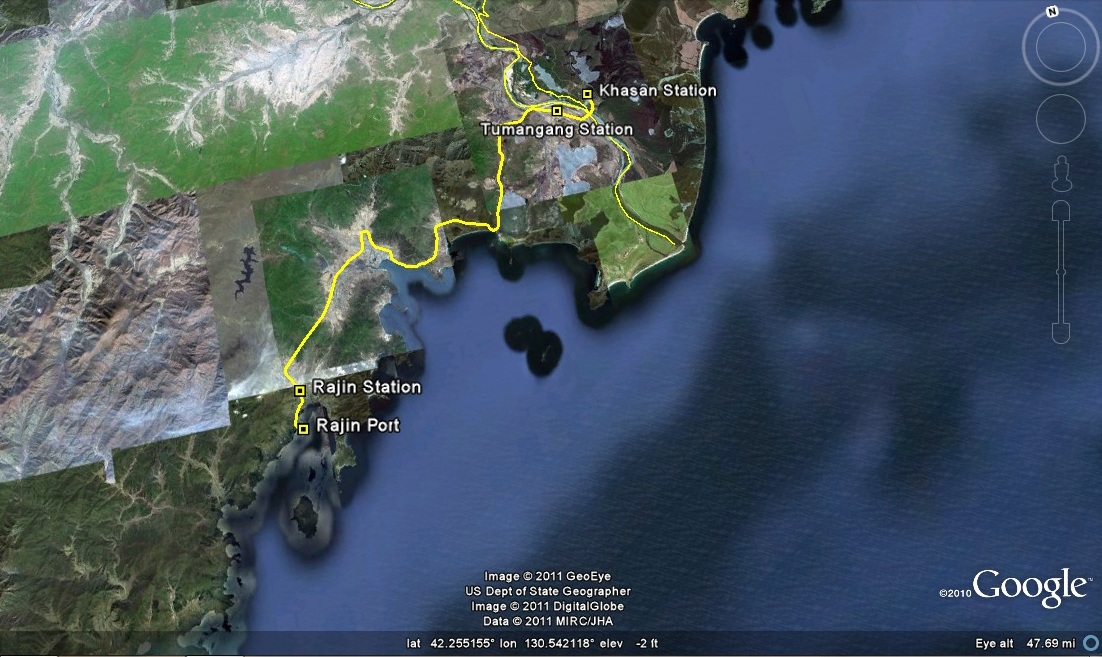
Rajin Port development was initially considered as a remodeling project to update the existing wharfs. In 2003, China began to implement construction of Piers 1, 2, and 3. However, the piers began to deteriorate and for the lack of railway and road infrastructure in the area, it delayed the transportation and distribution and could not perform its full function. As a solution, in 2008, North Korea transferred the usage right of Pier 1 to China and Pier 3 to Russia. At that time, Pier 1 was developed to primarily transport chemical fertilizers but it was recently updated as a transportation dock for coal. Russia, in addition to the port, also carried out a modernization project of the Rajin-Hassan railway system to improve the transport of containers.

The new port development plan as suggested by North Korea indicates Jian Group of China as the responsible party for developing the new port into a container port. However, considering that North Korea’s industry does not call for container ports, it is more likely that North Korea is expanding the port to make it a hub port to ship cargo to China, Russia, and Europe. Considering Rajin Port’s geographical advantage, it is likely that North Korea is striving to make it into an international hub port that connects the Pacific with Northeast Asia.

China’s recent advertisement of investment is also considered to be linked with the new port development in Rajin Port.

UPDATE 1 (2012-3-1): Accoridng to Stratfor, the Chinese have denied they plan to make this investment.

The Chinese Foreign Ministry denied allegations made in a Feb. 16 South Korean media report regarding its agreement with North Korea to jointly develop the Rajin-Sonbong Special Economic Zone (SEZ), a port area in northeast North Korea commonly referred to as the Rason Special Economic Zone.

According to the Yonhap news agency, Beijing agreed in late 2011 to invest about 19 billion yuan ($3 billion) into Rason, for which it would receive the lease of three piers for 50 years. Under the agreement, Beijing would also build an airfield, a thermal power plant and a 55-kilometer (34-mile) railway track connecting Rason to Tumen, China. The Chinese Foreign Ministry claimed that the specific details of the report are untrue and that China and North Korea had agreed only in principle to develop the zone.

China has long exerted its economic influence in North Korea and has an interest in the strategically important Rason Special Economic Zone. Chinese involvement in Rason dates back to the 1990s, though Beijing increased its involvement considerably in 2005 when it secured the rights to one of the port’s piers. Beijing has been particularly involved over the past few years. While the details of the deal remain unknown, it is clear that Beijing has arranged to help Pyongyang develop Rason, possibly by connecting the remote port to northwest China. Such a development would revitalize the zone — to the benefit of both countries.

ORIGINAL POST (2012-2-15): China has committed to infrastructure projects in Rason. According to Yonhap:

China has secured the rights to build three new piers in a special economic zone in North Korea’s northeast and use them for 50 years, sources said Wednesday.

China will also build an airfield and a thermal power plant in the special economic zone known as Rason, as well as a 55-kilometer railway track between China’s northeastern city of Tumen and Rason.

North Korea and China reached an agreement late last year to build infrastructure in Rason with Chinese investment of about US$3 billion, according to the sources in Seoul and Beijing.

The Daily NK offers some more data:

China has agreed to dig out dock 4 at Rasun to make it possible for 70,000 ton vessels to dock and to construct a runway long enough to accommodate passenger and cargo aircraft within the SEZ; the railroad is due to be complete by 2020, while the development of dock 5 and 6 will follow that of dock 4, Yonhap sources claim.

This agreement was reportedly signed quietly by North Korea’s Joint Ventures Committee and the Chinese government shortly before Kim Jong Il’s death.

The North Koreans have sought the construction of an airport and expansion of the port  for some time.

KITC published the image above in 1995 (Source here).  If you look carefully on the right side of the picture you will see the site of a proposed airport.

Above is a more recent map of Rason published by the DPRK. In the middle of the above map you can see a small airplane which represents the desired location of a future airfield. It is in the same location as shown on the KITC map.

Here is the approximate location on Google Earth (42.397884°, 130.592084°):

If you look at the left side of the KITC photo you can also see that there are many piers, however today there are only three.  I suspect that the new piers will be constructed south of the current piers and will look something like this:

The railway and power plant projects are intereting as well.  There is already a thermal power plant in Sonbong, so I expect that the Chinese are simply renovating it so that it generates more power or is simply more reliable (Google Earth:  42.327275°, 130.382585°):

At a presentation at the Korea Economic Institute in Washington, DC, Andray Abrahamian reported that increased electricity supplies for the Rason Zone could come from China.

As for the Tumen (China) – Rason railway line…this already exists as well.  The DPRK’s Hambuk Line (함북선) runs from Chongjin to Namyang (border with Tumen) to Rason:

The Tumen to Rason leg of this railway line, however, is approximately 156km (according to Google Earth) and likely runs pretty slowly.  The proposed new Chinese-built Tumen-Rason line is intended to be just 1/3 the distance!

Additional Information:

1. The Russians built a railway line from their border to the Rajin Port. Learn more here.

2. The Chinese and Russians have already rented two of Rajin’s three ports.

Read the full stories here:
China secures right to use 3 piers to be built on N. Korean port for 50 years
Yonhap
2012-2-15

China Reportedly Grabs 3 Docks and More
Daily NK
2012-2-15

Share

DPRK 2011 food shortage debate compendium

Friday, December 2nd, 2011

UPDATE (2012-2-1): Karin Lee of the National Committee on North Korea wrote a great summary of the DPRK’s food situation in 2011:

In December 2010, North Korea began asking multiple countries for food aid. Its request to the U.S. came in early 2011, but it wasn’t until December 2011 that a deal seemed close, with the U.S. prepared to provide 240,000 metric tons (MTs) of assistance. Kim Jong Il died soon after this news hit the press, and details of the potential deal were never announced.

In the ideal world, Ronald Reagan’s “hungry child” knows no politics. But the case of North Korea is far from ideal. The U.S. government states it does not take politics into consideration when determining whether to provide aid to North Korea. Instead, the decision is based on three criteria: need in North Korea, competing demands for assistance, and the ability to monitor aid effectively. Yet these three criteria are subjective and tinged by politics.

In 2011 a succession of four assessment delegations (one by U.S. NGOs, one by the U.S. government, one by the EU and one by the UN) visited the DPRK. All found pretty much the same thing: widespread chronic malnutrition, especially among children and pregnant or lactating women, and cases of acute malnutrition. The UN confirmed the findings late last year, reporting chronic malnutrition in children under five in the areas visited — 33% overall, and 45% in the northern part of the country.

Some donors responded quickly. For example, shortly after its July assessment, the EU announced a 10 Million Euro donation. Following its own May assessment, however, the U.S. government was slow to make a commitment. Competing demands may have played a role. In July, the predicted famine in the Horn of Africa emerged, prompting a U.S. response of over $668 million in aid to “the worst food crisis in half a century.” While there was no public linkage between U.S. action on the African famine and inaction on North Korea, there could have been an impact.

But the two biggest factors shaping the U.S. government’s indecisiveness continued to be uncertainty about both the severity of the need and the ability to establish an adequate monitoring regime. At times, South Korean private and public actors questioned the extent of the North’s need. Early on, a lawmaker in South Korea asserted that North Korea already had stockpiled 1,000,000 metric tons of rice for its military. Human rights activist Ha Tae Keung argued that North Korea would use the aid contributed in 2011 to augment food distributions in 2012 in celebration of the 100th birthday of Kim Il Sung and North Korea’s status as a “strong and prosperous nation.” According to Yonhap, shortly after the U.N. released the above-noted figures, South Korean Unification Minister Yu Woo-Ik called the food situation in North Korea not “very serious.”

South Korea’s ambivalence about the extent of the food crisis was noted by Capitol Hill, exacerbating congressional reluctance to support food aid. A letter to Secretary Clinton sent shortly before the U.S. assessment trip in May began with Senators Lieberman, McCain, Webb and Kyl explaining they shared South Korean government suspicions that food aid would be stockpiled and requesting State to “rigorously” evaluate any DPRK request for aid. With the close ROK-U.S. relationship one of the administration’s most notable foreign policy accomplishments, such a warning may have carried some weight.

Monitoring is of equal, if not greater congressional concern. Since the 1990s U.S. NGOs and USAID have worked hard with DPRK counterparts to expand monitoring protocols, and conditions have consistently improved over time. In the 2008/2009 program, the first food program funded by the U.S. government since 2000, the DPRK agreed to provisions such as Korean-speaking monitors. The NGO portion of the program was fairly successful in implementing the monitoring protocol; when implementation of the WFP portion hit some bumps, USAID suspended shipments to WFP until issues could be resolved. The DPRK ended the program prematurely in March 2009 with 330,000 MT remaining.

In 2011 the Network for North Korean Human Rights and Democracy conducted a survey of recent defectors to examine “aid effectiveness” in the current era. Out of the 500 interviewees, 274 left the DPRK after 2010. However, only six were from provinces where NGOs had distributed aid in 2008/2009. Disturbingly, of the 106 people interviewees who had knowingly received food aid, 29 reported being forced to return food. Yet the report doesn’t state their home towns, or when the events took place. Unfortunately such incomplete data proves neither the effectiveness nor ineffectiveness of the most recent monitoring regime.

Some believe that adequate monitoring is impossible. The House version of the 2012 Agricultural Appropriations Act included an amendment prohibiting the use of Food for Peace or Title II funding for food aid to North Korea; the amendment was premised on this belief. However the final language signed into law in November called for “adequate monitoring,” not a prohibition on funding.

The U.S. response, nine months in the making, reflects the doubts outlined above and the politically challenging task of addressing them. It took months for the two governments to engage in substantive discussions on monitoring after the May trip. In December, the State Department called the promised nutritional assistance “easier to monitor” because items such as highly fortified foods and nutritional supplements are supposedly less desirable and therefore less likely to be diverted than rice. The reported offer of 240,000 MT– less than the 330,000 MT the DPRK requested – reflects the unconfirmed report that the U.S. identified vulnerable populations but not widespread disaster.

In early January, the DPRK responded. Rather than accepting the assistance that was under discussion, it called on the United States to provide rice and for the full amount, concluding “We will watch if the U.S. truly wants to build confidence.” While this statement has been interpreted positively by some as sign of the new Kim Jong Un regime’s willingness to talk, it also demonstrates a pervasive form of politicization – linkage. A “diplomatic source” in Seoul said the December decision on nutritional assistance was linked to a North Korean pledge to suspend its uranium enrichment program. Linkage can be difficult to avoid, and the long decision-making process in 2011 may have exacerbated the challenge. Although Special Representative Glyn Davies was quick to state that “there isn’t any linkage” between the discussion of nutritional assistance and dialogue on security issues, he acknowledged that the ability of the DPRK and US to work together cooperatively on food assistance would be interpreted as a signal regarding security issues. Meanwhile, the hungry child in North Korea is still hungry.

UPDATE 75 (2011-12-5): The ROK will donate US$5.65 million to N. Korea through the UN. According to Yonhap:

South Korea said Monday it will donate US$5.65 million (about 6.5 billion won) for humanitarian projects in North Korea through the U.N. body responsible for the rights of children.

The donation to the United Nations Children’s Fund, or UNICEF, will benefit about 1.46 million infants, children and pregnant women in North Korea, according to the Unification Ministry, which is in charge of relations with the North.

Seoul’s contribution will be used to provide vaccines and other medical supplies as well as to treat malnourished children next year, said the ministry.

There have been concerns that a third of all North Korean children under five are chronically malnourished and that many more children are at risk of slipping into acute stages of malnutrition unless targeted assistance is sustained.

“The decision is in line with the government’s basic stance of maintaining its pure humanitarian aid projects for vulnerable people regardless of political situation,” Unification Ministry spokesman Choi Boh-seon told reporters.

South Korea has been seeking flexibility in its policies toward the North to try to improve their strained relations over the North’s two deadly attacks on the South last year.

Despite the South’s softer stance, North Korea recently threatened to turn Seoul’s presidential office into “a sea of fire” in response to South Korea’s military maneuvers near the tense western sea border.

South Korea donated $20 million for humanitarian projects in North Korea through the UNICEF between 1996 and 2009.

Last month, the South also resumed some $6.94 million worth of medical aid to the impoverished communist country through the World Health Organization.

Separately, South Korea also decided to give 2.7 billion won ($2.3 million) to a foundation to help build emergency medical facilities in an industrial complex in the North Korean border city of Kaesong.

UPDATE 74 (2011-12-2): The Choson Ilbo reports that the DPRK’s food prices are rising after the 2011 fall harvest, however, the price increase is not due to a shortage of output, but rather political directives. According to the article:

The price of rice in North Korea is skyrocketing, contrary to received wisdom that it drops after the harvest season. According to a source on North Korea on Wednesday, the rice price has risen from 2,400 won a kg in early October to 5,000 won in late November.

North Korean workers earn only 3,000-4,000 won per month.

This unusual hike in rice price seems to be related to preparation of next year’s political propaganda projects.

A South Korean government official said, “It seems the North Korean government is not releasing rice harvested this year in order to save it up” for celebrations of regime founder Kim Il-sung’s centenary next year, when the North has vowed to become “a powerful and prosperous nation.”

UPDATE 73 (2011-11-24): According to the Daily NK, DPRK television is calling on people to conserve food:

With barely a month left until 2012, the year in which people were promised a radical lifestyle transformation to coincide with the North Korea’s rebirth as a ‘strong and prosperous nation’, programs calling upon people to conserve food are now being broadcast by Chosun Central TV and the fixed-line cable broadcaster ‘3rd Broadcast’.

Chosun Central TV is broadcasting the programs as part of ‘Socio-Culture and Lifestyle Time’, which begins directly after the news on Thursdays at 8:40pm. The majority of the content is apparently now about saving food.

A Yangkang Province source told The Daily NK on Wednesday, “Recently the head lecturer from Jang Cheol Gu Pyongyang Commercial University, Dr. Seo Young Il, has been appearing on the program both on television and the cable broadcasting system, talking about saving food.”

In one such program, Professor Seo apparently noted, “In these days of the military-first era there is a new culture blossoming, one which calls for a varied diet,” before encouraging citizens to eat potatoes and rice, wild vegetables and rice and kimchi and rice rather than white rice on its own, and then adding that bread and wheat flour noodles are better than rice for lunch and dinner.

It is understood that older programs with titles such as ‘A Balanced Diet is Excellent Preparation for Saving Food’ and ‘Cereals with Rice: Good for Your Health’ are also being rebroadcast, while watchers are being informed that thinking meat is required for a good diet is ‘incorrect’.

Whenever North Korea is on high alert or there is a directive to be handed down from Kim Jong Il, both of Chosun Central TV and the 3rd Broadcast are used to communicate with the public. For this reason, some North Korea watchers believe the recent food-saving campaign may reflect a particularly weak food situation in the country going into the winter.

According to the source, one recent program showed a cookery competition involving members of the Union of Democratic Women from Pyongyang’s Moranbong District. During which, one woman was filmed extolling the virtues of potato soup, saying “If we follow the words of The General and try eating potatoes as a staple food, there will be no problem.”

Read all previous posts on the DPRK’s food situation this year blow:

(more…)

Share

Lankov on CNC technology

Wednesday, October 12th, 2011

Pictured above (Google Earth): a Pre-renovation satellite image of what is now the Huichon Ryonha General Machine Plant, one of two known factories which produce CNC machines.

I have posted several times on the DPRK’s growing use and promotion of CNC technology (here and here). In his most recent column in the Asia Times, Andrei Lankov mentions his exposure to this technology from his younger days in the Soviet Union:

An interesting confirmation of the trend is the current fad for CNC (Computer Numerical Control) technologies – computer automation at factories. The CNC craze is often associated with Kim Jong-eun, the most likely heir to the North Korean throne. Indeed there is good reason to believe that this is the case, but it doesn’t really matter whether this fad is sponsored by Kim Jong-eun or someone else. Rather, what is important is that this naive belief in the power of intelligent machinery that will miraculously transform the North. (See Happiness rolls over us like a wave, Asia Times Online, Feb 26, 2010)

Incidentally, when the present author was a Soviet teenager, back in the 1970s, he frequently read similar stories in the then-Soviet media. The Soviet leadership of the Leonid Brezhnev-era also invested some hope in the miraculous power of CNC technology. CNC is actually quite a sound idea and works very well if used in the right social and economic conditions.

However, such conditions were absent in the Soviet Union of the 1970s and are also seemingly completely absent from North Korea of today.

So, Pyongyang’s expectation for CNC, mobiles and computers are unfounded. These technologies, or for that matter any other technology, are unlikely to have any serious impact on the future of North Korea as long as the country’s social and political system remains unchanged. However, North Korea’s leadership cannot see or accept this.

The heavy official promotion of CNC stems from what Lankov calls “technological fetishism” (which would be a good band name), a condition he describes this way:

The logic behind technological fetishism is not that difficult to understand. The root cause of economic stagnation experienced by Stalinist regimes is the intrinsic inefficiency of the Stalinist economic model. But the potentates of such regimes as well as their henchmen could not admit such things – at least, openly.

For Stalinist leaders, the social system was perfect, or at least had to be presented as such. Therefore the only conceivable reason for obvious economic difficulties had to be technological issues. Being hard-core modernizers, Stalinists shared the modern belief in the power of technology as a force that could change people’s lives.

So by DPRK official logic, now that the DPRK has overcome imperialist economic blockades of the motherland and acquired vital CNC technology, economic growth lies just around the corner. Unfortunately for the people of the DPRK, real economic progress is always just ahead–but never now.

Share

Lankov on DPRK-Russian economic relations

Tuesday, September 27th, 2011

Andrei Lankov writes in the Korea Times:

In 2010, the volume of trade between these two countries was merely $110 million. As international trade goes, this volume is tiny. By comparison, in the same year North Korea’s trade with China was around $3.4 billion, some 30 times larger than its trade with Russia.

The reason for this inactivity is quite simple: Russian companies have no interest in dealing with North Korea. In the Soviet era, trade flourished because it was subsidized due to geopolitical concerns of Moscow. Currently, when it comes to pure economic considerations, North Korea has almost nothing to offer the new Russian economy.

North Korea has only two resources that can be sold on the international market. First, it has deposits of minerals (coal, iron ore). Second, it has a relatively large quantity of cheap labor ― or to put things in a less cynically capitalist way, there are millions of North Koreans willing to work for $10 a month.

But Russian companies are decisively uninterested in North Korean minerals. These mines may be attractive to resource-hungry China, but not to Russia, which has the riches of Siberia at its disposal. The chronic political instability in which North Korea is immersed is another reason which lessens Russian interest in North Korean minerals.

Cheap labor is more attractive, and indeed Russia has continuously used North Korean labor since 1967 but not in the North itself. Some Chinese companies began to outsource to North Korea, and built small factories there, in order to take advantage of the obscenely low local wages. This approach is not very attractive to Russia, since it is not a major player in producing winter parkas, wool hoods, or running shoes. Russian companies prefer to use North Korean workers inside Russia itself.

These workers are sent to Russia by the North Korean authorities and can be described as indentured labor. Their families are hostages who can be punished if a worker does something improper and the workers are also expected to ‘donate’ a significant part of their wages to the state. Despite these harsh conditions, one should not forget that these jobs are among the best paid regular jobs in the country. North Koreans compete for opportunities to become indentured laborers in Russia.

That said, the scale of these ventures is rather limited, as is the demand for cheap labor in the Russian Far East (the only part of Russia where the use of North Korean laborers really makes practical sense).

Aside from this, North Korea has something else to offer – its geographical location. This country blocks all land routes to the prosperous South. Russia has much interest in the South Korean market, especially when it comes to the sale of natural resources. Impeding this is the existence of North Korea, and the continued strained relations between the two Korean states, making sales of Russian commodities rather difficult.

So it is not incidental that the two most important potential projects are a railway and a gas pipeline. Both projects can hardly be described as “economic cooperation” between North Korea and Russia, since neither has much to do with the North Korean economy itself. North Korea, in these cases, is present merely as a space to be traversed. It would be no different if it were a dessert or jungle. Russia is willing to pay North Korea for facilitating Russia’s economic link with the South, and that is all.

So it is not surprising that an agreement on the pipeline construction was signed after the Russian-North Korean summit. This project is indeed acceptable to the North, since it will mean easy money for transit, it is favorable to Russia, and it will be good for the general situation since it will bind Russia, North and South Korea closer.

Yet, a word of caution is necessary. In spite of all official statements, we should not expect large-scale construction work to begin in the near future. The political risks remain huge, so it is likely that Russian companies will not rush headlong into the project. The recent agreement should rather be seen as a declaration of intent. In all probability, the trans-Korean pipeline and trans-Korean railway will be built eventually. But the completion of these important initiatives will probably take many, many years.

Read the full story here:
Russia-N. Korea Trade
Korea Times
Andrei Lankov
2011-9-25

Share

North Korea Encourages Investment in Rajin-Sonbong (Rason) Economic and Trade Zone

Friday, September 16th, 2011

Institute for Far Eastern Studies (IFES)
2011-9-14

At the seventh China Jilin and Northeast Asia Investment and Trade Expo (NEASIAEXPO), the North Korean delegation actively promoted the Rajin-Sonbong (Rajin) Economic and Trade Zone to attract investment.

During the expo, the DPRK’s Ministry of Trade and China’s Ministry of Commerce and People’s Government of Jilin Province co-sponsored the “(North) Korean Business Day and China-DPRK Trade and Investment Session” at the Changchun International Conference and Exhibition Center on September 7. Hwang Chol-nam, the vice mayor of Rason City, briefed the attendees on the current situation, advantages, and special benefits of his city.

According to Hwang, “The spacious 470 square-kilometer Rason Economic and Trade Zone is one of the largest economic trade zones,” and advertised the geographic and economic advantages of Rason as the “transportation hub of Northeast Asia that connects China and Russia via Tumen River and with Japan across the East Sea.”

He also introduced the three ports in the region. “Rajin Port is equipped with the annual loading capacity of 3 million ton and Sonbong Harbor is able to transport 2 to 3 million ton of oil while Ungsang Harbor is able to handle up to 600,000 cubic-meter of lumber annually.” He also boasted the ports to be deep enough where it does not freeze during the winter.

Rason was also introduced to have received the “special city” designation in 2010 and will grow to have a population of one million. The recently amended “Law on the Rason Economic and Trade Zone” was revised and supplement with over 50 articles.

Hwang also elaborated on the eight preferential policies providing special tax benefits to foreign investors. He asserted, “The government of North Korea will guarantee the investment of the foreign investors by not nationalizing or demanding requisitions. For inevitable cases where such demands occur, proper compensation will be provided.”

The income tax is also at 14 percent, which is 11 percent lower than other areas in North Korea. For companies with business plans over ten years, foreign capital companies will receive three years of tax-free benefit starting from the profit earning year and two years thereon after will receive 50 percent tax-free benefits. According to Hwang, over 100 foreign companies and offices are operating businesses currently in the special economic zone.

He also announced that the current highway construction project connecting Rajin with Wonjung is expected to be completed in October, and that the Tumen-Rajin port railway system is to be upgraded to a broad gauge railway next month.

Specifically, Russian Railways reached an agreement with North Korea to repair the Hasan-Rajin Railway and improve the Rajin port facilities, especially focusing on Pier 3. The plans include upgrading Rajin as a container harbor to be capable of transporting twenty-foot equivalent units annually. Russia and the DPRK have already conducted measurement and geological surveys and reached the process design phase.

However, Seo Gil-bok, the DPRK’s vice minister of commerce, stated in a speech that North Korea would “actively work hard to make the Rason region a successful collaboration between the DPRK and China,” saying further that they would “pull out all the stops to realize the goals agreed by the best leaders from both nations.”

Many foreign media and correspondents were present at the event to cover the “Korean Business Day.” At the event, North Korea actively promoted the Rason Economic and Trade Zone by also presenting a promotional video of the zone.

Share

Optimism remains on gas pipeline between North and South Korea

Tuesday, September 13th, 2011

Institute for Far Eastern Studies (IFES)
2011-9-7

An article entitled, “Joint energy project on the agenda” was featured in the KCNA on August 31, which elaborated on the agreement reached between the DPRK and Russia on August 24 for the construction of a gas pipeline. The joint project is also inclusive of South Korea.

The KCNA said in the article, “The three countries have explored various options in transporting gas and have reached a consensus on building a gas pipeline running through North Korea will be the most cost-effective option.”

It also stressed this project will be beneficial for all three parties. In addition, Russia was commended as the major world power in natural gas and oil reserves and production and stressed Russia is turning its attention to expanding the energy sector.

When the Sakhalin – Komsomolsk – Khabarovsk pipeline that began construction in 2009 is completed, it will be equipped to provide enough gas not only domestically but across the Pacific-Asia region, producing a capacity of 30 billion cubic meters of gas per year.

The news also covered the specific plans of the Russian government to expand its energy supply; to boost the exports of oil and gas from three to thirty percent and five to twenty-five percent respectively, until the year 2020.

Therefore, the inter-Korean gas pipeline construction between the DPRK and Russia will be a vital project for Russia.

On August 30, the ROK’s Grand National Party (GNP) chairman Hong Jun-pyo declared, “The trilateral negotiation will be expected to take place sometime in November on the inter-Korean gas pipeline project.”

Hong also stated, “The ROK-Russia and the DPRK-Russia bilateral agreements have already been reached. Once the three parties meet to sign the tripartite agreement, the project will soon take off.” He also added, “President Lee Myung-bak has quietly pushed forward with the gas pipeline project since he first took office and it will be his major accomplishment.”

After the bilateral summit was held between the two leaders of Russia and the DPRK on August 24, the two nations have consented to establish a special commission to work cooperatively on the gas transit project running through the territories of North Korea to South Korea.

Share

An affiliate of 38 North