Archive for the ‘Construction’ Category

New Pyongyang – Phyongsong Road

Sunday, June 16th, 2013

Naenara offers news of a rare DPRK international public tender:

Invitation for International Public Tender

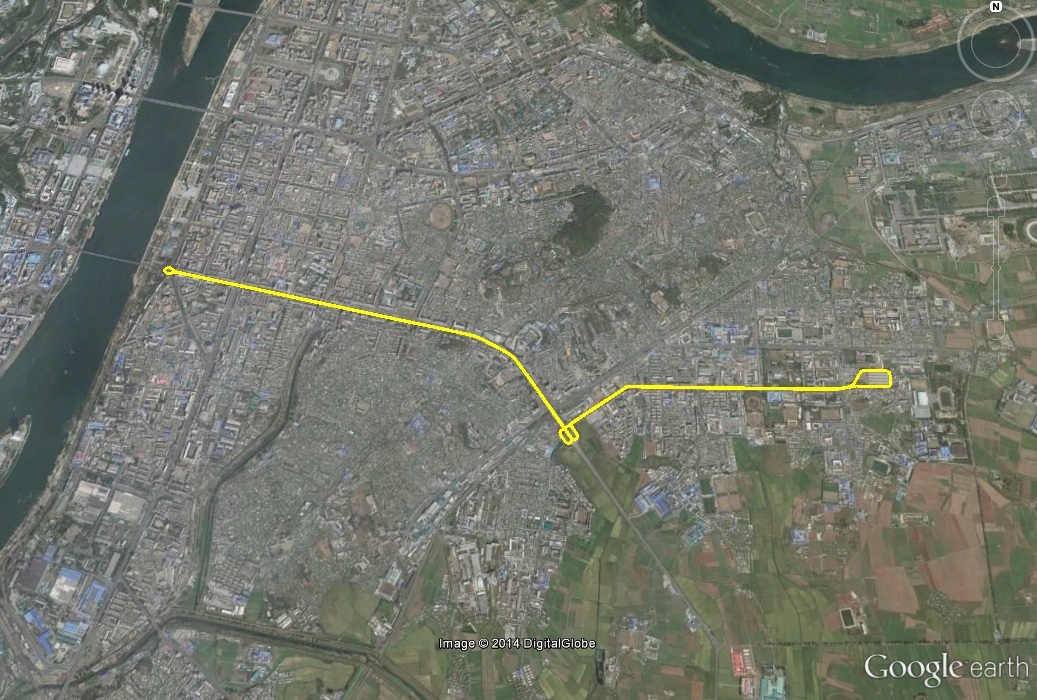
The Ministry of Land and Environment Protection of the Democratic People’s Republic of Korea plans to build a new road between Pyongyang and Phyongsong in order to facilitate public transportation in the western region of the country, including Pyongyang.

To this end, the ministry is going to purchase equipment and materials necessary for the project through international public tender. It also intends to employ international consultation services for technical assistance.

The international consultancy services will include road design, building operations and technical supervision (land fill, sand and gravel bedding, cement stability, paving, bridge construction, construction of small structures and protective guard and installation of road signs) and use of equipment and machines for road construction.

The equipment and materials to be purchased are as follows:

Hydraulic excavator, cement truck, self-propelled road liner, measuring equipment, bus, bulldozer, fuel truck, concrete cutter, geological testing equipment, cement, grader, trailer, voltage regulator, examination equipment, round steel, loader, sprinkler, water pumping equipment, drilling equipment, angle iron, Macadam roller, crane truck, dredger, printer, steel pipe, Dandem roller, stone crushing plant, horizontal vehicle for bridge construction, plotter, iron sheet, composite roller, mobile compressor, guniting machine, laptops, timber, tired roller, hammer drill, welder, laser surveyor’s rod (LEICA TCA 2003), asphalt, concrete paver (with the framed rails), rock-driller, electric generator, digital theodolite (SOKKIA DT 610S), fuel, concrete mixing station, asphaltic emulsion truck, pressure pump, automatic leveling instrument (SOKKIA C32II), aluminum sheet, asphalt mixing station, automatic truck, vibratory pile hammer, fork-lifter, luminous paper, mixture truck, asphalt paver, pressure pump, light reflection sign, and car.

Letters of tender invitation will be issued early in July 2013.

For more details, please contact:
International Implementing Office for Road Construction Project
Add: Pothonggang-dong No.1, Pothonggang District, Pyongyang, DPR Korea
Fax: 850-2-381-4416/4410

UPDATE 1 (2013-6-22): The Institute for Far Eastern Studies wrote about this tender:

North Korea to Acquire Road Equipment and Materials via International Auction
2013-6-22

North Korea has revealed plans to acquire equipment and materials for new road construction through an international auction.

In the May 29 economic news section of ‘Naenara,’ a website run by North Korea, it was reported that a new road is being built between Pyongyang and Pyungsung, South Pyongan Province. It announced that “with regards to the construction, the Ministry of Land and Environment Protection will purchase the necessary equipment and material through an internationally competitive auction.”

Naenara speculates that the ministry will purchase hydraulic excavators, buses, cement, and transformers, among fifty other items, with the auction invitation to be issued this July.  Naenara also announced that the construction and technological management of the roads will receive voluntary international consulting.

It is uncommon for North Korean media to publicize plans for receiving goods via an international auction. Whereas North Korea has usually made direct contact with foreign companies based in China, it has recently diversified its reception of foreign capital.

As the international society’s trust in North Korea is low, North Korea is pursuing changes in its methods of acquiring capital through avenues like international auctions. This can be interpreted as an intentional effort to show that North Korean liberalization and development policies are following international norms. Furthermore, in addition to adopting the law on economic development zones, North Korea is starting to focus more on developing a ‘special zone’, with construction of the ‘Sinuiju Special Zone’ scheduled to start soon.

At first, the ‘Sinuiju Special Zone’ was intended to develop by sections, receiving capital from not only Chinese companies but also Korean companies. However, due to faltering relations between the North and South, China has emerged as the sole partner of North Korea to co-develop the special zone.

Also, following the 12.1 Policy from last year, an umbrella organization will be set up to comprehensively manage the economic development zones pursued by the thirteen cities and provinces, and the two hundred twenty districts. While the North Korean Joint Venture Committee (Chaired by Lee Kwang-keun) was in charge of securing foreign investments for the development of the special zones, the new organization will manage not only all the specialized zones but also all the development zones.

Furthermore, there are plans to link Sinuiju, Pyongyang, and Kaesong via highway and high speed rail, an investment which is expected to cost 14.1 trillion KRW. The highway is expected to cost 4.7 trillion won and the high speed rail carries an anticipated price tag of 9.4 trillion won. In order to secure funding, North Korea plans to sell underground resources and secure sources of private investment. In terms of financing procurement methods, North Korea is considering BOT (build-own-transfer), BTL (build-transfer-lease), resources development rights as collateral, etc.

Share

North Korea passes city beautification law

Thursday, May 23rd, 2013

Institute for Far Eastern Studies (IFES)
2013-5-23

It has been confirmed that North Korea has passed a ‘City Beautification Law’ and that it is moving ahead in earnest with environmental beautification projects.

On May 9, 2013 the mouthpiece of North Korea’s cabinet, the Minju Chosun, introduced the city beautification legislation in its ‘Regulations Explained’ section. This is the first time city beautification has been mentioned in one of North Korea’s major publications. The Ministry of Unification claimed that “it has not yet been confirmed” whether this law has been enacted. The City Beatification Law was not included in the Complete Collection of North Korean Statutes which was published in October 2012. As such, one can infer that the City Beautification Law was enacted in the last few months.

According to Minju Chosun, the City Beautification Law is a five page document consisting of 42 clauses. The law’s purpose is “to contribute to providing a culturally sanitary living environment to the North Korean people by setting up strict institutions and establishing order in the following areas: the city cleaning industry, the beautification of buildings and facilities, and city planning.” The City Beautification Law sets regulations that provide for the participation of the North Korean people in the business of city beautification. It also establishes city beautification sectors for management by civic organizations, government agencies, and enterprises.

The legislation includes content which calls on North Koreans to strengthen cooperation and international exchanges in terms of city beautification. It also encourages scientific industry research for the sake of city beautification and the expansion of investment in the city beautification industry. Minju Chosun emphasized that city beautification is not something which can be taken on by only a few individual civic groups. Emphasizing that city beautification is a project which must be conducted on a national scale, the paper reported that, “it is a huge task which must be undertaken by all people across the country.”

Recent reports from major news centers in North Korea seem to confirm that North Korea is concentrating efforts in the city beautification business. In an April 3 article entitled “The Urban Planning Industry is a Noble Patriotic Industry,” Rodong Sinmun, the official paper of the Korean Workers’ Party, reported that “Continually, a great effort must be put into the innovation of the appearance of North Korea’s cities.” The paper suggested beautification techniques such as remodeling the facades of buildings, conserving fences, city planning, paving sidewalks with precast pavers, gardening and afforestation of areas around streams, and riverbank beautification.

On April 9, Pyongyang Broadcasting reported that Independence Road Park is being constructed in the Mangyongdae region as a relaxation area for workers and students. The park is projected to have facilities for volleyball, basketball, roller-skating, and mini-golf. At the end of last month, the Sweetbrier Center, a state of the art civic center, was opened on the bank of the Daedong River.

One is able to get a sense of North Korea’s plans for environmental beautification from Kim Jong Un’s recent statements and activities. While visiting the National Science Center Biological Building’s Turf Research Center, Kim emphasized the importance of cultivating grass: “Grass gives the ground a beautiful appearance by covering its exterior like silk. It plays an important role in protecting national land and in cultivating our living environment both culturally and in terms of sanitation.”

According to Kim’s statement, it can be assumed that the City Beautification Law’s enactment was driven by Kim Jong Un’s emphasis on building a “civilized socialist country.” The expansion of the task of city beatification from Pyongyang to other regions coincides with the slogan coined by the Kim regime: civilized socialist country. That the city beautification business is backed by legislation suggests it will not be a short term policy.

Share

On the DPRK’s thriving black market in real estate

Tuesday, May 7th, 2013

According to Radio Free Asia:

Private ownership of homes is illegal in North Korea, but residents of Pyongyang who make frequent trips to China and residents of cities on the border between the two countries told RFA it is no longer strange to hear about “sales” of government properties between individuals.

According to a virtual housing market for North Korean civilians, the country’s most expensive homes are located in Sinuiju, with Hyesan city in northern Yanggang province next in cost and Pyongyang in third.

A single family home or large apartment in what is deemed a good location in Sinuiju can fetch around U.S. $30,000, while those in the suburbs of Pyongyang and other border cities are priced less.

While houses are being built everyday in Pyongyang to supply a growing demand, it is difficult to find new homes in other cities, leading to a rise in the cost of real estate, the sources said.

A resident of Hyesan told RFA that homes in cities like his, near the border with China, command the highest prices on the black market because they provide access to Chinese money and infrastructure.

“I can’t say all houses in Hyesan are expensive, but those which are good for the smuggling trade and receive a clear Chinese cell phone signal are really high priced,” the source said, speaking on condition of anonymity.

“Several houses by the riverside are even priced similarly to Chinese houses on the opposite side of the border in [Jilin province’s] Changbai city,” he said.

Sources told RFA that the North Korean government has canceled licenses several times in recent years, issuing statements which describe the practice of housing transactions as an “offence against the system of the North Korea.”

But attempts to stamp out the trend have repeatedly failed as those involved in the sales include untouchable high-ranking officials and because the practice is too far reaching.

Read the full story here:
Illegal Trade in North Korean Homes Flourishes
Radio Free Asia
2013-5-7

Share

Tanchon Port reconstruction completed

Thursday, April 25th, 2013

Tanchon-port-2012-12-19

Pictured Above (2012-12-13): Tanchon Port

UPDATE 2 (2013-4-25): Yonhap reports on the DPRK’s plans for the Tanchon Port:

North Korea is scurrying to develop the resources-rich city of Tanchon on the east coast as part of the country’s efforts to make it a source of foreign currency income, recent news reports from the North showed.

Tanchon will become a key transit point in shipping goods to and from Russia’s Siberia, the northeastern part of China and Mongolia, said the Wednesday issue of the Choson Sinbo, a Korean language newspaper published by North Korean nationals in Japan.

The newspaper, a mouthpiece of North Korea, said the port city of Tanchon should become the source of finance for the country’s broader policy line of pursuing both economic development and nuclear capacities.
In a bid to boost exports, the country completed the construction of a port in May last year in the city with rich reserves of magnesite, zinc and other mineral resources, which sits about in the middle of the country’s east coast line. the Choson Sinbo said the city has about 5.4 billion tons of magnesite deposit, possibly the third biggest reserve in the world.

The news outlet also highlighted the country’s planned ways to increase earnings in the resources-rich city from which the country used to export mineral resources to China for meager profits.

“North Korea will move to manufacture processed magnesite goods in order to make high-value added goods,” the Choson Sinbo noted. “To that end, many plants will be built in the Tanchon region and the areas will become a new industrial zone.”

North Korean leader Kim Jong-un has also underlined the country’s plan to boost profits from the Tanchon development, saying in a national meeting of light industrial workers last month that profits from Tanchon development should be exclusively used to prop up the livelihood of North Korean people.

UPDATE 1 (2012-5-3): KCNA announces the completion of  the Tanchon Port:

A modern trading port made its appearance in the area of Tanchon in South Hamgyong Province on the occasion of the 100th anniversary of President Kim Il Sung’s birth.

The construction of the port with a cargo traffic capacity of millions of tons provides a guarantee for greatly contributing to developing the nation’s foreign trade and improving the people’s living standard.

A ceremony for the completion of the construction was held on the spot Thursday.

Present there were Choe Yong Rim, Kwak Pom Gi, Ro Tu Chol and other officials concerned, officials of the Ministry of Land and Marine Transport, builders and working people of industrial establishments in Tanchon City.

Read out there was a joint congratulatory message sent by the Central Committee of the Workers’ Party of Korea and the Cabinet of the DPRK to the officials and members of shock brigades who performed labor feats in the construction of the port.

The message highly praised them for successfully building another giant structure in the era of Songun greatly conducive to building an economic power true to the life-time desires and last instructions of President Kim Il Sung and leader Kim Jong Il.

It expressed belief that they would perform greater feats in the efforts for the country’s prosperity united close around the WPK Central Committee headed by the dear respected Kim Jong Un.

Minister of Land and Marine Transport Kang Jong Gwan, in his speech made for the occasion, said the construction of the port was a brilliant fruition of the wise leadership of Kim Jong Il who initiated the construction of the port and worked heart and soul to translate the desire of the President into a reality till the last moments of his revolutionary life and the clear-sighted guidance and meticulous care of Kim Jong Un.

Speakers at the ceremony pledged themselves to carry out their tasks including dredging in a short span of time in the same spirit as displayed in the construction of the port.

At the end of the ceremony the participants looked round different places of the port.

You can see video of the port inauguration here. (KCNA)

Just a few days ago, the Choson Sinbo reported the following (via Yonhap):

The North is estimated to have 15 billion tons of anthracite coal, a key mineral Pyongyang uses to produce steel, the Choson Sinbo newspaper said.

The North also has an estimated 5.4 billion tons of magnesite in Tanchon, a home to mines in South Hamgyong province, and other areas, according to the newspaper.

North Korea is set to open Tanchon as a modern trade port, the newspaper said, without giving any specific time frame for the opening.

ORIGINAL POST (2010-12-9): On December 2, KCNA announced that Kim Jong-il visited the port in Tanchon County, South Hamgyong County (40.412522°, 128.917731°) where he gave guidance on the port’s reconstruction.

Judging by the satellite imagery of the area on Google Earth, it appears that the project had already begun by May 13, 2009, where we can see concrete blocks ready to be used to extend the jettys (breakwaters).  I have outlined the proposed port project on Google Earth imagery below and provided a picture of the completed project from KCTV:

After the jettys are extended, the major construction work and dredging can begin.  Below are images of the port’s main construction site as it appears on Google Earth and a prediction of the project’s conclusion from KCNA:

It appears from the picture that the port will be connected to the railway system—likely via the nearby Tanchon Smeltery and Magnesia Plant (both recently renovated) whose products will probably be exported from the port.

Tanchon is also home to the DPRK’s Komdok and Taehung Youth Hero Mines (among others).  As is well known to readers, raw materials exports are the DPRK’s most significant (legal and transparent) source of hard currency.  According to Yonhap’s North Korea Handbook 2002:

Geomdeok [Komdok] Mine is a special company in Bonsan-dong, Dancheon, South Hamgyeon Province, and is very famous for about 300 million tons of deposited leads and zincs. This mine annually produces 52,000 tons of lead, 124,000 tons of zinc, both of which account for 47% of total production in North Korea, and more than twice as much as the production of Eunpa Mine, North Korea’s second largest mine, in Eunpa-gun North Hwanghae Province. Concentrates of lead and zinc produced from Geomdeok Mine are processed into electric zinc at Dancheon refinery. Opened in 1932, this mine produces 14,200 tons of raw ore annually with three ore dressing plants. Annual production capacity can reach up to 11 million tons. The first dressing plant was completed in July 1953, near the end of the Korean War. It now processes a million tons of ore a year. The second dressing plant was opened with a production capacity of 3,200 tons of ore. The third one constructed in September 1983 can process 10 million tons of ore.

Share

Some new Google Earth items

Tuesday, April 9th, 2013

I am way behind on blog posts. Actually, I am way behind on everything at the moment. However, I wanted to take a second to point out a couple of new items that appeared on Google Earth imagery today.

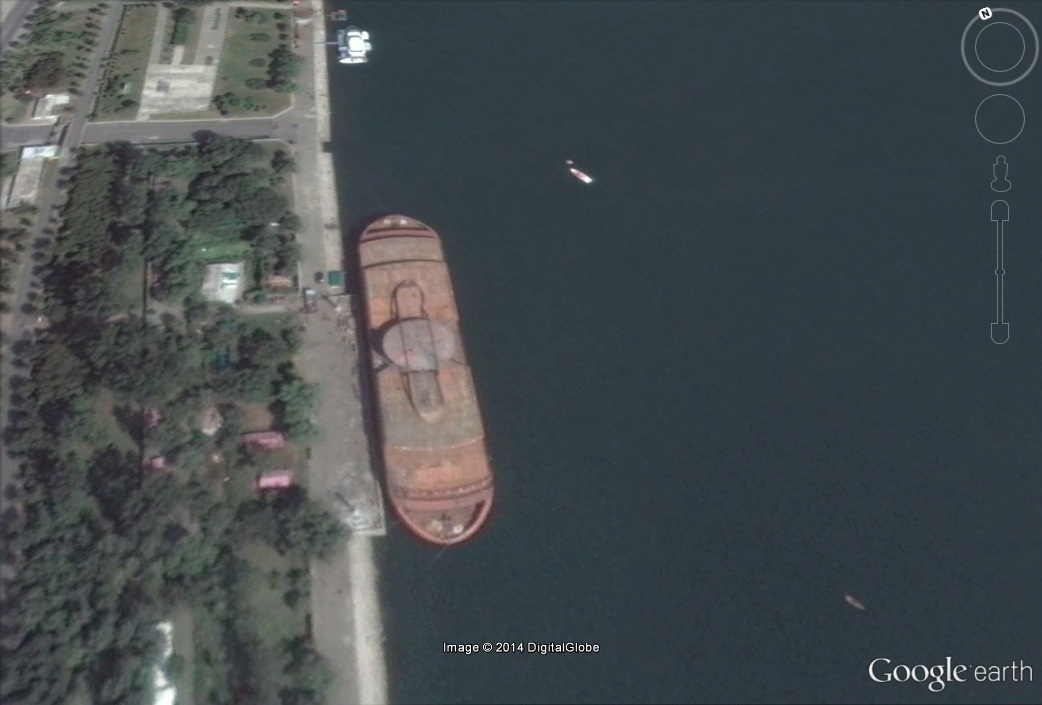
We can now see the new location of the USS Pueblo:

Pueblo-2013-Google Earth

Learn more about the Pueblo being moved here.

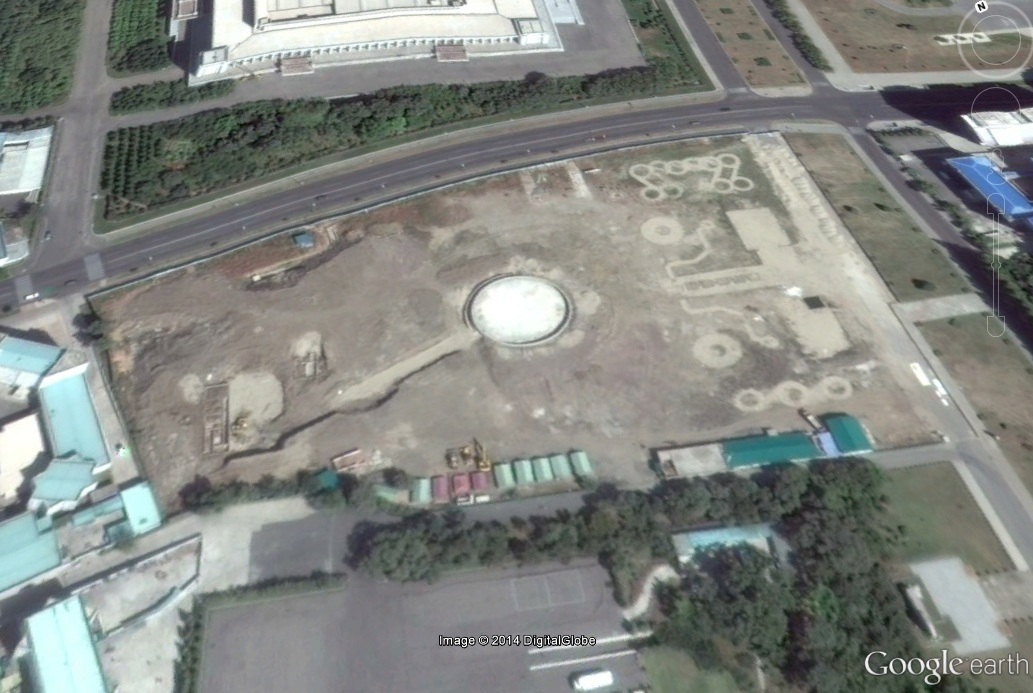
We can also see construction work has begun on the new shopping center and/or skate park in central Pyongyang:

Mansudae-construction

Learn more about the shopping center and/or skate park construction here.

Share

Some new retail developments in Pyongyang

Thursday, March 28th, 2013

Instagram is no longer an option for regular tourists to the DPRK, but expats and regular visitors are still allowed access to the service. So Koryo Tours has used mobile access to photograph some recent changes in Pyongyang. I thought I would post a couple of their interesting images below and match them with satellite imagery to give a little more perspective.

Taedonggang Bar No. 3 (대동강제3술집):

Taedong-gang-bar-no-3

Renovation on this bar began sometime after Feb 2012. The interior (pics by Koryo Tours) looks like any of the bars in Dupont Circle:

Taedonggang-bar-3-1 Taedonggang-bar-3-2

According to Koryo Tours, beer costs 1.5 Euros (per pint/half litre). There are seven taps along the bar. I assume they serve various brands of Taedonggang Beer.

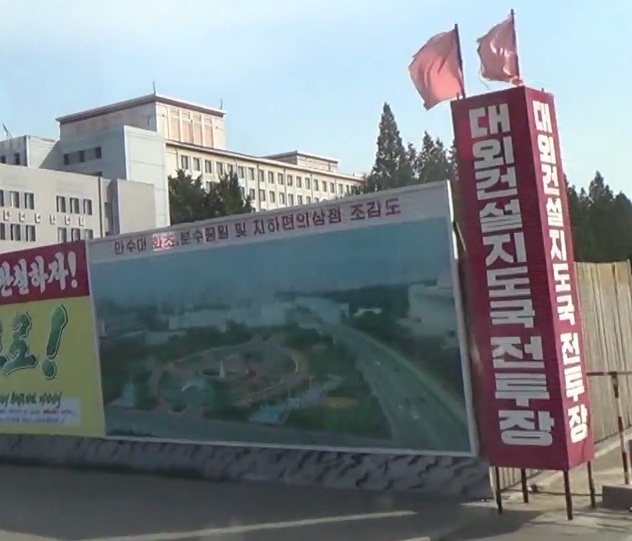
Koryo Tours also posted this image of a new shopping center under construction in downtown Pyongyang:

mansudae-shopping-center-construction

Plastered to the wall is a map of what the site will look like when construction is completed, however, it is too small to make out with any specificity with this image.  Currently we do not know any details about this facility (or even its proper name), but hopefully it will appear in the official North Korean media before too long. Here is the location of the new facility:

New-park-mansudae

The construction site sits on the former star-shaped fountain of the Mansudae Fountain Park….between the Mansudae Assembly Hall (Supreme People’s Assembly), Pyongyang Student’s and Children’s Palace, Mansudae Art Theater, and new Mansudae Street housing.

Share

Fatherland Liberation War Memorial Hall

Wednesday, March 27th, 2013

FLWM-satellite

Today NK News ran this story on the unfinished “Victory in the Fatherland Liberation War Memorial Hall” (조국해방전쟁승리기념관). I thought I would add some images of the interior of the building that were shown on North Korean television:

FLWM-interior-1 FLWM-interior-7

FLWM-interior-6 FLWM-interior-2

FLWM-interior-3 FLWM-interior-4

FLWM-interior-5


In addition to the construction of this building, the “Victory in the Fatherland Liberation War Museum” and the “Victory in the Fatherland Liberation War Memorial” are all under renovation. As previously reported (in December 2012), the Pueblo has also been moved here.

Share

New(ish) KPA construction in South Hwanghae Province

Wednesday, January 16th, 2013

The following post I reported on Radio Free Asia yesterday.

The Korean Peoples’ Army (KPA) is increasing its air and artillery capacity in South Hwanghae Province within the vicinity of the disputed West Sea maritime border and Yonphyong-do.

To begin with, in south-west Kangryong County near Sikyo-ri (강령군, 식여리), the DPRK has established four new KPA units each with dispersed revetments which could be used to protect deployed offensive capabilities such as artillery or short range rockets (MRLs)…maybe KN-08s? I will leave it to the professionals to figure out.

Sikyo-ri-KPA-units-1

According to available commercial satellite imagery, these units were built sometime between 2010-7-4 and 2012-6-20:

Sikyo-ri-2010 Sikyo-ri-2012

In the image above, just one of the four areas that has been constructed, we can see the creation of the new KPA unit as well as six revetments. These revetments lie 14-16 miles from Yonphyong-do.

To the east of this area, near Habupho, Kangryong County (하부포, 강령군), the Korean Peoples’ Army is building three lines of hardened artillery (HART) positions to protect the DPRK’s Multiple Rocket Launch (MRL) vehicles deployed to this area:

Kangryong-harts-2012

According to available satellite imagery, construction on these HARTs began in early 2011, and as of 2012-6-20, they appear to be nearly complete.

Kangryon-HARTs-2010-11-24 Kangryon-HARTs-2012-6-20

The line closest to Yongphyong-do, is 8.5 miles and contains three HARTs (Above). The second line is approximately 9 miles from Yonphyong-do and also contains three HARTs.  The third line is nearly 10 miles from Yonphyong-do and contains 6 HARTs.

The DPRK is also increasing capacities at it the closest fortified air force base in Kiam-ri, Thaethan County (기암리, 태탄군).

Thaethan-airfield-2011-6-13

Thaethan-airfield-2012-9-21

Pictured above are two satellite images of the Thaethan air force base in North Korea.  The top image is dated 2011-6-13. The lower image is dated 2012-9-21. The lower image has two highlight boxes.  In the box to the right, we can see the construction of 36 revetments which would be used to shield deployed artillery positions.In the box to the right, we can see an expansion of housing for use by the soldiers stationed at this base.

I have written previously about new KPA construction in the area here and here (photo). Joseph Bermudez also wrote about  a new hovercraft base in South Hwanghae.

Share

The future of Kim Il-sung University

Tuesday, January 15th, 2013

UPDATE 1 (2017-5-10): Building No. 3 was completed as part of the “Ryomyong Street” project.  According to the Pyongyang Times:

New building added to Kim Il Sung University

Building No. 3 has been unveiled at Kim Il Sung University located in the area of Ryongnam Hill which has been renovated along with landmark Ryomyong Street.

With an area of over 70 000 square metres, the building has well-equipped and multi-functional lecture rooms and labs, a sports field and welfare facilities.

An opening event was held on May 9.

ORIGINAL POST (2013-1-15): The campus of Kim Il-sung University has been the site of high-profile renovations and additions: the construction of the indoor swimming pool and renovation of the main building which includes an electronic library. The school also features a peculiar construction site that has made little progress over the years:


Pictured Above (Google Earth): (L) Kim Il-sung University on 2006-11-11, (R) Kim Il-sung University on 2012-6-20

Given the prestigious position the university holds in the DPRK I have often wondered what the hold up is on this site. Is it a funding issue? Is it a capacity (demand) issue? I still don’t know.

My curiosity about the construction project was raised again when I stumbled on this tourist photo taken at the Three Revolutions Exhibition (image date 2011-9-19):

The image features a new facility called the Kim Il-sung University Building No. 3 and it bears a resemblance to the construction site shown on the satellite imagery above.

That was interesting, but not really worth blogging about. However, on 2012-10-1 North Korean television aired a show about Kim Jong-il’s guidance in helping the school grow. The footage included this scene:

The proposed “Building No. 3” in this image is not entirely consistent with the artist rendering at the Three Revolutionas Exhibition, but it is similar. It is consistent with the satellite imagery, however.  We can also see that in addition to building No. 3 there are long term plans to to build yet another office/classroom building and a large stadium. Pyongyang could use another large stadium, right?

Share

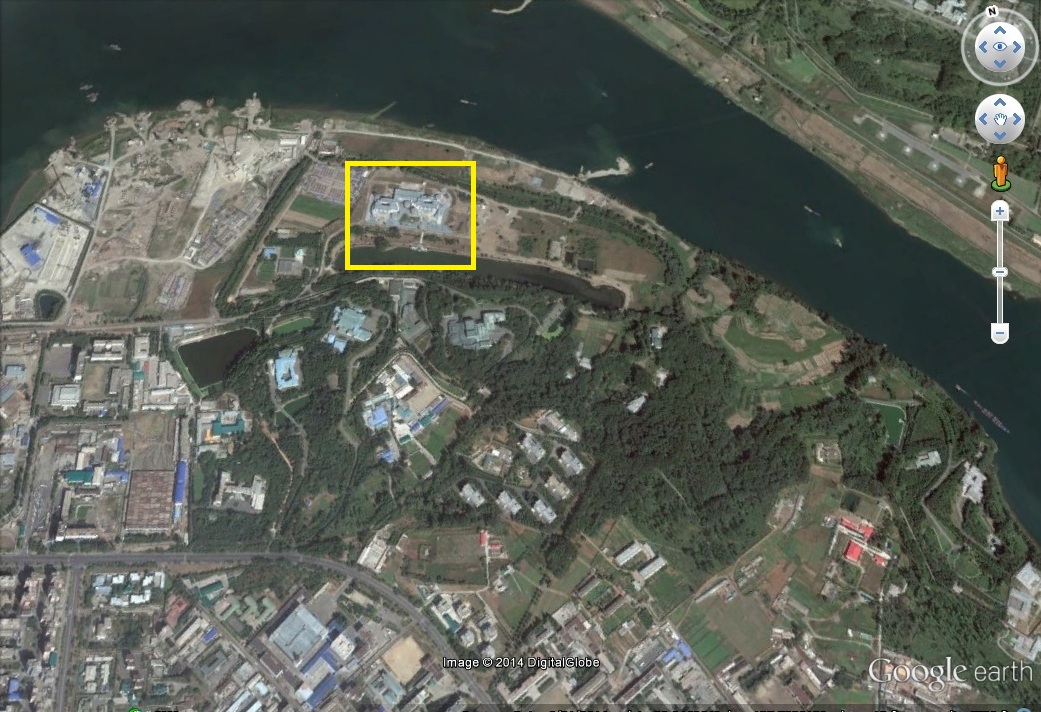
Kumsusan Palace renovations

Monday, December 17th, 2012


Pictured Above: Kumsusan Palace of the Sun (formerly “Kumsusan Memorial Palace”). On the left is an image from Google Earth (2012-6-20).  On the right is an image from GeoEye (2012-10-14).

UPDATE 4 (2012-12-17): The Kumsusan Palace has been opened and Kim jong-il’s body has been put on display. According to The Guardian:

North Korea has unveiled the embalmed body of Kim Jong-il, still in his trademark khaki jumpsuit, on the anniversary of his death.

Kim lies in state a few floors below his father, national founder Kim Il-sung, in the Kumsusan mausoleum, the cavernous former presidential palace. Kim Jong-il is presented lying beneath a red blanket, a spotlight shining on his face in a room suffused in red.

North Korea also unveiled Kim’s yacht and his armoured train carriage, where he is said to have died. Among the personal belongings featured in the mausoleum are the parka, sunglasses and pointy platform shoes he famously wore in the last decades of his life. A MacBook Pro lay open on his desk.

Here is footage from DPRK television:

UPDATE 3 (2012-12-17): Well, it was the first anniversary of Kim Jong-il’s death, rather than his February 2013 birthday anniversary, which marked the opening of the renovated Kumsusan Palace. According to the Associate Press (via USA Today):

North Korea unveiled the embalmed body of Kim Jong Il, still in his trademark khaki jumpsuit, on the anniversary of his death Monday as mourning mixed with pride over a recent satellite launch that was a long-held goal of the late authoritarian leader.

Kim lies in state a few floors below his father, national founder Kim Il Sung, in the Kumsusan mausoleum, the cavernous former presidential palace. Kim Jong Il is presented lying beneath a red blanket, a spotlight shining on his face in a room suffused in red.

Wails echoed through the chilly hall as a group of North Korean women sobbed into the sashes of their traditional Korean dresses as they bowed before his body. The hall bearing the glass coffin was opened to select visitors — including The Associated Press — for the first time since his death.

North Korea also unveiled Kim’s yacht and his armored train carriage, where he is said to have died. Among the personal belongings featured in the mausoleum are the parka, sunglasses and pointy platform shoes he famously wore in the last decades of his life. A MacBook Pro lay open on his desk.

Here is footage from North Korean television on the opening of the palace:

UPDATE 2 (2012-11-9): KCNA has reported on the renovations taking place outside the palace but not those taking place inside the palace:

Lawn Spreads Out around Kumsusan Palace of Sun

Pyongyang, November 9 (KCNA) — Service personnel, officials and working people carpeted the plaza park of the Kumsusan Palace of the Sun with turf of new species.

They created the lawn covering the area of tens of thousands of square meters in a short span of time with a single-minded desire to spruce up the area around the palace where the great Generalissimos Kim Il Sung and Kim Jong Il lie in state for perpetuity.

The lawn represents the ardent wishes of the service personnel and people of the DPRK to hold the great Generalissimos in high esteem for all ages.

They laid earth of 86 000 cubic meters on the ground to completely replace the former ground in a matter of several days.

They devoted themselves to such work as burning earth and humus soil and sowing the seeds of turf, covering up seeds with soil and taking care of them.

They provided the best conditions for the growth of the turf of new species by covering the area with fertile soil and humus of 12 000 cubic meters.

The seeds of all turfs sprouted in a matter of four-five days since their sowing and each has now two-three stems.

UPDATE 1: Raymond Cunningham photos of the place here.

ORIGINAL POST (2012-11-4): A few days ago I worked on this story for Radio Free Asia. The story highlights construction work being done at Kumsusan Palace. To date this work has not been reported in the North Korean media.

What do we see?  Most obviously, the large concrete plaza in front of the palace is being converted into a large park with new fountains and displays.

The former plaza was approximately 94,000 square meters of flat concrete blocks (according to Google Earth measurements). The new park in the plaza takes up approximately 57,000 square meters, or 60% of the real estate. This will prevent the sort of large scale military ceremonies that have taken place in the plaza over the years, however it will make the facility more enjoyable as a proper park.

We can also see that the main building is surrounded by debris (outlined in yellow), indicating that significant renovations are taking place within the building itself. Since the DPRK has announced that Kim Jong-il’s body will go on display like that of his father, Kim Il-sung, we can expect that exhibits on the life and accomplishments of Kim Jong-il are being added to complement the Kim Il-sung exhibits.

Given the date of the satellite image it is likely that the project will not be completed before winter temperatures arrive. It is possible that construction could come to a halt in the winter, yet I suspect that the North Korean workers (probably soldiers) will have to labor through the winter for a grand public opening on February 16th next year.

The construction work has yet to be announced in any official North Korean media outlet, and the cost and scale of the renovations are currently unknown outside of the DPRK.

The facility has not seen this scale of work since it was transformed following the death of Kim Il-sung.  During the renovations, the DPRK was widely criticized for spending millions of dollars on the palace even as many experienced food shortages and starvation throughout the country during the “Arduous March”.

Share

An affiliate of 38 North