Archive for March, 2009

Western apparel popular in DPRK

Tuesday, March 31st, 2009

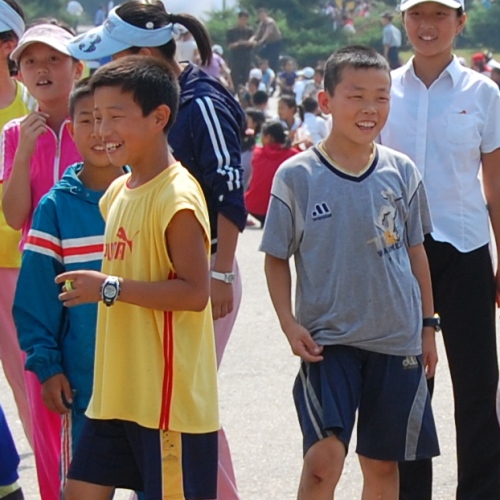
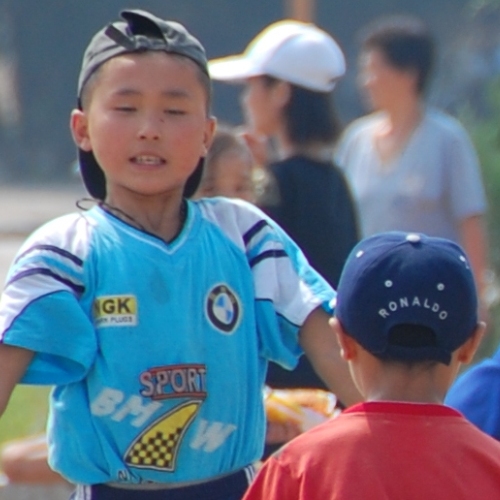
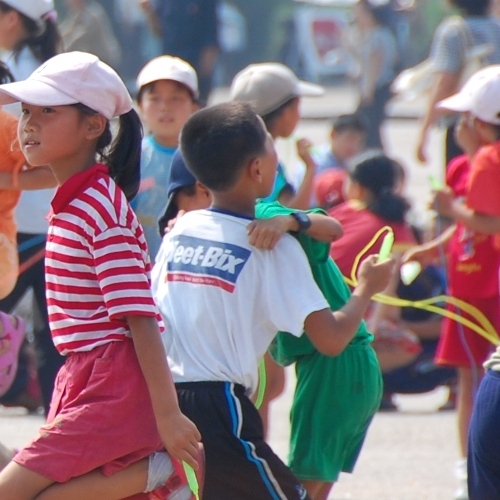
(Hat tip to Gavin) A reader recently visited the DPRK and took these pictures of children playing in Pyongyang.  There was no shortage of Western brands on display:

bmw.JPG weetbix.JPG

puma.JPG snoopy.JPG

Pictured above: BMW, Ronaldo, Weetbix (Weetabix), Puma, and Snoopy  

Thanks to entrepreneurial Chinese and DPRK merchants, Western brands are getting their foot in the door with some free advertising.  If BMW keeps up this covert strategy they might be able to knock Mercedes out of the top position some day!

Share

Limits of the “Lips and Teeth” Alliance: New Evidence on Sino-DPRK Relations, 1955-1984

Monday, March 30th, 2009

From the Wilson Center’s North Korea International Documentation Project:

The North Korea International Documentation Project is pleased to announce the publication of the latest addition to NKIDP Document Reader Series, Limits of the “Lips and Teeth” Alliance: New Evidence on Sino-DPRK Relations, 1955-1984.

The collection was specially prepared for the joint NKIDP-United States Institute of Peace conference, North Korean Attitudes Toward China: A Historical View of Contemporary Difficulties, and contains newly obtained documentary evidence on North Korea’s relations with China throughout the Cold War from Russian, (East) German, Albanian, and Hungarian archives. The 24 documents contained in the reader shed new and invaluable light on Pyongyang’s perspective of the Sino-DPRK relationship, and may force a reevaluation of the U.S. strategy of relying on China’s political leverage over North Korea to resolve contemporary disputes over North Korea’s nuclear weapons and ballistic missile programs.

Limits of the “Lips and Teeth” Alliance: New Evidence on Sino-DPRK Relations, 1955-1984 was edited by NKIDP Coordinator James Person with indispensable assistance from Tim McDonnell. NKIDP is part of the Center’s History and Public Policy Program directed by Dr. Christian Ostermann. This publication, like all NKIDP publications, was made possible by a generous grant from the Korea Foundation and is available for download free of charge from the NKIDP website.  

Download a PDF of the NKIDP reader here.

Share

Musudan rocket set up

Sunday, March 29th, 2009

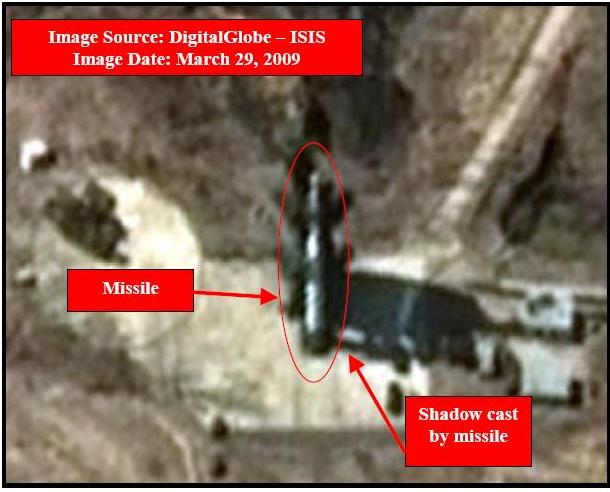
isis-musudan.JPGThough this web page is not focused on military affairs, today the Institute for Science and International Security (ISIS) sent out a picture of North Korea’s Taepodong 2 missile sitting on the launch pad at Musudan-ri. According to their email:

ISIS has obtained commercial satellite imagery from DigitalGlobe taken at approximately 11:00 AM local time on March 29, 2009 of the Musudan-ri missile site in North Korea. The missile is clearly visible in this image. It is also casting a shadow that is clearly differentiated from the missile launch gantry. According to news reports, the missile was installed on or after Tuesday, March 24, 2009. Since the missile is so easily seen in this image versus in imagery over the past several days since March 24 , it is likely that North Korea was previously shrouding the missile.

You may see the ISIS report here.

You can see the launch trajectory mapped out on Google Earth here.

As the T-2 will not threaten US territory, Uncle Sam has no plans to interfere with the launch.

Share

The first red Koreans

Friday, March 27th, 2009

Writing in the Korea Times, Andrei Lankov points out the interesting history of Koreans within the early communist movement:

The [Russian] revolution was followed by the Civil War which lasted to 1922, and during this conflict few ethnic groups supported the Communist Red Army with the same devotion and enthusiasm as the Koreans.

Some 8,000 Koreans joined the Red forces. This might not appear to be a large number, but the ethnic Korean community was roughly 100,000 strong in 1917, so it means that roughly one out of four able-bodied males joined the Communist army.

In most cases these people were volunteers, not draftees: for a long time, the Russian Far East was beyond the reach of the regular Red Army, so operations were conducted largely by guerrillas who relied on wide popular support.

At the same time, there were very few ethnic Koreans who chose to fight on the other side, with the anti-Communist Whites.

Such enthusiasm for the militant left was easy to explain. First, the battle cry of the Communists was “land to the farmers!” Most Koreans were farmers, but they often faced serious discrimination.

Russian authorities preferred to give land to the ethnic Russian settlers whose plots were then often toiled by Korean tenants. The Communists explicitly promised to change the situation by distributing land equally among all people who needed it.

Second, Koreans faced a certain amount of discrimination in old Russia, and Communists, being patiently anti-imperialist and anti-racist, promised that in a Communist Russia there would be no ethnic or racial discrimination whatsoever.

Third, in the Russian Far East the anti-Communist forces were supported and supplied by the Japanese. A large Japanese expeditionary force was actually dispatched to Siberia.

Taking into consideration that most Korean intellectuals (and nearly all politically active Korean leaders) had been active in the national liberation movement, they naturally enough became allies with their enemies’ enemy, that is with the Reds ― even if they did not initially harbor much sympathy for the Communists’ radical social program.

Thus, the Koreans entered the red guerrilla ranks in large numbers ― and in the early Communist armies they knew how to indoctrinate soldiers.

A number of those people, especially Russian speakers, soon became devoted Communists and active propagandists of the new teaching among their fellow Koreans.

The first prominent leader of the Korean Communists was a woman, Alexandra Stankevich (Nee Kim). Actually, she was more Russian than Korean in culture and education.

Her Korean father, a fluent Russian speaker and a professional interpreter, died when she was very young, and the girl was adopted by her father’s friend and his Russian family.

Alexandra received a good education, married (unhappily) a Russian man whom she later divorced, and traveled far across Russia.

From around 1915 she became very involved with underground socialist politics. In 1917-18 she was a prominent Communist leader in the maritime province and also a chief foreign policy negotiator for the local Communist government.

When in 1918 the government was overthrown by the Whites and their Japanese allies, Alexandra Kim was captured and killed.

Around the time of Alexandra Kim’s death, Yi Tong-hwi, a former officer of the Korean army, and by then a guerrilla commander, established the first Korean Communist group, called the Korean Socialist Party.

This happened in the city of Khabarovsk, and most party members were local Russian Koreans. Soon afterward, Yi Tong-hwi was even invited by Lenin to have a discussion about the Korean situation, in Moscow, and his small group became the first sprout of the Korean Communist movement, which for better or (more likely) worse influenced Korean history for the next hundred years.
Read the full story here:
First Red Koreans
Korea Times
Andrei Lankov
3/26/2009

Share

EU backs radio broadcasts into DPRK, RoK backs VOA

Friday, March 27th, 2009

Several foreign organizations are broadcasting radio content into North Korea: Free North Korea Radio, Open Radio for North Korea, Radio Free Chosun, Voice of America and  Radio Free Asia.   

According to Yonhap, the EU government and Reporters Without Borders (RSF) are throwing financial support behind FNKR, ORNK, and RFC:

The European Union (EU) and an international group of journalists forged a deal on Tuesday to provide 400 million won (US$290,000) to help anti-Pyongyang radio broadcasting stations run mostly by defectors from North Korea.

The EU and the Reporters sans Frontiers (RSF) signed the deal with three stations — Free North Korea Radio, Open Radio for Korea and Radio Free Chosun — in Seoul to fund their programs for the next three years.

The stations have been producing and sending shortwave anti-communism and human rights radio broadcasts across the border. In the past, North Korea has asked South Korea to suspend the stations, calling them an obstacle to unification.

In a related Associated Press story, the South Korean government is allowing Voice of America access to South Korean transmission equipment for the first time since the 1970s:

That makes the signal much clearer than VOA’s long-running shortwave broadcasts from far-flung stations in the Philippines, Thailand and the South Pacific island of Saipan. Moreover, it’s an AM signal, so listening in doesn’t require a shortwave radio.

“Radio can play a big role in changing people,” said Kim Dae-sung, who fled the North in 2000 and is now a reporter at Free North Korea Radio, a shortwave radio broadcaster in Seoul. “Even if it’s simply news, it’s something that North Koreans have never heard of.”

Still, the move could be seen as yet more provocative policymaking by a government already at loggerheads with the North over Lee’s tough policy on Pyongyang, and comes at a time of heightened regional tensions over North Korea’s plans to launch a rocket early next month. Nuclear envoys from South Korea and Japan flew to Washington for talks Friday with top U.S. diplomats about North Korea.

Since Jan. 1, VOA has been using the antenna facilities of the Far East Broadcasting Company-Korea, a Christian evangelical radio station, for half of its three-hour nighttime broadcast into the North. The antenna is only 40 miles (65 kilometers) from the border.

South Korea prohibited VOA from broadcasting from its soil for carrying a 1973 report on the kidnapping of Kim Dae-jung, then a leading South Korean dissident. The authoritarian Seoul government at the time is widely believed to have been behind the abduction.

North Korea condemns such broadcasts as “U.S. psychological warfare” and often jams the signals. So far, it has not interfered with VOA’s new AM broadcast, said radio expert Park. Doing so requires more equipment than blocking shortwave signals, and the fact that North Korea isn’t doing so may indicate the North is struggling economically, he said.

Read the full stories here:
EU, reporters promise 400 million won to promote radio broadcasts into North
Yonhap
3/24/2009 

VOA wins powerful base for broadcasts into NKorea
Associated Press (via Herald Tribune)
3/28/2009

Share

Satellites and salads as the DPRK moves toward construction of a strong and powerful nation

Thursday, March 26th, 2009

Institute for Far Eastern Studies (IFES)
NK Brief No 09-3-26-1
2009-03-26

North Korea has given notice that it will launch a rocket to place its ‘Kwangmyongsong 2’ satellite into orbit some time between the 4th and 8th of next month. The Choson Sinbo, the newspaper run by the pro-Pyongyang ‘General Association of Korean Residents in Japan’, carried an article emphasizing that the launch of the satellite will be an important step in the construction of a ‘Strong and Prosperous Nation’ by the year 2012.

The article, carrying the title, “Dream,” stated that “those who are clamoring that a missile and a satellite are the same” were trying to “steal away even the right to space development.” The paper went on to state that the children of North Korea would not have their dream of freely traveling to space “snatched away,” that the young would take delight in picking out the Kwangmyongsong 2 amongst the stars in the night sky, and that the next generation would further advance the North’s space exploration, “not as a dream, but as a reality,” insisting that Pyongyang is planning the launch of a satellite, not a missile.

On a less controversial note, North Korea’s online magazine “Uriminjokkiri (Our Nation by Itself)” announced on March 21 that renovations have been completed on eighteen restaurants in Pyongyang’s most famous dining district. Many areas of Pyongyang have been getting facelifts as the country prepares for 2012 celebrations of the creation of a Strong and Prosperous Nation in the year marking the 100th anniversary of the birth of Kim Il Sung. The website stated, “The interiors and exteriors of eighteen restaurants have been renovated and vanguard operating equipment has been installed.” It reported that the work was expected to take 2-3 years, but all renovations and upgrades have been made in the dining areas, kitchens, and storefronts in only 12 months. The restaurant district, near the Koryo Hotel and the (North) Korean Workers’ Party offices, is home to Pyongyang’s most exclusive restaurants, and offers a wide variety of dining experiences. 

Share

DPRK food prices stable

Monday, March 23rd, 2009

The Daily NK offers some recent food price data from the DPRK:

A defector named Kim, who keeps in touch with his family in the North, reported Monday in a telephone conversation with Daily NK, “The current food prices remain stable, according to sources from Hoiryeong and Pyongyang.”

Mr. Kim explained, “Rice sells in the Hoiryeong jangmadang at between 1,600 and 1,800won, around 200 won lower than before. Other grains and foods have fallen too. Pork sells for 2,800 to 3,000 won per kilogram and corn for 600 won per kilogram. An egg sells for 350 to 500.”

He added that, “Pork sold for about 5,000 won around lunar New Year’s Day and now it sells at half the price. Egg prices have risen a bit; they used to sell for 250 to 350 won. In Pyongyang, the price of rice, which was 2,200 won per kilogram in mid-January, is 1,700 won now. Corn per kilogram fell from 900 won to 750 won.”

He accounted for the lower food prices: In January, to greet the 60th anniversary of the friendship between North Korea and China, Chinese rice came in through Nampo port, so rice prices fell and provision of food increased. Since last year, the authorities have been able to deliver provisions to workers in a few major cities like Shinuiju.

He also relayed news that, “In February, a month’s provisions, 14 kilograms, were delivered to workers and their dependents; corn was provided through food distribution offices.”

Mr. Kim predicted that the situation will be at its worst in May and June of this year, although the food situation is comparatively much better than last year. No matter how good the last harvest was, though, it is not so significant for those who have to buy their food in the jangmadang.”

“Since 1995, food prices have always soared in May and June, the spring shortage season. After the spring this year they will soar again.”

In March or April, food in stock runs out and potatoes, barley, and other vegetables are not harvested until June. Therefore, rising food prices are a chronic spring phenomenon.

Pyongyang must feel reasonably confident, or they want us to think they feel reasonably confident, about current and anticipated food stocks.  As reported last week, the DPRK has requested that all foreign NGOs and aid agencies responsible for distributing food aid to cease operations and head home.

Mr. Kim does offer some good news from North Korea’s markets (Jangmadang).

For some time we have heard news that the North Korean government is attempting to turn the clock back on local markets by regulating who may work in them (older women), when they may openwhat they may sell, and at what price.  All of these restrictions are supposedly part of a plan to break them down and reorient the population towards receiving goods from state-owned shops and the Public Distribution System.  These measures could be part of the “2012 Kangsong Taeguk” plans, or they might simply be part of a longer-term political strategy.

It is rumored that these kinds of regulations have lead to violent backlashes because the socialist economy is not capable of supporting the population, and (paradoxically) markets are considered the social ”safety net”.  As a result, these market regulations are often ignored or “bypassed” by local officials and then quietly rescinded.  Mr. Kim offers anecdotal evidence that regulation of the markets has still proven unsuccessful:

“Decrees to close the jangmadang were posted at the entrances but in January they were all removed and the jangmadang operated as usual.”

Let’s hope that this is the fate of more recent regulations as well.

Read more below:
Previous posts on food.

Previous posts on North Korea’s markets.

Food Prices in North Korean Markets Stabilize
Daily NK
Yoo Gwan Hee
3/23/2009

Share

DPRK bans goods from markets

Sunday, March 22nd, 2009

Institute for Far Easter Studies (IFES)
NK Brief No. 09-3-20-1
2009-03-20

According to the North Korea Intellectuals Solidarity group, North Korean authorities released a list of goods banned from markets across the country on March 15. The ban goes into effect on April 1. The official list is said to include almost all wares currently being sold in the North’s markets, effectively banning market operations and practically outlawing private trade.

It was also reported that notices posted in the Hyesan and Wei Yan markets, in Yanggang Province, included not only a list of over 200 goods banned from sale, but also dictated the price at which allowable goods were to be sold.

Any goods from the United States or South Korea are specifically banned, as well as goods manufactured through inter-Korean projects such as joint ventures or from within the Kaesong Industrial Complex. Medicines and other supplies provided by the United Nations or other international organizations are also banned. Prices on foodstuffs were set, with Chinese millet to be sold at 1800 won, foxtail millet at 1700 won, and adzuki beans at 2100 won. Prices for privately harvested grains, eggs, tofu, poultry, pork, soybean oil, and other goods were also announced.

This measure appears to be in line with ongoing efforts underway since last year to close the North’s markets. While its effectiveness remains to be seen, if authorities succeed in shutting down markets, it could further exacerbate the North’s critical food shortages. In October of last year, North Korean authorities from regional commerce management offices throughout the country announced a ban on the sale of Chinese and South Korean goods, industrial products, and rice, corn and other grains, but this policy was never enforced.

Share

European insurers and LinkedIn nervous about the Swiss

Friday, March 20th, 2009

Over the last few years, the European Union has pursued an engagement policy with North Korea.   MEP Glyn Ford makes regular trips to Pyongyang to facilitate diplomatic progress; the German Freidrich Naumann Foundation runs economic education courses; European donors founded the Pyongyang Business School; and a small group of European ex-pat businessmen formed a de facto chamber of commerce, the European Business Association in Pyongyang.  Although European companies have experienced mixed success in the DPRK they continue to look for new opportunities

This morning, however, Felix Abt, a Swiss director of the PyongSu Pharmaceutical Joint Venture Co. in Pyongyang informs me that his life insurance policy (purchased from a European company) has been cancelled. 

“A European life insurance company cancelled my life insurance because I am a dangerous person living in a dangerous country. Credit card organisations cancel credit cards for such persons in such countries, health insurance companies come up with other reservations and limitations and the latest organisation that has just expelled me is LinkedIn with a very curious explanation.”

I am unsure how the cancellation of life insurance policies could impact other Europen investments in the DPRK, but the marginal effect cannot be positive.  Mr. Abt has been a resident of Pyongyang for years where he manufactures Western-quality pharmaceuticals.  Needless to say, the DPRK is very much in need of his services, so it is a shame that after all this time he is now considered a liability by his insurer.

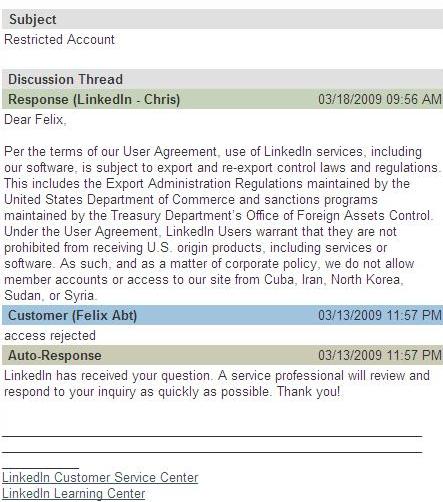
Mr. Abt also forwarded his rejection from the business networking site LinkedIn, which is posted below:
 

linkedin.JPG

Apparently LinkedIn‘s legal department considers logging into the server as “receiving goods of US origin” (the software I presume), and so it prohibits account holders, or even logging in, from Cuba, Iran, North Korea, Sudan and Syria—even if they are Swiss.

Share

Currency Conversion during Korean Unification

Wednesday, March 18th, 2009

Writing for the Brookings Institution’s Center for Northeast Asian Policy Studies, Yeongseop Rhee, Nonresident Fellow in Foreign Policy, takes on the topic of eventual currency union between North and South Korea, assuming that the two Koreas will eventually be unified and that the unification will follow a rapid process rather than a gradual one.

Under these conditions, Rhee discusses the complications of determining a proper conversion rate for the DPRK won, rejecting the official and black market rates, ultimately determining that an undervlued DPRK won conversion rate is preferable to a situation in which the DPRK won is converted at a rate above its true exchange value (a la German reunification). Quoting from the article:

The decision on a conversion rate will depend upon which policy objective is the most important. Considering their relative impacts and past experiences, I suggest that price/macroeconomic stability and competitiveness of North Korean industries should have the high priority: undervaluation of North Korean currency is therefore more desirable.[3] The experiences of other socialist countries show that inflation was one of the most difficult problems at the beginning of economic reforms. Even though the details of each country’s reform path depend upon the state of the economy, price/macroeconomic stabilization has to be the initial priority. Once price/macroeconomic stability is guaranteed, foreign capital – which North Korea eagerly needs for its successful transformation and development – can be attracted.

The undervaluation of North Korean currency is also desirable in terms of labor migration. According to studies on German unification,[4] the most important reason for migration from East to West was not the high incomes in West Germany, but the lack of job opportunities in East Germany. This implies that the overvaluation of North Korean currency to improve the standard of living of the North Korean people would cause more migration because of suffering competitiveness of North Korean firms and job opportunity, and would further place a higher burden on the government budget.

The author then goes on to address the timing of monetary unification (rapid vs. delayed conversion), prefering to emulate the German model of early conversion. Quoting from the article:

First, most proponents of a late currency union argue that currency unification needs to be delayed for a few years until North Korean economy is stabilized and improves to a certain level. However, a temporary delay of a few years will not guarantee the improvement of the North Korean economy to a certain level but is more likely to lead to its deterioration. Even though the North Korean economy may improve, it actually must grow much faster than South Korean economy for a long time to reach a certain compatible level. For example, even assuming North Korean economic growth of 10 percent per year – which would be extremely difficult – it will still take nearly one generation for North Korean per capita income to reach one half of the South Korean level. This suggests that it is impossible to improve the North Korean economy to a certain level compatible with South Korea’s within a few years. Thus, in terms of feasibility, an early union is better.

Second, a gradual strategy for economic reform and opening, such as China has chosen, would not be applicable to North Korea. In comparison with China, North Korea is over-industrialized like Eastern European countries. In this type of economy where the state sector is dominant, there is little reserve of labor outside the state sector that can provide the engine for growth for a new non-state sector, and gradualism cannot work in that context. A sharp downturn in industrial production upon the outset of market reforms is inevitable, and a significant loss of employment in the industrial sector should be expected and accepted as a structural adjustment in North Korea. Thus, the unified fiscal and monetary policy framework to promote structural reforms should be prepared as soon as possible through an early currency union.

Third, according to the theory of optimum currency area, if there exists an adjustment mechanism such as flexible prices and wages or other measures to absorb asymmetric shocks, it is more likely for two countries to form an optimum currency area. When the two Koreas are unified, large fiscal transfers from South Korea to North Korea can play that role of adjustment mechanism because asymmetric shocks to North Korea can be compensated by these fiscal transfers. The two Germanys could form an optimum currency area after the unification because of the centralization of the fiscal system. Thus, as long as fiscal transfers are guaranteed, which will be a sure fact in the case of Korean unification, the loss of the exchange rate policy instrument would not matter much in terms of absorbing asymmetric shocks, and an early monetary union is preferable.

Read the full article on the Brookings web page here.

(more…)

Share

buy Crestor cheap without prescription cheap Accutane for sale online no prescription required purchase Zithromax online purchase prednisone online no membership overnight shipping xenical online sale without prescription Valtrex online no rx overnight Flomax pharmacy generic prednisone online Flomax precio purchase online Crestor without rx buy Crestor 10 mg Buspar buy order online Crestor without prescription discount Zithromax purchase Buspar pay pal without rx cheap order rx Valtrex cheap generic Zithromax buy Zithromax legally Buspar wholesale comprar Bupropion generico purchase Amitriptyline over the counter cod overnight generic valtrex uk purchase rx Buspar without where to buy generic Buspar online without a rx purchase Valtrex online without rx buy finpecia on line xenical shipped over night without a perscription no presciption xenical Buy Accutane without prescription prednisone no r x foreign Proscar without rx medications buy of Cytotec buy Valtrex without rx needed Buspar free consultation fedex overnight delivery Nizoral canada where to buy Orlistat without a prescription Orlistat cheap no rx required canada buy in Valtrex uk buy on line Flomax prednisone How to get prednisone perscription valtrex buy no prescription buy Accutane without a prescription online buy cheap Zithromax under without rx buy Cytotec paypal without rx Finasteride 1 mg buy Flomax overnight buy cheap Rosuvastatin line buy Tamsulosin in england buy Orlistat with amex buy Flomax diet pills where to buy generic proscar online without a rx purchase Valtrex free consultation buy mail order Valtrex how to get prednisone Orlistat buy buy Valtrex and Valtrex online prednisone Crestor for sale buy Buspar fed ex Buy xenical without prescription purchase online rx Premarin without Buspirone 10 mg finpecia cheap overnight fedex buspar free consultation fedex overnight delivery prednisone online no prescription and overnight purchase prednisone money purchase Cytotec overnight US delivery buy Xenical cash on delivery purchase Zovirax amex online without prescription Accutane buy Accutane ordering xenical over the counter buy Xenical no visa online without prescription online purchase Xenical Orlistat by mail overnight shipping on generic accutane where can i buy Zithromax online without a prescription Orlistat without prescription Accutane order where can i purchase Orlistat without a prescription online prescription Valtrex online finpecia order Buy Cytotec no r x cheap Valacyclovir delivered overnight valtrex without script purchase generic valtrex online buy Flomax amex online without prescription Zithromax canada buy cheap generic Orlistat online Prednisone online order purchase Orlistat online without rx buy discount Zithromax line Xenical online no prescription xenical without presciption buy discount Zithromax line purchase Premarin online no membership buy 0.625 mg Premarin buy 40 mg Accutane buy xenical 120 mg buy cheapest Xenical where can i buy Xenical online without a prescription purchase xenical without Flomax overnight without rx purchase cheap Valtrex Flomax apotheke Flomax cash on delivery order cheap overnight Valacyclovir Amitriptyline no prescription to buy buy prednisone online without script Crestor online without prescription Flomax wholesale order xenical online with overnight delivery xenical with overnight fedex Prednisone no prior script no rx Crestor with fedex buy no perscription Buspar Cytotec bestellen buy generic Amitriptyline canada valtrex precio buy cheap Valtrex line buy Orlistat fed ex order overnight xenical online Zovirax buy buy Premarin without a prescription online order rx free Nizoral no prescription required prednisone pharmacy Valtrex Zithromax without rx overnight shipping purchase Orlistat no scams buy prednisone online cod Flomax bestellen where to purchase Accutane no prescription no fees online pharmacies Valtrex buy discount Accutane line cheap Amitriptyline online buy 5 mg Proscar buy no prior prescription Prednisone buy Prednisone diet pill order buy Maxalt online order cheap overnight Crestor wholesale valtrex cheap buy in Valtrex uk Buy prednisone overnight shipping Prednisone sale Crestor ordering Valtrex online Strattera from india ordering Strattera without a script order online Flomax without prescription want to buy Flomax in malaysia purchase Cytotec without prescription from us pharmacy buy Prednisone diet pill Accutane without dr safety order Prednisone buy one Cytotec pill online order Valtrex online with overnight delivery Cytotec overnight fed ex no prescription order Crestor overnight Premarin without rx Valtrex oral