Archive for the ‘Statistics’ Category

DPRK-PRC trade shoots up 25%

Thursday, August 28th, 2008

Instutite for Far Eastern Studies (IFES)
NK Brief No. 08-8-28-1
8/28/2008

Recently published Chinese customs statistics reveal that trade between North Korea and China in the first half of 2008 was 1.151 billion USD, 25 percent higher than in the same period last year.

Exports were up 13.5 percent at 330 million USD, while imports grew by 31.1 percent to 820 million USD. This means that the trade deficit for this period, 491 million USD, was 44.1 percent greater than the first half of 2007.

Mining topped the list of North Korean export industries, with 118 million USD worth of ores exported to China making up 36.2 percent of all goods sent across the border. Exports included 71 million USD worth of fossil fuel, 39 million USD worth of steel, 30 million USD in clothing, and 9 million USD in aluminum. On the other hand, Chinese goods imported by the North included 302 million USD in fossil fuels, making up 36.9% of all imports. 68 million USD in machinery, 37 million USD in electronics, 30 million USD in food, and 30 million USD worth of vehicles (excluding trains) were also brought in.

Mining exports were up 69.4 percent over the first half of 2007, making up the largest part of the increase in exports. The rising international price on natural resources was a factor in the North’s increase in exports of iron ore. The 68.1 percent rise in the import of fossil fuels, on the other hand, made up the largest share of the increase in imports, and this can also be attributed to the increase in global fuel prices. 

What comes after Sunshine?

Wednesday, August 27th, 2008

The policy of mutual benefits and common prosperity

It doesn’t have the same ring as “Sunshine Policy,” and the acronym PMBCP is too long, but this is the English name of South Korean President Lee Myung-bak’s policy towards the DPRK. 

According to Yonhap:

We decided to fix an English name for the policy because there have been many different translated versions,” Kim Ho-nyoun, spokesman for the Unification Ministry, the top Seoul office on North Korea, told reporters.

He said the name was chosen because it best suits the government’s policy of pursuing a relationship of co-existence and co-prosperity with the North beyond the current phase of reconciliation.

The government aims at a firmer inter-Korean reconciliation than its two liberal predecessors, seeking to bring tangible benefits not only to the North but to the South as well, officials said.

President Lee Myung-bak pledged during his election campaign to help the North triple its per capita gross national income to US$3,000 if it abandons its nuclear programs and opens itself to the world.

The so-called “Vision 3,000″ program is now part of Lee’s broader North Korea policy, officials said.

The goal of tripling the DPRK’s per capita GNI (GNP) to $3,000 is based on the assumption that the DPRK’s current per capita income is close to $1,000, which is a wild over statement.  Some more realistic assesments put it as low as $368 per yearHere is a wrap up of the DPRK’s most recent economic stats from the Bank of Korea.

Read the full article here:
Gov’t sets official English name for N.K. policy
Yonhap
Shim Sun-ah
8/26/2008

Inter Korea trade and exchange

Sunday, August 24th, 2008

Last week, the Choson Ilbo reported on trade, tourism and other exchanges between the two Koreas:

The number of [South Korean] tourists to North Korea plunged more than 60 percent last month following the shooting death of a South Korean tourist at Mt. Kumgang resort.

The Unification Ministry says the number dropped to about 21,000, almost a 20 percent decrease from July of last year. The resort was closed after the shooting.

The amount of trade between the Koreas also dropped 1.5 percent from last year.

Although commercial transactions at the jointly-operated Kaesong Industrial Complex in the North increased more than 28 percent year on year, non-commercial transactions, such as aid to the North, plunged more than 80 percent.

Read more here:
Tourism to N. Korea Drops 60% in July
Choson Ilbo
8/18/2008

DPRK and Myanmar trade: Guns and rubber

Sunday, August 24th, 2008

Myanmar severed diplomatic relations with the DPRK after North Korean agents attempted to assassinate South Korea  president Chun Doo Hwan on his October 1983 visit to Rangoon.

Diplomatic relations between the two countries were restored in April 2007.  Shortly after, North Korea was accused of selling rocket launchers to Myanmar’s SPDC (Orwellian acronym for: State Peace and Development Council)–formerly known as SLORC (State Law and Order Restoration Council).

Now the AFP reports that trade has expanded into natural resources, with which Myanmar is abundantly blessed:

Military-run Myanmar is to begin exporting rubber to North Korea, in a further warming of relations between the reclusive governments of the two countries, a weekly newspaper reported Tuesday.

“They will start by importing at least 10,000 tonnes within the first year,” Khaing Myint of the Myanmar Rubber Planters and Producers Association was quoted as saying by the Myanmar Times.

“We are extremely pleased to add another client nation to our export destinations for our rubber. We expect the first batch to be delivered in October,” Khaing Myint reportedly said.

Read the full article here:
Myanmar to begin rubber exports to North Korea
AFP
8/19/2008

Download glitch fixed: North Korea Google Earth (version 11)

Thursday, August 14th, 2008

The most authoritative map of North Korea on Google Earth
Download it here

This map covers North Korea’s agriculture, aviation, cultural locations, markets, manufacturing facilities, railroad, energy infrastructure, politics, sports venues, military establishments, religious facilities, leisure destinations, and national parks. It is continually expanding and undergoing revisions. This is the eleventh version.

Additions include: Mt. Paegun’s Ryonghung Temple and resort homes, Pyongyang’s Chongryu Restaurant, Swiss Development Agency (former UNDP office), Iranian Embassy, White Tiger Art Studio, KITC Store, Kumgangsan Store, Pyongyang Fried Chicken Restaurant, Kilju’s Pulp Factory (Paper), Kim Chaek Steel Mill, Chongjin Munitions Factory, Poogin Coal Mine, Ryongwun-ri cooperative farm, Thonggun Pavilion (Uiju), Chinju Temple (Yongbyon), Kim il Sung Revolutionary Museum (Pyongsong), Hamhung Zoo, Rajin electrified perimeter fence, Pyongsong market (North Korea’s largest), Sakju Recreation Center, Hoeryong Maternity Hospital, Sariwon Suwon reservoir (alleged site of US massacre), Sinpyong Resting Place, 700 Ridges Pavilion, Academy of Science, Hamhung Museum of the Revolutionary Activities of Comrade Kim Il Sung, South Hamgyong House of Culture, Hamhung Royal Villa, Pork Chop Hill, and Pyongyang’s Olympic torch route. Additional thanks go to Martyn Williams for expanding the electricity grid, particularly in Samjiyon, and various others who have contributed time improving this project since its launch.

Disclaimer: I cannot vouch for the authenticity of many locations since I have not seen or been to them, but great efforts have been made to check for authenticity. These efforts include pouring over books, maps, conducting interviews, and keeping up with other peoples’ discoveries. In many cases, I have posted sources, though not for all. This is a thorough compilation of lots of material, but I will leave it up to the reader to make up their own minds as to what they see. I cannot catch everything and I welcome contributions.  Additionally, this file is getting large and may take some time to load.

Hyundai Asan pays DPRK for July tourism

Tuesday, August 12th, 2008

Excerpt from the Choson Ilbo:

Asan said Thursday it paid US$675,250 to North Korea to cover costs accrued by 10,380 South Korean tourists who visited the mountain resort on July 1-11, until the tours halted after a South Korean tourist was shot and killed by a North Korean soldier at Mt. Kumgang.

Asan sends the payment at the end of each month, at the rate of $30 per person for a one day tour, $48 for two days or $80 for three days. Later this month, Asan will pay a further $928,560 to the North to cover the cost of trips to another tourist destination, Kaesong City. The cumulative payments Asan made to the North for the first six months of the year amounts to $10.7 million for the Mt. Kumgang tour, and $5.1 million for the Kaesong tour.

Read the full story here:
Asan Pays N.Korea for July Tours
Choson Ilbo
08/08/08

South Korea energy assitance to DPRK

Tuesday, August 12th, 2008

Despite tensions between North and South Korean this year, South Korea is still delivering promised energy aid to the North:

Under a six-nation accord signed last year, South Korea has started delivering energy assistance to North Korea.

This week’s shipment included 600 tons of round steel bars.

Seoul has so far provided assistance worth 124,000 tons of heavy fuel oil.

Read the full story here:
South Korea supplies the North with energy
Birmingham Star
08/08/08 

China’s tax windfall on DPRK border

Thursday, August 7th, 2008

In the last several months the Daily NK has reported on North Korea’s anti-corruption campaigns, particularly in Sinuiju and Hyesan, major DPRK/China trade hubs. Additionally, we have seen stories of how the Chinese are making life harder for resident North Koreans in the run up to the Olympics.

These measures, both of which should have an adverse impact on trade volume between the two coutries—and thus on tax revenues—made this recent report in the Daily NK all the more surprising. China’s Yanji Customs House (along the North Korean border) has reportedly seen a 226% increase in tax revenue this year from trade with North Korea.

How can China and the DPRK make life difficult for traders/entrepreneurs and still see an increase in the value of traded goods and corresponding tax revenue?  According to the article:

Jilin Newspaper in China reported on the 4th that “[…]For the first half of this year, tax revenues vis a vis North Korea totaled 34.22 million Yuan, up 226.2 percent from the year before.

The newspaper continued, “During this period, entrepreneurs in Yanji imported 64 thousand tons of iron ore from North Korea; that is a 2.3 percent increase from the same period a year ago. Accordingly, the tax amount of collected was 29.13 million Yuan, which is 66.1 percent of the total tax revenue derived from North Korea.”

The Yanji Custom House covers seven border gateways with North Korea, such as Juanhe-Wonjeongri, Shazi-Saebyul, Tumen-Namyang, Sanhe-Hoiryeong, Kaishantun-Sambong, Naping-Musan, and Guchengli-Samjangri.

According to the Yanji Custom House statistics, the Naping-Musan border gateway, where iron ore collected from the Musan mine enters China, is the first ranked for commercial traffic, and Guchengli-Samjangri, the gateway for North Korean timber, is second.

Tonghua Steel Group, Yanbian Tianchi Trade Incorporated Compay, and Zhonggang Group purchased 50-year mining rights for North Korea’s Musan mine in 2005. Since late 2007 they had been discussing a seven billion Yuan additional investment in it but that failed due to conflicting views on cooperative investment rate proportions, methods of withdrawing invested funds and other issues. As a consequence of the stalled investment, the Musan mine’s exports to China have not grown relative to last year’s figures.

So most of the trade that goes through Yanji is in raw natural resources, particularly iron ore and timber, and trade in these resources seems to be carried out by Chinese companies and is probably supported (protected) by senior policy makers on both sides of the border.  Rather than looking at politics as an explanation, it might simply be another result of rising global commodities prices.

The tax windfall could come from one of two sources: A volume (unit) import tax (ex: $1 for each ton of iron) or an ad valorem import tax (ex: tax on the monetary value of the goods).  It is not likely they impose much of an export tax to make a difference.

If China imposed a unit tax, the revenue gains would have to come from surging imports.  In this case, it would be likely that the Chinese companies had fixed-price contracts with their North Korean suppliers, and that  the increase in global commodity prices simply made DPRK iron ore comparatively very cheap.  When (if?) global iron prices fell, we would expect to see China decrease imports from North Korea.  But according to the article, iron imports are up only 2.3%—not enough to explain the surge in revenue.

It is more likely that China imposes an ad valorem tax on North Korean imports and the contracts between the Chinese companies and North Korean suppliers are set at (near) market prices.  Simply put, taxing the monetary value of increasingly valuable imports has been beneficial for the Chinese government.  Even though production at the Musan Mine has not increased much, revenues are probably way up.

Given the status of the Musan Mine as the DPRK’s largest, it is likely that funds raised from this mine are firmly under control.  It would be interesting to know the customs receipts in Dandong, Laioning Province, across the river from North Korea’s Sinuiju.  Sinuiju seems to have suffered the brunt of the DPRK’s anti-corruption drive, and it is the main railway and trade artery between North Korea China.  Most of the companies targeted for inspection were in Sinuiju.  Have Chinese tax collections/trade rebounded there?

Read the full story here:
226% Rise in Tax Revenues at Yanji Custom House
Daily NK
Lee Sung Jin
8/6/2008

A Dangerous Opportunity in North Korea

Thursday, July 31st, 2008

United Methodist Church: Kentucky Annual Conference
Dr. Bill Moore
7/31/2008

Dr. Bill Moore, the pastor of Southern Hills United Methodist Church in Lexington, was in North Korea May 14-29.  The son of United Methodist missionaries, he is a member of a humanitarian aid group called Christian Friends of Korea.  He offers a perspective on a deepening crisis.

I traveled to North Korea during the last two weeks of May as a member of a six-person delegation from a non-government organization (NGO) called Christian Friends of Korea. We flew into the capital city of Pyong Yang to confirm the arrival and proper distribution of donated goods, to deliver donors lists and greetings, and to build relationships and trust. The Board of Directors for this group, of which I am a member, is composed of former missionaries to Korea, the children of missionaries, and others with a concern to relieve the suffering and hardships of the people of this grim Communist dictatorship called the Democratic People’s Republic of Korea.  It is often hard to see the suffering faces of the 23 million North Koreans hidden behind the headlines of international diplomatic struggle and nuclear intrigue.  Famine, floods (two devastating events in 2007), and mismanagement have left the nation in economic ruin. Christian Friends of Korea (CFK) has been quietly working in the DPRK for 13 years, meeting some of the most basic needs of thousands of people struggling with the life-threatening, but curable disease of tuberculosis. CFK’s efforts to show love and compassion to people who continue to endure food shortages, poverty, disease, and oppression are building trust and chipping away at long-standing hostility.   
 
North Korea is a beautiful place in May.  Everything had greened up nicely.  The cottonwood trees had deposited wind-blown piles of downy fluff in the roadways, blanketing the bushes and spider webs.  The guest house on the banks of the Taedong River near Pyong Yang where our Christian Friends of Korea Team stayed for most of the visit had a dense backdrop of vegetation, populated by ring neck pheasant, which appeared unfazed by the foreigners nearby and sounded off regularly.  The acacia trees were in full bloom.

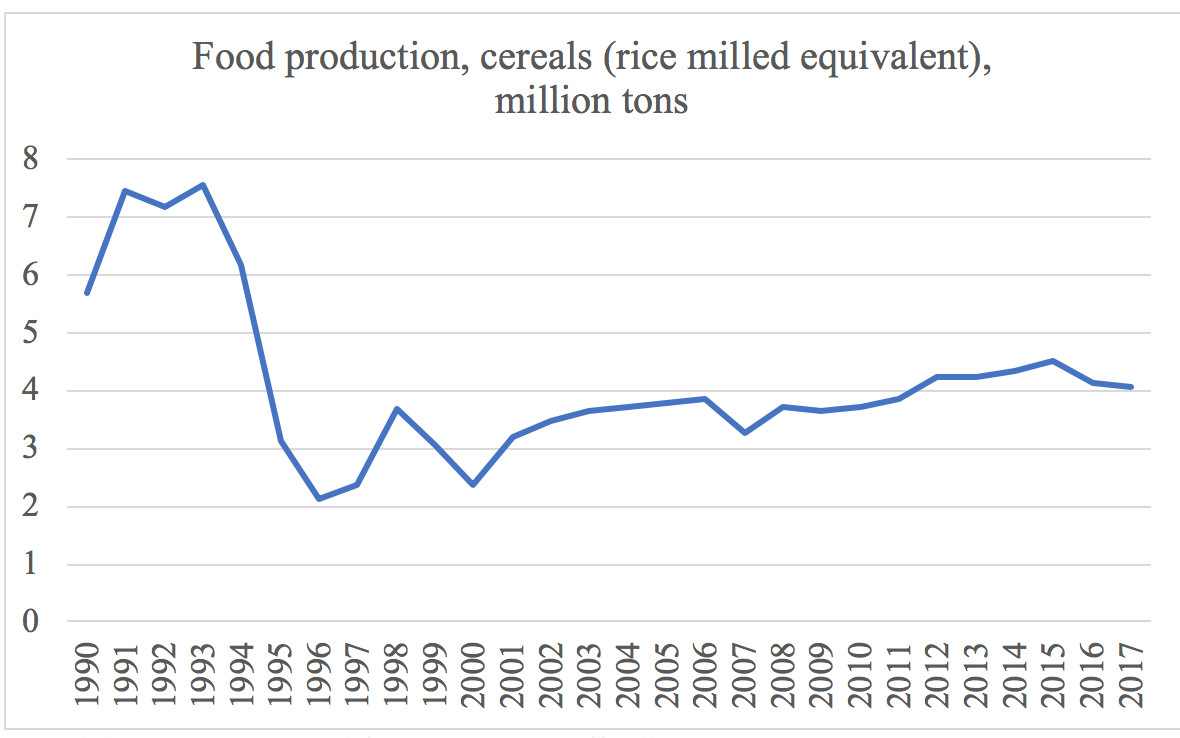
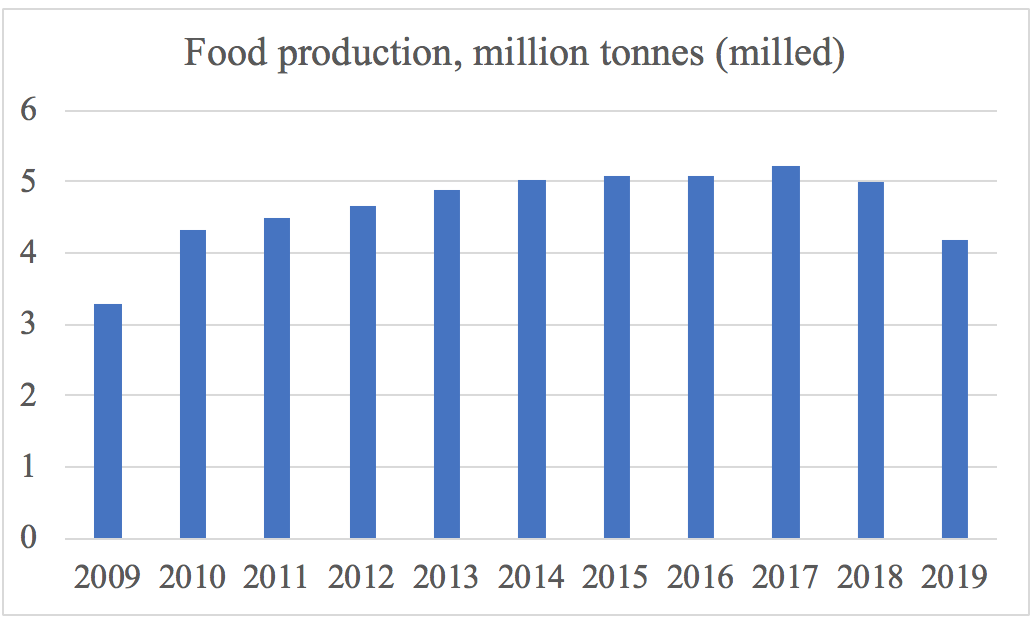
As we moved through the countryside, the workers on the collective farms were transplanting rice plants into the paddy fields.  This is a critical phase of life in the north, and everyone is expected to take part.  Backs bent, barefooted workers move slowly across the fields.  On the mud dikes of the water-filled paddies there are often patriotic slogans on placards, revolutionary red flags flying, and even sound trucks playing inspirational songs.  This idyllic picture of a worker’s paradise belies a truth that is not readily apparent.  The coming fall harvest, which is vital to a nation where one-third of the people suffer from malnutrition, is already in jeopardy.  Previous large shipments of fertilizer from South Korea have been withheld this year for political reasons.  China has pledged to fill the gap, but nothing has arrived yet.  Aid workers from other countries told us that the potato crop is already stunted, and predicted that the rice crop will be twenty-five percent less this year.  Even in years of good harvests, North Korea still falls about 1 million metric tons short of food, out of an estimated 5 million tons needed.    This year the shortfall is expected to exceed 1.6 million metric tons.  For those receiving rations, the daily government ration of grain per person was reduced from 250 grams to 150 grams in June.  Uncertain food aid, coupled with poor food security (effective agricultural production) means an increase among the populace in susceptibility to disease, particularly tuberculosis, which afflicts an estimated five percent of the North Korean people.  In fact, since last year, the registered cases of TB have risen from 52,000 to 100,000 cases.

This was the backdrop for our journey to the Democratic People’s Republic of Korea as an NGO working to provide medicine (specifically tuberculosis treatment drugs), medical equipment, farm machinery, vehicles, construction materials and food for the people of the DPRK.  The needs are real, and the urgency is intensifying. The Chinese character for “crisis” is composed of two other characters: “danger” and “opportunity.” As we traveled to fourteen different medical facilities, we could see that there is a “dangerous opportunity’ to make a difference in this land, and bring hope to many lives.

Our team was a diverse, ecumenical mix of six people.  Our Executive Director, Heidi Linton, grew up in Alaska, married into a famous Presbyterian missionary family, and has effectively immersed herself in the work of Christian Friends of Korea for the last 13 years.  By her indomitable spirit, genuine integrity, and meticulous attention to detail for providing aid and assistance, she has endeared herself to the North Korean leaders assigned to us through the Ministry of Public Health and forged a working relationship which is highly effective.  Dr. John Somerville, retired Presbyterian missionary, was our official Korean speaker on the trip.  A Harvard graduate in Asian studies, Dr. Somerville spent many years teaching in South Korea, and has visited the north on 10 previous visits.  Paul Moffett, a pastor at Lighthouse Christian Center in Puyallup, WA, is the great-grandson of pioneer Presbyterian missionary Samuel Moffett, who came to Pyong Yang in 1905.  Lee Wheeler is an agricultural engineer from Hesston, KS, representing the Mennonite Central Committee, a CFK partner.  He is a greenhouse expert who has also made 10 trips to the DPRK.   Terry Smith, Heidi’s able assistant, came from Memphis, TN and now lives in Black Mountain (headquarters of CFK).  I rounded out the team.  I’m the son of United Methodist missionaries, James and Margaret Moore.  My grandfather, Dr. Stanley Martin, was a Canadian Presbyterian medical missionary in China and Korea.  I grew up in Seoul, South Korea.

Our purpose in traveling to North Korea for Christian Friends of Korea was to make a “confirming” visit, checking to make sure that the supplies and equipment (more than three million dollars worth sent since January) had been properly received, inventoried and distributed; to present lists of donors to the facility directors; and to build relationships and trust with everyone with whom we had contact.  We were accompanied at all times by young government officials who were both personable and efficient, and escorted us to every location.  They shared with us a passion and concern for the welfare of their people.  Part of this work was to visit two warehouse locations to make sure supplies were moving out to the facilities.  This is important also to make way for incoming shipping containers.  It is noteworthy that our North Korean counterparts in the Ministry of Public Health value the aid assistance of CFK and a similar NGO so much that they actually built a spacious warehouse just for receiving shipments to be distributed to CFK ministry sites.  A forklift sent by CFK donors was in use there. The other main task of confirming was to visit the actual facilities, interview directors, staff, and patients, and assess the priorities and needs of each place.  These visits were the heart of our schedule.

A typical trip to one of the hospitals or TB rest homes began with a convoy of vehicles traveling to the locations scheduled for the day.  The road surface usually began with paved roads of varying quality that soon gave way to a washboard gravel road, a muddy track snaking up into the hills, or even a rocky stream bed that had to be forded.  Once we arrived, we were greeted by the director, doctors, nurses, and various local officials.  We would be seated around a table with refreshments provided for the visitors (strawberries, peanuts, tea), introductions would be made, the donor list presented in Korean with an explanation, and Heidi Linton would begin the process of inquiry.  What is the current situation in this place?  How many TB patients are there?   How did the devastating floods of 2007 affect the facility and patients?  What are your priorities here?  Is there enough food for the patients?  Local Communist party officials who attended the meetings were visibly uncomfortable about discussions of flood damage or food shortages.  Furtive glances were sometimes exchanged before hospital staff would answer such questions.  The stock answer: “The government provides us with food.” 

Questions would be asked about the arrival of vitamins, health kits, bedding, laundry soap, Pedialyte, doctor’s kits, hospital beds, and TB medicine.  Food shipments of canned meat, soy beans and dry vegetable soup mix were checked on.  A list of donors was presented to the directors at each location.  New equipment was sometimes delivered, including new electronic microscopes and a “Lab in a Suitcase,” a sophisticated package of diagnostic equipment to identify infected TB patients.  Some sites had cargo tri-motorcycles to transport supplies slated for delivery.  A new kind of greenhouse, which does not require an additional heat source even in frigid temperatures, was offered at each place.  A tour of the facilities meant a chance to meet the patients, to inquire about their health, and to offer best wishes and prayers for swift recovery.  Outside, the greenhouses, which are so important for supplementing meager government rations, would be inspected. Walking tractors and bicycles provided by CFK were noted.

One of the highlights of the journey was to see the wonderful progress that has been made in the construction of modern surgical facilities at both the North Hwangae TB Hospital in Sariwon and the South Hwangae TB Hospital in Haeju.  The surgical suites, built with the expertise and direction of CFK Technical Teams, feature new anti-microbial tile on the walls, non-skid floor tiles, power conditioners and new electrical wiring, heating/AC, lighting, and new surgical equipment and supplies enabling more complicated procedures and greatly improved surgical outcomes.  One patient, who had been brought to Sariwon for an operation from a TB rest home, remarked when he saw the gleaming facility, “I feel like I am cured already!”  The result of the renovations is stronger confidence among patients that healing will occur, and the number of patients willing to undergo surgery has tripled.  Because of the sterile conditions, post-operative infection has been greatly reduced.  Eighty percent of the patients used to have post-op infections.  Now it is down to 1 in 5 patients.  We also saw the preparations for a similar renovation at the Kaesong Provincial Pediatric Hospital (serving 144,000 children) where the surgery area has been stripped to the bare stones in preparation for the $200,000 make-over made possible by a CFK donor.  In earlier days this was a Methodist mission hospital, visited by my grandfather who installed x-ray equipment there in the early 1920’s.  At Hwangju TB Rest Home construction is under way to build new facilities that will house150 or more patients.  The buildings will replace two others that were destroyed in last year’s floods.  They need a roof right away, followed by windows and doors.  This is a critical need, and participation from United Methodist Churches would be most welcome in raising funds for this vital construction need.

While there are very encouraging signs of progress at CFK projects, there are specific needs that must be immediately addressed.  There is an expected shortfall in TB medicine, especially in terms of DOTS (Directly Observed Treatment Short Course) drugs which, when given under supervision, are very effective.  Because of a loss of funding by the World Health Organization, CFK is being asked to provide 12,000 treatments in our regions (North and South Hwanghae and Kaesong) which will cost in excess of $245,000.  In response to the deepening food crisis, two 40-foot containers of canned meat will be shipped before the end of the year in a joint effort with the Mennonite Central Committee, who generously provides $500,000 worth of this commodity to CFK projects annually.

Everywhere the CFK Team went on this confirming visit there were expressions of gratitude.  When one director was asked what further assistance he needed for his facility, he exclaimed, “You have already sent a lot!”  Heidi Linton responded that God in His love had provided these things.  The director’s response: “Please send thanks to our Christian friends in America.”

You might be asking: what does the work of Christian Friends of Korea have to do with The United Methodist Church?  It is difficult to do any kind of Christian ministry in North Korea since traditional denominational mission work is not allowed, but an effort through a non-government organization makes it possible.  When needs are critical, we must find mission partners wherever we can.  The mission of CFK also addresses two of the priorities coming out of General Conference: engaging ministry with the poor (preventing starvation) and making the world malaria free, AIDS-free, and tuberculosis free.  Here’s a piece of good news—the US government is in the process of shipping a total of 500,000 tons of food to North Korea as a result of some movement in the nuclear negotiations.  The United Nations World Food Program will distribute 400,000 tons throughout the DPRK.  As a part of this initiative, on June 30 it was announced that the U.S. Agency for International Development’s (USAID) office of Food for Peace will work with 5 aid agencies to distribute 100,000 metric tons of food to 550,000 people at risk, mostly children, elderly and nursing mothers, in two North Korean provinces.  The agencies involved in this effort are World Vision, Mercy Corps, Global Resource Services, Samaritan’s Purse, and Christian Friends of Korea.

(UPDATED) UN World Food program gearing up for operations

Wednesday, July 30th, 2008

Update 3: The second shipment of US food aid has arrived in North Korea.  Also, DPRK has suffered terrible rains in August.  Story here and here. 

UPDATE 2: The Daily NK reports some good news on the DPRKs food production:

With the stabilization of food prices in North Korea, which had skyrocketed during the first half of the year, the potato harvest which began at the end of June has been lifting the food burden of the citizens.

A source from North Korea said in a conversation with the Daily NK on the 26th, “In the border regions of North Hamkyung Province the first round of harvesting was successful. Accordingly, the price of new potatoes has fallen below 300 won since mid-July.”

The source added, “In the market in Hyesan, Yangkang Province, potatoes cost 280 won per kilogram. Newly-harvested barley has also been appearing; it’s a huge help to the civilians.”

Until the first week of June, the jangmadang price of potatoes in North Korea was 300 won in Pyongyang, 400 won in Hoiryeong, and 450 won in Chongjin per kilogram.

Regarding the price of rice and corn, the source continued, “In the North Hamkyung and Yangang Provinces, the price of rice is 2,200~2,400 won (per kg) and the price of corn 1,200~1,400 won. Originally, during the collective farm’s harvest distribution in December, 4kg of potato was equivalent to 1kg of corn, so the prices of rice and corn are not actually any more expensive now.”

UPDATE 1: Here (link) are the results of the UN World Food Program/FAO June DPRK survey. Some highlights:

The RFSA covered 53 counties in eight provinces (Ryanggang, North Hamgyong, South Hamgyong, Kangwon, North Hwanghae, South Hwanghae, South Phyongan, Pyongyang). Experts visited hundreds of households, child institutions and hospitals across the country in the most comprehensive assessment on food and nutrition conducted in DPRK since 2004. Key findings indicate:

  1. Food availability, accessibility and utilization have deteriorated sharply since 2007.
  2. Close to three quarters of the households have reduced their food intake.
  3. More malnourished and ill children are being admitted to hospitals and institutions.
  4. Diarrhoea caused by increased consumption of wild foods was one of the leading causes of malnutrition amongst children under five.

The experts found that the majority of the families surveyed have cut out protein from their diet, and are living on cereals and vegetables alone. Food prices have soared — rice now costs almost three times more than a year ago, and maize has quadrupled. Heavy reliance on support from relatives as a means of coping with food shortages is widespread in areas such as North Hamgyong Province, one of the worst affected regions.

Donors to WFP’s current programme in DPRK include the United States (US$60 million), Republic of Korea (US$20 million), Russian Federation (US$8 million), Switzerland (US$6.6 million), Germany (US$3.4 million), Australia (US$4.2 million), UN CERF (US$2.3 million, for CERF see: http://ochaonline.un.org), Multilateral funds (US$1.9 million), Cuba and Italy (US$1.5 million each), Canada, Denmark, Ireland, Luxembourg and Norway (US$1 million each), Finland (US$737,000), Turkey (US$150,000), Greece (US$ 45,000) and private donors (US$17,000).

ORIGINAL POST: North Korea’s food crisis has been out of the headlines since US food aid arrived a couple of weeks ago followed by the destruction of the Yongbyon cooling tower, six-party talks progress, ASEAN non-aggression treaty, and Kumgang shooting incident.  But now that the UN World Food Program is preparing operations, the crisis is back in the news.  From the Wahsington Post:

The main U.N. aid agency in North Korea, the World Food Program, will resume emergency operations there in the next two weeks to help feed more than 5 million people over the next 15 months at a cost of $500 million, said Jean-Pierre de Margerie, the agency’s country director in Pyongyang.

“The situation is indeed very serious,” de Margerie said at a news conference in Beijing.

The resumption of emergency operations, which were scaled back in 2005 on a request from the North Korean government, was decided after a U.N. survey last month showed the most severe and widespread hunger among North Koreans in a decade. The survey was taken after the Pyongyang government, in an unusual gesture, officially acknowledged a growing hunger crisis and appealed for international aid.

and

[…] the United States recently pledged to give North Korea 500,000 tons of food over the next six months, most of which will be distributed by the World Food Program as part of its emergency effort. De Margerie said the first delivery, 37,000 tons of wheat, arrived in a North Korean port two weeks ago, and more shiploads are expected soon.

In contrast to past practice, the North Korean government has been willing to allow U.N. aid workers more leeway to monitor delivery of the new food supplies, de Margerie said. Similarly supple oversight rules were negotiated by the United States as a condition for its 500,000-ton donation.

The ballooning food crisis began mainly because of flooding last summer that damaged fields, leading to insufficient crops and soaring food prices. At the same time, de Margerie said, imports dropped dramatically this spring, particularly from South Korea and China.

This exacerbated a perennial shortfall of around 20 percent, or 1.6 million tons, in the amount of food needed to adequately nourish North Korea’s 23 million inhabitants. As a result, prices of such staples as rice, eggs and corn doubled, tripled and even quadrupled, de Margerie said.

Now, de Margerie said, resumption of emergency operations will aim at getting food to between 5 million and 6 million people by September, which is considered a critical period because this autumn’s crops will not have entered the government-run distribution system. Quick donations of about $20 million are needed to get the new program running swiftly, he added.

And where are these funds going to come from.  Well, New Zealand has made public its intentions to fund the effort:

New Zealand will provide half a million dollars to the United Nations to help North Korea which is facing a food shortage.

New Zealand previously gave $500,000 via the Red Cross after last year’s floods.

New Zealand established diplomatic relations with North Korea in 2001.

According to Yonhap:

The areas undergoing the crisis include the Hamgyong and Ryanggang provinces, the site said, adding that the World Food Programme plans to launch a new project to address the food needs in these northeastern regions. 

Read the full stories here:
U.N.: Millions Hungry in North Korea
Washington Post Foreign Service
Edward Cody
7/30/2008

NZ to give aid to North Korea
National Business Review
6/29/2008

Northeastern NK in serious food crisis: UN Web site
Yonhap
7/26/2008