Archive for the ‘Law on the Rajin-Sonbong Trade Zone’ Category

Details on the Rason SEZ (version 2.0) emerging

Tuesday, September 13th, 2011

China has reportedly agreed to provide electricity to the Rason special economic zone, and the minimum wage investors can expect to pay the North Korean government to employ North Korean citizens qill be approximately US$80.

According to the Korea Times:

China has agreed to provide electricity to a special economic zone in North Korea’s northeast, a source said Tuesday.

The agreement to provide power to the Rason economic zone was signed between Jang Song-thaek, vice chairman of the North’s powerful National Defense Commission, and China’s Commerce Minister Chen Deming, during an economic meeting on June 8, the source said.

The source cited Chinese officials familiar with the project.

The project calls for laying high-voltage power distribution lines between the Chinese border city of Hunchun and the North’s city of Rajin as well as building a thermal power plant in Rason, the source said.

Construction for the power lines is likely to begin soon while the two sides are in talks to work out details for the envisioned power plant, the source said.

“Power is an important infrastructure in developing the Rason special economic zone,” said Cho Bong Hyun, an expert at the Seoul-based IBK Economic Research Institute. “China’s agreement to provide power increases the chances of the zone’s success.”

The North designated Rason as a special economic zone in 1991 and has since striven to develop it into a regional transportation hub, though no major progress has been made. (Yonhap)

According to Yonhap:

The minimum monthly wage for workers at a North Korean special economic zone has been set at US$80, a source familiar with the reclusive state said Thursday, a small enough sum that could attract Chinese firms to invest there.

North Korea designated Rason as a special economic zone in 1991 with the aim of developing it into a regional transportation hub. Amid few signs of progress, the country broke ground in June on a joint project to develop it into an economic and trade zone with China. The northeastern port city borders both China and Russia.

“According to a booklet I obtained on the tax policy of the Rason economic and trade zone, the minimum monthly wage for workers is $80,” said the source, who spoke on the condition of anonymity.

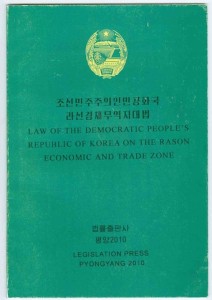
Under a North Korean law for the Rason economic zone, revised in January last year, the minimum monthly wage for local employees at foreign firms is set jointly by the employer and the municipal authorities.

The amount is higher than the $63.814 recently set as the minimum wage for North Korean workers at the inter-Korean industrial park in Kaesong, the North’s western city bordering South Korea, but less than the average salary of Chinese workers. According to the South’s state-run Korea Trade-Investment Promotion Agency (KOTRA), Chinese workers are paid a minimum of $167 per month.

Experts say this wage gap could attract Chinese investors to Rason, as they have already started showing signs of relocating operations to Vietnam, Indonesia and other countries with cheaper labor than China.

The booklet also contains details of Rason’s tax policy, including a five-year property tax exemption for buildings purchased through private funds and a corporate income tax rate of up to 14 percent, according to the source.

“The booklet was made by Rason’s tax bureau in July-August to introduce foreigners to its tax policy,” the source said.

And according to the Institute for Far Eastern Studies (IFES):

Hwang also elaborated on the eight preferential policies providing special tax benefits to foreign investors. He asserted, “The government of North Korea will guarantee the investment of the foreign investors by not nationalizing or demanding requisitions. For inevitable cases where such demands occur, proper compensation will be provided.”

The income tax is also at 14 percent, which is 11 percent lower than other areas in North Korea. For companies with business plans over ten years, foreign capital companies will receive three years of tax-free benefit starting from the profit earning year and two years thereon after will receive 50 percent tax-free benefits. According to Hwang, over 100 foreign companies and offices are operating businesses currently in the special economic zone.

Read the full stories here:
China agrees to provide power to NK’s Rason economic zone
Korea Times
2011-9-13

Minimum wage at N. Korean special economic zone set at US$80: source
Yonhap
2011-9-8

Share

DPRK revises law on Rason zone and enacts law on coal to attract foreign investment

Wednesday, March 17th, 2010

Institute for Far Eastern Studies (IFES)
NK Brief No. 10-03-17-1
2010-03-17

Following North Korea’s decision to raise the status of the Rajin-Sonbong region to the ‘Rason Special City’, it has revised the ‘Law on the Rajin-Sonbong Trade Zone’, considerably boosting the likelihood that the region will attract the foreign investment necessary to develop the free trade zone, as the revised law further protects investor activities in Rason.

The Rajin-Sonbong region was designated a ‘Free Economic and Trade Zone’ in 1991, but had very little economic impact. Over the years, North Korean authorities have enacted a few measures to try to keep the project alive, but there has been no significant turnaround. With the revision of the law on Rason, North Korean authorities are again focusing their attention on the region, with the goal of ‘opening the door to a strong and prosperous nation’ by 2012. It is also possible that the regime is eyeing the development of the region as a tool to solidify the transfer of power to yet a third Kim.

In December, 2009, after designating the special economic and trade zone, Kim Jong Il traveled to ‘Rason City’ for the first time in 18 years. Jang Song Thaek, director of the administrative bureau of the (North) Korean Workers’ Party, has also visited the area, leading observers to believe that even working-level preparations are being made following the policy decision to highlight the area.

The law on Rason, revised on January 27, is now made up of 5 chapters and 45 articles. 6 of those articles specifically concern promotion of the investment area and trade with overseas Koreans.

The most eye-catching article is no. 8, which addresses economic and trade activities by overseas Koreans. This type of activity was already protected by the existing law, but the revision reiterates that Koreans living outside of the North are allowed to carry out economic activities and trade in an attempt to snare investments from North Koreans living in China and Japan, as well as other diasporas.

In addition, Article 21 addresses the economic dealings of enterprises, groups and organizations outside of the zone, and stipulates that these groups operating within the Rason Special City would be able to engage in business activities with North Korean businesses in other regions. This essentially legalizes the sale of goods produced in the zone throughout the country.

Article 3, addressing investment opportunities, stipulates that investors are allowed to engage in business regarding manufacturing, farming, construction, transportation, communications, science and technology, tourism, distribution, and finance.

By revising the existing law, North Korean authorities have strengthened incentives for investors.

The latest revision also set the basic income tax of enterprises at 14 percent, while stating that enterprises specifically designated by the government would be taxed at a rate of 10 percent.

Furthermore, Article 2 of the revision emphasizes the tourism and investment roles of the special zone, referring to the zone as one for ‘investment, a transport hub, finance, tourism, and public service,” adding ‘investment’ and ‘tourism’ to those activities stipulated in the original law. The Rason Zone Law has been revised five times since its passing in 1993, undergoing change in 1999, 2002, 2005, 2007 and now 2010.

Authorities also revised the law on coal, which now legally regulates the exploration, distribution and use of coal, by the addition of Chapter 6 Article 76 of the ‘Coal Law’. Article 1 lays out the basis of the North’s law on coal, while Article 2 covers exploration, Article 3, ‘mine development,’ Article 4, ‘coal production,’ Article 5, ‘coal distribution and use,’ and Article 6, ‘management structure regarding the coal industry.’ The new law advocates “expansion of cooperation and exchange with other countries and international organizations on the exploration and mining development, as well as production and use.”

Share