Archive for the ‘Black markets’ Category

Pyongyang seeing more inspections

Wednesday, August 24th, 2011

According to the Daily NK:

With the border area enveloped in ‘Storm Trooper Unit’ inspections, operations against South Korean goods have been stepped up in distant Pyongyang, according to a man from the city who talked to the Daily NK in Dandong, China on Tuesday.

“Inspections by ‘Group 109’, which has been around for a while, have gradually become more intense,” the man, Kim, explained. “Worst of all, they are showing up in the middle of the night without warning to search for CDs, DVDs and recorders, and if there are any materials such as pornography or South Korean merchandise, then the offender is taken away. There are no exceptions.”

“In the past when the National Security Agency or People’s Safety Ministry came to inspect, people would pay them to let it slide, but nowadays the authorities send an agent from both of those agencies and the Defense Security Command as a team, which makes it hard to get out of it if you get caught,” he added.

A Daily NK source from Pyongyang confirmed the story, saying that as recently as July one could escape Group 109 punishment for watching South Korean or American DVDs with a bribe of $100 in central Pyongyang, or less in the surrounding areas.

Group 109 is an organization set up by the Chosun Workers’ Party to crack down on illegal media including CDs and DVDs. The group is one of a number of ‘Gruppas’, as they are locally known, currently operating in the capital, with others including Group 622, which handles juvenile delinquency, and Group 27, actually a branch of the Defense Security Command, which deals with mobile phone usage.

The various groups have been conducting their assorted inspections to weed out myriad ‘anti-socialist’ behavior for some time, but bribery has always provided an escape route, albeit while those without money or connections were made an example of. However in recent times, allegedly since successor Kim Jong Eun ordered more intense inspections and punishments, the ‘Gruppas’ have had to take their tasks more seriously.

The volume of South Korean goods trading in the market has contracted due to the recent crackdowns, but their popularity is undiminished; evasion of inspections is apparently being achieved via house calls to trusted clients. Kim says that the preference is only getting stronger for South Korean goods amongst cadres, a group which has always been safe from inspections.

“The traders go around the city knocking on people’s doors, quietly asking whether the residents would like to buy some South Korean merchandise. For this reason the nickname ‘knock-knocker’ is sometimes used to refer to them,” Kim explained.

Read the full story here:
Pyongyang Seeing Tighter Inspections
Daily NK
Lee Seok Young
2011-8-24

Share

Kim Jong-il and his sister on markets and the market economy

Monday, August 22nd, 2011

Stephan Haggard and Dan Pinkston have found and posted comments attributed to Kim Jong-il revealing some of his thinking on “markets” and the “market economy”:

Kim Jong-il, “On the promotion of a superior socialist economy…adhering to the principles of socialism” June 18, 2008, dialogue with party and state officials.

“…As I said on many occasions during the recent period, one must have a correct understanding of the market. As we allowed a certain use of markets with respect to economic management, some people understood this as a departure from the socialist principle and as a move towards a market economy through “reform” and “opening up” of the country’s economy.

But this is a very wrong way of reasoning. Having a misguided understanding of the market and the market economy on the part of economic planners shows their lack of ideology and knowledge… [If] one fails to exactly and deeply recognize the party’s ideology and policy with regards to economic planning, that person will have his or her faith in the superior socialist economy shaken and can be dazzled by “reform” or “opening up” that the imperialists brag about and also be captured by the fantasy that the capitalist market economy promises.

Workers need to be awakened from these pitfalls…. Markets are both home to and a hotbed for un-socialist phenomenon and capitalist factors in the economic sectors. Without devising a national plan about markets and neglecting them as they are, or further encouraging their activities and expanding their reach, the country’s economy will inevitably turn into a market economy. However, following the practical conditions by using the market to a certain extent while keeping it under national control does not necessarily mean a movement towards market economy. Markets and a market economy are not the same concepts. The question resides in how to perceive and treat the market, and how to use it following [appropriate] principles and direction…”

-Original text in Korean

“…….내가 최근시기 여러 기회에 말하였지만 시장에 대한 인식을 바로 가져야 합니다. 우리가 경제관리에서 시장을 일정하게 리용하도록 하였더니 한때 일부 사람들은 사회주의 원칙에서 벗어나 나라의 경제를 《개혁》《개방》하여 시장경제로 넘어가는 것처럼 리해한 것 같은데 이것은 아주 잘못된 생각입니다. 경제지도일꾼들이 시장과 시장경제에 대한 그릇된 인식을 가지게 되는 것은 사상의 빈곤 지식의 빈곤에 빠져있다는 것을 말해줍니다. 누구나 할 것 없이 경제사업과 관련한 당의 사상과 방침을 정확히, 깊이있게 인식하지 못하면 사회주의 경제의 우월성에 대한 신념이 흔들리게 되어 제국주의자들이 떠벌이는 《개혁》《개방》에 현혹될 수 있고 자본주의 시장경제에 대한 환상에 사로잡힐 수 있는 것입니다. 이에 대하여 일군들이 각성을 높여야 합니다….시장은 경제분야에서 나타나는 비사회주의적 현상, 자본주의적 요소의 본거지이며 온상입니다. 시장에 대하여 아무런 국가적 대책도 세우지 않고 그대로 내버려 두거나 시장을 더욱 조장하고 그 령역을 확대하는 방향으로 나간다면 불피코 나라의 경제가 시장경제로 넘어가게 됩니다. 그러나 현실적 조건에 따라 국가적 통제 밑에 시장을 일정하게 리용하는 것이 곧 시장경제로 가는 것은 아닙니다. 시장과 시장경제는 같은 개념이 아닙니다. 문제는 시장을 어떻게 보고 대하며 그것을 어떤 원칙과 방향에서 어떻게 리용하는가 하는데 있습니다….”

Marcus Noland followed up with a [longer] publication by Kim Jong-il’s sister, Kim Kyong-hui:

Strengthening Centralized, Unified State Guidance Over Economy, Kyo’ngje Yo’ngu

Our army and people are vigorously carrying out a general onward march to elevate the economy to a stage of leaping development through a new great revolutionary upswing under the great party’s military-first leadership.

Today, when our country is displaying its majestic appearance and might as a politically, ideologically, and militarily powerful state, in order to build it into an economically powerful socialist state and a socialist paradise where the people enjoy an affluent life with nothing more to desire in the world by concentrating efforts on the economic construction and on improving the people’s living standard, it is necessary to adhere to the socialist principle in the economic work and bring the superiority of the socialist planned economy into high play, and what is important in this is to strengthen the centralized and unified guidance of the state over the economic construction.

The great leader [ryo'ngdoja] Comrade Kim Jong Il [Kim Cho'ng-il] has pointed out the following:

“Above all else, it is necessary to strengthen the centralized and unified guidance of the state over the economic construction.”

Strengthening the centralized and unified guidance of the state in the socialist economic management arises as a basic demand for improving the economic management in line with the intrinsic nature of socialist society, further consolidating and developing the socialist economic system by bringing the superiority of the socialist planned economy into high play, and accelerating the construction of an economically powerful state.

Strengthening the centralized and unified guidance of the state is a basic demand for improving the socialist economic management because, above all, managing and operating the country’s economy in a planned manner under the state’s centralized and unified guidance is an intrinsic demand of the socialist economy that is based on collectivism and a basic principle of the socialist economic management.

Realizing the centralized and unified guidance of the state in the socialist economic management serves as a lifeline of the socialist economic management, which stems from the natural law-governed nature of the socialist economic development and the essential characteristics of the socialist economy.

The centralized and unified guidance of the state over the economy is, above all, an intrinsic demand of the socialist economy that is based on collectivism. The socialist economy is a large-scale collective economy in which all sectors and units of the people’s economy are organically connected with each other based on social ownership of the means of production, and it is a highly organized and centralized planned economy. This is the essential superiority of the socialist planned economy, which is distinct from the capitalist market economy that operates spontaneously on the basis of private ownership of the means of production. In a capitalist society, the bourgeois state is not able to perform the function of interconnecting the management activities of different enterprises and leading them in one direction. In a capitalist society, the economy moves in a spontaneous manner amid the pursuit of profits and competition based on the law of the jungle due to the conflict of interests between the capitalist class and the working popular masses and among capitalists, and this accompanies the bankruptcy of enterprises.

In contrast, the socialist economy is based on social ownership of the means of production, and it is managed and operated through goal consciousness by the popular masses as the masters. Social ownership of the means of production calls for combining all economic sectors and units into a single production organism, and also for the factories and enterprises comprising its components to move under a unitary command. Realizing planned ties between factories and enterprises and ensuring that the economy operates under a single unitary command are firmly guaranteed by the unified guidance of the socialist state.

The centralized and unified guidance of the state over the economy is also a basic principle of the socialist economic management.

Apart from the centralized and unified guidance of the state and the principle of managing a planned economy, socialism cannot be defended in the economic field, and the socialist economy cannot be developed.

The initiative of lower units has to be brought into high play in the socialist economic management, but this has to be achieved strictly on the basis of firmly guaranteeing the centralized and unified guidance of the state and within the framework of the socialist planned economy. It is only through the centralized and unified guidance of the state that it is possible to correctly map out plans so as to guarantee the greatest actual profits consistent with national interests and the all-people’s economic interests, mobilize all production potentials of the country to the maximum, concentrate forces and resources on the objects that are of key significance in the overall economic development, and thus achieve a planned and balanced development of the economy. If one moves in the direction of giving a free rein to economic management and enterprise management in an attempt to enhance the initiative of lower units and strengthen their “independence” and “self-reliance,” then the lower units will break way from the unified guidance and control of the state and act as they please, and this will not only bring about tremendous national waste and loss but also make it impossible to neither defend socialism in the economic field nor develop the socialist economy.

Strengthening the centralized and unified guidance of the state is a basic demand for improving the socialist economic management also because the centralized and unified guidance of the state over the economy has to be strengthened in order to be able to mobilize all potentials to the maximum based on the principle of self-reliance and thus elevate the country’s economy to a stage of leaping development and accelerate the construction of an economically powerful socialist state.

Today’s great upswing calls for more highly holding up the banner of self-reliance, and an economically powerful socialist state is a powerful state of self-reliance, a powerful state with a mighty self-supporting national economy.

We have laid the strong foundation of a socialist self-supporting national economy by highly displaying the revolutionary spirit of self-reliance under the wise leadership of the great leader [suryo'ngnim] and the respected and beloved general. Mobilizing and utilizing the potential of the already provided foundation of a self-supporting economy to the maximum is the most accurate way to elevate the country’s economy to a stage of leaping development and accelerate the construction of an economically powerful socialist state in our style in the present circumstances.

Though many obstacles are still lying in the way ahead of us, we have to open a road of advance for victory by relying on the boundless creative ability of all the people, our resources and technology, and the superiority of our system.

The centralized and unified guidance of the state over the economy has to be strengthened in order to elevate the country’s economy to a stage of leaping development by mobilizing the potential of the already provided foundation of a self-supporting national economy to the maximum and to accelerate the construction of an economically powerful socialist state.

Above all, the centralized and unified guidance of the state has to be strengthened in order to ensure a balanced and harmonious development of the economy in conformity with the aspiration and demand of the popular masses. An important task we are faced with in the economic construction at the present time is to rely on the superiority of the socialist planned economy to closely combine the normalization of production with modernization and push ahead with it vigorously, and thus decisively surpass the highest production level in all sectors of the people’s economy. It is only under the condition of strengthening the centralized and unified guidance of the state that it is possible to create the military-first era’s speed of waging the general onward march by mobilizing all production potentials of the country to the maximum from the viewpoint of national interests consistent with the party’s policy demands, and also accelerate the construction of an economically powerful socialist state by harmonizing the production ties centered on the objects of key significance in the economic development, guaranteeing the planned and disciplined nature of the economic work, and thus achieving a balanced development of the overall economy.

The centralized and unified guidance of the state has to be strengthened also to be able to bring the initiative of individual sectors and units, and local areas into high play and thus actively mobilize and utilize the potential of the self-supporting economy.

There may be things that are in short supply and that are missing in the process of building an economically powerful state. This is why the demand for bringing the initiative of each sector and unit into high play arises in order for all sectors and units of the people’s economy to normalize production and surpass the highest production level based on the existing assets.

Only when the centralized and unified guidance of the state over the economy is realized smoothly, is it possible to enhance the initiative of all sectors and units in line with the intrinsic requirement for the development of socialist economy that is based on collectivism and decisively boost the economic effectiveness in mobilizing and utilizing the reserves.

Strengthening the centralized and unified guidance of the state over the economy in no ways means disregarding the initiative of lower units. The socialist economic construction can be carried out successfully only when the unified guidance of the state is combined correctly with the initiative of lower units. This is because if the state’s centralized and unified guidance enables the economy to develop harmoniously on a pan-social level, then the initiative of lower units spurs factories and enterprises to increase production and perfect the production and technical processes on their own by positively exploring and mobilizing the existing reserves and production potentials pursuant to the economic plans established by the state. If the lower units are restrained based on the opinion that the management activities of each unit should be unconditionally subordinate to the state, then the initiative of factories and enterprises will be suppressed and the production will not proceed smoothly. This is why the centralized and unified guidance of the state over the economy is based on the premise of further enhancing the initiative of lower units.

All the economic guidance functionaries should have a correct perception of the state’s centralized and unified guidance and realize it correctly, and thus bring the genuine superiority of socialist planned economy into high play.

“위대한 당의 선군령도따라 우리 군대와 인민은 새로운 혁명적대고조로 경제를
비약적인 발전단계에 올려세우기 위한 총진군을 힘있게 벌려나가고있다.

정치사상강국, 군사강국의 위용과 위력을 온 세계에 떨치고있는 오늘 경제건설과
인민생활향상에 힘을 집중하여 우리 나라를 사회주의경제강국으로, 인민들이
세상에 부러움없이 잘 사는 사회주의락원으로 건설하기 위하여서는 경제사업에서
사회주의원칙을 고수하고 사회주의계획경제의 우월성을 높이 발양시켜야 하며
여기서 중요한것은 경제건설에 대한 국가의 중앙집권적, 통일적지도를
강화하는것이다.

위대한 령도자 김정일동지께서는 다음과 같이 지적하시였다.

《무엇보다도 경제건설에 대한 국가의 중앙집권적, 통일적지도를 강화하여야
합니다.》

사회주의경제관리에서 국가의 중앙집권적, 통일적지도를 강화하는것은
사회주의사회의 본성에 맞게 경제관리를 개선하고 사회주의계획경제의 우월성을
높이 발양시켜 사회주의경제제도를 더욱 공고발전시키며 경제강국건설을
다그치기 위한 기본요구로 제기된다.

국가의 중앙집권적, 통일적지도를 강화하는것이 사회주의경제관리개선의
기본요구로 되는것은 무엇보다먼저 나라의 경제를 국가의 중앙집권적,
통일적지도밑에 계획적으로 관리운영하는것이 집단주의에 기초한 사회주의경제의
본성적요구이며 사회주의경제관리의 기본원칙이기때문이다.

사회주의경제관리에서 국가의 중앙집권적, 통일적지도를 실현하는것은
사회주의경제발전의 합법칙성과 사회주의경제의 본질적특성으로부터 출발한
사회주의경제관리의 생명선이다.

경제에 대한 국가의 중앙집권적, 통일적지도는 우선 집단주의에 기초한
사회주의경제의 본성적요구이다. 사회주의경제는 생산수단에 대한 사회적소유에
기초하여 인민경제의 모든 부문들과 단위들이 유기적으로 련결된 대규모의
집단경제이며 고도로 조직화되고 중앙집권화된 계획경제이다. 이것은 생산수단에
대한 사적소유에 기초하여 자연발생적으로 움직이는 자본주의시장경제와 다른
사회주의계획경제의 본질적우월성이다. 자본주의사회에서는 부르죠아국가가
각이한 기업체들의 경영활동을 서로 맞물리고 하나의 방향으로 이끌어나갈수
있는 기능을 수행할수 없다. 자본주의사회에서는 자본가계급과
근로인민대중사이, 자본가들사이의 리해관계의 대립으로 하여 경제가 리윤추구와
약육강식의 경쟁속에서 자연발생적으로 진행되며 이것은 기업파산을 동반한다.

이와는 달리 사회주의경제는 생산수단에 대한 사회적소유에 기초하고있으며
인민대중이 주인이 되여 목적의식적으로 관리운영된다. 생산수단에 대한
사회적소유는 모든 경제부문, 단위들을 하나의 생산유기체로 결합시키는 한편 그
구성부분으로 되는 공장, 기업소들이 유일적인 지휘에 따라 움직일것을
요구한다. 공장, 기업소들사이에 계획적인 련계를 실현하며 경제가 하나의
유일적인 지휘밑에 움직이도록 하는것은 사회주의국가의 통일적지도에 의하여
확고히 담보된다.

경제에 대한 국가의 중앙집권적, 통일적지도는 또한 사회주의경제관리의
기본원칙이다.

국가의 중앙집권적, 통일적지도와 계획적경제관리원칙을 떠나서는 경제분야에서
사회주의를 지킬수 없고 사회주의경제를 발전시킬수도 없다.

사회주의경제관리에서 아래단위의 창발성을 높이 발양시켜야 하지만 그것은
어디까지나 국가의 중앙집권적, 통일적지도를 확고히 보장하는 기초우에서,
사회주의계획경제의 테두리안에서 이루어져야 한다. 국가적리익,
전인민경제적리익에 맞게 가장 큰 실리를 보장할수 있도록 계획을 세우며 나라의
모든 생산잠재력을 최대한으로 동원하고 전반적경제발전에서 관건적인 의의를
가지는 대상들에 력량과 자원을 집중하여 경제의 계획적, 균형적발전을
이룩하는것은 국가의 중앙집권적, 통일적지도에 의해서만 옳게 실현될수 있다.
아래단위의 창발성을 높이고 《독자성》과 《자립성》을 강화한다고 하면서
경제관리, 기업관리를 풀어놓는 방향으로 나간다면 아래단위들이 국가의
통일적지도와 통제에서 벗어나 제멋대로 움직이게 되며 국가적으로 막대한
랑비와 손실을 가져오는것은 물론 경제분야에서 사회주의를 지킬수도 없
사회주의경제를 발전시킬수도 없다.

국가의 중앙집권적, 통일적지도를 강화하는것이 사회주의경제관리개선의
기본요구로 되는것은 다음으로 경제에 대한 국가의 중앙집권적, 통일적지도를
강화하여야 자력갱생의 원칙에서 모든 잠재력을 최대한 동원하여 나라의 경제를
비약적인 발전단계에 올려세우고 사회주의경제강국건설을 다그칠수
있기때문이다.

오늘의 대고조는 자력갱생의 기치를 더 높이 들것을 요구하며
사회주의경제강국은 자력갱생의 강국, 위력한 자립적민족경제의 강국이다.

우리는 위대한 수령님과 경애하는 장군님의 현명한 령도밑에 자력갱생의
혁명정신을 높이 발휘하여 사회주의자립적민족경제의 토대를 튼튼히 마련하였다.
이미 마련된 자립적경제토대의 잠재력을 최대한 동원리용하는것은 오늘의
형편에서 우리 식으로 나라의 경제를 비약적인 발전단계에 올려세우
사회주의경제강국건설을 다그치는 가장 정확한 길이다.

우리앞에는 의연히 많은 난관이 가로놓여있지만 전체 인민의 무궁무진한
창조력과 우리의 자원과 기술, 우리 제도의 우월성에 의거하여 승리의 진격로를
열어나가야 한다.

이미 마련된 자립적민족경제토대의 잠재력을 최대한 동원하여 나라의 경제를
비약적인 발전단계에 올려세우고 사회주의경제강국건설을 다그치자면 경제에
대한 국가의 중앙집권적, 통일적지도를 강화하여야 한다.

우선 국가의 중앙집권적, 통일적지도를 강화해야 인민대중의 지향과 요구에 맞게
경제의 균형적이고 조화로운 발전을 보장할수 있다. 현시기 경제건설에서
우리앞에 나서는 중요한 과업은 사회주의계획경제의 우월성에 의거하여
생산정상화와 현대화를 밀접히 결합시켜 힘있게 밀고나감으로써 인민경제 모
부문에서 최고생산수준을 결정적으로 돌파하는것이다. 국가의 중앙집권적,
통일적지도를 강화하는 조건에서만 당의 정책적요구에 맞게 국가적리익의
견지에서 나라의 모든 생산잠재력을 최대한 동원하여 선군시대의 총진군속도를
창조할수 있으며 이와 함께 경제발전에서 관건적인 의의를 가지는 대상들을
중심으로 생산적련계를 조화롭게 하고 경제사업에서 계획성과 규률성을 보장하여
전반적경제의 균형적발전을 이룩함으로써 사회주의경제강국건설을 다그칠수
있다.

또한 국가의 중앙집권적, 통일적지도를 강화하여야 개별적부문과 단위, 지방의
창발성을 높이 발양시켜 자립경제의 잠재력을 적극 동원리용할수 있다.

경제강국을 건설하는 과정에는 부족한것도 있고 없는것도 있을수 있다. 따라서
인민경제 모든 부문, 모든 단위에서 있는 밑천을 가지고 생산을 정상화하
최고생산수준을 돌파하기 위하여서는 매개 부문, 단위의 창발성을 높이
발양시켜야 할 요구가 제기되게 된다.

경제에 대한 국가의 중앙집권적, 통일적지도를 원만히 실현하여야 모든 부문,
모든 단위의 창발성을 집단주의에 기초한 사회주의경제발전의 본성적요구에 맞게
발전시킬수 있으며 예비를 동원하고 리용하는데서 경제적효과성을 결정적으로
높일수 있다.

경제에 대한 국가의 중앙집권적, 통일적지도를 강화한다는것은 결코 아래단위의
창발성을 무시한다는것을 의미하지 않는다. 사회주의경제건설은 국가의
통일적지도와 아래단위의 창발성을 옳게 결합시킬 때 성과적으로 진행될수 있다.
그것은 국가의 중앙집권적, 통일적지도가 전사회적범위에서 경제가 조화롭게
발전될수 있게 한다면 아래단위의 창발성은 공장, 기업소들이 국가가 세운
경제계획에 따라 있는 예비와 생산잠재력을 적극 탐구동원하여 생산을 늘이
자체로 생산기술공정을 완비하도록 추동하기때문이다. 만일 매개 단위의
경영활동이 국가에 무조건 복종되여야 한다고 하면서 아래단위를 얽어매놓으면
공장, 기업소들의 창발성이 억제되여 생산을 원만히 진행할수 없게 된다.
그러므로 경제에 대한 국가의 중앙집권적, 통일적지도는 아래단위의 창발성을
더욱 높이는것을 전제로 한다.

모든 경제지도일군들은 국가의 중앙집권적, 통일적지도에 대한 옳은 인식을
가지고 이를 옳바로 실현함으로써 사회주의계획경제의 참다운 우월성을 높이
발양시켜나가야 할것이다.”

Share

On the de-facto privatization of industry in the DPRK…

Wednesday, August 17th, 2011

Pictured above (Google Earth): A bus depot in Rakrang-guyok, Pyongyang.  See in Google Maps here.

According to the Daily NK:

Growth and improvement is evident in some areas of the private sector in North Korea, Ishimaru Jiro of ASIAPRESS revealed on the 16th, pointing to the growth of bigger, better private transit concerns and relatively productive coal mining operations as evidence of this trend.

In the past, trains were almost the only viable means of long-distance transportation in North Korea. Then, as private business began to grow and the railways fell into a deep malaise, vehicles such as trucks and cars belonging to military bases, state security and state enterprises were pushed into service to earn money for moving people; this, the so-called ‘servi-cha’ industry.

The servi-cha industry has long been fragmented and small scale; but now transportation companies run by rich individuals (‘donju’) which purchase several buses and hire drivers, guides and mechanics, are acting just as a transit company in a capitalist state would do.

With profit-sharing and bribery as the backbone, a large number of North Korean organs and enterprises have decided to lend their name to these individuals, fuelling the growth and development of a network of sorts.

“From the early 2000s, a high-speed bus network mostly between major cities began to emerge,” Ishimaru, revealing the latest research by ASIAPRESS internal North Korean sources, commented. “The companies are packaged as an enterprise affiliated to some state authority outwardly, but they are actually operated by individuals who pay kickbacks to that authority.”

The People’s Safety Ministry affiliated 116 Task Force Team is one such transportation company, Ishimaru says. It operates buses connecting Shinuiju, South Pyongan Province and Pyongyang. Ordinarily, the bus parks at a station or major public location, and then departs when it is full of passengers going to the next destination.

Here are previous posts on the servi-cha industry.

Read the full sotry here:
Green Shoots of Private Enterprise Growth
Daily NK
2011-8-17

Share

The secret world of North Korea’s new rich

Tuesday, August 9th, 2011

Andrei Lankov provides some anecdotal evidence and a taxonomy of the DPRK’s growing entrepreneurial class (perhaps one of the most interesting and least reported aspects of the DPRK).  He also gives us a glimpse of how the North Korean version of the “infant industry” mindset can impede economic reform.

Here is a great blurb from the article in the Asia Times:

Who are they – the North Korean new rich? The upper crust of this social group consists of high-level officials. Some of them have gained their wealth through illegal means, but many have seen their business activities permitted and even actively encouraged by the government. Most of the money is made in foreign trade, with China being by the far the most significant partner.

Many North Korean companies, despite being technically owned by the state, are effectively private and are run by top officials and their relatives.

That said, these people are not that frequently seen on the streets of Pyongyang. They live in their own enclosed world, of which not much is known.

But if we go one or two steps down, we will encounter a very different type of North Korean entrepreneur – somebody who has made his or her (yes, surprising many of them are women) money more or less independent of the state.

Complete independence is not possible because every North Korean businessman has to pay officials just to make sure that they will not ask too many questions and turn a blind eye to activities that are still technically illegal. In many cases, North Korean entrepreneurs prefer to disguise their private operations under the cover of some state agency.

Take for example Pak. In his early 40s, he runs a truck company together with a few friends. The company has seven trucks and largely specializes in moving salt from salt ponds on the seacoast to major wholesale markets. The company employs a couple of dozen people, but officially it does not exist. On paper, all trucks are owned by state agencies and Pak’s employees are also officially registered as workers of state enterprises.

Pak bought used trucks in China, paying the Chinese owners with cash. He then took them to North Korea where he had the vehicles registered with various government agencies (army units are the best choice since military number plates give important advantages). Pak paid officials for their agreement to “adopt” the trucks. This is so common in the North that there is even an established rate of how much fake registration of a particular type of vehicle costs at which government agency.

Kim was a private owner of a gold mine. The gold mine was officially registered as a state enterprise. Technically, it was owned by a foreign trade company that in turn was managed by the financial department of the Party Central Committee. However, this was a legal fiction, pure and simple: Kim, once a mid-level police official, made some initial capital through bribes and smuggling, while his brother had made a minor fortune through selling counterfeit Western tobacco.

Then they used their money to grease the palms of bureaucrats, and they took over an old gold mine that had ceased operation in the 1980s. They restarted the small mine and hired workers, bought equipment and restarted operations. The gold dust was sold independently (and, strictly speaking, illegally) to Chinese traders.

The brothers agreed with the bureaucrats from the foreign trade company on how much money they should pay them roughly between 30-40% and the rest was used to run the business and enjoy life.

One step below we can see even humbler people like Ms Young, once an engineer at a state factory. In the mid-1990s, she began trading in second-hand Chinese dresses. By 2005 she was running a number of workshops that employed a few dozen women.

They made copies of Chinese garments using Chinese cloth, zippers and buttons. Some of the materials was smuggled across the border, while another part was purchased legally, mostly from a large market in the city of Raseon (a special economic zone which can be visited by Chinese merchants almost freely).

Interestingly, Ms Young technically remained an employee of a non-functioning state factory from which she was absent for months on end. She had to pay for the privilege of missing work and indoctrination sessions, deducting some $40 as her monthly “donation”. This is an impressive sum if compared with her official salary of merely US$2.

The North Korean new rich might occasionally feel insecure. They might be afraid of the state, because pretty much everything they do is in breach of some article of the North Korean criminal code. A serious breach indeed – technically any of the above described persons could be sent to face an execution squad at the moment the authorities change their mind.

And before we all get our hopes up that this emergent entrepreneurial class will eventually push the leadership to adopt economic reforms, Lankov reminds us how they could just as well serve to prolong the regime’s life:

Paradoxically, the long-term interests of the emerging North Korean business class might coincide with that of the Kim regime. Unlike normal people in the North, both groups – officials and entrepreneurs – have an interest in maintaining a separate North Korean state. Unification with the South is bound to spell disaster for both groups.

A person who is now running a couple of small shops might eventually, if North Korean capitalism continues uninterrupted growth, become an owner of a supermarket chain. If unification comes, he or she would be lucky to survive the competition with the South Korean retail giants and keep the few corner shops they had.

The full story is well worth reading here:
The secret world of North Korea’s new rich
Asia Times
Andrei Lankov
2011-8-10


Share

Foreign clothing gaining popularity in DPRK

Thursday, July 21st, 2011

According to the Daily NK:

Young people in North Korea are emerging as proponents of Hallyu (the South Korean cultural wave) and as fashion leaders, showing themselves to be particularly keen on the South Korean music, movies, and fashion that are being smuggled into the country and traded.

On Wednesday, The Daily NK met with a Chinese merchant who conducts business in Pyongyang to find out about trends amongst young people in North Korea. He told us that, “Hooded sweatshirts are enjoying immense popularity with young people at the moment.” The reason, he explained, is that, “They want to emulate the fashion they see in South Korean dramas.”

He added, “At the jangmadang, hooded sweatshirts sell for about 200 Yuan (around US$31), so they’re not cheap, but so many people come looking for them that we almost run out of hooded sweatshirts to sell.”

The source explained that, in spite of this, South Korean brands and products with English lettering are prohibited from being sold.

“As the days get hotter, people are looking to get their hands on short-sleeve clothing. Light-colored clothing is most popular,” he noted, also mentioning that, “In general, new clothes sell for about 15,000 won and second-hand clothes for about 3,000 won.

One-piece dresses are in vogue with females as summer takes hold. These dresses tend to sell at the jangmadang for around 70,000 won. Additionally, the source said, “There are lots of young ladies looking for high-heel shoes, which go for about 25,000-30,000 won. Skinny jeans are as popular as ever, and you see lots of people walking around in three-quarter pants.”

He also mentioned that many people are taking advantage of the opportunity to wear shorts and sleeveless shirts to beat the humidity.

However, authorities have already cracked down on “inappropriate attire” for women, for example by banning skirts that do not go down past the knee. The sleeveless shirts, short skirts and pants that have become fashionable in recent times are difficult to wear out of the house because a person wearing them would become a target of the Union of Democratic Women’s community watch guards.

Regarding this, the source said, “People get punished for wearing shorts or skirts that don’t come down past the knee. The UDW’s community watch guards are in every lane and alleyway inspecting women (who break the law). Sleeveless clothes do sell, but nobody can wear them. So they just wear such items at home.”

Furthermore, he mentioned that, “Young ladies walk around wearing earrings and bracelets,” explaining that, “Bracelets, watches, rings and hairpins all tend to be popular itemsbecause people think they’re pretty.” North Korean authorities restricted the wearing of accessories in the past, but appear to have eased off on this policy in recent times.

He relayed that crackdowns on South Korean-made goods are as common as ever. According to him, those who get caught in the crackdowns have their goods confiscated on the spot. “The crackdowns on South Korean goods are still going strong,” he said. “At the outdoor market, the patrolling officers are checking practically every item tag now. That’s how serious it has got.”

“The intensity of crackdowns on South Korean movies and dramas on DVD that are coming into the country is always increasing,” he said, “but university students and young people in general are getting hold of South Korean and other foreign movies and selling them in secret.”

South Korean dramas and movies usually sell for 5,000 won (a normal DVD sells for 1,300 won), and at the moment IRIS, Assorted Gems, Slave Hunter, Queen of the Game and Smile, Mom are said to be the most popular.

Read the full story here:
Fashion Also Influenced by South Korean Culture
Daily NK
Choi Cheong Ho
2011-7-21

Share

Informal sellers on the rise in DPRK markets

Thursday, July 7th, 2011

Pictured above (Google Earth, October 2010): (left) informal street market in Hadang-dong, (right) official market in Hadang-dong

According to the Daily NK:

Sources have reported a large increase in the number of ‘grasshopper traders’ in the alleyways around many of North Korea’s markets.

‘Grasshopper traders’ are individuals who conduct their trade activities without an official permit beyond official market boundaries, meaning that when security forces arrive they have to jump, like grasshoppers, to a new location. Growth in this kind of phenomenon would tend to suggest that the class of capital-holding middle class traders is shrinking, while the number of those trading day-to-day in order to make ends meet is growing. It is also related to the fact that official efforts to eliminate grasshopper trading are not as strict as they have been.

One source living in the traditionally more affluent capital, Pyongyang, explained to The Daily NK today that even there, “The number of grasshopper traders has increased a lot of late. There are too many to count,” adding that in the case of Hadang Market, the normal 100-200 grasshopper traders has grown to between 300-400 over a very short period.

Another source from Yangkang Province agreed, saying, “There are grasshopper traders camped in every alleyway around Hyesan Market. People are coming in twice the numbers they normally do, so cracking down on them is not easy.” Other local sources have revealed that markets in the provinces of North Hamkyung and Pyongan are in much the same state.

As expected, with an increasing degree of grasshopper trading comes an increasing number of market watch guards. However, whereas in the past those caught engaging in grasshopper trading stood to lose their wares, nowadays grasshopper traders are just warned about their conduct.

The Pyongyang source explained, “The number of market watch guards has increased by around ten, but their crackdowns are much weaker than they used to be. I know that the authorities have ordered them not to confiscate traders’ wares by force, just to enforce public order.”

This appears to be because the authorities fear that some of their excesses are inflicting too much harm on public opinion.

The Pyongyang source explained, “In many cases people oppose the young market watch guards’ attempts to take the belongings of traders by force, saying ‘they are worse than the Japanese’, and the authorities seem to care about that.”

Officials and the security forces are also being careful about their conduct because of fear of investigation, and this may also be affecting the market environment. Rumors are circulating which suggest that some cadres are being punished for things such as taking bribes.

On this point, the Pyongyang source added, “The central Party is conducting an inspection of the public organs charged with controlling the markets. The word is that people working for these organs are being investigated for things like taking bribes, going to the homes of traders to demand things, or just taking what they want from market stalls.”

Read the full story here:
Grasshopper Numbers Rising Fast
Daily NK
Choi Cheong-ho
2011-7-4

Share

DPRK food prices rising

Tuesday, July 5th, 2011

According to Bloomberg:

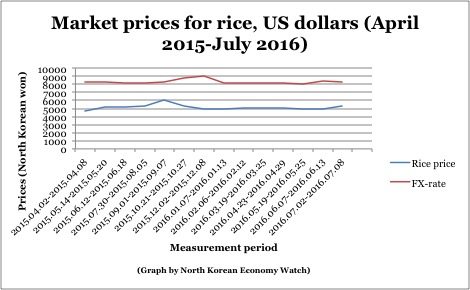
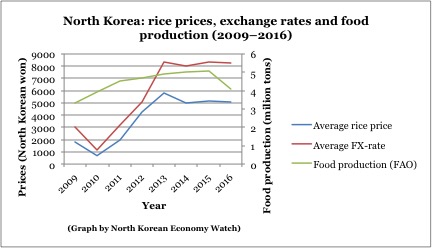
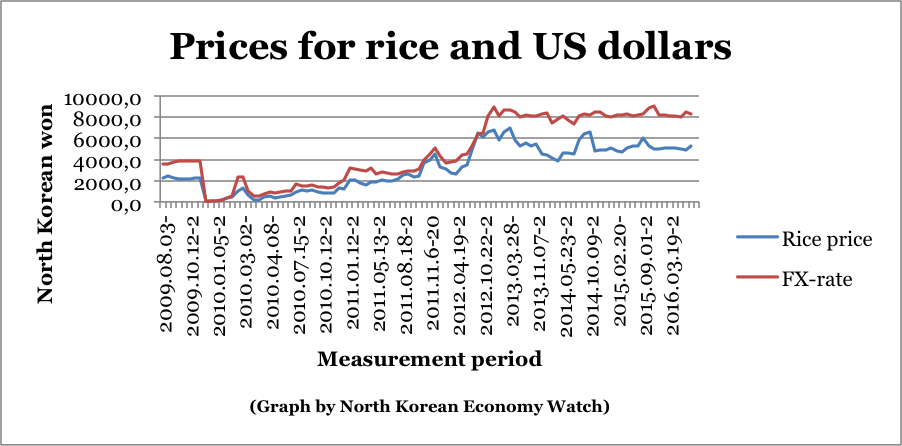
North Korean rice prices have quadrupled this year amid concern the regime is facing further economic isolation, according to a South Korean research report.

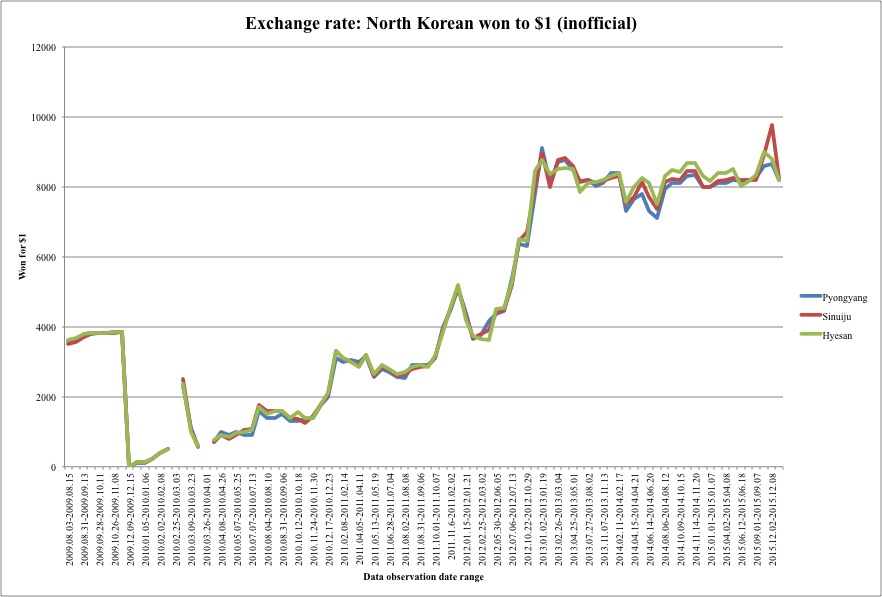
Rice prices jumped to as much as 2,200 North Korean won per kilogram during the first six months of the year from about 500 won at the end of 2010, South Korea’s state-run Korea Development Institute said today in an e-mailed statement. The difference was mostly caused by a slump in the domestic currency, which is a factor the government considers in setting the price, the report said.

North Korea’s won is not freely traded though the U.S. dollar is the de facto currency used in many markets.

South Korea in May last year cut off most trade with North Korea, accusing Kim Jong Il’s regime of torpedoing one of its warships in March that killed 46 sailors. The U.S. is assessing whether to provide food assistance to North Korea, which is also under United Nations sanctions for its nuclear tests.

The North Korean currency has weakened “sharply” since the regime shelled South Korea’s Yeonpyeong island in November amid concerns worsening relations will lead to further shortages of goods, the report said. North Korea has also increased coal exports to China to make up for the shortfall in trade with South Korea, causing energy shortages, it said.

While the regime lifted its ban on street markets that was placed at the end of 2009, high prices and goods shortages are preventing them from helping meet North Koreans’ needs, the report said.

Read the full story here:
North Korean Rice Prices Quadruple
Bloomberg
Bomi Lim
2010-7-5

Share

Daily NK on anti-socialist activities

Thursday, June 23rd, 2011

Part 1: The Illogicality of Anti-Socialist Policy
Lee Seok Young
2011-6-22

In North Korea today, those actions which are subject to the harshest oversight and most excessive punishment are those deemed anti-socialist, an expression of the extent to which such actions are seen as a threat to the regime.

Yet these very actions have already taken deep root in people’s lifestyles, spreading rapidly as a result of chronic economic difficulties, food insecurity, endemic corruption and the inflow of information from abroad.

First of all, every North Korean and defector the Daily NK meets says much the same thing; that if people had not followed an ‘anti-socialist’ path during the mid-90s famine, they could not have survived. The power which maintains North Korean society through the hardest times is that derived from anti-socialist actions, and it is those actions which the authorities would like to put an end to.

The blocking of these so-called ‘anti-socialist trends’ nominally began with Kim Jong Il’s 1992 work, ‘Socialism Is a Science’, issued following the fall of the Eastern Bloc. A time of great fear for the regime, ‘Socialism Is a Science’ expressed a determination to block out anti-socialist phenomena.

However, a famine exploded nationwide shortly after the publication of the thesis, placing these very anti-socialist modes of behavior at the core of the lives of almost everybody in the nation.

Having completely replaced Kim Jong Il and the Chosun Workers’ Party as the alpha provider of sustenance, money is now uppermost in the minds of the people. If they can, they are moving away from the collective farms, factories and enterprises to become more active in the market.

“At a time when the state didn’t provide rations and workers were not even receiving their monthly wages, the ones who started trading early on were all best able to avoid this predicament,” said one defector, “Others followed after their example and, rather than trying to find work, went straight into the market.”

Money, then, is the fundamental toxin that now threatens to shake the very basis of the Kim regime, completely undermining the ‘let’s work the same, have the same and live well’ lifestyle that the regime has long been demanding from the people.The authorities, as part of a losing battle to halt this slide, ‘educates’ the people with the mantra, “Don’t become a slave to money,” but it makes no difference.

People are growing more and more money-oriented. What simply began as a desperate rearguard action to survive extreme poverty has become a preoccupation with accumulating wealth. The many who don’t have the capital to start a business are keen to work with those who do.

One interviewee, a woman hailing from North Hamkyung Province, told The Daily NK, “They have to keep trying, but they can’t eliminate it. How could they, when the state itself is actually encouraging its spread? Everywhere you go, they demand bribes, and people with money never get punished even when clearly guilty, because everyone is desperate to earn money.”

Given that the central authorities demand Party funds from regional bodies, and regional Party and military cadres in turn work with smugglers, and the cadres charged with inspection turn a blind eye to criminal acts in exchange for bribes, the whole system is, as the interviewee said, rotten from the top down.

One defector who left his position as a cadre in a Yangkang Province enterprise agreed, recalling, “The Party periodically collected money from our factory, but since all the machinery had long since stopped running, they made us work in the market and give 30% of the profits to the authorities. It was the state that promoted anti-socialism in consequence.”

Another defector originally from North Hamkyung Province said in a similar vein, “The National Security and People’s Safety agents stationed on provincial borders stop people without the right permit to travel, but let them pass in exchange for a few packs of cigarettes. Some even ask for your wrist watch. It’s not just the people; the whole nation is busy being anti-socialist.”

Increasing exposure to foreign materials is also influencing the situation somewhat. Such things are especially popular with students and women working in the markets, two groups which are more up-to-date than most.

South Korean and Western culture is being transmitted quickly via DVD, and materials that are brought into the state from China by traders and smugglers are also pushing forward new trends such as the ‘Korean Wave.’

To the North Korean people, who once lived in near complete isolation from the rest of the world, the introduction of foreign materials has intensified their yearnings for a new life style. The stricter the regulations become, the thirstier for something else the people become.

Part 2: Crackdowns Enhancing Anti-Socialist Cycle
Mok Yong Jae
2011-06-23

‘Anti-socialism’ in North Korea is a destabilizing force disturbing the foundations of the system. For that reason, the authorities place a great emphasis on rooting it out. Inspections are frequent and their targets varied. But the fact is that this has done little to stop the growth of such activities; in fact, quite the opposite; some believe that targeted inspections actually increase instances of smuggling, for example.

These focused inspections are handed down in the name of the ‘Party Center’ in other words Kim Jong Il. The latest inspections over anti-socialist trends in border areas have been being carried out by Kim Jong Eun’s direct instruction. First people are educated about and warned against ‘anti-socialist behavior’, then provincial Party and military cadres launch an inspection.

If a concerted inspection is to be unleashed on a given area, an inspection unit is set up, and it does the work. In the case of recent inspections targeting drugs and defection, the inspection units have even been sent from the Central Committee of the Party. The makeup of the unit can differ slightly depending on the target of the inspection, but usually includes agents from the National Security Agency (NSA), People’s Safety Ministry and Prosecutors Office. Precise search sites are usually selected at random and the searches conducted without warning, while ‘criminals’ are flushed out in part by getting citizens to report on one another.

However, the effectiveness of this system has a limit. This is primarily due to an overwhelming degree of official corruption at nearly all levels.

The Spread of Bureaucracy and the Limits of Inspections

The primary agents conducting the inspections, agents from the NSA and PSM, collude with smugglers for their own benefit. Anti-socialist activities are not a new means of survival, and the more commonplace the inspections become, the more focused the agents doing it become on their own self-interest; i.e. rent seeking rather than uncovering instances of wrongdoing.

For example, agents seek out big smugglers only in order to offer them an opportunity for their actions to be ignored, something they will do for a price. A source from Yangkang Province explained to The Daily NK, “Hoping not to lose their goods, also so as to avoid prison, in many cases smugglers try to win over agents. They talk to the official for a while, and if they think ‘this guy can be won over’ then some even gently encourage them to find a way to forego any punishment.”

Then, when the inspecting agents begin dropping heavy hints about expensive merchandise, electronics or a piano, for example, the smugglers say, “I’d be delighted to buy that for you,” and for that receive their freedom.

Thus, it is rare for money to change hands directly; goods are bought in China and handed over when the inspection period has come to a close. The smuggler also obtains a permit to import a certain amount of other goods without penalty in the future. By winning over agents in this way, assistance in future times of trouble can also be secured.

In addition, as Lee Jae Won, the former chairman of the Korean Bar Association Committee on Human Rights in North Korea and someone who has interviewed a great number of defectors as author of the 2010 White Paper on Human Rights in North Korea, concludes, “Anti-socialist activities are extremely common for North Korean cadres in public positions such as prosecutors and judges.” The bribing of prosecutors and judges in exchange for leniency or to escape conviction is a daily occurrence, as much as bribing the security forces and cadres.

What Anti-socialist Counteroffensive? Officials are the source of Antisocialism

Now much more so than in the past, cadres and agents are directly involved in the antisocialist activities.

A Chinese-Korean trader who often goes between Dandong and Shinuiju told The Daily NK, “There are so many drugs in North Korea that even the officers supposed to be policing it are taking drugs themselves. Some of them even asked me to take opium to China and sell it. I go back to North Korea every year to visit relatives, and I’ve seen officers there doing bingdu (methamphetamines) with my own eyes.

It is also said that the families of cadres are the main source of South Korean movies and dramas on DVD. Party cadres are, in effect, the very source of the Korean Wave that their bosses in Pyongyang ban on the premise of defending the state from the ‘ideological and cultural invasion of the South Chosun reactionaries’.

A source from Pyongan Province confirmed the story, telling The Daily NK, “These DVDs and VCDs come from the houses of cadres who travel overseas a lot. The children of cadres love watching them. The families of traders have a lot of them, too, but it’s the cadres they’re spreading from.”

Thus, while the central Party single-mindedly attacks anti-socialist behaviour, the cadres and agents who are meant to be carrying out the orders are deeply involved in the ‘anti-socialism’ themselves. The more crackdowns that occur, the more contact there is between the elite and security forces on the one hand and smugglers and traders on the other, offering more opportunities for symbiosis. It is for this reason that some claim the inspections are actually catalyzing the anti-socialism.

Meanwhile, An Chan Il of the World North Korea Study Center pointed out to The Daily NK that the whole thing is completely inevitable, saying, “These inspection teams are not receiving proper rations from the state, so of course they take bribes instead when sent out into the field. Administrative irregularities and corruption are at the very heart of these anti-socialist inspections. The only way for the families of inspecting agents to survive is for the father to be a part of this anti-socialist behavior.”

Choi Yong Hwan from the Gyeonggi Research Institute agreed, adding, “These inspections are intensifying social inequality. The fundamental cause of this is the collapse of the state rationing system due to economic difficulties. It’s a situation where even the agents are hungry, so there is a permanent pattern of them attempting to guarantee their own survival via corruption. There is a vicious cycle repeating here, whereby those who are able to ingratiate themselves with the inspecting agents and cadres survive, and those who do not or cannot get punished.”

Share

DPRK law enforcement guidebook insights

Thursday, June 23rd, 2011

A DPRK law enforcement manual was “released” by a South Korean missionary group named Caleb Mission.  The document seemingly offers a glimpse of the typical workload of a North Korean police officer.  The document, to the best of my knowledge has not been posted on line yet, so caveat emptor.  The Korea Herald offers some details below:

The classified guidebook for law enforcement authorities published by the North’s police agency in June 2009 lists 721 actual cases related to criminal law, civil law and the code of criminal procedure and offers advice on how to punish offenders.

One of the cases in the 791-page reference book is about a hog-raiser who sold pork injected with growth hormones and made a lot of money by selling more meat.

In this case, the North Korean law enforcement authorities cannot do anything about the hog-raiser because the man made money by selling pork at a legally permitted price in the market through his own efforts, explains the guidebook.

The book also explains that the act of getting paid for transporting another person’s luggage from the train station using a bicycle cannot be seen as a crime because the law does not stipulate that selling an individual’s efforts is a crime.

A food salesperson can be punished for “violating the order of product sales,” however, if he sprayed water on his seaweed to make it look fresher.

Much of the guidebook is about crimes where individuals caused damage to the state by stealing from the government or neglecting their duties, an indication of the seriousness of economic difficulties many North Koreans are going through.

Attempts to evade mandatory military service and euthanasia have become social headaches in the North as well.

A doctor who took $800 from five people in exchange for forging their medical records was charged with bribery and violating the law on military duty.

If a person avoided conscription by lying about his eyesight and later was found to have normal eyesight, he could be questioned by the authorities on charges of violating the law on military service.

The guidebook also stresses that euthanasia is illegal, mentioning a case where a son drugged his father to death to relieve him of the pain from illness under the consent of his mother.

Both the mother and the son should be seen as accomplices in a murder because “although they did not have a foul motive in killing him, the victim did not ask for it,” the book reads.

Bribery and treats in exchange for influence-peddling was also prevalent in North Korea.

People accused of trading South Korean or American films were punished for illegally bringing in and distributing “decadent culture” under North Korean criminal law.

Read the whole story here:
Official guidebook offers glimpse of N.K. society
Korea Herald
Kim So-hyun
2011-06-22

Share

Meth as medicine

Tuesday, June 21st, 2011

From a recent Newsweek article about meth use in the DPRK:

First synthesized in 1893, meth is now one of the world’s most widely abused drugs, imbuing the user with intense feelings of euphoria, concentration, and grandiosity. Smoked, injected or snorted, the drug also suppresses the need for food and sleep for an extended period of time; coming down can bring fatigue, anxiety, and occasionally suicidal ideation.

Inside North Korea, observers say, many use meth in place of expensive and hard-to-obtain medicine. “People with chronic disease take it until they’re addicted,” says one worker for a South Korea-based NGO, who requested anonymity in order to avoid jeopardizing his work with defectors. “They take it for things like cancer. This drug is their sole form of medication,” says the NGO worker, who has interviewed hundreds of defectors in the past three years. A former bicycle smuggler who defected in 2009 told NEWSWEEK of seeing a doctor administering meth to a friend’s sick father. “He took it and could speak well and move his hand again five minutes later. Because of this kind of effect, elderly people really took to this medicine.”

Jiro Ishimaru, founder and editor of Rimjin-gang, a magazine about North Korea and reported by people inside the country but published in Japan, says he has seen several North Koreans take meth to relieve stress and fatigue, including his former North Korean business partner. “He didn’t start taking it as a drug but as a medicine,” Ishimaru says.

The drug also offers an escape that might not otherwise be possible. As Shin puts it: “There’s so little hope in North Korea—that’s why ice is becoming popular. People have given up.”

Read the full story here:
North Korea’s Meth Export
Newsweek
Isaac Stone Fish
2011-6-19

Share