UPDATE 30 (2014-12-1): According to the JoongAng Ilbo, the purge continues:
North Korea is engaged in another purge of people close to Jang Song-thaek, the once powerful uncle of leader Kim Jong-un who fell from grace and was executed last Dec. 12, sending a deep chill through the top ranks of the Workers’ Party and the country’s elite.
According to a report to be published Monday by the Institute for National Security Strategy, which is run by the National Intelligence Service, dozens of senior party members were executed or stripped of their titles in a second phase of a purge of allies of the fallen Jang.
Some were executed on treason charges, heightening fears among the top party elite with connections to Jang.
The report says the second purge began after the collapse of a new 23-story apartment building that killed more than 400 people in Pyongyang in May. Enraged by the accident, the 31-year-old leader blamed “remnants of Jang Song-thaek” for the collapse because the building was constructed by the Ministry of People’s Security, which used to be overseen by Jang.
The report says 20 officials were either executed by firing squad or sent out of Pyongyang in the purge. Choe Pu-il, head of the security ministry who is also known as a basketball coach of Kim when he was young, was demoted and has been out of public sight since July.
In September, nearly 20 members of the Propaganda and Agitation department and Guidance department of the Communist Party were also shot to death on charges of being anti-party, or guilty of bribery, having improper relationships with women and taking drugs.
In October, the report says about 10 party members were shot to death for their connection to Kim’s uncle. One senior secretary from the Workers’ Party’s Haeju committee was also allegedly executed for watching television dramas from South Korea in October.
Some were executed for trivial reasons, such as changing a song lyric that originally praised Kim Jong-un while singing karaoke, the report says.
The string of executions has the entire elite in Pyongyang on edge. According to the report, Foreign Minister Ri Su-yong, who was the de-facto guardian for Kim Jong-un when he studied in Switzerland, fretted about his future because he failed to stop a United Nation’s resolution calling Kim to be referred to the International Criminal Court for crimes against humanity.
“Minister Ri Su-yong feared he could not predict what would befall him after all his diplomatic efforts failed to stop the UN resolution,” wrote senior researcher Hyun Sung-il in the report’s opening statement.
Researcher Hyun was a former North Korean diplomat in Zambia who defected to the South in 1996.
One senior official at the research institute said there is a rumor among top party members that their country could crumble in less than 10 years in such conditions.
“When analyzing Kim’s lip movements during his chats with elderly party members on television, it is not rare to find him insulting them with foul language,” said the official, who spoke on the condition of anonymity.
UPDATE 29 (2014-8-30): The Asahi Shimbun reports on speculated collateral damage:
The purge and execution of North Korea’s de facto No. 2 man eight months ago has resulted in uncertain fates for his associates, some of whom have since been promoted and another likely incarcerated in a political prison camp.
Jang Song Thaek was the uncle to North Korean leader Kim Jong Un through marriage to the younger sister of Kim Jong Il, the late father and predecessor of Kim Jong Un.
Tokyo, Seoul and other parties believe struggles over concessions set the stage for the purge of Jang, who served as vice chairman of the powerful National Defense Commission.
The cadre of the country’s ruling Workers’ Party of Korea included many who had worked with Jang.
Kim Yang Gon, director of the party’s United Front Department, Kim Yong Il, director of the party’s International Department, and Kang Sok Ju, a party secretary, all worked under Jang when he was a section chief in the party’s Organization and Guidance Department in charge of the Foreign Ministry.
Choe Ryong Hae, another party secretary, and Mun Kyong Dok, former chief secretary of the Pyongyang municipal party committee, both worked with Jang when he held a senior position in the party’s youth work department.
Kang Sok Ju remains influential even after Jang’s execution in December. He was likely appointed a party secretary in charge of international affairs in April.
South Korean government officials said Kang recently met a visiting delegation of European political parties. Kang told the delegation that talks between Washington and Pyongyang are expected to take place in January next year, after U.S. midterm elections in November, according to the officials.
Choe Ryong Hae was also appointed a party secretary in April, although he was dismissed as director of the General Political Bureau of the military.
“Choe was held in low regard within the military but remains in the forefront because he has the trust of Kim Jong Un,” said a source well-versed in North Korean affairs.
Ri Su Yong, who is believed to have been under Jang’s direction in the former Commission for Joint Venture and Investment, was promoted to foreign minister in April.
Ji Jae Ryong, ambassador to China and a purported close aide to Jang, also remains politically active.
But life has turned miserable for Mun Kyong Dok, who Tokyo and Seoul believe has likely been sent to a political prison camp.
Kim Yang Gon has been spared a fall from grace, but rumors say he was seriously injured with a broken leg or is receiving about six months of political re-education.
Kim Yong Il may remain the director of the International Department, but he has undeniably lost his clout. There are rumors about his possible transfer to an ambassadorship.
That raises questions about why Jang’s purported associates have been treated differently.
Tokyo and Seoul believe struggles between Jang and the military over concessions set the stage for Jang’s purge.
Jang ordered concessions held by trading companies and other parties under the military’s umbrella to be moved to the Cabinet, the party’s Administrative Department, and other sectors under his own influence, partly because Kim Jong Il had misgivings about the military’s rise in power. The offended military likely co-opted Kim Jong Un to engineer Jang’s purge, according to the story.
No major change has, in fact, been seen in North Korea’s political line since Jang was purged.
“The incident did not develop into a full-scale purge of all officials concerned because it was not a political struggle,” a South Korean government official said.
Choe and other senior officials have taken turns avoiding being mentioned in official news reports for certain periods of time since Jang was purged. They were apparently questioned during those periods over whether they received any distribution of interest from Jang, the findings of which likely decided the fates of officials associated with him.
UPDATE 28 (2014-8-7): The South Korean media reports on the continuing fallout from the Jang purge:
The North Korean regime has shut down the Workers Party department once headed by purged eminence grise Jang Song-taek and executed or interned 11 high-ranking officials, sources said Sunday.
One of them was burned alive.
A source said the regime is preparing a third purge of officials who supported Jang. The first purge involved his family, relatives and high-ranking party officials, while the second purge underway. The third will target his supporters in provincial chapters of the Workers Party.
The source said Jang’s elder sister Kye-sun and her husband and ambassador to Cuba Jon Yong-jin, as well as their son-in-law Kim Yong-ho, who was head of a trading company, were executed. But ambassador to Malaysia Jang Yong-chol, Jang’s nephew, escaped with his life.
He was sent to a concentration camp shortly after Jang Song-taek’s execution but was ordered to return to Pyongyang without a job after South Korean media reported rumors of his execution, the source added.
Jang’s closest confidants Ri Yong-ha and Jang Su-gil as well as nine other high-ranking party officials were purged, while around 100 lower-ranking party officials loyal to Jang were sacked.
O Sang-hon, a deputy minister at the Ministry of Public Security, was “executed by flamethrower,” the source said.
The reason for the horrific method that he had turned the ministry into Jang’s personal protection squad, the source added. O managed a bureau in the ministry as his personal security service and raised its status to the same rank as officials guarding leader Kim Jong-un.
UPDATE 27 (2014-5): For what it is worth, Dennis Rodman claims that Jang Song-thaek is still alive. According to an interview with Dujour:
DJ: And the accusations about him having his family members killed…
DR: You could say anything here about North Korea and people would believe it. The last time I went there, when they said they killed his girlfriend, they killed his uncle, they just fed him to the dogs… They were standing right behind me.
DJ: You’re saying that the uncle that the North Korean government itself confirms was executed is actually alive?
DR: He was standing right there.
UPDATE 26 (2014-4-7): More rumors from the Chosun Ibo on the purge of Jang song-thaek:
The North Korean regime has shut down the Workers Party department once headed by purged eminence grise Jang Song-taek and executed or interned 11 high-ranking officials, sources said Sunday.
One of them was burned alive.
A source said the regime is preparing a third purge of officials who supported Jang. The first purge involved his family, relatives and high-ranking party officials, while the second purge underway. The third will target his supporters in provincial chapters of the Workers Party.
The source said Jang’s elder sister Kye-sun and her husband and ambassador to Cuba Jon Yong-jin, as well as their son-in-law Kim Yong-ho, who was head of a trading company, were executed. But ambassador to Malaysia Jang Yong-chol, Jang’s nephew, escaped with his life.
He was sent to a concentration camp shortly after Jang Song-taek’s execution but was ordered to return to Pyongyang without a job after South Korean media reported rumors of his execution, the source added.
Jang’s closest confidants Ri Yong-ha and Jang Su-gil as well as nine other high-ranking party officials were purged, while around 100 lower-ranking party officials loyal to Jang were sacked.
O Sang-hon, a deputy minister at the Ministry of Public Security, was “executed by flamethrower,” the source said.
The reason for the horrific method that he had turned the ministry into Jang’s personal protection squad, the source added. O managed a bureau in the ministry as his personal security service and raised its status to the same rank as officials guarding leader Kim Jong-un.
UPDATE 25 (2014-2-13): The DPRK has a new ambassador to Laos.
UPDATE 24 (2014-2-8): KCNA reports that the DPRK has replaced its ambassador to Nepal:
DPRK Ambassador to Nepal Appointed
Pyongyang, February 8 (KCNA) — Kim Yong Hak was appointed as DPRK ambassador to Nepal, according to a decree of the Presidium of the Supreme People’s Assembly of the DPRK.
UPDATE 25 (2014-2-5): RFA reports that dozens of entertainers and performers linked to Jang Song-thaek have been imprisoned:
North Korea’s leader Kim Jong Un has ordered the jailing of 40 popular actors and actresses as part of his relentless crackdown on those closely linked to his executed uncle, sources say.
Jang Song Thaek’s execution two months ago followed a massive purge in the government and military, and Kim seems to be moving now to flush out Jang’s allies in the entertainment industry, according to the sources.
“About 40 entertainers, referred to as a group linked to Jang Song Thaek, have been sent to Soosung prison in Chongjin in North Hamgyong province,” a source told RFA’s Korean Service, referring to a detention facility that is usually reserved for “first class” political prisoners.
“I heard this from a North Korean official of North Hamgyong province who is in charge of earning foreign currency,” the source said, as if to reinforce the credibility of his information.
The source said he was informed that entertainers belonging to such popular groups as the Chosun Art Film Studio, Pyongyang Circus Troupe, and Mansudae Art Theater were taken to the prison facility on Jan. 17 in two trucks.
Among those thrown in prison were Ryu Jin Ah, a singer with the Moranbong Band who was known to be Jang’s “lover,” and Li Yik Seung, an actor with Chosun Art Film Studio believed to be involved in “procuring” actresses for Jang and officials close to him, another source said.
The Moranbong Band made a public appearance in July 2012 on Kim’s orders and Ryu was bestowed a top entertainer title a year later, according to the official Korean Central News Agency.
Li, who won the Kim Jong Il Award in February 2012, played the role of a mine owner in “Comrade Kim Goes Flying,” a 2012 romantic comedy film co-produced by North Korea, Britain, and Belgium.
‘Womanizing problem’
The second source, also speaking on condition of anonymity, said Ryu and Li were linked to the 67-year-old Jang’s “womanizing problem,” cited as among reasons for his execution aside from the more serious charges of attempting to overthrow the government and seize power from his nephew.
“It is well known among residents in North Hamgyong province that a number of entertainers have been confined in the Soosung prison in Chongjin,” the source said.
A former Japanese chef for the Kim family told RFA recently that Kim had ordered Jang’s execution for his role in procuring teenage girls to satisfy the sexual desires of Kim’s father and Jang himself.
Chef Kenji Fujimoto said that by having Jang killed, Kim “wanted to prove that he’s different” from his father Kim Jong Il and his grandfather Kim Il Sung, both of whom he said had “quite a history with women.”
Fujimoto, who was Kim Jong Il’s personal sushi chef from 1988 to 2001, claimed that aside from his official duties as de facto number two to Kim Jong Il, the 67-year-old Jang had been in charge of a “pleasure division” tasked with recruiting girls aged 15-16 years for the late dictator.
In his New Year message broadcast on state TV, Kim Jong Un defended the execution of his uncle—who was married to his father’s sister—saying it was a “resolute action” and labeling Jang “scum.”
Jang was also de facto number two under the junior Kim before his execution and was considered instrumental in his rise to power in December 2011.
Sources inside North Korea had told RFA earlier that Kim was already purging the country’s military officer corps of personnel linked to Jang in a massive shake-up that has led to a freeze on military exercises and delayed replacement of cadres in the ruling party but raised promotion prospects for younger officers.
UPDATE 23 (2014-2-3): The DPRK’s ambassador to the United Kingdom gave an interview in which he discussed the purge of Jang Song-thaek. According to the Hankyoreh:
Hyun Hak-bong, North Korean ambassador to the United Kingdom, told the UK’s Sky News that Jang Song-thaek, former head of the administrative division of the Korean Workers’ Party, was executed for misappropriation of public funds.
When the subject of Jang came up in an interview on Jan. 30, Hyun said that Jang was sentenced to death in the court according to the law and that he was shot to death. This is the first time that a North Korean official has explained on the record why and how Jang was executed. Asked about the crimes Jang was charged with, Hyun said that he had committed the acts in question, anti-state acts, and that he had abused his authority and driven the North Korean economy into the ground. Hyun said that among Jang’s crimes was the misuse of 4.6 million euros in 2009.
In 2009, North Korean leader Kim Jong-un’s father Kim Jong-il was still alive. This implies that after Kim Jong-un took power, he suddenly took issue with something that had happened four years earlier.
In regard to this, Hyun said that the party had forgiven Jang’s behavior on several occasions in the past, but that this time his actions went “beyond the red line,” stressing that execution had been the only option.
Addressing reports that Jang’s family and relatives had been killed as well, Hyun called these fabricated reports and dismissed them as “political propaganda by our enemies.” However, when the interviewer asked Hyun if Jang’s family was still alive, the ambassador avoided a definitive response. “I know he was punished but if his family were punished or not, I don’t know,” Hyun said.
UPDATE 22 (2014-1-28): Rimjingang offers some speculation on the continued purges of Jang’s associates.
UPDATE 21 (2014-1-22): Alexandre Mansourov provides a detailed chronology of Jang’s fall from grace in 38 North.
UPDATE 20 (2014-1-20): Choson Ilbo reports that O Kuk-ryol has been taking over Jang’s portfolio:
A senior North Korean source on Sunday said O is gaining control of the financial operations of the National Defense Commission that was once managed by Jang as well as other business interests.
O has crucially gained control of agencies in charge of bringing in foreign currency such as a body created by Jang to develop an economic zone in Sinuiju near the border with China.
He has thus regained rights to the development of Rajin-Sonbong port, exports of seafood and gold mining that Jang stripped him of in 2010.
Radio Free Asia in the U.S. reported that companies managed by O have had exclusive control of LPG import licenses from China and Russia since Jang’s execution.
UPDATE 19 (2014-1-6): Pyongyang has replaced its coal industry and metal industry ministers. According to the Korea Herald:
The North’s official Korean Central News Agency on Sunday introduced Mun Myong-hak as coal industry minister, a position held by Rim Nam-su at least until a year ago, while reporting on the 30th anniversary of a coal mining complex in the western province of South Pyongan.
The charges culminating in Jang’s death unveiled by the KCNA included underpricing overseas “precious underground resources including coal” and land within an up-and-coming special economic zone.
The mineral-rich North has long been seeking to shore up its crumbling economy through exports of coal, iron ore, hard coal and other resources, mostly to China.
Seoul’s spy chief Nam Jae-joon late last month ascribed Jang’s shock purge to discords among the elite over lucrative coal export business.
It remains unclear, however, whether Jang and Rim had had a close relationship.
Former manager of a youth coal mine in South Pyongan, Mun was twice named a member of the Supreme People’s Assembly, in 2003 and 2009, before being introduced last January as head of a youth coal mining complex in Sunchon in the region.
His appointment was the latest in an ongoing personnel shakeup in Pyongyang.
On Thursday, Korean Central Television introduced Kim Yong-kwang as metal industry minister as it aired the reactions of ministry officials to Kim Jong-un’s New Year address. His predecessor Han Hyo-yon last appeared in state media last June.
Kim was vice metal industry minister from June 2008 and manager of a mining complex in Musan, North Hamgyong Province, from December 2011, and was nominated to the steering committee of the funeral of late leader Kim Jong-il around then.
“Our metal industry will actively contribute to strengthening national power by bringing up the working classes’ combative enthusiasm and reproducing steel,” he told the broadcaster on Thursday.
The Choson Sinbo, a pro-Pyongyang newspaper in Japan, said last month that Kim Jong-ha has become secretary of the Cabinet secretariat, succeeding Kim Yong-ho.
UPDATE 18 (2013-12-30): North Korea has recalled its deputy ambassador to UNESCO. According to Yonhap:
North Korea’s deputy ambassador to UNESCO was called back to Pyongyang from Paris on Monday, a diplomatic source said, marking the latest summoning of North Korean diplomats following the recent execution of leader Kim Jong-un’s uncle.
Hong Yong, the North’s deputy permanent delegate to UNESCO, and his wife were spotted at the Beijing airport before boarding an Air Koryo flight earlier in the day, the source said on the condition of anonymity.
Last week, the North’s ambassador to Sweden, Pak Kwang-chol, returned to North Korea. Pak was one of the close aides to the purged uncle, Jang Song-thaek.
“North Korea appears to be intensively carrying out recalls of high-ranking diplomats,” the source said.
“A number of North Korean diplomats, trade officials and businessmen, who served as close subordinates of Jang Song-thaek, have been returned home,” the source said.
North Korea’s ambassador to China, Ji Jae-ryong, has been conducting business as usual, but North Korean diplomats in Beijing “have been recently trying to refrain from outdoor activities,” the source said.
Ji, 71, has shared the same political fate as Jang over the past three decades and served as a “linking pin” between Jang and the Chinese leadership since he took up the post in 2010.
Earlier this month, the North’s ambassador to Malaysia, Jang Yong-chol, a nephew of the executed uncle, had also been summoned back to the country.
Mr. Hong had apparently held the post for just six months.
UPDATE 17 (2013-12-27): Yonhap reports that the DPRK’s ambassador to Sweden has been recalled. According to the article:
North Korean ambassador to Sweden, Pak Kwang-chol, was called back to Pyongyang on Friday, a diplomatic source said, marking the latest recall of North Korean diplomats following the recent execution of leader Kim Jong-un’s uncle.
Pak, one of close aides to the purged uncle, Jang Song-thaek, returned to North Korea via an Air Koryo flight after making a brief stopover in Beijing earlier in the day, the source said on the condition of anonymity.
Escorted by North Korean officials, Pak and his wife were spotted at Beijing airport before boarding the Air Koryo flight, the source said.
Park took up the post in September last year, according to a report by the North’s state media.
UPDATE 16 (2013-12-23): South Korea’s spy chief states that Jang’s demise stemmed from business dealings. According to AFP:
The shock purge and execution of the North Korean leader’s uncle stemmed from his attempts to take control of the country’s lucrative coal export business, South Korea’s spy chief told lawmakers Monday.
…
The execution — the biggest political upheaval since Kim took power two years ago — sparked speculation that Jang had lost out in a power struggle with hardline army generals.
But Nam Jae-Joon, the head of South Korea’s National Intelligence Service, said Jang’s attempts to secure control of state-run natural resources businesses played a big part in his downfall.
Nam, briefing members of parliament’s intelligence committee on the situation in the North, also said the young ruler currently “appears to have no problem” in his grip on power — but may stage armed provocations against the South sometime between January and March to rally domestic unity.
“Jang intervened too much in lucrative state businesses… related to coal, which drew mounting complaints from other [related] state bodies,” lawmaker Jung Chung-Rae, a member of the committee, quoted Nam as saying at the closed hearing.
Jang for years handled the country’s mineral exports, which go mostly to China.
The impoverished but mineral-rich North has sought for years to bolster its crumbling economy by increasing exports of coal and other minerals, which account for the bulk of its exports to China.
But Jang and his associates angered other top party officials by rapidly expanding their control over the coveted mineral businesses, Jung quoted Nam as saying.
“Kim Jong-Un was briefed about it… and issued orders to correct the situation,” Jung told reporters.
But many officials loyal to Jang did not immediately accept his orders, which eventually led an angry Kim to launch a sweeping purge, the lawmaker quoted the spy chief as saying.
The regime is currently probing officials in the ruling party’s administrative department once supervised by Jang as well as other state-run trading arms, Nam was quoted as saying.
According to the New York Times, also covered the announcement, though this telling of the story focuses more on a dispute that erupted from fishing rights:
The execution of the uncle of Kim Jong-un, North Korea’s leader, had its roots in a firefight between forces loyal to Mr. Kim and those supporting the man who was supposed to be his regent, according to accounts that are being pieced together by South Korean and American officials. The clash was over who would profit from North Korea’s most lucrative exports: coal, clams and crabs.
North Korean military forces were deployed to retake control of one of the sources of those exports, the rich crab and clam fishing grounds that Jang Song-thaek, the uncle of the country’s untested, 30-year-old leader, had seized from the military. In the battle for control of the fishing grounds, the emaciated, poorly trained North Korean forces “were beaten — very badly — by Uncle Jang’s loyalists,” according to one official.
The rout of his forces appears to have been the final straw for Mr. Kim, who saw his 67-year-old uncle as a threat to his authority over the military and, just as important, to his own family’s dwindling sources of revenue. Eventually, at Mr. Kim’s order, the North Korean military came back with a larger force and prevailed. Soon, Mr. Jang’s two top lieutenants were executed.
The two men died in front of a firing squad. But instead of rifles, the squad used antiaircraft machine guns, a form of execution that according to South Korean intelligence officials and news media was similar to the one used against some North Korean artists in August. Days later, Mr. Jang himself was publicly denounced, tried and executed, by more traditional means.
Given the opaqueness of North Korea’s inner circle, many details of the struggle between Mr. Kim and his uncle remain murky. But what is known suggests that while Mr. Kim has consolidated control and eliminated a potential rival, it has been at a huge cost: The open warfare between the two factions has revealed a huge fracture inside the country’s elite over who pockets the foreign currency — mostly Chinese renminbi — the country earns from the few nonnuclear exports its trading partners desire.
..
But when Mr. Kim succeeded his father two years ago, he took away some of the military’s fishing and trading rights and handed them to his cabinet, which he designated as the main agency to revive the economy. Mr. Jang was believed to have been a leading proponent of curtailing the military’s economic power.
r. Jang appears to have consolidated many of those trading rights under his own control — meaning that profits from the coal, crabs and clams went into his accounts, or those of state institutions under his control, including the administrative department of the ruling Workers’ Party of Korea, which he headed.
But this fall, the long-brewing tensions that arrangement created broke into the open. Radio Free Asia, in a report last week that cited anonymous North Korean sources, reported that Mr. Kim saw North Korean soldiers malnourished during his recent visits to islands near the disputed western sea border. They say he ordered Mr. Jang to hand over the operation of nearby fishing grounds back to the military.
According to accounts put together by South Korean and American officials, Mr. Jang and his associates resisted. When a company of about 150 North Korean soldiers showed up at the farm, Mr. Jang’s loyalists refused to hand over the operation, insisting that Mr. Jang himself would have to approve. The confrontation escalated into a gun battle, and Radio Free Asia reports that two soldiers were killed and that the army backed off. Officials say the number of casualties is unknown, but they have received similar accounts.
It is hard to know exactly how large a role the episode played in Mr. Jang’s downfall — there is more money in coal than in seafood — but Mr. Kim was reportedly enraged when he heard of the clash. Mr. Nam said that by mid-November his agents were already reporting that Mr. Jang had been detained. The Dec. 12 verdict noted that Mr. Jang “instructed his stooges to sell coal and other precious underground resources at random.”
Mr. Nam said the fact that such behind-the-scenes tensions had spun so far out of control that Mr. Kim had to order his own uncle’s execution raised questions about the government’s internal unity.
“The fissure within the regime could accelerate if it further loses popular support,” the lawmakers quoted Mr. Nam as saying.
New Focus International has published three articles on the Jang affair. These articles take a different approach than the articles above. These look at Pyongyang’s the de facto political culture and competition between JST and the party’s Organization and Guidance Department. You can read them here:
1. The transformation of N.Korean politics through the execution of Jang Song-thaek
2. Purge and execution of Jang Song-thaek: The transformation of N.Korean political procedure
3. Kim Jong-un is not in charge. Then who is?
4. We have just witnessed a coup in North Korea
5. This is it: North Korea’s hidden power system
Here is coverage at the Wall Street Journal’s Korea Real Time.
UPDATE 15 (2013-12-20): The Daily NK reports that Jang’s family members have been rounded up and punished.
UPDATE 14 (2013-12-6): Jang’s purge has had impact on operations at Rason Economic and Trade Zone and Hwanggumphyong SEZ.
UPDATE 13 (2013-12-17): NK News reports that articles about Jang song-thaek have been deleted from the KCNA.kp web page (thought not the KCNA.co.jp site). According to the article:
In total, 10-15 articles on Jang were deleted, with approximately 500 other articles mentioning Jang’s name edited to remove Jang’s name specifically.
“The scale of what they’re attempting to do here is unprecedented. North Korea ‘s websites are somewhat of an unknown quantity, and nothing on this scale has been detected before,” said Frank Feinstein, a New Zealand based computing specialist that tracks North Korean media output for NK News’s KCNA Watch.
“They’re attempting to write not just Jang, but several other elites, right out of the history books,” Feinstein added.
UPDATE 12 (2013-12-16): James Person at the Wilson Center’s NKIDB writes about the DPRK’s last major purge in the 1960s.
UPDATE 11 (2013-12-15): Michael Madden has written a thorough obituary for Jang Song-thaek.
UPDATE 10 (2013-12-15): KCNA lists Kim Kyong-hui on the funeral committee for Kim Kuk-thae, indicating she has survived the purge of her husband.
UPDATE 9 (2013-12-13): 38 North has published three prespectives on Jang’s execution: Haksoon Paik, James Church, Alexandre Mansourov
UPDATE 8 (2013-12-12): NK News has thoughts on Jang’s execution from David Straub, Victor Cha, Andrei Lankov, and Sunny Lee.
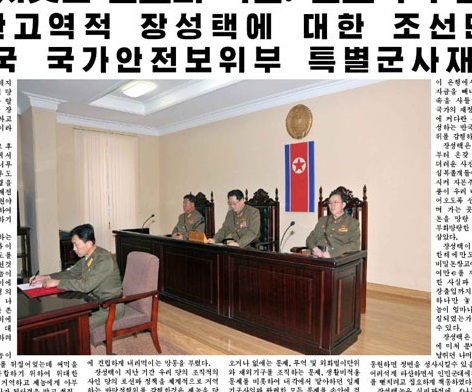
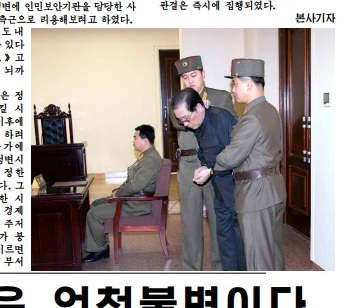
UPDATE 7 (2013-12-12): Rodong Sinmun has coverage (in Korean). Here are two images that were published of the tribunal that sentenced Mr. Jang:
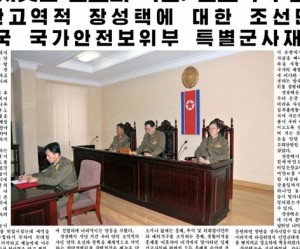
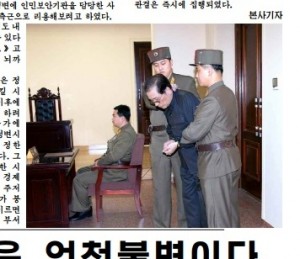
Top: The three-member military tribunal of the Ministry of State Security. Bottom: Jang can be seen in handcuffs as he is escorted by two guards from the Ministry of State Security.
UPDATE 6 (2013-12-12): KCNA announces execution of Jang song-thaek:
Traitor Jang Song Thaek Executed
Pyongyang, December 13 (KCNA) — Upon hearing the report on the enlarged meeting of the Political Bureau of the Central Committee of the Workers’ Party of Korea, the service personnel and people throughout the country broke into angry shouts that a stern judgment of the revolution should be meted out to the anti-party, counter-revolutionary factional elements. Against the backdrop of these shouts rocking the country, a special military tribunal of the DPRK Ministry of State Security was held on December 12 against traitor for all ages Jang Song Thaek.
The accused Jang brought together undesirable forces and formed a faction as the boss of a modern day factional group for a long time and thus committed such hideous crime as attempting to overthrow the state by all sorts of intrigues and despicable methods with a wild ambition to grab the supreme power of our party and state.
The tribunal examined Jang’s crimes.
All the crimes committed by the accused were proved in the course of hearing and were admitted by him.
A decision of the special military tribunal of the Ministry of State Security of the DPRK was read out at the trial.
Every sentence of the decision served as sledge-hammer blow brought down by our angry service personnel and people on the head of Jang, an anti-party, counter-revolutionary factional element and despicable political careerist and trickster.
The accused is a traitor to the nation for all ages who perpetrated anti-party, counter-revolutionary factional acts in a bid to overthrow the leadership of our party and state and the socialist system.
Jang was appointed to responsible posts of the party and state thanks to the deep political trust of President Kim Il Sung and leader Kim Jong Il and received benevolence from them more than any others from long ago.
He held higher posts than before and received deeper trust from supreme leader Kim Jong Un, in particular.
The political trust and benevolence shown by the peerlessly great men of Mt. Paektu were something he hardly deserved.
It is an elementary obligation of a human being to repay trust with sense of obligation and benevolence with loyalty.
However, despicable human scum Jang, who was worse than a dog, perpetrated thrice-cursed acts of treachery in betrayal of such profound trust and warmest paternal love shown by the party and the leader for him.
From long ago, Jang had a dirty political ambition. He dared not raise his head when Kim Il Sung and Kim Jong Il were alive. But, reading their faces, Jang had an axe to grind and involved himself in double-dealing. He began revealing his true colors, thinking that it was just the time for him to realize his wild ambition in the period of historic turn when the generation of the revolution was replaced.
Jang committed such an unpardonable thrice-cursed treason as overtly and covertly standing in the way of settling the issue of succession to the leadership with an axe to grind when a very important issue was under discussion to hold respected Kim Jong Un in high esteem as the only successor to Kim Jong Il in reflection of the unanimous desire and will of the entire party and army and all people.
When his cunning move proved futile and the decision that Kim Jong Un was elected vice-chairman of the Central Military Commission of the Workers’ Party of Korea at the Third Conference of the WPK in reflection of the unanimous will of all party members, service personnel and people was proclaimed, making all participants break into enthusiastic cheers that shook the conference hall, he behaved so arrogantly and insolently as unwillingly standing up from his seat and half-heartedly clapping, touching off towering resentment of our service personnel and people.
Jang confessed that he behaved so at that time as a knee-jerk reaction as he thought that if Kim Jong Un’s base and system for leading the army were consolidated, this would lay a stumbling block in the way of grabbing the power of the party and state.
When Kim Jong Il passed away so suddenly and untimely to our sorrow, he began working in real earnest to realize its long-cherished greed for power.
Abusing the honor of often accompanying Kim Jong Unduring his field guidance, Jang tried hard to create illusion about him by projecting himself internally and externally as a special being on a par with the headquarters of the revolution.
In a bid to rally a group of reactionaries to be used by him for toppling the leadership of the party and state, he let the undesirable and alien elements including those who had been dismissed and relieved of their posts after being severely punished for disobeying the instructions of Kim Jong Il and kowtowing to him work in a department of the Central Committee of the WPK and organs under it in a crafty manner.
Jang did serious harm to the youth movement in our country, being part of the group of renegades and traitors in the field of youth work bribed by enemies. Even after they were disclosed and purged by the resolute measure of the party, he patronized those cat’s paws and let them hold important posts of the party and state.
He had let Ri Ryong Ha, flatterer, work with him since the 1980s whenever he was transferred to other posts and systematically promoted Ri up to the post of first vice department director of the Party Central Committee though he had been purged for his factional act of denying the unitary leadership of the party. Jang thus made Ri his trusted stooge.
Jang let his confidants and flatterers who had been fired for causing an important case of denying the unitary leadership of the party work in his department and organs under it in a crafty manner in a few years. He systematically rallied ex-convicts, those problematic in their past careers and discontented elements around him and ruled over them as sacred and inviolable being.
He worked hard to put all affairs of the country under his control, massively increasing the staff of his department and organs under it, and stretch his tentacles to ministries and national institutions. He converted his department into a “little kingdom” which no one dares touch.
He was so imprudent as to prevent the Taedonggang Tile Factory from erecting a mosaic depicting Kim Il Sung and Kim Jong Iland a monument to field guidance given by them. Moreover, Jang turned down the unanimous request of the service personnel of a unit of the Korean People’s Internal Security Forces to have the autograph letter sent by Kim Jong Un to the unit carved on a natural granite and erected with good care in front of the building of its command. He was so reckless as to instruct the unit to erect it in a shaded corner.
He committed such anti-party acts as systematically denying the party line and policies, its organizational will, in the past period. These acts were a revelation of deliberate and sinister attempt to create extreme illusion and idolization of him by making him appear as a special being who can overrule either issues decided by the party or its line.
He went so rude as to take in the middle even those things associated with intense loyalty and sincerity of our army and people towards the party and the leader and distribute them among his confidants in an effort to take credit upon himself for doing so. This behavior was to create illusion about him.
Due to his persistent moves to create illusion and idolization of him his flatterers and followers in his department and organs under it praised him as “No. 1 comrade.” They went the lengths of denying even the party’s instructions to please him at any cost.
Jang established such a heterogenous work system in the department and the relevant organs as considering what he said as more important than the party’s policies. Consequently, his trusted henchmen and followers made no scruple of perpetrating such counterrevolutionary act as disobeying the order of the Supreme Commander of the KPA.
The revolutionary army will never pardon all those who disobey the order of the Supreme Commander and there will be no place for them to be buried even after their death.
Dreaming a fantastic dream to become premier at an initial stage to grab the supreme power of the party and state, Jang made his department put major economic fields of the country under its control in a bid to disable the Cabinet. In this way he schemed to drive the economy of the country and people’s living into an uncontrollable catastrophe.
He put inspection and supervision organs belonging to the Cabinet under his control in defiance of the new state machinery established by Kim Jong Il at the First Session of the Tenth Supreme People’s Assembly. He put all issues related to all structural works handled by the Cabinet under his control and had the final say on them, making it impossible for the Cabinet to properly perform its function and role as an economic command. They included the issues of setting up and disorganizing committees, ministries and national institutions and provincial, city and county-level organs, organizing units for foreign trade and earning foreign money and structures overseas and fixing living allowances.
When he attempted to make a false report to the party without having agreement with the Cabinet and the relevant ministry on the issue related to the state construction control organization, officials concerned expressed just opinion that his behavior was contrary to the construction law worked out by Kim Il Sung andKim Jong Il. Hearing this, he made the reckless remark that “the rewriting of the construction law would solve the problem.”
Abusing his authority, he undermined the work system related to the construction of the capital city established by Kim Il Sungand Kim Jong Il, reducing the construction building-materials bases to such bad shape little short of debris in a few years. He weakened the ranks of technicians and skilled workers at the unit for the construction of the capital city in a crafty manner and transferred major construction units to his confidants so that they might make money. In this way he deliberately disturbed the construction in Pyongyang.
He instructed his stooges to sell coal and other precious underground resources at random. Consequently, his confidants were saddled with huge debts, deceived by brokers. Jang made no scruple of committing such act of treachery in May last as selling off the land of the Rason economic and trade zone to a foreign country for a period of five decades under the pretext of paying those debts.
It was none other than Jang who wirepulled behind scene Pak Nam Gi, traitor for all ages, to recklessly issue hundreds of billions of won in 2009, sparking off serious economic chaos and disturbing the people’s mind-set.
Jang encouraged money-making under various pretexts to secure funds necessary for gratifying his political greed and was engrossed in irregularities and corruption. He thus took the lead in spreading indolent, careless and undisciplined virus in our society.
After collecting precious metals since the construction of Kwangbok Street in the 1980s, he set up a secret organ under his control and took a fabulous amount of funds from a bank and purchased precious metals in disregard of the state law. He thus committed such anti-state criminal acts as creating a great confusion in financial management system of the state.
He let the decadent capitalist lifestyle find its way to our society by distributing all sorts of pornographic pictures among his confidants since 2009. He led a dissolute, depraved life, squandering money wherever he went.
He took at least 4.6 million Euro from his secret coffers and squandered it in 2009 alone and enjoyed himself in casino in a foreign country. These facts alone clearly show how corrupt and degenerate he was.
Jang was so reckless with his greed for power that he persistently worked to stretch his tentacles even to the People’s Army with a foolish calculation that he would succeed in staging a coup if he mobilized the army.
He fully revealed his despicable true colors as a traitor for all ages in the course of questioning by uttering as follows: “I attempted to trigger off discontent among service personnel and people when the present regime does not take any measure despite the fact that the economy of the country and people’s living are driven into catastrophe. Comrade supreme leader is the target of the coup.”
As regards the means and methods for staging the coup, Jang said: “I was going to stage the coup by using army officers who had close ties with me or by mobilizing armed forces under the control of my confidants. I don’t know well about recently appointed army officers but have some acquaintances with those appointed in the past period. I thought the army might join in the coup if the living of the people and service personnel further deteriorate in the future. And I calculated that my confidants in my department including Ri Ryong Ha and Jang Su Gil would surely follow me and had a plan to use the one in charge of the people’s security organ as my confidant. It was my calculation that I might use several others besides them.”
Asked about the timing of the coup and his plan to do after staging the coup, Jang answered: “I didn’t fix the definite time for the coup. But it was my intention to concentrate my department and all economic organs on the Cabinet and become premier when the economy goes totally bankrupt and the state is on the verge of collapse in a certain period. I thought that if I solve the problem of people’s living at a certain level by spending an enormous amount of funds I have accumulated under various names after becoming premier, the people and service personnel will shout “hurrah” for me and I will succeed in the coup in a smooth way.”
Jang dreamed such a foolish dream that once he seizes power by a base method, his despicable true colors as “reformist” known to the outside world would help his “new government” get “recognized” by foreign countries in a short span of time.
All facts go to clearly prove that Jang is a thrice-cursed traitor without an equal in the world as he had desperately worked for years to destabilize and bring down the DPRK and grab the supreme power of the party and state by employing all the most cunning and sinister means and methods, pursuant to the “strategic patience” policy and “waiting strategy” of the U.S. and the south Korean puppet group of traitors.
The hateful and despicable nature of the anti-party, anti-state and unpopular crimes committed by Jang was fully disclosed in the course of the trial conducted at the special military tribunal of the DPRK Ministry of State Security.
The era and history will eternally record and never forget the shuddering crimes committed by Jang Song Thaek, the enemy of the party, revolution and people and heinous traitor to the nation.
No matter how much water flows under the bridge and no matter how frequently a generation is replaced by new one, the lineage of Paektu will remain unchanged and irreplaceable.
Our party, state, army and people do not know anyone exceptKim Il Sung, Kim Jong Il and Kim Jong Un.
Our service personnel and people will never pardon all those who dare disobey the unitary leadership of Kim Jong Un, challenge his absolute authority and oppose the lineage of Paektu to an individual but bring them to the stern court of history without fail and mercilessly punish them on behalf of the party and revolution, the country and its people, no matter where they are in hiding.
The special military tribunal of the Ministry of State Security of the DPRK confirmed that the state subversion attempted by the accused Jang with an aim to overthrow the people’s power of the DPRK by ideologically aligning himself with enemies is a crime punishable by Article 60 of the DPRK Criminal Code, vehemently condemned him as a wicked political careerist, trickster and traitor for all ages in the name of the revolution and the people and ruled that he would be sentenced to death according to it.
The decision was immediately executed.
You can never clap too loud or too long…
See more NK News here and here.
UPDATE 5 (2013-12-12): Here is Ruediger Frank in 38 North.
UPDATE 4 (2013-12-11): Rodong Sinmun followed up with this article the next day:
An order of the respected Supreme Commander is what our army should carry out at the risk of its life.
It has been invariable faith and will of our revolutionary army at all times — in the days when it had to smash armed provocations of the U.S. and its satellites and in the days when it has been engaged in both socialist construction and national defense.
Our revolutionary arms has always been merciless at all its enemies, particularly those who attempted to do harm to the headquarters of our revolution; those who refused to obey the order of the Supreme Commander and those who dreamed different dreams while in the same bed.
Jang Song Thaek and a handful of his followers dared to challenge our Party policies and disobeyed the orders of our Supreme Commander. Their crimes have been exposed now. This angered men and officers of our People’s Army.
Roaring voices now come from all corners of the country, “Our rifle never wavers. Hand those betrayers to us. We will finish them off, leaving no traces of their dirty bodies.”
The anti-Party, counter-revolutionary, factional crimes of Jang Song Thaek and his villains make us more keenly alive to the mission of the revolutionary army.
The first target we are going to crush is those who want to haggle about our Party’s line and directions, make a mess of the Party leadership exploits, keep away from the Party and class principles, and those who try to turn the pure minds of our people to rotten fish.
Our revolutionary army knows no one but its respected Supreme Commander Kim Jong Un.
UPDATE 3 (2013-12-10): Rodong Sinmun offers the following summary of the meeting:
Let Us Unite Firm around Kim Jong Un To
Accomplish Revolutionary Cause of Juche
Now our army and people have united firmer than ever before around the Workers’ Party of Korea.
An enlarged meeting of the Political Bureau of the Central Committee of the WPK was held under the guidance of the respected Marshal Kim Jong Un. It was a historic landmark meeting in strengthening our party and accomplishing the revolutionary cause of Juche in our country.
The meeting laid bare the anti-party, counter-revolutionary, factional acts of Jang Song Thaek and his group who opposed the monolithic system of the party leadership.
Our party removed Jang from the Party and purged the party ranks of his group, thus giving a telling blow to the factionalists.
Our army and people welcomed the resolution of the meeting and reaffirmed their conviction to go along the road of final victory under the leadership of the party, holding high the banner of Kimilsungism-Kimjongilism.
The enlarged meeting is of weighty significance in further consolidating the organizational and ideological unity of the party centered on Kim Jong Un.
It will also go a long way towards cementing the single-minded unity of our party and revolutionary ranks.
The meeting also marked an important turn in our efforts to build a thriving nation.
All the Party members, men of the People’s Army and people should learn to know the significance and importance of the meeting and unite them closer around the great party and continue to march vigorously for final victory of revolution.
They must always remain true to Kim Jong Un’s idea and lines and to his leadership. And in this, officials must take the lead.
Complacence and concession are taboo in ideological work because they may leave a margin for any unsound idea to make an inroad and decay sound minds.
The Party organizations of all levels must work to prepare every member of the party and of the working people as one ready to share weal and woe with the respected Marshal.
Let all of us more firmly unite around Kim Jong Un and continue our onward march with full vigor to realize the idea and cause of the great generalissimos.
UPDATE 2 (2013-12-9): Martyn Williams is the first in the Western Hemisphere to get the TV footage:
Michael Madden has some of the names and relationships from the video outlined here.
UPDATE 1 (2013-12-9): Andrei Lankov offers analysis at NK News. Alexandre Mansourov offers additional information at 38 North.
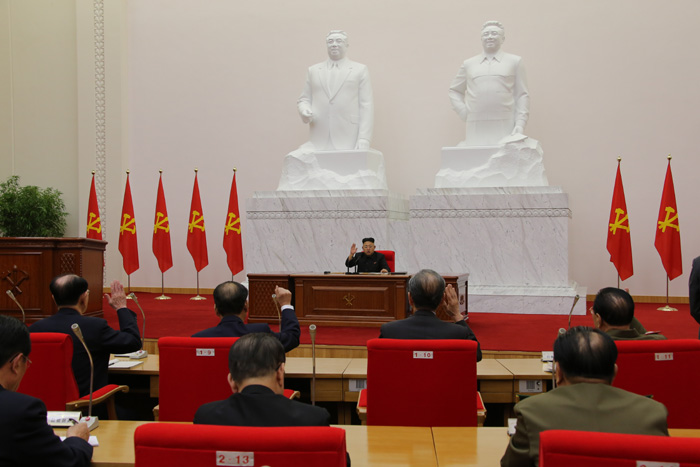
ORIGINAL POST (2013-12-9): According to KCNA (2013-12-9):
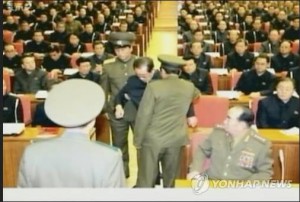
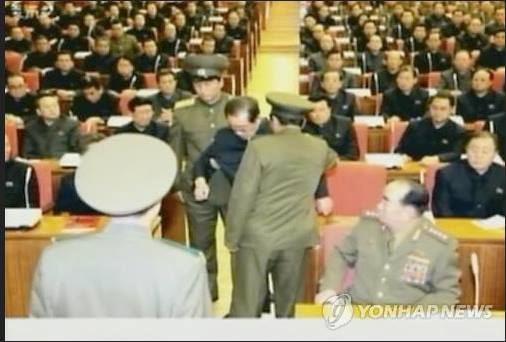
Pictured above (Yonhap, KCTV): Jang being removed from Politburo meeting. Jean Lee notes that Jang was sitting in the audience. He was not up on the stage with other members of the leadership.
Report on Enlarged Meeting of Political Bureau of Central Committee of WPK
Pyongyang, December 9 (KCNA) — A report on the enlarged meeting of the Political Bureau of the Central Committee of the Workers’ Party of Korea (WPK) was released on December 8.
The following is the full text of the report:
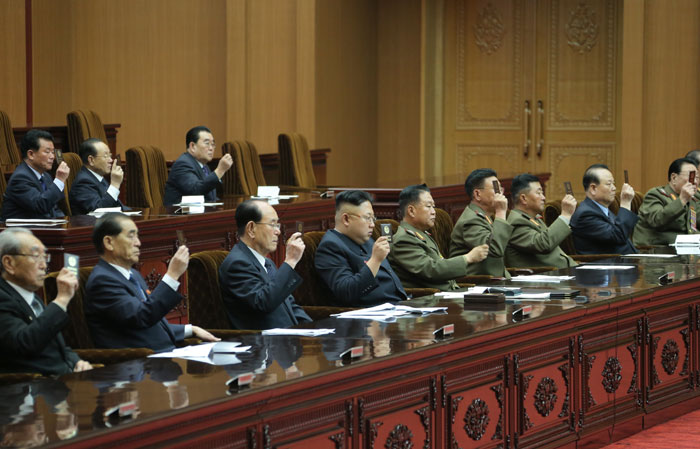
An enlarged meeting of the Political Bureau of the Central Committee of the WPK was held in Pyongyang, the capital of the revolution, on Dec. 8.
Respected Comrade Kim Jong Un, first secretary of the WPK, guided the meeting.
Present there were members and alternate members of the Political Bureau of the Central Committee of the WPK.
Leading officials of the Central Committee of the WPK, provincial party committees and armed forces organs attended it as observers.
Our party members, service personnel and all other people have made energetic efforts to implement the behests of leader Kim Jong Il, entrusting their destiny entirely to Kim Jong Un and getting united close around the Central Committee of the WPK since the demise of Kim Jong Il, the greatest loss to the nation.
In this historic period for carrying forward the revolutionary cause of Juche the chance elements and alien elements who had made their ways into the party committed such anti-party, counter-revolutionary factional acts as expanding their forces through factional moves and daring challenge the party, while attempting to undermine the unitary leadership of the party.
In this connection, the Political Bureau of the C.C., the WPK convened its enlarged meeting and discussed the issue related to the anti-party, counter-revolutionary factional acts committed by Jang Song Thaek.
The meeting, to begin with, fully laid bare the anti-party, counter-revolutionary factional acts of Jang Song Thaek and their harmfulness and reactionary nature.
It is the immutable truth proved by the nearly 70-year-long history of the WPK that the party can preserve its revolutionary nature as the party of the leader and fulfill its historic mission only when it firmly ensures its unity and cohesion based on the monolithic idea and the unitary center of leadership.
The entire party, whole army and all people are dynamically advancing toward the final victory in the drive for the building of a thriving nation, meeting all challenges of history and resolutely foiling the desperate moves of the enemies of the revolution under the leadership of Kim Jong Un. Such situation urgently calls for consolidating as firm as a rock the single-minded unity of the party and the revolutionary ranks with Kim Jong Un as its unitary centre and more thoroughly establishing the monolithic leadership system of the party throughout the party and society.
The Jang Song Thaek group, however, committed such anti-party, counter-revolutionary factional acts as gnawing at the unity and cohesion of the party and disturbing the work for establishing the party unitary leadership system and perpetrated such ant-state, unpopular crimes as doing enormous harm to the efforts to build a thriving nation and improve the standard of people’s living.
Jang pretended to uphold the party and leader but was engrossed in such factional acts as dreaming different dreams and involving himself in double-dealing behind the scene.
Though he held responsible posts of the party and state thanks to the deep political trust of the party and leader, he committed such perfidious acts as shunning and obstructing in every way the work for holding President Kim Il Sung and Kim Jong Il in high esteem for all ages, behaving against the elementary sense of moral obligation and conscience as a human being.
Jang desperately worked to form a faction within the party by creating illusion about him and winning those weak in faith and flatterers to his side.
Prompted by his politically-motivated ambition, he tried to increase his force and build his base for realizing it by implanting those who had been punished for their serious wrongs in the past period into ranks of officials of departments of the party central committee and units under them.
Jang and his followers did not sincerely accept the line and policies of the party, the organizational will of the WPK, but deliberately neglected their implementation, distorted them and openly played down the policies of the party. In the end, they made no scruple of perpetrating such counter-revolutionary acts as disobeying the order issued by the supreme commander of the Korean People’s Army.
The Jang group weakened the party’s guidance over judicial, prosecution and people’s security bodies, bringing very harmful consequences to the work for protecting the social system, policies and people.
Such acts are nothing but counter-revolutionary, unpopular criminal acts of giving up the class struggle and paralyzing the function of popular democratic dictatorship, yielding to the offensive of the hostile forces to stifle the DPRK.
Jang seriously obstructed the nation’s economic affairs and the improvement of the standard of people’s living in violation of the pivot-to-the-Cabinet principle and the Cabinet responsibility principle laid down by the WPK.
The Jang group put under its control the fields and units which play an important role in the nation’s economic development and the improvement of people’s living in a crafty manner, making it impossible for the economic guidance organs including the Cabinet to perform their roles.
By throwing the state financial management system into confusion and committing such act of treachery as selling off precious resources of the country at cheap prices, the group made it impossible to carry out the behests of Kim Il Sung and Kim Jong Il on developing the industries of Juche iron, Juche fertilizer and Juche vinalon.
Affected by the capitalist way of living, Jang committed irregularities and corruption and led a dissolute and depraved life.
By abusing his power, he was engrossed in irregularities and corruption, had improper relations with several women and was wined and dined at back parlors of deluxe restaurants.
Ideologically sick and extremely idle and easy-going, he used drugs and squandered foreign currency at casinos while he was receiving medical treatment in a foreign country under the care of the party.
Jang and his followers committed criminal acts baffling imagination and they did tremendous harm to our party and revolution.
The ungrateful criminal acts perpetrated by the group of Jang Song Thaek are lashing our party members, service personnel of the People’s Army and people into great fury as it committed such crimes before they observed two-year mourning for Kim Jong Il, eternal general secretary of the WPK.
Speeches were made at the enlarged meeting.
Speakers bitterly criticized in unison the anti-party, counter-revolutionary factional acts committed by the Jang group and expressed their firm resolution to remain true to the idea and leadership of Kim Jong Un and devotedly defend the Party Central Committee politically and ideologically and with lives.
The meeting adopted a decision of the Political Bureau of the Party Central Committee on relieving Jang of all posts, depriving him of all titles and expelling him and removing his name from the WPK.
The party served warning to Jang several times and dealt blows at him, watching his group’s anti-party, counter-revolutionary factional acts as it has been aware of them from long ago. But it did not pay heed to it but went beyond tolerance limit. That was why the party eliminated Jang and purged his group, unable to remain an onlooker to its acts any longer, dealing telling blows at sectarian acts manifested within the party.
Our party will never pardon anyone challenging its leadership and infringing upon the interests of the state and people in violation of the principle of the revolution, regardless of his or her position and merits.
No matter how mischievously a tiny handful of anti-party, counter-revolutionary factional elements may work, they can never shake the revolutionary faith of all party members, service personnel and people holding Kim Jong Un in high esteem as the unitary centre of unity and unitary centre of leadership.
The discovery and purge of the Jang group, a modern day faction and undesirable elements who happened to worm their ways into our party ranks, made our party and revolutionary ranks purer and helped consolidate our single-minded unity remarkably and advance more dynamically the revolutionary cause of Juche along the road of victory.
No force on earth can deter our party, army and people from dynamically advancing toward a final victory, single-mindedly united around Kim Jong Un under the uplifted banner of great Kimilsungism-Kimjongilism.
Though the report notes that many of Jang’s associates have been purged, Yonhap notes that the DPRK ambassador to China, one of Jang’s associates, is conducting business as usual.
The North Korean ambassador to China, considered one of the close aides to the purged uncle of the North’s leader Kim Jong-un, appears to be conducting “business as usual for now,” a Seoul diplomatic source said Monday, on the same day that Pyongyang confirmed the powerful uncle had been sacked from office.
The North Korean ambassador, Ji Jae-ryong, has shared the same political fate as the purged uncle, Jang Song-thaek, over the past three decades, and served as a “linking pin” between Jang and the Chinese leadership since he took up the post in 2010, the source said.
“So far, we have detected no unusual movements at the North Korean embassy in Beijing,” the source said on the condition of anonymity.
“It has also been business as usual for Ambassador Ji Jae-ryong and other North Korean diplomats,” the source said.
The same article notes that some of Jang’s relatives in Malaysia were recalled.
Last week, an intelligence source in Beijing said that the North Korean ambassador to Malaysia, Jang Yong-chol, who is a nephew of Jang, was believed to have been recalled home.
The wife and two 20-something sons of the North Korean ambassador to Malaysia were also spotted last week before boarding an Air Koryo flight in China’s northeastern city of Shenyang, multiple witnesses said.
And in Cuba (Japan Times)…
North Korea’s ambassador to Cuba, Jon Yong Jin — the husband of Jang’s elder sister — has also been recalled, he said, according to a joint briefing by ruling and opposition party lawmakers.
Here is the report by Voice of [North] Korea:
See Madden’s post here. NK News has info here.
Here is coverage in major media outlets: New York Times, Bloomberg, Los Angeles Times, Wall Street Journal (and here), Associated Press.
Although it is still rumor at this point, some have speculated that Jang has been executed. The Ministry of Unification asserts he is “safe”. The JoongAng Daily reports he is in his Changgwang residence.
It is also rumored that one of Jang’s associates is under the protection of the South Korean government at a secret location in China (see here and here). Two other associates, Ri Ryong-ha and Jang Su-gil, have allegedly been executed. Seoul denies they have anybody under their protection.
Mr. Jang’s removal was announced several days ago by the South Korean intelligence service. According to the New York Times:
Mr. Jang’s apparent fall from power came after his two deputies at the administrative department of the ruling Workers’ Party of Korea were executed last month on charges of “corruption and anti-party activities,” according to South Korean lawmakers who were briefed by intelligence officials in a hurriedly scheduled meeting at the National Assembly in Seoul.
The intelligence agency did not reveal how it learned of the executions, the lawmakers said.
“I don’t think Jang’s deputies were executed for mere corruption. Rather, they were executed because they established a ‘power,’ ” said Cheong Seong-chang, a senior analyst at Sejong Institute in South Korea.
…
Mr. Jang would not be the first No. 2 or the first uncle of the North Korean leader to lose power. Kim Jong-il plotted a purge of his own powerful uncle to solidify control after the death of his father, the North’s founding president, Kim Il-sung.
In July last year, Kim Jong-un removed his then No. 2 man, Vice Marshal Ri Yong-ho.
Analysts said they suspected that Mr. Jang’s downfall may have been engineered by Kim Won-hong, who was made head of the nation’s secret police and spy agency in April last year, and Vice Marshal Choe Ryong-hae, who became the top political officer in the military under Mr. Kim. On Tuesday, the South Korean intelligence officials said North Korea’s secret police began investigating the corruption of Mr. Jang’s close allies this year.
Reuters offers great background info on Mr. Jang:
The man considered the power behind the throne in secretive North Koreais believed to be out of a job, thanks to his nephew and leader Kim Jong Un, and it wasn’t immediately clear if this time he can find the way back.
Jang Song Thaek survived purges and official displeasure to reach the pinnacle of his career, thanks largely to his sometimes tempestuous marriage to Kim Kyong Hui, the 67-year-old daughter of North Korea’s founder, Kim Il Sung.
The Pyongyang power couple formed a kind of regency in the obscurantist political world of the North behind Kim Jong Un, its young and mercurial leader, who succeeded his father, Kim Jong Il, in December 2011.
“The most important thing for Jang Song Thaek is he has institutional memory – he knows where all the bodies are buried and that’s critical in North Korea,” said Mike Madden, a North Korea expert and author of NK Leadership Watch blog.
“He knows who has a drinking problem, and whose wife likes to talk to her relatives a little too much.”
The couple’s reach was augmented by their control over the ruling Korean Workers’ Party’s secret funds that handle the Kim family’s finances both at home and abroad, according to An Chan Il, a former North Korean military officer who defected to the South and has become an expert on the North’s power elite.
After his dismissal in 2004, Jang, 67, was rehabilitated to stand at the peak of power as Vice Chairman of the National Defence Commission, the country’s top military body, and was a member of the ruling Workers’ Party Politburo.
He has likely been sacked from both posts, according to South Korean lawmaker Jung Cheong-rae, who on Tuesday cited a senior South Korean official with the National Intelligence Service (NIS).
“Jang is both the greatest benefactor and the greatest threat (to Kim Jong Un)”, said Park Hyeong-jung at the state-run Korea Institute of National Unification in Seoul back in April.
Jang met Kim Kyong Hui when they were students at Kim Il Sung University. He had good looks and charm, was popular and outgoing, known more for partying and deftness with the accordion than his academic achievements, according to Hwang Jang-yop, a former Workers’ Party secretary and defector who was head of the school at the time.
PARTIES AND WOMEN
His humble background made Jang a less than ideal suitor for the headstrong daughter of North Korea’s founder. Yet Kim Kyong Hui did not let her father’s objections stop her from marrying – with the help of her brother, according to Jang Jin Song, a North Korean defector who previously worked at the Workers’ Party United Front Department, a propaganda unit tasked with destabilising South Korea.
The marriage was not a happy one, he said. As Jang Song Thaek started rising through the ranks of the Workers’ Party, he became less attentive to his family. It was an open secret that he partied hard and womanised, said defectors in Seoul and South Korean politicians who met Jang on a 2002 visit as part of an economic delegation touring the South’s industrial successes.
Their daughter, Kum-song, died in an apparent suicide while attending school in France, ironically because her parents objected to her boyfriend, according to Jang Jin Song.
Kim Kyong Hui herself had an affair with a young pianist who taught her daughter, according to Jang Jin Song, who recalled that a classmate of his at the Pyongyang University of Music and Dance had been a rival for Kim’s affections. The piano teacher, a former child prodigy and household name, and who was 10 years younger than his paramour, would soon disappear.
Kim Kyong Hui would be told he had committed suicide. But Jang the defector said Kim knew her husband had had her lover killed, one of a vast number of people to fall victim to a reign of terror Jang Song Thaek orchestrated in the late 1990s.
Before he became the power behind the throne under Kim Jong Un, Jang was ejected from the elite in 2004 for angering Kim Jong Il by hosting lavish parties, according to media reports and assessments by South Korean think-tanks.
Two years later, he was back, and in 2011 was widely credited with orchestrating the ouster of Army chief of staff Ri Yong Ho, a major rival who had been a loyal aide to the father of Pyongyang’s current leader.
Jang’s removal, if final, could mean Kim Jong Un has lost perhaps the strongest benefactor he could have to help his transformation into a ruler of the calibre of his predecessors, a factor that leaves the question of his future return open.
“Jang’s a big potato to get rid of,” said Madden of NK Leadership Watch. “They can’t get rid of him completely. If they do, they’re in trouble because this is the guy you do not want going to a foreign country.
“… Jang is basically a Kim Jong Il figure. Kim Jong Un does not have the intellectual capacity to do what his father did. His father was really in touch with a lot of things that Kim Jong Un is not.”
See also this article by Aiden Foster-Carter in the Wall Street Journal’s Korea Real Time.