Archive for the ‘Mass games’ Category
Thursday, July 31st, 2008
I received a Koryo Tours email update this morning about the status of future Mass Games performances:
We have just been told by our partners in the DPRK that there is a chance there will be no mass games next year – possibly not even until 2012 which is the next big anniversary (Juche 100 – the 100th birthday of Kim Il Sung!!!). For Americans this year’s mass games may be the last opportunity to visit the country.
Nothing has been set in stone but we wanted to give you all pre-warning. This year there are 2 different performances – ARIRANG and PROSPER THE MOTHERLAND! – the latter has never been seen before so it really is a once-in-a-lifetime opportunity.
Historically the Mass Games are performed on special anniversary holidays (those in years divisible by 5 or 10). Since 2005 (60th anniversary of victory over Japanese imperialism) they have been held annually. This change could mark a return to the original schedule.
You can subscribe to the Koryo Tours email list here.
Posted in 2012 Strong and Prosperous Nation (Kangsong Taeguk), Art, Civil society, Koryo Tours, Mass games, Sports, Tourism | Comments Closed
Saturday, July 26th, 2008
Koryo Tours has tremendous access to the DPRK and they are pursuing several interesting projects. Check out their newsletter here. Of special note, there will be two different mass games performances this summer/autumn. From the newsletter:
As before the big news though in terms of tourism in DPRK is the Mass Games event – this year for the first time two different performances have been arranged with the classic Arirang show being performed on Mon, Wed, Fri and Sat, and the brand new, not-yet-seen (even by the critics!) Prosper the Motherland! taking place on Tuesdays and Thursdays. Both of these shows feature the full complement of 100,000 performers in the May Day Stadium and both will run to approx 90 minutes offering anyone who s there the chance to witness what is simply the greatest show on Earth, some information on the events can be found here. The Olympics will pale in comparison… a double dose of Mass Games will undoubtedly be vastly superior to the sight of amateur athletes running around in circles and throwing things!
Also, Nick Bonner is producing a new (non-documentary) film in North Korea. The plot, according to the newsletter:
Comrade Kim goes Flying – we are in development with our new romantic comedy feature film…to be filmed in Pyongyang with Korean cast and crew….more about this later – but a coal miner dreams of flying on the trapeze until she is thwarted by the strong man….
UPDATE: Here is an interview with KT’s Simon Cockerell on Interview Blog.
Posted in Art, Film, Koryo Tours, Mass games, Tourism | Comments Closed
Monday, May 12th, 2008
Koryo Tours Press Release
5/12/2008
British run Koryo Tours have just been informed that this year’s Mass Games in North Korea have been expanded to include two different events, both staged in Pyongyang’s May Day stadium with a full compliment of 100,000 performers. Running from August 4th until the end of September every day bar Sunday will see a 100 minute afternoon performance of an all-new Mass Games show named ‘Prosper the Motherland!’ staged specially for the 60th anniversary of the foundation of the Democratic People’s Republic of Korea, 9th September 1948. The classic ‘Arirang’ an 80 minute gymnastic and socialist realism extravaganza will be performed in the evening.
Koryo Tours are running their usual full compliment of tours during this time and details can be found on their website. Koryo Tours offer regular group tours, tours for US citizens (only possible during the Mass Games), specialized trips including to Mount Paekdu, independent tours for small groups, as well as many others. This will likely be a bigger opening event than the Olympics and on a larger scale than ever before.
Posted in Koryo Tours, Mass games, Sports, Tourism | Comments Closed
Thursday, January 31st, 2008
Joong Ang Daily
1/18/2008
North Korean athletes will enter the 2008 Beijing Olympics in August with a completely different concept of international sport to the one embraced by former Cold War allies.
Eastern Bloc states used to spend heavily on sports systems that turned out Goliaths, whose wins at the Olympics were used to validate what they argued was a superior political system.
The impoverished North, however, is happier playing the role of David, where its rare wins are attributed to the teachings of pudgy leader Kim Jong-il and its losses are blamed on a playing field made unfair by its foes.
“North Korea’s paranoid nationalism can use defeat just as well as it can use victory,” said Brian Myers, an associate professor at Dongseo University in Seoul, South Korea. He specializes in analyzing the North’s ideology. The reclusive North spends its limited resources to inspire its masses and not to impress the outside world on the playing field.
“North Korean nationalism does not boast that North Koreans are physically superior to other races,” Myers explained. The North’s propaganda spreads the message of being morally superior.
North Korea is likely to grab a handful of medals in Beijing in sports such as judo, weightlifting or wrestling. It has shunned overtures from the South to compete as a joint team in Beijing, which could bring it greater sports glory, because its neighbor wants to field a squad with the best athletes on the Korean Peninsula. The North wants equal representation. At the 2004 Athens Olympics, South Korea won 30 medals while the North took five. Their combined 35 would have been seventh highest, just below the 37 of their mutual arch-rival Japan.
“North Korea has realized at this stage that no number of victories on the sports stage could change the country’s reputation as an economic basket case,” Myers said.
North Korea’s athletes may be better at providing entertainment for the opening ceremony than at competing. The North’s biggest sports spectacle is its Arirang Mass Games, a circus-like extravaganza that includes legions of teenage girl gymnasts, goose-stepping soldiers flashing taekwondo kicks and a massive flip-card animation section.
The message of the event, in which some 100,000 play a role, is that the group is North Korea’s strength, and the group reveres and protects the leaders of the destitute state.
Sports are often associated with the ruling communist party, featuring competitions with farming collectives, factory workers and soldiers. Its best athletes are celebrated for upholding “the dignity of the nation”.
“Sports constitute a powerful driving force in firmly preparing the entire people for national defense and labor,” its official media said, citing the teachings of state founder Kim Il Sung.
The North relishes the role of underdog. When one of its athletes or teams achieves even moderate success, it makes the most of the victory, proclaiming it a result of the state’s military-first policy and its self-reliance ideal called “juche.” And of course, Dear Leader Kim Jong-il, who is celebrated in state propaganda for penning operas, piloting jet fighters and shooting 11 holes-in-one the first time he played golf, also turns out to be a remarkable motivator for athletes.
After Jong Song-ok won the women’s marathon gold at the 1999 World Athletic Championships in Seville, state media quoted her as saying: “I ran the race picturing the great leader of our people Kim Jong-il. This greatly encouraged me and was the source of my strength.”
Kye Sun-hui, North Korean Olympic gold medalist in women’s judo, said Kim “gave her strength, courage, matchless guts and pluck.”
Posted in Civil society, Football (soccer), Mass games, Political economy, Sports | Comments Closed
Friday, December 14th, 2007
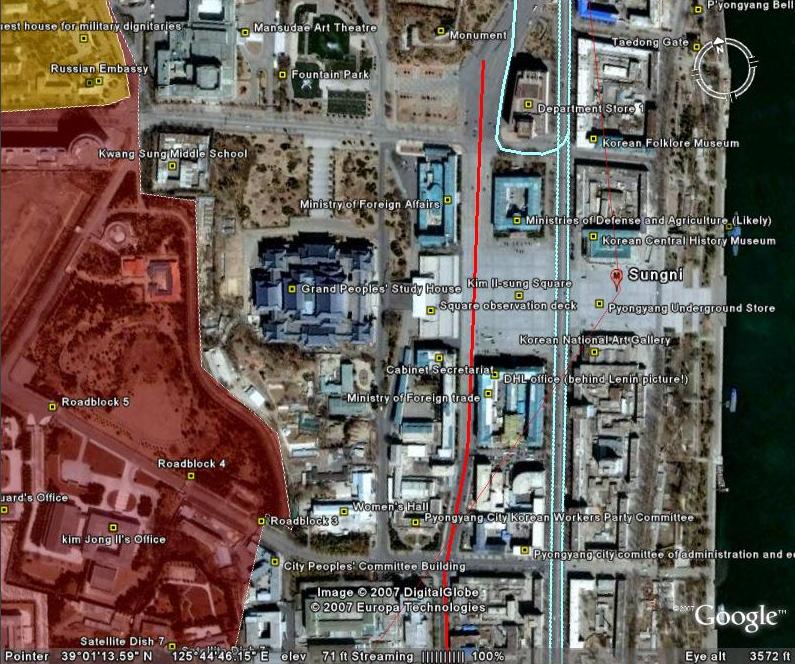
The most authoritative map of North Korea on Google Earth
North Korea Uncovered v.7
Download it here
 This map covers North Korea’s agriculture, aviation, cultural locations, manufacturing facilities, railroad, energy infrastructure, politics, sports venues, military establishments, religious facilities, leisure destinations, and national parks. It is continually expanding and undergoing revisions. This is the sixth version.
Additions to the latest version of “North Korea Uncovered” include: A Korean War folder featuring overlays of US attacks on the Sui Ho Dam, Yalu Bridge, and Nakwon Munitians Plant (before/after), plus other locations such as the Hoeryong Revolutionary Site, Ponghwa Revolutionary Site, Taechon reactor (overlay), Pyongyang Railway Museum, Kwangmyong Salt Works, Woljong Temple, Sansong Revolutionary Site, Jongbansan Fort and park, Jangsan Cape, Yongbyon House of Culture, Chongsokjong, Lake Yonpung, Nortern Limit Line (NLL), Sinuiju Old Fort Walls, Pyongyang open air market, and confirmed Pyongyang Intranet nodes.
Disclaimer: I cannot vouch for the authenticity of many locations since I have not seen or been to them, but great efforts have been made to check for authenticity. These efforts include pouring over books, maps, conducting interviews, and keeping up with other peoples’ discoveries. In many cases, I have posted sources, though not for all. This is a thorough compilation of lots of material, but I will leave it up to the reader to make up their own minds as to what they see. I cannot catch everything and I welcome contributions.
Posted in Architecture, Art, Automobiles, Aviation, Cell phones, Civil society, Coal, Committee for Cultural Relations with Foreign Countries, Communications, Computing/IT, Construction, Dams/hydro, Department Store No. 1, Education, Electricity, Email, Energy, Film, Finance, Football (soccer), Forestry, Gambling, General markets (FMR: Farmers Market), Golf, Google Earth, Hana Electronics Company, Health care, Hoteling, Hwanggumphyong and Wihwado Economic Zones (Sinuiju), Hyesan Youth Cooper Mine, International Aid, Internet, Intranet, Juche, Kaesong Industrial Complex (KIC), Kim Chaek University of Technology, Kim Il Sung University, Korea Computer Center (KCC), Korean Buddhist Association, Korean People's Army, Light Industry, Lumber, Mansudae creative Company (art studio), Manufacturing, Mass games, Maternity Hospital, Military, Mining/Minerals, Ministry of foreign Affairs, Ministry of Foreign Trade, Mt. Kumgang Tourist Special Zone, Musan Mine, Nuclear, Pyongyang Embroidery Institute, Pyongyang Film Studio, Pyongyang Informatics Center (PIC), Pyongyang International Information Center of New Techn, Pyongyang International Trade Fair, Pyongyang Metro, Pyongyang University of Medicine, Radio, Railways, Rason Economic and Trade Zone (Rajin-Sonbong), Real estate, Religion, Restaurants, Sea shipping, Sports, Television, Transportation, Wind | Comments Closed
Sunday, November 11th, 2007
The most authoritative map of North Korea on Google Earth
North Korea Uncovered: Version 6
Download it here
 This map covers North Korea’s agriculture, aviation, cultural locations, manufacturing facilities, railroad, energy infrastructure, politics, sports venues, military establishments, religious facilities, leisure destinations, and national parks. It is continually expanding and undergoing revisions. This is the sixth version.
Additions to the newest version of North Korea Uncovered include: Alleged Syrian nuclear site (before and after bombing), Majon beach resort, electricity grid expansion, Runga Island in Pyongyang, Mt. Ryongak, Yongbyon historical fort walls, Suyang Fort walls and waterfall in Haeju, Kaechon-Lake Taesong water project, Paekma-Cholsan waterway, Yachts (3), and Hyesan Youth Copper Mine.
Disclaimer: I cannot vouch for the authenticity of many locations since I have not seen or been to them, but great efforts have been made to check for authenticity. These efforts include pouring over books, maps, conducting interviews, and keeping up with other peoples’ discoveries. In many cases, I have posted sources, though not for all. This is a thorough compilation of lots of material, but I will leave it up to the reader to make up their own minds as to what they see. I cannot catch everything and I welcome contributions.
Posted in Advertising, Agriculture, Architecture, Automobiles, Aviation, Banking, Black markets, Committee for Cultural Relations with Foreign Countries, Communications, Computing/IT, Dams/hydro, Department Store No. 1, Economic reform, Education, Electricity, Energy, Environmental protection, Film, Finance, Fiscal & monetary policy, Football (soccer), Forestry, Gambling, Gasoline, General markets (FMR: Farmers Market), Golf, Google Earth, Hana Electronics Company, Health care, Hoteling, Hwanggumphyong and Wihwado Economic Zones (Sinuiju), Hyesan Youth Cooper Mine, Kaesong Industrial Complex (KIC), Kim Il Sung University, Korea Computer Center (KCC), Library, Light Industry, Mansudae creative Company (art studio), Manufacturing, Mass games, Maternity Hospital, Military, Mining/Minerals, Ministry of Culture, Ministry of Foreign Trade, Mt. Kumgang Tourist Special Zone, Musan Mine, Music, Nuclear, Pyongyang Embroidery Institute, Pyongyang Film Studio, Pyongyang Informatics Center (PIC), Pyongyang International Information Center of New Techn, Pyongyang International Trade Fair, Pyongyang Metro, Railways, Rason Economic and Trade Zone (Rajin-Sonbong), Real estate, Religion, Restaurants, Sea shipping, Special Economic Zones (Established before 2013), Sports, Steel, Supreme Peoples Assembly, Television, Tourism, Transportation, Water, Wind | Comments Closed
Wednesday, November 7th, 2007
According to the Koryo Tours website, the DPRK will once again be performing Arirang in 2008. This time around, American tours have been extended by a full day. Where as previous tours ran from Saturday to Tuesday, now they will run from Tuesday to Saturday (matching the days that Air Koryo flies to Beijing).
I saw the Mass Games in 2005 with Kim Jong Il himself (official coverage, Simon’s coverage). It was quite an experience. You will never see anything like it.
Traditionally the Mass Games have only been held on big holidays (typically on notable anniversaries: 10,15, 20, etc.) This is now the fourth year in a row that Arirang will be performed (2005, 2006, 2007, 2008), a show that was first performed in 2003 (I think).
To the Americans out there: it is not illegal and will not put you on any kind of watch list.
Warning: flooding in October has interrupted trips the last two years!
Posted in Koryo Tours, Mass games, Sports, Tourism | Comments Closed
Saturday, October 6th, 2007
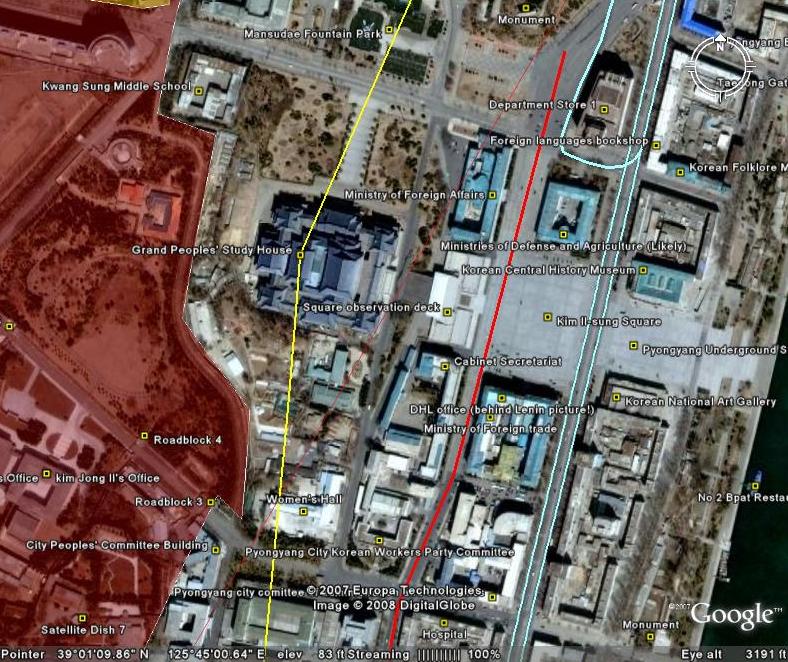
Version 5: Download it here (on Google Earth)
This map covers North Korea’s agriculture, aviation, cultural locations, manufacturing facilities, railroad, energy infrastructure, politics, sports venues, military establishments, religious facilities, leisure destinations, and national parks. It is continually expanding and undergoing revisions. This is the fifth version.
Additions to the latest version of “North Korea Uncovered” include updates to new Google Earth overlays of Sinchon, UNESCO sites, Railroads, canals, and the DMZ, in addition to Kim Jong Suk college of eduation (Hyesan), a huge expansion of the electricity grid (with a little help from Martyn Williams) plus a few more parks, antiaircraft sites, dams, mines, canals, etc.
Disclaimer: I cannot vouch for the authenticity of many locations since I have not seen or been to them, but great efforts have been made to check for authenticity. These efforts include pouring over books, maps, conducting interviews, and keeping up with other peoples’ discoveries. In many cases, I have posted sources, though not for all. This is a thorough compilation of lots of material, but I will leave it up to the reader to make up their own minds as to what they see. I cannot catch everything and I welcome contributions.
I hope this map will increase interest in North Korea. There is still plenty more to learn, and I look forward to receiving your additions to this project.
Posted in 1990s Famine, Advertising, Agriculture, Architecture, Arduous March, Art, Automobiles, Aviation, Banking, Civil society, Coal, Communications, Computing/IT, Cosmetics, Dams/hydro, DPRK organizations, Economic reform, Education, Electricity, Energy, Environmental protection, Film, Finance, Fiscal & monetary policy, Football (soccer), Foreign direct investment, Forestry, Gambling, Gasoline, General markets (FMR: Farmers Market), Golf, Google Earth, Health care, Hoteling, Hwanggumphyong and Wihwado Economic Zones (Sinuiju), Illicit activities, Juche, Kaesong Industrial Complex (KIC), Labor conditions/wages, Leisure, Library, Light Industry, Manufacturing, Mass games, Military, Mining/Minerals, Mt. Kumgang Tourist Special Zone, Music, Nuclear, Political economy, Pyongyang International Trade Fair, Pyongyang Metro, Radio, Railways, Rason Economic and Trade Zone (Rajin-Sonbong), Real estate, Religion, Restaurants, Sea shipping, Special Economic Zones (Established before 2013), Television, Tourism, Transportation, Water, Worker's Party | 2 Comments »
Thursday, September 20th, 2007
The DPRK pulled a “Ross Perot” with the Arirang Mass Games this year.
After initially announcing that severe flooding would not interrupt the performance (as it had in 2006) the games were in fact cancelled because much of the population was mobilized for infrastructure repairs.
Well, I guess things are manageable again, at least in Pyongynag, because the Mass Games are back on. According to Koryo Tours:
September 6th IMPORTANT UPDATE: We have just been informed that the mass games, which were suspended due to the flooding, will be back on from September 17th. All tours going to DPRK between then and October 10th will be able to see the games.
UPDATE:
N. Korea to resume ‘Arirang’ mass gymnastic performance
Yonhap
9/23/2007
North Korea will resume its annual large-scale artistic performance that was suspended last month due to damages from heavy rain, the country’s official media reported Sunday.
“The Arirang Festival will continue … amid strong interest at home and abroad,” the North’s Korea Central Television Station reported.
The first part of this year’s show was held between mid-May and May 20, and ran every day except Sundays for about 80 minutes starting at 8 p.m. The second part, which was to run from Aug. 1 to mid-October, was suspended last last month due to flood recovery efforts by many North Koreans.
In the show, some 100,000 people perform synchronized acrobatics on the field while various images are displayed in the stands. From outside North Korea, the festival is largely considered a propaganda show.
Pyongyang is eager to show off the country’s unity and its tight control over its 23 million people to the outside world amid chronic economic hardships and the standoff over its nuclear weapons program.
The resumption was at least partially expected, as South Korean officials announced earlier this week that they are pushing for the leaders of the two Koreas, Roh Moo-hyun and Kim Jong-il, to sit side-by-side to watch the performance on Aug. 2, during South Korean President Roh’s scheduled visit to the North early next month.
Devastating floods are believed to have destroyed 11 percent of the North’s farmland, and the number of dead and missing is estimated to be more than 300, with the homeless numbering about 300,000. An estimated 46,580 homes of 88,400 families were destroyed or damaged, according to the North’s media.
This year’s performance carries special significance for North Korea, as it celebrates the 95th anniversary of the birth of its founding leader, Kim Il-sung, who died of heart failure in 1994. This year also marks the 62nd anniversary of Korea’s liberation from Japan’s colonial rule and the founding of the North’s ruling Workers’ Party.
Past Stories below:
(more…)
Posted in Automobiles, Civil society, Koryo Tours, Mass games, Sports, Tourism, Transportation | 1 Comment »
Friday, August 17th, 2007
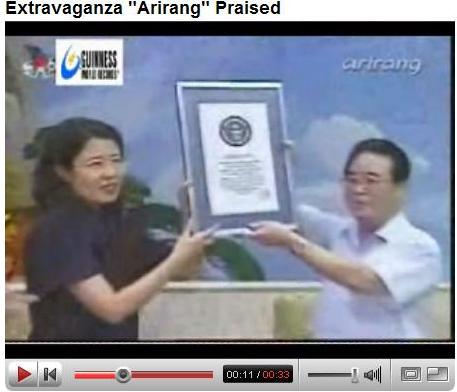
Click the picture to see it on YouTube.
 Guinness Certificate Awarded to “Arirang”
KCNA
8/16/2007
A certificate of the Guinness World Records was awarded to the grand gymnastic and artistic performance “Arirang”.
It was handed to Song Sok Hwan, vice-minister of Culture, by Wu Xiaohong, representative of the Guinness World Records Ltd., on a visit to the DPRK at the May Day Stadium on August 15.
The record of largest gymnastic and artistic performance in the world was created in Pyongyang, the capital of the DPRK, the certificate says.
Conveying the certificate, the representative said the grand gymnastic and artistic performance “Arirang” could be successfully created thanks to the wise leadership of Kim Jong Il, and expressed deepest respect to him.
Warmly haling the registration of the performance in the Guinness World Records, the representative hoped that “Arirang” would successfully go on in the future.
More than 7 million Koreans in the north and the south and overseas and foreigners have watched the performance which has taken place over 180 times.
Extravaganza “Arirang” Praised
KCNA
8/16/2007
The grand gymnastic and artistic performance “Arirang” participated in by 100,000 persons is the most successful work both in its scale and ideological and artistic value.
Wu Xiaohong, representative of the Guinness World Records Ltd. on a visit to the DPRK, said this after appreciating the performance now going on in Pyongyang with great success.
I have never seen such peculiar work as the grand gymnastic and artistic performance “Arirang” in any other countries, she said, and went on:
What impressed me very much is that it is fantastic and conspicuous.
I marveled at the might of the unity of the Korean people while watching the performance.
It is my view that such extravaganza can be created only in the DPRK wisely led by Kim Jong Il.
It is something worth boasting before the world that such peculiar performance is going on in the DPRK.
The Guinness World Records Ltd. recognized the grand gymnastic and artistic performance “Arirang” going on at the May Day Stadium in Pyongyang, the capital of the DPRK, as the largest one in the world.
The Guinness Book of World Records published by the company is distributed to at least 100 countries.
I would like to express my sincere thanks to the Korean people for having created “Arirang” as a great masterpiece of the world.
It is my hope that the performance will prove successful in the future, too.
Posted in Civil society, Mass games, Ministry of Culture, Sports | Comments Closed