Archive for the ‘Gambling’ Category

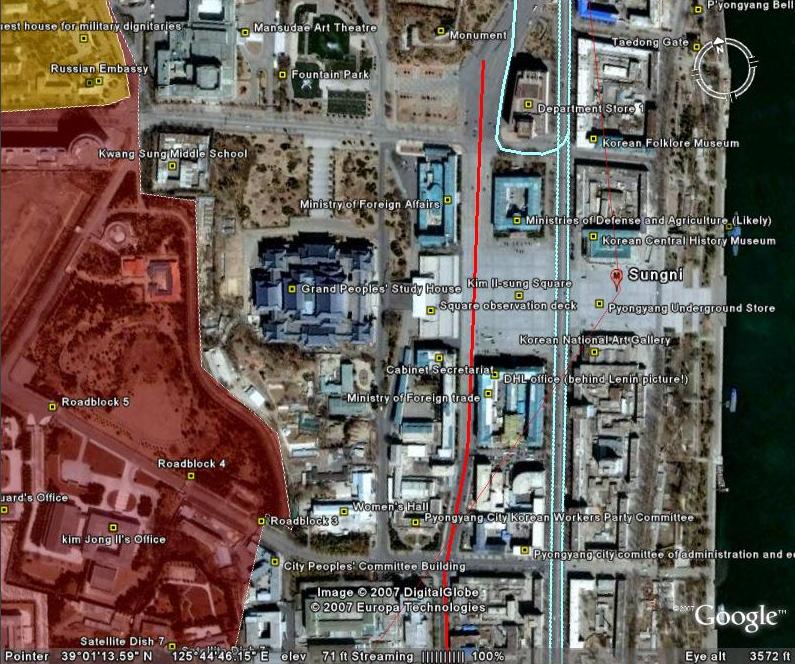
North Korea Uncovered (Google Earth)

Sunday, April 22nd, 2007

DOWNLOAD IT HERE (to your own Google Earth)

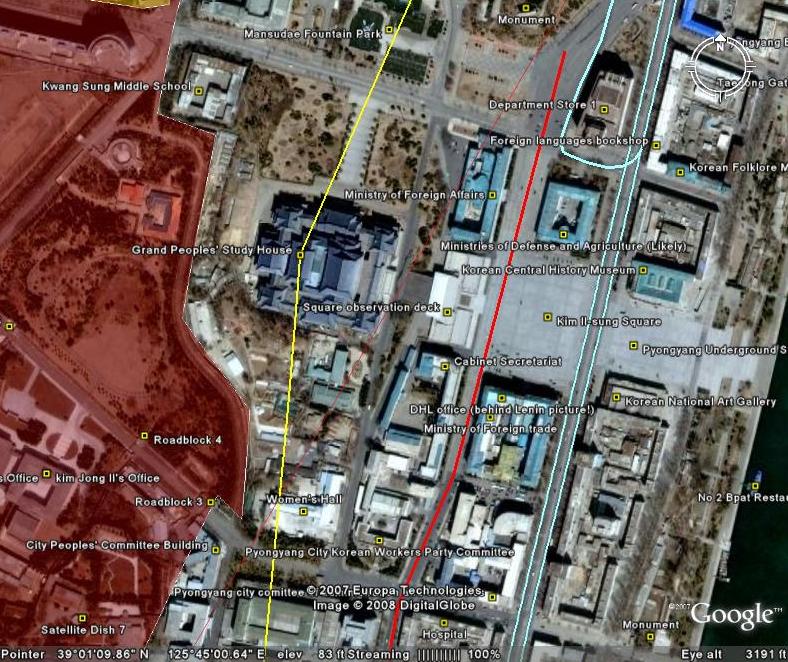
Using numerous maps, articles, and interviews I have mapped out North Korea by “industry” (or topic) on Google Earth.  This is the most authoritative map of North Korea that exists publicly today.

Agriculture, aviation, cultural, manufacturing, railroad, energy, politics, sports, military, religion, leisure, national parks…they are all here, and will captivate anyone interested in North Korea for hours.

Naturally, I cannot vouch for the authenticity of many locations since I have not seen or been to them, but great efforts have been made to check for authenticity. In many cases, I have posted sources, though not for all. This is a thorough compilation of lots of material, but I will leave it up to the reader to make up their own minds on the more “controversial” locations.  In time, I hope to expand this further by adding canal and road networks. 

I hope this post will launch a new interest in North Korea. There is still plenty more to learn, and I look forward to hearing about improvements that can be made.

North Korea’s Kim Allows Tentative Stirrings of Profit Motive

Wednesday, December 28th, 2005

Bloomberg
Bradley K. Martin
12/28/2005

A sign of North Korea’s fledgling moves toward a market economy can be found at the Pyongyang monument commemorating the 1945 founding of the Workers’ Party. Beneath a 50-meter-tall rendition of the party’s logo — a hammer, sickle and writing brush — sits a street photographer.

A handmade sign displays her price list and sample photos, mostly of groups of North Korean visitors, with the monument as background.

The photographer is one of countless sidewalk entrepreneurs - - most of them selling food and drink — who have set up shop in North Korea since 2002. Before that, they would have been hauled off to re-education camps for profiteering. In the late 1990s, North Korea’s Civil Law Dictionary described merchants as a class to be eradicated because they “buy goods from producers at a low price and sell them to consumers at a high price by way of fraud, deceit and spoils.”

Since then, the party newspaper, Rodong Shinmun, has quoted Kim Jong Il, who’s held supreme power since the 1994 death of his father, Kim Il Sung, as favoring profits under socialist economic management.

North Korea, one of the world’s last Stalinist regimes, has gradually begun permitting commerce. On a four-day visit to Pyongyang, the capital, in October — arranged and scripted by the government — a group of 17 Western journalists got a glimpse of the changes. Clean, new restaurants were packed with paying customers while the streets — almost empty in 1979 and only lightly traveled in ‘89 and ‘92 — bustled with bicycles, motorbikes and Japanese sedans.

Casino Pyongyang

In the state-owned Yanggakdo Hotel on an island in the Taedong River, a mostly Chinese clientele played slot machines, cards or roulette at the Casino Pyongyang. Since 1998, Macau billionaire Stanley Ho, through his Sociedade de Turismo e Diversoes de Macau SARL, has invested $30 million in the casino, whose staff is also Chinese.

Now some investors from farther afield are joining pioneering Chinese and South Koreans in plunging into a country once so isolated it was known as the Hermit Kingdom. In September, Anglo- Sino Capital Partners, a London-based fund manager, said it had formed the Chosun Development & Investment Fund, which plans to raise $50 million for investments in North Korea.

“It’s the last virgin economy,” says Colin McAskill, 65, a director of Anglo-Sino and chairman of Koryo Asia Ltd., which is investment adviser to the new fund.

Natural Resources

Besides recent changes in the economic system, a 99 percent literacy rate and a minimum wage for workers in foreign-invested ventures of only $35 a month, McAskill says, he was drawn by North Korea’s rich natural resources — including iron ore, copper, lead, zinc, molybdenum, gold, nickel, manganese, tungsten, anthracite and lignite.

The fund will concentrate on North Korean companies that have been active internationally in the past, with track records as foreign currency earners, says McAskill.

He negotiated on behalf of North Korea with foreign bank creditors in 1987, when the country was unable to repay some $900 million in balance-of-payment loans that had enabled the regime in the 1970s to purchase Western industrial technology — Swiss watch-making machinery, for example — as well as such non-capital goods as 1,000 Volvo sedans from Sweden.

Oil Potential

The country’s petroleum potential lured Dublin-based Aminex Plc and its Korea-focused subsidiary, Korex Ltd., which in August announced the signing of a nine-year production-sharing agreement to explore and develop 66,000 square kilometers (25,000 square miles) of North Korean territory. The agreement covers areas in the Yellow Sea’s West Korea Bay and in the Sea of Japan as well as onshore.

While North Korea lacks proven petroleum reserves, according to the U.S. Energy Information Agency, the West Korea Bay in particular may contain hydrocarbon reserves, as it’s considered to be a geological extension of China’s oil-rich Bohai Bay.

More foreign investment may come, says Tony Michell, a Seoul- based consultant on North Korea. Michell, a 58-year-old Briton, says he has recently shepherded 20 senior managers of international companies, representing seven nationalities, to Pyongyang.

“They’re big players,” says Michell, declining to identify his clients by name or company. “They’re looking at everything, from services to manufacturing. They want to get the measure of the North Koreans and be ready if the six-party talks succeed.”

Six-Party Talks

The so-called six-party talks — between North Korea and China, Japan, Russia, South Korea and the U.S. — are aimed at ending the country’s pursuit of nuclear weapons. In September, the six countries agreed on a statement of principles to govern further talks. It called for a nuclear-free Korean peninsula, a peace treaty and economic cooperation in energy, trade and investment.

Seoul-based Hyundai Research Institute, an affiliate of the Hyundai Group, projected in September that a successful outcome to the talks would be worth as much as $55 billion to the economy in the North — and more than twice that in the South.

Optimism about the economy has boosted the prices of defaulted North Korean debt originally owed to hundreds of creditors, mostly European banks, which in the 1970s began meeting as a London-based ad hoc group to discuss restructuring options. In the 1990s, that so-called London Club turned a portion of the debt into Euroclearable certificates, securities that were denominated in Swiss francs and German marks.

The certificates are trading at about 20-21 percent of face value, up from 12 percent in 2003, according to London-based Exotix Ltd., a unit of Icap Plc, one of a few financial firms that make an over-the-counter market in them.

Excessive Optimism

The debt’s price has risen in the past on excessive optimism about the country’s future. In early 1998, the debt was trading at nearly 60 percent of face value amid rumors that North Korea would collapse imminently and be absorbed by wealthy South Korea, which would then make good on the entire outstanding debt.

That had not happened by the time of the crash later that year in global emerging-market securities, when the North Korean debt price sank to about 25 percent of face value.

Exotix estimates that North Korea owes the equivalent of some $1.6 billion in principal and interest to banks out of a total $14 billion in principal and interest owed globally to mainly communist and formerly communist countries.

Although a cease-fire was declared in 1953 in the war between North Korea and China on one side and the United Nations — under whose flag the Americans, South Koreans and others had fought — on the other side, no peace treaty has ever been signed.

The U.S. maintains sanctions under the Trading with the Enemy Act that restrict trade and financial transactions with North Korea — and apply to Americans and permanent residents of the U.S. and to branches, subsidiaries and controlled affiliates of U.S. organizations throughout the world.

China, Russia

North Korea’s flirtations with capitalism are belated compared with those of China and the former Soviet Union, which began opening their economies in the 1970s.

North Korea did pass a law legalizing foreign investment in 1984. The law, which permitted equity joint ventures between state enterprises and foreigners, attracted only $150 million in investment during the following decade, largely because investors were put off by the country’s poor roads, railroads, power systems and phone networks and by official interference in joint ventures’ recruitment, dismissal and compensation of workers, according to a 2000 thesis by Pilho Park, a postgraduate student at the University of Wisconsin Law School in Madison.

Vietnam Example

In contrast, Vietnam lured $7.5 billion in investment in the first five years after it opened its economy to foreign capital in 1988, Park wrote.

Following the collapse of European communism in the early 1990s, North Korea opened the Rajin-Sonbong Free Economic and Trade Zone on the northeastern border with China and Russia. A brief flurry of investor interest ensued and then fizzled out when a crisis over the country’s nuclear weapons program took North Korea to the brink of war with the U.S. and South Korea in 1994.

In the mid ’90s, catastrophic floods, combined with the collapse of the global communist system of aid and preferential trade, caused a severe energy shortage that crippled the economy. As much as 70 percent of manufacturing capacity went idle, according to the South Korean central bank.

Also in the mid ’90s, famine killed as many as 2.5 million North Koreans, by the estimate of the U.S. Agency for International Development.

Food Insecurity

Since then, food aid from abroad, an absence of large-scale natural catastrophes and a 2005 harvest that was the biggest in 10 years have kept North Korea from the massive starvation that’s taken place elsewhere, including Niger, says Richard Ragan, North Korea director for the United Nations World Food Program.

Still, “the country faces chronic food insecurity,” Ragan says. “One of the things that happened with the food shortages is that marginal lands became less controlled. You see people trying to farm on some of the most inhospitable plots of land you could imagine.”

In October, steep, unterraced hillsides were plowed outside Pyongyang. The crops can then wash down, rocks and all, during rainstorms, harming water supplies and damaging farmland - fertility.

A second nuclear weapons crisis boiled up in 2002 when the U.S. accused the North of conducting a secret uranium enrichment program — to replace a plutonium program that it had frozen as part of a settlement of the earlier crisis.

Economic Rules

That same year, the regime proceeded with what then Prime Minister Hong Song Nam described as dramatic new economic measures, which helped bring arbitrarily set prices and foreign exchange rates closer to those prevailing on the black market.

The North Korean won consequently dropped to 150 won to the dollar in December 2002 from 2.15 to the dollar a year earlier. The official rate is currently about 170 won, while on the black market, one dollar can bring about 2,000 won.

The government also introduced pay incentives aimed at boosting worker productivity. The system is in operation at enterprises such as the Pyongyang Embroidery Institute, where some 400 women stitch elaborate pictures for framing and sale.

Employees who don’t perform up to expectations aren’t fired; they’re denied raises, says spokeswoman Woo Kum Suk. Unable to live on their minuscule basic salary, equivalent at black market rates to something over a dollar a month, non-performers eventually quit and go elsewhere, Woo says. Good workers can see their salaries raised as much as fivefold.

Consumers

“In my opinion, it’s good to have this system,” she says. “Although the government supplies things to us, sometimes there’s something more we want to buy.”

North Korea has some way to go before many investors rush in. According to a UN report, net investment inflow for 2003 — the most recent year for which statistics are available — was a negative figure: minus $5 million.

Currently the country is constructing a new special economic zone at Kaesong, just north of the South Korean border, where several small companies from the South already employ North Koreans to make clothing, footwear and household goods. Authorities declined to let Western reporters visit it, permitting only a glimpse from a highway bridge a mile away.

Those who are investing are taking a long-term view. Singaporean entrepreneur Richard Savage was looking at least five years into the future in 2001, when he formed a joint venture tree plantation with the Ministry of Foreign Trade. The company, Evergreen Kormax Paulownia Ltd., is 30 percent-owned by the government, which has assigned Savage 20,000 hectares (49,000 acres) on a 50-year lease with an option to extend for 20 more.

Timber Business

Savage, 58, says he, family members, friends and a few other investors have put $3 million into the project so far. Savage says he hopes that by the time the paulownia trees mature — they grow as fast as 7 centimeters (2.85 inches) a day on his farm, and some may be ready for harvesting five years after planting — he’ll be able to sell the wood in a unified Korean market.

When the Northern economy takes off, the first beneficiary will be the building industry, he says. “That’s why I’m in timber,” he says, adding that his fallback plan is to sell the wood to China, Japan and South Korea.

It’s not the first venture in North Korea for Savage, who wears a cowboy hat and whose e-mail moniker is WildRichSavage. In 1994, he introduced North Korean officials to Loxley Pcl, a Thai telecommunications company. In 1995, an affiliate formed for the purpose, Loxley Pacific Co., signed a joint venture agreement with North Korea’s post and telecommunications ministry to create modern telecommunications in the Rajin-Sonbong special economic zone. The venture earns about $1 million a year, Loxley Pacific Chief Financial Officer C.C. Kuei, 56, says.

Mining for Gold

North Korea’s 1992 Foreign Investment Law guaranteed that foreign investors’ shares of profits could be repatriated, a promise that’s now being tested by Kumsan Joint Venture Co., a gold mining concern that’s half owned by a Singapore-led group of Asian investors and half owned by Hungsong Economic Group, a large trading, mining and manufacturing group in Pyongyang that’s controlled by North Korea’s military.

Roger Barrett, a Beijing-based British consultant, has helped arrange financing and technology for Kumsan. Barrett, 50, introduced Kumsan to the foreign investors, whom he declined to identify.

The company used its investment to buy secondhand mining equipment from Australia in 2004 for the venture’s mine 2,000 meters (6,562 feet) above sea level near the city of Hamhung. In the first year the new equipment was used, Barrett says, the mine produced about 100 kilograms (220 pounds) of gold, half of which the foreign investors took out of the country. He says doing business with North Koreans has proved to be absolutely normal. “It’s working very well,” he says.

Foreign-Run Bank

The business environment in North Korea is surprisingly welcoming, says Nigel Cowie, 43, a former HSBC Holdings Plc banker who was hired a decade ago by Peregrine Investment Holdings Ltd. to start North Korea’s only foreign-run bank.

When Peregrine collapsed in 1998, Cowie and the North Korean joint venture partner kept the local unit operating. He and three other investors bought Peregrine’s 70 percent stake in it from the firm’s liquidators in 2000. Cowie, who’s general manager of what’s now called Daedong Credit Bank, says the bank has about $10 million in assets and has only foreigners as customers, mostly Chinese, Japanese and Western individuals and institutions. Only North Korean-owned banks can do business with state enterprises and North Korean individuals.

Better Living Conditions

Living conditions for expatriates have improved significantly in the past three or four years, Cowie says over a meal of Korean barbecue in the capital’s Koryo Hotel. “For me, personally, it’s things like creature comforts, more shops, Internet, e-mail,” he says. While the Internet is available to foreigners, it is forbidden to most North Koreans.

Cowie says his biggest challenge at the bank comes from outside North Korea. In September, the U.S. Treasury Department barred U.S. financial institutions from dealing with a Macau bank, Banco Delta Asia, that it said had been “a willing pawn” in corrupt North Korean activities and represented a risk for money laundering and other financial crimes.

The bank and North Korea both denied the charges, but the Macau government took over the bank and announced it would provide no services to North Korea in the future. Cowie says the action tied up a big chunk of Daedong Credit Bank’s customers’ assets because Banco Delta Asia had been a main correspondent bank for North Korean banks.

The Treasury Department in October broadened its dragnet by ordering a freeze of the assets, wherever in the world the U.S. could assert its jurisdiction, of eight North Korean companies it suspected of involvement in proliferating weapons of mass destruction.

`WMD Trafficking’

The department explained its action in an Oct. 21 statement on its Web site: “The designations announced today are part of the ongoing interagency effort by the United States Government to combat WMD trafficking by blocking the property of entities and individuals that engage in proliferation activities and their support networks.”

North Korea sought to connect the Treasury actions to Washington’s position in the six-party talks. The country’s Korean Central News Agency, using the acronym for the Democratic People’s Republic of Korea, said on Dec. 2 that “lifting the financial sanctions against the DPRK is essential for creating an atmosphere for implementing the joint statement and a prerequisite to the progress of the six-party talks.”

Assistant Secretary of State Christopher Hill, the chief U.S. envoy to the talks, had said in a Nov. 11 press conference that the asset freeze wasn’t directly related to the talks.

Money Laundering Banned

Cowie says he doubts the U.S. action was intended to harm Daedong, which had already issued a manual prohibiting money laundering. He says he fears such U.S. actions could damp investor enthusiasm for North Korea. “It can cause the people doing legitimate business to just give up,” he says.

Cowie isn’t packing up to leave, though. Neither is Felix Abt, a Swiss native who heads a new European Business Association in Pyongyang. “I am very busy with visiting foreign business delegations,” Abt, 50, says. “Take it as a sign that the economy is developing and that more foreign business activities are under way.”

Outsiders’ investment on capitalism’s farthest frontier is gradually bringing benefits to North Koreans, too, says Savage, the tree farmer. “I can’t convert the whole country, but for the people who work for me, I’m giving them a better standard of living,” he says. “Slowly, people will prefer not to work for the government.”

If Savage and his fellow pioneers have their way, it’s only a matter of time before capitalism takes root in North Korea.

Psychiatrist with a head for business

Saturday, December 3rd, 2005

Asia Times
Michael Rank
12/3/2005

From psychiatrist to international banker and gambling tycoon is an unusual career path, but Hong Kong-born Dr Johnny Hon says it makes quite a lot of sense. “Wealthy clients need a psychiatrist more than they need a banker,” he quipped. “Training in psychiatry makes you understand clients better. Most of them are elderly. They are concerned about their health and how to plan for passing their wealth down to their children.”

Hon, 34, was awarded a PhD in psychiatry from Cambridge University in 1998, but left medicine for finance after being recruited by the Dutch bank ABN AMRO as a private banker in Hong Kong. He didn’t stay with the Amsterdam-based bank long, however, and now has his own business empire, Global Group (Europe) plc, stretching from a joint venture bank in North Korea to a stake in a lottery in China, not to mention another bank in the Comoro Islands off Madagascar and an online gambling company in London.

Hon’s business ventures tend towards the exotic, but in an interview at his headquarters in London’s Docklands financial district he came across as measured and affable - even if I never did quite understand how he switched from a dissertation on the association between Down’s Sydrome and Alzheimer’s disease to international finance.

This has been a big year for Hon, who in June opened the Koryo Global Credit Bank in Pyongyang and in July announced the signing of a contract to co-manage the state sports lottery in the southwestern Chinese province of Guizhou.

Under the deal with Guizhou, Hon’s UK company, Betex, became the first non-Chinese company to become involved in gambling operations in mainland China (although numerous overseas gaming firms are involved in the Macau SAR). Gambling is illegal in China, with the big and fast-growing exception of state-sponsored lotteries, currently worth US$4.8 billion a year, although illegal gaming expenditures are estimated at 10 to 15 times as much, according to a recent Deutsche Bank report.

The Chinese government is aiming to cash in on the huge illegal gaming market through a vast network of video lottery terminals, and Deutsche Bank says “these measures will help lottery capture 40-50% of the illegal gambling market over the next three years”. Hon said his company had invested about 1.75 million British pounds ($3.05 million) in Guizhou, where there were currently 780 lottery sales points. These will be upgraded to give results in real time rather than be downloaded twice a day.

“So far we are involved only in Guizhou,” one of China’s poorest provinces, he said. “But we will hopefully speak to more provinces. Gaming in China has a lot of potential.” Underlining this potential, Deutsche Bank has cited the Peking University Center for Lottery Research as valuing illegal gambling activities in China - including underground casinos, slot machines, black market sports betting, and illicit lotteries - at around $75 billion. State lotteries are supposed to hand a proportion of their profits to charity and to sports development bodies, but corruption is said to be rife.

Hon said he was “taking a cautious approach” with his bank in North Korea, in which Global Group has a 70% stake and state-owned Koryo Bank has 30%. Stalinist North Korea is notoriously closed and secretive, but Hon said up to 200 foreign business people lived in Pyongyang and the country was gradually developing a market economy. He said he was “very bullish” about the future of North-South Korean economic cooperation, and stressed the potential of the Kaesong industrial zone, where a large number of South Korean companies have opened factories.

Hon noted that China’s economic reforms had been greatly boosted by overseas Chinese entrepreneurs from Hong Kong and Taiwan, who have cultural, linguistic and family ties with the mainland, and South Koreans and overseas Koreans could make a similar contribution to North Korea’s economic development.

“I keep telling my North Korean friends to make use of the huge resources and capital from South Korea,” Hon said. “Labor costs are even cheaper than China … People are well educated and have good discipline. They need the right economic policies.” Regarding North Korea’s relations with the West, Hon said: “There have been a lot of misunderstandings on both sides … There is a big gap in how they read the West and how we read them.”

Hon noted that Macau billionaire, Stanley Ho, had a casino in Pyongyang, and said that “maybe I will talk to him a bit about banking arrangements”. But he denied that he had any involvement with North Korea’s reported online lottery venture, which is aimed mainly at South Koreans. North Korea is highly puritanical and its citizens are barred from the Pyongyang casino, whose main customers are Chinese entrepreneurs and tourists.

Hon said he was motivated not simply by money, but also wanted to “make positive contributions” to impoverished Third World countries. “I came to the conclusion that you can do more good to help more people by making money first,” he added.

This was part of the reason why he founded a bank on the tiny, impoverished island of Anjouan in the Comoros in 2002. The Comoros, in which Anjouan has autonomous status, have endured 19 coups or attempted coups since gaining independence from France in 1975, and Hon wryly admitted that “at the moment the bank has caused me more problems than it is worth”. He founded the bank after he was “asked to help” by the president of Anjouan to assist in drafting new financial laws and setting up an offshore banking industry on the Indian Ocean island.

Global says it is the only company authorized by the government of Anjouan to market financial and banking licenses. But the company says some websites allege that this is not the case and that Global is challenging this in the courts.

Hon, a British citizen, was educated in Britain from the age of 13 and says on his website that in just six years he “has built up a mini conglomerate, with interests in banking, property development, gaming, finance and leisure and from which the combined turnover in 2005 is expected to reach well in excess of 1 billion British pounds. Even more remarkable is that whilst building the Global Group of Companies from scratch, he has managed to pursue so many other interests both charitable and political.”

On the charitable side, Hon was part of a team that provided North Korea with 120 wheelchairs after a large explosion on a railway line last year in which 169 people died. There was speculation, strongly denied by the North Korean government, that the explosion was a failed assassination attempt against the country’s all-powerful leader, Kim Jong-il.

On the political side, Hon is a business supporter of Britain’s governing Labour Party, and a signed photograph of Prime Minister Tony Blair “to Johnny and all at Global” is on prominent display in the company’s boardroom. In Britain, his gaming company, Betex, is seeking a listing on the Alternative Investment Market, which has a more flexible regime than the main stock exchange, while Hon is also actively seeking business partners for tourism ventures in the Caribbean. Hon said he employs 115 people worldwide, mainly in Britain but including about 10 in China and seven in North Korea.

His other interests include helping Chinese companies get a stock market listing in London. These companies span a wide range of sectors, from biotechnology to education and tourism. On his website he lists some 30 companies of which he is founder or director, and states that Global Group “is growing at a rapid rate, employing more and more staff and operating in more diverse areas than ever before. Under Johnny’s chairmanship the group is certain to go onwards and upwards.”

Hon definitely seems like a man to watch, and you never know in which exotic corner of the world he is going to turn up next.

An Employee from the Emperor Hotel in Rajin Out to Do Business in a Market Place

Monday, November 14th, 2005

Daily NK
Kim Young Jin
11/14/2005

Employees from the Emperor Hotel in the city of Rajin in North Korea are said to make their livings by doing business in market places. The hotel is well known for its casino.

On the 13th day of this month I had an interview with a manager of the hotel, who I will call Kim Myung Chul (alias, 42 years of age) for the sake of his safety. “The hotel has had much difficulty paying wages to its employees since it closed its casino in February,” he said. “It laid off about half of its 300 employees, and even some of the remaining half had to open restaurants near the hotel or start business in market places for their livings.”

The Emperor Hotel is a five star hotel founded by the Emperor Group in Hong Kong that invested about 24 million dollars in it. It is well known for the finest casino in North Korea.

For the last two years, two high raking Chinese officials have lost a large sum of government money to the casino and the Chinese government complained to the North pressing it to close it. Thus, it was closed in February, and the hotel lost many Chinese tourists. The number of Chinese tourists had been almost 20 thousands a year before. Virtually the hotel is out of business now.

Chae Moon Ho, a former head of Traffic and Transportation Office of Yanbian Autonomous Prefecture in Jilin, China squandered 3,510,000 yuan (more than 434,000 dollars) of government money in the casino and was sentenced to 8 year imprisonment at the first trial. Mr. Wang, a former superintendent of highway construction, wasted 870,000 yuan (about 107,000 dollars) of government money in the casino and was taken into custody.

After these incidents, the Chinese government had prevented travel agencies around Yanbian area from holding North Korean tourism in March this year. It lifted the ban last September.

The following is some excerpts from the interview.

- When did you start to work for the Emperor Hotel?

I have been working in the hotel since 2000. People in Rajin call it Bipa Hotel or the Five Star Hotel. When the hotel was first opened, it was run in a capitalistic way. Even hostesses from Russia and China were recruited. But they have all returned now because they could no longer get paid. It took 3 years to complete its construction. I heard that it had been intended to be a 30 story building, but it is 7 stories high because the Emperor Group cut spending. Visitors were usually foreign gamblers and those Chinese who enjoyed fish and other seafoods.

- How is business now?

Business situation became very tough after the Chinese stopped coming. Usually thousands of Chinese people visited for the summer, and Russian and Chinese gamblers constantly came and went. But since the casino was closed and the Chinese stopped coming, it has been difficult for the employees to be paid. The hotel even laid off half of its employees. At frist 300 people were recruited, but there are less than 150 employees now. Among them, less than 50, mostly janitors, cooks, Karaoche coordinators, massagists, come to the hotel to work.

- Does the owner not pay the employees?

I do not know. Even though the owner is Emperor Group from Hongkong, the employees are controlled by the Administrative Committee of Rajin city. I suppose that wages must be distributed by the civil authorities. Anyhow, I have not been able to be paid since last spring.

- What kind of people are employed in the hotel?

High ranking people were eliminated from the recruit lest they be contaminated by capitalism brought in by foreign gamblers. For example, Kim Il Sung University graduates, partisans, workers involved with law and national defense and their family members were all eliminated. Mostly tall and good looking people from Rajin were accepted.

- How are the employees paid?

At first, we were well paid. We were not rationed but received wages. Until 2000, I received 300 yuan a month. At that time, 1 yuan($0.1237) was equivalent of 25 Chosun(NK) won($0.0125), and rice was quite cheap. Hence 300 yuan made a sound pay. Moreover, we were fed three times a day and allowed to sleep in the hotel, which was considerable benefits for us. But while business was getting difficult, employees were being turned into 8.3 workers one after another. Finally, payment started to be incomplete from last February. We could just take three meals a day thanks to the money the 8.3 workers gave to the hotel.

- What is 8.3 worker?

The hotel forced some of its employees to earn money all by themselves and to give some part of it to the hotel. 8.3 worker is called so because Kim Il Sung ordered the system during a factory visit on a third day of August.

- How do 8.3 workers earm money?

Some workers opened restaurants near the hotel, and others merchandize in market places. There are people like me who are out here in China and do business with old customers. Chinese tourists like to eat fish and other seafoods in Rajin. That’s why 8.3 workers like to open seafood restaurants near the hotel calling them branch restaurants of the hotel. There are more than 10 such restaurants near the hotel. There are also a few souvenir shops. If they earn money, they give some of it to the hotel. Those who merchandize are just like that. If you give some money to the hotel every month, you are not required to go there to work.

- Does the money go to Emperor Group?

No. It goes to the Administrative Committee of Rajin city. The hotel is just a Work Place: we are not under the owner’s control. We are required to take permission from the Administrative Committee to work outside the hotel.

- Do 8.3 workers make much money?

It is advantageous for business to be an employee for the hotel. We do not pay such heavy taxes as ordinary merchandizers do. It is also easier for us to occupy stalls in market places than for ordinary merchandisers.

- What is people’s life like in Rajin recently?

Outsiders envy Rajin and Seonbong because they compose the free trade zone, but the situation is on the contrary. The government takes more from Rajin and Seonbong because of the free trade. Rice is also more expensive. They are good places for the rich to live in but not for the poor.

Coming in From the Cold

Thursday, October 25th, 2001

UN PAN
Bertil Lintner
Suh-Kyung Yoon

Pak Ku Po and his companion would not make it in international business circles.  They have no name cards and one of them does not even want to give his name. They claim they know nothing about the place where they are based–”we’re just newcomers here”–but promise to be more forthcoming “the next time we meet.”  Their secretiveness is perhaps understandable as they work for Zokwang Trading, a state-owned North Korean company in Macau, which in the past has been accused of being involved in the distribution of counterfeit money, arms smuggling and terrorist training. North Korea had been accused of state-sponsored terrorism long before Afghanistan decided to give shelter to Osama bin Laden and the seeds of the present conflict in Central Asia were sown.

But now things are supposed to have changed, and Zokwang and other North Korean trading companies–and there are many of them throughout East Asia–claim they are legitimate business operations. Pak, for instance, says that Zokwang is involved mainly in the export of North Korean ginseng to Asian countries, and sweaters and other knitwear to France and Canada. Over the past few years, North Korea has embarked on a vigorous commercial drive across the globe, and, for the first time, it is making serious attempts to attract foreign investment. Is Pyongyang finally turning to capitalism to save the world’s last Stalinist state?

The main question is whether this change in attitude will, in the long run, also change North Korea’s economy and society–as similar initiatives by the Chinese communists in the late 1970s have begun to transform China. Or will more hard currency in the state’s coffers only serve to delay the collapse of one of the world’s most atavistic regimes, thus prolonging the suffering of the North Korean people? And have North Korean businesses overseas really become legitimate? Or are they still peddling fake bank notes, drugs and ballistic-missile technology? This is an important issue going forward because the United States has made it clear it will track down all sources of funding for terrorists in future–and now that other sources are drying up,lesser-known alternatives may come into vogue.

There is little doubt that the sale of ballistic-missile technology in violation of the Missile Technology Control Regime and, more generally, the export of weapons to terrorist organizations and the states that harbour them, is far more lucrative than all of Pyongyang’s legitimate commercial ventures put together. But it is equally true that the international war on terrorism will only make such sales more difficult with every passing day.

Ri To Sop, North Korean consul general at the recently established diplomatic mission in Hong Kong, is firm in his assurances. “Our Dear Leader has told us that this is a new millennium, and that we should not do things in the old way. There will be changes. Just wait and see,” he says. The “Dear Leader,” North Korea’s reclusive supremo, Kim Jong Il, visited China in May this year, where his hosts took him to see the stock exchange in Shanghai. In July, he embarked on a 10-day epic train journey through Siberia to Moscow and St. Petersburg, where he visited sites commemorating the 1917 communist revolution, but also held talks with Russia’s new, born-again capitalist leadership. The trip was hailed by South Korean Foreign Minister Han Seung Soo: “[This is] a very positive development because it is an indication that North Korea is willing to open up.”

The main force behind North Korea’s commercial drive is, perhaps not surprisingly, the country’s powerful military. In June, a North Korean defector described the North Korean People’s Army as the country’s biggest “foreign-exchange earner.” From early spring this year, servicemen have been made to engage in a variety of export-oriented projects including mushroom harvesting, gold mining, medicinal-herb collection and crab fishing.

The ruling Korean Workers’ Party is also reported to be operating more than 40 restaurants in six countries as a means of raising hard currency. The first North Korean eatery opened in Austria as early as in March 1986, but in recent years more have followed in China, Russia and Indonesia. According to South Korean intelligence, North Korea will soon open restaurants also in Bulgaria and Australia. 

Even more imaginatively, the Dongkong Foreign Trade Corporation in the Chinese city of Dandong, just across the border from North Korea, acquired in September the exclusive right to sell North Korean medicines in the international market–including a brand called Cheongchun No. 1, which is a home-made North Korean version of Viagra.

EFFORTS PAYING OFF
In Thailand, a North Korean-owned company, Wolmyongsan Progress Joint Venture, has for years been engaged in mining activities near the Burmese border in Kanchanaburi, west of Bangkok, while Kosun Import-Export, which is based in the Thai capital itself, is permitted to trade in rice, rubber, paper, tapioca and clothing.  Kosun is located in a discreet office on the top floor of an eight-storey building in a Bangkok suburb. The company is also involved in property, apparently owning the building and renting out flats and office space.

At first glance, it seems that North Korea’s dive into the world of capitalism is paying off. North Korea does not release any trade or economic figures, but according to data collected by South Korea’s state-run Korea Trade-Investment Promotion Agency, or Kotra, from the North’s main trading partners–China, Japan, Thailand and Hong Kong–its external trade in 2000 jumped by 33.1% to $1.96 billion from a year earlier.  It was the second straight year that North Korea saw its trade volume expand and that, too, at a much higher rate than the modest 2.6% increase in 1999.

Kotra is now actively promoting more trade with North Korea. In April this year, the agency published a fact book on how to do business in the Stalinist state, complete with useful phone numbers in Pyongyang and the complete text, in English, of all new laws relating to foreign trade and investment. South Korea’s interest in the development of the impoverished north is understandable. Since South Korean President Kim Dae Jung undertook his historic journey to Pyongyang in June last year, the question of a reunification of the Korean peninsula has become much more urgent–and the South Koreans are painfully aware of the wide income gap between the North and the South.

“Unless we help North Korea develop and strengthen its economy, both countries would collapse if they were reunited,” says a South Korean diplomat on condition of anonymity. “The South would not be able to take care of the North. The gap is just too wide today.” The cost of reunification was first discussed in South Korea shortly after East and West Germany–at a tremendous price–became one country in 1990. According to Marcus Noland, a researcher at the Institute for International Economics, Washington, South Korea would have to invest as much as $3.17 trillion in order to avoid an abrupt influx of people to the South and to upgrade living standards in the North–significantly more than West Germany had to pay to raise living standards in East Germany to an acceptable level.

A closer look at Kotra’s upbeat trade figures for North Korea also reveals a somewhat less rosy picture. In 2000, North Korea exported $556 million worth of machinery and chemical goods–while importing $1.4 billion worth of food, computers and vehicles. The North’s perennial trade deficit is expected to worsen this year as the country has to increase imports of rice, corn and other grains. According to the Bank of Korea, North Korea’s foreign debt totals $12.3 billion and Pyongyang’s credit rating is the lowest in the world.

There is no doubt that it is the dire straits that North Korea has found itself in which have forced its government to resort to commerce, not any real change of mind in the inviolability of the country’s austere socialist system. According to a study by Heather Smith and Yiping Huang of the Australian National University, the present food crisis in North Korea was caused by the disruption in trading ties with former communist allies in the late 1980s. The former Soviet Union ceased providing aid in 1987. More devastatingly, they emphasize, both the former Soviet Union in 1990 and China in 1993 demanded that North Korea pay standard international prices for goods, and that it pay in hard currency rather than through barter trade, as previously had been the case. This affected petroleum imports to the degree that they declined from 506,000 tonnes in 1989 to 30,000 tonnes in 1992.

Subsequently, North Korea embarked on its overseas capitalist ventures. According to a Western diplomat who follows developments in North Korea, the country’s embassies abroad were mobilized to raise badly needed foreign exchange. This, he says, was done partly in the name of the diplomats themselves, or through locally established trading companies, which in reality are offshoots of bigger, Pyongyang-based state trading corporations. “Not only do the embassies have to be self-sufficient, they are also expected to send money back to the government in Pyongyang,” the diplomat says. “How they raise money is immaterial. It can be by legal or illegal means. And it’s often done by abusing diplomatic privileges.”

The sad truth is that the North Koreans are desperate and prepared to do anything to make money, and Bangkok seems to be emerging as a centre for many of their activities. Western intelligence officials based in the Thai capital are aware of the import and sale of luxury cars, which are brought in duty-free by North Korean diplomats. Another way of raising money is to insure a cargo consignment at a disproportionate level, and then report the goods lost. “This is usually done through international insurance markets, and there is little the companies can do but to pay up,” the diplomat says.

And earlier this year, fake $100 notes turned up in Bangkok. The police believed that the North Korean embassy was responsible as some of its diplomats were caught trying to deposit the forgeries in local banks. The North Korean diplomats were warned not to try it again. In a more novel enterprise, the North Koreans in Bangkok were reported to be buying second-hand mobile phones–and sending them in diplomatic pouches to Bangladesh, where they were resold to customers who cannot afford new ones.

And even where businesses tend to be more legitimate, North Korea has managed to attract some rather unusual investors. As early as 1991, the North Koreans established a “free economic and trade zone” in Rajin-Sonbong along the Tumen River near the border with China and Russia. Some 746 square kilometres were set aside for “foreign capitalists”–but there have been very few takers apart from pro-Pyongyang ethnic Koreans from Japan, who have invested because of patriotic duty rather than any expectations of quick returns. In fact, there is only one major foreign investor in the entire zone: Hong Kong entrepreneur Albert Yeung Sau Shing, who controls the Emperor Group, which has interests in gold, securities, property and entertainment in Hong Kong and China as well as a banking venture in Cambodia.

In October 1999, Yeung opened the $180 million Seaview Casino Hotel in Rajin-Sonbong. Although locals are banned from entering the establishment, the Emperor Group is betting that wealthy Chinese and Russians will come there to gamble. The casino has 52 slot machines and 16 gaming tables offering everything from blackjack and baccarat to roulette. In Hong Kong, Yeung is best remembered for his acquittal at his dramatic trial for criminal intimidation in 1995 when all five witnesses called by the prosecution testified that they did not remember anything. Yeung was accused of having kept a former employee prisoner after threatening to break his leg. Even the victim himself said he could not remember what had happened.

In the same year, Macau gambling tycoon Stanley Ho also opened a casino in North Korea, but in the capital itself. Ho’s $30 million Casino Pyongyang is located in the Yanggakdo Hotel, where his partner is Macau businessman Wong Sing-wa. His company, the Talented Dragon Investment Firm, in 1990 became Pyongyang’s unofficial consulate in Macau with authority to issue North Korean visas.

Wong, who has interests in several Macau casinos, made headlines in early 1998, when a Lisbon-based weekly newspaper, the Independent, protested over his presence in a delegation from Macau that was being received by the Portuguese president. The paper cited a Macau official as saying that Wong had “no criminal record, but we have registered information that links him to organized crime” in Macau.

With such business partners, it is obvious that the North Koreans have a long way to go before they acquire a better understanding of how capitalism really works. Nor has North Korea, despite its efforts, managed to attract a large number of new investors.  In July this year, a delegation of representatives from 17 Hong Kong companies went to North Korea on a trip initiated by the new consulate in the special administrative region. But though they showed some interest, no commitments were made.

LITTLE BUSINESS INTEREST
In October, the Singapore Confederation of Industry sent a 25-member delegation to North Korea to look into business opportunities, but little investment is expected from there as well. In recent years, only one Singapore company, Maxgro Holdings, has concluded a joint-venture agreement with North Korea. Maxgro intends to plant 80 million paulownia trees on 20,000 hectares of state-owned land and the project is meant to produce wood for furniture, veneers and musical instruments. But at a value of only $23 million, it is hardly going to turn things around in North Korea.

And, as the fake dollars in circulation in Bangkok show, old habits die hard. In fact, North Korea’s main export item remains ballistic-missile technology. There are especially two North Korean companies that have attracted the attention of Western diplomats: the Changgwang Sinyong Corporation and the Lyongaksan General Trading Company.

In the 1990s, Changgwang was sanctioned by the U.S. government for exporting ballistic-missile technology to Pakistan. In July this year, Changgwang was once again sanctioned by Washington, this time for providing Iran with the same technology. According to Western diplomats, Lyongaksan, which like Changgwang is controlled by the North Korean military, sends people under commercial cover to countries such as Syria and Libya, where they in reality sell weapons systems. According to a report which the Seoul-based Korean Institute for Defence Analyses released in April, North Korea has exported at least 540 missiles to Libya, Iraq and other Middle East countries since 1985.

Libya recently bought 50 Rodong-1 missiles with a range of 1,000 kilometres. Cash-starved North Korea has not hesitated to sell weapons to whoever wants to buy them, including terrorist groups. A video of an attack last year by the Liberation Tigers of Tamil Eelam on a Sri Lankan navy vessel shows speedboats which appeared to be of North Korean origin. The rebels also appeared to be using a North Korean variant of the Russian 107 millimetre Katysha rocket launcher. And in late 1990, North Korea sold Burma 20 million rounds of 7.62 millimetre rifle ammunition, which intelligence sources say ended up in the hands of the United Wa State Army, a drug-trafficking group which is active in the Burmese sector of the golden triangle.

While the world is focusing on the terrorist threat from Afghanistan, North Korea’s potential for mischief has been almost overlooked. But in testimony on April 17 this year, Deputy CIA Director John E. McLaughlin warned: “North Korea’s challenge to regional and global security is magnified by two . . . factors . . . first the North’s pursuit of weapons of mass destruction and long-range missiles, and its readiness–and eagerness–to become missile salesman to the world. And second, the economic and humanitarian disaster that has afflicted the people of the North–a catastrophe whose effects will endure for generations, no matter how the Korean situation finally plays out.”

Unlike North Korea’s more mainstream trading companies, its sale of ballistic-missile technology and military hardware raises millions of dollars, which–minus commissions for the North Korean “businessmen” in the field–flow back into Pyongyang’s coffers. “There is no evidence to suggest that this money is used to put food upon the tables of North Korea’s starving people,” quips a Western diplomat.

North Korea, which depends on international aid to feed its people, has imported $340 million worth of military hardware over the past decade, according to South Korean security officials. This may be less in absolute terms than what South Korea spends on its military. But the much-poorer North spends 14.3% of the country’s GDP on its military compared to the 3.1% spent by the South.

So, for the time being, missiles rather than mushrooms make up the backbone of the North Korea’s exports. If some capitalist seeds have been sown during the present drive to shore up the economy, it will take some time for a new business mentality to emerge. Kim Jong Il, it seems, is not yet about to become another Deng Xiaoping.  But in a world ever more concerned with the spread of biological, chemical and nuclear weapons, states that are known, or suspected, to possess them will find themselves facing intense scrutiny–if not outright isolation. North Korea, thus, has very good reason to come in from the cold.