Archive for July, 2011

Kim Jong-il guidance focused on economy in 2011

Thursday, July 7th, 2011

According to Yonhap:

North Korean leader Kim Jong-il has focused his inspection tours on economic facilities in the first six months of the year, an official said Wednesday, indicating that he wants to improve his country’s faltering economy ahead of next year’s landmark centennial anniversary of his late father’s birth.

Kim made 63 public appearances during January and June, the largest number ever compared to the same period in previous years.

On 28 of the outings, the North Korean leader inspected economic facilities, Unification Ministry spokeswoman Lee Jong-joo told reporters.

Kim “has been increasing activities on economic areas since 2008,” she said.

The North has vowed to improve light industries and agriculture as part of its stated campaign to build a prosperous and powerful nation next year, the centennial of the birth of the country’s late founder, Kim Il-sung, the father of current leader Kim.

The move comes amid doubt about whether the North can make any economic breakthrough by next year.

North Korea has built some 500 houses in its capital of Pyongyang, far short of its goal of building 100,000 houses by next year, according to the National Intelligence Service, Seoul’s spy agency.

During the first half of this year the North Korean leader inspected just one military unit and made 13 other military-related public appearances, including art performances, Lee said.

Meanwhile, Kim’s son and heir apparent, Kim Jong-un, accompanied his father on 35 inspection trips, more than 80 percent of which were related to the military.

This year I have actually been keeping a spreadsheet of KJI’s guidance trips.  I have a list of 80 public appearances by Kim Jong-il and 47 could be considered economic.  It is kind of hard to determine since many facilities are actually dual-use and provide goods for both the civilian and military economies.  Also, many “cultural” activities in which Kim Jong-il partakes are actually military-related since he attends them with KPA leaders.  Anyway, I have provided the full list of KJI’s public appearances and links to the relevant KCNA stories in this Excel spreadsheet.  You can do your own calculations.


Share

Philippines donates to DPRK school

Thursday, July 7th, 2011

Pictured above (Google Earth): Suspected location of Kaeson Middle School (Google Maps)

According to the Philippine Department of Foreign Affairs:

Foreign Affairs Undersecretary for Policy Erlinda F. Basilio turned over to the Pyongyang Kaeson Middle School a Philippine donation of Philippine and ASEAN books, as well as a computer set consisting of one desktop computer, one laptop computer, and one printer last July 1.

Undersecretary Basilio was in Pyongyang with other Philippine officials to take part in scheduled Policy Consultations with the Foreign Ministry of the Democratic People’s Republic of Korea (DPRK).

Established in August 1960 and located in Pyongyang’s Moranbong District, Pyongyang Kaeson Middle School was designated the Philippines-DPRK Friendship School on 23 August 2010, as part of the 10th anniversary of the establishment of diplomatic relations between the two countries. The school is run by nine officials and 79 teachers, and has a student population of 1,454.

The donation was undertaken in cooperation with the Philippine Embassy in Beijing and the PH-Korea Friendship Society, based in Pyongyang.

The Philippines and the DPRK established diplomatic relations on 12 July 2000.

Additional information:

1. The DPRK routiney names schools and farms as “Country X-DPRK Friendship school/farm”.   For example, the Songyo Secondary School is also the “DPRK-Mongolia Friendship School”.  I have written about “friendship farms” before (here and here).

2. The PH [Philippine]-Korea Friendship Society is an “organization” in the “TaeMun” (대문) portfolio.  대문 is the North Korean abbreviation for 대외문화련락위원회, or in English, the Committee for Cultural Relations with Foreign Countries.  I say “organization” because in reality this friendship society, like all of the others, contains only one or two part-time members.  TaeMun takes its origins from an imported Soviet office named the All Union Society for Cultural Relations with Foreign Countries (Всесоюзное общество культурных связей с заграницей), known in the West by the acronym VOKS (from the Russian “BOKC”).  Historically, its  job was to create sympathetic constituencies in foreign countries and provide the North Korean government with an alternate channel of foreign information, but since the Arduous March they have transformed their mission to focus more directly on resource acquisition.  There is some tension between TaeMun and the DPRK Foreign Ministry.  TaeMun has a web page here.

3. Here are some previous posts on the DPRK-Philippines relationship: here, here, here and here.

Share

DPRK defectors in the US

Wednesday, July 6th, 2011

According to KBS Global:

The Voice of America (VOA) said Wednesday that two North Korean defectors were granted refugee status and settled in the U.S. in June.

The VOA referenced a report by the U.S. State Department that said from October last year through June, a total of 21 North Koreans entered the U.S. as refugees.

The VOA reported that since the passage of the North Korean Human Rights Act in the U.S. in 2004, the number of North Korean refugees entering the U.S. has increased to 122.

Previous stories stories about DPRK emigration can be found here.

Share

Cost of defetion

Wednesday, July 6th, 2011

According to a recent article in the BBC:

Mrs Kwon says she makes $2,000-$3,000 (£1,250-£1,875) a month, helping people escape. And she says that is nothing to be ashamed of.

“Nowadays, they’re asking for 3.5m won per person to bring someone out of North Korea to China,” she says.

“That’s about $3,500. And from China to South Korea would cost another $2,500. I don’t have that kind of money, so I had to say ‘No’. The cost is rising because it’s getting more difficult to get people out.”

Recent reports – which are very difficult to verify – say North Korea is tightening security along its border with China; the main route for defectors trying to leave. As the risks increase, so does the price.

Additional Information:
1. Story citation: Shadowy world of Korea’s people smugglers, BBC, Lucy Williamson, 2011-7-6

2. Previous posts on emigration from the DPRK to the ROK.

Share

A.Q. Kahn claims Pakistan military sold nuclear technology to the DPRK

Wednesday, July 6th, 2011


According to the Washington Post:

The founder of Pakistan’s nuclear bomb program asserts that the government of North Korea bribed top military officials in Islamabad to obtain access to sensitive nuclear technology in the late 1990s.

Abdul Qadeer Khan has made available documents that he says support his claim that he personally transferred more than $3 million in payments by North Korea to senior officers in the Pakistani military, which he says subsequently approved his sharing of technical know-how and equipment with North Korean scientists.

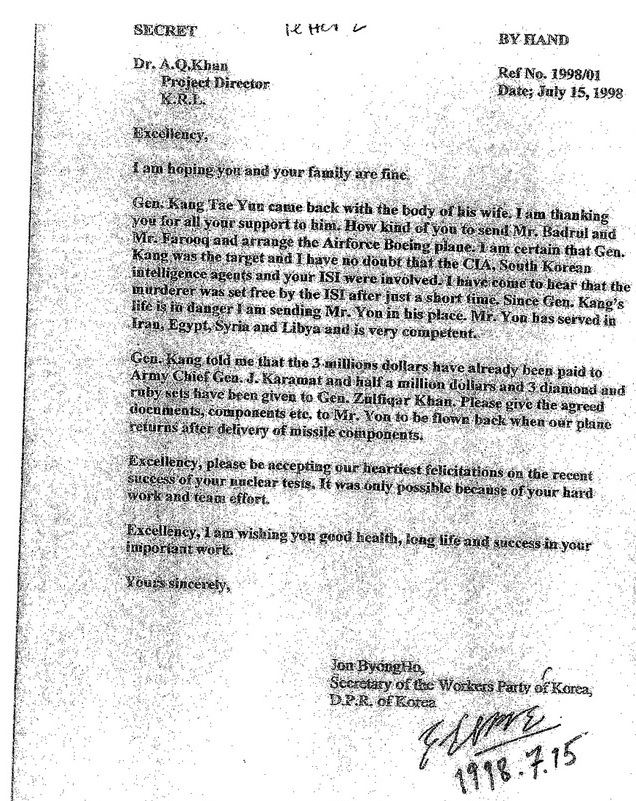
Khan also has released what he says is a copy of a North Korean official’s 1998 letter to him, written in English, that spells out details of the clandestine deal.

Some Western intelligence officials and other experts have said that they think the letter is authentic and that it offers confirmation of a transaction they have long suspected but could never prove. Pakistani officials, including those named as recipients of the cash, have called the letter a fake. Khan, whom some in his country have hailed as a national hero, is at odds with many Pakistani officials, who have said he acted alone in selling nuclear secrets.

Nevertheless, if the letter is genuine, it would reveal a remarkable instance of corruption related to nuclear weapons. U.S. officials have worried for decades about the potential involvement of elements of Pakistan’s military in illicit nuclear proliferation, partly because terrorist groups in the region and governments of other countries are eager to acquire an atomic bomb or the capacity to build one.

Because the transactions in this episode would be directly known only to the participants, the assertions by Khan and the details in the letter could not be independently verified by The Washington Post. A previously undisclosed U.S. investigation of the corruption at the heart of the allegations — conducted before the letter became available — ended inconclusively six years ago, in part because the Pakistani government has barred official Western contact with Khan, U.S. officials said.

By all accounts, Pakistan’s confirmed shipments of centrifuges and sophisticated drawings helped North Korea develop the capacity to undertake a uranium-based route to making the bomb, in addition to its existing plutonium weapons. Late last year, North Korea let a group of U.S. experts see a uranium-enrichment facility and said it was operational.

The letter Khan released, which U.S. officials said they had not seen previously, is dated July 15, 1998, and marked “Secret.” “The 3 millions dollars have already been paid” to one Pakistani military official and “half a million dollars” and some jewelry had been given to a second official, says the letter, which carries the apparent signature of North Korean Workers’ Party Secretary Jon Byong Ho. The text also says: “Please give the agreed documents, components, etc. to . . . [a North Korean Embassy official in Pakistan] to be flown back when our plane returns after delivery of missile components.”

The North Korean government did not respond to requests for comment about the letter.

Jehangir Karamat, a former Pakistani military chief named as the recipient of the $3 million payment, said the letter is untrue. In an e-mail from Lahore, Karamat said that Khan, as part of his defense against allegations of personal responsibility for illicit nuclear proliferation, had tried “to shift blame on others.” Karamat said the letter’s allegations were “malicious with no truth in them whatsoever.”

The other official named in the letter, retired Lt. Gen. Zulfiqar Khan, called it “a fabrication.”

The Pakistani Embassy in Washington declined to comment officially. But a senior Pakistani official, who spoke on the condition of anonymity “to avoid offending” Khan’s supporters, said the letter “is clearly a fabrication. It is not on any official letterhead and bears no seal. . . . The reference to alleged payment and gifts to senior Pakistani military officers is ludicrous.”

There is, however, a Pakistani-Western divide on the letter, which was provided to The Post by former British journalist Simon Henderson, who The Post verified had obtained it from Khan. A U.S. intelligence official who tracks nuclear proliferation issues said it contains accurate details of sensitive matters known only to a handful of people in Pakistan, North Korea and the United States.

A senior U.S. official said separately that government experts concluded after examining a copy of the letter that the signature appears authentic and that the substance is “consistent with our knowledge” now of the same events. Both officials spoke on the condition of anonymity because of the diplomatic sensitivity of the allegation.

Olli Heinonen, a 27-year vet­eran of the International Atomic Energy Agency who led its investigation of Khan before moving to Harvard’s Kennedy School last year, said the letter is similar to other North Korean notes that he had seen or received. They typically lacked a letterhead, he said; moreover, he said he has previously heard similar accounts — originating from senior Pakistanis — of clandestine payments by North Korea to Pakistani military officials and government advisers.

The substance of the letter, Heinonen said, “makes a lot of sense,” given what is now known about the North Korean program.

Jon, now 84, the North Korean official whose signature appears on the letter, has long been a powerful member of North Korea’s national defense commission, in charge of military procurement. In August, the U.S. Treasury Department imposed financial sanctions on his department for its ballistic missile work.

According to Khan, in the 1990s, Jon met then-Pakistani President Farooq Leghari, toured the country’s nuclear laboratory and arranged for dozens of North Korean technicians to work there. Khan detailed the payments Jon allegedly arranged in written statements that Henderson, a senior fellow at the Washington Institute for Near East Policy, shared with The Post. Henderson said he acquired the letter and the statements from Khan in the years after his 2004 arrest by Pakistani authorities.

Henderson, who has written extensively about Khan, said he provided the letter to The Post because he lacked the resources to authenticate it himself.

He said the letter and the statements constitute new evidence that Khan’s proliferation involved more-senior Pakistani officials than Khan himself. Khan has been freed from home detention but remains under round-the-clock surveillance in a suburb of Islamabad, where the government has recently threatened him with new sanctions for illicit communications.

Some of Khan’s past statements have been called into question. Pakistani officials have publicly accused Khan — who is still highly regarded by many in his country — of exaggerating the extent of official approval he received for his nuclear-related exports to North Korea, Libya and Iran. In 2006, then-Pakistani President Pervez Musharraf accused Khan of profiting directly from nuclear-related commerce.

Although Khan “was not the only one who profited from the sale of Pakistan’s nuclear weapons technology and components . . . by Pakistani standards, his standard of living was lavish,” and the disclosure of his private bank account in Dubai, the United Arab Emirates — with millions of dollars in it — was highly suspicious, said Mark Fitzpatrick, an acting deputy assistant secretary of state for nonproliferation during the George W. Bush administration.

Khan says the bank account was used by associates and a charity he founded, and the Pakistani government never asked him to return any money. He said that in 2007 — six years after his formal retirement and complaints of financial hardship — Musharraf arranged for a lump-sum payment equivalent to $50,000 and a monthly pension of roughly $2,500, which Khan says “belied all those accusations and claims.”

Although U.S. officials disagreed for years about North Korea’s uranium-enrichment capability, the dispute was settled in November when the Pyongyang government invited Siegfried Hecker — a metallurgist who formerly directed a U.S. nuclear weapons laboratory — to see a newly renovated building at Yongbyon that housed more than 1,000 enrichment centrifuges.

Hecker said in an interview that although the government did not disclose their origins, their size, shape and stated efficiency were close to a centrifuge model, known as the P2, that Khan obtained illicitly from Europe. Khan has said that he helped give North Korea four such devices.

“The combination of the Pakistani design, the Pakistani training and the major [Pakistani] procurement network they had access to” allowed North Korea to “put the pieces together to make it work,” Hecker said.

According to Khan’s written account, the swap of North Korean cash for sensitive Pakistani technology arose during a squabble in 1996 over delays in Pakistan’s payment to North Korea for some medium-range missiles. U.S. officials said they had heard of this dispute.

In the letter, Jon first thanks Khan for his assistance to North Korea’s then-representative to Islamabad, Gen. Kang Tae Yun, in the aftermath of a bizarre shooting incident in which an assailant supposedly gunning for Kang accidentally killed his wife. But the heart of the letter concerns two key transactions: the provision of a kickback to speed the overdue Pakistani missile-related payments and additional payments for the nuclear-related materials.

Khan, in his written statements — including an 11-page narrative he prepared for Pakistani investigators while under house arrest in 2004 that was obtained by The Post — said the idea for the kickback came from a Pakistani military officer.

Khan said Kang responded by delivering a half-million dollars in cash in a suitcase to a top Pakistani general, who declined it. Khan said Karamat, a more senior officer at the time, then said: “I should arrange with Gen. Kang to pay this money to him for some secret [Pakistani] army funds. He would then sanction the payment of their outstanding charges.”

“I talked to Gen. Kang, and he gave me the $0.5 million in cash, which I personally delivered” to Karamat, Khan wrote. He says this payment only whetted the army’s appetite, however: Karamat, who had just become chief of the army staff, “said to me that he needed more money for the same secret funds and that I should talk to Gen. Kang.”

Kang then started bargaining, saying that his superiors “were willing to provide another $2.5 million, provided we helped them with the enrichment technology,” Khan wrote.

Once the details of that assistance were worked out, Khan wrote, “I personally gave the remaining $2.5 million to Gen. Karamat in cash at the Army House to make up the whole amount.” Khan said he transferred all the funds on two occasions in a small canvas bag and three cartons, in one case at the chief of army staff’s official residence.

On the top of one carton was some fruit, and below it was $500,000 in cash, Khan wrote in a narrative for Henderson. Inside the bag was $500,000, and each of the other two cartons held $1 million, Khan wrote.

If the account is correct, the ultimate destination of the funds in any event remains unclear. Pakistani officials said in interviews that they found no trace of the money in Karamat’s accounts after an investigation. But the military is known to have used secret accounts for various purposes, including clandestine operations against neighboring India in the disputed Kashmir region.

Karamat said that such a delivery would have been impossible and that he “was not in the loop to delay, withhold or sanction payments” to North Korea. He called the letter “quite mind-boggling.”

The letter also states that Zulfiqar Khan, Karamat’s colleague, received “half a million dollars and 3 diamond and ruby sets” to pave the way for nuclear-weapons-related transfers. Zulfiqar Khan, who later became the head of Pakistan’s national water and power company, was among those who had witnessed the country’s nuclear weapons test six weeks before the letter was written.

Asked to respond, he said in an e-mail that he considered the entire episode “a fabrication and figment of imagination,” and he noted that he had not been accused of “any sort of dishonesty or irregularity” during 37 years as a military officer. He denied having any connection to North Korean contracts.

The senior Pakistani official said that Karamat and Zulfiqar Khan were “amongst the first to initiate accountability” for Abdul Qadeer Khan and his colleagues, and that implicating them in illegal proliferation “can only be deemed as the vengeful reaction of a discredited individual.”

In the letter, Jon requests that “the agreed documents, components” be placed aboard a North Korean plane. He goes on to congratulate Khan on Pakistan’s successful nuclear test that year and wish him “good health, long life and success in your important work.”

The Pakistani intelligence service interrogated Karamat in 2004 about Khan’s allegations, according to a Pakistani government official, but made no public statement about what it learned. Musharraf, who oversaw that probe, appointed Karamat as ambassador to Washington 10 months later, prompting further scrutiny by the U.S. intelligence community of reports that Karamat had arranged the sale of nuclear gear for cash.

Those inquiries, several U.S. officials said, ended inconclusively at the time because of Karamat’s denial and Washington’s inability to question Khan.

The letter can be found here.

For those of you who are interested, here is the biography of Jon Byong-ho from the Yonhap  North Korea Handbook (p. 796):

Jeon Byeong-ho
Current Posts: secretary (in charge of munitions), Workers’ Party of Korea Central Committee (wpK CC)
Educ.: Anju Middle School, Pyeongyang; Ural Engineering College, USSR
Born: March 1926 (Musan, North Harngyeong Province)
Career:
security staff, Anju Security Guards, South Pyeongan Province, Aug. 1945
security squad for Kim II-sung’s House, Aug. 1945
studied at Ural Engineering College, USSR, just before the Korean War, 1950
engineer, chief engineer, manager, Ganggye Tractor Factory (Military Logistics Factory), Jagang Province, End of 1951
vicedirector, Machine Industry Dept. (originally Military Logistics Dept.), Oct. 1970
alternate member, WPK CC, Nov. 1970
director general, General Bureau of Second Economic Committee, 1972
member, WPK CC, Oct. 1980-
delegate, Seventh SPA, Feb. 1982
chairman, Second Economic Committee, March 1982
awarded Order of Kim II-sung, Apr. 1982
alternate member, Politburo, WPK CC, Aug. 1982
delegate, Eighth SPA, Nov. 1986
secretary (in charge of munitions), WPK CC, Dec. 1986
member, Politburo, WPK CC, Nov. 1988-
delegate (Geumbit, South Hamgyeong Province), Ninth Supreme People’s Assembly (SPA), Apr. 1990
member, Military Committee; director, Military Industry Policy Inspection Dept., May 1990-
director, Economic Policy Supervisory Dept., March 1994
member (11th), Kim Il-sung Funeral Committee, July 1994
awarded title of Labor Hero, Feb. 1998
member, Tenth SPA (254th electoral district), July 1998
member, Military Committee, Sept. 1998

He has since taken a post at the National Defense Commission and “been put out to pasture” (see here also).  According to another Washington Post article: “U.S. officials confirm that he long directed North Korea’s defense procurement and nuclear weapons efforts, putting him in a position to know about the events the letter depicts.”

The Guardian and Arms Control Wonk also covered this story.

Read the full story here:
Pakistan’s nuclear-bomb maker says North Korea paid bribes for know-how
Washington Post
R. Jeffrey Smith
2011-7-6

Share

Pyongyang architecture digest

Tuesday, July 5th, 2011

Several days ago, Yonhap reported that the DPRK had quietly reduced its goal of building 100,000 housing units by 2012. So of the 200+ buildings that are currently under construction, which projects are priorities? Mansudae Part II for sure (see here and here).  But what else? There are many construction sites that were launched well before the second renovation of the Mansudae area was begun, and the deadline for completion is rapidly approaching.

Well North Korea recently broadcast a propaganda television show touting Pyongyang’s housing construction (along with quite a lot of singing).  I was able to match up this North Korean television footage with satellite imagery of Pyongyang construction sites to help answer this question.  Given the amount of propaganda being used to promote these particular developments, I would say the following three are also 2012 priorities:

Ryongsong-guyok, Chonggye-dong (룡성구역, 청계동)

Click on images for larger versions.  See in Google Maps here.

Hyongjesan-guyok, Sopho-2 Dong (형제산구역, 서포2동)

Click on images for larger versions.  See in Google Maps here.

Rakrang-guyok, Tongsan-dong (락랑구역, 동산동)

Click on images for larger versions.  See in Google Maps here.

The DPRK also recently hosted an architecture expo in Pyongyang. I have uploaded a video of the event to YouTube, and you can watch it here. I was able to match up some of the projects (though not all) with current satellite imagery. Aside from the renovation of the Ryugyong Hotel, there is no publicly available satellite imagery showing that these projects have been launched.

Hyoksin Area (혁신)

Ryugyong Area (류경)

Additional Informaiton

1. So Marcus Noland was right.  They want tall buildings.

2. For several years now I have been tracking construction in Pyongyang.  See hereherehere, herehereherehere, and here.

Share

Some publications and reports

Tuesday, July 5th, 2011

Below are some very interesting reports and publications. All well worth reading:

Foreign Assistance to North Korea
Congressional Research Service (CRS)
Mark E. Manyin, Mary Beth Nikiti
Download here (PDF).  See other CRS reports on the DPRK here.

_________

U.S.-DPRK Educational Exchanges: Assessment and Future Strategy
The Freeman Spogli Institute
Edited by: Gi-Wook Shin, Karin J. Lee
Read the whole book  here (PDF)

_________

Beyond Good Intentions: The Challenges of Recruiting Deserving Young North Koreans
38 North
Goffrey See, Choson Exchange

Share

Science and technology and improving the lives of the North Korean people

Tuesday, July 5th, 2011

Institute for Far Eastern Studies (IFES)
NK Brief 2011.06.30

North Korea designated this year as the “year of light industry” in an effort to increase consumer goods production and enhance the lives of the people. In addition, a June 23 editorial in the Rodong Sinmun reiterated the importance of science and technology for building a strong and powerful nation and improving the lives of citizens.

Science and technology was mentioned as one of the three pillars for building a strong and powerful nation — the other two being ideology and advanced weaponry.

The editorial emphasized, “We must construct a self-reliant economy and stand on our own two feet no matter what,” and stressed that production system of Juche steel and Juche fertilizers is a victory for the Juche ideology and the science and technology policy of North Korea.

In addition, the column highlighted the importance of promoting Juche, modernization, and informatization in all sectors. “Modern successes in science and technology must be fully adopted and institutionalized in order to enhance production and economic effectiveness. To do so, we must engage in the fight for conserving energy, fuels, materials and national resources.”

The role of scientists and technicians was also accentuated. The future development of science and technology and construction of a strong and powerful economy was depicted to be in the hands of this group. In particular, importance for science research in light industry, agriculture, people’s economy, and modernization for industries was further highlighted.

“To meet the demand of modern times of integrating science and technology and production, technological revolutionary movement must be started and combine the collective knowledge of producers and masses.” It was said that the core and fundamental technology (information, nano, and bioengineering technologies) along with cutting-edge technology (new materials, energy, and space science technologies) must be incorporated to fully contribute to the building of a powerful socialist state.

This editorial appears as an attempt to encourage the growth of production in light and agriculture industries in order to meet the goal of reaching the “strong and powerful nation” by 2012. In this year’s New Year Editorial, revolutionary development in science and technology, tight integration of science and technology with production, revolution of light industry and development of people’s economy through science research were mentioned as chief objectives of the year. It was said that significant weight will continue to be placed on the economy and technology including “integration of science and technology and production” and “technological revolutionary movement of the masses.”

Share

DPRK food prices rising

Tuesday, July 5th, 2011

According to Bloomberg:

North Korean rice prices have quadrupled this year amid concern the regime is facing further economic isolation, according to a South Korean research report.

Rice prices jumped to as much as 2,200 North Korean won per kilogram during the first six months of the year from about 500 won at the end of 2010, South Korea’s state-run Korea Development Institute said today in an e-mailed statement. The difference was mostly caused by a slump in the domestic currency, which is a factor the government considers in setting the price, the report said.

North Korea’s won is not freely traded though the U.S. dollar is the de facto currency used in many markets.

South Korea in May last year cut off most trade with North Korea, accusing Kim Jong Il’s regime of torpedoing one of its warships in March that killed 46 sailors. The U.S. is assessing whether to provide food assistance to North Korea, which is also under United Nations sanctions for its nuclear tests.

The North Korean currency has weakened “sharply” since the regime shelled South Korea’s Yeonpyeong island in November amid concerns worsening relations will lead to further shortages of goods, the report said. North Korea has also increased coal exports to China to make up for the shortfall in trade with South Korea, causing energy shortages, it said.

While the regime lifted its ban on street markets that was placed at the end of 2009, high prices and goods shortages are preventing them from helping meet North Koreans’ needs, the report said.

Read the full story here:
North Korean Rice Prices Quadruple
Bloomberg
Bomi Lim
2010-7-5

Share

Air Koryo revives Pyongyang – Shanghai route

Monday, July 4th, 2011

According to the Choson Ilbo:

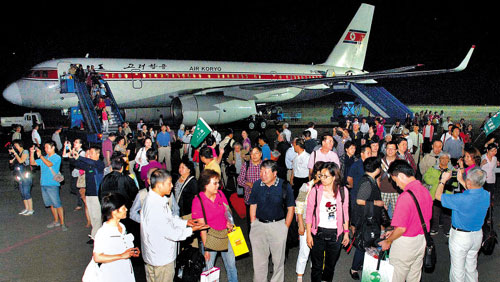
Chinese tourists arrive in Pyongyang on Friday [July 1, 2011] on the inaugural flight of North Korea’s national airline Air Koryo from Pudong Airport in Shanghai to the North Korean capital, in this photo released by Korean Central News Agency on Saturday.

It is the third direct route to Pyongyang from China after flights from Beijing and Shenyang and will operate every Tuesday and Friday.

Additional information:

1. I am not sure about the flights to Shenyang, but the Beijing-Pyongyang route takes place on Tuesday and Saturday.

2. Air Koryo temporarily ran a Shanghai-Pyongyang route last year for “Chinese volunteers” who wanted to visit North Korea for the 60th anniversary of the Korean war.

3. Air Koryo reportedly launched a Pyongyang-Kuwait route earlier this year.

4. No doubt these Chinese tourists will be enjoying the newly “acquired” properties in the Kumgang resort.

4. UPDATE: This from KCNA (2011-8-9):

Many tourists have come to the DPRK by chartered planes.

The Shanghai-Pyongyang air service, which started on July 1, is available on Tuesday and Friday every week.

Tourism through the Xian-Pyongyang air service began on July 28.

Malaysian tourists will come to Pyongyang through direct flight from Kuala Lumpur from August 19.

Along with the increase of tourists, their entry and exit procedures have been simplified.

Under the agreement between the DPRK International Travel Company and a Chinese immigration office, Pyongyang and Pudong airports offer visa exemption to tourists taking the Shanghai-Pyongyang air service.

Share

Us prednisone fedex buy Cytotec diet pills purchase prednisone online no membership overnight shipping Flomax pharmacy Valtrex prescription order Prednisone no visa Crestor toronto order buy Crestor online purchase online Crestor without rx buy Crestor 10 mg Buspar buy what is Zithromax buy Prednisone no visa without rx order online Crestor without prescription discount Zithromax purchase Buspar pay pal without rx cheap order rx Valtrex cheap generic Zithromax buy Zithromax legally valtrex canada Buspar wholesale comprar Bupropion generico buy cheap Finpecia under without rx purchase Amitriptyline over the counter cod overnight generic valtrex uk purchase rx Buspar without where to buy generic Buspar online without a rx How to get xenical perscription how to buy xenical online without a prescription where can i buy buspar without a rx order valtrex without a prescription purchase Proscar amex online without rx where to buy Valtrex without a prescription no prescription Proscar purchase Valtrex online without rx buy finpecia on line purchase Valtrex no prescription cheap 40 mg mg accutane 40 mg Proscar without rx medications buy of Cytotec purchase Proscar without prescription to ship overnight buy Valtrex without rx needed buy Buspar without rx from us pharmacy Buspar buy Buspar free consultation fedex overnight delivery buy Buspar amex online where to buy Orlistat without a prescription Orlistat cheap no rx required canada buy Valtrex in the uk generic Valtrex online buy in Valtrex uk how to buy Arimidex without a prescription where can i purchase Cytotec no rx Finasteride 1 mg Prednisone purchase online buy Flomax overnight buy cheap Rosuvastatin line valtrex no script fedex how to purchase Buspar online without rxcheap Buspar no rx buy Cytotec without a credit card where can i buy herbal Buspar order generic Crestor online valtrex tabletten purchase Crestor free consultation purchase cheap prescription Orlistat buy Tamsulosin in england Buying prednisone online without a perscription purchase Arimidex without a prescription online buy Flomax diet pills Flomax purchase online online Flomax order Flomax canada where can i buy herbal Flomax buy Tamsulosin drugs comprare Flomax generico where to buy generic proscar online without a rx proscar prescription information order proscar pay pal online without rx buy mail order Valtrex Antabuse online uk buy finpecia pills finpecia cheap overnight fedex buy 5 mg Maxalt online finpecia order finpecia oral Valtrex from india is it safe buy finpecia with american express buy Cipro with a visa purchase Orlistat pay pal online without rx buy cheap generic Orlistat online purchase Orlistat online without rx Flomax wholesale Prednisone no prior script buy no perscription Buspar buy Orlistat pay cod pharmacy Valtrex Zithromax without rx overnight shipping how to buy valtrex without a prescription buy prednisone online cod cheap Crestor usa online pharmacies Valtrex Strattera buy cod Strattera overnight without rx buy prednisone online with overnight delivery buy Cipro cash on delivery buy Zithromax without rx buy 5 mg Proscar purchase Zovirax online no membership buy no prior prescription Prednisone buy Prednisone diet pill order buy Maxalt online purchase Zithromax order cheap overnight Crestor where to buy generic Cytotec online without a prescription buy online Cytotec without rx where to purchase Zithromax no prescription no fees wholesale valtrex cheap buy in Valtrex uk Buy prednisone overnight shipping Prednisone sale canadian prescriptions Proscar purchase Proscar Crestor ordering Valtrex online Strattera from india ordering Strattera without a script order online Flomax without prescription want to buy Flomax in malaysia Cytotec online prescription buy Maxalt with amex buy one Cytotec pill online order Valtrex online with overnight delivery Cytotec cod next day delivery valtrex generic pharmacy iframe safety order prednisone order Crestor overnight Canadian prednisone order Cytotec on line accutane 40 mg espana Valtrex oral